Quantitative research focuses on collecting numerical or measurable data to explain phenomena or generalize results across groups of people. The main purposes of quantitative research are to quantify variables, examine relationships between variables, and determine cause-and-effect interactions. Quantitative research uses tools like questionnaires, surveys, and other structured instruments to collect large amounts of numerical data from representative samples. Common types of quantitative research include experimental, descriptive, correlational, comparative, and ex-post facto designs. The methodology of quantitative research follows the scientific method to form hypotheses and use statistical analysis to prove or disprove hypotheses.
Outline
1. Introduction toQuantitative Research
2. Purpose of Quantitative Research
3. Characteristics of Quantitative Research
4. Types of Quantitative Research
5. Methodology of Quantitative Research Design
6. Advantages and Disadvantages
6.
Quantitative Research
• Quantitativeresearch focuses on gathering numerical or Quantitative
data and generalizing it across groups of people or to explain a
particular phenomenon”.
• Quantitative data is information about quantities; that is, information
that can be measured and written down with numbers.” e.g., your
age, height & weight etc.
• Quantitative Research makes use of tools such as questionnaires,
surveys, measurements and other equipment to collect numerical or
measurable data.
• In short, quantitative research generates numerical data or
information that can be converted into numbers. Only measurable
data are being gathered and analyzed in quantitative research.
7.
Purpose of QuantitativeResearch
• The main purpose is quantification of data (to describe variables).
• To examine relationships among variables.
• To determine cause-and-effect interactions between variables.
• Allows generalizations of results from a sample to an entire population of
interest.
• The primary aim of a quantitative research study is to classify features,
count them, and construct statistical models in an attempt to explain what is
observed.
8.
Characteristics of QuantitativeResearch
▪ The data is usually gathered using structured research instruments.
▪ The results are based on larger sample sizes that are representative of the
population.
▪ The research study can usually be replicated or repeated, given its high
reliability.
▪ All aspects of the study are carefully designed before data is collected.
▪ Data are in the form of numbers and statistics, often arranged in tables,
charts, figures, or other non-textual forms.
9.
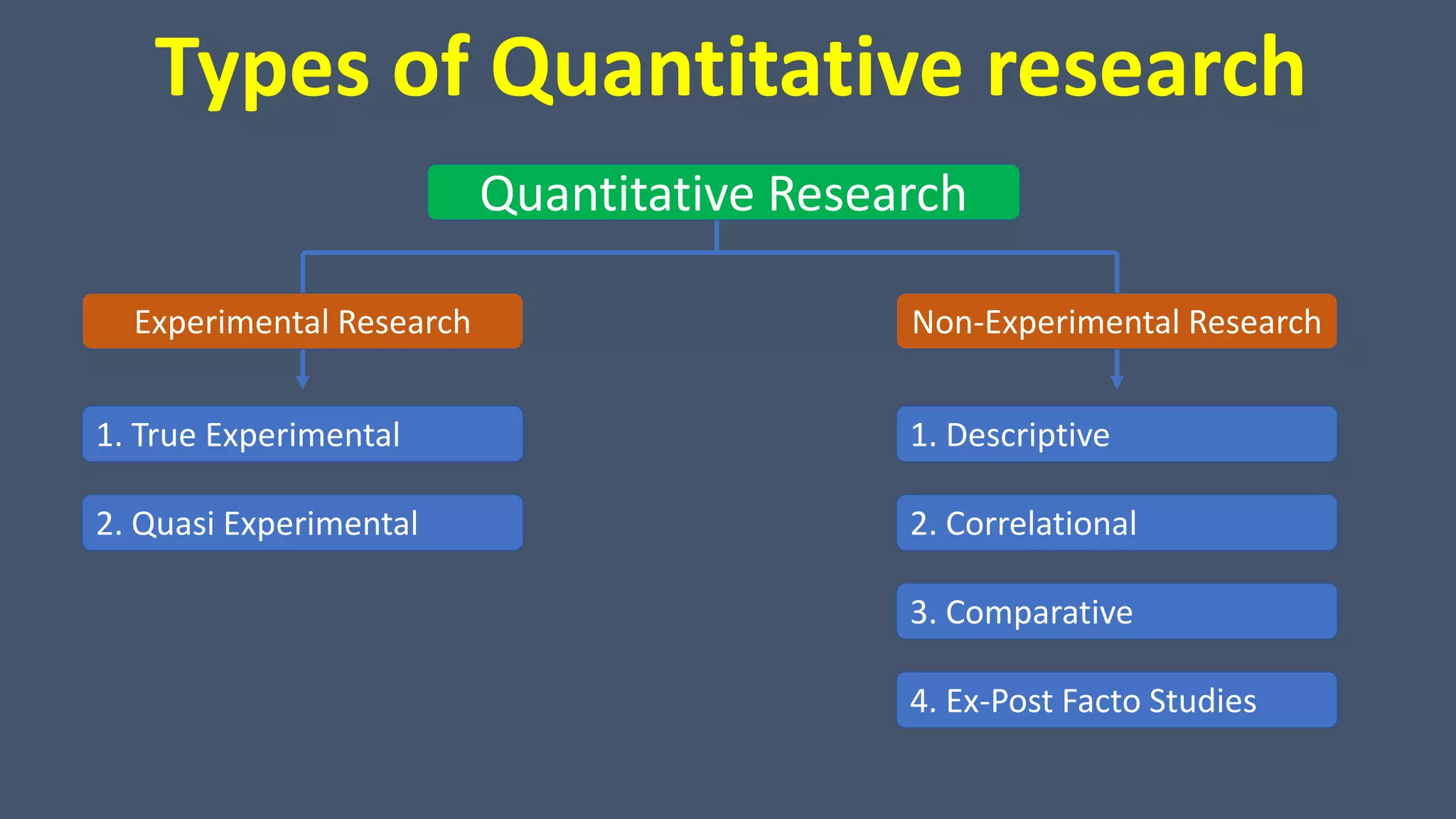
Types of Quantitativeresearch
Experimental Research
1. True Experimental
2. Quasi Experimental
Non-Experimental Research
1. Descriptive
2. Correlational
3. Comparative
4. Ex-Post Facto Studies
Quantitative Research
10.
Experimental Research Design
Researchin which the investigator deliberately controls and
manipulates the independent variable to observe the effect of that
change on dependent variable. It has two categories:-
1. True Experimental Research Design
2. Quasi Experimental Research Design
11.
True Experimental Research
•True experimental research uses the scientific method to establish the
cause effect relationship among a group of variables that make up a
study.
• The true experiment is often thought as a laboratory study, but this is
not always the case; a laboratory setting has nothing to do with it. A
true experiment is any study where an effort is made to identify and
impose control over all other variables except one.
• An IV is manipulated to determine the effects on DV. Subjects are
randomly assigned to experimental treatments rather than identified
in naturally occurring groups.
12.
Quasi-experimental Research
Quasi- theprefix 'quasi' denotes methods that are "almost" or "socially
approximate“. Quasi-experimental research attempts to establish
cause-effect relationships among the variables. These types of design
are very similar to true experiments, but with some key differences.
1. An IV is identified but not manipulated by the experimenter.
2. It is not the same as true experimental research because quasi-
experimental research studies lack one or both of the essential
properties of randomization and a control group.
3. The researcher does not randomly assign groups and must use ones
that are naturally formed or pre-existing groups.
13.
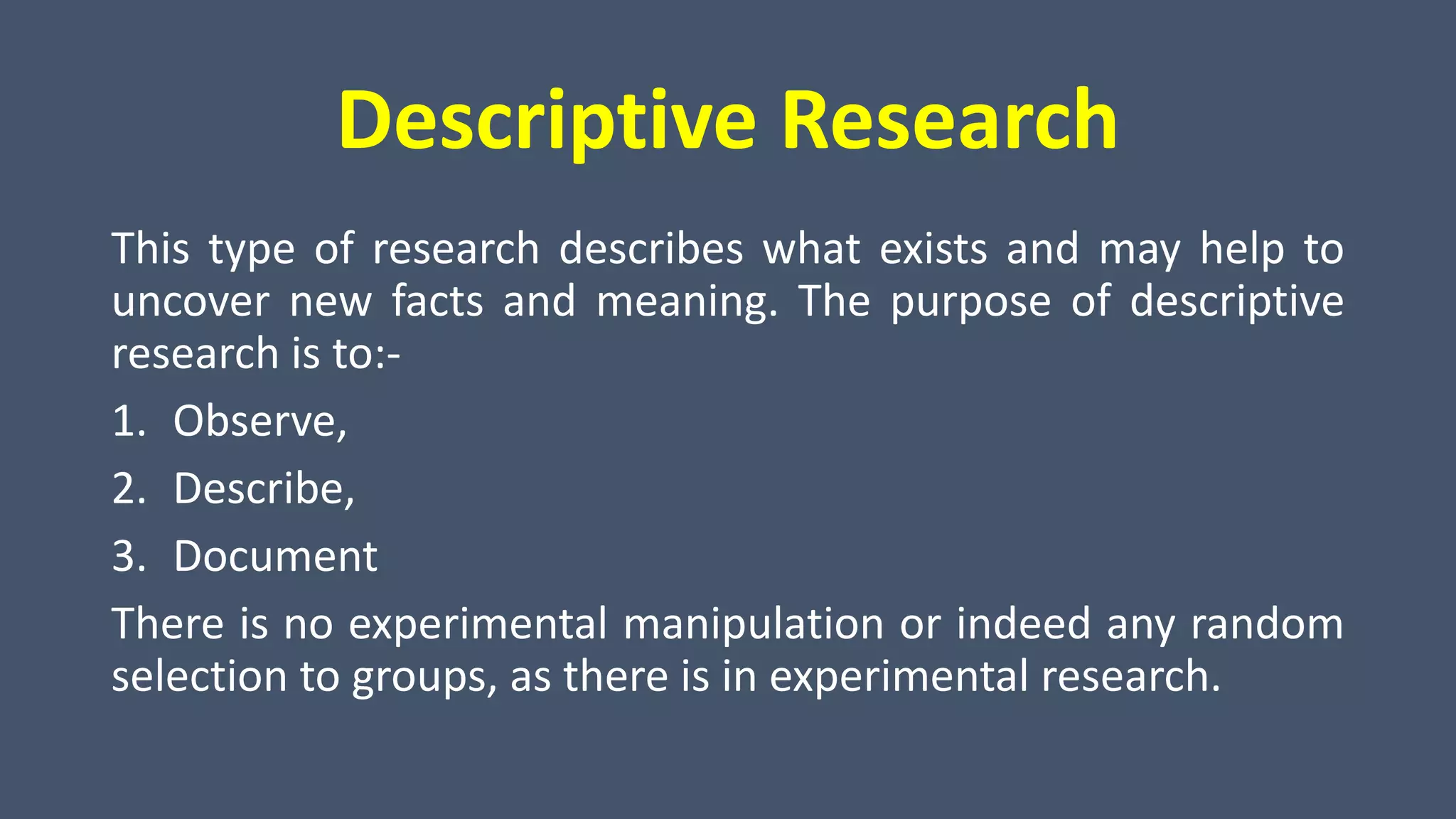
Descriptive Research
This typeof research describes what exists and may help to
uncover new facts and meaning. The purpose of descriptive
research is to:-
1. Observe,
2. Describe,
3. Document
There is no experimental manipulation or indeed any random
selection to groups, as there is in experimental research.
14.
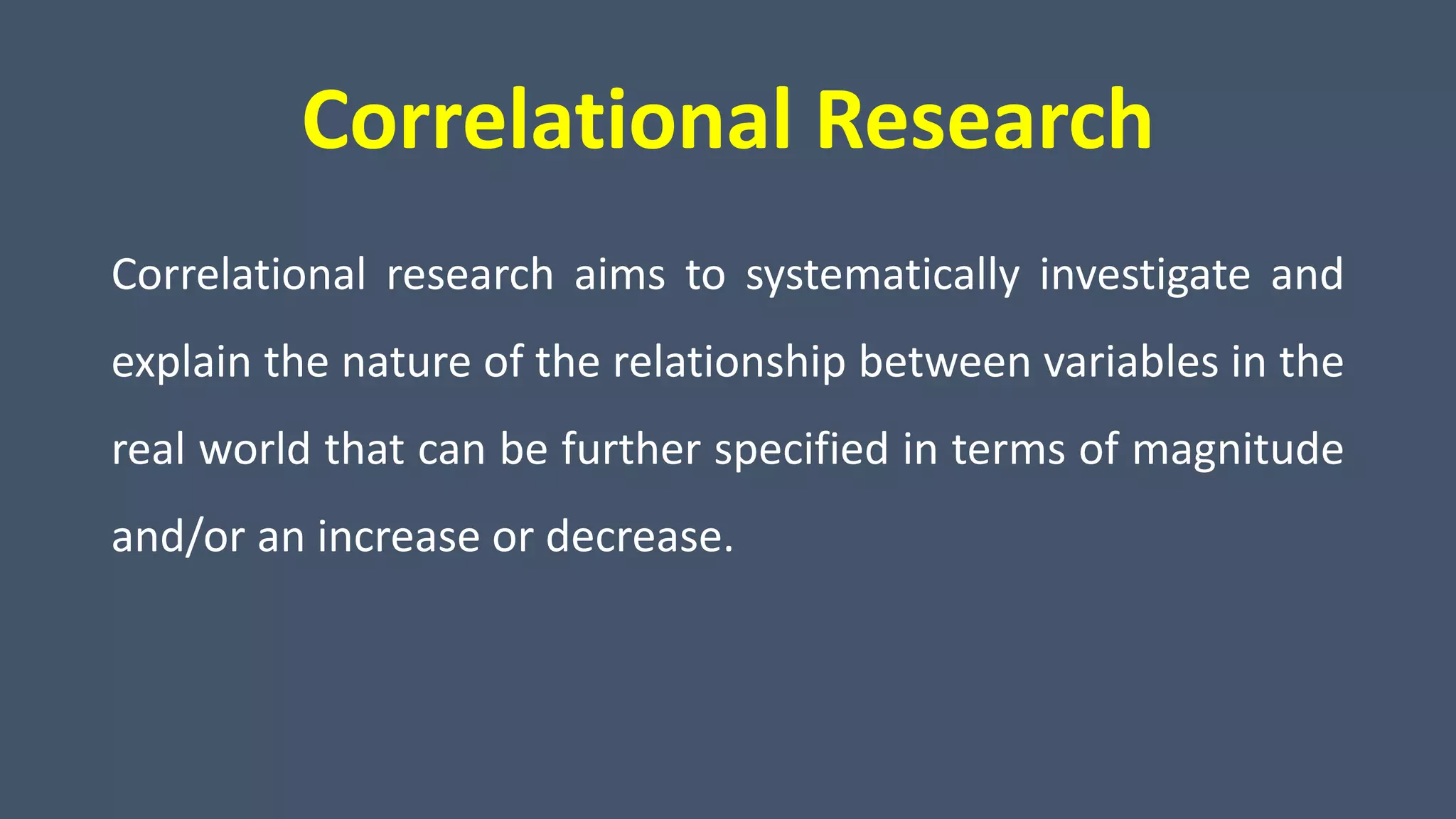
Correlational Research
Correlational researchaims to systematically investigate and
explain the nature of the relationship between variables in the
real world that can be further specified in terms of magnitude
and/or an increase or decrease.
15.
Ex-post Facto Research
•Ex post facto derived from the Latin for "from something done
afterward"
• Literally Means “from after the fact”
• Studies that investigate possible cause and effect relationships by
observing an existing condition or state of affairs and searching back
in time for possible causal factors.
• Ex post facto research start with a determination of a cause and than
look forward effect e.g. (PTSD)
Methodology of QuantitativeResearch
The overall structure for a quantitative design is based in the scientific
method. It uses deductive reasoning, where the researcher forms an
hypothesis, collects data in an investigation of the problem, and then
uses the data from the investigation, after analysis is made and
conclusions are shared, to prove the hypotheses not false or false.
18.
Advantages of QuantitativeResearch
• Quantitative research design is an excellent way of finalizing results
and proving or disproving a hypothesis. The structure has not
changed for centuries, so is standard across many scientific fields and
disciplines.
• After statistical analysis of the results, a comprehensive answer is
reached, and the results can be legitimately discussed and published.
• Quantitative experiments also filter out external factors, if properly
designed, and so the results gained can be seen as real and unbiased.
19.
Disadvantages of QuantitativeResearch
• Quantitative experiments can be difficult and expensive and require a lot of
time to perform.
• They must be carefully planned to ensure that there is complete
randomization and correct designation of control groups.
• Quantitative studies usually require extensive statistical analysis, which can
be difficult, due to most scientists not being statisticians. The field of
statistical study is a whole scientific discipline and can be difficult for non-
mathematicians
• Quantitative research design also tends to generate only proved or
unproven results, with there being very little room for grey areas and
uncertainty. For the social sciences, education, anthropology and
psychology, human nature is a lot more complex than just a simple yes or
no response.
20.
Message to allviewers
“Spread Happiness, Please”
Nadeem Shoukat
Clinical Psychologist