Nadeem Shoukat
MS Clinical Psychology
nadeemsho@gmail.com
+92 302 3443 759
 Definition of EBD
 Classification
 Types
 Common Habits of Emotional & Behaviorally disturbed Individuals
 Characteristics of EBD
 Causes
 Diagnosis
 Assessment
 Prevalence
 Tips, Strategies, or Instructional Techniques (Management)
 Emotion is our internal feelings, driving from ones
circumstances, mood or relationship with others. These
feeling results in physical and psychological changes that
influence thought and behavior.
 Behavior is our action that the people can observe and
measure. There are mainly two types of behavior
1. Overt Behavior -Observable Behavior
2. Covert Behavior -Measureable Behavior
 Disorder is defined as a clinically significant behavioral or
psychological syndrome that occurs in an individual and
that is typically associated with either a painful symptom or
impairment in one or more important areas of functioning.
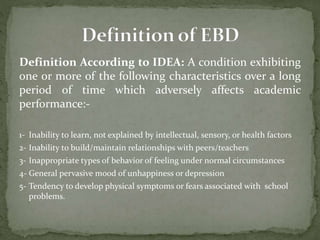
Definition According to IDEA: A condition exhibiting
one or more of the following characteristics over a long
period of time which adversely affects academic
performance:-
1- Inability to learn, not explained by intellectual, sensory, or health factors
2- Inability to build/maintain relationships with peers/teachers
3- Inappropriate types of behavior of feeling under normal circumstances
4- General pervasive mood of unhappiness or depression
5- Tendency to develop physical symptoms or fears associated with school
problems.
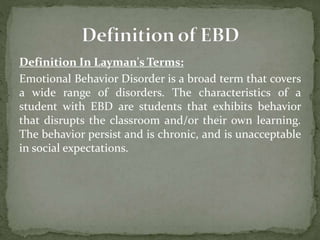
Definition In Layman's Terms:
Emotional Behavior Disorder is a broad term that covers
a wide range of disorders. The characteristics of a
student with EBD are students that exhibits behavior
that disrupts the classroom and/or their own learning.
The behavior persist and is chronic, and is unacceptable
in social expectations.
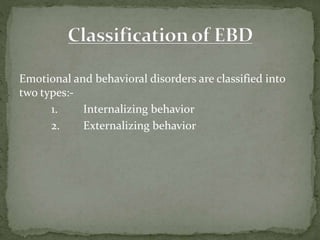
Emotional and behavioral disorders are classified into
two types:-
1. Internalizing behavior
2. Externalizing behavior
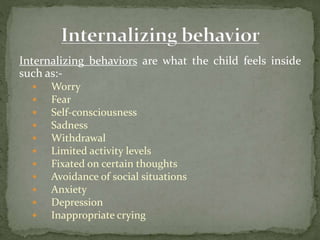
Internalizing behaviors are what the child feels inside
such as:-
 Worry
 Fear
 Self-consciousness
 Sadness
 Withdrawal
 Limited activity levels
 Fixated on certain thoughts
 Avoidance of social situations
 Anxiety
 Depression
 Inappropriate crying
Externalizing behaviors are what the child displays to
others such as:-
 Disobedience
 Aggressiveness
 Hyperactivity
 Tantrums
 Lying And Stealing
 Destructiveness
 Self-control difficulties
There are several different types of emotional/behavioral
disorders that fall in one or both of two categories
(Internalizing behavior or Externalizing behavior), few
of the disorders are
 Anxiety Disorders
 Severe Depression
 Attention-deficit/Hyperactivity Disorder
 Conduct Disorder
 Eating Disorders
 Oppositional Defiant Disorder
 Most common of childhood disorders
 Signs:
 Phobias of objects or situations
 Patterns of excessive, unrealistic worry that cannot be
attributed to any recent experience
 Panic disorder which causes ‘panic attacks’ that includes
physical symptoms, such as a rapid heartbeat and dizziness.
 Obsessive-compulsive disorder causes children to become
trapped in a pattern of repeated thoughts or behaviors
 Post-traumatic stress disorder – causes a pattern of flashbacks
and other symptoms which occurs to children who have
experienced a psychologically distressing event, such as
abuse, being a victim or witness of violence, or being exposed
to war or natural disasters
 Team with parents to develop strategies
 Encourage completion of activities and assignments
 Allow extra time
 Develop and follow a regular classroom routine
 Write schedule on the board so there are no surprises
Can occur at any age, Studies show that 2 of every
100 children may have major depression and 8 of
every 100 adolescents may be affected.
Signs:
 Children often feel sad, cry, or feel worthless
 Lost interest in play activities and schoolwork declines
 Changes in appetite or sleeping patterns; vague physical
complaints
 Believe they are ugly, unable to do anything right, or that
the world or their life is hopeless
 All of these symptoms could easily lead to suicide as well.
 Team with parents to develop strategies
 Encourage completion of activities and assignments
 Allow extra time
 Develop and follow a regular classroom routine
 Write schedule on the board so there are no surprises
 The term ADHD refers to Attention Deficit
Hyperactivity Disorder, a condition that makes it
difficult for children to pay attention and/or control
their behavior.
 A persistent patterns of inattention and/or
hyperactivity- impulsivity that interferes with
functioning or development.
 Symptoms are presents in multiple settings (e.g.,
school and home), that can result in performance
issues in social, educational, or work settings.
 Symptoms are divided into 3 categories
 Inattention
 Hyperactivity
 impulsivity
 Behavior modification,
 Counseling and guidance of parents and appropriate
training and education of the child.
 Drug therapy can help to improve the CNS dysfunction or
other associated problems.

 The offenses students commit around this disorder often
grow more serious over time
 These offenses include: lying, theft, aggression, truancy,
the setting of fires, and vandalism
 Students have little concern for others
 The repeatedly violate the basic rights of others and the
rules of society
 They act out their feelings or impulses in destructive ways
 Avoid giving ultimatums – use options instead
 Do not touch the students
 Consider a work experience program
 Develop a plan ahead of time in case of a rage-full
experience
 Don’t carry a grudge against the student; be able to start
over
 Select materials that are relevant to their lives
 This occurs to children and adolescents who are intensely
afraid of gaining weight and do NOT believe they are
underweight.
 This can be life threatening.
 The two most common are anorexia nervosa and bulimia
nervosa.
 Children with anorexia nervosa have difficulty maintaining
a healthy body weight.
 Children with bulimia nervosa feel compelled to binge and
rid the food from their bodies by vomiting, abusing
laxatives, taking enemas, or exercising obsessively.
 Avoid negative attention to their weight, body image, or
eating disorder
 Help the student to set realistic goals
 Be flexible with tests and classroom assignments
 Encourage a supportive classroom environment
 Never force a student to participate in a group activity
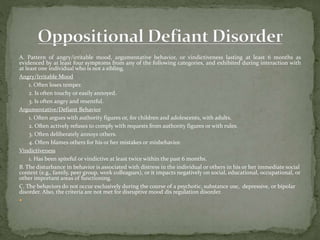
A. Pattern of angry/irritable mood, argumentative behavior, or vindictiveness lasting at least 6 months as
evidenced by at least four symptoms from any of the following categories, and exhibited during interaction with
at least one individual who is not a sibling.
Angry/Irritable Mood
1. Often loses temper.
2. Is often touchy or easily annoyed.
3. Is often angry and resentful.
Argumentative/Defiant Behavior
1. Often argues with authority figures or, for children and adolescents, with adults.
2. Often actively refuses to comply with requests from authority figures or with rules.
3. Often deliberately annoys others.
4. Often blames others for his or her mistakes or misbehavior.
Vindictiveness
1. Has been spiteful or vindictive at least twice within the past 6 months.
B. The disturbance in behavior is associated with distress in the individual or others in his or her immediate social
context (e.g., family, peer group, work colleagues), or it impacts negatively on social, educational, occupational, or
other important areas of functioning.
C. The behaviors do not occur exclusively during the course of a psychotic, substance use, depressive, or bipolar
disorder. Also, the criteria are not met for disruptive mood dis regulation disorder.

 Head banging
 Body rocking and rhythmic movements
 Pica
 Nail biting (Onychophagia)
 Thumb sucking
 Temper tantrums
 Bed wetting (enuresis)
 Tics
 Bruxism (Teeth Grinding)
External Behavior
 Generally disobedient behavior
 Does not follow directions within a reasonable amount of time
 Argue excessively
 Temper Tantrums
 Hit and fighting
 Rule breaking
 Destroys property,
 Lies,
 Steals
 Ignore the teacher
 Don't complete assignment
 Externalized may suffer from conduct disorders, ODD, OCD,
and eating disorder .
Internal Behaviours
 Very little social interaction
 Seldom plays with other children
 Extremely fearful without reason
 Complains of being sick or hurt
 Don’t have the social skills needed to make friends and
have fun
 Often retreat into daydreams and fantasies
 Internalizes can also suffer from Anxiety separation
Anxiety Fears and phobias, OCD and panic Disorders
Social And Adaptive Behavior
 Disruption & Aggression
 Not completing tasks
 Difficulty sharing
 Difficulty playing games
 Difficulty apologizing
 Problems solving difficulty
 Trouble accepting consequences
 Difficulty expressing affection
 Difficulty meeting classroom demands
 Can also have language deficits
 School avoidance
 Somatic complaints
 Poor school performance
Academic Achievement
 Difficulty in all academic areas
 Students with EBD have the poorest academic outcomes
 Deficits remain stable or gets worse as they grow older
 High level of drop out rate from high school
The specific causes of EBD remain subtle. However following
factors can contribute to EBD:
 Biological factors
 Environment factors
 Family factors
 School Factors
Biological factors
 Genetics
 Brain Damage
 Brain Dysfunction
 Malnutrition
 Physical Illness
Environmental factors
 Media
 Peer Groups
 Society
 Exposure to violence
 Extreme stress
 Loss of an important person
Family factors
 Interactions between parents and their child influences the
child's opinions, behaviors, and emotions.
 One factor associated with emotional problems is child
abuse. Child abuse may result in poor impulse control and
poor self-concepts. Aggression and anger are often noticed
in children who have been abused.
School factors
In our society school failure may attach to personal failure.
Academic failure and low intelligence, when combined with
antisocial behavior or conduct disorder, indicate social
adjustment problems in adulthood.
 Psychologist and Psychiatrist can identified EBD. Also, many hospitals and
most community mental health centers offer comprehensive diagnostic
and evaluation programs for children and adolescents. Three factors are
often considered when determining if a child is disturbed:
1. Intensity
2. Pattern
3. Duration of behavior
 Intensity refers to the severity of the child’s problem. How does it get in the
way of the child's (or society's) goals? How much does it draw attention
from others? For obvious reasons, this factor is the easiest to identify.
 Pattern refers to the times when the problems occur. Do problems only
occur during the school day? Only during math class? At bedtime? Answer
to these questions may yield very helpful.
 Duration refers to the length of time the child's problem has been present.
For example, some school districts require a 3-month duration before they
suggest that a child has an emotional or behavioral problem.
 Observations
 Checklists
 Reports
 Interviews With parents and teachers
 Use of academic testing
 Informal data collection
 Functional Behavioral Assessment
 Use of behavior rating scales, behavior assessment systems,
personality inventories and projective tests.
 Estimated 3-6% of all school children have EBD. Significant
numbers of children remain unidentified and receive no
services.
 74% are male
3. Address the academic deficiencies of the student
By addressing the academic deficiencies of the students it will
attempt to offset or minimize inappropriate behaviors.
4. Using a Behavior Self Control/ Management Plan
Which includes rules needed to meet the goal, the goal, feedback,
and measurement of the monitoring of the rules and sub goals.
5. Using Proactive strategy of Contingency Contracting
The method in which a teacher develops contracts with students
that state what behaviors students are to complete and perform,
and what consequences the instructor will provide.
Emotional & behavioral disorder 3

Emotional & behavioral disorder 3

  • 5.
    Nadeem Shoukat MS ClinicalPsychology nadeemsho@gmail.com +92 302 3443 759
  • 6.
     Definition ofEBD  Classification  Types  Common Habits of Emotional & Behaviorally disturbed Individuals  Characteristics of EBD  Causes  Diagnosis  Assessment  Prevalence  Tips, Strategies, or Instructional Techniques (Management)
  • 7.
     Emotion isour internal feelings, driving from ones circumstances, mood or relationship with others. These feeling results in physical and psychological changes that influence thought and behavior.  Behavior is our action that the people can observe and measure. There are mainly two types of behavior 1. Overt Behavior -Observable Behavior 2. Covert Behavior -Measureable Behavior  Disorder is defined as a clinically significant behavioral or psychological syndrome that occurs in an individual and that is typically associated with either a painful symptom or impairment in one or more important areas of functioning.
  • 8.
    Definition According toIDEA: A condition exhibiting one or more of the following characteristics over a long period of time which adversely affects academic performance:- 1- Inability to learn, not explained by intellectual, sensory, or health factors 2- Inability to build/maintain relationships with peers/teachers 3- Inappropriate types of behavior of feeling under normal circumstances 4- General pervasive mood of unhappiness or depression 5- Tendency to develop physical symptoms or fears associated with school problems.
  • 9.
    Definition In Layman'sTerms: Emotional Behavior Disorder is a broad term that covers a wide range of disorders. The characteristics of a student with EBD are students that exhibits behavior that disrupts the classroom and/or their own learning. The behavior persist and is chronic, and is unacceptable in social expectations.
  • 10.
    Emotional and behavioraldisorders are classified into two types:- 1. Internalizing behavior 2. Externalizing behavior
  • 11.
    Internalizing behaviors arewhat the child feels inside such as:-  Worry  Fear  Self-consciousness  Sadness  Withdrawal  Limited activity levels  Fixated on certain thoughts  Avoidance of social situations  Anxiety  Depression  Inappropriate crying
  • 12.
    Externalizing behaviors arewhat the child displays to others such as:-  Disobedience  Aggressiveness  Hyperactivity  Tantrums  Lying And Stealing  Destructiveness  Self-control difficulties
  • 13.
    There are severaldifferent types of emotional/behavioral disorders that fall in one or both of two categories (Internalizing behavior or Externalizing behavior), few of the disorders are  Anxiety Disorders  Severe Depression  Attention-deficit/Hyperactivity Disorder  Conduct Disorder  Eating Disorders  Oppositional Defiant Disorder
  • 14.
     Most commonof childhood disorders  Signs:  Phobias of objects or situations  Patterns of excessive, unrealistic worry that cannot be attributed to any recent experience  Panic disorder which causes ‘panic attacks’ that includes physical symptoms, such as a rapid heartbeat and dizziness.  Obsessive-compulsive disorder causes children to become trapped in a pattern of repeated thoughts or behaviors  Post-traumatic stress disorder – causes a pattern of flashbacks and other symptoms which occurs to children who have experienced a psychologically distressing event, such as abuse, being a victim or witness of violence, or being exposed to war or natural disasters
  • 15.
     Team withparents to develop strategies  Encourage completion of activities and assignments  Allow extra time  Develop and follow a regular classroom routine  Write schedule on the board so there are no surprises
  • 16.
    Can occur atany age, Studies show that 2 of every 100 children may have major depression and 8 of every 100 adolescents may be affected. Signs:  Children often feel sad, cry, or feel worthless  Lost interest in play activities and schoolwork declines  Changes in appetite or sleeping patterns; vague physical complaints  Believe they are ugly, unable to do anything right, or that the world or their life is hopeless  All of these symptoms could easily lead to suicide as well.
  • 17.
     Team withparents to develop strategies  Encourage completion of activities and assignments  Allow extra time  Develop and follow a regular classroom routine  Write schedule on the board so there are no surprises
  • 18.
     The termADHD refers to Attention Deficit Hyperactivity Disorder, a condition that makes it difficult for children to pay attention and/or control their behavior.  A persistent patterns of inattention and/or hyperactivity- impulsivity that interferes with functioning or development.  Symptoms are presents in multiple settings (e.g., school and home), that can result in performance issues in social, educational, or work settings.  Symptoms are divided into 3 categories  Inattention  Hyperactivity  impulsivity
  • 19.
     Behavior modification, Counseling and guidance of parents and appropriate training and education of the child.  Drug therapy can help to improve the CNS dysfunction or other associated problems.
  • 20.
     The offensesstudents commit around this disorder often grow more serious over time  These offenses include: lying, theft, aggression, truancy, the setting of fires, and vandalism  Students have little concern for others  The repeatedly violate the basic rights of others and the rules of society  They act out their feelings or impulses in destructive ways
  • 21.
     Avoid givingultimatums – use options instead  Do not touch the students  Consider a work experience program  Develop a plan ahead of time in case of a rage-full experience  Don’t carry a grudge against the student; be able to start over  Select materials that are relevant to their lives
  • 22.
     This occursto children and adolescents who are intensely afraid of gaining weight and do NOT believe they are underweight.  This can be life threatening.  The two most common are anorexia nervosa and bulimia nervosa.  Children with anorexia nervosa have difficulty maintaining a healthy body weight.  Children with bulimia nervosa feel compelled to binge and rid the food from their bodies by vomiting, abusing laxatives, taking enemas, or exercising obsessively.
  • 23.
     Avoid negativeattention to their weight, body image, or eating disorder  Help the student to set realistic goals  Be flexible with tests and classroom assignments  Encourage a supportive classroom environment  Never force a student to participate in a group activity
  • 24.
    A. Pattern ofangry/irritable mood, argumentative behavior, or vindictiveness lasting at least 6 months as evidenced by at least four symptoms from any of the following categories, and exhibited during interaction with at least one individual who is not a sibling. Angry/Irritable Mood 1. Often loses temper. 2. Is often touchy or easily annoyed. 3. Is often angry and resentful. Argumentative/Defiant Behavior 1. Often argues with authority figures or, for children and adolescents, with adults. 2. Often actively refuses to comply with requests from authority figures or with rules. 3. Often deliberately annoys others. 4. Often blames others for his or her mistakes or misbehavior. Vindictiveness 1. Has been spiteful or vindictive at least twice within the past 6 months. B. The disturbance in behavior is associated with distress in the individual or others in his or her immediate social context (e.g., family, peer group, work colleagues), or it impacts negatively on social, educational, occupational, or other important areas of functioning. C. The behaviors do not occur exclusively during the course of a psychotic, substance use, depressive, or bipolar disorder. Also, the criteria are not met for disruptive mood dis regulation disorder. 
  • 25.
     Head banging Body rocking and rhythmic movements  Pica  Nail biting (Onychophagia)  Thumb sucking  Temper tantrums  Bed wetting (enuresis)  Tics  Bruxism (Teeth Grinding)
  • 26.
    External Behavior  Generallydisobedient behavior  Does not follow directions within a reasonable amount of time  Argue excessively  Temper Tantrums  Hit and fighting  Rule breaking  Destroys property,  Lies,  Steals  Ignore the teacher  Don't complete assignment  Externalized may suffer from conduct disorders, ODD, OCD, and eating disorder .
  • 27.
    Internal Behaviours  Verylittle social interaction  Seldom plays with other children  Extremely fearful without reason  Complains of being sick or hurt  Don’t have the social skills needed to make friends and have fun  Often retreat into daydreams and fantasies  Internalizes can also suffer from Anxiety separation Anxiety Fears and phobias, OCD and panic Disorders
  • 28.
    Social And AdaptiveBehavior  Disruption & Aggression  Not completing tasks  Difficulty sharing  Difficulty playing games  Difficulty apologizing  Problems solving difficulty  Trouble accepting consequences  Difficulty expressing affection  Difficulty meeting classroom demands  Can also have language deficits  School avoidance  Somatic complaints  Poor school performance
  • 29.
    Academic Achievement  Difficultyin all academic areas  Students with EBD have the poorest academic outcomes  Deficits remain stable or gets worse as they grow older  High level of drop out rate from high school
  • 30.
    The specific causesof EBD remain subtle. However following factors can contribute to EBD:  Biological factors  Environment factors  Family factors  School Factors
  • 31.
    Biological factors  Genetics Brain Damage  Brain Dysfunction  Malnutrition  Physical Illness
  • 32.
    Environmental factors  Media Peer Groups  Society  Exposure to violence  Extreme stress  Loss of an important person
  • 33.
    Family factors  Interactionsbetween parents and their child influences the child's opinions, behaviors, and emotions.  One factor associated with emotional problems is child abuse. Child abuse may result in poor impulse control and poor self-concepts. Aggression and anger are often noticed in children who have been abused.
  • 34.
    School factors In oursociety school failure may attach to personal failure. Academic failure and low intelligence, when combined with antisocial behavior or conduct disorder, indicate social adjustment problems in adulthood.
  • 35.
     Psychologist andPsychiatrist can identified EBD. Also, many hospitals and most community mental health centers offer comprehensive diagnostic and evaluation programs for children and adolescents. Three factors are often considered when determining if a child is disturbed: 1. Intensity 2. Pattern 3. Duration of behavior  Intensity refers to the severity of the child’s problem. How does it get in the way of the child's (or society's) goals? How much does it draw attention from others? For obvious reasons, this factor is the easiest to identify.  Pattern refers to the times when the problems occur. Do problems only occur during the school day? Only during math class? At bedtime? Answer to these questions may yield very helpful.  Duration refers to the length of time the child's problem has been present. For example, some school districts require a 3-month duration before they suggest that a child has an emotional or behavioral problem.
  • 36.
     Observations  Checklists Reports  Interviews With parents and teachers  Use of academic testing  Informal data collection  Functional Behavioral Assessment  Use of behavior rating scales, behavior assessment systems, personality inventories and projective tests.
  • 37.
     Estimated 3-6%of all school children have EBD. Significant numbers of children remain unidentified and receive no services.  74% are male
  • 38.
    3. Address theacademic deficiencies of the student By addressing the academic deficiencies of the students it will attempt to offset or minimize inappropriate behaviors. 4. Using a Behavior Self Control/ Management Plan Which includes rules needed to meet the goal, the goal, feedback, and measurement of the monitoring of the rules and sub goals. 5. Using Proactive strategy of Contingency Contracting The method in which a teacher develops contracts with students that state what behaviors students are to complete and perform, and what consequences the instructor will provide.