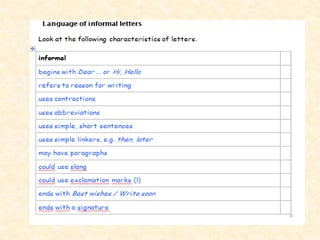
Informal or friendly letters

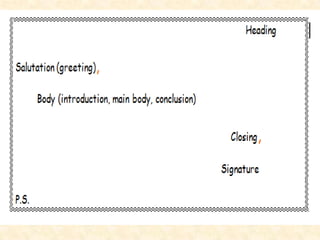
      They have five parts:
• 1. The Heading: The heading can include
  your address and the date. In casual,
  friendly letters your address is not
  necessary.
• 2. The Salutation (greeting): The
  greeting always ends with a comma. The
  greeting may be formal, beginning with
  the word “dear” and using the person’s
  given name or relationship, or it may be
  informal if appropriate e.g. Dear Uncle,
  Hi Joe,
• 3. The Body: The body of the letter is the
  information you are writing in your letter. It
  includes the message you want to write.
  Normally in a friendly letter, the beginning of
  paragraphs is indented*. It usually includes
  an introduction where we greet the person
  and state the reason we are writing; the main
  body we develop the subject and the
  conclusion or signalling the end where we use
  suitable remarks (invite, send greeting, etc)
  or indicate that the letter is going to finish.

• * to start a line of writing towards the middle
  of the page than other lines.
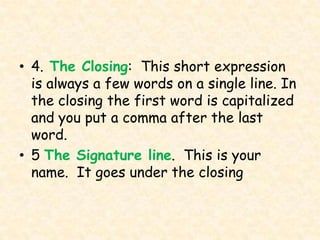
• 4. The Closing: This short expression
  is always a few words on a single line. In
  the closing the first word is capitalized
  and you put a comma after the last
  word.
• 5 The Signature line. This is your
  name. It goes under the closing
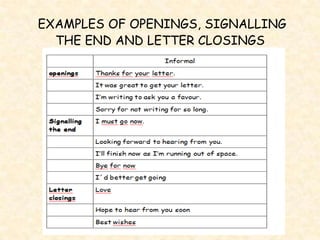
EXAMPLES OF OPENINGS, SIGNALLING
  THE END AND LETTER CLOSINGS
• CLICK HERE TO SEE SOME EXAMPLES AND DO
  THE EXERCISES

Informal letters

  • 1.
    Informal or friendlyletters They have five parts:
  • 2.
    • 1. TheHeading: The heading can include your address and the date. In casual, friendly letters your address is not necessary. • 2. The Salutation (greeting): The greeting always ends with a comma. The greeting may be formal, beginning with the word “dear” and using the person’s given name or relationship, or it may be informal if appropriate e.g. Dear Uncle, Hi Joe,
  • 3.
    • 3. TheBody: The body of the letter is the information you are writing in your letter. It includes the message you want to write. Normally in a friendly letter, the beginning of paragraphs is indented*. It usually includes an introduction where we greet the person and state the reason we are writing; the main body we develop the subject and the conclusion or signalling the end where we use suitable remarks (invite, send greeting, etc) or indicate that the letter is going to finish. • * to start a line of writing towards the middle of the page than other lines.
  • 4.
    • 4. TheClosing: This short expression is always a few words on a single line. In the closing the first word is capitalized and you put a comma after the last word. • 5 The Signature line. This is your name. It goes under the closing
  • 7.
    EXAMPLES OF OPENINGS,SIGNALLING THE END AND LETTER CLOSINGS
  • 8.
    • CLICK HERETO SEE SOME EXAMPLES AND DO THE EXERCISES