WELCOME TO
SESSION 03
Teacher: Maria Miranda
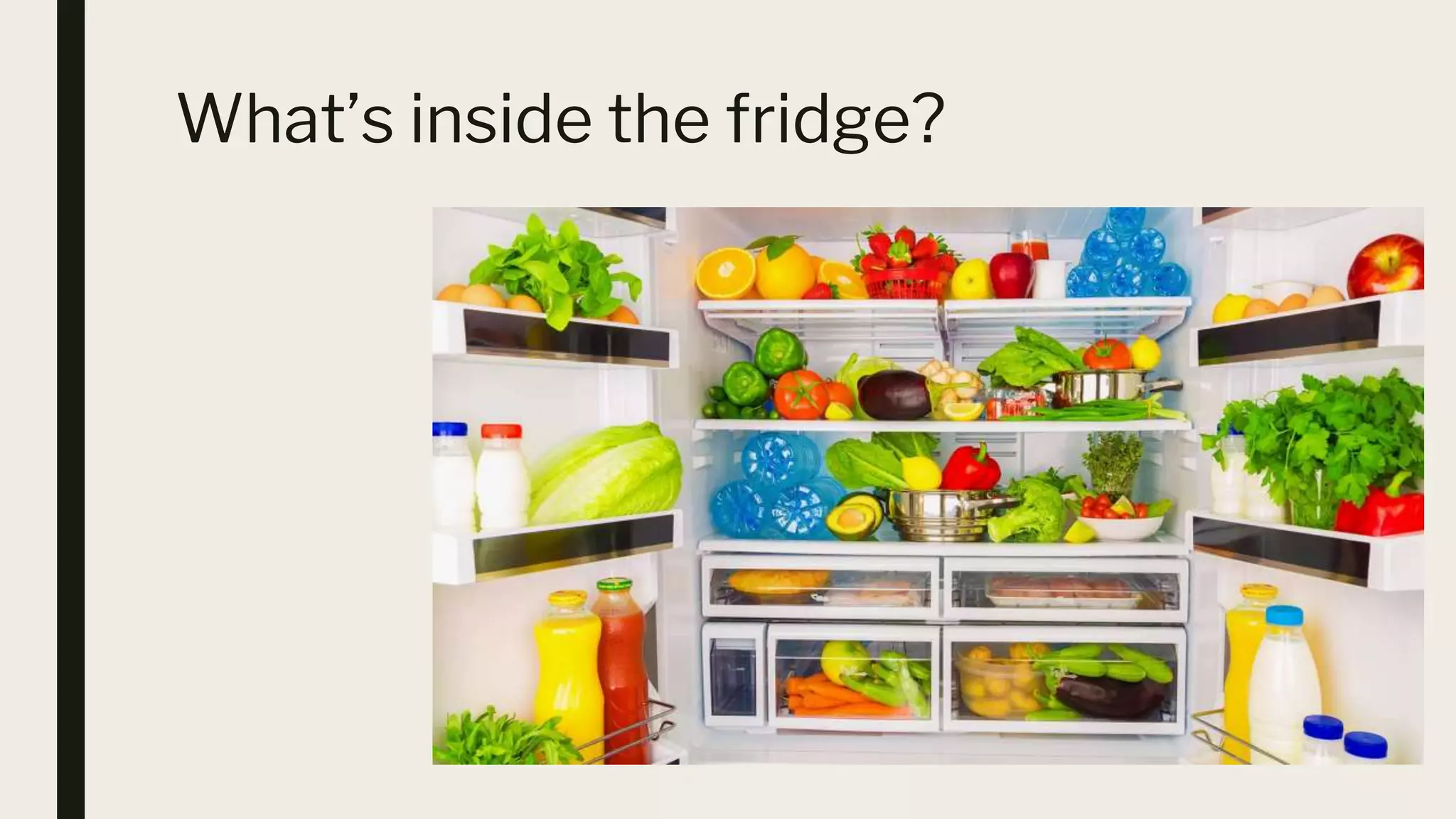
What’s inside the fridge?
QUANTIFIERS
Quantifiers are words that are used to state quantity or amount of
something without stating the exact number.
Agenda for Today
■ Review Activities
■ Quantifiers
■ Showing agreement or disagreement.
Quantifiers answer the questions
"How many?" and "How much?"
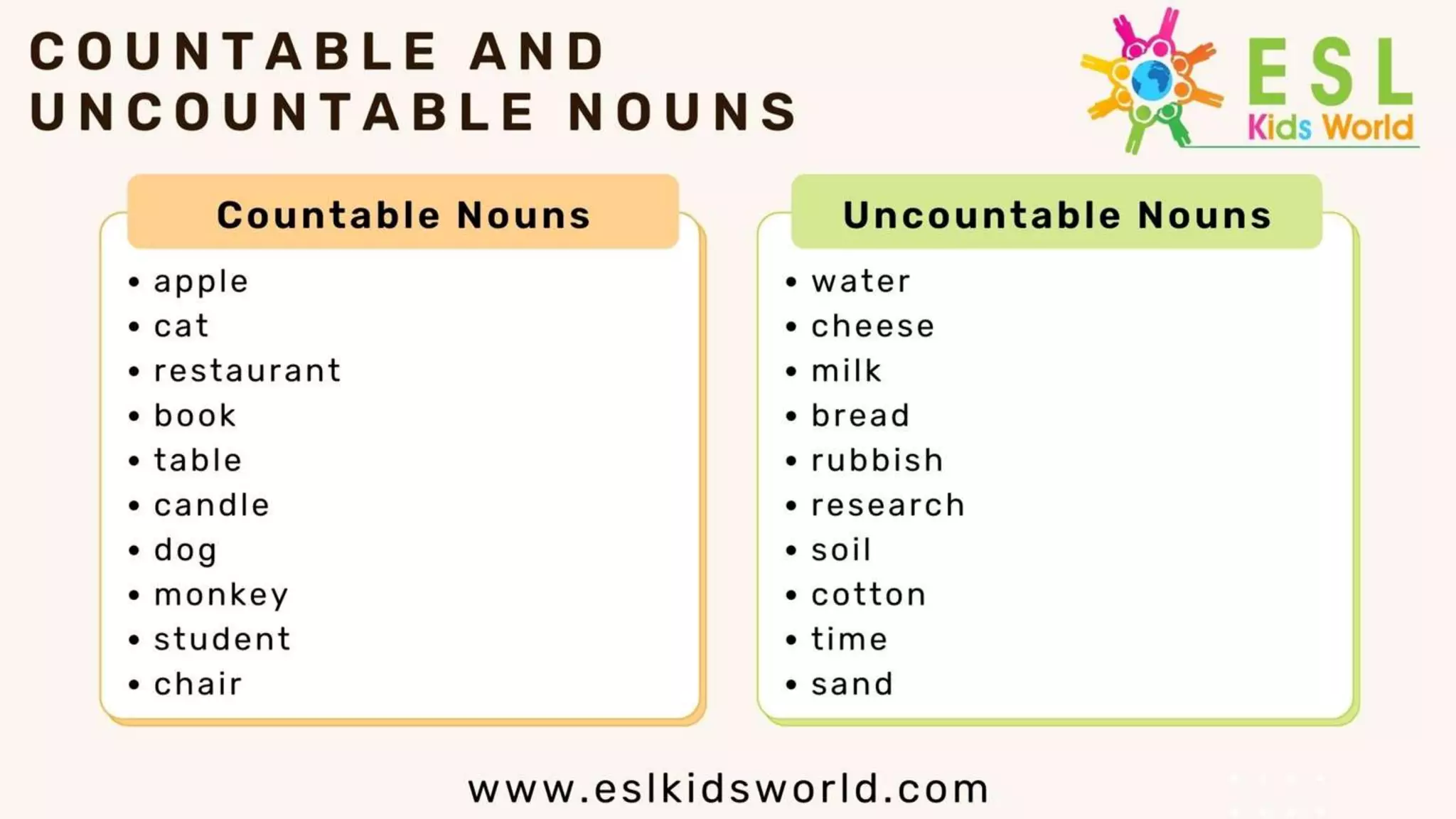
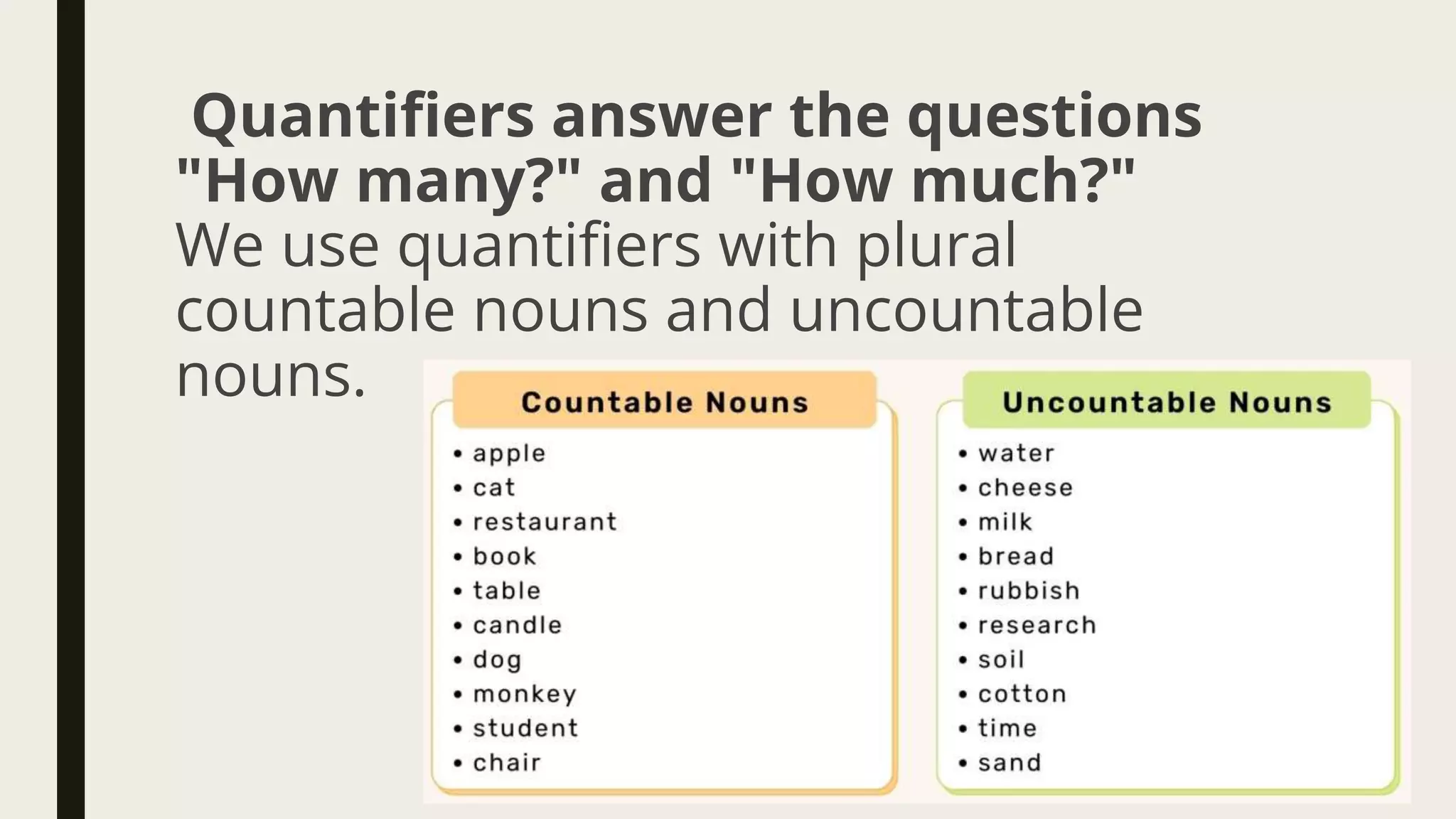
We use quantifiers with plural
countable nouns and uncountable
nouns.
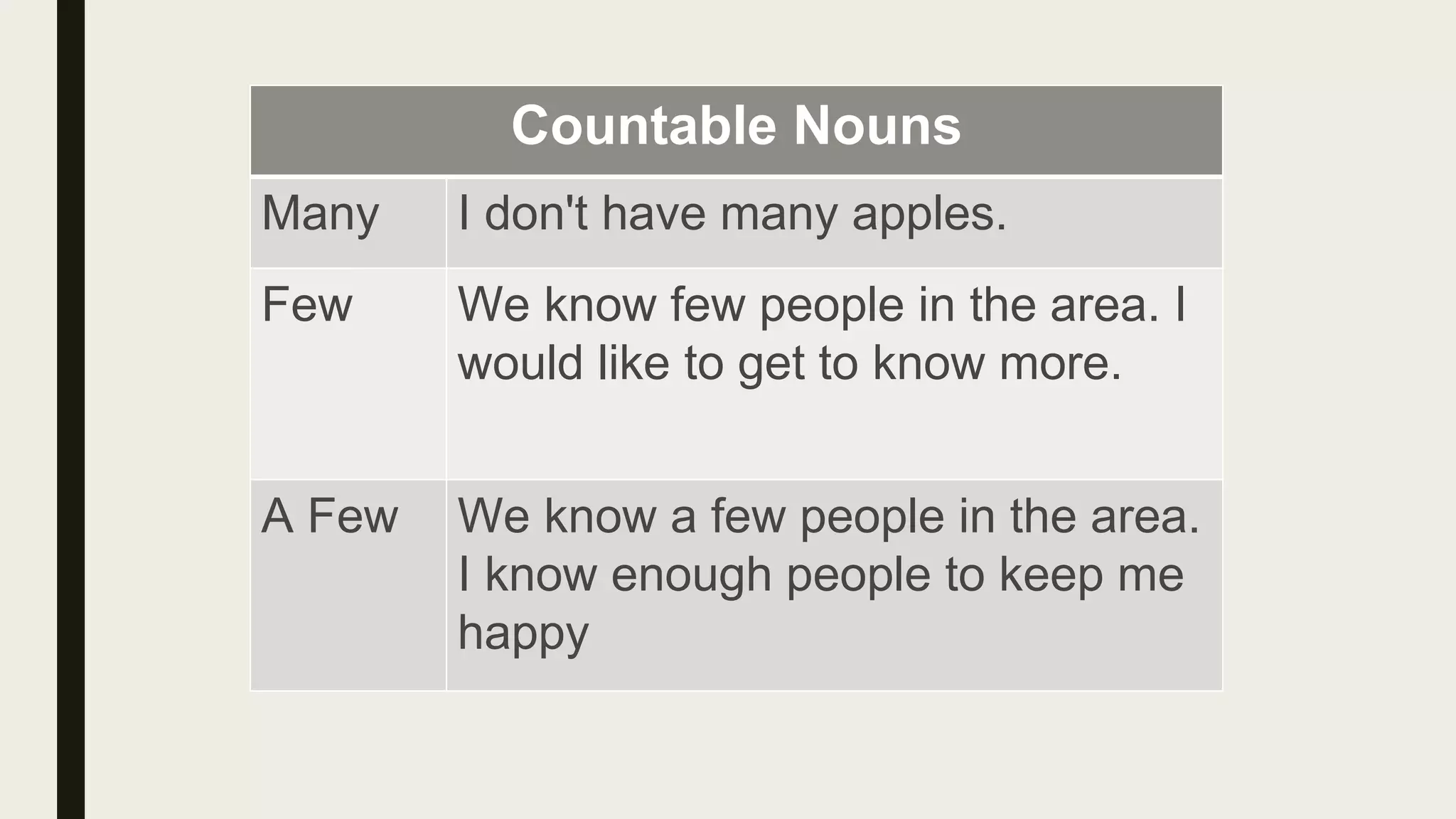
Countable Nouns
Many I don't have many apples.
Few We know few people in the area. I
would like to get to know more.
A Few We know a few people in the area.
I know enough people to keep me
happy
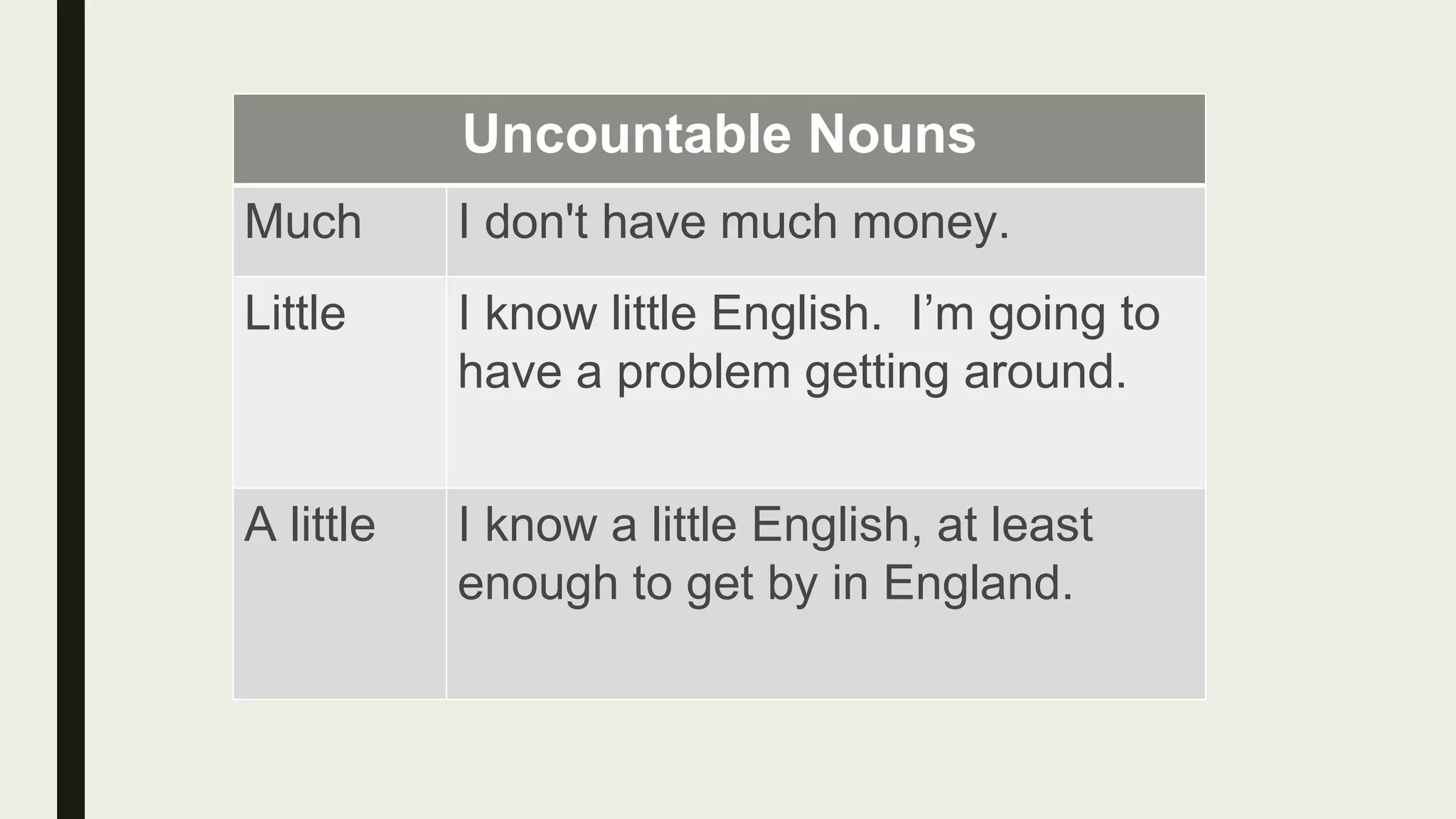
Uncountable Nouns
Much I don't have much money.
Little I know little English. I’m going to
have a problem getting around.
A little I know a little English, at least
enough to get by in England.
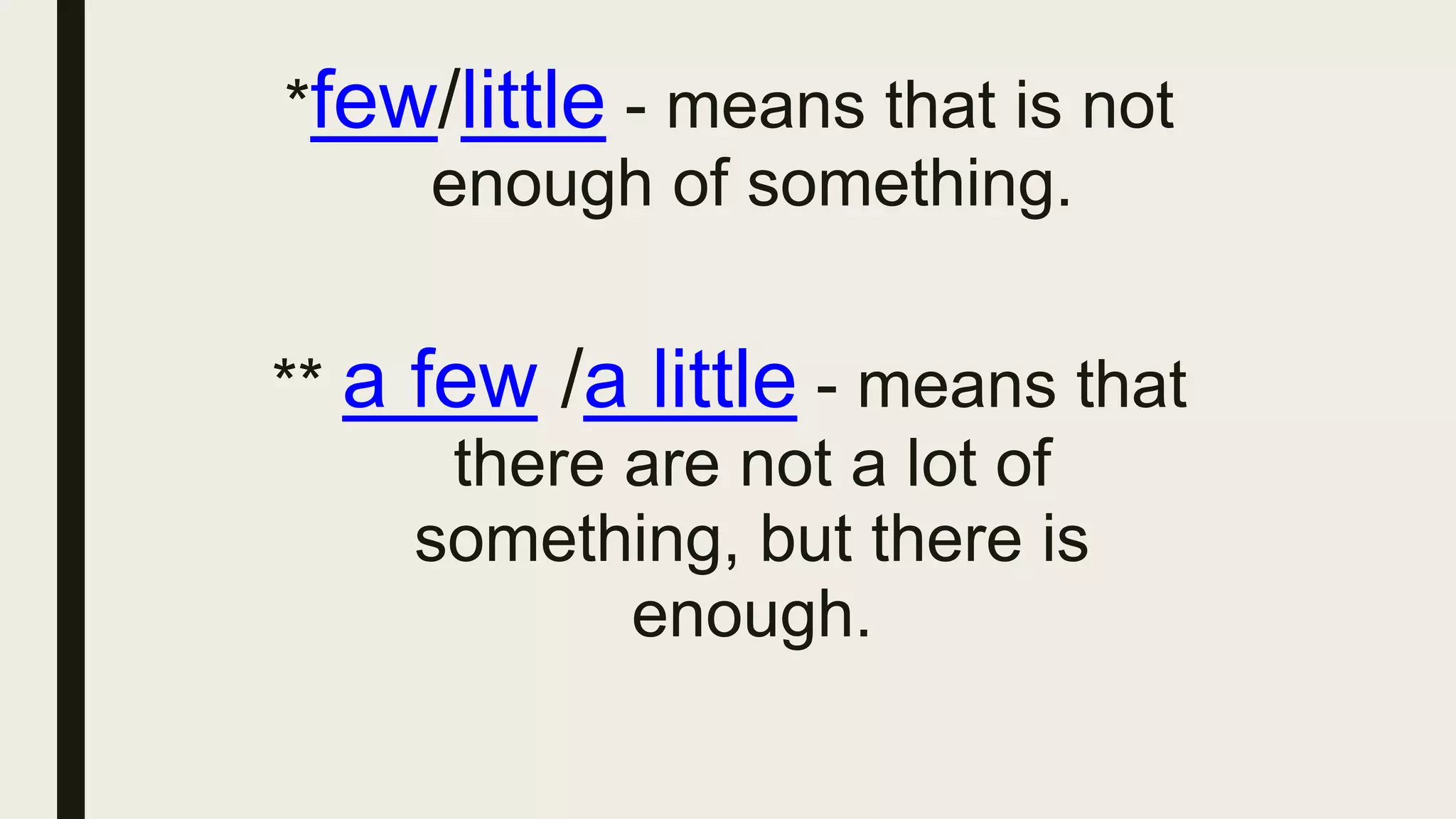
*few/little - means that is not
enough of something.
** a few /a little - means that
there are not a lot of
something, but there is
enough.
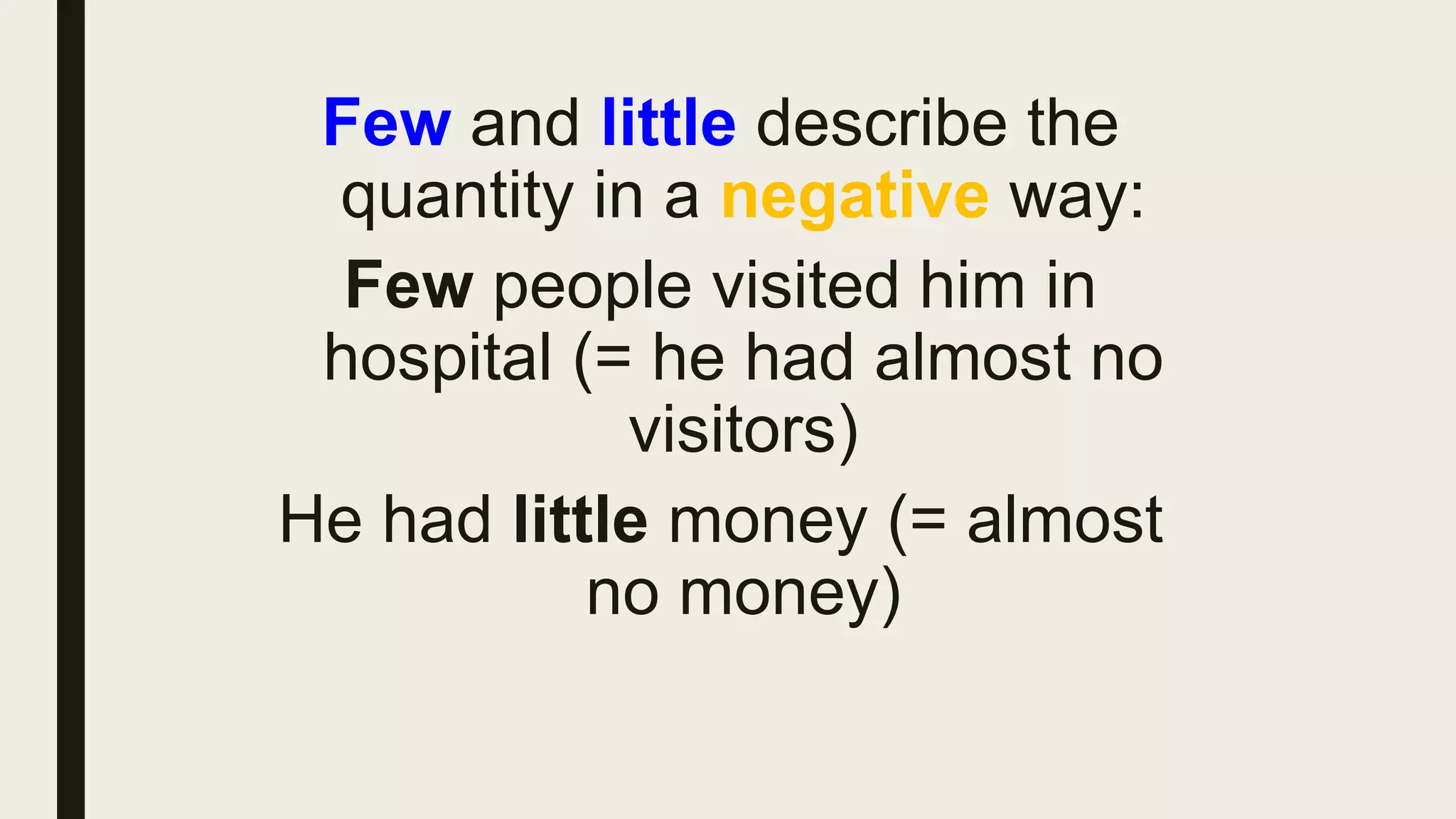
Few and little describe the
quantity in a negative way:
Few people visited him in
hospital (= he had almost no
visitors)
He had little money (= almost
no money)
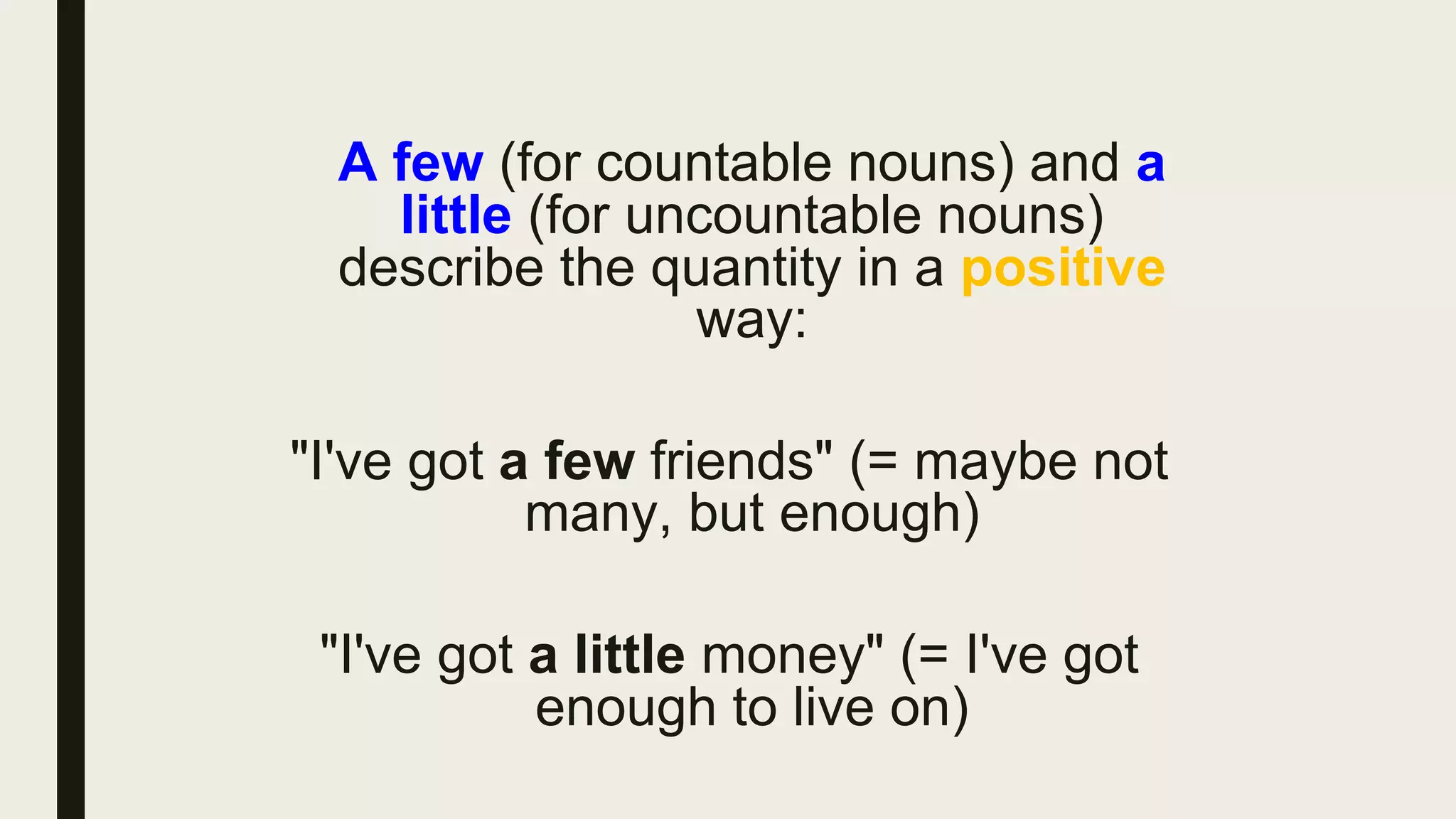
A few (for countable nouns) and a
little (for uncountable nouns)
describe the quantity in a positive
way:
"I've got a few friends" (= maybe not
many, but enough)
"I've got a little money" (= I've got
enough to live on)
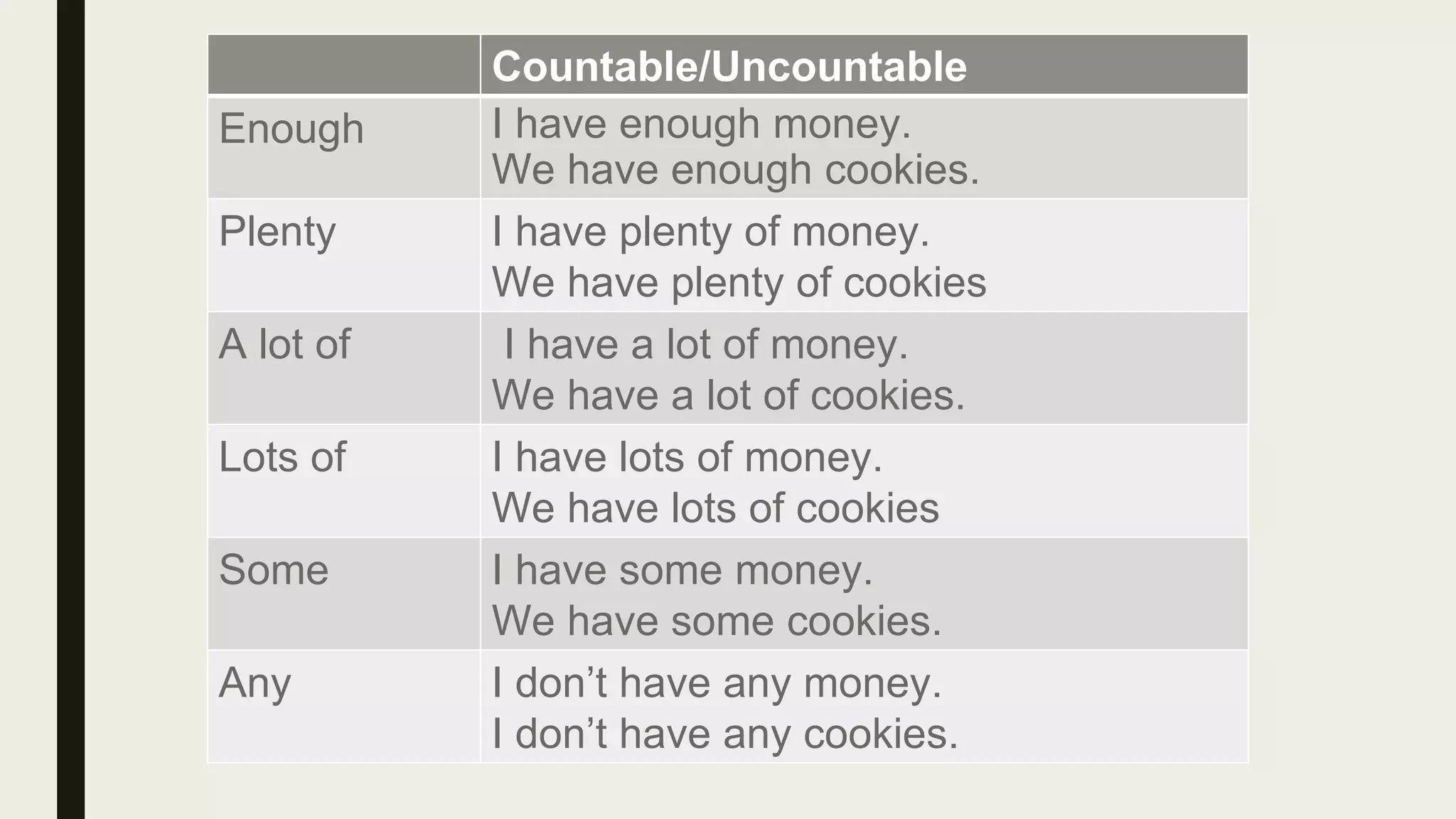
Countable/Uncountable
Enough I have enough money.
We have enough cookies.
Plenty I have plenty of money.
We have plenty of cookies
A lot of I have a lot of money.
We have a lot of cookies.
Lots of I have lots of money.
We have lots of cookies
Some I have some money.
We have some cookies.
Any I don’t have any money.
I don’t have any cookies.
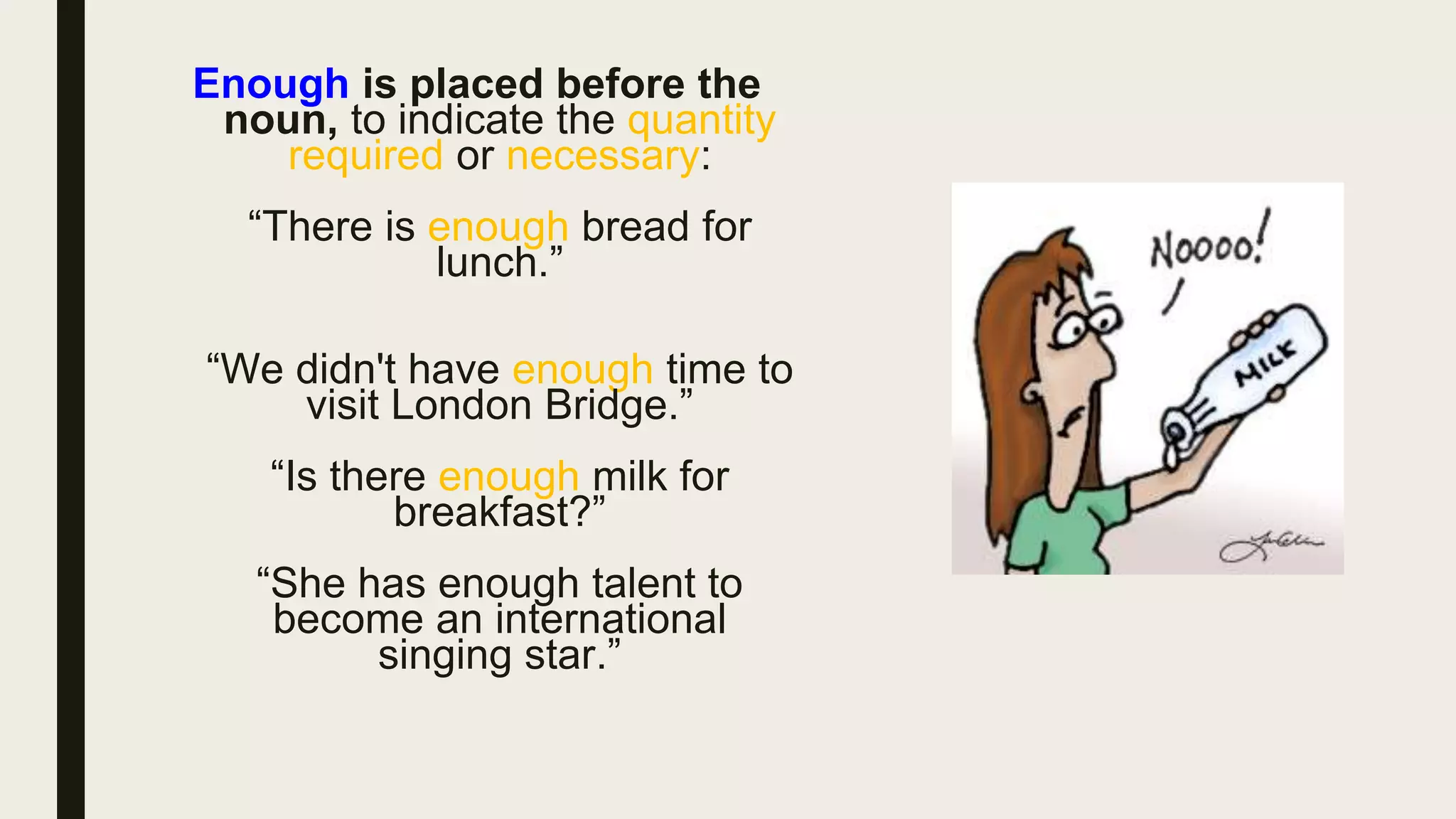
Enough is placed before the
noun, to indicate the quantity
required or necessary:
“There is enough bread for
lunch.”
“We didn't have enough time to
visit London Bridge.”
“Is there enough milk for
breakfast?”
“She has enough talent to
become an international
singing star.”
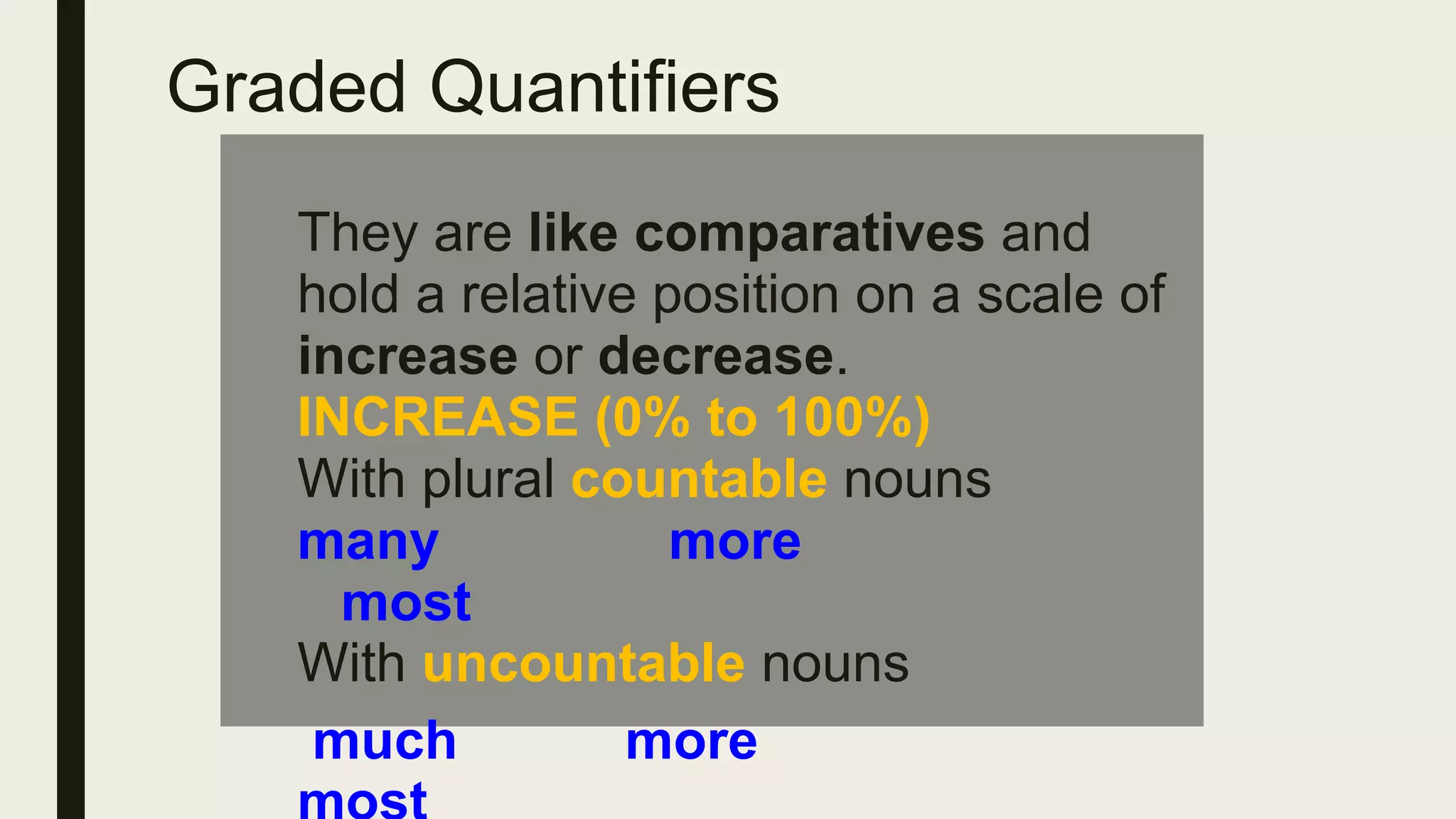
Graded Quantifiers
They are like comparatives and
hold a relative position on a scale of
increase or decrease.
INCREASE (0% to 100%)
With plural countable nouns
many more
most
With uncountable nouns
much more
·
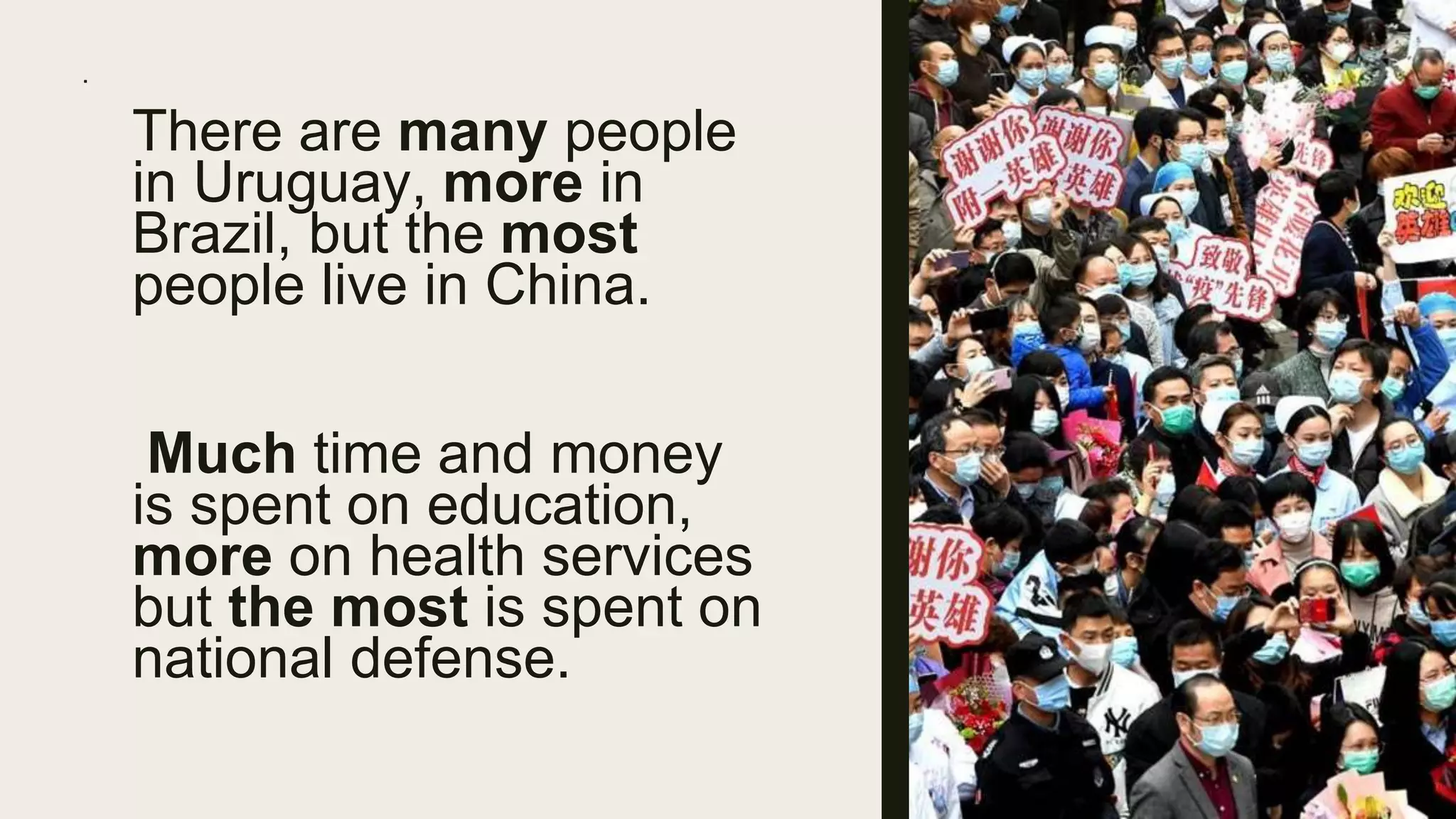
There are many people
in Uruguay, more in
Brazil, but the most
people live in China.
Much time and money
is spent on education,
more on health services
but the most is spent on
national defense.
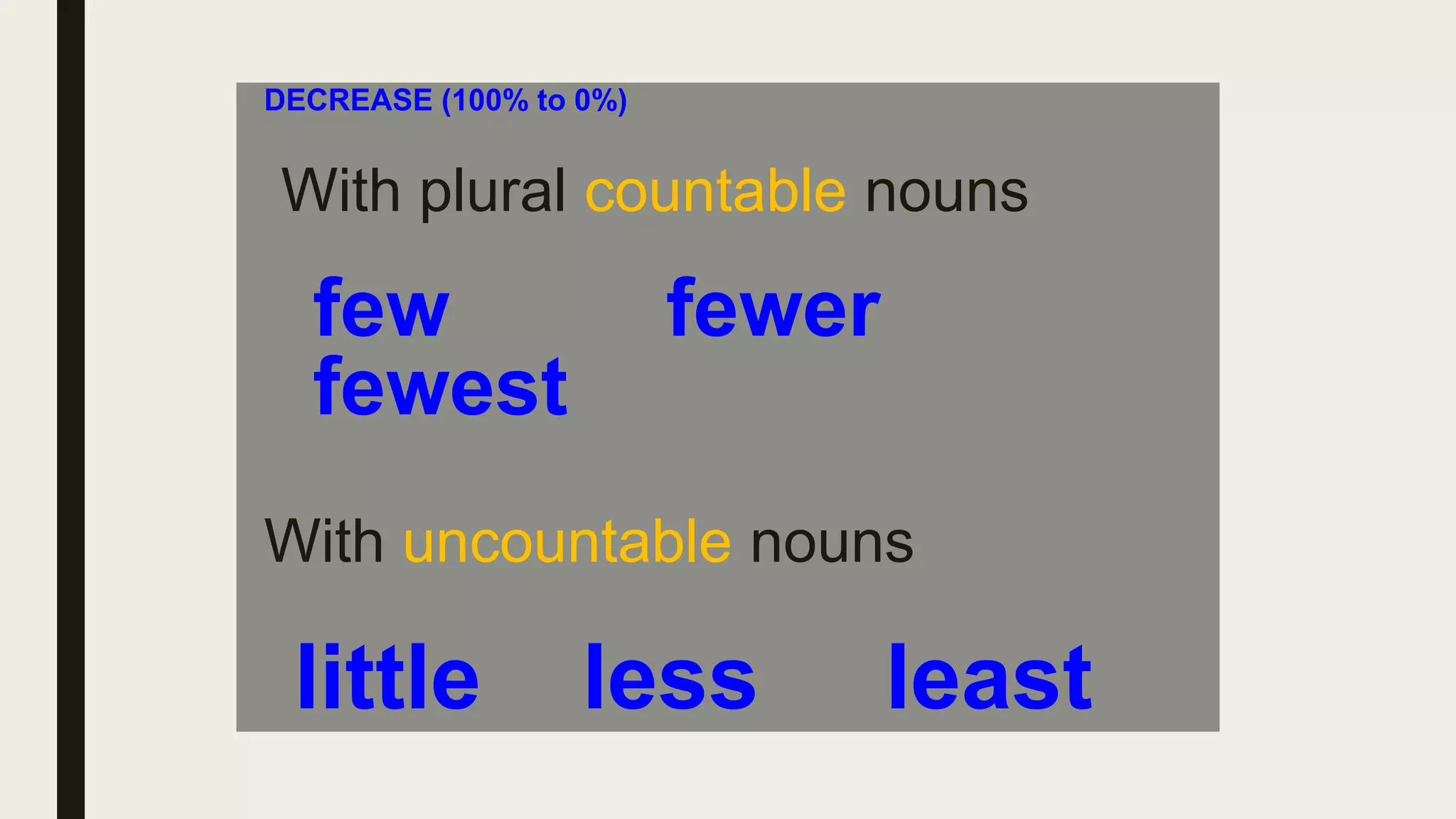
DECREASE (100% to 0%)
With plural countable nouns
few fewer
fewest
With uncountable nouns
little less least
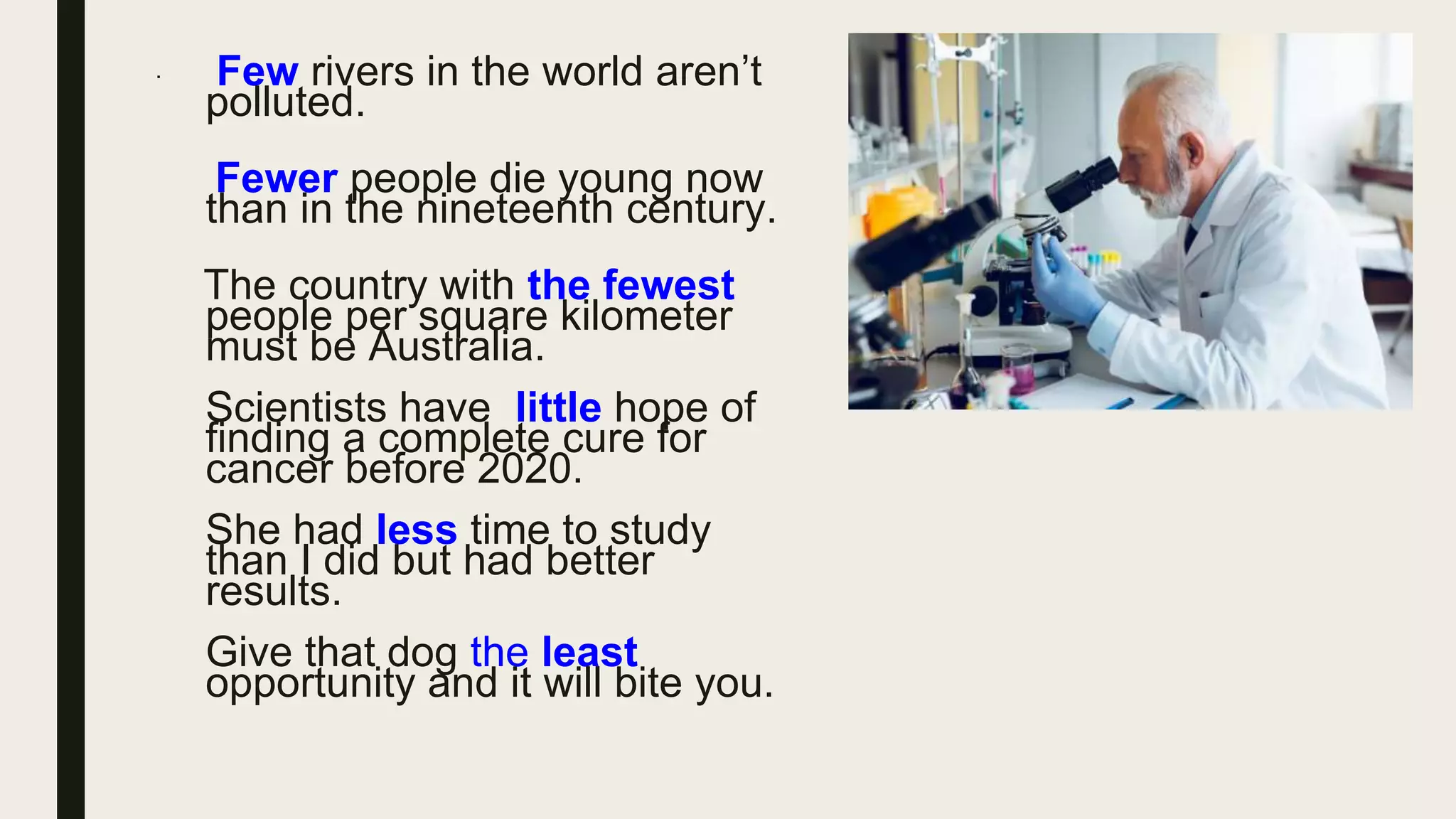
· Few rivers in the world aren’t
polluted.
Fewer people die young now
than in the nineteenth century.
The country with the fewest
people per square kilometer
must be Australia.
Scientists have little hope of
finding a complete cure for
cancer before 2020.
She had less time to study
than I did but had better
results.
Give that dog the least
opportunity and it will bite you.
SOME AND
ANY
When to use some and any?
Some and any are used to state
the quantity, amount of
something. When using some
or any the exact number is not
stated.
Some and any can be used
when:
The exact number is not known.
The exact number is not important
or relevant.
Some and any are used with
countable nouns and uncountable
nouns
Any
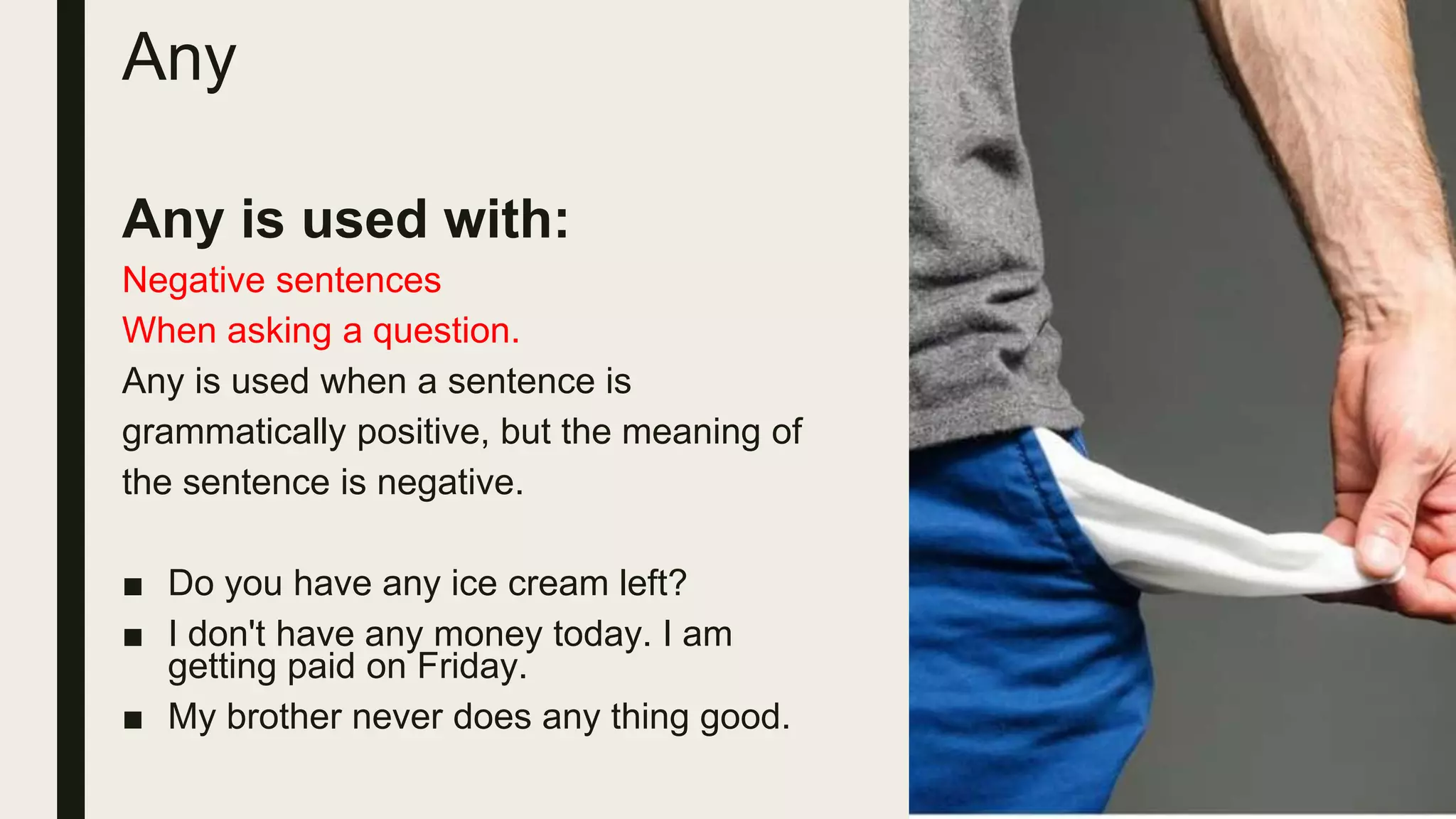
Any is used with:
Negative sentences
When asking a question.
Any is used when a sentence is
grammatically positive, but the meaning of
the sentence is negative.
■ Do you have any ice cream left?
■ I don't have any money today. I am
getting paid on Friday.
■ My brother never does any thing good.
Some
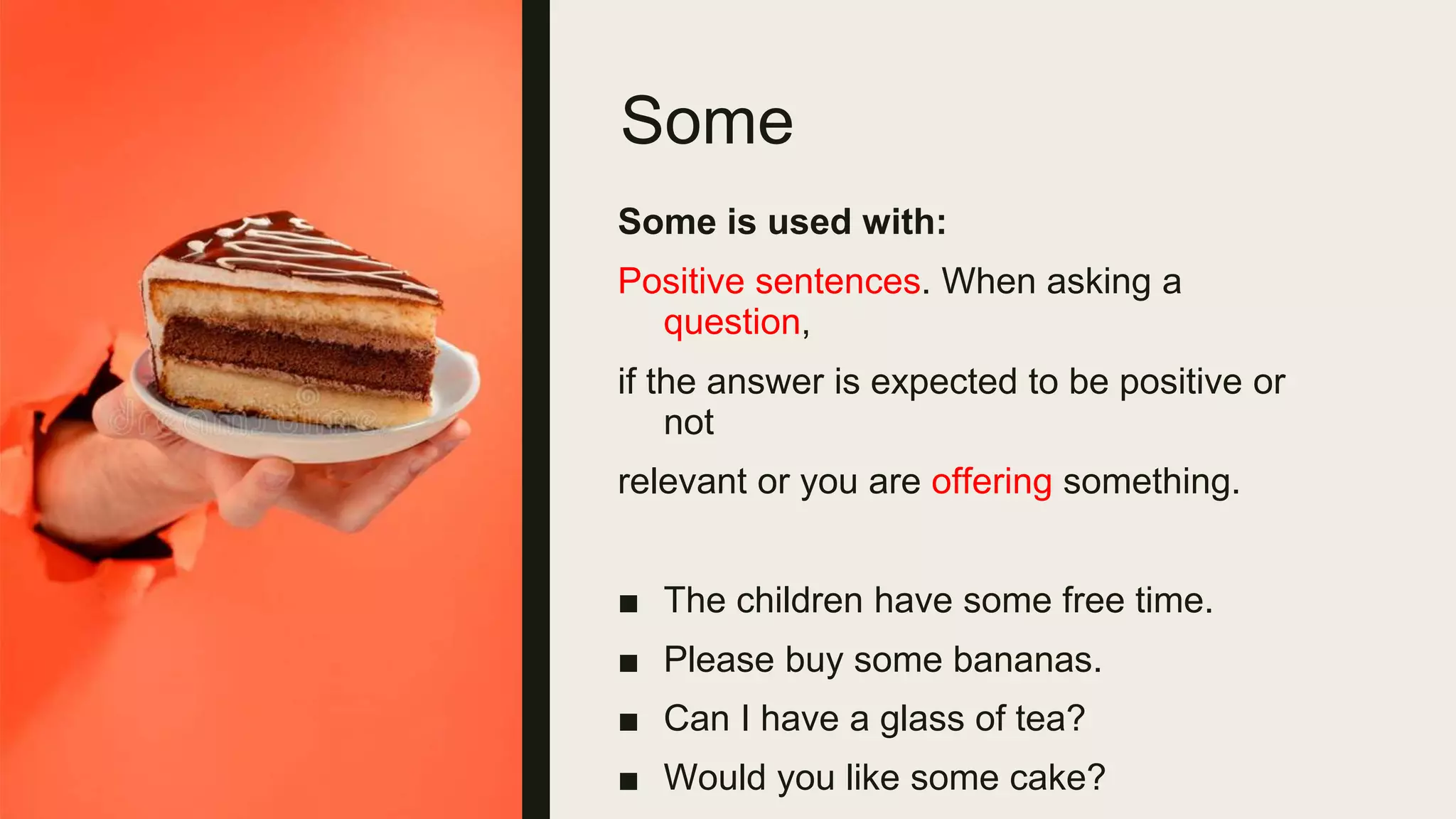
Some is used with:
Positive sentences. When asking a
question,
if the answer is expected to be positive or
not
relevant or you are offering something.
■ The children have some free time.
■ Please buy some bananas.
■ Can I have a glass of tea?
■ Would you like some cake?
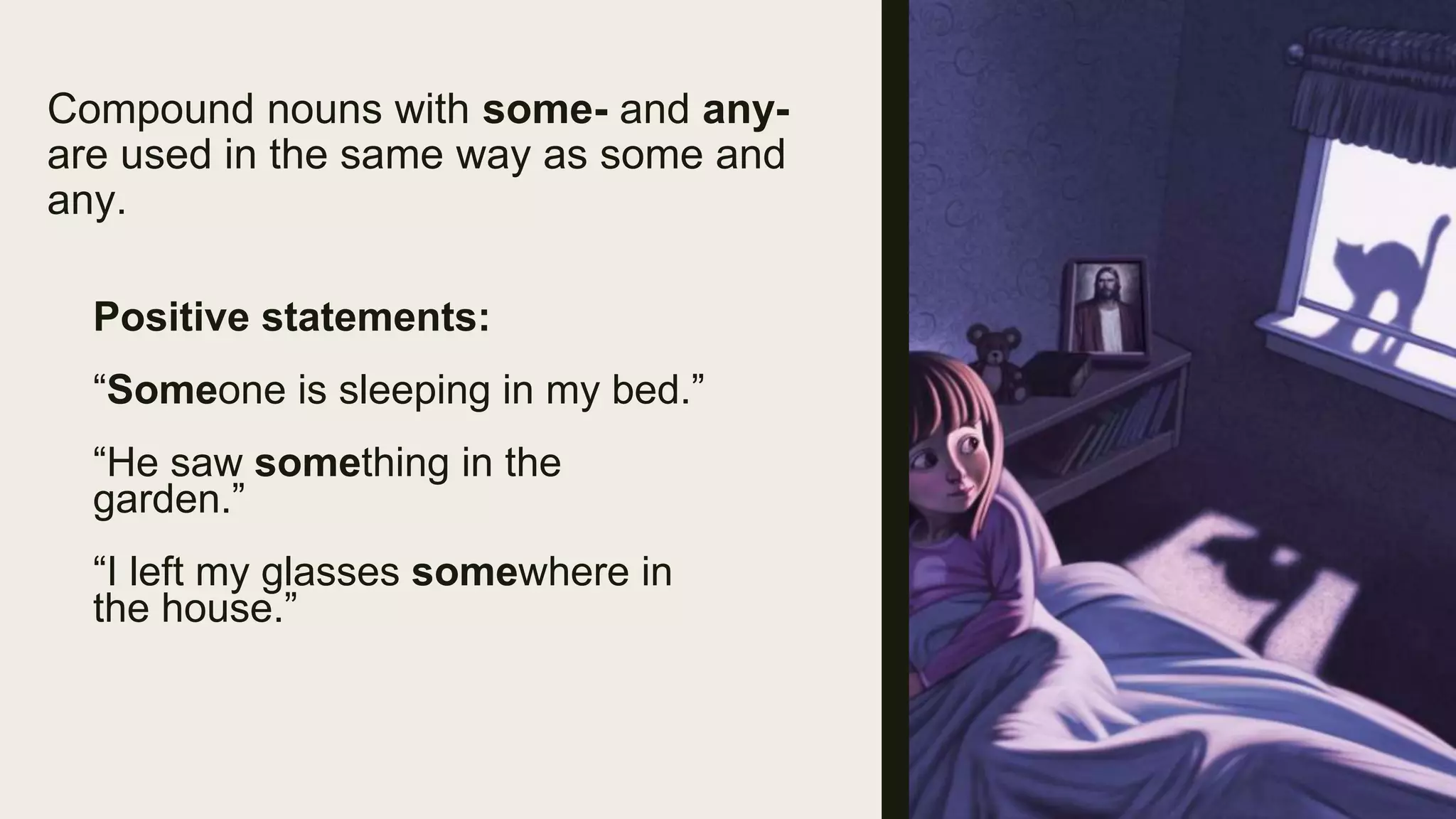
Compound nouns with some- and any-
are used in the same way as some and
any.
Positive statements:
“Someone is sleeping in my bed.”
“He saw something in the
garden.”
“I left my glasses somewhere in
the house.”
Questions:
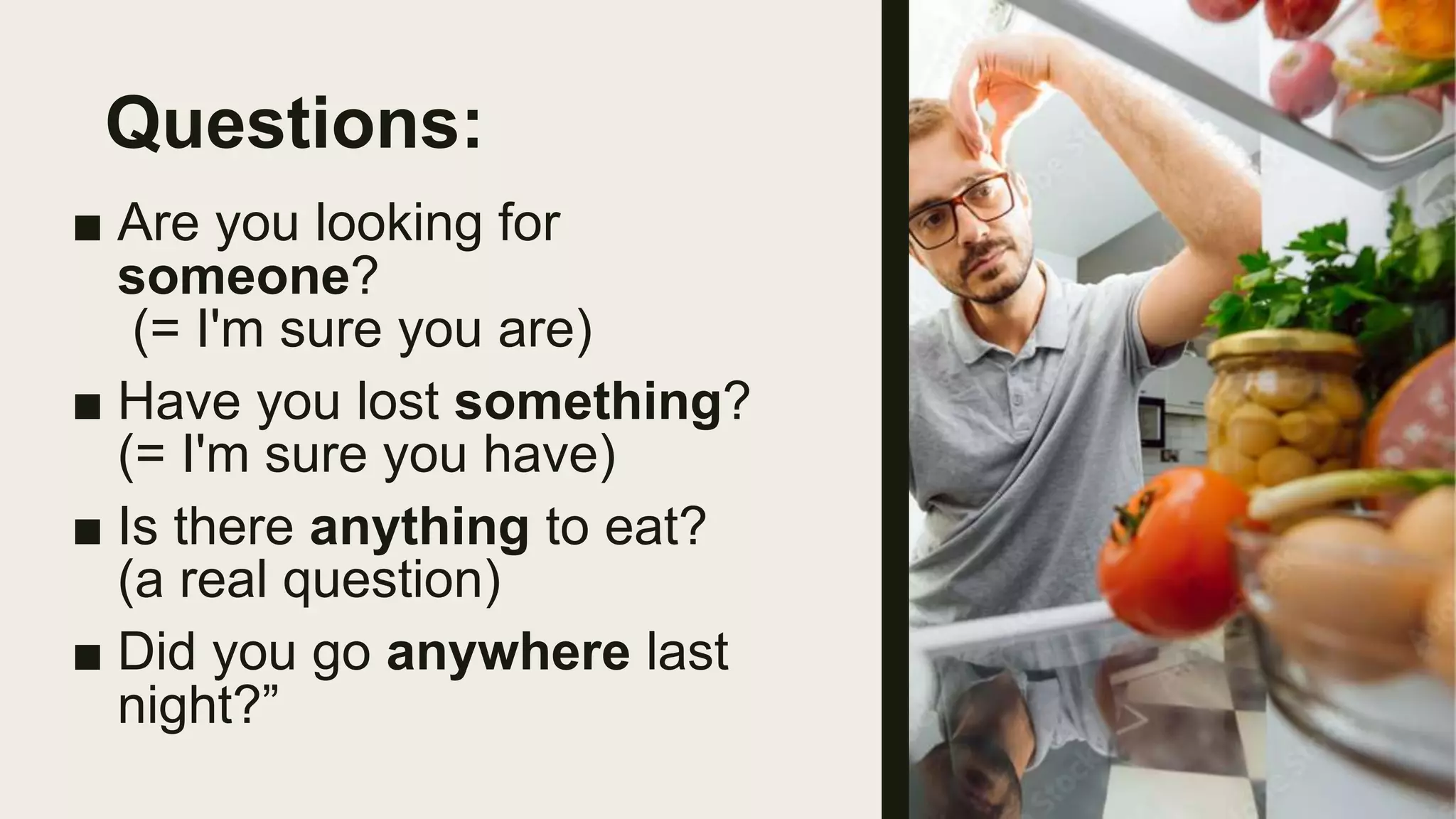
■ Are you looking for
someone?
(= I'm sure you are)
■ Have you lost something?
(= I'm sure you have)
■ Is there anything to eat?
(a real question)
■ Did you go anywhere last
night?”
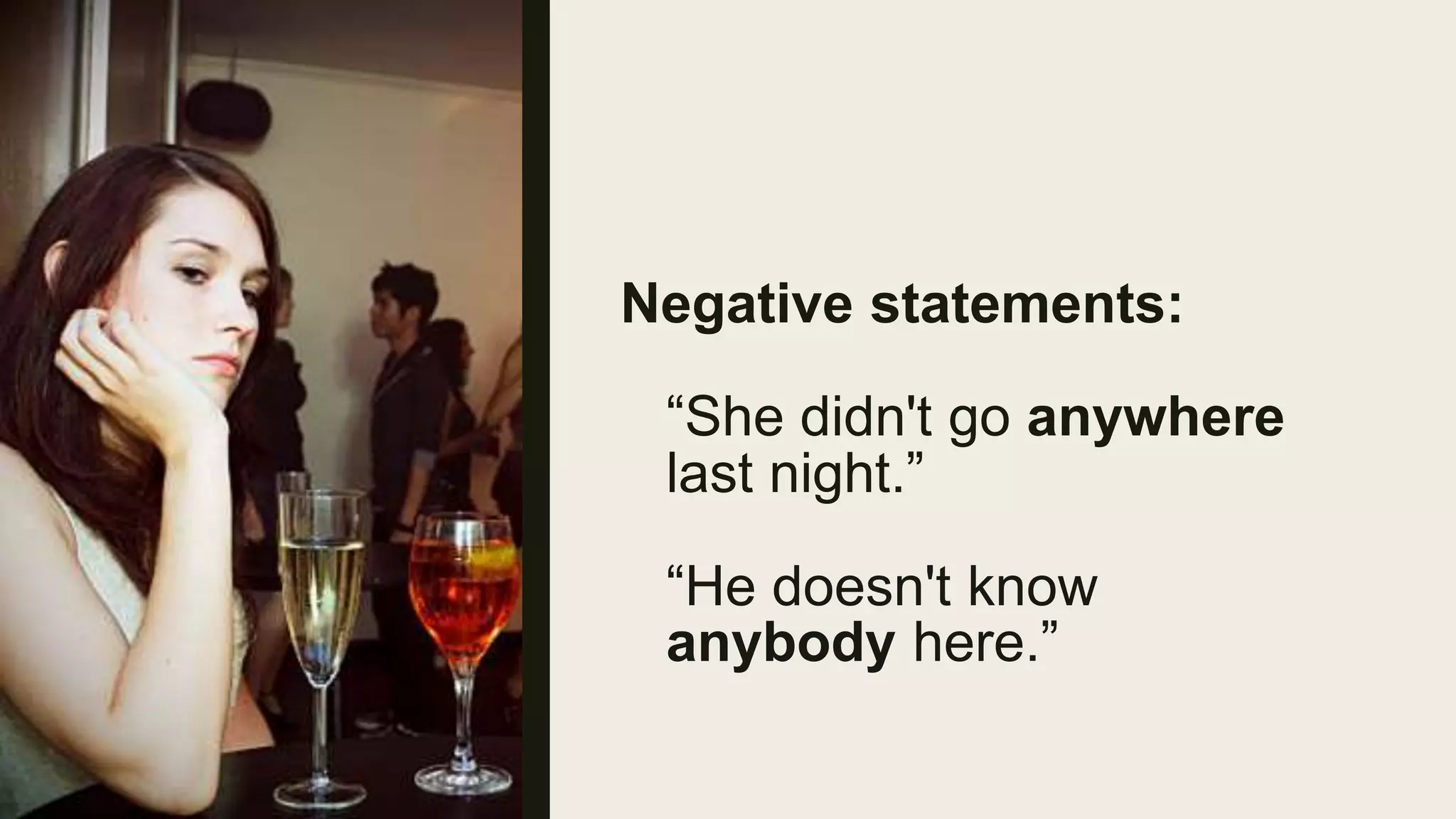
Negative statements:
“She didn't go anywhere
last night.”
“He doesn't know
anybody here.”
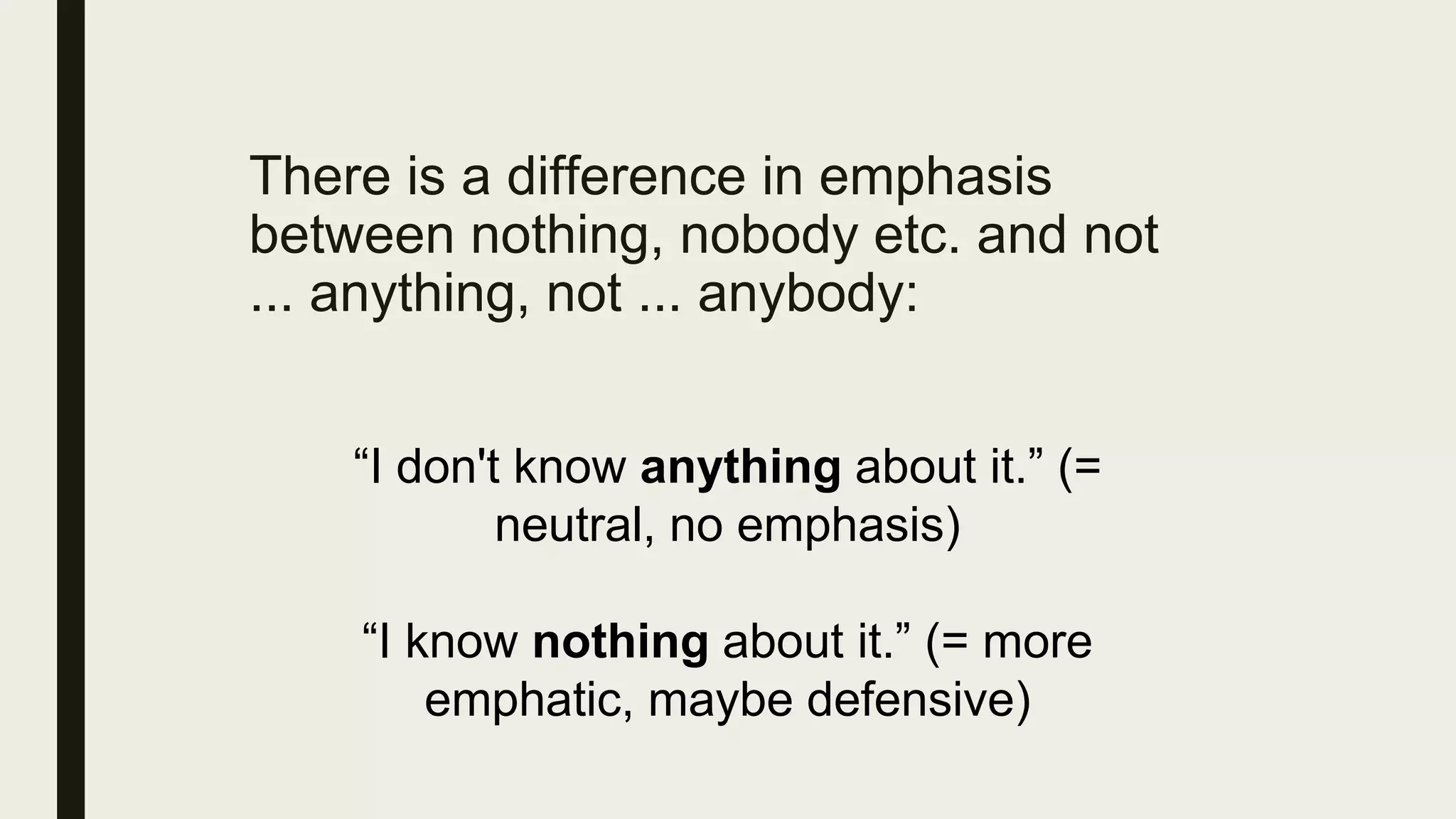
There is a difference in emphasis
between nothing, nobody etc. and not
... anything, not ... anybody:
“I don't know anything about it.” (=
neutral, no emphasis)
“I know nothing about it.” (= more
emphatic, maybe defensive)
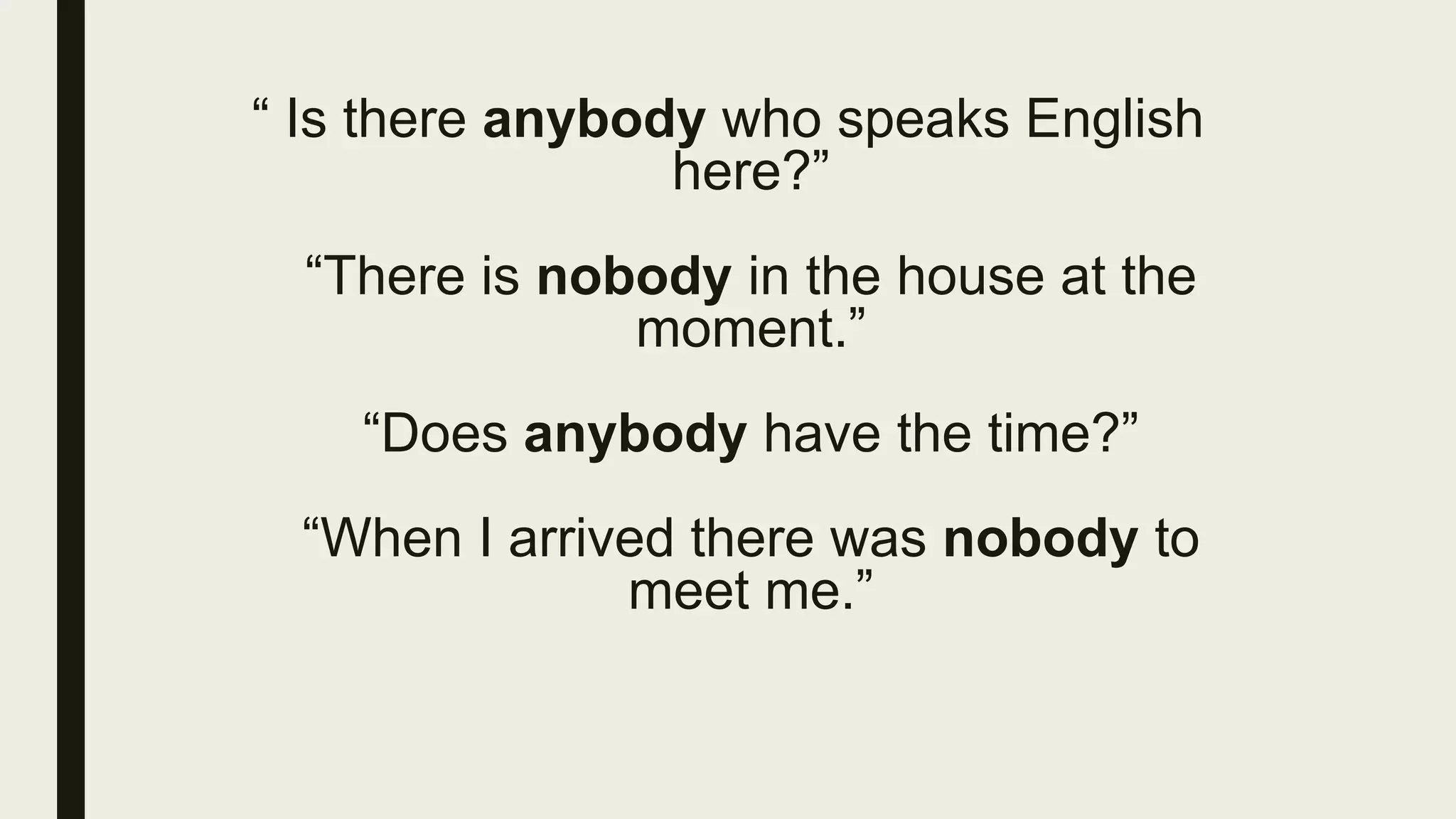
“ Is there anybody who speaks English
here?”
“There is nobody in the house at the
moment.”
“Does anybody have the time?”
“When I arrived there was nobody to
meet me.”
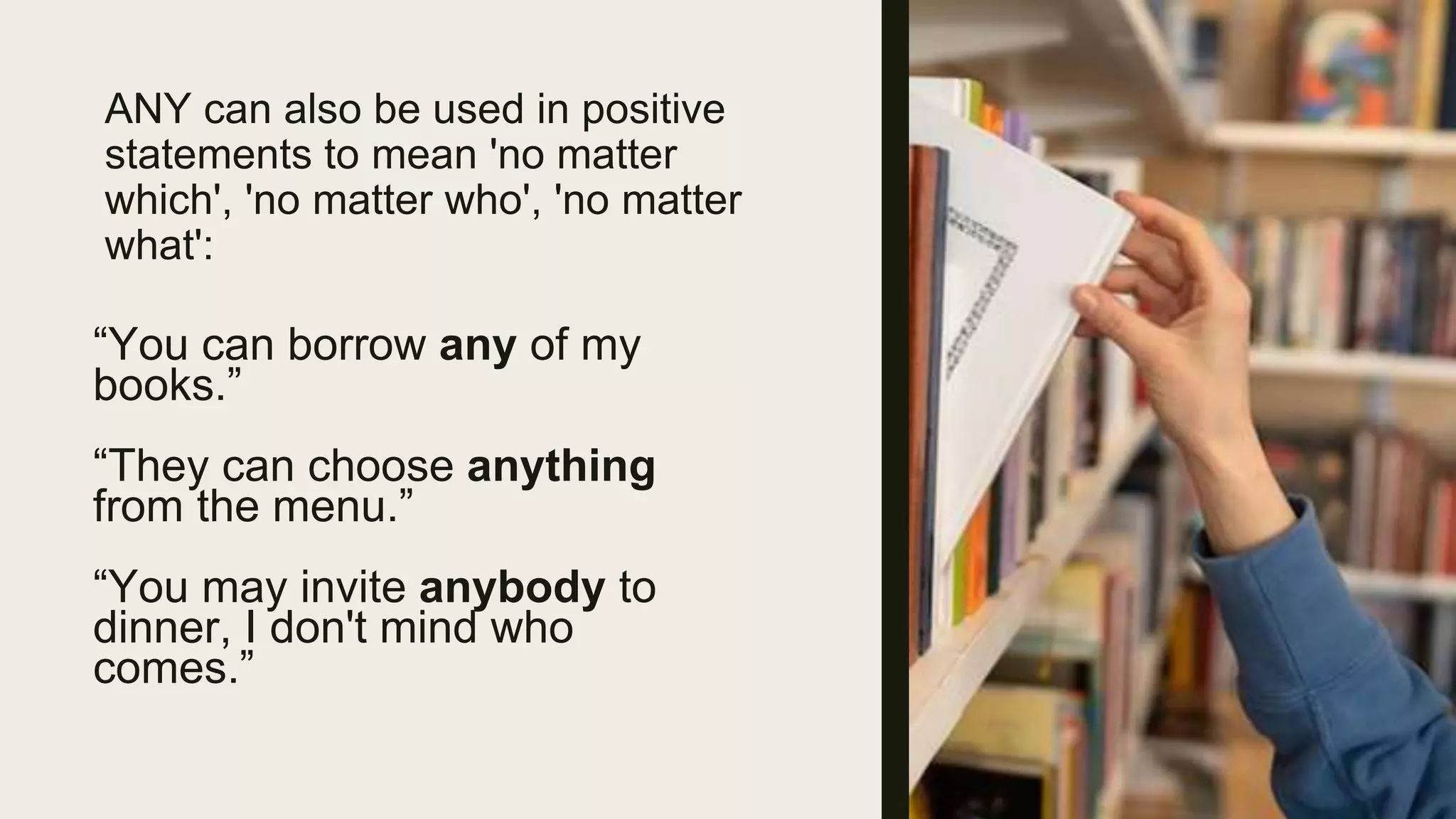
ANY can also be used in positive
statements to mean 'no matter
which', 'no matter who', 'no matter
what':
“You can borrow any of my
books.”
“They can choose anything
from the menu.”
“You may invite anybody to
dinner, I don't mind who
comes.”
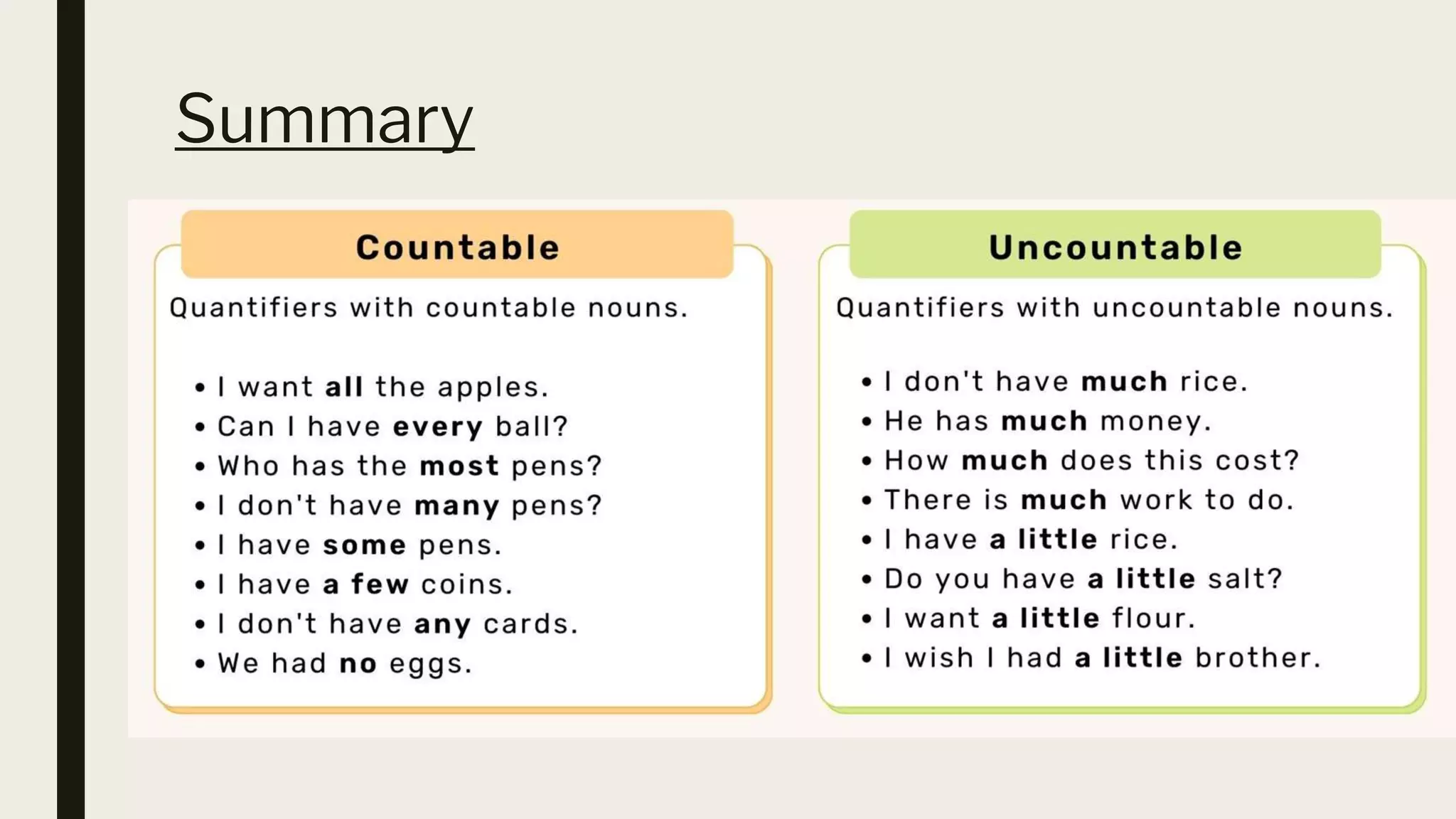
Summary
Let’s play!
Thank you!

Welcome to Session 03.pptx

  • 1.
  • 2.
  • 3.
    QUANTIFIERS Quantifiers are wordsthat are used to state quantity or amount of something without stating the exact number.
  • 4.
    Agenda for Today ■Review Activities ■ Quantifiers ■ Showing agreement or disagreement.
  • 5.
    Quantifiers answer thequestions "How many?" and "How much?" We use quantifiers with plural countable nouns and uncountable nouns.
  • 6.
    Countable Nouns Many Idon't have many apples. Few We know few people in the area. I would like to get to know more. A Few We know a few people in the area. I know enough people to keep me happy
  • 7.
    Uncountable Nouns Much Idon't have much money. Little I know little English. I’m going to have a problem getting around. A little I know a little English, at least enough to get by in England.
  • 8.
    *few/little - meansthat is not enough of something. ** a few /a little - means that there are not a lot of something, but there is enough.
  • 9.
    Few and littledescribe the quantity in a negative way: Few people visited him in hospital (= he had almost no visitors) He had little money (= almost no money)
  • 10.
    A few (forcountable nouns) and a little (for uncountable nouns) describe the quantity in a positive way: "I've got a few friends" (= maybe not many, but enough) "I've got a little money" (= I've got enough to live on)
  • 11.
    Countable/Uncountable Enough I haveenough money. We have enough cookies. Plenty I have plenty of money. We have plenty of cookies A lot of I have a lot of money. We have a lot of cookies. Lots of I have lots of money. We have lots of cookies Some I have some money. We have some cookies. Any I don’t have any money. I don’t have any cookies.
  • 12.
    Enough is placedbefore the noun, to indicate the quantity required or necessary: “There is enough bread for lunch.” “We didn't have enough time to visit London Bridge.” “Is there enough milk for breakfast?” “She has enough talent to become an international singing star.”
  • 13.
    Graded Quantifiers They arelike comparatives and hold a relative position on a scale of increase or decrease. INCREASE (0% to 100%) With plural countable nouns many more most With uncountable nouns much more
  • 14.
    · There are manypeople in Uruguay, more in Brazil, but the most people live in China. Much time and money is spent on education, more on health services but the most is spent on national defense.
  • 15.
    DECREASE (100% to0%) With plural countable nouns few fewer fewest With uncountable nouns little less least
  • 16.
    · Few riversin the world aren’t polluted. Fewer people die young now than in the nineteenth century. The country with the fewest people per square kilometer must be Australia. Scientists have little hope of finding a complete cure for cancer before 2020. She had less time to study than I did but had better results. Give that dog the least opportunity and it will bite you.
  • 17.
  • 18.
    When to usesome and any? Some and any are used to state the quantity, amount of something. When using some or any the exact number is not stated.
  • 19.
    Some and anycan be used when: The exact number is not known. The exact number is not important or relevant. Some and any are used with countable nouns and uncountable nouns
  • 20.
    Any Any is usedwith: Negative sentences When asking a question. Any is used when a sentence is grammatically positive, but the meaning of the sentence is negative. ■ Do you have any ice cream left? ■ I don't have any money today. I am getting paid on Friday. ■ My brother never does any thing good.
  • 21.
    Some Some is usedwith: Positive sentences. When asking a question, if the answer is expected to be positive or not relevant or you are offering something. ■ The children have some free time. ■ Please buy some bananas. ■ Can I have a glass of tea? ■ Would you like some cake?
  • 22.
    Compound nouns withsome- and any- are used in the same way as some and any. Positive statements: “Someone is sleeping in my bed.” “He saw something in the garden.” “I left my glasses somewhere in the house.”
  • 23.
    Questions: ■ Are youlooking for someone? (= I'm sure you are) ■ Have you lost something? (= I'm sure you have) ■ Is there anything to eat? (a real question) ■ Did you go anywhere last night?”
  • 24.
    Negative statements: “She didn'tgo anywhere last night.” “He doesn't know anybody here.”
  • 25.
    There is adifference in emphasis between nothing, nobody etc. and not ... anything, not ... anybody: “I don't know anything about it.” (= neutral, no emphasis) “I know nothing about it.” (= more emphatic, maybe defensive)
  • 26.
    “ Is thereanybody who speaks English here?” “There is nobody in the house at the moment.” “Does anybody have the time?” “When I arrived there was nobody to meet me.”
  • 27.
    ANY can alsobe used in positive statements to mean 'no matter which', 'no matter who', 'no matter what': “You can borrow any of my books.” “They can choose anything from the menu.” “You may invite anybody to dinner, I don't mind who comes.”
  • 28.
  • 29.
  • 30.