TO vs FOR
A quick review for ESL students
Tara L. Lockhart
Dartmouth, Canada
TO or FOR ?
WHICH STATEMENT IS CORRECT?
I’m studying for improving my English.
OR
I’m studying to improve my English.
TO or FOR ?
Don’t say: I’m studying for improving my English.
(* for is used to talk about purpose when it is followed by a noun, if it is
followed by a gerund, it is talking about the function of a thing.)
OR
Do say: I’m studying to improve my English.
(infinitive of purpose)
Use TO in these situations
Destination > “We’re going to Paris.”
What time it is > “It’s a quarter to 2.”
Distance > “It’s about ten miles from my house
to the university.”
Comparing > “I prefer sleeping to working.”
Giving > “I gave the book to my sister.”
*Motive/Reason – with verb (infinitive)
“I came here to see you.”
Remember!!
• to has two uses.
1. It can be a preposition.
When to is used as a preposition it is followed
by a noun which acts as its object.
2. It can also be an infinitive marker.
When to is used as a infinitive marker, it should
be followed by a verb.
Use FOR in these situations
Benefits > “Yogurt is good for your digestion.”
Period of time > “We’ve lived here for 2 years.”
Schedule > “I made an appointment for May 3rd.”
Agree with > “Are you for or against the
development of nuclear weapons?”
Doing something to help someone > “Could you
carry these books for me?”
*Motive/Reason – with noun
“Let’s go out for a drink.”
Function – with verb (-ing form)
“I wear these glasses for reading.”
Work with a partner – will you use
TO or FOR?
1. Walking is good _____ our health.
2. We stand ______ peace.
3. The government should do something _____ the poor.
4. They go _____ the office /work at 9 am.
5. She is working hard ______ win the first rank.
6. He gave his laptop _______ his sister.
7. This money is ____ buying food, not beer. /… ___ food, not beer.
8. I will use this money ____ buy food, not beer.
9. I enjoy going ____ long walks in the evenings.
10. They leave _____ the office / work at 9 am.
Work with a partner – will you use
TO or FOR?
1. Walking is good for our health.
2. We stand for peace.
3. The government should do something for the poor.
4. They go to the office /work at 9 am.
5. She is working hard to win the first rank.
6. He gave his laptop to his sister.
7. This money is for buying food, not beer. /…for food, not
beer.
8. I will use this money to buy food, not beer.
9. I enjoy going for long walks in the evenings.
10. They leave for the office / work at 9 am.
Showing purpose using to and for
Both for and to can be used to talk about
somebody's purpose in doing something, however,
the structures are different.
1. We stopped at the pub for a drink.
2. We stopped at the pub to drink
3. I went to London for a conference.
4. I went to London to attend a conference
5. I’m studying English for university / my job.
6. I’m studying English to get into university / to
improve my English / to get a job.
Showing function using to and for
• For can be used before an -ing form to express
the purpose / function of a thing.
An altimeter is used for measuring height above
sea level.
OR
An altimeter is used to measure height above
sea level.
Infinitive of Purpose (to + verb)
When the clause has a person as the subject, we
usually use an infinitive to express the purpose
of a thing.
• We use an altimeter to measure height above
sea level.
*Using “for” as in the previous slide is often
used in spoken English, but both are correct.
Next slide is a speaking activity.
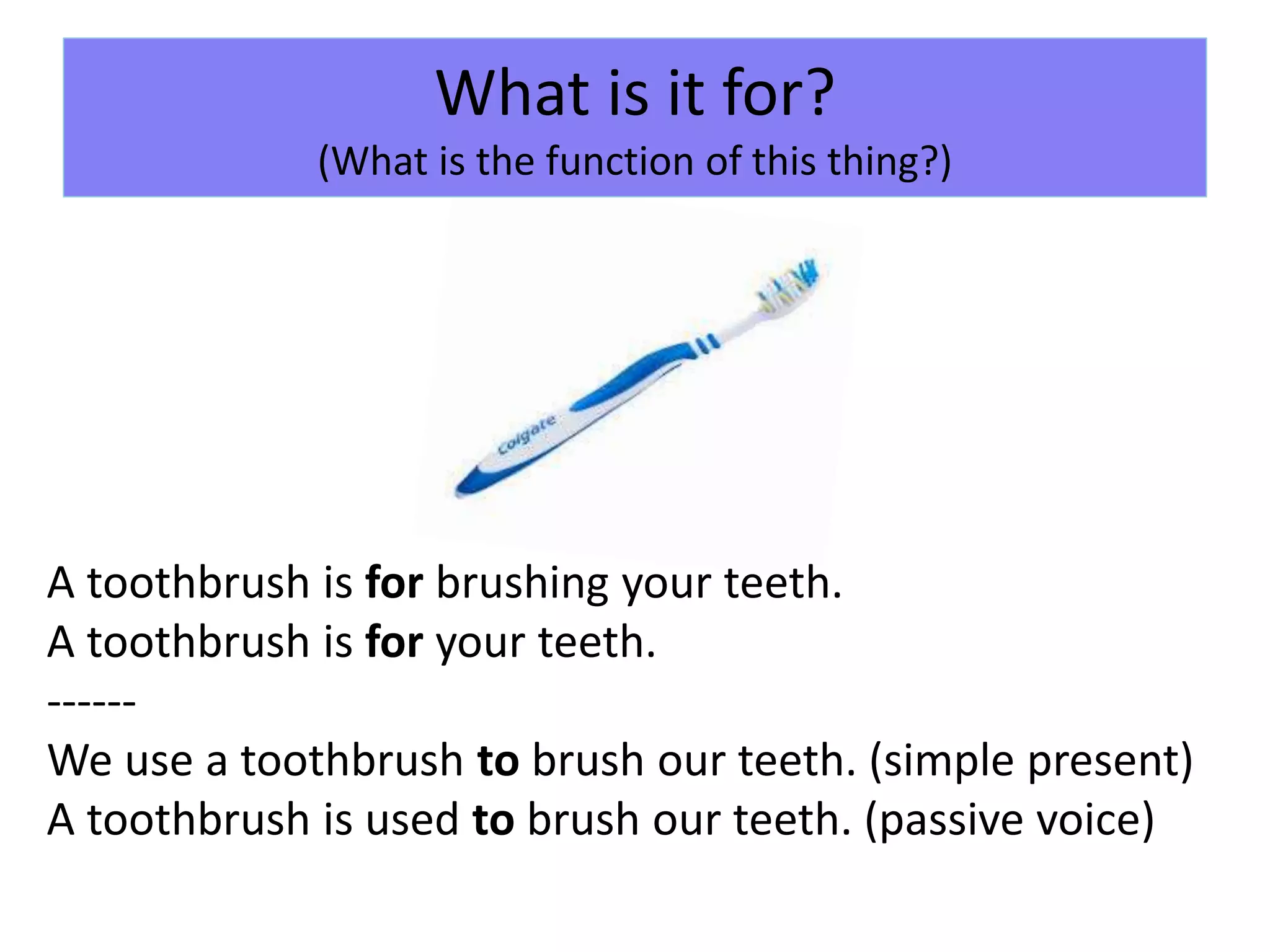
What is it for?
(What is the function of this thing?)
A toothbrush is for brushing your teeth.
A toothbrush is for your teeth.
------
We use a toothbrush to brush our teeth. (simple present)
A toothbrush is used to brush our teeth. (passive voice)
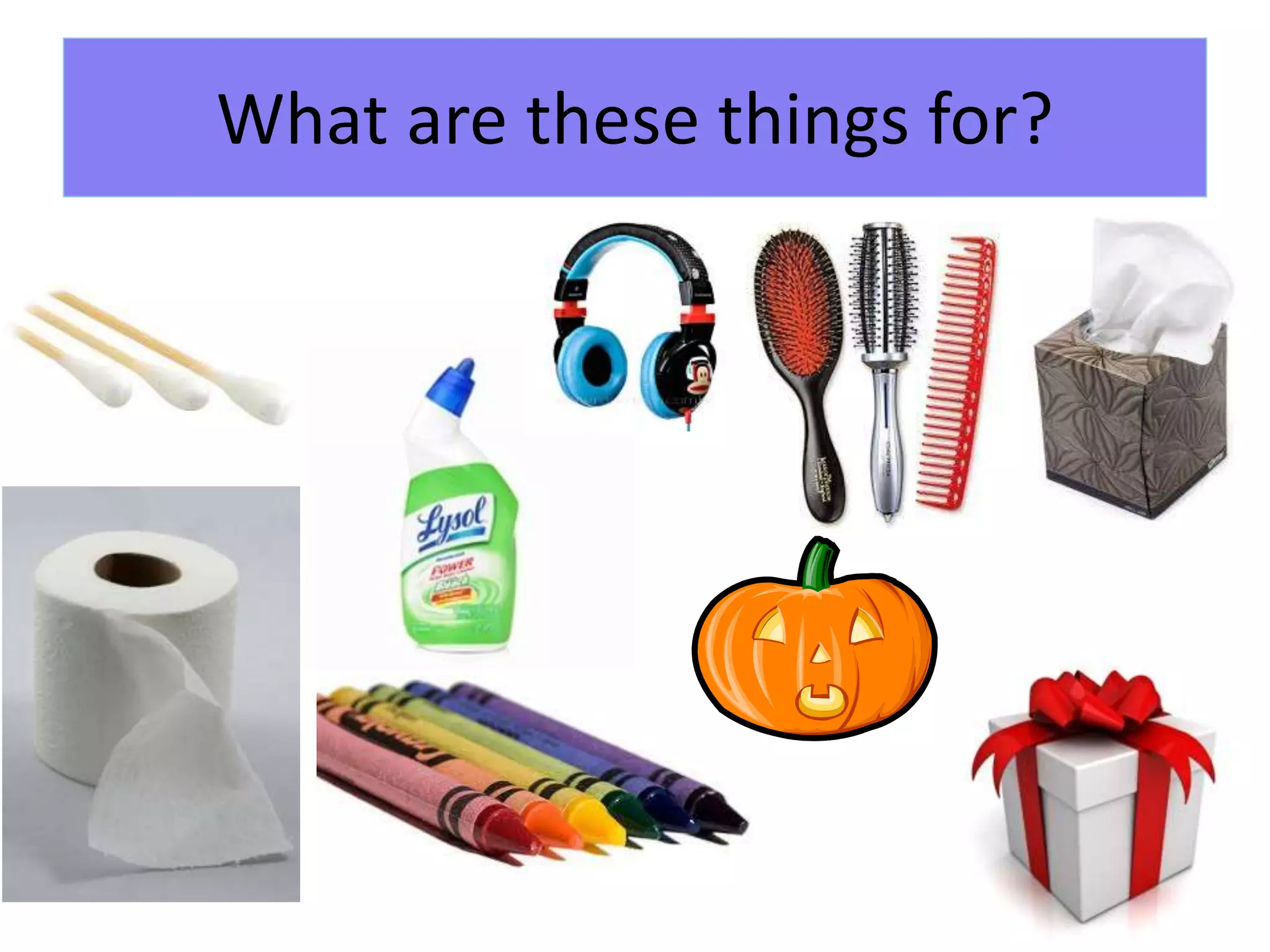
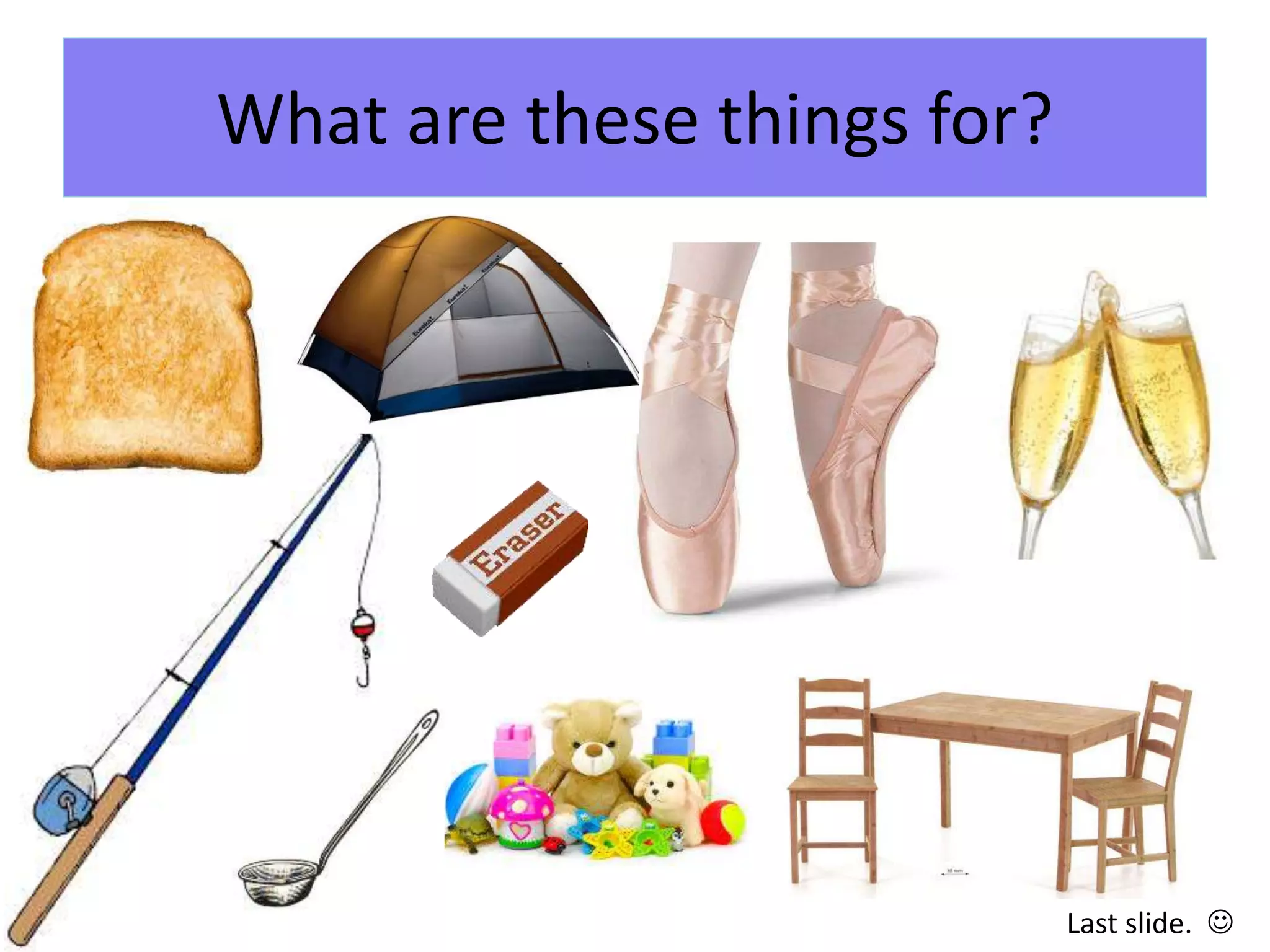
What are these things for?
Last slide. 

To vs for prepositions

  • 1.
    TO vs FOR Aquick review for ESL students Tara L. Lockhart Dartmouth, Canada
  • 2.
    TO or FOR? WHICH STATEMENT IS CORRECT? I’m studying for improving my English. OR I’m studying to improve my English.
  • 3.
    TO or FOR? Don’t say: I’m studying for improving my English. (* for is used to talk about purpose when it is followed by a noun, if it is followed by a gerund, it is talking about the function of a thing.) OR Do say: I’m studying to improve my English. (infinitive of purpose)
  • 4.
    Use TO inthese situations Destination > “We’re going to Paris.” What time it is > “It’s a quarter to 2.” Distance > “It’s about ten miles from my house to the university.” Comparing > “I prefer sleeping to working.” Giving > “I gave the book to my sister.” *Motive/Reason – with verb (infinitive) “I came here to see you.”
  • 5.
    Remember!! • to hastwo uses. 1. It can be a preposition. When to is used as a preposition it is followed by a noun which acts as its object. 2. It can also be an infinitive marker. When to is used as a infinitive marker, it should be followed by a verb.
  • 6.
    Use FOR inthese situations Benefits > “Yogurt is good for your digestion.” Period of time > “We’ve lived here for 2 years.” Schedule > “I made an appointment for May 3rd.” Agree with > “Are you for or against the development of nuclear weapons?” Doing something to help someone > “Could you carry these books for me?” *Motive/Reason – with noun “Let’s go out for a drink.” Function – with verb (-ing form) “I wear these glasses for reading.”
  • 7.
    Work with apartner – will you use TO or FOR? 1. Walking is good _____ our health. 2. We stand ______ peace. 3. The government should do something _____ the poor. 4. They go _____ the office /work at 9 am. 5. She is working hard ______ win the first rank. 6. He gave his laptop _______ his sister. 7. This money is ____ buying food, not beer. /… ___ food, not beer. 8. I will use this money ____ buy food, not beer. 9. I enjoy going ____ long walks in the evenings. 10. They leave _____ the office / work at 9 am.
  • 8.
    Work with apartner – will you use TO or FOR? 1. Walking is good for our health. 2. We stand for peace. 3. The government should do something for the poor. 4. They go to the office /work at 9 am. 5. She is working hard to win the first rank. 6. He gave his laptop to his sister. 7. This money is for buying food, not beer. /…for food, not beer. 8. I will use this money to buy food, not beer. 9. I enjoy going for long walks in the evenings. 10. They leave for the office / work at 9 am.
  • 9.
    Showing purpose usingto and for Both for and to can be used to talk about somebody's purpose in doing something, however, the structures are different. 1. We stopped at the pub for a drink. 2. We stopped at the pub to drink 3. I went to London for a conference. 4. I went to London to attend a conference 5. I’m studying English for university / my job. 6. I’m studying English to get into university / to improve my English / to get a job.
  • 10.
    Showing function usingto and for • For can be used before an -ing form to express the purpose / function of a thing. An altimeter is used for measuring height above sea level. OR An altimeter is used to measure height above sea level.
  • 11.
    Infinitive of Purpose(to + verb) When the clause has a person as the subject, we usually use an infinitive to express the purpose of a thing. • We use an altimeter to measure height above sea level. *Using “for” as in the previous slide is often used in spoken English, but both are correct. Next slide is a speaking activity.
  • 12.
    What is itfor? (What is the function of this thing?) A toothbrush is for brushing your teeth. A toothbrush is for your teeth. ------ We use a toothbrush to brush our teeth. (simple present) A toothbrush is used to brush our teeth. (passive voice)
  • 13.
    What are thesethings for?
  • 14.
    What are thesethings for? Last slide. 

Editor's Notes

  • #2 Source: http://www.espressoenglish.net/difference-between-to-and-for/
  • #14 They’re (used) for cleaning your ears. …for brushing /combing your hair. …for blowing your nose./…for wiping your face. /…for dabbing your eyes. / for the living room. The toilet paper is for the bathroom. / …for wiping your arse.  ha ha The Lysol is for cleaning the toilet. The Jack-o-Lantern is for Halloween. The present is for you. The crayons are for colouring. Etc, etc…
  • #15 For breakfast / eating. …for dancing/ballet ….for celebrating …for fishing / for catching fish / for kids / for playing with… / for the kitchen / for eating at… for mistakes / for erasing mistakes ….for camping / for sleeping ….for soup, etc