Countable and Uncountable
          Nouns
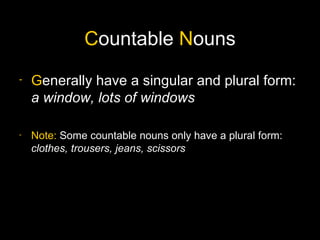
Countable Nouns
-   Generally have a singular and plural form:
    a window, lots of windows

-   Note: Some countable nouns only have a plural form:
    clothes, trousers, jeans, scissors
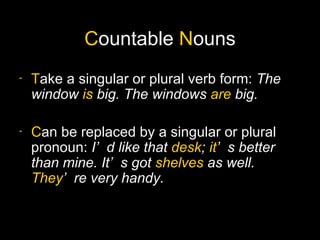
Countable Nouns
-   Take a singular or plural verb form: The
    window is big. The windows are big.

-   Can be replaced by a singular or plural
    pronoun: I’ d like that desk; it’ s better
    than mine. It’ s got shelves as well.
    They’ re very handy.
Countable Nouns
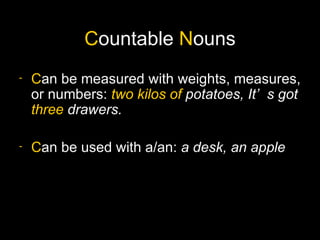
-   Can be measured with weights, measures,
    or numbers: two kilos of potatoes, It’ s got
    three drawers.

-   Can be used with a/an: a desk, an apple
Uncountable Nouns
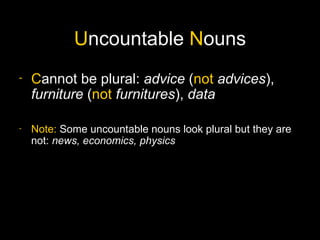
-   Cannot be plural: advice (not advices),
    furniture (not furnitures), data

-   Note: Some uncountable nouns look plural but they are
    not: news, economics, physics
Uncountable Nouns
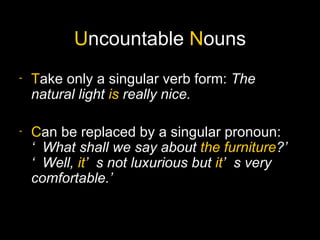
-   Take only a singular verb form: The
    natural light is really nice.

-   Can be replaced by a singular pronoun:
    ‘ What shall we say about the furniture?’
    ‘ Well, it’ s not luxurious but it’ s very
    comfortable.’
Uncountable Nouns
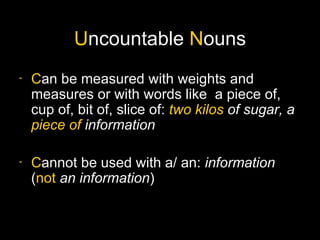
-   Can be measured with weights and
    measures or with words like a piece of,
    cup of, bit of, slice of: two kilos of sugar, a
    piece of information

-   Cannot be used with a/ an: information
    (not an information)
Some
Some
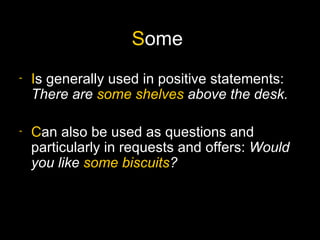
-   Is generally used in positive statements:
    There are some shelves above the desk.

-   Can also be used as questions and
    particularly in requests and offers: Would
    you like some biscuits?
Some
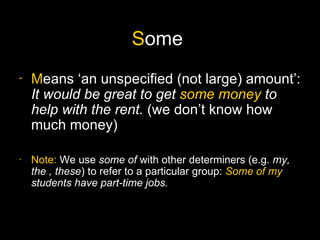
-   Means ‘an unspecified (not large) amount’:
    It would be great to get some money to
    help with the rent. (we don’t know how
    much money)

-   Note: We use some of with other determiners (e.g. my,
    the , these) to refer to a particular group: Some of my
    students have part-time jobs.
Any
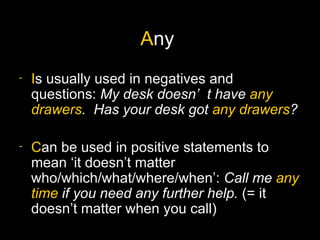
-   Is usually used in negatives and
    questions: My desk doesn’ t have any
    drawers. Has your desk got any drawers?

-   Can be used in positive statements to
    mean ‘it doesn’t matter
    who/which/what/where/when’: Call me any
    time if you need any further help. (= it
    doesn’t matter when you call)
Any
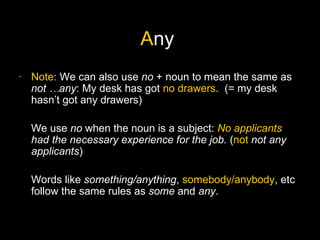
-   Note: We can also use no + noun to mean the same as
    not …any: My desk has got no drawers. (= my desk
    hasn’t got any drawers)

    We use no when the noun is a subject: No applicants
    had the necessary experience for the job. (not not any
    applicants)

    Words like something/anything, somebody/anybody, etc
    follow the same rules as some and any.
Quantities
Quantities
We can use the words in the following table
 to say how may or how much:
Quantities
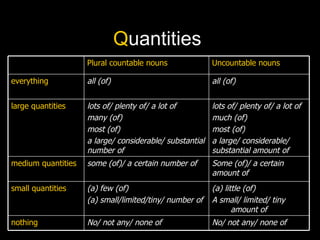
                    Plural countable nouns               Uncountable nouns

everything          all (of)                             all (of)


large quantities    lots of/ plenty of/ a lot of         lots of/ plenty of/ a lot of
                    many (of)                            much (of)
                    most (of)                            most (of)
                    a large/ considerable/ substantial   a large/ considerable/
                    number of                            substantial amount of
medium quantities   some (of)/ a certain number of       Some (of)/ a certain
                                                         amount of
small quantities    (a) few (of)                         (a) little (of)
                    (a) small/limited/tiny/ number of    A small/ limited/ tiny
                                                                amount of
nothing             No/ not any/ none of                 No/ not any/ none of
Quantities
-   A few and a little are different from few
    and little. Compare: Few rooms have such
    good natural light. (= not many, so you are
    lucky)

    We have a few rooms available with a sea
    view. (= a small number)
Quantities
-   Little research has been done in this area.
    (= not enough)
    A little research has already been carried
    out in this area. (= a small amount)

-   Note: We use a few of with other determiners (e.g. my,
    the, these) to refer to a particular group: A few of the
    rooms have a sea view.
Quantities
-   Lots of / a lot of are less formal than
    much / many:
    There are lots of advertisements for
    accommodation in the paper.
    Many scientists believe that global
    warming is having a negative impact on
    our climate.
Quantities
-   Note: We do not usually use lots of with negative
    statements:
    We don’ t have a lot/ much time so we’ ll have to be
    quick. (not we don’ t have lots of time)

-   Note: We do not usually use much in positive sentences:
    I found a lot of information on the internet. (not much
    information)
Questions?

For more slide presentations visit:
This presentation was based on:
       Grammar for EILTS
               by
Diana Hopkins with Pauline Cullen

Countable and Uncountable Nouns

  • 1.
  • 2.
    Countable Nouns - Generally have a singular and plural form: a window, lots of windows - Note: Some countable nouns only have a plural form: clothes, trousers, jeans, scissors
  • 3.
    Countable Nouns - Take a singular or plural verb form: The window is big. The windows are big. - Can be replaced by a singular or plural pronoun: I’ d like that desk; it’ s better than mine. It’ s got shelves as well. They’ re very handy.
  • 4.
    Countable Nouns - Can be measured with weights, measures, or numbers: two kilos of potatoes, It’ s got three drawers. - Can be used with a/an: a desk, an apple
  • 5.
    Uncountable Nouns - Cannot be plural: advice (not advices), furniture (not furnitures), data - Note: Some uncountable nouns look plural but they are not: news, economics, physics
  • 6.
    Uncountable Nouns - Take only a singular verb form: The natural light is really nice. - Can be replaced by a singular pronoun: ‘ What shall we say about the furniture?’ ‘ Well, it’ s not luxurious but it’ s very comfortable.’
  • 7.
    Uncountable Nouns - Can be measured with weights and measures or with words like a piece of, cup of, bit of, slice of: two kilos of sugar, a piece of information - Cannot be used with a/ an: information (not an information)
  • 8.
  • 9.
    Some - Is generally used in positive statements: There are some shelves above the desk. - Can also be used as questions and particularly in requests and offers: Would you like some biscuits?
  • 10.
    Some - Means ‘an unspecified (not large) amount’: It would be great to get some money to help with the rent. (we don’t know how much money) - Note: We use some of with other determiners (e.g. my, the , these) to refer to a particular group: Some of my students have part-time jobs.
  • 11.
    Any - Is usually used in negatives and questions: My desk doesn’ t have any drawers. Has your desk got any drawers? - Can be used in positive statements to mean ‘it doesn’t matter who/which/what/where/when’: Call me any time if you need any further help. (= it doesn’t matter when you call)
  • 12.
    Any - Note: We can also use no + noun to mean the same as not …any: My desk has got no drawers. (= my desk hasn’t got any drawers) We use no when the noun is a subject: No applicants had the necessary experience for the job. (not not any applicants) Words like something/anything, somebody/anybody, etc follow the same rules as some and any.
  • 13.
  • 14.
    Quantities We can usethe words in the following table to say how may or how much:
  • 15.
    Quantities Plural countable nouns Uncountable nouns everything all (of) all (of) large quantities lots of/ plenty of/ a lot of lots of/ plenty of/ a lot of many (of) much (of) most (of) most (of) a large/ considerable/ substantial a large/ considerable/ number of substantial amount of medium quantities some (of)/ a certain number of Some (of)/ a certain amount of small quantities (a) few (of) (a) little (of) (a) small/limited/tiny/ number of A small/ limited/ tiny amount of nothing No/ not any/ none of No/ not any/ none of
  • 16.
    Quantities - A few and a little are different from few and little. Compare: Few rooms have such good natural light. (= not many, so you are lucky) We have a few rooms available with a sea view. (= a small number)
  • 17.
    Quantities - Little research has been done in this area. (= not enough) A little research has already been carried out in this area. (= a small amount) - Note: We use a few of with other determiners (e.g. my, the, these) to refer to a particular group: A few of the rooms have a sea view.
  • 18.
    Quantities - Lots of / a lot of are less formal than much / many: There are lots of advertisements for accommodation in the paper. Many scientists believe that global warming is having a negative impact on our climate.
  • 19.
    Quantities - Note: We do not usually use lots of with negative statements: We don’ t have a lot/ much time so we’ ll have to be quick. (not we don’ t have lots of time) - Note: We do not usually use much in positive sentences: I found a lot of information on the internet. (not much information)
  • 20.
    Questions? For more slidepresentations visit:
  • 21.
    This presentation wasbased on: Grammar for EILTS by Diana Hopkins with Pauline Cullen