 ALL students will be able to :
 Explain what a countable and uncountable noun is. ( L3c)
 Be able to identify countable and
uncountable nouns
 Understand and apply the spelling rules
with 100%
A noun is…………..
A person
A Place
A ‘thing’
Some nouns are countable and some
nouns are uncountable.
 Nouns which we can count.
 Singular and Plural forms.
Examples:
1. She doesn’t eat an apple every day.
2. She eats three apples every day.
 If there is only one (singular noun) we use a or
an in front of it.
e.g. a lemon, an apple
 If there is more than one ( plural noun) we
usually add –s, - es, -ies to the noun.
e.g. apples, lemons
One book
Two books
Three books
One pen
Two pens
Three pens
A tomato
An onion
 Nouns which we can’t count.
 They don’t have plural forms.
Examples:
1. orange juice makes salads tastier.
2. Happiness is important to people.
 They are always in the singular form so we never
use a or an with them.
 However, we can use quantity words with them.
 e.g. a bag of, a cup of….
Sugar
Water
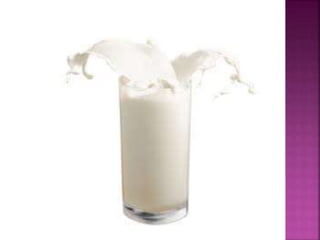
Milk
Liquid: milk, water, juice, soup
Gas: Oxygen, hydrogen
Powder and Grain: Rice, wheat, sand, flour, sugar, coffee
Abstract Ideas: advice, motivation, friendship
Mass nouns: furniture, hair, transportation
Natural phenomena: sunshine, snow, rain, weather
States of being: sleep, stress, childhood
Feelings: anger, sadness, happiness, enthusiasm
Form of Bar: chocolate, soap, cheese, bread
Materials: gold, bronze, silver
PRACTICE:
Put the nouns in the right column:
Egg, cheese, girl, pencil, butter, jacket, oil,
Salt, juice, school, meat, cat
COUNTABLE UNCOUNTABLE
https://es.liveworksheets.com/gn1372695ke
Remember:
We generally use
SOME in affirmative
sentences.
are used
to state the quantity,
amount of something.
QUANTIFIERS
SOME: algunos, algunas, algún, alguna
Algo de
ANY: ningún, ninguna, ningun@s, nada
de, algunos, algunas, algún, alguna
Algo de
QUANTIFIERS
Some: affirmative sentences
Uncountable noun: some/ singular
• there is some water in the glass
• I have some meat in the fridge
Countable/plural
There are some apples on the table
I have some homeworks
Affirmative sentences
A: I have a dog
An: I have an orange
ANY: Negative and Interrogative
sentences
• I don’t have any sugar
• Is there any meat ?
SOME AND ANY
ARE USED WHEN
1.The exact number is not known;
2.The exact number is not important.
SOME
IS USED IN POSITIVE SENTENCES .
There are some apples on the table .
/ countable /
There is some water in the glass.
/ uncountable /
There is some rice
and
Some milk.
ANY
IS USED IN QUESTIONS AND NEGATIVE
SENTENCES .
Are there any apples in the basket ?
Is there any milk in the fridge ?
There aren’t any apples in the basket.
There isn’t any milk in the fridge.
We use ANY in negative
and interrogative
sentences - for
countable nouns in
plural and for
uncountable nouns.
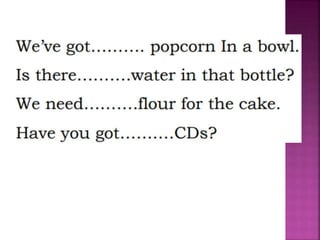
1.There is not ________sugar in the coffee.
2.There are ___________ stars in the sky.
3.There aren’t ________ roses on the table.
4.Father says, ‘Please give me ________ oil.’
5.Is there ________ orange juice?
6.There is ________ paper on the desk.
• There isn’t ______ water in the bottle.
• I can’t find _______books about
dinosaurs.
• Are there ______oranges in the fridge?
• There are _______ pictures on the wall.
Complete with A – AN- SOME - ANY
1, There are_______ potatoes in the fridge.
2.- There aren´t _______ yogurth on the table.
3.- I don´t have ______ money.
4.- Susan needs______ sugar to prepare the cake.
5.- Do you want ______ cake?
6.- Peter and Karla don´t have ______ cheese to their
hamburger
7.- We don´t have _______ money to buy a present to our
mother
8.- There are _______ oranges and bananas in the fridge. Do
you want ?
9.- Do you need______lettuce to the sandwich? Thanks, but I
don´t like.
10. Is there _____milk? No there isn`t
COMPLETE a, an, some, any en los espacios en blanco.
1. I need __________ volunteer to sweep the kitchen.
2. Let's buy __________ grapes for the party.
3. There aren't __________ strawberries.
4. It was __________ easy exam. Everybody passed it.
5. There is __________ lady at the door who asks for you.
6. We don't have __________ coke.
7. "Are there __________ trees?"
"No, there aren't __________ (trees). It's a desert place."
8. I have lost __________ crayons I bought yesterday.
9. There isn't __________ apple juice left. Let's buy
__________ (apple juice).
Do we need any
chocolate?
No, we don’t need
any.
SOME or
ANY ?
 I have SOME apples but I don’t have ANY
bananas.
 Mary didn’t buy any flowers.
 Don’t buy any pasta, we have got some in the
cupboard.
 I can see a house and some trees.
https://es.liveworksheets.com/ki1675732jh
Practice a an some any
https://es.liveworksheets.com/sa2178534gr
}excelente
Much, Many and (A) lot
of ( a lot)
To talk about
countable and
uncountable names we
can use MANY, MUCH
and a lot of to express
big quantities.
1. Use MANY for
countable nouns.
2. Use MUCH for
uncountable nouns.
Much Many
We use much for uncountable nouns.
How much money have you got?
I haven’t got much time.
There’s too much noise in here!
We use many for countable plural
nouns.
How many pencils have you got?
There aren’t many cinemas in London.
There were too many people on the
bus.
In negative and
interrogative sentences
we usually use MUCH and
MANY.
Many
 Countable nouns
 Negative sentences
 Questions
 Are there many restaurants in your town?
Much
 Uncountable nouns
 Negative sentences
 Questions
 There isn’t much salt on these chips.
We use “a lot (of)” with C
and U nouns for a big
quantity.
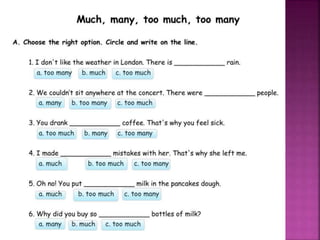
 To talk about a quantity which is bigger than
we want or need
 Too much= uncountable nouns
 Too many= plural countable nouns
 There is too much cheese on my burger.
 I think too many children eat fast food.
A lot/ lots of
We use a lot and lots of with countable plural nouns
and uncountable nouns. We can use them in
positives
Examples: -
There were a lot/ lots of people at the party.
 Used with countable AND uncountable nouns.
 There are a lot of/ lots of restaurants here.
Check it out!
In afffirmative sentences
we usually use A LOT.
In questions :
How much/How many?
1. How many potatoes do you
need for the fries?
2. How much coffee do you
drink in the morning?
If we want to ask about the quantity of a countable noun
we use the phrase, how many?
e.g. How many apples do you want?
If we want to ASK about quantity we use the
phrase how much
e.g. How much sugar do you want in your tea?
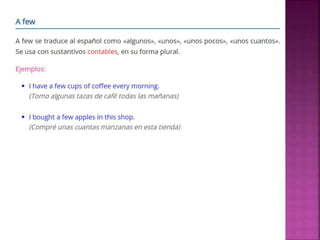
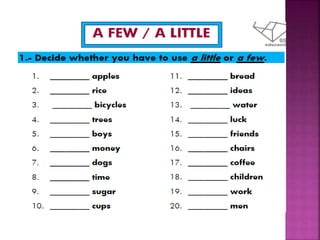
A few
 Countable nouns
 Positive sentences
 I would like a few potatoes please.
A little
 Uncountable
 Positive sentences
 I would like a few potatoes with a little
cheese, please.
We use “a little” or “not
much” with U nouns for
a small quantity. .
We use “a few” or “not
many” with C nouns for a
small quantity. .
 To talk about a quantity which is smaller
than we want or need.
 Uncountable nouns
 Plural countable nouns
 Some people don’t eat enough fruit.

countable-and-uncountable-noun FINAL.pptx

  • 2.
     ALL studentswill be able to :  Explain what a countable and uncountable noun is. ( L3c)  Be able to identify countable and uncountable nouns  Understand and apply the spelling rules with 100%
  • 3.
    A noun is………….. Aperson A Place A ‘thing’
  • 4.
    Some nouns arecountable and some nouns are uncountable.
  • 5.
     Nouns whichwe can count.  Singular and Plural forms. Examples: 1. She doesn’t eat an apple every day. 2. She eats three apples every day.  If there is only one (singular noun) we use a or an in front of it. e.g. a lemon, an apple  If there is more than one ( plural noun) we usually add –s, - es, -ies to the noun. e.g. apples, lemons
  • 6.
  • 7.
  • 8.
  • 9.
     Nouns whichwe can’t count.  They don’t have plural forms. Examples: 1. orange juice makes salads tastier. 2. Happiness is important to people.  They are always in the singular form so we never use a or an with them.  However, we can use quantity words with them.  e.g. a bag of, a cup of….
  • 10.
  • 11.
    Liquid: milk, water,juice, soup Gas: Oxygen, hydrogen Powder and Grain: Rice, wheat, sand, flour, sugar, coffee Abstract Ideas: advice, motivation, friendship Mass nouns: furniture, hair, transportation Natural phenomena: sunshine, snow, rain, weather States of being: sleep, stress, childhood Feelings: anger, sadness, happiness, enthusiasm Form of Bar: chocolate, soap, cheese, bread Materials: gold, bronze, silver
  • 13.
    PRACTICE: Put the nounsin the right column: Egg, cheese, girl, pencil, butter, jacket, oil, Salt, juice, school, meat, cat COUNTABLE UNCOUNTABLE
  • 16.
  • 27.
    Remember: We generally use SOMEin affirmative sentences.
  • 28.
    are used to statethe quantity, amount of something.
  • 29.
    QUANTIFIERS SOME: algunos, algunas,algún, alguna Algo de ANY: ningún, ninguna, ningun@s, nada de, algunos, algunas, algún, alguna Algo de
  • 30.
  • 31.
    Some: affirmative sentences Uncountablenoun: some/ singular • there is some water in the glass • I have some meat in the fridge Countable/plural There are some apples on the table I have some homeworks
  • 32.
    Affirmative sentences A: Ihave a dog An: I have an orange ANY: Negative and Interrogative sentences • I don’t have any sugar • Is there any meat ?
  • 33.
    SOME AND ANY AREUSED WHEN 1.The exact number is not known; 2.The exact number is not important.
  • 38.
    SOME IS USED INPOSITIVE SENTENCES . There are some apples on the table . / countable / There is some water in the glass. / uncountable /
  • 39.
    There is somerice and Some milk.
  • 40.
    ANY IS USED INQUESTIONS AND NEGATIVE SENTENCES . Are there any apples in the basket ? Is there any milk in the fridge ? There aren’t any apples in the basket. There isn’t any milk in the fridge.
  • 41.
    We use ANYin negative and interrogative sentences - for countable nouns in plural and for uncountable nouns.
  • 44.
    1.There is not________sugar in the coffee. 2.There are ___________ stars in the sky. 3.There aren’t ________ roses on the table. 4.Father says, ‘Please give me ________ oil.’ 5.Is there ________ orange juice? 6.There is ________ paper on the desk.
  • 45.
    • There isn’t______ water in the bottle. • I can’t find _______books about dinosaurs. • Are there ______oranges in the fridge? • There are _______ pictures on the wall.
  • 46.
    Complete with A– AN- SOME - ANY 1, There are_______ potatoes in the fridge. 2.- There aren´t _______ yogurth on the table. 3.- I don´t have ______ money. 4.- Susan needs______ sugar to prepare the cake. 5.- Do you want ______ cake? 6.- Peter and Karla don´t have ______ cheese to their hamburger 7.- We don´t have _______ money to buy a present to our mother 8.- There are _______ oranges and bananas in the fridge. Do you want ? 9.- Do you need______lettuce to the sandwich? Thanks, but I don´t like. 10. Is there _____milk? No there isn`t
  • 47.
    COMPLETE a, an,some, any en los espacios en blanco. 1. I need __________ volunteer to sweep the kitchen. 2. Let's buy __________ grapes for the party. 3. There aren't __________ strawberries. 4. It was __________ easy exam. Everybody passed it. 5. There is __________ lady at the door who asks for you. 6. We don't have __________ coke. 7. "Are there __________ trees?" "No, there aren't __________ (trees). It's a desert place." 8. I have lost __________ crayons I bought yesterday. 9. There isn't __________ apple juice left. Let's buy __________ (apple juice).
  • 48.
    Do we needany chocolate? No, we don’t need any.
  • 49.
    SOME or ANY ? I have SOME apples but I don’t have ANY bananas.  Mary didn’t buy any flowers.  Don’t buy any pasta, we have got some in the cupboard.  I can see a house and some trees.
  • 50.
    https://es.liveworksheets.com/ki1675732jh Practice a ansome any https://es.liveworksheets.com/sa2178534gr }excelente
  • 57.
    Much, Many and(A) lot of ( a lot)
  • 58.
    To talk about countableand uncountable names we can use MANY, MUCH and a lot of to express big quantities.
  • 59.
    1. Use MANYfor countable nouns. 2. Use MUCH for uncountable nouns.
  • 60.
    Much Many We usemuch for uncountable nouns. How much money have you got? I haven’t got much time. There’s too much noise in here! We use many for countable plural nouns. How many pencils have you got? There aren’t many cinemas in London. There were too many people on the bus.
  • 61.
    In negative and interrogativesentences we usually use MUCH and MANY.
  • 62.
    Many  Countable nouns Negative sentences  Questions  Are there many restaurants in your town? Much  Uncountable nouns  Negative sentences  Questions  There isn’t much salt on these chips.
  • 63.
    We use “alot (of)” with C and U nouns for a big quantity.
  • 66.
     To talkabout a quantity which is bigger than we want or need  Too much= uncountable nouns  Too many= plural countable nouns  There is too much cheese on my burger.  I think too many children eat fast food.
  • 69.
    A lot/ lotsof We use a lot and lots of with countable plural nouns and uncountable nouns. We can use them in positives Examples: - There were a lot/ lots of people at the party.  Used with countable AND uncountable nouns.  There are a lot of/ lots of restaurants here.
  • 71.
    Check it out! Inafffirmative sentences we usually use A LOT.
  • 72.
    In questions : Howmuch/How many? 1. How many potatoes do you need for the fries? 2. How much coffee do you drink in the morning?
  • 73.
    If we wantto ask about the quantity of a countable noun we use the phrase, how many? e.g. How many apples do you want?
  • 75.
    If we wantto ASK about quantity we use the phrase how much e.g. How much sugar do you want in your tea?
  • 77.
    A few  Countablenouns  Positive sentences  I would like a few potatoes please. A little  Uncountable  Positive sentences  I would like a few potatoes with a little cheese, please.
  • 78.
    We use “alittle” or “not much” with U nouns for a small quantity. .
  • 79.
    We use “afew” or “not many” with C nouns for a small quantity. .
  • 81.
     To talkabout a quantity which is smaller than we want or need.  Uncountable nouns  Plural countable nouns  Some people don’t eat enough fruit.

Editor's Notes