Holt Handbook  Chapter 5 The Phrase: Prepositional, Verbal, and Appositive Phrases
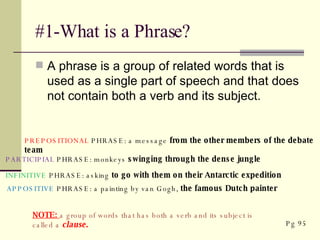
#1-What is a Phrase? A phrase is a group of related words that is used as a single part of speech and that does not contain both a verb and its subject. PREPOSITIONAL  PHRASE: a message  from the other members of the debate team PARTICIPIAL  PHRASE: monkeys  swinging through the dense jungle INFINITIVE  PHRASE: asking  to go with them on their Antarctic expedition APPOSITIVE  PHRASE: a painting by van Gogh,  the famous Dutch painter NOTE:  a group of words that has both a verb and its subject is called a  clause . Pg 95
#2-The Prepositional Phrase A prepositional phrase includes a preposition, a noun or pronoun called  the object of the preposition,  and any modifiers of that object.  EXAMPLES: The Seine River flows  through Paris.  [The noun Paris is the object of the preposition through.]   EXAMPLES: The car  in front of us  slid  into an icy snow bank.  [The pronoun  us  is the object of the compound preposition  in front of.  The noun  snow bank  is the object of the preposition  into .]
NOTE: Be careful not to confuse a prepositional phrase with an infinitive. A prepositional phrase always has an object that is a noun or a pronoun. An infinitive is a verb form that usually begins with  to .  PREPOSITIONAL PHRASE: When we went  to Florida , we saw the old Spanish fort in St. Augustine.  INFINITIVE: When we were in Florida, we went  to see  the old Spanish fort in St. Augustine.  Pg 96
#3-The Adjective Phrase A prepositional phrase that modifies a noun or a pronoun is called an  adjective phrase. EXAMPLES: Wang Wei was a talented painter  of landscapes .  [the prepositional phrase  of landscapes  modifies the noun  painter,  telling what kind of painter.]  EXAMPLES: Mrs. O’Meara is the one  on the left .  [the prepositional phrase  on the left  modifies the pronoun  one,  telling which one Mrs. O’Meara is.]  Pg. 97
#4-The Adverb Phrase A prepositional phrase that modifies a verb, an adjective, or an adverb is called an  adverb phrase. EXAMPLES: the snow fell  throughout the day  .  [the phrase   modifies the verb  fell,  telling  when  the snow fell.]  An adverb phrase tells  how, when, where, why , or  to what extent ( how long, how much, or how far ). EXAMPLES: Are you good  at soccer?   [the phrase   modifies the adjective  good,  telling  how  you are good.]  Pg 99
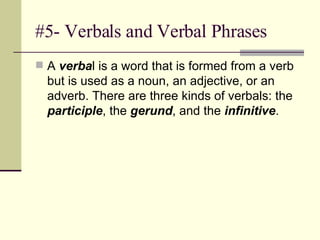
#5- Verbals and Verbal Phrases A  verba l is a word that is formed from a verb but is used as a noun, an adjective, or an adverb. There are three kinds of verbals: the  participle , the  gerund , and the  infinitive .
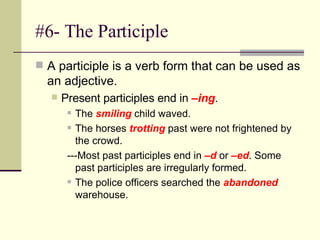
#6- The Participle A participle is a verb form that can be used as an adjective.  Present participles end in  –ing . The  smiling  child waved. The horses  trotting  past were not frightened by the crowd.  ---Most past participles end in  –d  or  –ed . Some past participles are irregularly formed.  The police officers searched the  abandoned  warehouse.
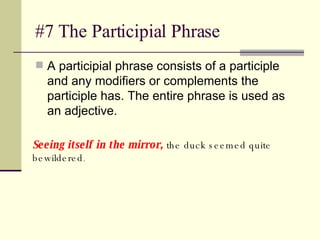
#7 The Participial Phrase A participial phrase consists of a participle and any modifiers or complements the participle has. The entire phrase is used as an adjective. Seeing itself in the mirror,  the duck seemed quite bewildered .
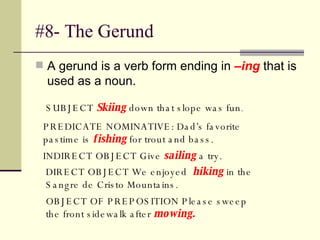
#8- The Gerund A gerund is a verb form ending in  –ing  that is used as a noun.  SUBJECT  Skiing  down that slope was fun .  PREDICATE NOMINATIVE: Dad’s favorite pastime is  fishing  for trout and bass.  INDIRECT OBJECT Give  sailing  a try.  DIRECT OBJECT We enjoyed  hiking  in the Sangre de Cristo Mountains.  OBJECT OF PREPOSITION Please sweep the front sidewalk after  mowing.
The Gerund Phrase A gerund phrase consists of a gerund and any modifiers or complements the gerund has. The entire phrase is used as a noun.  Having a part-time job  may interfere with your schoolwork.  The townspeople heard  the loud clanging of the fire bell.  NOTE: When a noun or a pronoun comes immediately before a gerund, use the possessive form of the noun or pronoun.
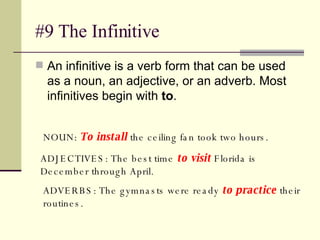
#9 The Infinitive An infinitive is a verb form that can be used as a noun, an adjective, or an adverb. Most infinitives begin with  to .  NOUN:  To install  the ceiling fan took two hours.  ADJECTIVES: The best time  to visit  Florida is December through April.  ADVERBS: The gymnasts were ready  to practice  their routines.
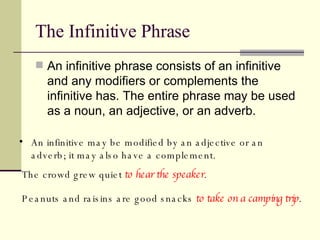
The Infinitive Phrase An infinitive phrase consists of an infinitive and any modifiers or complements the infinitive has. The entire phrase may be used as a noun, an adjective, or an adverb.  An infinitive may be modified by an adjective or an adverb; it may also have a complement. The crowd grew quiet  to hear the speaker . Peanuts and raisins are good snacks  to take on a camping trip .
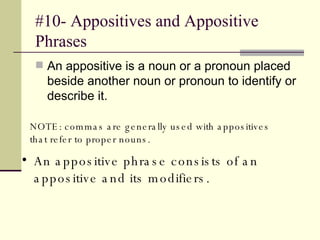
#10- Appositives and Appositive Phrases An appositive is a noun or a pronoun placed beside another noun or pronoun to identify or describe it.  NOTE: commas are generally used with appositives that refer to proper nouns.  An appositive phrase consists of an appositive and its modifiers.

Chapter 5

  • 1.
    Holt Handbook Chapter 5 The Phrase: Prepositional, Verbal, and Appositive Phrases
  • 2.
    #1-What is aPhrase? A phrase is a group of related words that is used as a single part of speech and that does not contain both a verb and its subject. PREPOSITIONAL PHRASE: a message from the other members of the debate team PARTICIPIAL PHRASE: monkeys swinging through the dense jungle INFINITIVE PHRASE: asking to go with them on their Antarctic expedition APPOSITIVE PHRASE: a painting by van Gogh, the famous Dutch painter NOTE: a group of words that has both a verb and its subject is called a clause . Pg 95
  • 3.
    #2-The Prepositional PhraseA prepositional phrase includes a preposition, a noun or pronoun called the object of the preposition, and any modifiers of that object. EXAMPLES: The Seine River flows through Paris. [The noun Paris is the object of the preposition through.] EXAMPLES: The car in front of us slid into an icy snow bank. [The pronoun us is the object of the compound preposition in front of. The noun snow bank is the object of the preposition into .]
  • 4.
    NOTE: Be carefulnot to confuse a prepositional phrase with an infinitive. A prepositional phrase always has an object that is a noun or a pronoun. An infinitive is a verb form that usually begins with to . PREPOSITIONAL PHRASE: When we went to Florida , we saw the old Spanish fort in St. Augustine. INFINITIVE: When we were in Florida, we went to see the old Spanish fort in St. Augustine. Pg 96
  • 5.
    #3-The Adjective PhraseA prepositional phrase that modifies a noun or a pronoun is called an adjective phrase. EXAMPLES: Wang Wei was a talented painter of landscapes . [the prepositional phrase of landscapes modifies the noun painter, telling what kind of painter.] EXAMPLES: Mrs. O’Meara is the one on the left . [the prepositional phrase on the left modifies the pronoun one, telling which one Mrs. O’Meara is.] Pg. 97
  • 6.
    #4-The Adverb PhraseA prepositional phrase that modifies a verb, an adjective, or an adverb is called an adverb phrase. EXAMPLES: the snow fell throughout the day . [the phrase modifies the verb fell, telling when the snow fell.] An adverb phrase tells how, when, where, why , or to what extent ( how long, how much, or how far ). EXAMPLES: Are you good at soccer? [the phrase modifies the adjective good, telling how you are good.] Pg 99
  • 7.
    #5- Verbals andVerbal Phrases A verba l is a word that is formed from a verb but is used as a noun, an adjective, or an adverb. There are three kinds of verbals: the participle , the gerund , and the infinitive .
  • 8.
    #6- The ParticipleA participle is a verb form that can be used as an adjective. Present participles end in –ing . The smiling child waved. The horses trotting past were not frightened by the crowd. ---Most past participles end in –d or –ed . Some past participles are irregularly formed. The police officers searched the abandoned warehouse.
  • 9.
    #7 The ParticipialPhrase A participial phrase consists of a participle and any modifiers or complements the participle has. The entire phrase is used as an adjective. Seeing itself in the mirror, the duck seemed quite bewildered .
  • 10.
    #8- The GerundA gerund is a verb form ending in –ing that is used as a noun. SUBJECT Skiing down that slope was fun . PREDICATE NOMINATIVE: Dad’s favorite pastime is fishing for trout and bass. INDIRECT OBJECT Give sailing a try. DIRECT OBJECT We enjoyed hiking in the Sangre de Cristo Mountains. OBJECT OF PREPOSITION Please sweep the front sidewalk after mowing.
  • 11.
    The Gerund PhraseA gerund phrase consists of a gerund and any modifiers or complements the gerund has. The entire phrase is used as a noun. Having a part-time job may interfere with your schoolwork. The townspeople heard the loud clanging of the fire bell. NOTE: When a noun or a pronoun comes immediately before a gerund, use the possessive form of the noun or pronoun.
  • 12.
    #9 The InfinitiveAn infinitive is a verb form that can be used as a noun, an adjective, or an adverb. Most infinitives begin with to . NOUN: To install the ceiling fan took two hours. ADJECTIVES: The best time to visit Florida is December through April. ADVERBS: The gymnasts were ready to practice their routines.
  • 13.
    The Infinitive PhraseAn infinitive phrase consists of an infinitive and any modifiers or complements the infinitive has. The entire phrase may be used as a noun, an adjective, or an adverb. An infinitive may be modified by an adjective or an adverb; it may also have a complement. The crowd grew quiet to hear the speaker . Peanuts and raisins are good snacks to take on a camping trip .
  • 14.
    #10- Appositives andAppositive Phrases An appositive is a noun or a pronoun placed beside another noun or pronoun to identify or describe it. NOTE: commas are generally used with appositives that refer to proper nouns. An appositive phrase consists of an appositive and its modifiers.