Unit 6
Health & Medicine
by Dulce Rosales
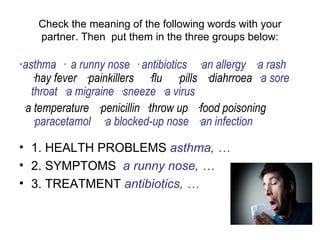
Check the meaning of the following words with your
    partner. Then put them in the three groups below:

·asthma · a runny nose · antibiotics ·an allergy ·a rash
   ·hay fever ·painkillers ·flu ·pills ·diahrroea ·a sore
   throat ·a migraine ·sneeze ·a virus
 ·a temperature ·penicillin ·throw up ·food poisoning
   ·paracetamol ·a blocked-up nose ·an infection

• 1. HEALTH PROBLEMS asthma, …
• 2. SYMPTOMS a runny nose, …
• 3. TREATMENT antibiotics, …
Look at some typical doctor’s statements and
questions and complete them with the words given

1. What seems to be the problem?
                           problem
2. How long have you been ___like this?
3. Are you ___ to anything?        4. What have you ____recently?
5. Come ____ if you are not feeling better in a few days.
6. Have you been ___ anything for that?
7. Have you got any other ____? 8. Right, let me have a look at you.
9. I am just going to take your_____.
10. Here is a _______ for some painkilers.


• problem prescription back feeling taking
  temperature symptoms allergic eaten look
Here are some typical patient’s expressions.
               Match them (1-10 to a-j)

•   1 I am not feeling      •   A   feeling very well recently
•   2 I haven’t been        •   B   getting really bad headaches
•   3 I’ve got              •   C   very well
•   4 My chest              •   D   a terrible stomach ache
•   5 I keep                •   E    hurts
•   6 I can’t stop          •   F   to penicillin
•   7 Do I need             •   G    sneezing
•   8 I’m allergic          •   H   should I take them?
•   9 How often             •   I   make another appointment?
•   10 Do I need to         •   J   some antibiotics
At the Doctor's Office
Common Questions Your Doctor
Might Ask You


   ·What seems to be the problem?
   · How can I help you ?
   · What can I do for you?
   · How long have you been experiencing
   these symptoms?
   · Are you in pain?
   · Can you describe the pain?
     Where exactly does it hurt?
• Does the pain get worse when you do
  something?
• Are you taking any medication for the pain?
• What prescription drugs are you taking?
• Do you have any allergies? Are you allergic to
  anything?
• Are you pregnant? (if you are a woman)
• Is that uncomfortable?
• Does that hurt?
Common Directions or Instructions
during an Examination

• · Lay down on the examination
  table/bed.
• · Squeeze my hands.
• · Relax your leg/arm.
• · Tell me when it hurts.
• · Stand and face the mirror.
• · Breath in (inhale), breath out (exhale).
• · Take off your /shirt/sweater etc. (!)
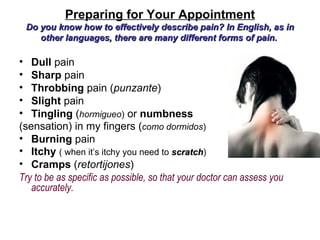
Preparing for Your Appointment
 Do you know how to effectively describe pain? In English, as in
    other languages, there are many different forms of pain.

• Dull pain
• Sharp pain
• Throbbing pain (punzante)
• Slight pain
• Tingling (hormigueo) or numbness
(sensation) in my fingers (como dormidos)
• Burning pain
• Itchy ( when it’s itchy you need to scratch)
                                         scratch
• Cramps (retortijones)
Try to be as specific as possible, so that your doctor can assess you
   accurately.
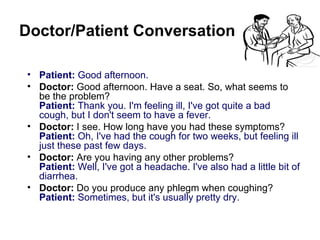
Doctor/Patient Conversation

 • Patient: Good afternoon.
 • Doctor: Good afternoon. Have a seat. So, what seems to
   be the problem?
   Patient: Thank you. I'm feeling ill, I've got quite a bad
   cough, but I don't seem to have a fever.
 • Doctor: I see. How long have you had these symptoms?
   Patient: Oh, I've had the cough for two weeks, but feeling ill
   just these past few days.
 • Doctor: Are you having any other problems?
   Patient: Well, I've got a headache. I've also had a little bit of
   diarrhea.
 • Doctor: Do you produce any phlegm when coughing?
   Patient: Sometimes, but it's usually pretty dry.
Doctor: Do you smoke?
Patient: Yes, a few cigarettes a day. Certainly
  no more than a half a pack a day.
Doctor: How about allergies? Do you have any
  allergies?
Patient: Not that I'm aware of.
Doctor: Does your head feel stuffy?
Patient: Yes, for the past few days.
Doctor: OK. Now let's have a look. Could you
  please open your mouth and say 'ah'?
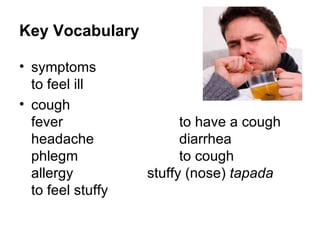
Key Vocabulary

• symptoms
  to feel ill
• cough
  fever                  to have a cough
  headache               diarrhea
  phlegm                 to cough
  allergy          stuffy (nose) tapada
  to feel stuffy
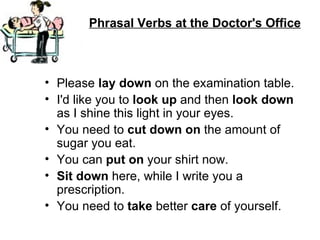
Phrasal Verbs at the Doctor's Office


• Please lay down on the examination table.
• I'd like you to look up and then look down
  as I shine this light in your eyes.
• You need to cut down on the amount of
  sugar you eat.
• You can put on your shirt now.
• Sit down here, while I write you a
  prescription.
• You need to take better care of yourself.
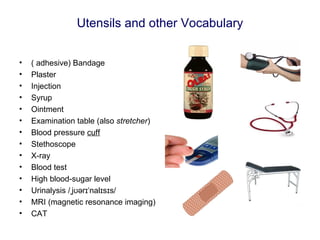
Utensils and other Vocabulary


•   ( adhesive) Bandage
•   Plaster
•   Injection
•   Syrup
•   Ointment
•   Examination table (also stretcher)
•   Blood pressure cuff
•   Stethoscope
•   X-ray
•   Blood test
•   High blood-sugar level
•   Urinalysis /ˌjʊərɪˈnalɪsɪs/
•   MRI (magnetic resonance imaging)
•   CAT

At the doctor's

  • 1.
    Unit 6 Health &Medicine by Dulce Rosales
  • 2.
    Check the meaningof the following words with your partner. Then put them in the three groups below: ·asthma · a runny nose · antibiotics ·an allergy ·a rash ·hay fever ·painkillers ·flu ·pills ·diahrroea ·a sore throat ·a migraine ·sneeze ·a virus ·a temperature ·penicillin ·throw up ·food poisoning ·paracetamol ·a blocked-up nose ·an infection • 1. HEALTH PROBLEMS asthma, … • 2. SYMPTOMS a runny nose, … • 3. TREATMENT antibiotics, …
  • 3.
    Look at sometypical doctor’s statements and questions and complete them with the words given 1. What seems to be the problem? problem 2. How long have you been ___like this? 3. Are you ___ to anything? 4. What have you ____recently? 5. Come ____ if you are not feeling better in a few days. 6. Have you been ___ anything for that? 7. Have you got any other ____? 8. Right, let me have a look at you. 9. I am just going to take your_____. 10. Here is a _______ for some painkilers. • problem prescription back feeling taking temperature symptoms allergic eaten look
  • 4.
    Here are sometypical patient’s expressions. Match them (1-10 to a-j) • 1 I am not feeling • A feeling very well recently • 2 I haven’t been • B getting really bad headaches • 3 I’ve got • C very well • 4 My chest • D a terrible stomach ache • 5 I keep • E hurts • 6 I can’t stop • F to penicillin • 7 Do I need • G sneezing • 8 I’m allergic • H should I take them? • 9 How often • I make another appointment? • 10 Do I need to • J some antibiotics
  • 5.
    At the Doctor'sOffice Common Questions Your Doctor Might Ask You ·What seems to be the problem? · How can I help you ? · What can I do for you? · How long have you been experiencing these symptoms? · Are you in pain? · Can you describe the pain? Where exactly does it hurt?
  • 6.
    • Does thepain get worse when you do something? • Are you taking any medication for the pain? • What prescription drugs are you taking? • Do you have any allergies? Are you allergic to anything? • Are you pregnant? (if you are a woman) • Is that uncomfortable? • Does that hurt?
  • 7.
    Common Directions orInstructions during an Examination • · Lay down on the examination table/bed. • · Squeeze my hands. • · Relax your leg/arm. • · Tell me when it hurts. • · Stand and face the mirror. • · Breath in (inhale), breath out (exhale). • · Take off your /shirt/sweater etc. (!)
  • 8.
    Preparing for YourAppointment Do you know how to effectively describe pain? In English, as in other languages, there are many different forms of pain. • Dull pain • Sharp pain • Throbbing pain (punzante) • Slight pain • Tingling (hormigueo) or numbness (sensation) in my fingers (como dormidos) • Burning pain • Itchy ( when it’s itchy you need to scratch) scratch • Cramps (retortijones) Try to be as specific as possible, so that your doctor can assess you accurately.
  • 9.
    Doctor/Patient Conversation •Patient: Good afternoon. • Doctor: Good afternoon. Have a seat. So, what seems to be the problem? Patient: Thank you. I'm feeling ill, I've got quite a bad cough, but I don't seem to have a fever. • Doctor: I see. How long have you had these symptoms? Patient: Oh, I've had the cough for two weeks, but feeling ill just these past few days. • Doctor: Are you having any other problems? Patient: Well, I've got a headache. I've also had a little bit of diarrhea. • Doctor: Do you produce any phlegm when coughing? Patient: Sometimes, but it's usually pretty dry.
  • 10.
    Doctor: Do yousmoke? Patient: Yes, a few cigarettes a day. Certainly no more than a half a pack a day. Doctor: How about allergies? Do you have any allergies? Patient: Not that I'm aware of. Doctor: Does your head feel stuffy? Patient: Yes, for the past few days. Doctor: OK. Now let's have a look. Could you please open your mouth and say 'ah'?
  • 11.
    Key Vocabulary • symptoms to feel ill • cough fever to have a cough headache diarrhea phlegm to cough allergy stuffy (nose) tapada to feel stuffy
  • 12.
    Phrasal Verbs atthe Doctor's Office • Please lay down on the examination table. • I'd like you to look up and then look down as I shine this light in your eyes. • You need to cut down on the amount of sugar you eat. • You can put on your shirt now. • Sit down here, while I write you a prescription. • You need to take better care of yourself.
  • 13.
    Utensils and otherVocabulary • ( adhesive) Bandage • Plaster • Injection • Syrup • Ointment • Examination table (also stretcher) • Blood pressure cuff • Stethoscope • X-ray • Blood test • High blood-sugar level • Urinalysis /ˌjʊərɪˈnalɪsɪs/ • MRI (magnetic resonance imaging) • CAT