Quantifiers All/every, etc.
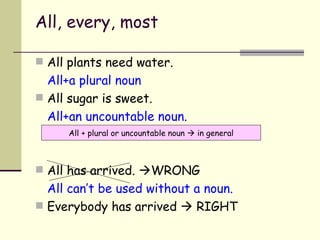
All, every, most All plants need water. All+a plural noun All sugar is sweet. All+an uncountable noun. All has arrived.   WRONG All can’t be used without a noun. Everybody has arrived    RIGHT All + plural or uncountable noun    in general
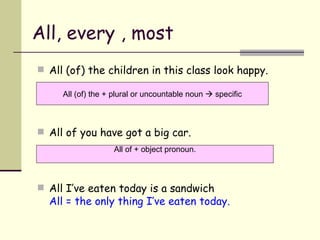
All, every , most All (of) the children in this class look happy. All of you have got a big car. All I’ve eaten today is a sandwich All = the only thing I’ve eaten today. All (of) the + plural or uncountable noun    specific All of + object pronoun.
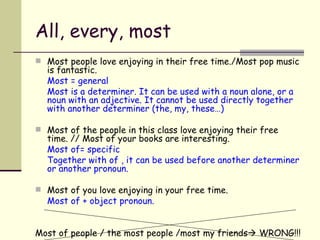
All, every, most Most people love enjoying in their free time./Most pop music is fantastic. Most = general Most is a determiner. It can be used with a noun alone, or a noun with an adjective. It cannot be used directly together with another determiner (the, my, these…) Most of the people in this class love enjoying their free time. // Most of your books are interesting. Most of= specific Together with of , it can be used before another determiner or another pronoun. Most of you love enjoying in your free time. Most of + object pronoun. Most of people / the most people /most my friends    WRONG!!!
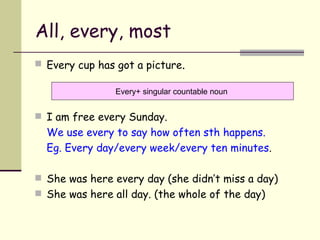
All, every, most Every cup has got a picture . I am free every Sunday. We use every to say how often sth happens. Eg. Every day/every week/every ten minutes . She was here every day (she didn’t miss a day) She was here all day. (the whole of the day)   Every+ singular countable noun
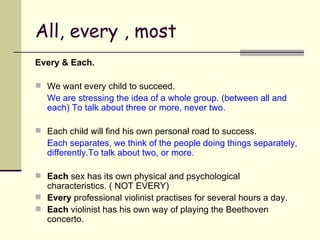
All, every , most Every & Each. We want every child to succeed. We are stressing the idea of a whole group. (between all and each) To talk about three or more, never two. Each child will find his own personal road to success. Each separates, we think of the people doing things separately, differently.To talk about two, or more. Each  sex has its own physical and psychological characteristics. ( NOT EVERY) Every  professional violinist practises for several hours a day. Each  violinist has his own way of playing the Beethoven concerto.
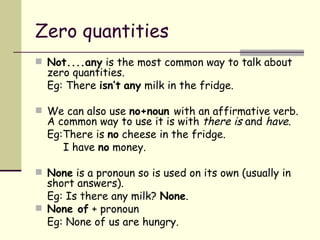
Zero quantities Not....any  is the most common way to talk about zero quantities. Eg: There  isn’t   any  milk in the fridge. We can also use  no+noun  with an affirmative verb. A common way to use it is with  there is  and  have . Eg:There is  no  cheese in the fridge.   I have  no  money. None  is a pronoun so is used on its own (usually in short answers). Eg: Is there any milk?  None . None of  + pronoun  Eg: None of us are hungry.
Both, neither, either Both  Sarah  and  Joe are short.  Neither  Sarah  nor  Joe play basketball. Sarah wanted to play  either  tennis  or  football. In the end she played both sports. Both= A and B Either= A or B Neither= not A not B. Both: plural verb // Neither: singular/ plural We are talking about two things. Sarah and Joe  both  played tennis. When both refers to the subject of a clause it can also be used before a main verb. Neither of them saw the car. Neither/both/ either + of + object pronoun.
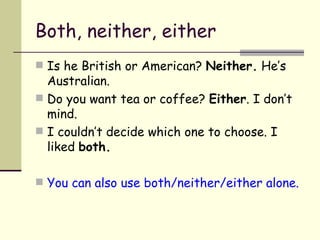
Both, neither, either Is he British or American?  Neither.  He’s Australian. Do you want tea or coffee?  Either . I don’t mind. I couldn’t decide which one to choose. I liked  both. You can also use both/neither/either alone.

Quantifiers

  • 1.
  • 2.
    All, every, mostAll plants need water. All+a plural noun All sugar is sweet. All+an uncountable noun. All has arrived.  WRONG All can’t be used without a noun. Everybody has arrived  RIGHT All + plural or uncountable noun  in general
  • 3.
    All, every ,most All (of) the children in this class look happy. All of you have got a big car. All I’ve eaten today is a sandwich All = the only thing I’ve eaten today. All (of) the + plural or uncountable noun  specific All of + object pronoun.
  • 4.
    All, every, mostMost people love enjoying in their free time./Most pop music is fantastic. Most = general Most is a determiner. It can be used with a noun alone, or a noun with an adjective. It cannot be used directly together with another determiner (the, my, these…) Most of the people in this class love enjoying their free time. // Most of your books are interesting. Most of= specific Together with of , it can be used before another determiner or another pronoun. Most of you love enjoying in your free time. Most of + object pronoun. Most of people / the most people /most my friends  WRONG!!!
  • 5.
    All, every, mostEvery cup has got a picture . I am free every Sunday. We use every to say how often sth happens. Eg. Every day/every week/every ten minutes . She was here every day (she didn’t miss a day) She was here all day. (the whole of the day) Every+ singular countable noun
  • 6.
    All, every ,most Every & Each. We want every child to succeed. We are stressing the idea of a whole group. (between all and each) To talk about three or more, never two. Each child will find his own personal road to success. Each separates, we think of the people doing things separately, differently.To talk about two, or more. Each sex has its own physical and psychological characteristics. ( NOT EVERY) Every professional violinist practises for several hours a day. Each violinist has his own way of playing the Beethoven concerto.
  • 7.
    Zero quantities Not....any is the most common way to talk about zero quantities. Eg: There isn’t any milk in the fridge. We can also use no+noun with an affirmative verb. A common way to use it is with there is and have . Eg:There is no cheese in the fridge. I have no money. None is a pronoun so is used on its own (usually in short answers). Eg: Is there any milk? None . None of + pronoun Eg: None of us are hungry.
  • 8.
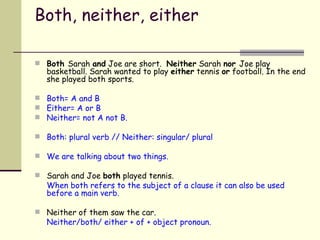
    Both, neither, eitherBoth Sarah and Joe are short. Neither Sarah nor Joe play basketball. Sarah wanted to play either tennis or football. In the end she played both sports. Both= A and B Either= A or B Neither= not A not B. Both: plural verb // Neither: singular/ plural We are talking about two things. Sarah and Joe both played tennis. When both refers to the subject of a clause it can also be used before a main verb. Neither of them saw the car. Neither/both/ either + of + object pronoun.
  • 9.
    Both, neither, eitherIs he British or American? Neither. He’s Australian. Do you want tea or coffee? Either . I don’t mind. I couldn’t decide which one to choose. I liked both. You can also use both/neither/either alone.