edutainesl.wordpress.com
Passive Voice
In the Present and Past Simple
Developed by Alina Dashkevich
edutainesl.wordpress.com
Passive and Active Voice + exercises
https://www.youtube.com/watch?v=rr7gAJuobp8
Transitive and Intransitive verbs in the Passive Voice
https://www.youtube.com/watch?v=HUH-1VUe5Co
Active vs Passive
https://www.youtu
be.com/watch?v=
CGUVO-mG80I
By vs With
https://www.youtu
be.com/watch?v=
zwH6qK7qM7M
Which tense is this?
What is the subject of
the sentence?
+VerbSubject
Which tense is this?
What is the subject of
the sentence?
+VerbSubject
Which tense is this?
What is the subject of
the sentence?
Present Simple
Who performs the
action?
+VerbSubject
Which tense is this?
What is the subject of
the sentence?
Present Simple
Who performs the
action?
+VerbSubject
Which tense is this?
What is the subject of
the sentence?
Present Simple
They
Who performs the
action?
+VerbSubject
Which tense is this?
What is the subject of
the sentence?
Present Simple
The subject performs the action.
This is active voice!
They
Who performs the
action?
+VerbSubject
Which tense is this?
What is the subject of
the sentence?
Present Simple
Which tense is this?
+be+Verb
Subject
Present Simple
Which tense is this?
+be+Verb
Subject
What is the subject of
the sentence?
Present Simple
Food Which tense is this?
+be+Verb
Subject
What is the subject of
the sentence?
Present Simple
Food Which tense is this?
+be+Verb
Subject
What is the subject of
the sentence?
Present Simple
Who performs the
action?
Food Which tense is this?
People
+be+Verb
Subject
What is the subject of
the sentence?
Present Simple
Who performs the
action?
Food Which tense is this?
People
+be+Verb
Subject
What is the subject of
the sentence?
Present Simple
Who performs the
action?
The subject receives the action.
This is passive voice!
Which tense is this?
+V2/edSubject
Which tense is this?
+V2/edSubject
Past Simple
Which tense is this?
+V2/edSubject
What is the subject of
the sentence?
Past Simple
Lorena Which tense is this?
+V2/edSubject
What is the subject of
the sentence?
Past Simple
Lorena Which tense is this?
+V2/edSubject
What is the subject of
the sentence?
Past Simple
Lorena Which tense is this?
+V2/edSubject
What is the subject of
the sentence?
Past Simple
Lorena Which tense is this?
+V2/edSubject
What is the subject of
the sentence?
Past Simple
Who performs the
action?
Lorena Which tense is this?
+V2/edSubject
What is the subject of
the sentence?
Past Simple
Who performs the
action?
Lorena Which tense is this?
+V2/edSubject
What is the subject of
the sentence?
Past Simple
Who performs the
action?
Lorena Which tense is this?
+V2/edSubject
What is the subject of
the sentence?
Past Simple
Who performs the
action?The subject performs the action.
This is active voice!
Which tense is this?
+was/were+
V3/ed
Subject
Which tense is this?
+was/were+
V3/ed
Subject
Past Simple
Which tense is this?
+was/were+
V3/ed
Subject
What is the subject of
the sentence?
Past Simple
This horse Which tense is this?
+was/were+
V3/ed
Subject
What is the subject of
the sentence?
Past Simple
This horse Which tense is this?
+was/were+
V3/ed
Subject
What is the subject of
the sentence?
Past Simple
Who performed the
action?
This horse Which tense is this?
+was/were+
V3/ed
Subject
What is the subject of
the sentence?
Past Simple
Who performed the
action?
Lorena
This horse Which tense is this?
+was/were+
V3/ed
Subject
What is the subject of
the sentence?
Past Simple
Who performed the
action?
The subject receives the the action.
This is passive voice!
Lorena
This horse Which tense is this?
+was/were+
V3/ed
Subject
What is the subject of
the sentence?
Past Simple
Who performed the
action?
The subject receives the the action.
This is passive voice!
Lorena
Lorena
causes
the action
People drive cars.
Cars are driven by people.
People drive cars.Cars are driven by
people.
Which one is active
and which one is passive?
People drive cars.
Cars are driven by people.
Cars are driven by
people.
People drive cars.
Which one is active
and which one is passive?
People drive cars.
Cars are driven by people.
Cars are driven by
people.
People drive cars.
Which one is active
and which one is passive?
Passive Voice
People drive cars.
Cars are driven by people.
Cars are driven by
people.
People drive cars.
Which one is active
and which one is passive?
Passive Voice
People drive cars.
Cars are driven by people.
Cars are driven by
people.
People drive cars.
Which one is active
and which one is passive?
Passive Voice Active voice
People drive cars.
Cars are driven by people.
Cars are driven by
people.
People drive cars.
Which one is active
and which one is passive?
Passive Voice Active voice
People drive cars.
Cars are driven by people.
Cars are driven by
people.
People drive cars.
Which one is active
and which one is passive?
Passive Voice Active voice
People drive cars.
Cars are driven by people.
Cars are driven by
people.
S
People drive cars.
Which one is active
and which one is passive?
Passive Voice Active voice
People drive cars.
Cars are driven by people.
Cars are driven by
people.
S O
People drive cars.
Which one is active
and which one is passive?
Passive Voice Active voice
People drive cars.
Cars are driven by people.
Cars are driven by
people.
S O
People drive cars.
Which one is active
and which one is passive?
Passive Voice Active voice
People drive cars.
Cars are driven by people.
Cars are driven by
people.
S O
O
People drive cars.
Which one is active
and which one is passive?
Passive Voice Active voice
People drive cars.
Cars are driven by people.
Cars are driven by
people.
S O
S O
People drive cars.
Which one is active
and which one is passive?
Passive Voice Active voice
People drive cars.
Cars are driven by people.
Cars are driven by
people.
S O
S O
Notice that
The subject of the
active sentence
becomes the object
of the passive
sentence, and the
object of the active
sentence becomes
the subject of the
passive sentence.
People drive cars.
He buys candies.
The candies are
bought by him.
He buys candies.
The candies are
bought by him.
He buys candies.
The candies are
bought by him.
He buys candies.
BY + Object
pronoun
The candies are
bought by him.
He buys candies.
BY + Object
pronoun
Josh won many awards.
The candies are
bought by him.
He buys candies.
BY + Object
pronoun
Josh won many awards.
Many awards were
won by Josh.
The candies are
bought by him.
He buys candies.
BY + Object
pronoun
Josh won many awards.
Many awards were
won by Josh.
The candies are
bought by him.
He buys candies.
BY + Object
pronoun
Josh won many awards.
Many awards were
won by Josh.
BY + Object
pronoun
The candies are
bought by him.
He buys candies.
BY + Object
pronoun
Josh won many awards.
Many awards were
won by Josh.
BY + Object
pronoun
How do we form Passive Voice in the Present
and Past Simple?
The candies are
bought by him.
He buys candies.
BY + Object
pronoun
Josh won many awards.
Many awards were
won by Josh.
BY + Object
pronoun
How do we form Passive Voice in the Present
and Past Simple?
We use BY + object/object
pronoun to say who does
the action.
The candies are
bought by him.
He buys candies.
BY + Object
pronoun
Josh won many awards.
Many awards were
won by Josh.
BY + Object
pronoun
How do we form Passive Voice in the Present
and Past Simple?
BE + Past
Participle
Present Simple
S + am/is/are
+ Past
Participle
Past Simple
S + was/were
+ Past
Participle
We use BY + object/object
pronoun to say who does
the action.
They don’t play rugby here,
they play only football.
Rugby is not played
here.
They don’t play rugby here,
they play only football.
Rugby is not played
here.
They don’t play rugby here,
they play only football.
He didn’t take this photo in
winter.
Rugby is not played
here.
They don’t play rugby here,
they play only football.
This photo was not
taken in winter.
He didn’t take this photo in
winter.
Rugby is not played
here.
They don’t play rugby here,
they play only football.
This photo was not
taken in winter.
He didn’t take this photo in
winter.
Notice that we can omit the BY-phrase
(by them, by him, by us, by people), if it is not
important, who performs the action
Rugby is not played
here.
They don’t play rugby here,
they play only football.
This photo was not
taken in winter.
Negations
Present Simple
S+ am/is/are +
not + Past
Participle
Past Simple
S+ was/were +
not + Past
Participle
He didn’t take this photo in
winter.
Notice that we can omit the BY-phrase
(by them, by him, by us, by people), if it is not
important, who performs the action
Do people keep monkeys in
zoos?
Are monkeys
kept in zoos?
Do people keep monkeys in
zoos?
Are monkeys
kept in zoos?
Do people keep monkeys in
zoos?
Did the toy scare the cat?
Are monkeys
kept in zoos?
Do people keep monkeys in
zoos?
Was the cat scared by
the toy?
Did the toy scare the cat?
Are monkeys
kept in zoos?
Do people keep monkeys in
zoos?
Was the cat scared by
the toy?
Did the toy scare the cat?
Notice the position of the subject in questions.
Are monkeys
kept in zoos?
Do people keep monkeys in
zoos?
Was the cat scared by
the toy?
Did the toy scare the cat?
Notice the position of the subject in questions.
Are monkeys
kept in zoos?
Do people keep monkeys in
zoos?
Was the cat scared by
the toy?
Questions
Present Simple
Am/is/are + S
+ Past
Participle?
Past Simple
Was/were + S
+ Past
Participle?
Did the toy scare the cat?
Notice the position of the subject in questions.
Rewrite the sentences
into active or passive
voice.
They saw the accident.
The accident was
seen by them.
They saw the accident.
The lion yawned.
The accident was
seen by them.
They saw the accident.
No Passive form.
The lion yawned.
The accident was
seen by them.
They saw the accident.
No Passive form.
The lion yawned.
The accident was
seen by them.
They saw the accident.
Verb +Object
No Passive form.
The lion yawned.
The accident was
seen by them.
They saw the accident.
VerbVerb +Object
No Passive form.
The lion yawned.
Transitive and
intransitive
verbs
Transitive
Verb + Object
The accident was
seen by them.
They saw the accident.
VerbVerb +Object
No Passive form.
The lion yawned.
Transitive and
intransitive
verbs
Transitive
Verb + Object
The accident was
seen by them.
They saw the accident.
VerbVerb +Object
Intransitive
Verb + object
No Passive form.
The lion yawned.
Transitive and
intransitive
verbs
Transitive
Verb + Object
The accident was
seen by them.
They saw the accident.
VerbVerb +Object
Intransitive
Verb + object
Intransitive verbs cannot be used in the Passive voice
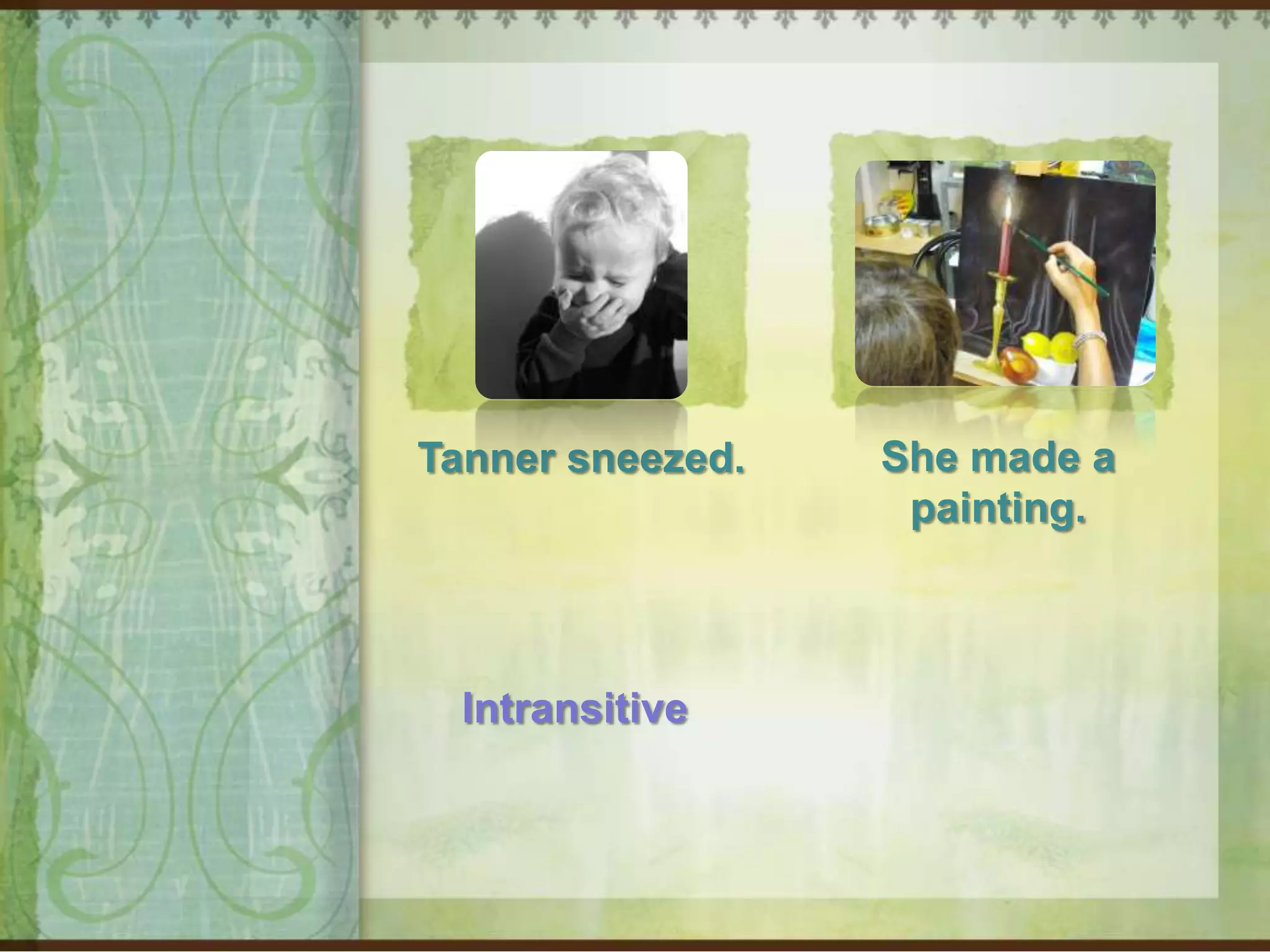
Tanner sneezed.
Intransitive
Tanner sneezed.
Intransitive
Tanner sneezed. She made a
painting.
Intransitive
The painting was
made by her.
Tanner sneezed. She made a
painting.
Intransitive
The painting was
made by her.
Tanner sneezed. She made a
painting.
Intransitive
Verb + object
Transitive and
intransitive
verbs
Transitive
Verb + Object
Decide if the following
verbs are transitive or
intransitive.
If the verb is transitive
change it into the passive
form.
The cook made the cake
with flour.
The cake was
made with
flour.
The cook made the cake
with flour.
The cake was
made with
flour.
The cook made the cake
with flour. She held the kitten.
The cake was
made with
flour.
The cook made the cake
with flour.
The kitten was
held by her.
She held the kitten.
The cake was
made with
flour.
The cook made the cake
with flour.
The kitten was
held by her.
We use BY + object/
object pronoun to
say who does/did
the action.
She held the kitten.
The cake was
made with
flour.
The cook made the cake
with flour.
The kitten was
held by her.
We use BY + object/
object pronoun to
say who does/did
the action.
We use WITH +
instrument/materia
l/ingredient to say
what the agent
used to .
She held the kitten.
We use BY + object/
object pronoun to
say who does/did
the action.
We use WITH +
instrument/materia
l/ingredient to say
what the agent
used to .
Victor smashed the
window with a stone.
We use BY + object/
object pronoun to
say who does/did
the action.
We use WITH +
instrument/materia
l/ingredient to say
what the agent
used to .
The window
was smashed
with a stone by
Victor.
Victor smashed the
window with a stone.
We use BY + object/
object pronoun to
say who does/did
the action.
We use WITH +
instrument/materia
l/ingredient to say
what the agent
used to .
Victor smashed the
window with a stone.
We use BY + object/
object pronoun to
say who does/did
the action.
We use WITH +
instrument/materia
l/ingredient to say
what the agent
used to .
She opened the door with
a key.
The window
was smashed
with a stone by
Victor.
Victor smashed the
window with a stone.
The door was opened
with the key.
The door was opened
by her.
We use BY + object/
object pronoun to
say who does/did
the action.
We use WITH +
instrument/materia
l/ingredient to say
what the agent
used to .
She opened the door with
a key.
The window
was smashed
with a stone by
Victor.
Complete the sentence
using BY or WITH.
Have Fun Learning 
Developed by Alina Dashkewitz edutainesl.wordpress.com

Passive voice in the Present and Past Simple

  • 1.
  • 2.
    Passive Voice In thePresent and Past Simple Developed by Alina Dashkevich edutainesl.wordpress.com
  • 3.
    Passive and ActiveVoice + exercises https://www.youtube.com/watch?v=rr7gAJuobp8 Transitive and Intransitive verbs in the Passive Voice https://www.youtube.com/watch?v=HUH-1VUe5Co Active vs Passive https://www.youtu be.com/watch?v= CGUVO-mG80I By vs With https://www.youtu be.com/watch?v= zwH6qK7qM7M
  • 5.
    Which tense isthis? What is the subject of the sentence?
  • 6.
    +VerbSubject Which tense isthis? What is the subject of the sentence?
  • 7.
    +VerbSubject Which tense isthis? What is the subject of the sentence? Present Simple
  • 8.
    Who performs the action? +VerbSubject Whichtense is this? What is the subject of the sentence? Present Simple
  • 9.
    Who performs the action? +VerbSubject Whichtense is this? What is the subject of the sentence? Present Simple
  • 10.
    They Who performs the action? +VerbSubject Whichtense is this? What is the subject of the sentence? Present Simple
  • 11.
    The subject performsthe action. This is active voice! They Who performs the action? +VerbSubject Which tense is this? What is the subject of the sentence? Present Simple
  • 14.
  • 15.
    Which tense isthis? +be+Verb Subject Present Simple
  • 16.
    Which tense isthis? +be+Verb Subject What is the subject of the sentence? Present Simple
  • 17.
    Food Which tenseis this? +be+Verb Subject What is the subject of the sentence? Present Simple
  • 18.
    Food Which tenseis this? +be+Verb Subject What is the subject of the sentence? Present Simple Who performs the action?
  • 19.
    Food Which tenseis this? People +be+Verb Subject What is the subject of the sentence? Present Simple Who performs the action?
  • 20.
    Food Which tenseis this? People +be+Verb Subject What is the subject of the sentence? Present Simple Who performs the action? The subject receives the action. This is passive voice!
  • 22.
  • 23.
    Which tense isthis? +V2/edSubject
  • 24.
    Which tense isthis? +V2/edSubject Past Simple
  • 25.
    Which tense isthis? +V2/edSubject What is the subject of the sentence? Past Simple
  • 26.
    Lorena Which tenseis this? +V2/edSubject What is the subject of the sentence? Past Simple
  • 27.
    Lorena Which tenseis this? +V2/edSubject What is the subject of the sentence? Past Simple
  • 28.
    Lorena Which tenseis this? +V2/edSubject What is the subject of the sentence? Past Simple
  • 29.
    Lorena Which tenseis this? +V2/edSubject What is the subject of the sentence? Past Simple Who performs the action?
  • 30.
    Lorena Which tenseis this? +V2/edSubject What is the subject of the sentence? Past Simple Who performs the action?
  • 31.
    Lorena Which tenseis this? +V2/edSubject What is the subject of the sentence? Past Simple Who performs the action?
  • 32.
    Lorena Which tenseis this? +V2/edSubject What is the subject of the sentence? Past Simple Who performs the action?The subject performs the action. This is active voice!
  • 34.
  • 35.
    Which tense isthis? +was/were+ V3/ed Subject
  • 36.
    Which tense isthis? +was/were+ V3/ed Subject Past Simple
  • 37.
    Which tense isthis? +was/were+ V3/ed Subject What is the subject of the sentence? Past Simple
  • 38.
    This horse Whichtense is this? +was/were+ V3/ed Subject What is the subject of the sentence? Past Simple
  • 39.
    This horse Whichtense is this? +was/were+ V3/ed Subject What is the subject of the sentence? Past Simple Who performed the action?
  • 40.
    This horse Whichtense is this? +was/were+ V3/ed Subject What is the subject of the sentence? Past Simple Who performed the action? Lorena
  • 41.
    This horse Whichtense is this? +was/were+ V3/ed Subject What is the subject of the sentence? Past Simple Who performed the action? The subject receives the the action. This is passive voice! Lorena
  • 42.
    This horse Whichtense is this? +was/were+ V3/ed Subject What is the subject of the sentence? Past Simple Who performed the action? The subject receives the the action. This is passive voice! Lorena Lorena causes the action
  • 43.
    People drive cars. Carsare driven by people. People drive cars.Cars are driven by people.
  • 44.
    Which one isactive and which one is passive? People drive cars. Cars are driven by people. Cars are driven by people. People drive cars.
  • 45.
    Which one isactive and which one is passive? People drive cars. Cars are driven by people. Cars are driven by people. People drive cars.
  • 46.
    Which one isactive and which one is passive? Passive Voice People drive cars. Cars are driven by people. Cars are driven by people. People drive cars.
  • 47.
    Which one isactive and which one is passive? Passive Voice People drive cars. Cars are driven by people. Cars are driven by people. People drive cars.
  • 48.
    Which one isactive and which one is passive? Passive Voice Active voice People drive cars. Cars are driven by people. Cars are driven by people. People drive cars.
  • 49.
    Which one isactive and which one is passive? Passive Voice Active voice People drive cars. Cars are driven by people. Cars are driven by people. People drive cars.
  • 50.
    Which one isactive and which one is passive? Passive Voice Active voice People drive cars. Cars are driven by people. Cars are driven by people. S People drive cars.
  • 51.
    Which one isactive and which one is passive? Passive Voice Active voice People drive cars. Cars are driven by people. Cars are driven by people. S O People drive cars.
  • 52.
    Which one isactive and which one is passive? Passive Voice Active voice People drive cars. Cars are driven by people. Cars are driven by people. S O People drive cars.
  • 53.
    Which one isactive and which one is passive? Passive Voice Active voice People drive cars. Cars are driven by people. Cars are driven by people. S O O People drive cars.
  • 54.
    Which one isactive and which one is passive? Passive Voice Active voice People drive cars. Cars are driven by people. Cars are driven by people. S O S O People drive cars.
  • 55.
    Which one isactive and which one is passive? Passive Voice Active voice People drive cars. Cars are driven by people. Cars are driven by people. S O S O Notice that The subject of the active sentence becomes the object of the passive sentence, and the object of the active sentence becomes the subject of the passive sentence. People drive cars.
  • 57.
  • 58.
    The candies are boughtby him. He buys candies.
  • 59.
    The candies are boughtby him. He buys candies.
  • 60.
    The candies are boughtby him. He buys candies. BY + Object pronoun
  • 61.
    The candies are boughtby him. He buys candies. BY + Object pronoun Josh won many awards.
  • 62.
    The candies are boughtby him. He buys candies. BY + Object pronoun Josh won many awards. Many awards were won by Josh.
  • 63.
    The candies are boughtby him. He buys candies. BY + Object pronoun Josh won many awards. Many awards were won by Josh.
  • 64.
    The candies are boughtby him. He buys candies. BY + Object pronoun Josh won many awards. Many awards were won by Josh. BY + Object pronoun
  • 65.
    The candies are boughtby him. He buys candies. BY + Object pronoun Josh won many awards. Many awards were won by Josh. BY + Object pronoun How do we form Passive Voice in the Present and Past Simple?
  • 66.
    The candies are boughtby him. He buys candies. BY + Object pronoun Josh won many awards. Many awards were won by Josh. BY + Object pronoun How do we form Passive Voice in the Present and Past Simple? We use BY + object/object pronoun to say who does the action.
  • 67.
    The candies are boughtby him. He buys candies. BY + Object pronoun Josh won many awards. Many awards were won by Josh. BY + Object pronoun How do we form Passive Voice in the Present and Past Simple? BE + Past Participle Present Simple S + am/is/are + Past Participle Past Simple S + was/were + Past Participle We use BY + object/object pronoun to say who does the action.
  • 69.
    They don’t playrugby here, they play only football.
  • 70.
    Rugby is notplayed here. They don’t play rugby here, they play only football.
  • 71.
    Rugby is notplayed here. They don’t play rugby here, they play only football. He didn’t take this photo in winter.
  • 72.
    Rugby is notplayed here. They don’t play rugby here, they play only football. This photo was not taken in winter. He didn’t take this photo in winter.
  • 73.
    Rugby is notplayed here. They don’t play rugby here, they play only football. This photo was not taken in winter. He didn’t take this photo in winter. Notice that we can omit the BY-phrase (by them, by him, by us, by people), if it is not important, who performs the action
  • 74.
    Rugby is notplayed here. They don’t play rugby here, they play only football. This photo was not taken in winter. Negations Present Simple S+ am/is/are + not + Past Participle Past Simple S+ was/were + not + Past Participle He didn’t take this photo in winter. Notice that we can omit the BY-phrase (by them, by him, by us, by people), if it is not important, who performs the action
  • 76.
    Do people keepmonkeys in zoos?
  • 77.
    Are monkeys kept inzoos? Do people keep monkeys in zoos?
  • 78.
    Are monkeys kept inzoos? Do people keep monkeys in zoos? Did the toy scare the cat?
  • 79.
    Are monkeys kept inzoos? Do people keep monkeys in zoos? Was the cat scared by the toy? Did the toy scare the cat?
  • 80.
    Are monkeys kept inzoos? Do people keep monkeys in zoos? Was the cat scared by the toy? Did the toy scare the cat? Notice the position of the subject in questions.
  • 81.
    Are monkeys kept inzoos? Do people keep monkeys in zoos? Was the cat scared by the toy? Did the toy scare the cat? Notice the position of the subject in questions.
  • 82.
    Are monkeys kept inzoos? Do people keep monkeys in zoos? Was the cat scared by the toy? Questions Present Simple Am/is/are + S + Past Participle? Past Simple Was/were + S + Past Participle? Did the toy scare the cat? Notice the position of the subject in questions.
  • 84.
    Rewrite the sentences intoactive or passive voice.
  • 101.
    They saw theaccident.
  • 102.
    The accident was seenby them. They saw the accident.
  • 103.
    The lion yawned. Theaccident was seen by them. They saw the accident.
  • 104.
    No Passive form. Thelion yawned. The accident was seen by them. They saw the accident.
  • 105.
    No Passive form. Thelion yawned. The accident was seen by them. They saw the accident. Verb +Object
  • 106.
    No Passive form. Thelion yawned. The accident was seen by them. They saw the accident. VerbVerb +Object
  • 107.
    No Passive form. Thelion yawned. Transitive and intransitive verbs Transitive Verb + Object The accident was seen by them. They saw the accident. VerbVerb +Object
  • 108.
    No Passive form. Thelion yawned. Transitive and intransitive verbs Transitive Verb + Object The accident was seen by them. They saw the accident. VerbVerb +Object Intransitive Verb + object
  • 109.
    No Passive form. Thelion yawned. Transitive and intransitive verbs Transitive Verb + Object The accident was seen by them. They saw the accident. VerbVerb +Object Intransitive Verb + object Intransitive verbs cannot be used in the Passive voice
  • 111.
  • 112.
  • 113.
  • 114.
    Intransitive The painting was madeby her. Tanner sneezed. She made a painting.
  • 115.
    Intransitive The painting was madeby her. Tanner sneezed. She made a painting. Intransitive Verb + object Transitive and intransitive verbs Transitive Verb + Object
  • 117.
    Decide if thefollowing verbs are transitive or intransitive. If the verb is transitive change it into the passive form.
  • 130.
    The cook madethe cake with flour.
  • 131.
    The cake was madewith flour. The cook made the cake with flour.
  • 132.
    The cake was madewith flour. The cook made the cake with flour. She held the kitten.
  • 133.
    The cake was madewith flour. The cook made the cake with flour. The kitten was held by her. She held the kitten.
  • 134.
    The cake was madewith flour. The cook made the cake with flour. The kitten was held by her. We use BY + object/ object pronoun to say who does/did the action. She held the kitten.
  • 135.
    The cake was madewith flour. The cook made the cake with flour. The kitten was held by her. We use BY + object/ object pronoun to say who does/did the action. We use WITH + instrument/materia l/ingredient to say what the agent used to . She held the kitten.
  • 136.
    We use BY+ object/ object pronoun to say who does/did the action. We use WITH + instrument/materia l/ingredient to say what the agent used to .
  • 137.
    Victor smashed the windowwith a stone. We use BY + object/ object pronoun to say who does/did the action. We use WITH + instrument/materia l/ingredient to say what the agent used to .
  • 138.
    The window was smashed witha stone by Victor. Victor smashed the window with a stone. We use BY + object/ object pronoun to say who does/did the action. We use WITH + instrument/materia l/ingredient to say what the agent used to .
  • 139.
    Victor smashed the windowwith a stone. We use BY + object/ object pronoun to say who does/did the action. We use WITH + instrument/materia l/ingredient to say what the agent used to . She opened the door with a key. The window was smashed with a stone by Victor.
  • 140.
    Victor smashed the windowwith a stone. The door was opened with the key. The door was opened by her. We use BY + object/ object pronoun to say who does/did the action. We use WITH + instrument/materia l/ingredient to say what the agent used to . She opened the door with a key. The window was smashed with a stone by Victor.
  • 142.
  • 156.
    Have Fun Learning Developed by Alina Dashkewitz edutainesl.wordpress.com