PAST SIMPLE
Francisco José Valencia Gutiérrez
2 types of verbs
• REGULAR
• IRREGULAR
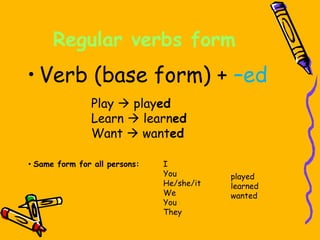
Regular verbs form
• Verb (base form) + –ed
Play  played
Learn  learned
Want  wanted
• Same form for all persons: I
You
He/she/it
We
You
They
played
learned
wanted
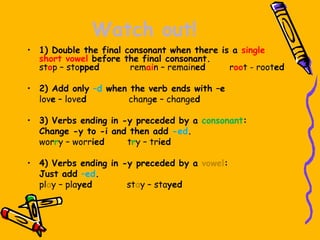
Watch out!
• 1) Double the final consonant when there is a single
short vowel before the final consonant.
stop – stopped remain – remained root - rooted
• 2) Add only –d when the verb ends with –e
love – loved change – changed
• 3) Verbs ending in -y preceded by a consonant:
Change -y to -i and then add -ed.
worry – worried try – tried
• 4) Verbs ending in -y preceded by a vowel:
Just add –ed.
play – played stay – stayed
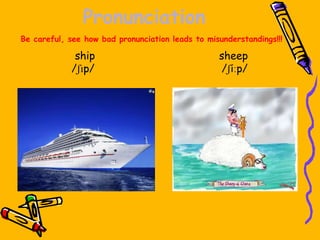
Pronunciation
ship sheep
/ʃɪp/ /ʃiːp/
Be careful, see how bad pronunciation leads to misunderstandings!!!
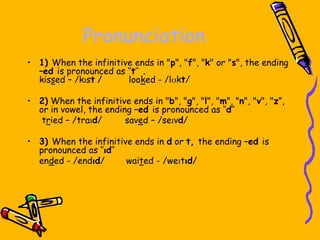
Pronunciation
• 1) When the infinitive ends in "p", "f", "k" or "s", the ending
–ed is pronounced as ‘’t’’ .
kissed – /kɪst / looked - /lʊkt/
• 2) When the infinitive ends in "b", "g", "l", "m", "n", "v", "z”,
or in vowel, the ending –ed is pronounced as ‘’d’’
tried – /traɪd/ saved – /seɪvd/
• 3) When the infinitive ends in d or t, the ending –ed is
pronounced as ‘’ɪd’’
ended - /endɪd/ waited - /weɪtɪd/
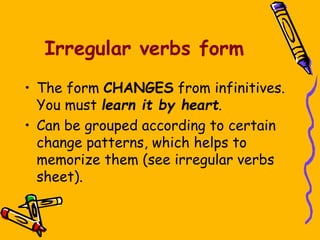
Irregular verbs form
• The form CHANGES from infinitives.
You must learn it by heart.
• Can be grouped according to certain
change patterns, which helps to
memorize them (see irregular verbs
sheet).
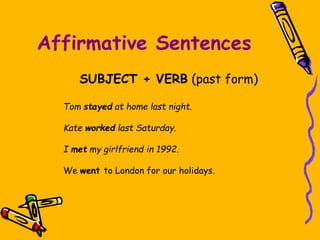
Affirmative Sentences
SUBJECT + VERB (past form)
Tom stayed at home last night.
Kate worked last Saturday.
I met my girlfriend in 1992.
We went to London for our holidays.
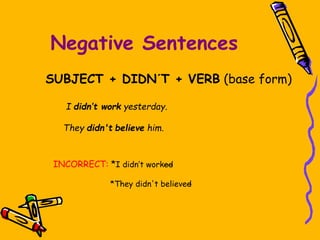
Negative Sentences
SUBJECT + DIDN´T + VERB (base form)
I didn’t work yesterday.
They didn't believe him.
INCORRECT: *I didn’t worked
*They didn't believed
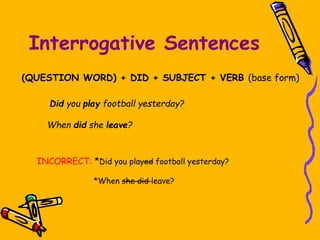
Interrogative Sentences
(QUESTION WORD) + DID + SUBJECT + VERB (base form)
Did you play football yesterday?
When did she leave?
INCORRECT: *Did you played football yesterday?
*When she did leave?
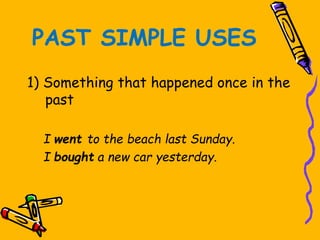
PAST SIMPLE USES
1) Something that happened once in the
past
I went to the beach last Sunday.
I bought a new car yesterday.
Past Simple Use
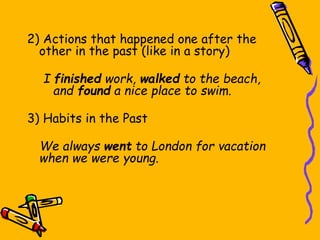
2) Actions that happened one after the
other in the past (like in a story)
I finished work, walked to the beach,
and found a nice place to swim.
3) Habits in the Past
We always went to London for vacation
when we were young.
Past Simple Use
4) A longer action that started and finished
in the past
I lived in Germany for two years.
5) Past facts or generalizations
The Aztec lived in Mexico.
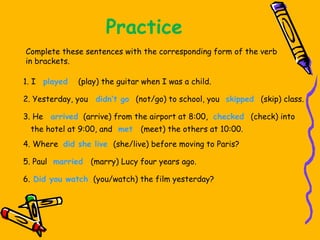
Practice
Complete these sentences with the corresponding form of the verb
in brackets.
1. I played (play) the guitar when I was a child.
2. Yesterday, you didn’t go (not/go) to school, you skipped (skip) class.
3. He arrived (arrive) from the airport at 8:00, checked (check) into
the hotel at 9:00, and met (meet) the others at 10:00.
4. Where did she live (she/live) before moving to Paris?
5. Paul married (marry) Lucy four years ago.
6. Did you watch (you/watch) the film yesterday?
Past Simple UseTHAT’S ALL!!!

Past Simple

  • 1.
    PAST SIMPLE Francisco JoséValencia Gutiérrez
  • 2.
    2 types ofverbs • REGULAR • IRREGULAR
  • 3.
    Regular verbs form •Verb (base form) + –ed Play  played Learn  learned Want  wanted • Same form for all persons: I You He/she/it We You They played learned wanted
  • 4.
    Watch out! • 1)Double the final consonant when there is a single short vowel before the final consonant. stop – stopped remain – remained root - rooted • 2) Add only –d when the verb ends with –e love – loved change – changed • 3) Verbs ending in -y preceded by a consonant: Change -y to -i and then add -ed. worry – worried try – tried • 4) Verbs ending in -y preceded by a vowel: Just add –ed. play – played stay – stayed
  • 5.
    Pronunciation ship sheep /ʃɪp/ /ʃiːp/ Becareful, see how bad pronunciation leads to misunderstandings!!!
  • 6.
    Pronunciation • 1) Whenthe infinitive ends in "p", "f", "k" or "s", the ending –ed is pronounced as ‘’t’’ . kissed – /kɪst / looked - /lʊkt/ • 2) When the infinitive ends in "b", "g", "l", "m", "n", "v", "z”, or in vowel, the ending –ed is pronounced as ‘’d’’ tried – /traɪd/ saved – /seɪvd/ • 3) When the infinitive ends in d or t, the ending –ed is pronounced as ‘’ɪd’’ ended - /endɪd/ waited - /weɪtɪd/
  • 7.
    Irregular verbs form •The form CHANGES from infinitives. You must learn it by heart. • Can be grouped according to certain change patterns, which helps to memorize them (see irregular verbs sheet).
  • 8.
    Affirmative Sentences SUBJECT +VERB (past form) Tom stayed at home last night. Kate worked last Saturday. I met my girlfriend in 1992. We went to London for our holidays.
  • 9.
    Negative Sentences SUBJECT +DIDN´T + VERB (base form) I didn’t work yesterday. They didn't believe him. INCORRECT: *I didn’t worked *They didn't believed
  • 10.
    Interrogative Sentences (QUESTION WORD)+ DID + SUBJECT + VERB (base form) Did you play football yesterday? When did she leave? INCORRECT: *Did you played football yesterday? *When she did leave?
  • 11.
    PAST SIMPLE USES 1)Something that happened once in the past I went to the beach last Sunday. I bought a new car yesterday.
  • 12.
    Past Simple Use 2)Actions that happened one after the other in the past (like in a story) I finished work, walked to the beach, and found a nice place to swim. 3) Habits in the Past We always went to London for vacation when we were young.
  • 13.
    Past Simple Use 4)A longer action that started and finished in the past I lived in Germany for two years. 5) Past facts or generalizations The Aztec lived in Mexico.
  • 14.
    Practice Complete these sentenceswith the corresponding form of the verb in brackets. 1. I played (play) the guitar when I was a child. 2. Yesterday, you didn’t go (not/go) to school, you skipped (skip) class. 3. He arrived (arrive) from the airport at 8:00, checked (check) into the hotel at 9:00, and met (meet) the others at 10:00. 4. Where did she live (she/live) before moving to Paris? 5. Paul married (marry) Lucy four years ago. 6. Did you watch (you/watch) the film yesterday?
  • 15.