DETERMINERS
AND
QUANTIFIERS
What are determines and
quantifiers?
Determiners and quantifiers are little
words that precede and modify nouns.
Example: the student, a book, a little money,
whatever purposes, a lot of trees.
Sometimes these words will tell the reader or
listener whether we are referring to a specific or
general thing and sometimes they tell how much or
how many.
Determiners are words which come at the beginning of the
noun phrase. They tell us whether the noun phrase is
specific or general.
Determiners are either specific or general.
The specific determiners are:
-the definite article
-the possessives: my, your, his, her, its; our, their, whose
-demonstratives: this, that, these, those
- interrogatives: which
We use a specific determiner when we believe the
listener/reader knows exactly what we are referring to.
Example: Can you close the door please? Look at this
nice car.. Thank you very much
The general determiners are:
•indefinite article : a, an; any; another; other; what;
whatever
When we are talking about things in general and the listener/reader does not know
exactly what we are referring to, we can use a singular noun with the indefinite
article a or an:
Example: A woman was lifted to safety by a helicopter. A man climbing nearby saw
the accident.
or we can use a non-count noun or a plural noun with no determiner:
Example: Milk is very good for you. (= uncount noun)
Health and education are very important. (= 2 uncount nouns)
Girls normally do better in school than boys. (= plural nouns with no determiner)
or we can use the general determiner any with a singular noun or a non-count
noun when we are talking about all of those people or things: Example: It’s very
easy. Any child can do it. (= All children can do it) With a full license you are allowed
to drive any car. I like beef, lamb, pork - any meat.
We use the general determiner “another” to talk about an
additional person or thing.
The plural form of another is other:
Example: Would you like another glass of wine?
I spoke to John, Helen and a few other friends.
Note that usually we cannot use more than one determiner
in the same noun phrase.
QUANTIFIERS
Like determiners, quantifiers are words that precede and modify
nouns.
We use quantifiers when we want to give someone information
about the number of something: how much or how many.
Selecting the correct quantifier depends on our understanding
the distinction between Count and Non-Count Nouns.
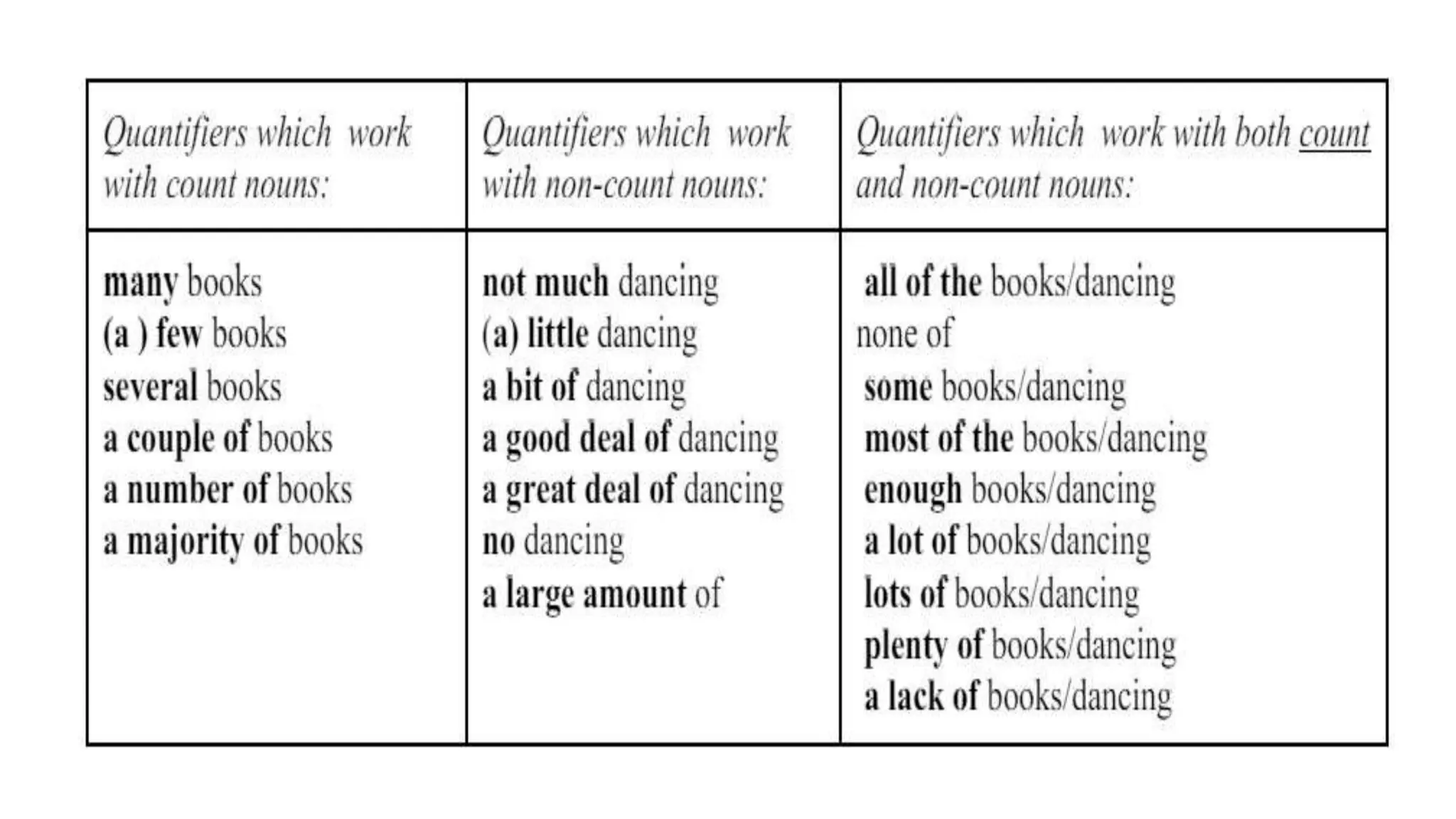
For our purposes, we will choose the count noun (plural noun)
books and the non-count noun dancing:
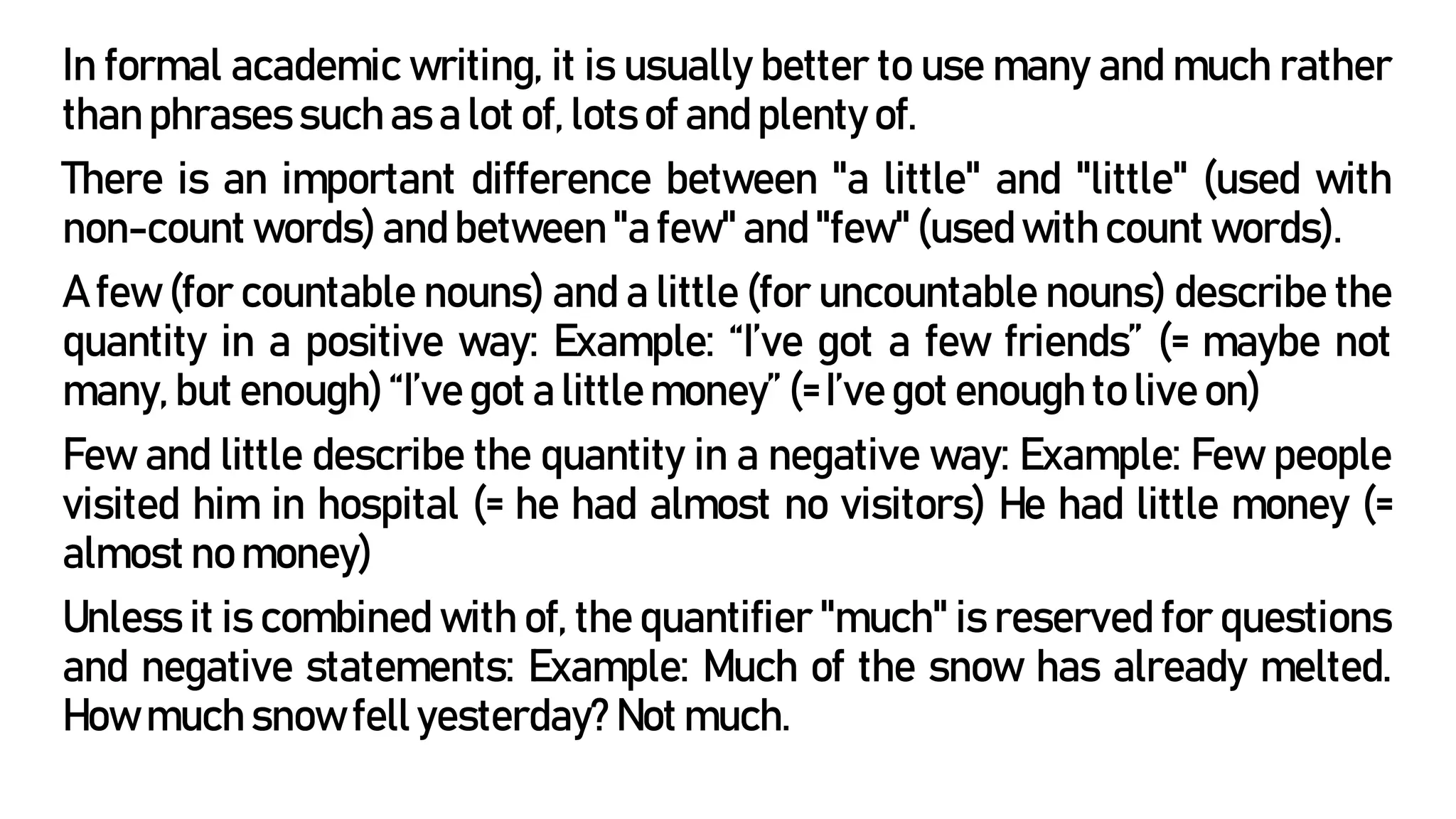
In formal academic writing, it is usually better to use many and much rather
than phrases such as a lot of, lots of and plenty of.
There is an important difference between "a little" and "little" (used with
non-count words) and between "a few" and "few" (used with count words).
A few (for countable nouns) and a little (for uncountable nouns) describe the
quantity in a positive way: Example: “I’ve got a few friends” (= maybe not
many, but enough) “I’ve got a little money” (= I’ve got enough to live on)
Few and little describe the quantity in a negative way: Example: Few people
visited him in hospital (= he had almost no visitors) He had little money (=
almost no money)
Unless it is combined with of, the quantifier "much" is reserved for questions
and negative statements: Example: Much of the snow has already melted.
How much snow fell yesterday? Not much.
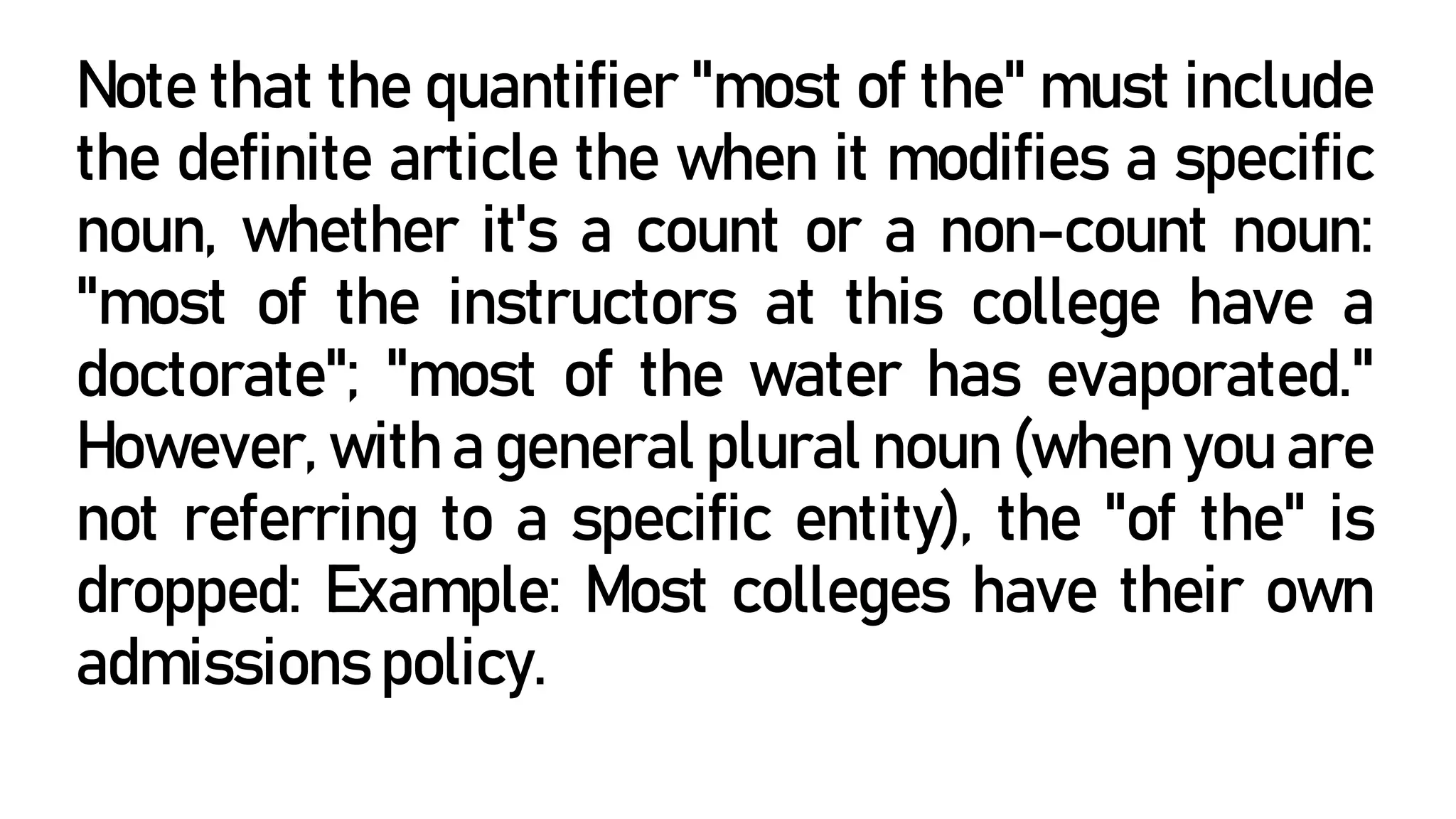
Note that the quantifier "most of the" must include
the definite article the when it modifies a specific
noun, whether it's a count or a non-count noun:
"most of the instructors at this college have a
doctorate"; "most of the water has evaporated."
However, with a general plural noun (when you are
not referring to a specific entity), the "of the" is
dropped: Example: Most colleges have their own
admissions policy.
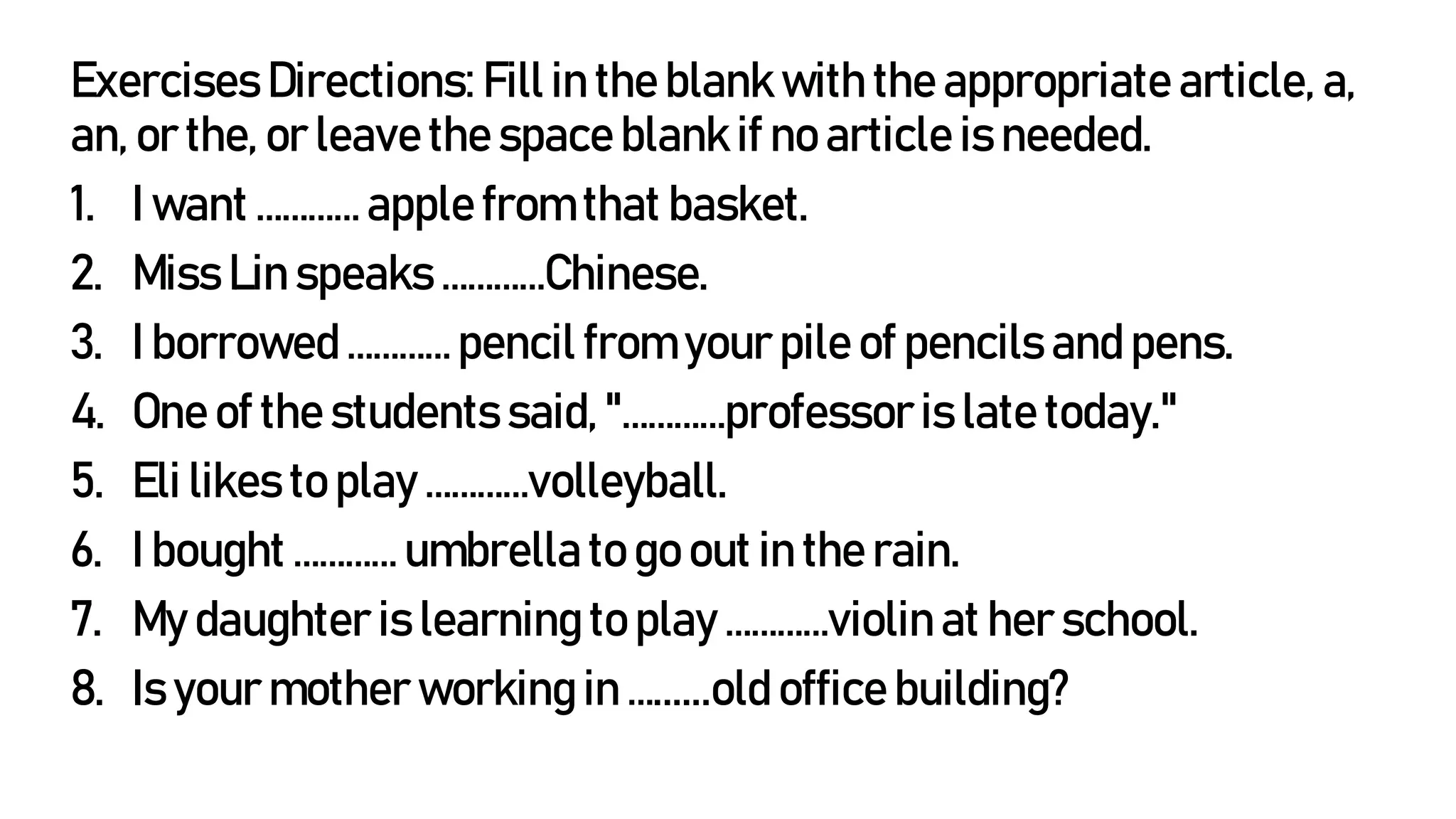
Exercises Directions: Fill in the blank with the appropriate article, a,
an, or the, or leave the space blank if no article is needed.
1. I want ………… apple from that basket.
2. Miss Lin speaks …………Chinese.
3. I borrowed ………… pencil from your pile of pencils and pens.
4. One of the students said, "…………professoris late today."
5. Eli likes to play …………volleyball.
6. I bought ………… umbrella to go out in the rain.
7. My daughter is learning to play …………violin at her school.
8. Is your mother working in …......old office building?
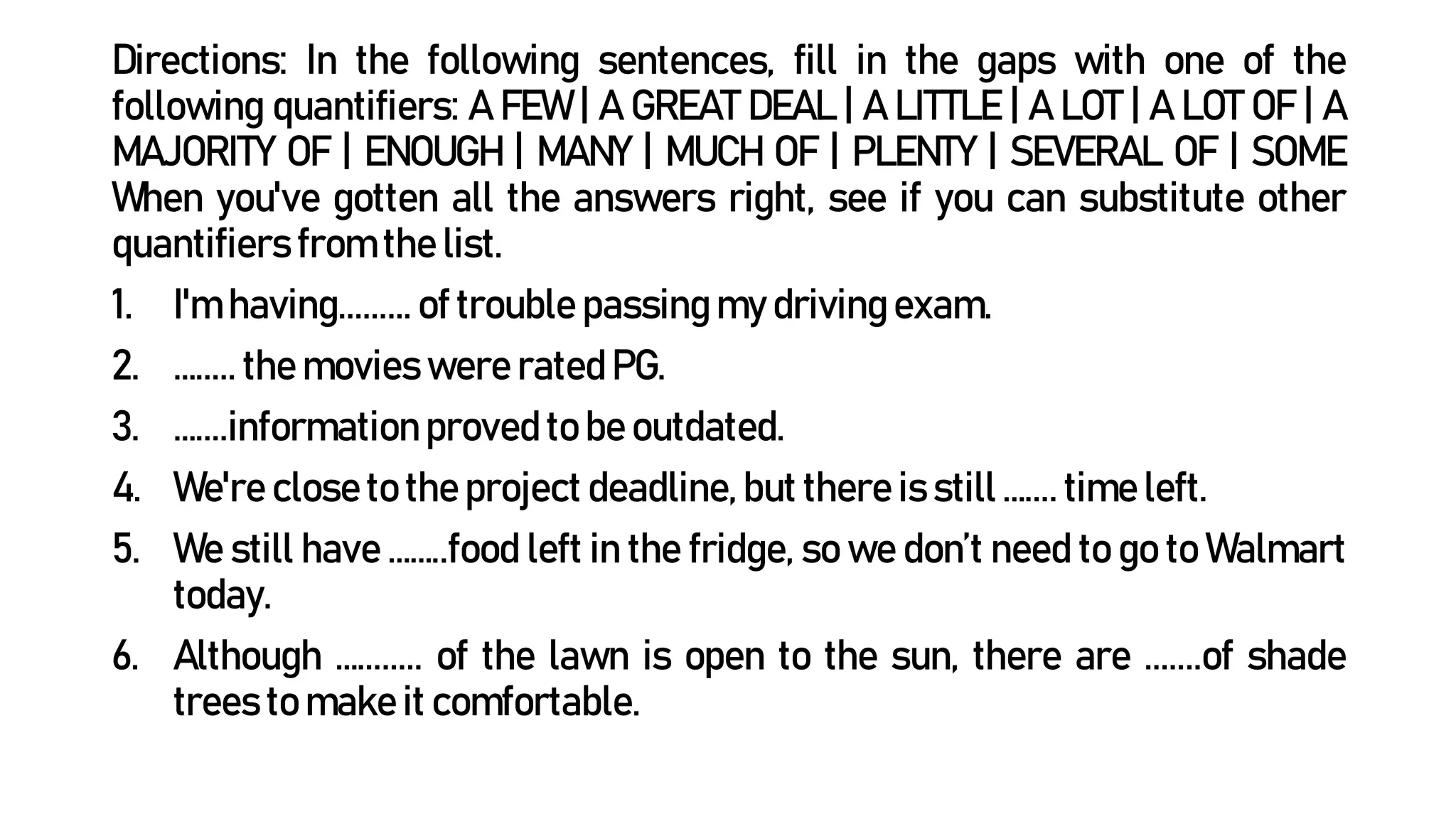
Directions: In the following sentences, fill in the gaps with one of the
following quantifiers: A FEW | A GREAT DEAL | A LITTLE | A LOT | A LOT OF | A
MAJORITY OF | ENOUGH | MANY | MUCH OF | PLENTY | SEVERAL OF | SOME
When you've gotten all the answers right, see if you can substitute other
quantifiers from the list.
1. I'm having......... of trouble passing my driving exam.
2. …..... the movies were rated PG.
3. …....informationproved to be outdated.
4. We're close to the project deadline, but there is still ….... time left.
5. We still have ……..food left in the fridge, so we don’t need to go to Walmart
today.
6. Although …........ of the lawn is open to the sun, there are .......of shade
trees to make it comfortable.

Quantifier in English 1234567890qwertyui

  • 1.
  • 2.
    What are determinesand quantifiers? Determiners and quantifiers are little words that precede and modify nouns.
  • 3.
    Example: the student,a book, a little money, whatever purposes, a lot of trees. Sometimes these words will tell the reader or listener whether we are referring to a specific or general thing and sometimes they tell how much or how many.
  • 4.
    Determiners are wordswhich come at the beginning of the noun phrase. They tell us whether the noun phrase is specific or general. Determiners are either specific or general. The specific determiners are: -the definite article -the possessives: my, your, his, her, its; our, their, whose -demonstratives: this, that, these, those - interrogatives: which
  • 5.
    We use aspecific determiner when we believe the listener/reader knows exactly what we are referring to. Example: Can you close the door please? Look at this nice car.. Thank you very much The general determiners are: •indefinite article : a, an; any; another; other; what; whatever
  • 6.
    When we aretalking about things in general and the listener/reader does not know exactly what we are referring to, we can use a singular noun with the indefinite article a or an: Example: A woman was lifted to safety by a helicopter. A man climbing nearby saw the accident. or we can use a non-count noun or a plural noun with no determiner: Example: Milk is very good for you. (= uncount noun) Health and education are very important. (= 2 uncount nouns) Girls normally do better in school than boys. (= plural nouns with no determiner) or we can use the general determiner any with a singular noun or a non-count noun when we are talking about all of those people or things: Example: It’s very easy. Any child can do it. (= All children can do it) With a full license you are allowed to drive any car. I like beef, lamb, pork - any meat.
  • 7.
    We use thegeneral determiner “another” to talk about an additional person or thing. The plural form of another is other: Example: Would you like another glass of wine? I spoke to John, Helen and a few other friends. Note that usually we cannot use more than one determiner in the same noun phrase.
  • 8.
    QUANTIFIERS Like determiners, quantifiersare words that precede and modify nouns. We use quantifiers when we want to give someone information about the number of something: how much or how many. Selecting the correct quantifier depends on our understanding the distinction between Count and Non-Count Nouns. For our purposes, we will choose the count noun (plural noun) books and the non-count noun dancing:
  • 10.
    In formal academicwriting, it is usually better to use many and much rather than phrases such as a lot of, lots of and plenty of. There is an important difference between "a little" and "little" (used with non-count words) and between "a few" and "few" (used with count words). A few (for countable nouns) and a little (for uncountable nouns) describe the quantity in a positive way: Example: “I’ve got a few friends” (= maybe not many, but enough) “I’ve got a little money” (= I’ve got enough to live on) Few and little describe the quantity in a negative way: Example: Few people visited him in hospital (= he had almost no visitors) He had little money (= almost no money) Unless it is combined with of, the quantifier "much" is reserved for questions and negative statements: Example: Much of the snow has already melted. How much snow fell yesterday? Not much.
  • 11.
    Note that thequantifier "most of the" must include the definite article the when it modifies a specific noun, whether it's a count or a non-count noun: "most of the instructors at this college have a doctorate"; "most of the water has evaporated." However, with a general plural noun (when you are not referring to a specific entity), the "of the" is dropped: Example: Most colleges have their own admissions policy.
  • 12.
    Exercises Directions: Fillin the blank with the appropriate article, a, an, or the, or leave the space blank if no article is needed. 1. I want ………… apple from that basket. 2. Miss Lin speaks …………Chinese. 3. I borrowed ………… pencil from your pile of pencils and pens. 4. One of the students said, "…………professoris late today." 5. Eli likes to play …………volleyball. 6. I bought ………… umbrella to go out in the rain. 7. My daughter is learning to play …………violin at her school. 8. Is your mother working in …......old office building?
  • 13.
    Directions: In thefollowing sentences, fill in the gaps with one of the following quantifiers: A FEW | A GREAT DEAL | A LITTLE | A LOT | A LOT OF | A MAJORITY OF | ENOUGH | MANY | MUCH OF | PLENTY | SEVERAL OF | SOME When you've gotten all the answers right, see if you can substitute other quantifiers from the list. 1. I'm having......... of trouble passing my driving exam. 2. …..... the movies were rated PG. 3. …....informationproved to be outdated. 4. We're close to the project deadline, but there is still ….... time left. 5. We still have ……..food left in the fridge, so we don’t need to go to Walmart today. 6. Although …........ of the lawn is open to the sun, there are .......of shade trees to make it comfortable.