QuantifiersQuantifiers
Objetivos de la clase

Reconocer la diferencia entre sustantivos
contables e incontables

Reconocer los cuantificadores y determinar
con que tipo de sustantivos trabajan.
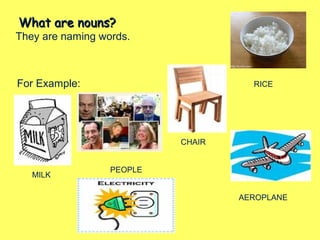
What are nouns?What are nouns?
They are naming words.
For Example:
MILK
CHAIR
RICE
AEROPLANE
PEOPLE
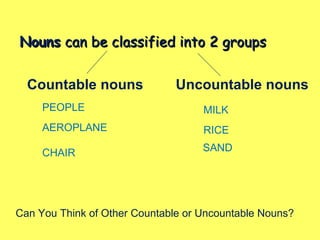
NounsNouns can be classified into 2 groupscan be classified into 2 groups
Countable nouns Uncountable nouns
PEOPLE
AEROPLANE
CHAIR
MILK
RICE
Can You Think of Other Countable or Uncountable Nouns?
SAND
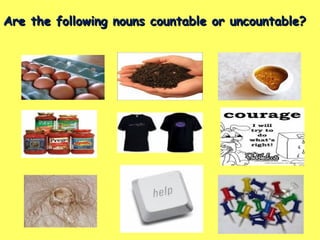
Are the following nouns countable or uncountable?Are the following nouns countable or uncountable?
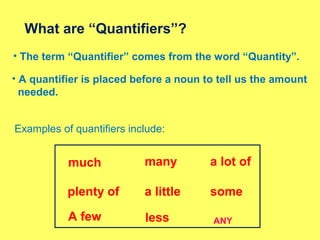
• The term “Quantifier” comes from the word “Quantity”.
What are “Quantifiers”?
• A quantifier is placed before a noun to tell us the amount
needed.
Examples of quantifiers include:
much many a lot of
a little
A few less
plenty of some
ANY
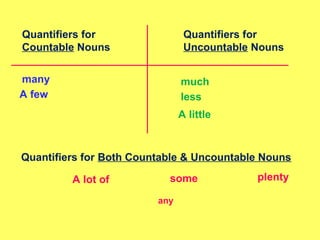
Quantifiers for
Countable Nouns
Quantifiers for
Uncountable Nouns
many
A few
much
less
A little
Quantifiers for Both Countable & Uncountable Nouns
A lot of plentysome
any
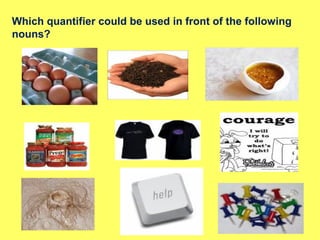
Which quantifier could be used in front of the following
nouns?
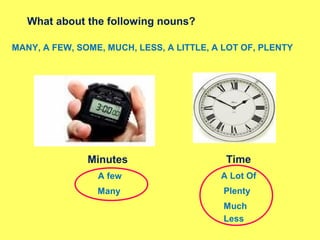
What about the following nouns?
Minutes Time
A Lot Of
Plenty
Much
A few
Many
Less
MANY, A FEW, SOME, MUCH, LESS, A LITTLE, A LOT OF, PLENTY
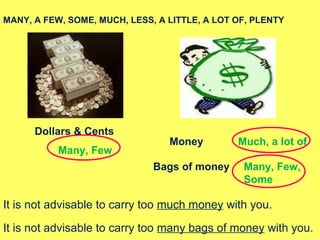
Dollars & Cents
Money
Bags of money
Many, Few
Much, a lot of
Many, Few,
Some
MANY, A FEW, SOME, MUCH, LESS, A LITTLE, A LOT OF, PLENTY
It is not advisable to carry too much money with you.
It is not advisable to carry too many bags of money with you.
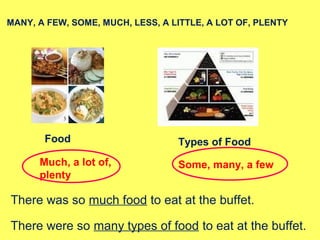
Food Types of Food
Much, a lot of,
plenty
MANY, A FEW, SOME, MUCH, LESS, A LITTLE, A LOT OF, PLENTY
Some, many, a few
There was so much food to eat at the buffet.
There were so many types of food to eat at the buffet.
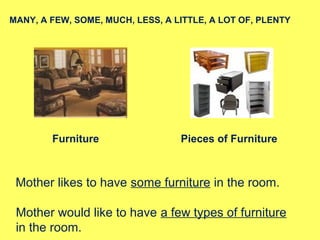
Furniture Pieces of Furniture
MANY, A FEW, SOME, MUCH, LESS, A LITTLE, A LOT OF, PLENTY
Mother likes to have some furniture in the room.
Mother would like to have a few types of furniture
in the room.
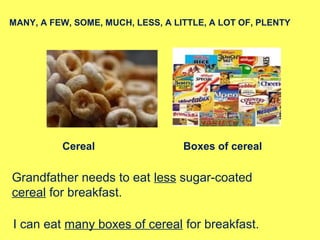
Cereal Boxes of cereal
MANY, A FEW, SOME, MUCH, LESS, A LITTLE, A LOT OF, PLENTY
Grandfather needs to eat less sugar-coated
cereal for breakfast.
I can eat many boxes of cereal for breakfast.
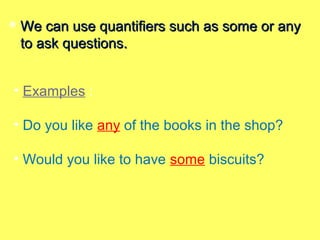
 We can use quantifiers such as some or anyWe can use quantifiers such as some or any
to ask questions.to ask questions.
• Examples :
• Do you like any of the books in the shop?
• Would you like to have some biscuits?
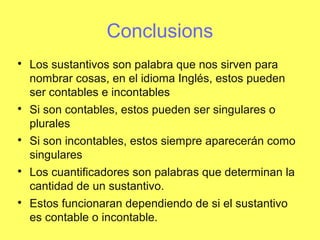
Conclusions

Los sustantivos son palabra que nos sirven para
nombrar cosas, en el idioma Inglés, estos pueden
ser contables e incontables

Si son contables, estos pueden ser singulares o
plurales

Si son incontables, estos siempre aparecerán como
singulares

Los cuantificadores son palabras que determinan la
cantidad de un sustantivo.

Estos funcionaran dependiendo de si el sustantivo
es contable o incontable.

Quantifiers

  • 1.
  • 2.
    Objetivos de laclase  Reconocer la diferencia entre sustantivos contables e incontables  Reconocer los cuantificadores y determinar con que tipo de sustantivos trabajan.
  • 3.
    What are nouns?Whatare nouns? They are naming words. For Example: MILK CHAIR RICE AEROPLANE PEOPLE
  • 4.
    NounsNouns can beclassified into 2 groupscan be classified into 2 groups Countable nouns Uncountable nouns PEOPLE AEROPLANE CHAIR MILK RICE Can You Think of Other Countable or Uncountable Nouns? SAND
  • 5.
    Are the followingnouns countable or uncountable?Are the following nouns countable or uncountable?
  • 6.
    • The term“Quantifier” comes from the word “Quantity”. What are “Quantifiers”? • A quantifier is placed before a noun to tell us the amount needed. Examples of quantifiers include: much many a lot of a little A few less plenty of some ANY
  • 7.
    Quantifiers for Countable Nouns Quantifiersfor Uncountable Nouns many A few much less A little Quantifiers for Both Countable & Uncountable Nouns A lot of plentysome any
  • 8.
    Which quantifier couldbe used in front of the following nouns?
  • 9.
    What about thefollowing nouns? Minutes Time A Lot Of Plenty Much A few Many Less MANY, A FEW, SOME, MUCH, LESS, A LITTLE, A LOT OF, PLENTY
  • 10.
    Dollars & Cents Money Bagsof money Many, Few Much, a lot of Many, Few, Some MANY, A FEW, SOME, MUCH, LESS, A LITTLE, A LOT OF, PLENTY It is not advisable to carry too much money with you. It is not advisable to carry too many bags of money with you.
  • 11.
    Food Types ofFood Much, a lot of, plenty MANY, A FEW, SOME, MUCH, LESS, A LITTLE, A LOT OF, PLENTY Some, many, a few There was so much food to eat at the buffet. There were so many types of food to eat at the buffet.
  • 12.
    Furniture Pieces ofFurniture MANY, A FEW, SOME, MUCH, LESS, A LITTLE, A LOT OF, PLENTY Mother likes to have some furniture in the room. Mother would like to have a few types of furniture in the room.
  • 13.
    Cereal Boxes ofcereal MANY, A FEW, SOME, MUCH, LESS, A LITTLE, A LOT OF, PLENTY Grandfather needs to eat less sugar-coated cereal for breakfast. I can eat many boxes of cereal for breakfast.
  • 14.
     We canuse quantifiers such as some or anyWe can use quantifiers such as some or any to ask questions.to ask questions. • Examples : • Do you like any of the books in the shop? • Would you like to have some biscuits?
  • 15.
    Conclusions  Los sustantivos sonpalabra que nos sirven para nombrar cosas, en el idioma Inglés, estos pueden ser contables e incontables  Si son contables, estos pueden ser singulares o plurales  Si son incontables, estos siempre aparecerán como singulares  Los cuantificadores son palabras que determinan la cantidad de un sustantivo.  Estos funcionaran dependiendo de si el sustantivo es contable o incontable.