Nouns & Determiners 
REVIEW
Countable nouns 
 A countable noun can be 
1. singular (banana) 
2. plural (bananas) 
Countable nouns are things we can count. 
 We can say ‘one banana’ ,‘two bananas’ etc.
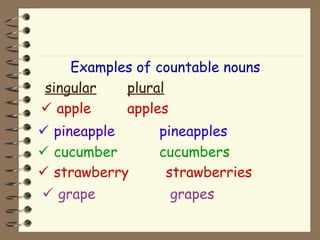
Examples of countable nouns 
singular plural 
 apple apples 
 pineapple pineapples 
 cucumber cucumbers 
 strawberry strawberries 
 grape grapes
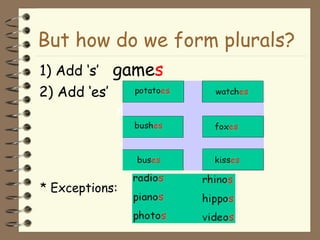
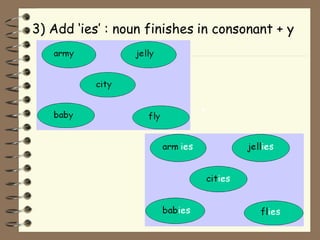
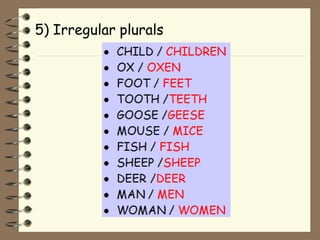
But how do we form plurals? 
1) Add ‘s’ games 
2) Add ‘es’ 
* Exceptions:
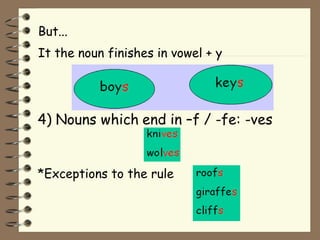
But... 
It the noun finishes in vowel + y 
*Exceptions to the rule
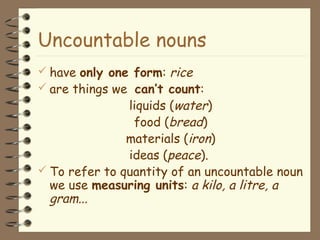
Uncountable nouns 
 have only one form: rice 
 are things we can’t count: 
liquids (water) 
food (bread) 
materials (iron) 
ideas (peace). 
 To refer to quantity of an uncountable noun 
we use measuring units: a kilo, a litre, a 
gram...
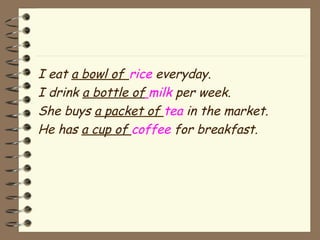
I eat a bowl of rice everyday. 
I drink a bottle of milk per week. 
She buys a packet of tea in the market. 
He has a cup of coffee for breakfast.
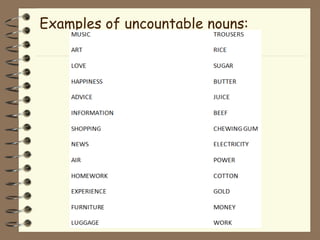
Examples of uncountable nouns:
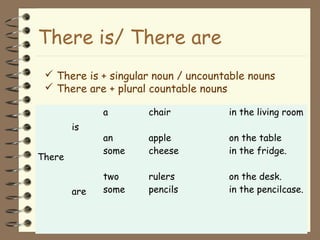
There is/ There are 
 There is + singular noun / uncountable nouns 
 There are + plural countable nouns 
There 
is 
a 
chair 
in the living room 
an apple on the table 
some cheese in the fridge. 
are 
two rulers on the desk. 
some pencils in the pencilcase.
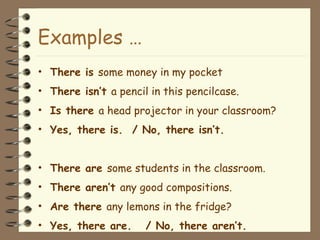
Examples … 
• There is some money in my pocket 
• There isn’t a pencil in this pencilcase. 
• Is there a head projector in your classroom? 
• Yes, there is. / No, there isn’t. 
• There are some students in the classroom. 
• There aren’t any good compositions. 
• Are there any lemons in the fridge? 
• Yes, there are. / No, there aren’t.
Determiners 
 A determiner is used to modify a noun. 
 It indicates reference to something specific or of a 
particular type. 
 It is followed by a noun.
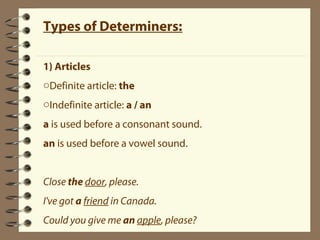
Types of Determiners: 
1) Articles 
oDefinite article: the 
oIndefinite article: a / an 
a is used before a consonant sound. 
an is used before a vowel sound. 
Close the door, please. 
I've got a friend in Canada. 
Could you give me an apple, please?
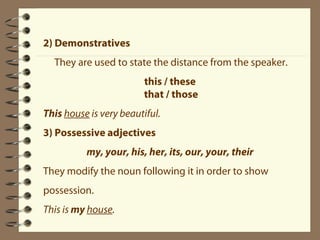
2) Demonstratives 
They are used to state the distance from the speaker. 
this / these 
that / those 
This house is very beautiful. 
3) Possessive adjectives 
my, your, his, her, its, our, your, their 
They modify the noun following it in order to show 
possession. 
This is my house.
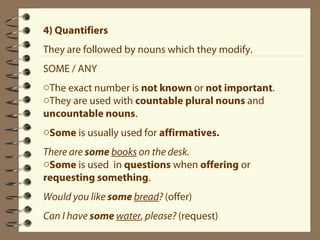
4) Quantifiers 
They are followed by nouns which they modify. 
SOME / ANY 
oThe exact number is not known or not important. 
oThey are used with countable plural nouns and 
uncountable nouns. 
oSome is usually used for affirmatives. 
There are some books on the desk. 
oSome is used in questions when offering or 
requesting something. 
Would you like some bread? (offer) 
Can I have some water, please? (request)
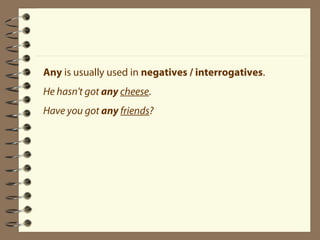
Any is usually used in negatives / interrogatives. 
He hasn't got any cheese. 
Have you got any friends?
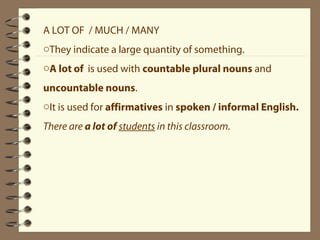
A LOT OF / MUCH / MANY 
oThey indicate a large quantity of something. 
oA lot of is used with countable plural nouns and 
uncountable nouns. 
oIt is used for affirmatives in spoken / informal English. 
There are a lot of students in this classroom.
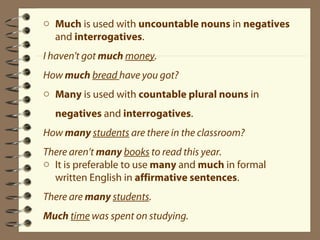
o Much is used with uncountable nouns in negatives 
and interrogatives. 
I haven't got much money. 
How much bread have you got? 
o Many is used with countable plural nouns in 
negatives and interrogatives. 
How many students are there in the classroom? 
There aren’t many books to read this year. 
o It is preferable to use many and much in formal 
written English in affirmative sentences. 
There are many students. 
Much time was spent on studying.
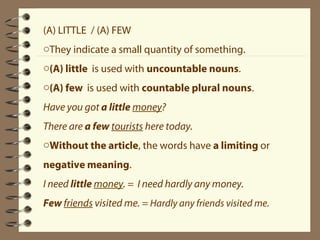
(A) LITTLE / (A) FEW 
oThey indicate a small quantity of something. 
o(A) little is used with uncountable nouns. 
o(A) few is used with countable plural nouns. 
Have you got a little money? 
There are a few tourists here today. 
oWithout the article, the words have a limiting or 
negative meaning. 
I need little money. = I need hardly any money. 
Few friends visited me. = Hardly any friends visited me.
NO 
oIt indicates negation of something. 
oIt is used with countable nouns and uncountable 
nouns. 
“How many pencils are there?” 
““There are no pencils = There aren’t any pencils.” 
“How much money have you got?” 
“I have no money. = I haven’t got any money.”

Nouns & Determiners

  • 1.
  • 2.
    Countable nouns A countable noun can be 1. singular (banana) 2. plural (bananas) Countable nouns are things we can count.  We can say ‘one banana’ ,‘two bananas’ etc.
  • 3.
    Examples of countablenouns singular plural  apple apples  pineapple pineapples  cucumber cucumbers  strawberry strawberries  grape grapes
  • 4.
    But how dowe form plurals? 1) Add ‘s’ games 2) Add ‘es’ * Exceptions:
  • 6.
    But... It thenoun finishes in vowel + y *Exceptions to the rule
  • 8.
    Uncountable nouns have only one form: rice  are things we can’t count: liquids (water) food (bread) materials (iron) ideas (peace).  To refer to quantity of an uncountable noun we use measuring units: a kilo, a litre, a gram...
  • 9.
    I eat abowl of rice everyday. I drink a bottle of milk per week. She buys a packet of tea in the market. He has a cup of coffee for breakfast.
  • 10.
  • 11.
    There is/ Thereare  There is + singular noun / uncountable nouns  There are + plural countable nouns There is a chair in the living room an apple on the table some cheese in the fridge. are two rulers on the desk. some pencils in the pencilcase.
  • 12.
    Examples … •There is some money in my pocket • There isn’t a pencil in this pencilcase. • Is there a head projector in your classroom? • Yes, there is. / No, there isn’t. • There are some students in the classroom. • There aren’t any good compositions. • Are there any lemons in the fridge? • Yes, there are. / No, there aren’t.
  • 13.
    Determiners  Adeterminer is used to modify a noun.  It indicates reference to something specific or of a particular type.  It is followed by a noun.
  • 14.
    Types of Determiners: 1) Articles oDefinite article: the oIndefinite article: a / an a is used before a consonant sound. an is used before a vowel sound. Close the door, please. I've got a friend in Canada. Could you give me an apple, please?
  • 15.
    2) Demonstratives Theyare used to state the distance from the speaker. this / these that / those This house is very beautiful. 3) Possessive adjectives my, your, his, her, its, our, your, their They modify the noun following it in order to show possession. This is my house.
  • 16.
    4) Quantifiers Theyare followed by nouns which they modify. SOME / ANY oThe exact number is not known or not important. oThey are used with countable plural nouns and uncountable nouns. oSome is usually used for affirmatives. There are some books on the desk. oSome is used in questions when offering or requesting something. Would you like some bread? (offer) Can I have some water, please? (request)
  • 17.
    Any is usuallyused in negatives / interrogatives. He hasn't got any cheese. Have you got any friends?
  • 18.
    A LOT OF/ MUCH / MANY oThey indicate a large quantity of something. oA lot of is used with countable plural nouns and uncountable nouns. oIt is used for affirmatives in spoken / informal English. There are a lot of students in this classroom.
  • 19.
    o Much isused with uncountable nouns in negatives and interrogatives. I haven't got much money. How much bread have you got? o Many is used with countable plural nouns in negatives and interrogatives. How many students are there in the classroom? There aren’t many books to read this year. o It is preferable to use many and much in formal written English in affirmative sentences. There are many students. Much time was spent on studying.
  • 20.
    (A) LITTLE /(A) FEW oThey indicate a small quantity of something. o(A) little is used with uncountable nouns. o(A) few is used with countable plural nouns. Have you got a little money? There are a few tourists here today. oWithout the article, the words have a limiting or negative meaning. I need little money. = I need hardly any money. Few friends visited me. = Hardly any friends visited me.
  • 21.
    NO oIt indicatesnegation of something. oIt is used with countable nouns and uncountable nouns. “How many pencils are there?” ““There are no pencils = There aren’t any pencils.” “How much money have you got?” “I have no money. = I haven’t got any money.”