PRESENTED BY
Mr. Gite Navnath Khandu.
First Yr. M.Pharm (QAT)
Roll No:- 206
GUIDED BY
Mr. Mahale M.V. (M.Pharm)
Dept. of Pharmaceutical Analysis
Amrutvahini College of Pharmacy, Sangamner.
3/15/2018Quality Risk Management
1. Introduction
2. Scope
3. Principles Of Quality Risk Management
4. General Quality Risk Management Process
a) Responsibilities
b) Initiating a Quality Risk Management Process
c) Risk Assessment
d) Risk Control
e) Risk Communication
f) Risk Review
5. Risk Management Methodology
6. Integration Of Quality Risk Management Into Industry And Regulatory Operations
7. References. 3/15/2018Quality Risk Management 1
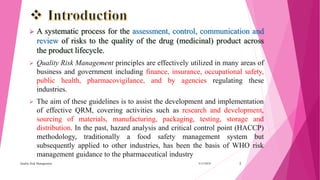
 A systematic process for the assessment, control, communication and
review of risks to the quality of the drug (medicinal) product across
the product lifecycle.
 Quality Risk Management principles are effectively utilized in many areas of
business and government including finance, insurance, occupational safety,
public health, pharmacovigilance, and by agencies regulating these
industries.
 The aim of these guidelines is to assist the development and implementation
of effective QRM, covering activities such as research and development,
sourcing of materials, manufacturing, packaging, testing, storage and
distribution. In the past, hazard analysis and critical control point (HACCP)
methodology, traditionally a food safety management system but
subsequently applied to other industries, has been the basis of WHO risk
management guidance to the pharmaceutical industry
3/15/2018Quality Risk Management 2
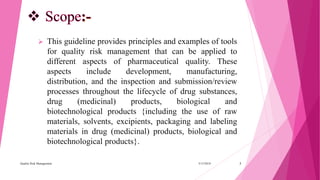
 This guideline provides principles and examples of tools
for quality risk management that can be applied to
different aspects of pharmaceutical quality. These
aspects include development, manufacturing,
distribution, and the inspection and submission/review
processes throughout the lifecycle of drug substances,
drug (medicinal) products, biological and
biotechnological products {including the use of raw
materials, solvents, excipients, packaging and labeling
materials in drug (medicinal) products, biological and
biotechnological products}.
3/15/2018Quality Risk Management 3
 Two primary principles of quality risk management are:
 The evaluation of the risk to quality should be based
on scientific knowledge and ultimately link to the
protection of the patient; and
 The level of effort, formality and documentation of
the quality risk management process should be
commensurate with the level of risk.
3/15/2018Quality Risk Management 4
 Quality risk management is a systematic process for
the assessment, control, communication and review
of risks to the quality of the drug (medicinal)
product across the product lifecycle.
3/15/2018Quality Risk Management 5
3/15/2018Quality Risk Management 6
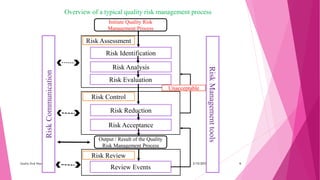
Initiate Quality Risk
Management Process
Risk Identification
Risk Analysis
Risk Evaluation
Risk Assessment
Risk Control
Risk Reduction
Risk Acceptance
Output / Result of the Quality
Risk Management Process
Review Events
Risk Review
RiskCommunication
RiskManagementtools
Unacceptable
Overview of a typical quality risk management process
3/15/2018Quality Risk Management 8
1. Responsibilities:-
 Quality risk management activities are usually, but not
always, undertaken by interdisciplinary teams.
 When teams are formed, they should include experts from
the appropriate areas (e.g., quality unit, business
development, engineering, regulatory affairs, production
operations, sales and marketing, legal, statistics and clinical)
 Decision makers should
 take responsibility for coordinating quality risk
management across various functions and departments of
their organization; and
 assure that a quality risk management process is defined,
deployed and reviewed and that adequate resources are
available.
3/15/2018Quality Risk Management 8
 Quality risk management should include systematic processes
designed to coordinate, facilitate and improve science-based decision
making with respect to risk. Possible steps used to initiate and plan a
quality risk management process might include the following:
 Define the problem and/or risk question, including pertinent
assumptions identifying the potential for risk;
 Assemble background information and/ or data on the potential
hazard, harm or human health impact relevant to the risk
assessment;
 Identify a leader and necessary resources;
 Specify a timeline, deliverables and appropriate level of decision
making for the risk management process.
3/15/2018Quality Risk Management 9
 Risk assessment consists of the identification of hazards and
the analysis and evaluation of risks associated with exposure
to those hazards.
 Risk identification is a systematic use of information to
identify hazards referring to the risk question or problem
description. Information can include historical data, theoretical
analysis, informed opinions, and the concerns of stakeholders.
 Risk analysis is the estimation of the risk associated with the
identified hazards. It is the qualitative or quantitative process
of linking the likelihood of occurrence and severity of harms.
In some risk management tools, the ability to detect the harm
(detectability) also factors in the estimation of risk.
 Risk evaluation compares the identified and analyzed
risk against given risk criteria. Risk evaluations
consider the strength of evidence for all three of the
fundamental questions.
 In doing an effective risk assessment, the robustness
of the data set is important because it determines the
quality of the output.
3/15/2018Quality Risk Management 10
4. Risk Control:-
 Risk control includes decision making to reduce and/or
accept risks.
 The purpose of risk control is to reduce the risk to an
acceptable level.
 The amount of effort used for risk control should be
proportional to the significance of the risk.
 Decision makers might use different processes,
including benefit-cost analysis, for understanding the
optimal level of risk control.
3/15/2018Quality Risk Management 11
 Risk reduction might include actions taken to mitigate
the severity and probability of harm.
 Processes that improve the detectability of hazards and
quality risks might also be used as part of a risk control
strategy.
 The implementation of risk reduction measures can
introduce new risks into the system or increase the
significance of other existing risks.
 Hence, it might be appropriate to revisit the risk
assessment to identify and evaluate any possible change
in risk after implementing a risk reduction process.
3/15/2018Quality Risk Management 12
 Risk acceptance is a decision to accept risk.
 Risk acceptance can be a formal decision to accept the
residual risk or it can be a passive decision in which
residual risks are not specified.
 For some types of harms, even the best quality risk
management practices might not entirely eliminate risk.
3/15/2018Quality Risk Management 13
 Risk communication is the sharing of information about risk
and risk management between the decision makers and others.
 The output/result of the quality risk management process
should be appropriately communicated and documented.
 Communications might include those among interested parties;
e.g., regulators and industry, industry and the patient, within a
company, industry or regulatory authority, etc.
 Communication need not be carried out for each and every risk
acceptance.
3/15/2018Quality Risk Management 14
6. Risk Review:-
 Risk management should be an ongoing part of the quality
management process.
 A mechanism to review or monitor events should be
implemented.
 Once a quality risk management process has been initiated, that
process should continue to be utilized for events that might
impact the original quality risk management decision, whether
these events are planned (e.g., results of product review,
inspections, audits, change control) or unplanned (e.g., root
cause from failure investigations, recall).
3/15/2018Quality Risk Management 16
Risk Management Methodology
 Quality risk management supports a scientific and practical
approach to decision-making.
 It provides documented, transparent and reproducible
methods to accomplish steps of the quality risk management
process based on current knowledge about assessing the
probability, severity and sometimes detectability of the risk.
 Such approaches continue to provide useful information that
might support topics such as handling of complaints, quality
defects, deviations and allocation of resources.
3/15/2018Quality Risk Management 17
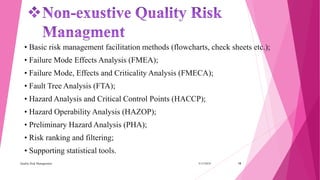
• Basic risk management facilitation methods (flowcharts, check sheets etc.);
• Failure Mode Effects Analysis (FMEA);
• Failure Mode, Effects and Criticality Analysis (FMECA);
• Fault Tree Analysis (FTA);
• Hazard Analysis and Critical Control Points (HACCP);
• Hazard Operability Analysis (HAZOP);
• Preliminary Hazard Analysis (PHA);
• Risk ranking and filtering;
• Supporting statistical tools.
3/15/2018Quality Risk Management 18
 Quality risk management is a process that supports science-
based and practical decisions when integrated into quality
systems.
 quality risk management can facilitate better and more
informed decisions, can provide regulators with greater
assurance of a company’s ability to deal with potential
risks, and might affect the extent and level of direct
regulatory oversight.
3/15/2018Quality Risk Management 19
 Integration Of Quality Risk Management
Into Industry And Regulatory Operations
 Training of both industry and regulatory personnel in quality
risk management processes provides for greater
understanding of decision-making processes and builds
confidence in quality risk management outcomes.
 Quality risk management should be integrated into existing
operations and documented appropriately.
3/15/2018Quality Risk Management 20
 Examples for industry and regulatory operations
 Quality management.
 Examples for industry operations and activities
 Development;
 Facility, equipment and utilities;
 Materials management;
 Production;
 Laboratory control and stability testing;
 Packaging and labeling.
 Examples for regulatory operations
 Inspection and assessment activities.
3/15/2018Quality Risk Management 21
1) Quality Risk Management : INTERNATIONAL CONFERENCE ON
HORMONISATION –(ICH) Q9 Guidline –9 November 2005
3/15/2018Quality Risk Management 21
References:-
3/15/2018 22Quality Risk Management

Quality Risk Management

  • 1.
    PRESENTED BY Mr. GiteNavnath Khandu. First Yr. M.Pharm (QAT) Roll No:- 206 GUIDED BY Mr. Mahale M.V. (M.Pharm) Dept. of Pharmaceutical Analysis Amrutvahini College of Pharmacy, Sangamner. 3/15/2018Quality Risk Management
  • 2.
    1. Introduction 2. Scope 3.Principles Of Quality Risk Management 4. General Quality Risk Management Process a) Responsibilities b) Initiating a Quality Risk Management Process c) Risk Assessment d) Risk Control e) Risk Communication f) Risk Review 5. Risk Management Methodology 6. Integration Of Quality Risk Management Into Industry And Regulatory Operations 7. References. 3/15/2018Quality Risk Management 1
  • 3.
     A systematicprocess for the assessment, control, communication and review of risks to the quality of the drug (medicinal) product across the product lifecycle.  Quality Risk Management principles are effectively utilized in many areas of business and government including finance, insurance, occupational safety, public health, pharmacovigilance, and by agencies regulating these industries.  The aim of these guidelines is to assist the development and implementation of effective QRM, covering activities such as research and development, sourcing of materials, manufacturing, packaging, testing, storage and distribution. In the past, hazard analysis and critical control point (HACCP) methodology, traditionally a food safety management system but subsequently applied to other industries, has been the basis of WHO risk management guidance to the pharmaceutical industry 3/15/2018Quality Risk Management 2
  • 4.
     This guidelineprovides principles and examples of tools for quality risk management that can be applied to different aspects of pharmaceutical quality. These aspects include development, manufacturing, distribution, and the inspection and submission/review processes throughout the lifecycle of drug substances, drug (medicinal) products, biological and biotechnological products {including the use of raw materials, solvents, excipients, packaging and labeling materials in drug (medicinal) products, biological and biotechnological products}. 3/15/2018Quality Risk Management 3
  • 5.
     Two primaryprinciples of quality risk management are:  The evaluation of the risk to quality should be based on scientific knowledge and ultimately link to the protection of the patient; and  The level of effort, formality and documentation of the quality risk management process should be commensurate with the level of risk. 3/15/2018Quality Risk Management 4
  • 6.
     Quality riskmanagement is a systematic process for the assessment, control, communication and review of risks to the quality of the drug (medicinal) product across the product lifecycle. 3/15/2018Quality Risk Management 5
  • 7.
    3/15/2018Quality Risk Management6 Initiate Quality Risk Management Process Risk Identification Risk Analysis Risk Evaluation Risk Assessment Risk Control Risk Reduction Risk Acceptance Output / Result of the Quality Risk Management Process Review Events Risk Review RiskCommunication RiskManagementtools Unacceptable Overview of a typical quality risk management process
  • 8.
    3/15/2018Quality Risk Management8 1. Responsibilities:-  Quality risk management activities are usually, but not always, undertaken by interdisciplinary teams.  When teams are formed, they should include experts from the appropriate areas (e.g., quality unit, business development, engineering, regulatory affairs, production operations, sales and marketing, legal, statistics and clinical)  Decision makers should  take responsibility for coordinating quality risk management across various functions and departments of their organization; and  assure that a quality risk management process is defined, deployed and reviewed and that adequate resources are available.
  • 9.
    3/15/2018Quality Risk Management8  Quality risk management should include systematic processes designed to coordinate, facilitate and improve science-based decision making with respect to risk. Possible steps used to initiate and plan a quality risk management process might include the following:  Define the problem and/or risk question, including pertinent assumptions identifying the potential for risk;  Assemble background information and/ or data on the potential hazard, harm or human health impact relevant to the risk assessment;  Identify a leader and necessary resources;  Specify a timeline, deliverables and appropriate level of decision making for the risk management process.
  • 10.
    3/15/2018Quality Risk Management9  Risk assessment consists of the identification of hazards and the analysis and evaluation of risks associated with exposure to those hazards.  Risk identification is a systematic use of information to identify hazards referring to the risk question or problem description. Information can include historical data, theoretical analysis, informed opinions, and the concerns of stakeholders.  Risk analysis is the estimation of the risk associated with the identified hazards. It is the qualitative or quantitative process of linking the likelihood of occurrence and severity of harms. In some risk management tools, the ability to detect the harm (detectability) also factors in the estimation of risk.
  • 11.
     Risk evaluationcompares the identified and analyzed risk against given risk criteria. Risk evaluations consider the strength of evidence for all three of the fundamental questions.  In doing an effective risk assessment, the robustness of the data set is important because it determines the quality of the output. 3/15/2018Quality Risk Management 10
  • 12.
    4. Risk Control:- Risk control includes decision making to reduce and/or accept risks.  The purpose of risk control is to reduce the risk to an acceptable level.  The amount of effort used for risk control should be proportional to the significance of the risk.  Decision makers might use different processes, including benefit-cost analysis, for understanding the optimal level of risk control. 3/15/2018Quality Risk Management 11
  • 13.
     Risk reductionmight include actions taken to mitigate the severity and probability of harm.  Processes that improve the detectability of hazards and quality risks might also be used as part of a risk control strategy.  The implementation of risk reduction measures can introduce new risks into the system or increase the significance of other existing risks.  Hence, it might be appropriate to revisit the risk assessment to identify and evaluate any possible change in risk after implementing a risk reduction process. 3/15/2018Quality Risk Management 12
  • 14.
     Risk acceptanceis a decision to accept risk.  Risk acceptance can be a formal decision to accept the residual risk or it can be a passive decision in which residual risks are not specified.  For some types of harms, even the best quality risk management practices might not entirely eliminate risk. 3/15/2018Quality Risk Management 13
  • 15.
     Risk communicationis the sharing of information about risk and risk management between the decision makers and others.  The output/result of the quality risk management process should be appropriately communicated and documented.  Communications might include those among interested parties; e.g., regulators and industry, industry and the patient, within a company, industry or regulatory authority, etc.  Communication need not be carried out for each and every risk acceptance. 3/15/2018Quality Risk Management 14
  • 16.
    6. Risk Review:- Risk management should be an ongoing part of the quality management process.  A mechanism to review or monitor events should be implemented.  Once a quality risk management process has been initiated, that process should continue to be utilized for events that might impact the original quality risk management decision, whether these events are planned (e.g., results of product review, inspections, audits, change control) or unplanned (e.g., root cause from failure investigations, recall). 3/15/2018Quality Risk Management 16
  • 17.
    Risk Management Methodology Quality risk management supports a scientific and practical approach to decision-making.  It provides documented, transparent and reproducible methods to accomplish steps of the quality risk management process based on current knowledge about assessing the probability, severity and sometimes detectability of the risk.  Such approaches continue to provide useful information that might support topics such as handling of complaints, quality defects, deviations and allocation of resources. 3/15/2018Quality Risk Management 17
  • 18.
    • Basic riskmanagement facilitation methods (flowcharts, check sheets etc.); • Failure Mode Effects Analysis (FMEA); • Failure Mode, Effects and Criticality Analysis (FMECA); • Fault Tree Analysis (FTA); • Hazard Analysis and Critical Control Points (HACCP); • Hazard Operability Analysis (HAZOP); • Preliminary Hazard Analysis (PHA); • Risk ranking and filtering; • Supporting statistical tools. 3/15/2018Quality Risk Management 18
  • 19.
     Quality riskmanagement is a process that supports science- based and practical decisions when integrated into quality systems.  quality risk management can facilitate better and more informed decisions, can provide regulators with greater assurance of a company’s ability to deal with potential risks, and might affect the extent and level of direct regulatory oversight. 3/15/2018Quality Risk Management 19  Integration Of Quality Risk Management Into Industry And Regulatory Operations
  • 20.
     Training ofboth industry and regulatory personnel in quality risk management processes provides for greater understanding of decision-making processes and builds confidence in quality risk management outcomes.  Quality risk management should be integrated into existing operations and documented appropriately. 3/15/2018Quality Risk Management 20
  • 21.
     Examples forindustry and regulatory operations  Quality management.  Examples for industry operations and activities  Development;  Facility, equipment and utilities;  Materials management;  Production;  Laboratory control and stability testing;  Packaging and labeling.  Examples for regulatory operations  Inspection and assessment activities. 3/15/2018Quality Risk Management 21
  • 22.
    1) Quality RiskManagement : INTERNATIONAL CONFERENCE ON HORMONISATION –(ICH) Q9 Guidline –9 November 2005 3/15/2018Quality Risk Management 21 References:-
  • 23.