QUALITY
RISK MANAGEMENT
ICH Q9
Presented By: Rashid Mureed7/21/2014
Quality Risk Managment (ICH-Q9)
QUALITY
RISK MANAGEMENT
ICH-Q9
CONTENTS
 Introduction/Definition
 New Paradigm/Incremental Steps
 Contributing items to manage quality risks
 Principles of Quality Risk Management
 Basis of Quality Risk Management
 Quality Risk Management Process
 Risk Management Methods & Tools
 Potential Applications for QRM
 Adv. of QRM as technique
 Challenges
 Opportunity for the Industry & Regulators
 Change in behaviour
7/21/2014Quality Risk Managment (ICH-Q9)
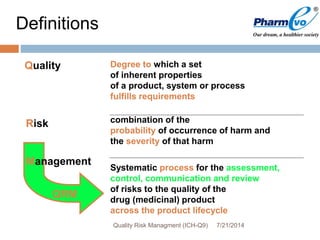
Quality
Risk
Degree to which a set
of inherent properties
of a product, system or process
fulfills requirements
combination of the
probability of occurrence of harm and
the severity of that harm
Management
QRM
Systematic process for the assessment,
control, communication and review
of risks to the quality of the
drug (medicinal) product
across the product lifecycle
Definitions
7/21/2014Quality Risk Managment (ICH-Q9)
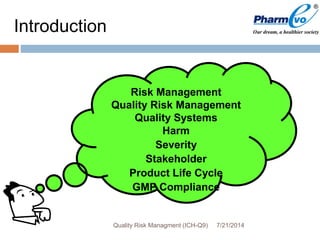
Introduction
7/21/2014Quality Risk Managment (ICH-Q9)
Risk Management
Quality Risk Management
Quality Systems
Harm
Severity
Stakeholder
Product Life Cycle
GMP Compliance
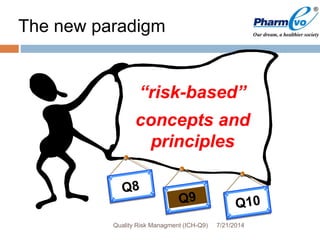
“risk-based”
concepts and
principles
The new paradigm
7/21/2014Quality Risk Managment (ICH-Q9)
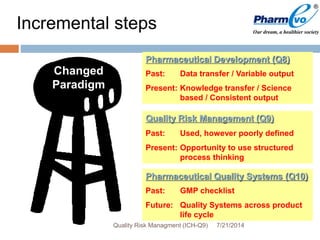
Incremental steps
Pharmaceutical Development (Q8)
Past: Data transfer / Variable output
Present: Knowledge transfer / Science
based / Consistent output
Quality Risk Management (Q9)
Past: Used, however poorly defined
Present: Opportunity to use structured
process thinking
Pharmaceutical Quality Systems (Q10)
Past: GMP checklist
Future: Quality Systems across product
life cycle
Changed
Paradigm
7/21/2014Quality Risk Managment (ICH-Q9)
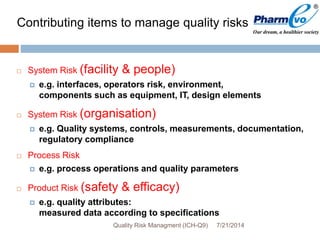
 System Risk (facility & people)
 e.g. interfaces, operators risk, environment,
components such as equipment, IT, design elements
 System Risk (organisation)
 e.g. Quality systems, controls, measurements, documentation,
regulatory compliance
 Process Risk
 e.g. process operations and quality parameters
 Product Risk (safety & efficacy)
 e.g. quality attributes:
measured data according to specifications
Contributing items to manage quality risks
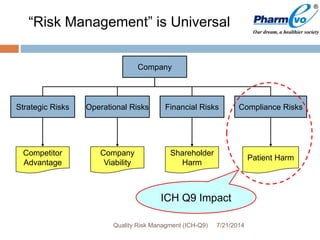
“Risk Management” is Universal
Company
Operational Risks Financial Risks Compliance Risks
Company
Viability
Shareholder
Harm
Patient Harm
ICH Q9 Impact
Competitor
Advantage
Strategic Risks
7/21/2014Quality Risk Managment (ICH-Q9)
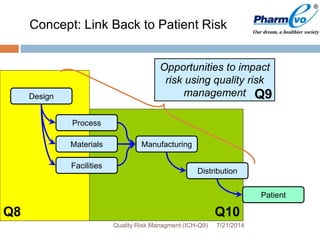
Concept: Link Back to Patient Risk
7/21/2014Quality Risk Managment (ICH-Q9)
Q8 Q10
Process
Materials
Design
Manufacturing
Distribution
Patient
Facilities
Opportunities to impact
risk using quality risk
management Q9
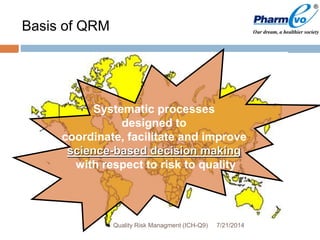
Systematic processes
designed to
coordinate, facilitate and improve
science-based decision making
with respect to risk to quality
7/21/2014Quality Risk Managment (ICH-Q9)
Basis of QRM
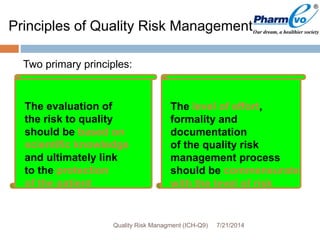
Principles of Quality Risk Management
The evaluation of
the risk to quality
should be based on
scientific knowledge
and ultimately link
to the protection
of the patient
The level of effort,
formality and
documentation
of the quality risk
management process
should be commensurate
with the level of risk
7/21/2014Quality Risk Managment (ICH-Q9)
Two primary principles:
7/21/2014Quality Risk Managment (ICH-Q9)
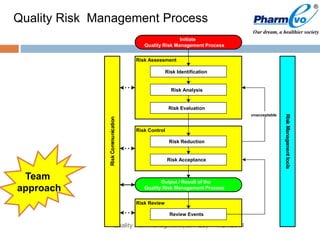
Risk Review
RiskCommunication
Risk Assessment
Risk Evaluation
unacceptable
Risk Control
Risk Analysis
Risk Reduction
Risk Identification
Review Events
Risk Acceptance
Initiate
Quality Risk Management Process
Output / Result of the
Quality Risk Management Process
RiskManagementtools
Team
approach
Quality Risk Management Process
7/21/2014Quality Risk Managment (ICH-Q9)
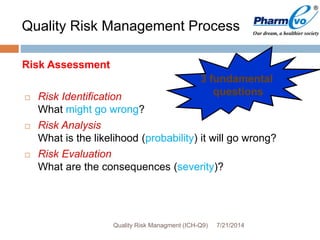
 Risk Identification
What might go wrong?
 Risk Analysis
What is the likelihood (probability) it will go wrong?
 Risk Evaluation
What are the consequences (severity)?
Risk Assessment
3 fundamental
questions
Quality Risk Management Process
7/21/2014Quality Risk Managment (ICH-Q9)
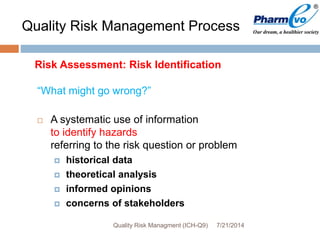
“What might go wrong?”
 A systematic use of information
to identify hazards
referring to the risk question or problem
 historical data
 theoretical analysis
 informed opinions
 concerns of stakeholders
Risk Assessment: Risk Identification
Quality Risk Management Process
7/21/2014Quality Risk Managment (ICH-Q9)
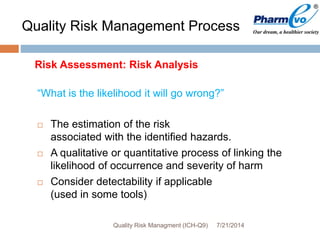
“What is the likelihood it will go wrong?”
 The estimation of the risk
associated with the identified hazards.
 A qualitative or quantitative process of linking the
likelihood of occurrence and severity of harm
 Consider detectability if applicable
(used in some tools)
Risk Assessment: Risk Analysis
Quality Risk Management Process
7/21/2014Quality Risk Managment (ICH-Q9)
Risk Assessment: Risk Analysis
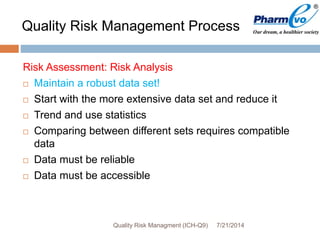
 Maintain a robust data set!
 Start with the more extensive data set and reduce it
 Trend and use statistics
 Comparing between different sets requires compatible
data
 Data must be reliable
 Data must be accessible
Quality Risk Management Process
7/21/2014Quality Risk Managment (ICH-Q9)
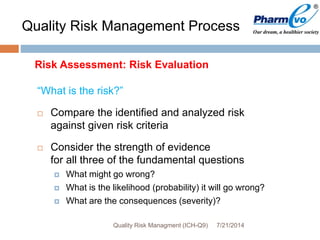
“What is the risk?”
 Compare the identified and analyzed risk
against given risk criteria
 Consider the strength of evidence
for all three of the fundamental questions
 What might go wrong?
 What is the likelihood (probability) it will go wrong?
 What are the consequences (severity)?
Risk Assessment: Risk Evaluation
Quality Risk Management Process
7/21/2014Quality Risk Managment (ICH-Q9)
Risk Assessment: Risk Evaluation
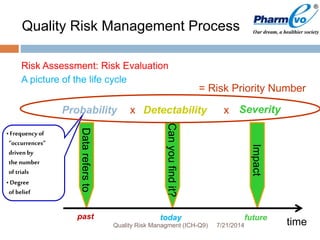
A picture of the life cycle
Probability Detectability Severity
past today future
Datarefersto
Impact
Canyoufindit?
= Risk Priority Number
x x
• Frequency of
“occurrences”
driven by
the number
of trials
• Degree
of belief
time
Quality Risk Management Process
7/21/2014Quality Risk Managment (ICH-Q9)
Quality Risk Management Process
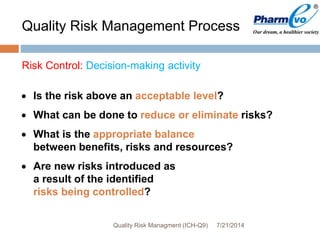
 Is the risk above an acceptable level?
 What can be done to reduce or eliminate risks?
 What is the appropriate balance
between benefits, risks and resources?
 Are new risks introduced as
a result of the identified
risks being controlled?
Risk Control: Decision-making activity
7/21/2014Quality Risk Managment (ICH-Q9)
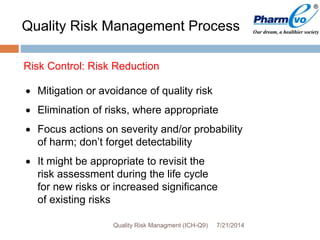
 Mitigation or avoidance of quality risk
 Elimination of risks, where appropriate
 Focus actions on severity and/or probability
of harm; don’t forget detectability
 It might be appropriate to revisit the
risk assessment during the life cycle
for new risks or increased significance
of existing risks
Risk Control: Risk Reduction
Quality Risk Management Process
7/21/2014Quality Risk Managment (ICH-Q9)
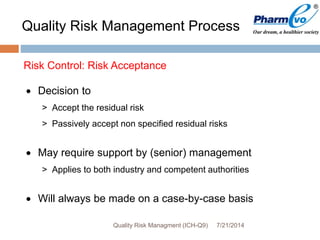
 Decision to
> Accept the residual risk
> Passively accept non specified residual risks
 May require support by (senior) management
> Applies to both industry and competent authorities
 Will always be made on a case-by-case basis
Risk Control: Risk Acceptance
Quality Risk Management Process
7/21/2014Quality Risk Managment (ICH-Q9)
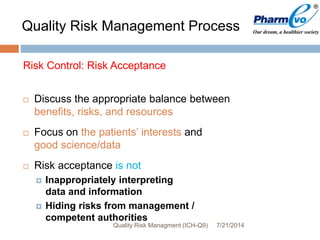
Risk Control: Risk Acceptance
 Discuss the appropriate balance between
benefits, risks, and resources
 Focus on the patients’ interests and
good science/data
 Risk acceptance is not
 Inappropriately interpreting
data and information
 Hiding risks from management /
competent authorities
Quality Risk Management Process
7/21/2014Quality Risk Managment (ICH-Q9)
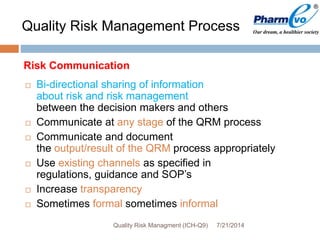
 Bi-directional sharing of information
about risk and risk management
between the decision makers and others
 Communicate at any stage of the QRM process
 Communicate and document
the output/result of the QRM process appropriately
 Use existing channels as specified in
regulations, guidance and SOP’s
 Increase transparency
 Sometimes formal sometimes informal
Risk Communication
Quality Risk Management Process
7/21/2014Quality Risk Managment (ICH-Q9)
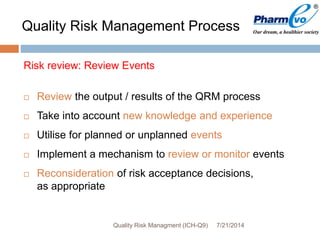
Risk review: Review Events
 Review the output / results of the QRM process
 Take into account new knowledge and experience
 Utilise for planned or unplanned events
 Implement a mechanism to review or monitor events
 Reconsideration of risk acceptance decisions,
as appropriate
Quality Risk Management Process
7/21/2014Quality Risk Managment (ICH-Q9)
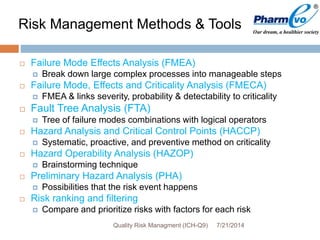
 Failure Mode Effects Analysis (FMEA)
 Break down large complex processes into manageable steps
 Failure Mode, Effects and Criticality Analysis (FMECA)
 FMEA & links severity, probability & detectability to criticality
 Fault Tree Analysis (FTA)
 Tree of failure modes combinations with logical operators
 Hazard Analysis and Critical Control Points (HACCP)
 Systematic, proactive, and preventive method on criticality
 Hazard Operability Analysis (HAZOP)
 Brainstorming technique
 Preliminary Hazard Analysis (PHA)
 Possibilities that the risk event happens
 Risk ranking and filtering
 Compare and prioritize risks with factors for each risk
Risk Management Methods & Tools
7/21/2014Quality Risk Managment (ICH-Q9)
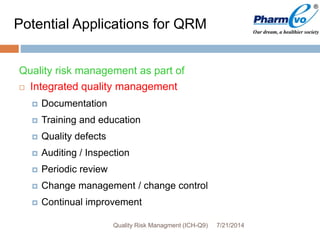
Quality risk management as part of
 Integrated quality management
 Documentation
 Training and education
 Quality defects
 Auditing / Inspection
 Periodic review
 Change management / change control
 Continual improvement
Potential Applications for QRM
7/21/2014Quality Risk Managment (ICH-Q9)
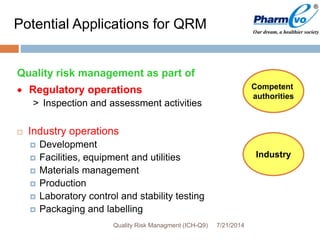
Quality risk management as part of
 Regulatory operations
> Inspection and assessment activities
 Industry operations
 Development
 Facilities, equipment and utilities
 Materials management
 Production
 Laboratory control and stability testing
 Packaging and labelling
Competent
authorities
Industry
Potential Applications for QRM
Adv. of QRM as technique
• Improves decision making
– Identifies what gives most benefit to the patient
• Is scientific & data-driven
– Reduces subjectivity
• Ranks risk - allows prioritization
– Better use of resources
• Means of building in Quality
• Improves transparency - inside organisation and builds
trust with competent authorities
– Enables regulatory flexibility
• Benefits apply throughout product lifecycle
7/21/2014Quality Risk Managment (ICH-Q9)
Challenges
• Interpreting and adopting the concepts
of quality risk management into specific areas
– Embed this behavior into quality aspects
of business, technology and regulation
– Adopt in existing structures, organizations and
Quality System
– Balance the documented use of “informal” and
“formal” quality risk management
7/21/2014Quality Risk Managment (ICH-Q9)
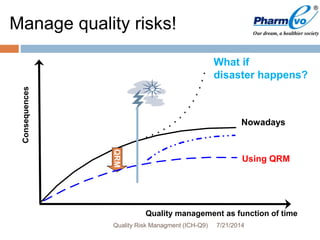
Consequences
What if
disaster happens?
Nowadays
QRM
Using QRM
Manage quality risks!
Quality management as function of time
7/21/2014Quality Risk Managment (ICH-Q9)
• Using the same guideline apply QRM to
– Industry (development, manufacture and distribution)
– Competent authorities (reviewer and inspectorate)
• Facilitates common approaches to quality risk
management in our every day jobs
• Supports science-based decision making
• Focus resources based on risks to patients
• Avoids restrictive and unnecessary requirements
• Facilitates communication and transparency
Opportunity for the Industry &
Regulators
7/21/2014Quality Risk Managment (ICH-Q9)
Remember
• The use of Quality Risk Management is not mandatory
However, if you don’t use it,
you will not gain the benefits
7/21/2014Quality Risk Managment (ICH-Q9)
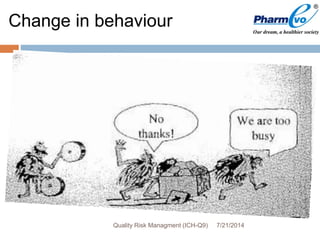
Change in behaviour
7/21/2014Quality Risk Managment (ICH-Q9)
Change in behaviour
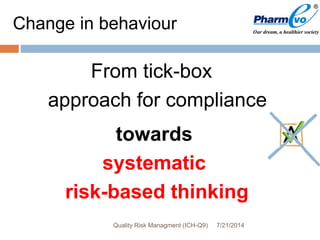
From tick-box
approach for compliance
towards
systematic
risk-based thinking
7/21/2014Quality Risk Managment (ICH-Q9)
Change in behaviour
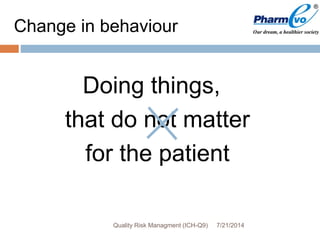
Doing things,
that do not matter
for the patient
7/21/2014Quality Risk Managment (ICH-Q9)
Focus resources
where they matter most to protect the patient

Quality Risk Management-ICH Q9-2014

  • 1.
    QUALITY RISK MANAGEMENT ICH Q9 PresentedBy: Rashid Mureed7/21/2014 Quality Risk Managment (ICH-Q9) QUALITY RISK MANAGEMENT ICH-Q9
  • 2.
    CONTENTS  Introduction/Definition  NewParadigm/Incremental Steps  Contributing items to manage quality risks  Principles of Quality Risk Management  Basis of Quality Risk Management  Quality Risk Management Process  Risk Management Methods & Tools  Potential Applications for QRM  Adv. of QRM as technique  Challenges  Opportunity for the Industry & Regulators  Change in behaviour 7/21/2014Quality Risk Managment (ICH-Q9)
  • 3.
    Quality Risk Degree to whicha set of inherent properties of a product, system or process fulfills requirements combination of the probability of occurrence of harm and the severity of that harm Management QRM Systematic process for the assessment, control, communication and review of risks to the quality of the drug (medicinal) product across the product lifecycle Definitions 7/21/2014Quality Risk Managment (ICH-Q9)
  • 4.
    Introduction 7/21/2014Quality Risk Managment(ICH-Q9) Risk Management Quality Risk Management Quality Systems Harm Severity Stakeholder Product Life Cycle GMP Compliance
  • 5.
    “risk-based” concepts and principles The newparadigm 7/21/2014Quality Risk Managment (ICH-Q9)
  • 6.
    Incremental steps Pharmaceutical Development(Q8) Past: Data transfer / Variable output Present: Knowledge transfer / Science based / Consistent output Quality Risk Management (Q9) Past: Used, however poorly defined Present: Opportunity to use structured process thinking Pharmaceutical Quality Systems (Q10) Past: GMP checklist Future: Quality Systems across product life cycle Changed Paradigm 7/21/2014Quality Risk Managment (ICH-Q9)
  • 7.
    7/21/2014Quality Risk Managment(ICH-Q9)  System Risk (facility & people)  e.g. interfaces, operators risk, environment, components such as equipment, IT, design elements  System Risk (organisation)  e.g. Quality systems, controls, measurements, documentation, regulatory compliance  Process Risk  e.g. process operations and quality parameters  Product Risk (safety & efficacy)  e.g. quality attributes: measured data according to specifications Contributing items to manage quality risks
  • 8.
    “Risk Management” isUniversal Company Operational Risks Financial Risks Compliance Risks Company Viability Shareholder Harm Patient Harm ICH Q9 Impact Competitor Advantage Strategic Risks 7/21/2014Quality Risk Managment (ICH-Q9)
  • 9.
    Concept: Link Backto Patient Risk 7/21/2014Quality Risk Managment (ICH-Q9) Q8 Q10 Process Materials Design Manufacturing Distribution Patient Facilities Opportunities to impact risk using quality risk management Q9
  • 10.
    Systematic processes designed to coordinate,facilitate and improve science-based decision making with respect to risk to quality 7/21/2014Quality Risk Managment (ICH-Q9) Basis of QRM
  • 11.
    Principles of QualityRisk Management The evaluation of the risk to quality should be based on scientific knowledge and ultimately link to the protection of the patient The level of effort, formality and documentation of the quality risk management process should be commensurate with the level of risk 7/21/2014Quality Risk Managment (ICH-Q9) Two primary principles:
  • 12.
    7/21/2014Quality Risk Managment(ICH-Q9) Risk Review RiskCommunication Risk Assessment Risk Evaluation unacceptable Risk Control Risk Analysis Risk Reduction Risk Identification Review Events Risk Acceptance Initiate Quality Risk Management Process Output / Result of the Quality Risk Management Process RiskManagementtools Team approach Quality Risk Management Process
  • 13.
    7/21/2014Quality Risk Managment(ICH-Q9)  Risk Identification What might go wrong?  Risk Analysis What is the likelihood (probability) it will go wrong?  Risk Evaluation What are the consequences (severity)? Risk Assessment 3 fundamental questions Quality Risk Management Process
  • 14.
    7/21/2014Quality Risk Managment(ICH-Q9) “What might go wrong?”  A systematic use of information to identify hazards referring to the risk question or problem  historical data  theoretical analysis  informed opinions  concerns of stakeholders Risk Assessment: Risk Identification Quality Risk Management Process
  • 15.
    7/21/2014Quality Risk Managment(ICH-Q9) “What is the likelihood it will go wrong?”  The estimation of the risk associated with the identified hazards.  A qualitative or quantitative process of linking the likelihood of occurrence and severity of harm  Consider detectability if applicable (used in some tools) Risk Assessment: Risk Analysis Quality Risk Management Process
  • 16.
    7/21/2014Quality Risk Managment(ICH-Q9) Risk Assessment: Risk Analysis  Maintain a robust data set!  Start with the more extensive data set and reduce it  Trend and use statistics  Comparing between different sets requires compatible data  Data must be reliable  Data must be accessible Quality Risk Management Process
  • 17.
    7/21/2014Quality Risk Managment(ICH-Q9) “What is the risk?”  Compare the identified and analyzed risk against given risk criteria  Consider the strength of evidence for all three of the fundamental questions  What might go wrong?  What is the likelihood (probability) it will go wrong?  What are the consequences (severity)? Risk Assessment: Risk Evaluation Quality Risk Management Process
  • 18.
    7/21/2014Quality Risk Managment(ICH-Q9) Risk Assessment: Risk Evaluation A picture of the life cycle Probability Detectability Severity past today future Datarefersto Impact Canyoufindit? = Risk Priority Number x x • Frequency of “occurrences” driven by the number of trials • Degree of belief time Quality Risk Management Process
  • 19.
    7/21/2014Quality Risk Managment(ICH-Q9) Quality Risk Management Process  Is the risk above an acceptable level?  What can be done to reduce or eliminate risks?  What is the appropriate balance between benefits, risks and resources?  Are new risks introduced as a result of the identified risks being controlled? Risk Control: Decision-making activity
  • 20.
    7/21/2014Quality Risk Managment(ICH-Q9)  Mitigation or avoidance of quality risk  Elimination of risks, where appropriate  Focus actions on severity and/or probability of harm; don’t forget detectability  It might be appropriate to revisit the risk assessment during the life cycle for new risks or increased significance of existing risks Risk Control: Risk Reduction Quality Risk Management Process
  • 21.
    7/21/2014Quality Risk Managment(ICH-Q9)  Decision to > Accept the residual risk > Passively accept non specified residual risks  May require support by (senior) management > Applies to both industry and competent authorities  Will always be made on a case-by-case basis Risk Control: Risk Acceptance Quality Risk Management Process
  • 22.
    7/21/2014Quality Risk Managment(ICH-Q9) Risk Control: Risk Acceptance  Discuss the appropriate balance between benefits, risks, and resources  Focus on the patients’ interests and good science/data  Risk acceptance is not  Inappropriately interpreting data and information  Hiding risks from management / competent authorities Quality Risk Management Process
  • 23.
    7/21/2014Quality Risk Managment(ICH-Q9)  Bi-directional sharing of information about risk and risk management between the decision makers and others  Communicate at any stage of the QRM process  Communicate and document the output/result of the QRM process appropriately  Use existing channels as specified in regulations, guidance and SOP’s  Increase transparency  Sometimes formal sometimes informal Risk Communication Quality Risk Management Process
  • 24.
    7/21/2014Quality Risk Managment(ICH-Q9) Risk review: Review Events  Review the output / results of the QRM process  Take into account new knowledge and experience  Utilise for planned or unplanned events  Implement a mechanism to review or monitor events  Reconsideration of risk acceptance decisions, as appropriate Quality Risk Management Process
  • 25.
    7/21/2014Quality Risk Managment(ICH-Q9)  Failure Mode Effects Analysis (FMEA)  Break down large complex processes into manageable steps  Failure Mode, Effects and Criticality Analysis (FMECA)  FMEA & links severity, probability & detectability to criticality  Fault Tree Analysis (FTA)  Tree of failure modes combinations with logical operators  Hazard Analysis and Critical Control Points (HACCP)  Systematic, proactive, and preventive method on criticality  Hazard Operability Analysis (HAZOP)  Brainstorming technique  Preliminary Hazard Analysis (PHA)  Possibilities that the risk event happens  Risk ranking and filtering  Compare and prioritize risks with factors for each risk Risk Management Methods & Tools
  • 26.
    7/21/2014Quality Risk Managment(ICH-Q9) Quality risk management as part of  Integrated quality management  Documentation  Training and education  Quality defects  Auditing / Inspection  Periodic review  Change management / change control  Continual improvement Potential Applications for QRM
  • 27.
    7/21/2014Quality Risk Managment(ICH-Q9) Quality risk management as part of  Regulatory operations > Inspection and assessment activities  Industry operations  Development  Facilities, equipment and utilities  Materials management  Production  Laboratory control and stability testing  Packaging and labelling Competent authorities Industry Potential Applications for QRM
  • 28.
    Adv. of QRMas technique • Improves decision making – Identifies what gives most benefit to the patient • Is scientific & data-driven – Reduces subjectivity • Ranks risk - allows prioritization – Better use of resources • Means of building in Quality • Improves transparency - inside organisation and builds trust with competent authorities – Enables regulatory flexibility • Benefits apply throughout product lifecycle 7/21/2014Quality Risk Managment (ICH-Q9)
  • 29.
    Challenges • Interpreting andadopting the concepts of quality risk management into specific areas – Embed this behavior into quality aspects of business, technology and regulation – Adopt in existing structures, organizations and Quality System – Balance the documented use of “informal” and “formal” quality risk management 7/21/2014Quality Risk Managment (ICH-Q9)
  • 30.
    Consequences What if disaster happens? Nowadays QRM UsingQRM Manage quality risks! Quality management as function of time 7/21/2014Quality Risk Managment (ICH-Q9)
  • 31.
    • Using thesame guideline apply QRM to – Industry (development, manufacture and distribution) – Competent authorities (reviewer and inspectorate) • Facilitates common approaches to quality risk management in our every day jobs • Supports science-based decision making • Focus resources based on risks to patients • Avoids restrictive and unnecessary requirements • Facilitates communication and transparency Opportunity for the Industry & Regulators 7/21/2014Quality Risk Managment (ICH-Q9)
  • 32.
    Remember • The useof Quality Risk Management is not mandatory However, if you don’t use it, you will not gain the benefits 7/21/2014Quality Risk Managment (ICH-Q9)
  • 33.
    Change in behaviour 7/21/2014QualityRisk Managment (ICH-Q9)
  • 34.
    Change in behaviour Fromtick-box approach for compliance towards systematic risk-based thinking 7/21/2014Quality Risk Managment (ICH-Q9)
  • 35.
    Change in behaviour Doingthings, that do not matter for the patient 7/21/2014Quality Risk Managment (ICH-Q9)
  • 36.
    7/21/2014Quality Risk Managment(ICH-Q9) Focus resources where they matter most to protect the patient