Prepared by :-Deepak Kumar Sahoo, Manager –Business Excellence 
Training Program on FMEAFailure Mode and Effects Analysis 
Prepared By : Deepak Kumar Sahoo
Prepared by :-Deepak Kumar Sahoo, Manager –Business Excellence 
Agenda 
FMEA History 
What is FMEA 
Definitions 
What it Can Do For You 
Types of FMEA 
Team Members Roles 
FMEA Terminology 
Getting Started with an FMEA 
The Worksheet 
FMEA Scoring 
-i -
Prepared by :-Deepak Kumar Sahoo, Manager –Business Excellence 
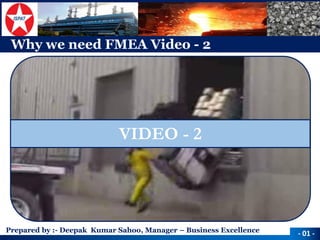
Why we need FMEA Video -2 
-01 - 
VIDEO -1
Prepared by :-Deepak Kumar Sahoo, Manager –Business Excellence 
Why we need FMEA Video -2 
-01 - 
VIDEO -2
Prepared by :-Deepak Kumar Sahoo, Manager –Business Excellence 
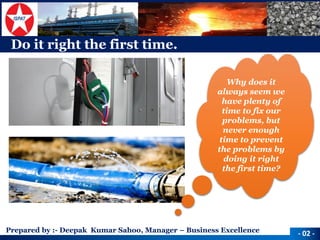
Do it right the first time. 
Why does it always seem we have plenty of time to fix our problems, but never enough time to prevent the problems by doing it right the first time? 
-02 -
Prepared by :-Deepak Kumar Sahoo, Manager –Business Excellence 
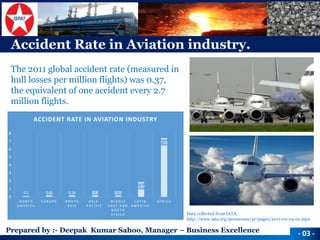
Accident Rate in Aviation industry. 
The 2011 global accident rate (measured in hull losses per million flights) was 0.37, the equivalent of one accident every 2.7 million flights. 
0.1 
0.45 
0.34 
0.8 
0.72 
1.87 
7.41 
0 
1 
2 
3 
4 
5 
6 
7 
8 
NORTH AMERICA 
EUROPE 
NORTH ASIA 
ASIA- PACIFIC 
MIDDLE EAST AND NORTH AFRICA 
LATIN AMERICA 
AFRICA 
ACCIDENT RATE IN AVIATION INDUSTRY 
Data collected from IATA. 
http://www.iata.org/pressroom/pr/pages/2011-02-23-01.aspx 
-03 -
Prepared by :-Deepak Kumar Sahoo, Manager –Business Excellence 
Murphy’s Law 
“Everything that can fail, shall fail” 
This is known as Murphy’s Law and is one of the main reasons behind the FMEA technique. 
Consequently, during the design of a system or product, the designer must always think in terms of: 
What could go wrong with the system or process? 
How badly might it go wrong? 
What needs to be done to prevent failures? 
-04 -
Prepared by :-Deepak Kumar Sahoo, Manager –Business Excellence 
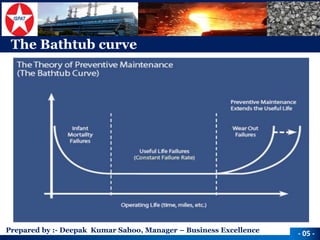
The Bathtub curve 
-05 -
Prepared by :-Deepak Kumar Sahoo, Manager –Business Excellence 
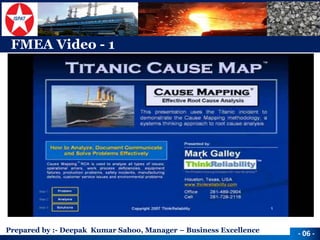
FMEA Video -1 
-06 -
Prepared by :-Deepak Kumar Sahoo, Manager –Business Excellence 
How it Origin ? 
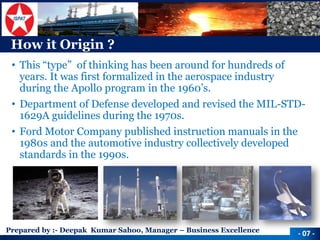
•This “type” of thinking has been around for hundreds of years. It was first formalized in the aerospace industry during the Apollo program in the 1960’s. 
•Department of Defense developed and revised the MIL-STD- 1629A guidelines during the 1970s. 
•Ford Motor Company published instruction manuals in the 1980s and the automotive industry collectively developed standards in the 1990s. 
-07 -
Prepared by :-Deepak Kumar Sahoo, Manager –Business Excellence 
What is FMEA ? 
•FMEA Stands for Failure mode effect Analysis. 
•FMEA is a tool that allows you to: 
•Prevent System, Product and Process problems before they occur 
•Reduce costs by identifying system, product and process improvements early in the development cycle 
•Create more robust processes 
•Prioritize actions that decrease risk of failure 
•Evaluate the system, design and processes from a new vantage point 
-08 -
Prepared by :-Deepak Kumar Sahoo, Manager –Business Excellence 
A Systematic Process 
FMEA provides a systematic process to: 
Identify and evaluate 
potential failure modes 
potential causes of the failure mode 
Identify and quantify the impact of potential failures 
Identify and prioritize actions to reduce or eliminate the potential failure 
Implement action plan based on assigned responsibilities and completion dates 
Document the associated activities 
-09 -
Prepared by :-Deepak Kumar Sahoo, Manager –Business Excellence 
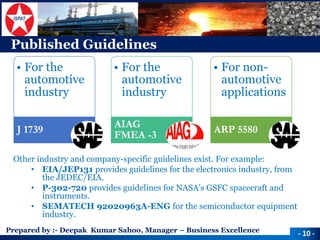
Published Guidelines 
Other industry and company-specific guidelines exist. For example: 
•EIA/JEP131 provides guidelines for the electronics industry, from the JEDEC/EIA. 
•P-302-720provides guidelines for NASA’s GSFC spacecraft and instruments. 
•SEMATECH 92020963A-ENG for the semiconductor equipment industry. 
-10 - 
•For the automotive industry 
J 1739 
•For the automotive industry 
AIAG FMEA -3 
•For non- automotive applications 
ARP 5580
Prepared by :-Deepak Kumar Sahoo, Manager –Business Excellence 
Rule of Ten (10) 
-11 - 
[ $ 10 ] 
Discovered During Design/ Process Engineering 
[ $ 100 ] 
Discovered During incoming inspection. 
[ $ 1000 ] 
Discovered During the final test 
[ $ 10000 ] 
Discovered in the field
Prepared by :-Deepak Kumar Sahoo, Manager –Business Excellence 
Benefits of FMEA. 
-12 - 
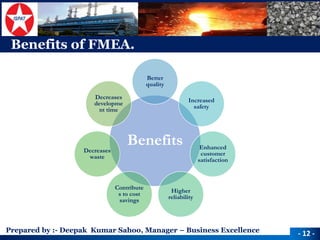
Benefits 
Better quality 
Increased safety 
Enhanced customer satisfaction 
Higher reliability 
Contributes to cost savings 
Decreases waste 
Decreases development time
Prepared by :-Deepak Kumar Sahoo, Manager –Business Excellence 
Type of FMEAs. 
-13 - 
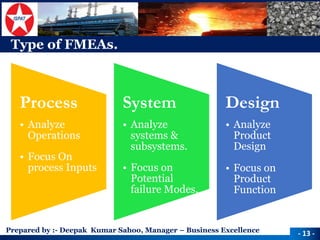
Process 
•Analyze Operations 
•Focus On process Inputs 
System 
•Analyze systems & subsystems. 
•Focus on Potential failure Modes. 
Design 
•Analyze Product Design 
•Focus on Product Function
Prepared by :-Deepak Kumar Sahoo, Manager –Business Excellence 
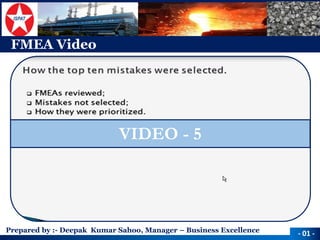
FMEA Video 
-01 - 
VIDEO -5
Prepared by :-Deepak Kumar Sahoo, Manager –Business Excellence 
FMEA Terminology1 
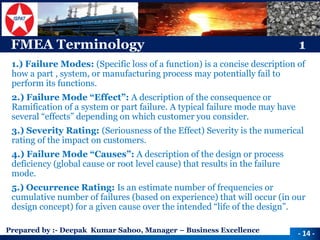
1.) Failure Modes: (Specific loss of a function) is a concise description of how a part , system, or manufacturing process may potentially fail to perform its functions. 
2.) Failure Mode “Effect”: A description of the consequence or Ramification of a system or part failure. A typical failure mode may have several “effects” depending on which customer you consider. 
3.) Severity Rating: (Seriousness of the Effect) Severity is the numerical rating of the impact on customers. 
4.) Failure Mode “Causes”: A description of the design or process deficiency (global cause or root level cause) that results in the failure mode. 
5.) Occurrence Rating: Is an estimate number of frequencies or cumulative number of failures (based on experience) that will occur (in our design concept) for a given cause over the intended “life of the design”. 
-14 -
Prepared by :-Deepak Kumar Sahoo, Manager –Business Excellence 
FMEA Terminology2 
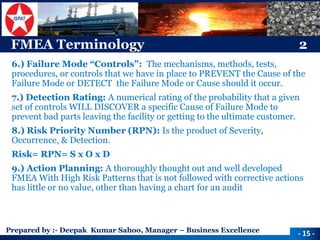
6.) Failure Mode “Controls”: The mechanisms, methods, tests, procedures, or controls that we have in place to PREVENT the Cause of the Failure Mode or DETECT the Failure Mode or Cause should it occur. 
7.) Detection Rating: A numerical rating of the probability that a given set of controls WILL DISCOVER a specific Cause of Failure Mode to prevent bad parts leaving the facility or getting to the ultimate customer. 
8.) Risk Priority Number (RPN): Is the product of Severity, Occurrence, & Detection. 
Risk= RPN= S x O x D 
9.) Action Planning: A thoroughly thought out and well developed FMEA With High Risk Patterns that is not followed with corrective actions has little or no value, other than having a chart for an audit 
-15 -
Prepared by :-Deepak Kumar Sahoo, Manager –Business Excellence 
FMEA Video 
-01 - 
VIDEO -4
Prepared by :-Deepak Kumar Sahoo, Manager –Business Excellence 
FMEA Video 
-01 - 
VIDEO -3
Prepared by :-Deepak Kumar Sahoo, Manager –Business Excellence 
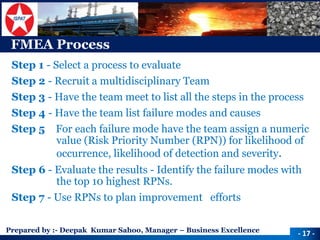
FMEA Process 
Step 1 -Select a process to evaluate 
Step 2 -Recruit a multidisciplinary Team 
Step 3 -Have the team meet to list all the steps in the process 
Step 4 -Have the team list failure modes and causes 
Step 5 For each failure mode have the team assign a numeric value (Risk Priority Number (RPN)) for likelihood of occurrence, likelihood of detection and severity. 
Step 6 -Evaluate the results -Identify the failure modes with the top 10 highest RPNs. 
Step 7 -Use RPNs to plan improvement efforts 
-17 -
Prepared by :-Deepak Kumar Sahoo, Manager –Business Excellence 
FMEA Video 
-01 - 
VIDEO -5
Prepared by :-Deepak Kumar Sahoo, Manager –Business Excellence 
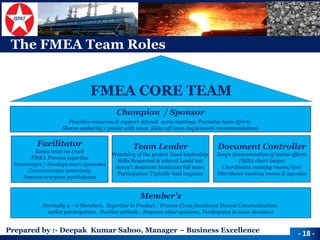
Champion / Sponsor 
Provides resources & support Attends some meetings Promotes team efforts 
Shares authority / power with team Kicks off team Implements recommendations 
The FMEA Team Roles 
Team Leader 
Watchdog of the project Good leadership 
Skills Respected & relaxed Leads but 
doesn’t dominate Maintains full team 
Participation Typically lead engineer 
Facilitator 
Keeps team on track 
FMEA Process expertise 
Encourages / develops team dynamics 
Communicates assertively 
Ensures everyone participates 
Document Controller 
Keeps documentation of teams efforts 
FMEA chart keeper 
Coordinates meeting rooms/time 
Distributes meeting rooms & agendas 
Member’s 
Normally 4 –6 Members, Expertise in Product / Process Cross functional Honest Communication, 
Active participation , Positive attitude , Respects other opinions, Participates in team decisions 
FMEA CORE TEAM 
-18 -
Prepared by :-Deepak Kumar Sahoo, Manager –Business Excellence 
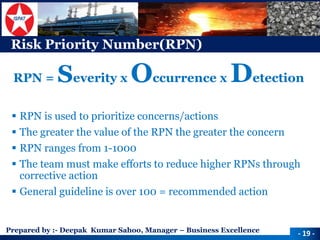
Risk Priority Number(RPN) 
RPN = Severity x Occurrence x Detection 
RPN is used to prioritize concerns/actions 
The greater the value of the RPN the greater the concern 
RPN ranges from 1-1000 
The team must make efforts to reduce higher RPNs through corrective action 
General guideline is over 100 = recommended action 
-19 -
Prepared by :-Deepak Kumar Sahoo, Manager –Business Excellence 
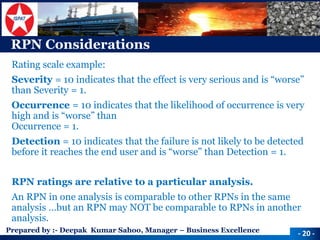
RPN Considerations 
Rating scale example: 
Severity= 10 indicates that the effect is very serious and is “worse” than Severity = 1. 
Occurrence= 10 indicates that the likelihood of occurrence is very high and is “worse” than Occurrence = 1. 
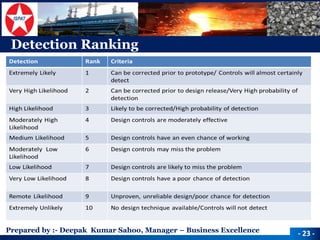
Detection= 10 indicates that the failure is not likely to be detected before it reaches the end user and is “worse” than Detection = 1. 
RPN ratings are relative to a particular analysis. 
An RPN in one analysis is comparable to other RPNs in the same analysis …but an RPN may NOT be comparable to RPNs in another analysis. 
-20 -
Prepared by :-Deepak Kumar Sahoo, Manager –Business Excellence 
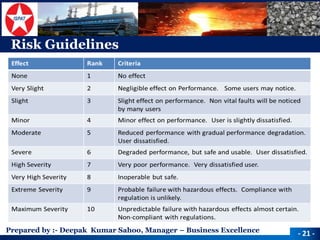
Risk Guidelines 
-21 -
Prepared by :-Deepak Kumar Sahoo, Manager –Business Excellence 
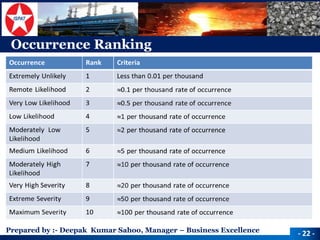
Occurrence Ranking 
-22 -
Prepared by :-Deepak Kumar Sahoo, Manager –Business Excellence 
Detection Ranking 
-23 -
Prepared by :-Deepak Kumar Sahoo, Manager –Business Excellence 
FMEA Video 
-01 - 
VIDEO -5
Prepared by :-Deepak Kumar Sahoo, Manager –Business Excellence 
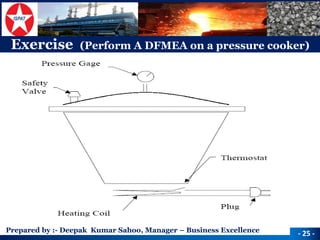
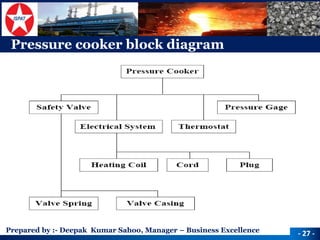
Exercise (Perform A DFMEA on a pressure cooker) 
-25 -
Prepared by :-Deepak Kumar Sahoo, Manager –Business Excellence 
Pressure Cooker Safety Features 
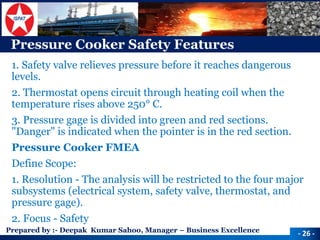
1. Safety valve relieves pressure before it reaches dangerous levels. 
2. Thermostat opens circuit through heating coil when the temperature rises above 250°C. 
3. Pressure gage is divided into green and red sections. "Danger" is indicated when the pointer is in the red section. 
Pressure Cooker FMEA 
Define Scope: 
1. Resolution -The analysis will be restricted to the four major subsystems (electrical system, safety valve, thermostat, and pressure gage). 
2. Focus -Safety 
-26 -
Prepared by :-Deepak Kumar Sahoo, Manager –Business Excellence 
Pressure cooker block diagram 
-27 -
Prepared by :-Deepak Kumar Sahoo, Manager –Business Excellence 
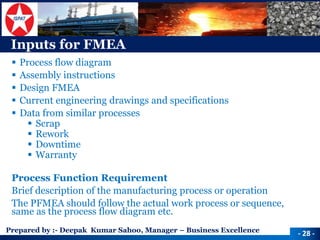
Inputs for FMEA 
Process flow diagram 
Assembly instructions 
Design FMEA 
Current engineering drawings and specifications 
Data from similar processes 
Scrap 
Rework 
Downtime 
Warranty 
Process Function Requirement 
Brief description of the manufacturing process or operation 
The PFMEA should follow the actual work process or sequence, same as the process flow diagram etc. 
-28 -
Prepared by :-Deepak Kumar Sahoo, Manager –Business Excellence 
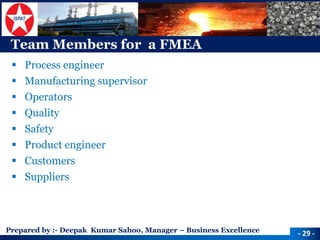
Team Members for a FMEA 
Process engineer 
Manufacturing supervisor 
Operators 
Quality 
Safety 
Product engineer 
Customers 
Suppliers 
-29 -
Prepared by :-Deepak Kumar Sahoo, Manager –Business Excellence 
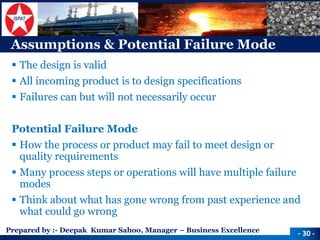
Assumptions & Potential Failure Mode 
The design is valid 
All incoming product is to design specifications 
Failures can but will not necessarily occur 
Potential Failure Mode 
How the process or product may fail to meet design or quality requirements 
Many process steps or operations will have multiple failure modes 
Think about what has gone wrong from past experience and what could go wrong 
-30 -
Prepared by :-Deepak Kumar Sahoo, Manager –Business Excellence 
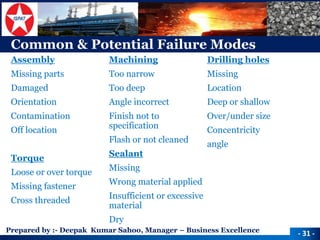
Common & Potential Failure Modes 
Assembly 
Missing parts 
Damaged 
Orientation 
Contamination 
Off location 
Torque 
Loose or over torque 
Missing fastener 
Cross threaded 
Machining 
Too narrow 
Too deep 
Angle incorrect 
Finish not to specification 
Flash or not cleaned 
Sealant 
Missing 
Wrong material applied 
Insufficient or excessive material 
Dry 
Drilling holes 
Missing 
Location 
Deep or shallow 
Over/under size 
Concentricity 
angle 
-31 -
Prepared by :-Deepak Kumar Sahoo, Manager –Business Excellence 
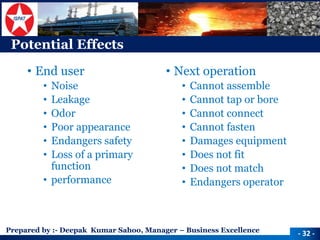
Potential Effects 
•End user 
•Noise 
•Leakage 
•Odor 
•Poor appearance 
•Endangers safety 
•Loss of a primary function 
•performance 
•Next operation 
•Cannot assemble 
•Cannot tap or bore 
•Cannot connect 
•Cannot fasten 
•Damages equipment 
•Does not fit 
•Does not match 
•Endangers operator 
-32 -
Prepared by :-Deepak Kumar Sahoo, Manager –Business Excellence 
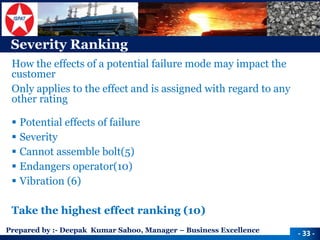
Severity Ranking 
How the effects of a potential failure mode may impact the customer 
Only applies to the effect and is assigned with regard to any other rating 
Potential effects of failure 
Severity 
Cannot assemble bolt(5) 
Endangers operator(10) 
Vibration (6) 
Take the highest effect ranking (10) 
-33 -
Prepared by :-Deepak Kumar Sahoo, Manager –Business Excellence 
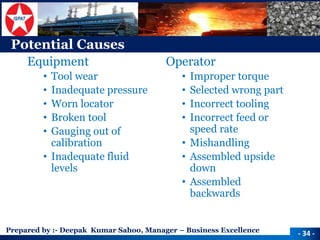
Potential Causes 
Equipment 
•Tool wear 
•Inadequate pressure 
•Worn locator 
•Broken tool 
•Gauging out of calibration 
•Inadequate fluid levels 
Operator 
•Improper torque 
•Selected wrong part 
•Incorrect tooling 
•Incorrect feed or speed rate 
•Mishandling 
•Assembled upside down 
•Assembled backwards 
-34 -
Prepared by :-Deepak Kumar Sahoo, Manager –Business Excellence 
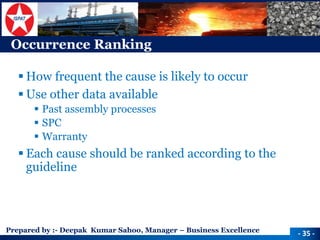
Occurrence Ranking 
How frequent the cause is likely to occur 
Use other data available 
Past assembly processes 
SPC 
Warranty 
Each cause should be ranked according to the guideline 
-35 -
Prepared by :-Deepak Kumar Sahoo, Manager –Business Excellence 
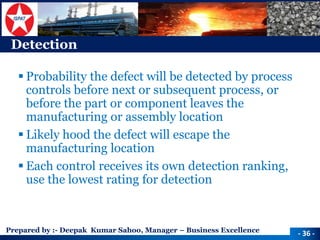
Detection 
Probability the defect will be detected by process controls before next or subsequent process, or before the part or component leaves the manufacturing or assembly location 
Likely hood the defect will escape the manufacturing location 
Each control receives its own detection ranking, use the lowest rating for detection 
-36 -
Prepared by :-Deepak Kumar Sahoo, Manager –Business Excellence 
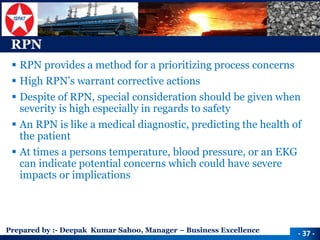
RPN 
RPN provides a method for a prioritizing process concerns 
High RPN’s warrant corrective actions 
Despite of RPN, special consideration should be given when severity is high especially in regards to safety 
An RPN is like a medical diagnostic, predicting the health of the patient 
At times a persons temperature, blood pressure, or an EKG can indicate potential concerns which could have severe impacts or implications 
-37 -
Prepared by :-Deepak Kumar Sahoo, Manager –Business Excellence 
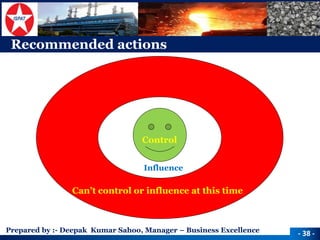
Recommended actions 
Control 
Influence 
Can’t control or influence at this time 
-38 -
Prepared by :-Deepak Kumar Sahoo, Manager –Business Excellence 
Recommended actions 
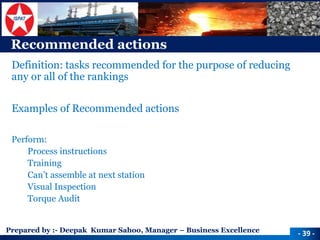
Definition: tasks recommended for the purpose of reducing any or all of the rankings 
Examples of Recommended actions 
Perform: 
Process instructions 
Training 
Can’t assemble at next station 
Visual Inspection 
Torque Audit 
-39 -
Prepared by :-Deepak Kumar Sahoo, Manager –Business Excellence 
FMEA Video 
-01 - 
VIDEO -5
Prepared by :-Deepak Kumar Sahoo, Manager –Business Excellence 
Connect With Me @ 
Email:-dksahoo2@gmail.com / defydk@hotmail.com 
LinkedIn :-www.linkedin.com/in/dksahoo 
Slide share :-www.slideshare.com/dksahoo2 
-42 - 
Feedback & Comments !

FMEA_BAL_Deepak_Sahoo

  • 1.
    Prepared by :-DeepakKumar Sahoo, Manager –Business Excellence Training Program on FMEAFailure Mode and Effects Analysis Prepared By : Deepak Kumar Sahoo
  • 2.
    Prepared by :-DeepakKumar Sahoo, Manager –Business Excellence Agenda FMEA History What is FMEA Definitions What it Can Do For You Types of FMEA Team Members Roles FMEA Terminology Getting Started with an FMEA The Worksheet FMEA Scoring -i -
  • 3.
    Prepared by :-DeepakKumar Sahoo, Manager –Business Excellence Why we need FMEA Video -2 -01 - VIDEO -1
  • 4.
    Prepared by :-DeepakKumar Sahoo, Manager –Business Excellence Why we need FMEA Video -2 -01 - VIDEO -2
  • 5.
    Prepared by :-DeepakKumar Sahoo, Manager –Business Excellence Do it right the first time. Why does it always seem we have plenty of time to fix our problems, but never enough time to prevent the problems by doing it right the first time? -02 -
  • 6.
    Prepared by :-DeepakKumar Sahoo, Manager –Business Excellence Accident Rate in Aviation industry. The 2011 global accident rate (measured in hull losses per million flights) was 0.37, the equivalent of one accident every 2.7 million flights. 0.1 0.45 0.34 0.8 0.72 1.87 7.41 0 1 2 3 4 5 6 7 8 NORTH AMERICA EUROPE NORTH ASIA ASIA- PACIFIC MIDDLE EAST AND NORTH AFRICA LATIN AMERICA AFRICA ACCIDENT RATE IN AVIATION INDUSTRY Data collected from IATA. http://www.iata.org/pressroom/pr/pages/2011-02-23-01.aspx -03 -
  • 7.
    Prepared by :-DeepakKumar Sahoo, Manager –Business Excellence Murphy’s Law “Everything that can fail, shall fail” This is known as Murphy’s Law and is one of the main reasons behind the FMEA technique. Consequently, during the design of a system or product, the designer must always think in terms of: What could go wrong with the system or process? How badly might it go wrong? What needs to be done to prevent failures? -04 -
  • 8.
    Prepared by :-DeepakKumar Sahoo, Manager –Business Excellence The Bathtub curve -05 -
  • 9.
    Prepared by :-DeepakKumar Sahoo, Manager –Business Excellence FMEA Video -1 -06 -
  • 10.
    Prepared by :-DeepakKumar Sahoo, Manager –Business Excellence How it Origin ? •This “type” of thinking has been around for hundreds of years. It was first formalized in the aerospace industry during the Apollo program in the 1960’s. •Department of Defense developed and revised the MIL-STD- 1629A guidelines during the 1970s. •Ford Motor Company published instruction manuals in the 1980s and the automotive industry collectively developed standards in the 1990s. -07 -
  • 11.
    Prepared by :-DeepakKumar Sahoo, Manager –Business Excellence What is FMEA ? •FMEA Stands for Failure mode effect Analysis. •FMEA is a tool that allows you to: •Prevent System, Product and Process problems before they occur •Reduce costs by identifying system, product and process improvements early in the development cycle •Create more robust processes •Prioritize actions that decrease risk of failure •Evaluate the system, design and processes from a new vantage point -08 -
  • 12.
    Prepared by :-DeepakKumar Sahoo, Manager –Business Excellence A Systematic Process FMEA provides a systematic process to: Identify and evaluate potential failure modes potential causes of the failure mode Identify and quantify the impact of potential failures Identify and prioritize actions to reduce or eliminate the potential failure Implement action plan based on assigned responsibilities and completion dates Document the associated activities -09 -
  • 13.
    Prepared by :-DeepakKumar Sahoo, Manager –Business Excellence Published Guidelines Other industry and company-specific guidelines exist. For example: •EIA/JEP131 provides guidelines for the electronics industry, from the JEDEC/EIA. •P-302-720provides guidelines for NASA’s GSFC spacecraft and instruments. •SEMATECH 92020963A-ENG for the semiconductor equipment industry. -10 - •For the automotive industry J 1739 •For the automotive industry AIAG FMEA -3 •For non- automotive applications ARP 5580
  • 14.
    Prepared by :-DeepakKumar Sahoo, Manager –Business Excellence Rule of Ten (10) -11 - [ $ 10 ] Discovered During Design/ Process Engineering [ $ 100 ] Discovered During incoming inspection. [ $ 1000 ] Discovered During the final test [ $ 10000 ] Discovered in the field
  • 15.
    Prepared by :-DeepakKumar Sahoo, Manager –Business Excellence Benefits of FMEA. -12 - Benefits Better quality Increased safety Enhanced customer satisfaction Higher reliability Contributes to cost savings Decreases waste Decreases development time
  • 16.
    Prepared by :-DeepakKumar Sahoo, Manager –Business Excellence Type of FMEAs. -13 - Process •Analyze Operations •Focus On process Inputs System •Analyze systems & subsystems. •Focus on Potential failure Modes. Design •Analyze Product Design •Focus on Product Function
  • 17.
    Prepared by :-DeepakKumar Sahoo, Manager –Business Excellence FMEA Video -01 - VIDEO -5
  • 18.
    Prepared by :-DeepakKumar Sahoo, Manager –Business Excellence FMEA Terminology1 1.) Failure Modes: (Specific loss of a function) is a concise description of how a part , system, or manufacturing process may potentially fail to perform its functions. 2.) Failure Mode “Effect”: A description of the consequence or Ramification of a system or part failure. A typical failure mode may have several “effects” depending on which customer you consider. 3.) Severity Rating: (Seriousness of the Effect) Severity is the numerical rating of the impact on customers. 4.) Failure Mode “Causes”: A description of the design or process deficiency (global cause or root level cause) that results in the failure mode. 5.) Occurrence Rating: Is an estimate number of frequencies or cumulative number of failures (based on experience) that will occur (in our design concept) for a given cause over the intended “life of the design”. -14 -
  • 19.
    Prepared by :-DeepakKumar Sahoo, Manager –Business Excellence FMEA Terminology2 6.) Failure Mode “Controls”: The mechanisms, methods, tests, procedures, or controls that we have in place to PREVENT the Cause of the Failure Mode or DETECT the Failure Mode or Cause should it occur. 7.) Detection Rating: A numerical rating of the probability that a given set of controls WILL DISCOVER a specific Cause of Failure Mode to prevent bad parts leaving the facility or getting to the ultimate customer. 8.) Risk Priority Number (RPN): Is the product of Severity, Occurrence, & Detection. Risk= RPN= S x O x D 9.) Action Planning: A thoroughly thought out and well developed FMEA With High Risk Patterns that is not followed with corrective actions has little or no value, other than having a chart for an audit -15 -
  • 20.
    Prepared by :-DeepakKumar Sahoo, Manager –Business Excellence FMEA Video -01 - VIDEO -4
  • 21.
    Prepared by :-DeepakKumar Sahoo, Manager –Business Excellence FMEA Video -01 - VIDEO -3
  • 22.
    Prepared by :-DeepakKumar Sahoo, Manager –Business Excellence FMEA Process Step 1 -Select a process to evaluate Step 2 -Recruit a multidisciplinary Team Step 3 -Have the team meet to list all the steps in the process Step 4 -Have the team list failure modes and causes Step 5 For each failure mode have the team assign a numeric value (Risk Priority Number (RPN)) for likelihood of occurrence, likelihood of detection and severity. Step 6 -Evaluate the results -Identify the failure modes with the top 10 highest RPNs. Step 7 -Use RPNs to plan improvement efforts -17 -
  • 23.
    Prepared by :-DeepakKumar Sahoo, Manager –Business Excellence FMEA Video -01 - VIDEO -5
  • 24.
    Prepared by :-DeepakKumar Sahoo, Manager –Business Excellence Champion / Sponsor Provides resources & support Attends some meetings Promotes team efforts Shares authority / power with team Kicks off team Implements recommendations The FMEA Team Roles Team Leader Watchdog of the project Good leadership Skills Respected & relaxed Leads but doesn’t dominate Maintains full team Participation Typically lead engineer Facilitator Keeps team on track FMEA Process expertise Encourages / develops team dynamics Communicates assertively Ensures everyone participates Document Controller Keeps documentation of teams efforts FMEA chart keeper Coordinates meeting rooms/time Distributes meeting rooms & agendas Member’s Normally 4 –6 Members, Expertise in Product / Process Cross functional Honest Communication, Active participation , Positive attitude , Respects other opinions, Participates in team decisions FMEA CORE TEAM -18 -
  • 25.
    Prepared by :-DeepakKumar Sahoo, Manager –Business Excellence Risk Priority Number(RPN) RPN = Severity x Occurrence x Detection RPN is used to prioritize concerns/actions The greater the value of the RPN the greater the concern RPN ranges from 1-1000 The team must make efforts to reduce higher RPNs through corrective action General guideline is over 100 = recommended action -19 -
  • 26.
    Prepared by :-DeepakKumar Sahoo, Manager –Business Excellence RPN Considerations Rating scale example: Severity= 10 indicates that the effect is very serious and is “worse” than Severity = 1. Occurrence= 10 indicates that the likelihood of occurrence is very high and is “worse” than Occurrence = 1. Detection= 10 indicates that the failure is not likely to be detected before it reaches the end user and is “worse” than Detection = 1. RPN ratings are relative to a particular analysis. An RPN in one analysis is comparable to other RPNs in the same analysis …but an RPN may NOT be comparable to RPNs in another analysis. -20 -
  • 27.
    Prepared by :-DeepakKumar Sahoo, Manager –Business Excellence Risk Guidelines -21 -
  • 28.
    Prepared by :-DeepakKumar Sahoo, Manager –Business Excellence Occurrence Ranking -22 -
  • 29.
    Prepared by :-DeepakKumar Sahoo, Manager –Business Excellence Detection Ranking -23 -
  • 30.
    Prepared by :-DeepakKumar Sahoo, Manager –Business Excellence FMEA Video -01 - VIDEO -5
  • 31.
    Prepared by :-DeepakKumar Sahoo, Manager –Business Excellence Exercise (Perform A DFMEA on a pressure cooker) -25 -
  • 32.
    Prepared by :-DeepakKumar Sahoo, Manager –Business Excellence Pressure Cooker Safety Features 1. Safety valve relieves pressure before it reaches dangerous levels. 2. Thermostat opens circuit through heating coil when the temperature rises above 250°C. 3. Pressure gage is divided into green and red sections. "Danger" is indicated when the pointer is in the red section. Pressure Cooker FMEA Define Scope: 1. Resolution -The analysis will be restricted to the four major subsystems (electrical system, safety valve, thermostat, and pressure gage). 2. Focus -Safety -26 -
  • 33.
    Prepared by :-DeepakKumar Sahoo, Manager –Business Excellence Pressure cooker block diagram -27 -
  • 34.
    Prepared by :-DeepakKumar Sahoo, Manager –Business Excellence Inputs for FMEA Process flow diagram Assembly instructions Design FMEA Current engineering drawings and specifications Data from similar processes Scrap Rework Downtime Warranty Process Function Requirement Brief description of the manufacturing process or operation The PFMEA should follow the actual work process or sequence, same as the process flow diagram etc. -28 -
  • 35.
    Prepared by :-DeepakKumar Sahoo, Manager –Business Excellence Team Members for a FMEA Process engineer Manufacturing supervisor Operators Quality Safety Product engineer Customers Suppliers -29 -
  • 36.
    Prepared by :-DeepakKumar Sahoo, Manager –Business Excellence Assumptions & Potential Failure Mode The design is valid All incoming product is to design specifications Failures can but will not necessarily occur Potential Failure Mode How the process or product may fail to meet design or quality requirements Many process steps or operations will have multiple failure modes Think about what has gone wrong from past experience and what could go wrong -30 -
  • 37.
    Prepared by :-DeepakKumar Sahoo, Manager –Business Excellence Common & Potential Failure Modes Assembly Missing parts Damaged Orientation Contamination Off location Torque Loose or over torque Missing fastener Cross threaded Machining Too narrow Too deep Angle incorrect Finish not to specification Flash or not cleaned Sealant Missing Wrong material applied Insufficient or excessive material Dry Drilling holes Missing Location Deep or shallow Over/under size Concentricity angle -31 -
  • 38.
    Prepared by :-DeepakKumar Sahoo, Manager –Business Excellence Potential Effects •End user •Noise •Leakage •Odor •Poor appearance •Endangers safety •Loss of a primary function •performance •Next operation •Cannot assemble •Cannot tap or bore •Cannot connect •Cannot fasten •Damages equipment •Does not fit •Does not match •Endangers operator -32 -
  • 39.
    Prepared by :-DeepakKumar Sahoo, Manager –Business Excellence Severity Ranking How the effects of a potential failure mode may impact the customer Only applies to the effect and is assigned with regard to any other rating Potential effects of failure Severity Cannot assemble bolt(5) Endangers operator(10) Vibration (6) Take the highest effect ranking (10) -33 -
  • 40.
    Prepared by :-DeepakKumar Sahoo, Manager –Business Excellence Potential Causes Equipment •Tool wear •Inadequate pressure •Worn locator •Broken tool •Gauging out of calibration •Inadequate fluid levels Operator •Improper torque •Selected wrong part •Incorrect tooling •Incorrect feed or speed rate •Mishandling •Assembled upside down •Assembled backwards -34 -
  • 41.
    Prepared by :-DeepakKumar Sahoo, Manager –Business Excellence Occurrence Ranking How frequent the cause is likely to occur Use other data available Past assembly processes SPC Warranty Each cause should be ranked according to the guideline -35 -
  • 42.
    Prepared by :-DeepakKumar Sahoo, Manager –Business Excellence Detection Probability the defect will be detected by process controls before next or subsequent process, or before the part or component leaves the manufacturing or assembly location Likely hood the defect will escape the manufacturing location Each control receives its own detection ranking, use the lowest rating for detection -36 -
  • 43.
    Prepared by :-DeepakKumar Sahoo, Manager –Business Excellence RPN RPN provides a method for a prioritizing process concerns High RPN’s warrant corrective actions Despite of RPN, special consideration should be given when severity is high especially in regards to safety An RPN is like a medical diagnostic, predicting the health of the patient At times a persons temperature, blood pressure, or an EKG can indicate potential concerns which could have severe impacts or implications -37 -
  • 44.
    Prepared by :-DeepakKumar Sahoo, Manager –Business Excellence Recommended actions Control Influence Can’t control or influence at this time -38 -
  • 45.
    Prepared by :-DeepakKumar Sahoo, Manager –Business Excellence Recommended actions Definition: tasks recommended for the purpose of reducing any or all of the rankings Examples of Recommended actions Perform: Process instructions Training Can’t assemble at next station Visual Inspection Torque Audit -39 -
  • 46.
    Prepared by :-DeepakKumar Sahoo, Manager –Business Excellence FMEA Video -01 - VIDEO -5
  • 47.
    Prepared by :-DeepakKumar Sahoo, Manager –Business Excellence Connect With Me @ Email:-dksahoo2@gmail.com / defydk@hotmail.com LinkedIn :-www.linkedin.com/in/dksahoo Slide share :-www.slideshare.com/dksahoo2 -42 - Feedback & Comments !