PES
MODERN COLLEGE OF PHARMACY (Ladies)
MOSHI, PUNE
Savitribai Phule Pune University
B.PHARM
Semester- VII
By
Mrs. Sneha Patil
Assistant Professor
Dept. of Pharmaceutics
Quality risk management -
Technology development and
transfer
Quality risk management
2
 Quality - the degree of excellence of something
 Risk – The combination of the probability of occurrence of harm
and the severity of that them
 Definition of Risk management as per WHO – a strategic safety
program designed to decrease product risk by using one or
more interventions tools
 ICH Q 9 guideline, quality risk management provides a
structure to initiate and follow a risk management process
Quality risk management
3
Scope
Aspects
1.Development
2.Manufacturing
3.Distribution
4.Inspection
5.Submission/review processes throughout the lifecycle of drug
substances, medicinal products, biological and biotechnological
products
Quality risk management
4
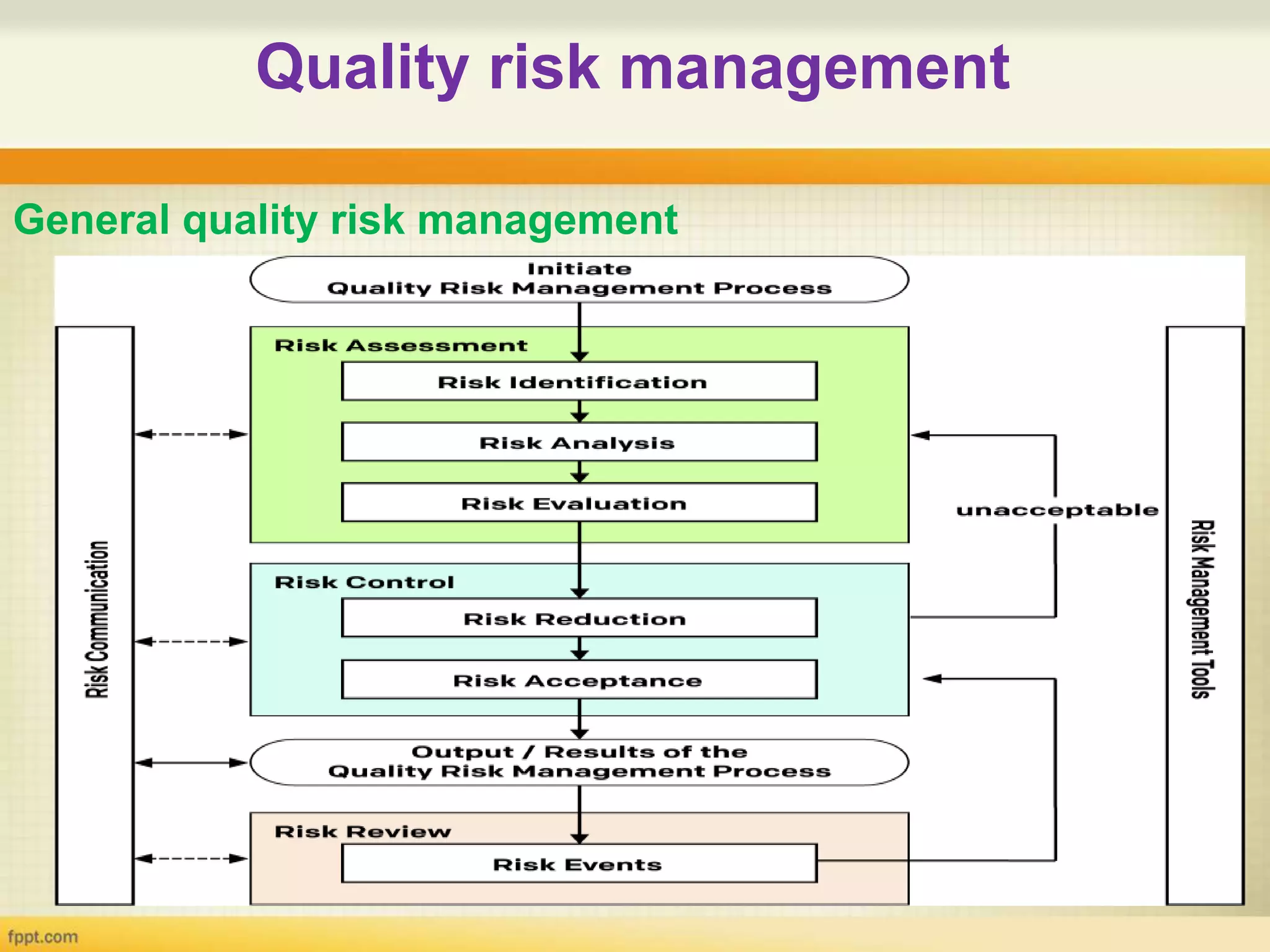
General quality risk management
Quality risk management continue….
5
General quality risk management
Responsibilities
 When QRM team is formed, they should include experts from
the appropriate areas and persons having knowledge about the
quality risk management process
 Decision makers must take responsibility for co-ordinating QRM
across various functions and departments of their organization
Quality risk management continue….
6
General quality risk management
Initiating a QRM process
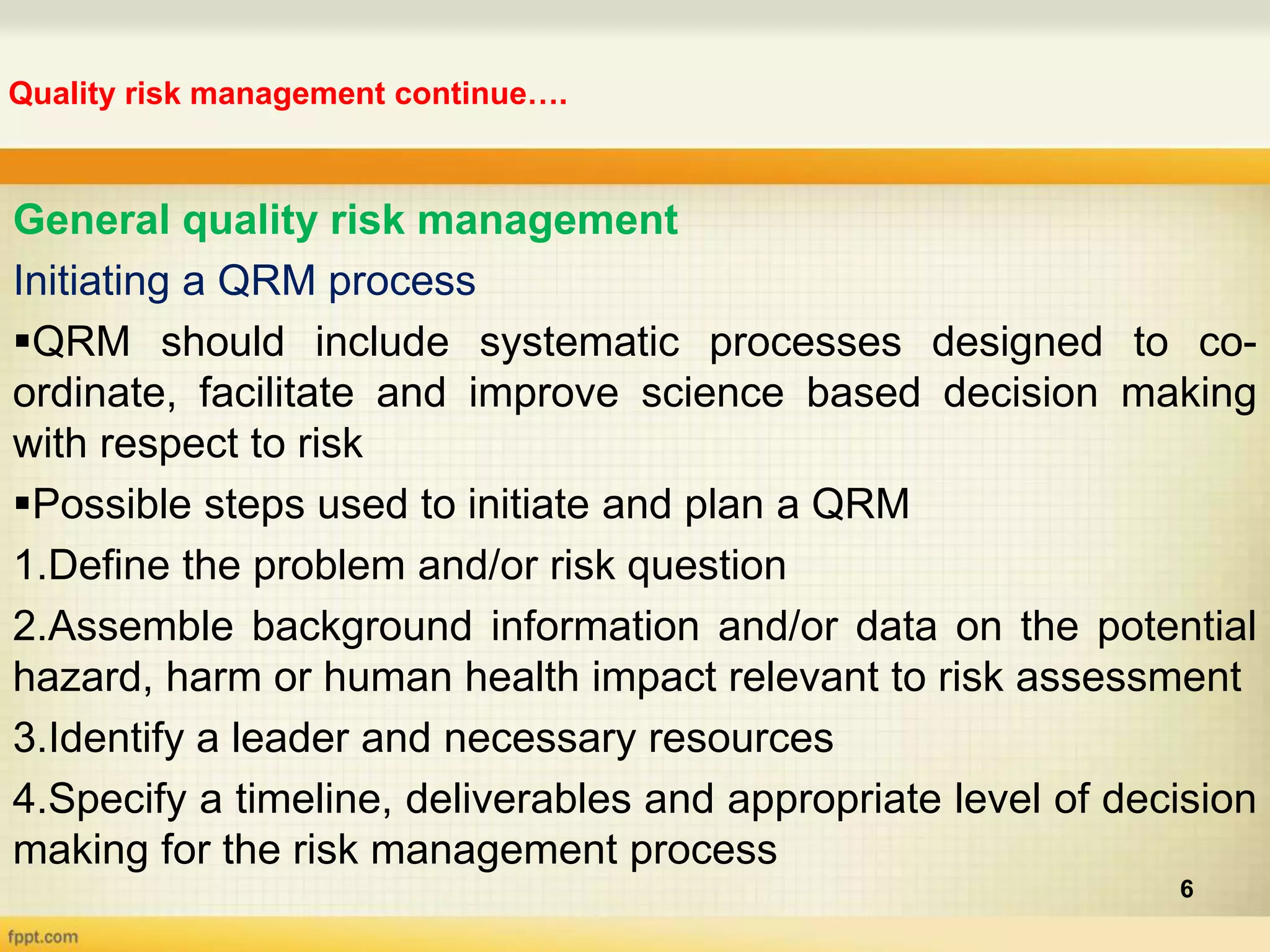
QRM should include systematic processes designed to co-
ordinate, facilitate and improve science based decision making
with respect to risk
Possible steps used to initiate and plan a QRM
1.Define the problem and/or risk question
2.Assemble background information and/or data on the potential
hazard, harm or human health impact relevant to risk assessment
3.Identify a leader and necessary resources
4.Specify a timeline, deliverables and appropriate level of decision
making for the risk management process
Quality risk management continue….
7
General quality risk management
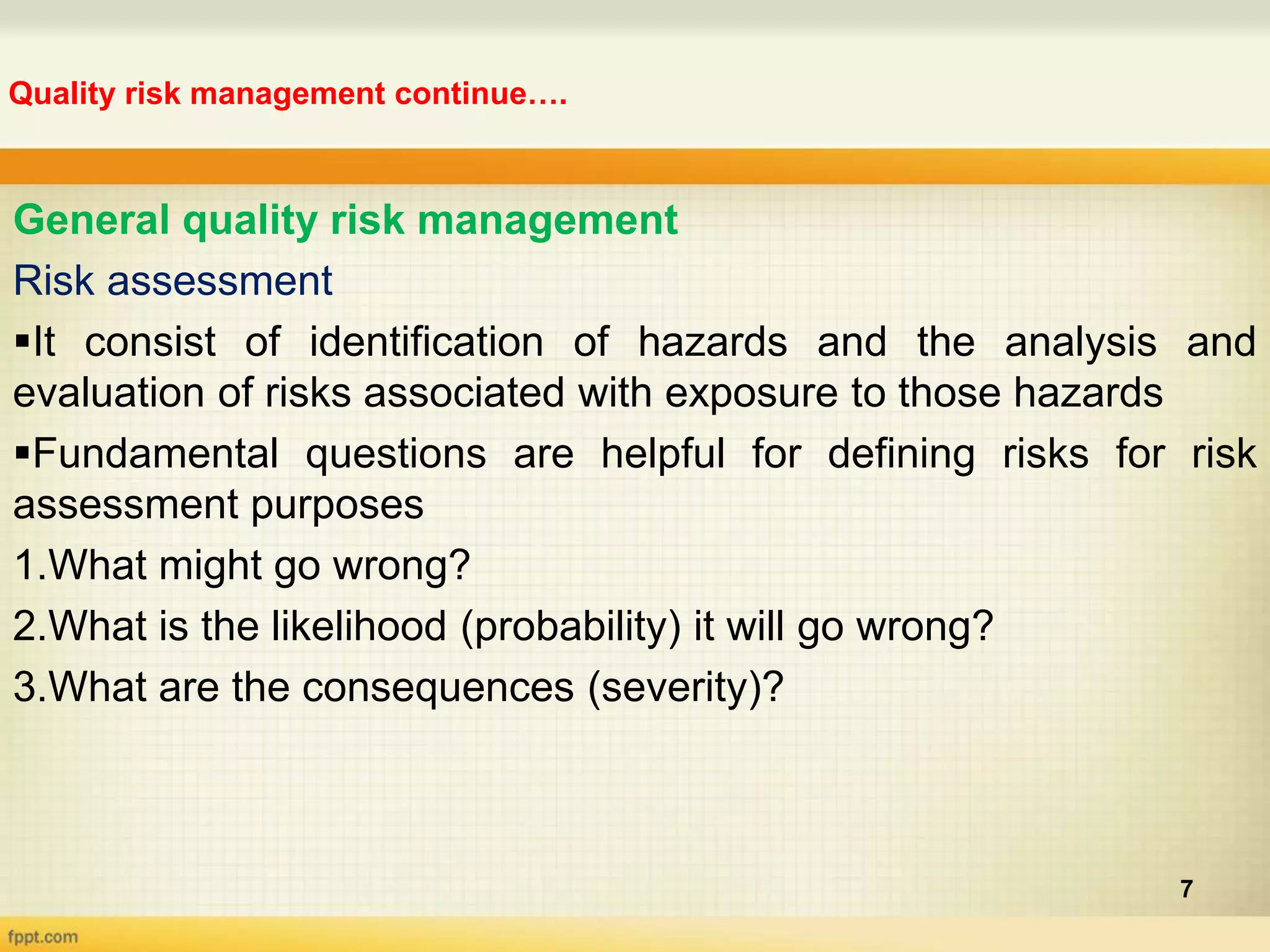
Risk assessment
It consist of identification of hazards and the analysis and
evaluation of risks associated with exposure to those hazards
Fundamental questions are helpful for defining risks for risk
assessment purposes
1.What might go wrong?
2.What is the likelihood (probability) it will go wrong?
3.What are the consequences (severity)?
Quality risk management continue….
8
General quality risk management
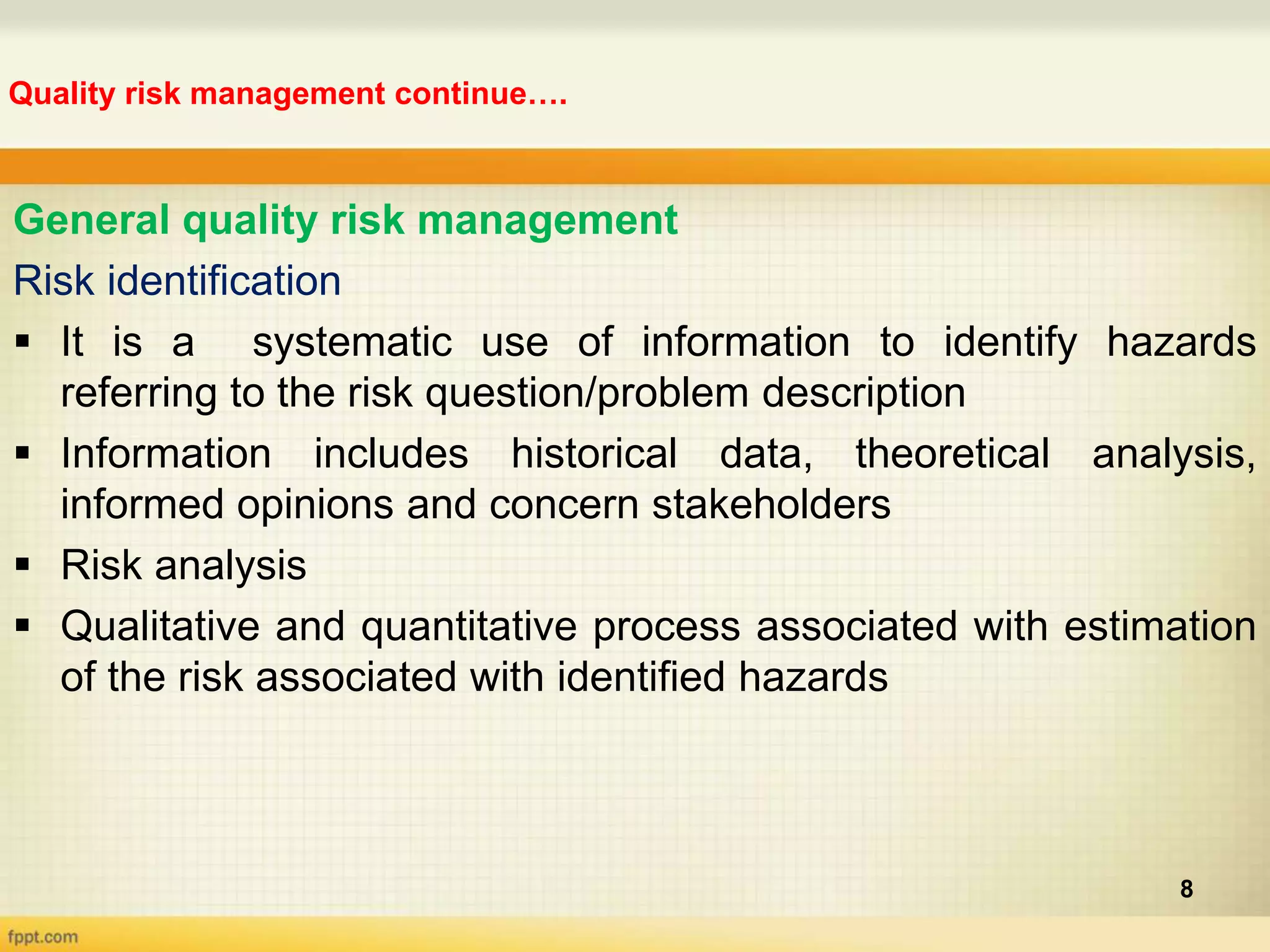
Risk identification
 It is a systematic use of information to identify hazards
referring to the risk question/problem description
 Information includes historical data, theoretical analysis,
informed opinions and concern stakeholders
 Risk analysis
 Qualitative and quantitative process associated with estimation
of the risk associated with identified hazards
Quality risk management continue….
9
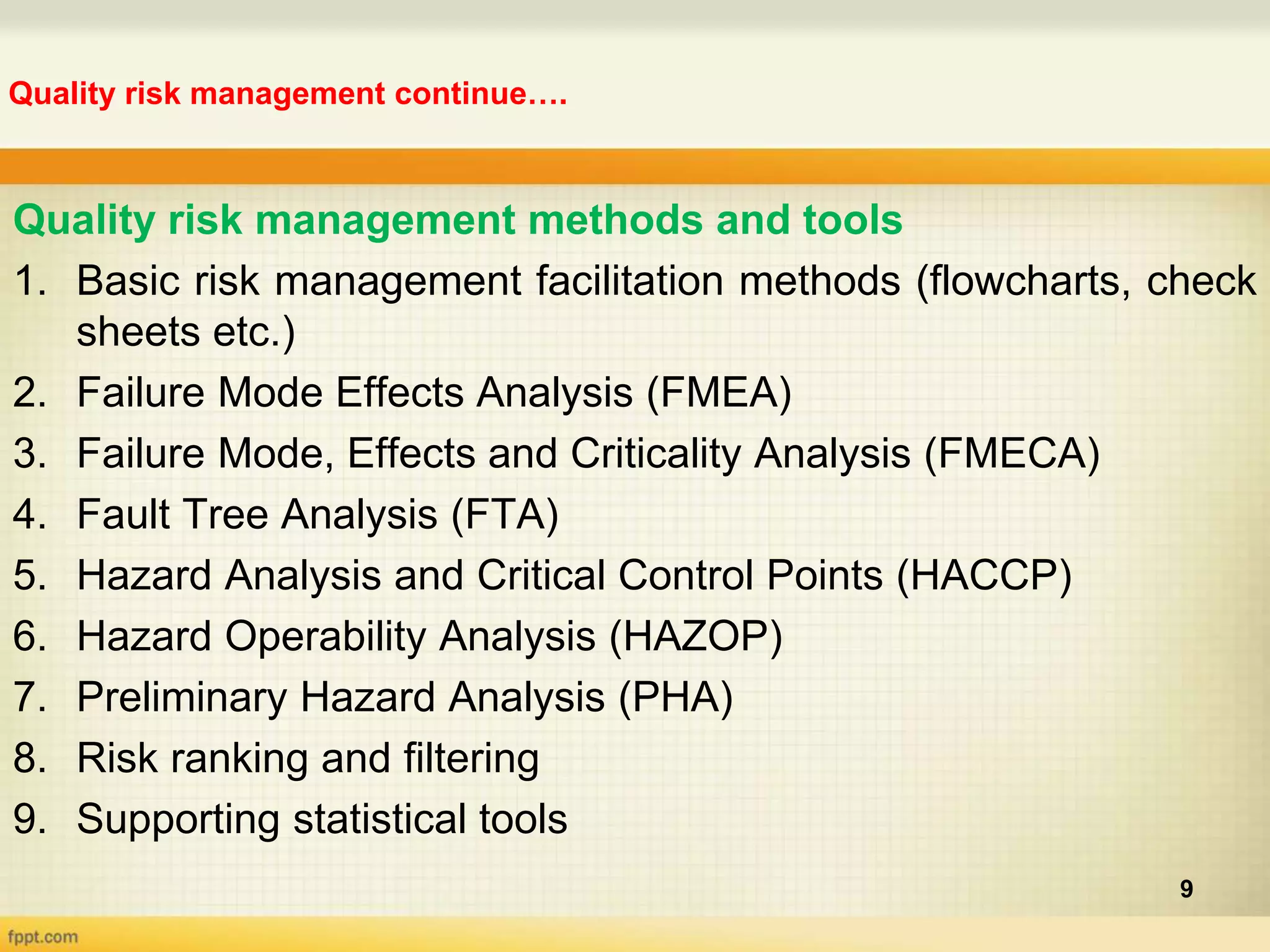
Quality risk management methods and tools
1. Basic risk management facilitation methods (flowcharts, check
sheets etc.)
2. Failure Mode Effects Analysis (FMEA)
3. Failure Mode, Effects and Criticality Analysis (FMECA)
4. Fault Tree Analysis (FTA)
5. Hazard Analysis and Critical Control Points (HACCP)
6. Hazard Operability Analysis (HAZOP)
7. Preliminary Hazard Analysis (PHA)
8. Risk ranking and filtering
9. Supporting statistical tools
Quality risk management continue….
10
Quality risk management methods and tools
1.Basic risk management facilitation methods (flowcharts, check
sheets etc.)
Simple techniques that are commonly used to structure risk
management by organizing data and facilitating decision-making
are :
a.Flowcharts
b.Check Sheets
c.Process Mapping
d.Cause and Effect Diagrams (also called an Ishikawa diagram or
fish bone diagram)
Quality risk management continue….
11
Quality risk management methods and tools
2. Failure Mode Effects Analysis (FMEA)
 FMEA (see IEC 60812) provides for an evaluation of potential
failure modes for processes and their likely effect on outcomes
and/or product performance
 Once failure modes are established, risk reduction can be used
to eliminate, contain, reduce or control the potential failures.
FMEA relies on product and process understanding
 FMEA methodically breaks down the analysis of complex
processes into manageable steps
 It is a powerful tool for summarizing the important modes of
failure, factors causing these failures and the likely effects of
these failures
Quality risk management continue….
12
Quality risk management methods and tools
2. Failure Mode Effects Analysis (FMEA)
 FMEA can be applied to equipment and facilities and might be
used to analyze a manufacturing operation and its effect on
product or process
Quality risk management continue….
13
Quality risk management methods and tools
3. Failure Mode, Effects and Criticality Analysis (FMECA)
 Each failure mode of the product is identified and then
evaluated for critically or severity
 Critically is then translated into a risk and if this level of risk is
not acceptable, corrective action must be taken
 It is utilized for failure and risk associated with manufacturing
process
Quality risk management continue….
14
Quality risk management methods and tools
4. Fault Tree Analysis (FTA)
 This tool assumes failure of the functionality of a product or
process
 FTA can be used to investigate complaints or deviations in
order to fully understand their root cause and to ensure that
intended improvements will fully resolve the issue and not lead
to other issues (i.e. solve one problem yet cause a different
problem)
 Fault Tree Analysis is an effective tool for evaluating how
multiple factors affect a given issue
 FTA relies on the experts’ process understanding to identify
causal factors
Quality risk management continue….
15
Quality risk management methods and tools
5. Hazard Analysis and Critical Control Points (HACCP)
 HACCP is a systematic, proactive, and preventive tool for
assuring product quality, reliability, and safety
 It involves hazard analysis, determining critical control point,
establishing critical limit, establishing a system to monitor
critical control point and establishing a record keeping system
 It might be used to identify and manage risks associated with
physical, chemical and biological hazards (including
microbiological contamination)
Quality risk management continue….
16
Quality risk management methods and tools
6. Hazard Operability Analysis (HAZOP)
 It is a systematic brainstorming technique for identifying
hazards using so-called “guide-words”
 “Guidewords” (e.g., No, More, Other Than, Part of, etc.) are
applied to relevant parameters (e.g., contamination,
temperature) to help identify potential deviations from normal
use or design intentions
 HAZOP can be applied to manufacturing processes, including
outsourced production and formulation as well as the upstream
suppliers, equipment and facilities for drug substances and
drug (medicinal) products
 It has also been used primarily in the pharmaceutical industry
for evaluating process safety hazards
Quality risk management continue….
17
Quality risk management methods and tools
7. Preliminary Hazard Analysis (PHA)
 PHA is a tool of analysis based on applying prior experience or
knowledge of a hazard or failure to identify future hazards,
hazardous situations and events that might cause harm, as well
as to estimate their probability of occurrence for a given activity,
facility, product or system
Quality risk management continue….
18
Quality risk management methods and tools
7. Preliminary Hazard Analysis (PHA)
The tool consists of:
1.The identification of the possibilities that the risk event happens
2.The qualitative evaluation of the extent of possible injury or
damage to health that could result and
3.A relative ranking of the hazard using a combination of severity
and likelihood of occurrence, and
4.The identification of possible remedial measures
Quality risk management continue….
19
Quality risk management methods and tools
8. Risk ranking and filtering
 This tool for comparing and ranking risks
 Risk ranking of complex systems typically requires evaluation of
multiple diverse quantitative and qualitative factors for each risk
 The tool involves breaking down a basic risk question into as
many components as needed to capture factors involved in the
risk
 These factors are combined into a single relative risk score that
can then be used for ranking risks
 “Filters,” in the form of weighting factors or cut-offs for risk
scores, can be used to scale or fit the risk ranking to
management or policy objectives
 Used to prioritize manufacturing sites for inspection/audit by
regulators or industry
Quality risk management continue….
20
Quality risk management methods and tools
9. Supporting statistical tools
 Output of a risk assessment may be combination of quantitative
and qualitative estimation of risk
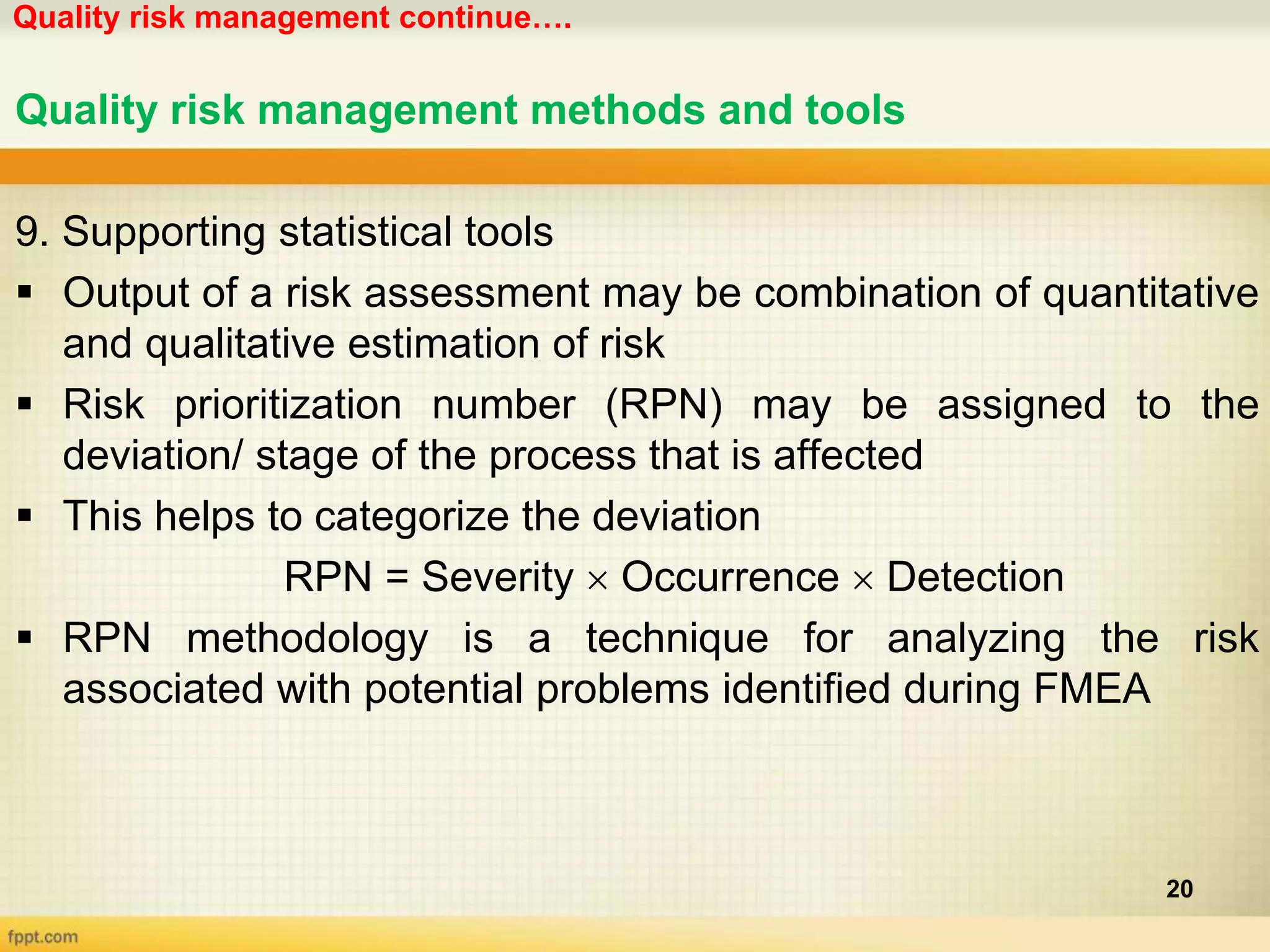
 Risk prioritization number (RPN) may be assigned to the
deviation/ stage of the process that is affected
 This helps to categorize the deviation
RPN = Severity  Occurrence  Detection
 RPN methodology is a technique for analyzing the risk
associated with potential problems identified during FMEA
Quality risk management continue….
21
Quality risk management methods and tools
9. Supporting statistical tools
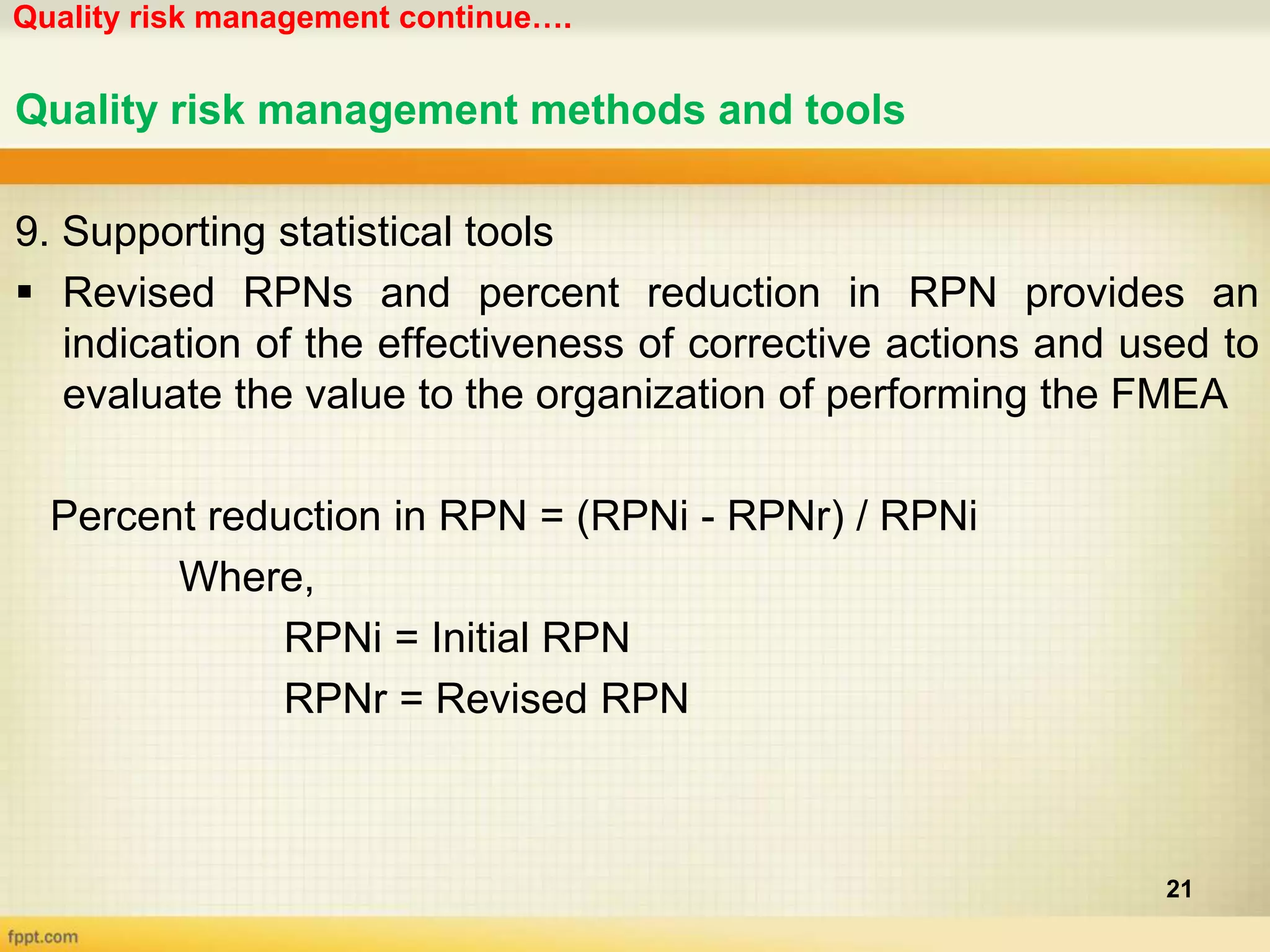
 Revised RPNs and percent reduction in RPN provides an
indication of the effectiveness of corrective actions and used to
evaluate the value to the organization of performing the FMEA
Percent reduction in RPN = (RPNi - RPNr) / RPNi
Where,
RPNi = Initial RPN
RPNr = Revised RPN
Quality risk management continue….
22
Quality risk management methods and tools
9. Supporting statistical tools
Principal statistical tools commonly used in the pharmaceutical
industry are:
a.Control Charts: e.g. Acceptance Control Charts, Control Charts
with Arithmetic Average and Warning Limits, Cumulative Sum
Charts, Shewhart Control Charts, Weighted Moving Average
b. Design of Experiments (DOE)
c. Histograms
d. Pareto Charts
e. Process Capability Analysis
Quality risk management continue….
23
Quality risk management methods and tools
9. Supporting statistical tools
Principal statistical tools commonly used in the pharmaceutical
industry are:
a.Control Charts: e.g. Acceptance Control Charts, Control Charts
with Arithmetic Average and Warning Limits, Cumulative Sum
Charts, Shewhart Control Charts, Weighted Moving Average
b. Design of Experiments (DOE)
c. Histograms
d. Pareto Charts
e. Process Capability Analysis
References
1. Kalyani Veena, Ali Younus Mohammed. Industrial Pharmacy –
II. First edition: Nirali Prakashan , Pune; 2020, Pg.no. 2.8-
2.12
2. Kataria Mahesh, Bilandi Ajay. Industrial Pharmacy –II. First
edition: Nirali Prakashan , Pune; 2021, Pg.no. 2.4-2.8
24
25

Quality risk management -Technology development and transfer

  • 1.
    PES MODERN COLLEGE OFPHARMACY (Ladies) MOSHI, PUNE Savitribai Phule Pune University B.PHARM Semester- VII By Mrs. Sneha Patil Assistant Professor Dept. of Pharmaceutics Quality risk management - Technology development and transfer
  • 2.
    Quality risk management 2 Quality - the degree of excellence of something  Risk – The combination of the probability of occurrence of harm and the severity of that them  Definition of Risk management as per WHO – a strategic safety program designed to decrease product risk by using one or more interventions tools  ICH Q 9 guideline, quality risk management provides a structure to initiate and follow a risk management process
  • 3.
    Quality risk management 3 Scope Aspects 1.Development 2.Manufacturing 3.Distribution 4.Inspection 5.Submission/reviewprocesses throughout the lifecycle of drug substances, medicinal products, biological and biotechnological products
  • 4.
    Quality risk management 4 Generalquality risk management
  • 5.
    Quality risk managementcontinue…. 5 General quality risk management Responsibilities  When QRM team is formed, they should include experts from the appropriate areas and persons having knowledge about the quality risk management process  Decision makers must take responsibility for co-ordinating QRM across various functions and departments of their organization
  • 6.
    Quality risk managementcontinue…. 6 General quality risk management Initiating a QRM process QRM should include systematic processes designed to co- ordinate, facilitate and improve science based decision making with respect to risk Possible steps used to initiate and plan a QRM 1.Define the problem and/or risk question 2.Assemble background information and/or data on the potential hazard, harm or human health impact relevant to risk assessment 3.Identify a leader and necessary resources 4.Specify a timeline, deliverables and appropriate level of decision making for the risk management process
  • 7.
    Quality risk managementcontinue…. 7 General quality risk management Risk assessment It consist of identification of hazards and the analysis and evaluation of risks associated with exposure to those hazards Fundamental questions are helpful for defining risks for risk assessment purposes 1.What might go wrong? 2.What is the likelihood (probability) it will go wrong? 3.What are the consequences (severity)?
  • 8.
    Quality risk managementcontinue…. 8 General quality risk management Risk identification  It is a systematic use of information to identify hazards referring to the risk question/problem description  Information includes historical data, theoretical analysis, informed opinions and concern stakeholders  Risk analysis  Qualitative and quantitative process associated with estimation of the risk associated with identified hazards
  • 9.
    Quality risk managementcontinue…. 9 Quality risk management methods and tools 1. Basic risk management facilitation methods (flowcharts, check sheets etc.) 2. Failure Mode Effects Analysis (FMEA) 3. Failure Mode, Effects and Criticality Analysis (FMECA) 4. Fault Tree Analysis (FTA) 5. Hazard Analysis and Critical Control Points (HACCP) 6. Hazard Operability Analysis (HAZOP) 7. Preliminary Hazard Analysis (PHA) 8. Risk ranking and filtering 9. Supporting statistical tools
  • 10.
    Quality risk managementcontinue…. 10 Quality risk management methods and tools 1.Basic risk management facilitation methods (flowcharts, check sheets etc.) Simple techniques that are commonly used to structure risk management by organizing data and facilitating decision-making are : a.Flowcharts b.Check Sheets c.Process Mapping d.Cause and Effect Diagrams (also called an Ishikawa diagram or fish bone diagram)
  • 11.
    Quality risk managementcontinue…. 11 Quality risk management methods and tools 2. Failure Mode Effects Analysis (FMEA)  FMEA (see IEC 60812) provides for an evaluation of potential failure modes for processes and their likely effect on outcomes and/or product performance  Once failure modes are established, risk reduction can be used to eliminate, contain, reduce or control the potential failures. FMEA relies on product and process understanding  FMEA methodically breaks down the analysis of complex processes into manageable steps  It is a powerful tool for summarizing the important modes of failure, factors causing these failures and the likely effects of these failures
  • 12.
    Quality risk managementcontinue…. 12 Quality risk management methods and tools 2. Failure Mode Effects Analysis (FMEA)  FMEA can be applied to equipment and facilities and might be used to analyze a manufacturing operation and its effect on product or process
  • 13.
    Quality risk managementcontinue…. 13 Quality risk management methods and tools 3. Failure Mode, Effects and Criticality Analysis (FMECA)  Each failure mode of the product is identified and then evaluated for critically or severity  Critically is then translated into a risk and if this level of risk is not acceptable, corrective action must be taken  It is utilized for failure and risk associated with manufacturing process
  • 14.
    Quality risk managementcontinue…. 14 Quality risk management methods and tools 4. Fault Tree Analysis (FTA)  This tool assumes failure of the functionality of a product or process  FTA can be used to investigate complaints or deviations in order to fully understand their root cause and to ensure that intended improvements will fully resolve the issue and not lead to other issues (i.e. solve one problem yet cause a different problem)  Fault Tree Analysis is an effective tool for evaluating how multiple factors affect a given issue  FTA relies on the experts’ process understanding to identify causal factors
  • 15.
    Quality risk managementcontinue…. 15 Quality risk management methods and tools 5. Hazard Analysis and Critical Control Points (HACCP)  HACCP is a systematic, proactive, and preventive tool for assuring product quality, reliability, and safety  It involves hazard analysis, determining critical control point, establishing critical limit, establishing a system to monitor critical control point and establishing a record keeping system  It might be used to identify and manage risks associated with physical, chemical and biological hazards (including microbiological contamination)
  • 16.
    Quality risk managementcontinue…. 16 Quality risk management methods and tools 6. Hazard Operability Analysis (HAZOP)  It is a systematic brainstorming technique for identifying hazards using so-called “guide-words”  “Guidewords” (e.g., No, More, Other Than, Part of, etc.) are applied to relevant parameters (e.g., contamination, temperature) to help identify potential deviations from normal use or design intentions  HAZOP can be applied to manufacturing processes, including outsourced production and formulation as well as the upstream suppliers, equipment and facilities for drug substances and drug (medicinal) products  It has also been used primarily in the pharmaceutical industry for evaluating process safety hazards
  • 17.
    Quality risk managementcontinue…. 17 Quality risk management methods and tools 7. Preliminary Hazard Analysis (PHA)  PHA is a tool of analysis based on applying prior experience or knowledge of a hazard or failure to identify future hazards, hazardous situations and events that might cause harm, as well as to estimate their probability of occurrence for a given activity, facility, product or system
  • 18.
    Quality risk managementcontinue…. 18 Quality risk management methods and tools 7. Preliminary Hazard Analysis (PHA) The tool consists of: 1.The identification of the possibilities that the risk event happens 2.The qualitative evaluation of the extent of possible injury or damage to health that could result and 3.A relative ranking of the hazard using a combination of severity and likelihood of occurrence, and 4.The identification of possible remedial measures
  • 19.
    Quality risk managementcontinue…. 19 Quality risk management methods and tools 8. Risk ranking and filtering  This tool for comparing and ranking risks  Risk ranking of complex systems typically requires evaluation of multiple diverse quantitative and qualitative factors for each risk  The tool involves breaking down a basic risk question into as many components as needed to capture factors involved in the risk  These factors are combined into a single relative risk score that can then be used for ranking risks  “Filters,” in the form of weighting factors or cut-offs for risk scores, can be used to scale or fit the risk ranking to management or policy objectives  Used to prioritize manufacturing sites for inspection/audit by regulators or industry
  • 20.
    Quality risk managementcontinue…. 20 Quality risk management methods and tools 9. Supporting statistical tools  Output of a risk assessment may be combination of quantitative and qualitative estimation of risk  Risk prioritization number (RPN) may be assigned to the deviation/ stage of the process that is affected  This helps to categorize the deviation RPN = Severity  Occurrence  Detection  RPN methodology is a technique for analyzing the risk associated with potential problems identified during FMEA
  • 21.
    Quality risk managementcontinue…. 21 Quality risk management methods and tools 9. Supporting statistical tools  Revised RPNs and percent reduction in RPN provides an indication of the effectiveness of corrective actions and used to evaluate the value to the organization of performing the FMEA Percent reduction in RPN = (RPNi - RPNr) / RPNi Where, RPNi = Initial RPN RPNr = Revised RPN
  • 22.
    Quality risk managementcontinue…. 22 Quality risk management methods and tools 9. Supporting statistical tools Principal statistical tools commonly used in the pharmaceutical industry are: a.Control Charts: e.g. Acceptance Control Charts, Control Charts with Arithmetic Average and Warning Limits, Cumulative Sum Charts, Shewhart Control Charts, Weighted Moving Average b. Design of Experiments (DOE) c. Histograms d. Pareto Charts e. Process Capability Analysis
  • 23.
    Quality risk managementcontinue…. 23 Quality risk management methods and tools 9. Supporting statistical tools Principal statistical tools commonly used in the pharmaceutical industry are: a.Control Charts: e.g. Acceptance Control Charts, Control Charts with Arithmetic Average and Warning Limits, Cumulative Sum Charts, Shewhart Control Charts, Weighted Moving Average b. Design of Experiments (DOE) c. Histograms d. Pareto Charts e. Process Capability Analysis
  • 24.
    References 1. Kalyani Veena,Ali Younus Mohammed. Industrial Pharmacy – II. First edition: Nirali Prakashan , Pune; 2020, Pg.no. 2.8- 2.12 2. Kataria Mahesh, Bilandi Ajay. Industrial Pharmacy –II. First edition: Nirali Prakashan , Pune; 2021, Pg.no. 2.4-2.8 24
  • 25.