Presented By:
Miss. Mohini Tawade,
First Year M. Pharmacy,
Department of Quality Assurance,
Guided By:
Dr. (Mrs.) Shubhangi Pharande,
Dr. D.Y. Patil College of Pharmacy, Akurdi,
Pune.
Hazard And Risk
Management
8/03/20XX PITCH DECK 2
INTRODUCTION
Hazard:
Situation that posses a level of threat to life, health, property, or environment
Hazard Management involves identifying hazard, assessing the hazard, and controlling the
risk.
Risk:
Risk = Probability + Severity
Risk management involves risk identification, assessment, mitigation, elimination and
communication.
Importance of Risk Assessment and Risk Management:
 Identifying and understanding potential risk
 Prioritizing Risks/ Risk Ranking
 Preventing or minimizing the negative impact on the organization
 Enhancing decision-making
 Ensuring compliance with regulations and standards
 Supporting continues improvement
 Cost-effective resource allocation
 Corrective and Preventive Action
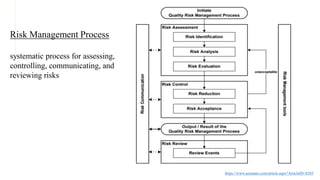
Risk Management Process
systematic process for assessing,
controlling, communicating, and
reviewing risks
https://www.azonano.com/article.aspx?ArticleID=6283
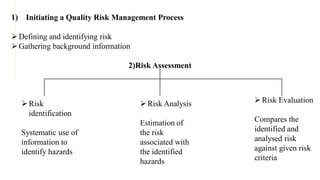
1) Initiating a Quality Risk Management Process
Defining and identifying risk
Gathering background information
2)Risk Assessment
Risk
identification
Systematic use of
information to
identify hazards
Risk Analysis
Estimation of
the risk
associated with
the identified
hazards
Risk Evaluation
Compares the
identified and
analysed risk
against given risk
criteria
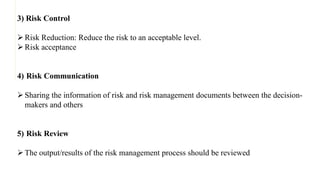
3) Risk Control
Risk Reduction: Reduce the risk to an acceptable level.
Risk acceptance
4) Risk Communication
Sharing the information of risk and risk management documents between the decision-
makers and others
5) Risk Review
The output/results of the risk management process should be reviewed
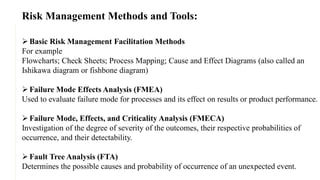
Risk Management Methods and Tools:
Basic Risk Management Facilitation Methods
For example
Flowcharts; Check Sheets; Process Mapping; Cause and Effect Diagrams (also called an
Ishikawa diagram or fishbone diagram)
Failure Mode Effects Analysis (FMEA)
Used to evaluate failure mode for processes and its effect on results or product performance.
Failure Mode, Effects, and Criticality Analysis (FMECA)
Investigation of the degree of severity of the outcomes, their respective probabilities of
occurrence, and their detectability.
Fault Tree Analysis (FTA)
Determines the possible causes and probability of occurrence of an unexpected event.
8
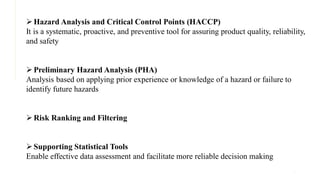
Hazard Analysis and Critical Control Points (HACCP)
It is a systematic, proactive, and preventive tool for assuring product quality, reliability,
and safety
Preliminary Hazard Analysis (PHA)
Analysis based on applying prior experience or knowledge of a hazard or failure to
identify future hazards
Risk Ranking and Filtering
Supporting Statistical Tools
Enable effective data assessment and facilitate more reliable decision making
9
Preliminary Hazard Analysis:
Preliminary hazard analysis (PHA) is a semi-quantitative analysis that is performed to:
Identify all potential hazards and accidental events that may lead to an accident
Rank the identified accidental events according to their severity
Identify required hazard controls measures and follow-up actions
As an initial step of a detailed risk analysis of a system concept or an existing system.
10
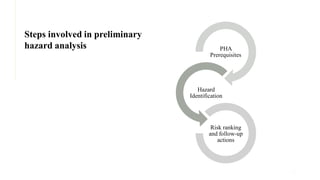
PHA
Prerequisites
Hazard
Identification
Risk ranking
and follow-up
actions
Steps involved in preliminary
hazard analysis

Hazard And Risk Management.pdf

  • 1.
    Presented By: Miss. MohiniTawade, First Year M. Pharmacy, Department of Quality Assurance, Guided By: Dr. (Mrs.) Shubhangi Pharande, Dr. D.Y. Patil College of Pharmacy, Akurdi, Pune. Hazard And Risk Management
  • 2.
    8/03/20XX PITCH DECK2 INTRODUCTION Hazard: Situation that posses a level of threat to life, health, property, or environment Hazard Management involves identifying hazard, assessing the hazard, and controlling the risk. Risk: Risk = Probability + Severity Risk management involves risk identification, assessment, mitigation, elimination and communication.
  • 3.
    Importance of RiskAssessment and Risk Management:  Identifying and understanding potential risk  Prioritizing Risks/ Risk Ranking  Preventing or minimizing the negative impact on the organization  Enhancing decision-making  Ensuring compliance with regulations and standards  Supporting continues improvement  Cost-effective resource allocation  Corrective and Preventive Action
  • 4.
    Risk Management Process systematicprocess for assessing, controlling, communicating, and reviewing risks https://www.azonano.com/article.aspx?ArticleID=6283
  • 5.
    1) Initiating aQuality Risk Management Process Defining and identifying risk Gathering background information 2)Risk Assessment Risk identification Systematic use of information to identify hazards Risk Analysis Estimation of the risk associated with the identified hazards Risk Evaluation Compares the identified and analysed risk against given risk criteria
  • 6.
    3) Risk Control RiskReduction: Reduce the risk to an acceptable level. Risk acceptance 4) Risk Communication Sharing the information of risk and risk management documents between the decision- makers and others 5) Risk Review The output/results of the risk management process should be reviewed
  • 7.
    Risk Management Methodsand Tools: Basic Risk Management Facilitation Methods For example Flowcharts; Check Sheets; Process Mapping; Cause and Effect Diagrams (also called an Ishikawa diagram or fishbone diagram) Failure Mode Effects Analysis (FMEA) Used to evaluate failure mode for processes and its effect on results or product performance. Failure Mode, Effects, and Criticality Analysis (FMECA) Investigation of the degree of severity of the outcomes, their respective probabilities of occurrence, and their detectability. Fault Tree Analysis (FTA) Determines the possible causes and probability of occurrence of an unexpected event.
  • 8.
    8 Hazard Analysis andCritical Control Points (HACCP) It is a systematic, proactive, and preventive tool for assuring product quality, reliability, and safety Preliminary Hazard Analysis (PHA) Analysis based on applying prior experience or knowledge of a hazard or failure to identify future hazards Risk Ranking and Filtering Supporting Statistical Tools Enable effective data assessment and facilitate more reliable decision making
  • 9.
    9 Preliminary Hazard Analysis: Preliminaryhazard analysis (PHA) is a semi-quantitative analysis that is performed to: Identify all potential hazards and accidental events that may lead to an accident Rank the identified accidental events according to their severity Identify required hazard controls measures and follow-up actions As an initial step of a detailed risk analysis of a system concept or an existing system.
  • 10.