Presented by
Geethasravya.Sunkavalli
 Risk can be defined as the
combination of the probability
of an uncertain, sudden or
extreme event and its
consequences
 In all types of undertaking,
there is the potential for events
and consequences that
constitute opportunities for
benefit (upside) or threats to
success (downside).
Risk Management 2
 The key word in the
definition of risk is
uncertain event.
 The challenge is to
identify a potential
event which, if it
happened, could trigger
a set of undesirable
consequences for the
Organization
Risk Management 3
Risk is characterized
by an uncertain
event (or
uncertainty) that
may carry a
potential impact on
the organization.
With the goal of achieving
sustained benefit within
each activity and across the
portfolio of all activities.
It is the process whereby
organizations methodically
address the risks attached
to their activities
Risk Management 4
Risk
management is a
central part of
any
organization's
strategic
management.
 The focus of good risk management
 Is the identification and treatment of these
risks.
 Objective is to add maximum sustainable
value to all the activities of the
organization.
Risk Management 5
Helps understand the potential upside and
downside of all those factors which can
affect the organization
Increases the
probability of
success,
Reduces probability
of failure and the
uncertainty of
achieving objectives
Patient
protection
Risk
assessment
Process
understanding
Regulations
Scientific knowledge/ principles
 All quality risk evaluations must be based on
Scientific and process-specific knowledge and
ultimately linked primarily to the protection of the
patient.
 The level of effort, formality and documentation of
the QRM process should be commensurate with the
level of risk.
 When applied, processes using QRM methodologies
should be dynamic, iterative and responsive to
change.
 The capability for continual improvement should be
embedded in the QRM process.
 Raising the level of protection for the patient
by reduction of the risk to which that patient
is exposed at the time he receive a drug
product.
 Applied in both proactively and
retrospectively.
Risk Management 11
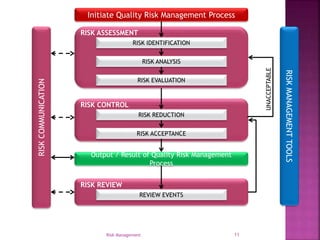
Initiate Quality Risk Management Process
RISK IDENTIFICATION
RISK ANALYSIS
RISK EVALUATION
RISK ASSESSMENT
RISK REDUCTION
RISK ACCEPTANCE
RISK CONTROL
Output / Result of Quality Risk Management
Process
REVIEW EVENTS
RISK REVIEW
RISKCOMMUNICATION
UNACCEPTABLE
RISKMANAGEMENTTOOLS
 Define problem.
 Assemble the background information / data.
 Identify a leader & necessary resource.
 Specify the time line.
 Implementing party, i.e. personnel with
appropriate product-specific knowledge and
experience ( example from user departments
like production, qa, qc and other).
 Person should be able to
 Conduct risk analysis.
 Identify, analyze, evaluate, control,
communicate and review the risk.
 Consider the impact of risk findings on
related or similar products and /or process
Risk Management 15
 Risk assessment begins with well-defined
problem description or risk question, which is
more helpful to address the risk question.
 For clearly defining risk, three fundamental
questions are often helpful.
 What might go wrong?
 What is the likelihood (probability) it will go
wrong?
 What are the consequences (severity)?
Risk Management 17
 Risk identification addresses the “What
might go wrong?” question, including
identifying the possible consequences. This
provides the basis for further steps in the
quality risk management process.
 Risk identification shall be done after
elaborate team discussions based on prior
knowledge, historical data, theoretical
analysis, literature references and concerns
of stake holders.
Risk Management 18
 Risk analysis is the estimation of the risk
associated with the identified hazards.
 Risk analysis is the qualitative or quantitative
process of linking the likelihood of
occurrence and severity of harms.
Risk Management 20
 Risk evaluation compares the identified and
analyzed risk against given risk criteria.
 Based on the outcome of the Risk Assessment
the identified risk shall be analyzed /
evaluated for severity and probability of
occurrence.
 Consider the strength of evidence for all the
three fundamental questions before
considering evaluation and ranking the risk.
Risk Management 22
 During risk analysis and evaluation, input
material characteristics, control and process
understanding, output characteristics and
controls, factors influencing the product
quality shall be kept in mind.
 Risk shall be assessed and documented .
 When risk is evaluated, a numerical
probability shall be used.
Risk Management 23
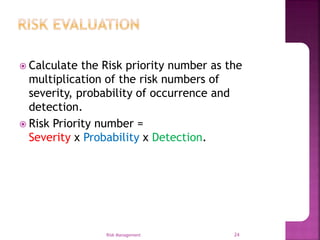
 Calculate the Risk priority number as the
multiplication of the risk numbers of
severity, probability of occurrence and
detection.
 Risk Priority number =
Severity x Probability x Detection.
Risk Management 24
Level Patient Effect Process Effect
10 Patient getting effected Fatally
 Irreparable damage to
batch/product
 Product Quality Attributes
are affected. Possible
regulatory deficiency /
customer query
7
Patient is not affected fatally
but deemed efficacy is not
achieved. BUT the effect is Not
noticeable.
 Reprocessing is possible but
without affecting the quality
attributes
4
Patient is not affected fatally
but deemed efficacy is not
achieved.
BUT the effect is noticeable and
manageable.
 Manufacturing related
Deviations not affecting the
quality of the product.
1 No impact on Patient.
 No impact on Process &
Quality
Risk Management 25
Level Patient Effect Process Effect
10
 [Certainty] Availability of
prior
Knowledge/Information/Refe
rence [KIR] that the
phenomenon shall occur
 Irreparable damage to
batch/product
 Product Quality Attributes
are affected. Possible
regulatory deficiency /
customer query
7
 [Uncertain] No KIR available
with possibility of
surprise/stray results.[risk]
Fairly certain of the chances.
4
 [Uncertain] No KIR available,
but needs to studied .
Remote possibility of Chance
1
 Availability of prior [KIR]
that the phenomenon shall
NOT occur
Almost uncertain no
probability to happen
Risk Management 26
Level Process Control Analytical Control
10
 In-process Checks /
Parameters / Systems/
Procedural controls are NOT
available.
 No Analytical
Technique/Procedure is
available.
7
 In-Process parameters /
Procedural controls to be
established.
 Qualitative detection
technique.
4
 In-process Parameters /
Procedural controls to be
standardized.
 Quantitative Detection
technique.
1
 In-process Test/Checks/
Parameters / Systems are
available.
 Multiple analytical tests
support
Detection/Measurement of
required attributes.
Risk Management 27
 The level of overall risk is calculated as :
 RISK = (S) X (P) X (D)
 The Risk Priority Number (RPN / Over all risk)
changes based upon the risk. The risk assessment
team shall decide the acceptance criteria. For
example the Risk Priority Number (RPN /Over all
risk) is categorized as below:
 RISK PRIORITY NUMBER - RISK LEVELS
 1-64 - Low
 65 – 343 - Medium
 344 – 1000 - High
Risk Management 28
 Rational :
 Considering 4 out of 10 for severity, probability
of occurrence and chance of detection the RPN
of 64 is considered as low risk.
 Considering 7 out of 10 for severity, probability
of occurrence and chance of detection the RPN
of 343 is considered as Medium risk and
 above 343 is considered as high risk.
 Based on the process criticality and
requirements, an acceptable risk priority
number shall be fixed to prioritize the risk
control measures.
Risk Management 29
 Note: This acceptable level will depend on many
parameters and should be decided on a case-by-
case basis.
 Other appropriate tools, but not limited to like
FMEA, FTA (Fault tree analysis), HACCP, HAZOP,
(Hazard operability) PHA (Preliminary hazard
analysis), Risk ranking, supporting statistical
tools may be used to arrive at a detailed risk
analysis.
 After risk analysis process to mitigate the
evaluated risks, team members shall meet to
arrive at a formal decision to accept the residual
risk.
Risk Management 30
 Risk control is decision making to reduce and/or
accept risks and to reduce the risk to an
acceptable level.
 The amount of effort used for risk control should
be proportional to the significance of the risk.
 During risk controlling, the following shall be
focused.
 Is the risk above an acceptable level?
 What can be done to reduce or eliminate risks?
 What is the appropriate balance among benefits, risks
and resources?
 Are new risks introduced as a result of the identified
risks being controlled?
Risk Management 32
 Based on the process criticality and
requirements, an acceptable risk priority number
shall be fixed to prioritize the risk control
measures.
 Note: This acceptable level will depend on many
parameters and should be decided on a case-by-
case basis.
 Once the above process is completed, if any
mitigation is required, the actions to be taken,
target date and the responsible person shall be
identified by the user department along with the
team and documented
 If the risk control indicated is not considered
adequate, the risk assessment shall be repeated
with the available new knowledge.
Risk Management 33
 Sharing of information about risk and risk
management between the decision makers
and others.
 At any stage of QRM process.
 The output/ results of the QRM process
should be appropriately communicated and
documneted.
 Risk management should be an ongoing part
of the quality management process.
 The output/results of the risk management
process should be reviewed to take into
account new knowledge and experience.
 The frequency of any review should be based
upon the level of risk. Risk review might
include reconsideration of risk acceptance
decisions.
 During the risk summary /conclusion, the risk
reduction measures /actions taken to
mitigate the severity and probability of harm
shall be reviewed.
 Once all agreed mitigation measures /
actions are completed, the same shall be
checked by the Department Head and
acknowledged in summary and conclusion
report
Risk Management 38
Thank you

Qrm presentation

  • 1.
  • 2.
     Risk canbe defined as the combination of the probability of an uncertain, sudden or extreme event and its consequences  In all types of undertaking, there is the potential for events and consequences that constitute opportunities for benefit (upside) or threats to success (downside). Risk Management 2
  • 3.
     The keyword in the definition of risk is uncertain event.  The challenge is to identify a potential event which, if it happened, could trigger a set of undesirable consequences for the Organization Risk Management 3 Risk is characterized by an uncertain event (or uncertainty) that may carry a potential impact on the organization.
  • 4.
    With the goalof achieving sustained benefit within each activity and across the portfolio of all activities. It is the process whereby organizations methodically address the risks attached to their activities Risk Management 4 Risk management is a central part of any organization's strategic management.
  • 5.
     The focusof good risk management  Is the identification and treatment of these risks.  Objective is to add maximum sustainable value to all the activities of the organization. Risk Management 5 Helps understand the potential upside and downside of all those factors which can affect the organization Increases the probability of success, Reduces probability of failure and the uncertainty of achieving objectives
  • 6.
  • 7.
     All qualityrisk evaluations must be based on Scientific and process-specific knowledge and ultimately linked primarily to the protection of the patient.  The level of effort, formality and documentation of the QRM process should be commensurate with the level of risk.  When applied, processes using QRM methodologies should be dynamic, iterative and responsive to change.  The capability for continual improvement should be embedded in the QRM process.
  • 9.
     Raising thelevel of protection for the patient by reduction of the risk to which that patient is exposed at the time he receive a drug product.  Applied in both proactively and retrospectively.
  • 11.
    Risk Management 11 InitiateQuality Risk Management Process RISK IDENTIFICATION RISK ANALYSIS RISK EVALUATION RISK ASSESSMENT RISK REDUCTION RISK ACCEPTANCE RISK CONTROL Output / Result of Quality Risk Management Process REVIEW EVENTS RISK REVIEW RISKCOMMUNICATION UNACCEPTABLE RISKMANAGEMENTTOOLS
  • 13.
     Define problem. Assemble the background information / data.  Identify a leader & necessary resource.  Specify the time line.
  • 15.
     Implementing party,i.e. personnel with appropriate product-specific knowledge and experience ( example from user departments like production, qa, qc and other).  Person should be able to  Conduct risk analysis.  Identify, analyze, evaluate, control, communicate and review the risk.  Consider the impact of risk findings on related or similar products and /or process Risk Management 15
  • 17.
     Risk assessmentbegins with well-defined problem description or risk question, which is more helpful to address the risk question.  For clearly defining risk, three fundamental questions are often helpful.  What might go wrong?  What is the likelihood (probability) it will go wrong?  What are the consequences (severity)? Risk Management 17
  • 18.
     Risk identificationaddresses the “What might go wrong?” question, including identifying the possible consequences. This provides the basis for further steps in the quality risk management process.  Risk identification shall be done after elaborate team discussions based on prior knowledge, historical data, theoretical analysis, literature references and concerns of stake holders. Risk Management 18
  • 20.
     Risk analysisis the estimation of the risk associated with the identified hazards.  Risk analysis is the qualitative or quantitative process of linking the likelihood of occurrence and severity of harms. Risk Management 20
  • 22.
     Risk evaluationcompares the identified and analyzed risk against given risk criteria.  Based on the outcome of the Risk Assessment the identified risk shall be analyzed / evaluated for severity and probability of occurrence.  Consider the strength of evidence for all the three fundamental questions before considering evaluation and ranking the risk. Risk Management 22
  • 23.
     During riskanalysis and evaluation, input material characteristics, control and process understanding, output characteristics and controls, factors influencing the product quality shall be kept in mind.  Risk shall be assessed and documented .  When risk is evaluated, a numerical probability shall be used. Risk Management 23
  • 24.
     Calculate theRisk priority number as the multiplication of the risk numbers of severity, probability of occurrence and detection.  Risk Priority number = Severity x Probability x Detection. Risk Management 24
  • 25.
    Level Patient EffectProcess Effect 10 Patient getting effected Fatally  Irreparable damage to batch/product  Product Quality Attributes are affected. Possible regulatory deficiency / customer query 7 Patient is not affected fatally but deemed efficacy is not achieved. BUT the effect is Not noticeable.  Reprocessing is possible but without affecting the quality attributes 4 Patient is not affected fatally but deemed efficacy is not achieved. BUT the effect is noticeable and manageable.  Manufacturing related Deviations not affecting the quality of the product. 1 No impact on Patient.  No impact on Process & Quality Risk Management 25
  • 26.
    Level Patient EffectProcess Effect 10  [Certainty] Availability of prior Knowledge/Information/Refe rence [KIR] that the phenomenon shall occur  Irreparable damage to batch/product  Product Quality Attributes are affected. Possible regulatory deficiency / customer query 7  [Uncertain] No KIR available with possibility of surprise/stray results.[risk] Fairly certain of the chances. 4  [Uncertain] No KIR available, but needs to studied . Remote possibility of Chance 1  Availability of prior [KIR] that the phenomenon shall NOT occur Almost uncertain no probability to happen Risk Management 26
  • 27.
    Level Process ControlAnalytical Control 10  In-process Checks / Parameters / Systems/ Procedural controls are NOT available.  No Analytical Technique/Procedure is available. 7  In-Process parameters / Procedural controls to be established.  Qualitative detection technique. 4  In-process Parameters / Procedural controls to be standardized.  Quantitative Detection technique. 1  In-process Test/Checks/ Parameters / Systems are available.  Multiple analytical tests support Detection/Measurement of required attributes. Risk Management 27
  • 28.
     The levelof overall risk is calculated as :  RISK = (S) X (P) X (D)  The Risk Priority Number (RPN / Over all risk) changes based upon the risk. The risk assessment team shall decide the acceptance criteria. For example the Risk Priority Number (RPN /Over all risk) is categorized as below:  RISK PRIORITY NUMBER - RISK LEVELS  1-64 - Low  65 – 343 - Medium  344 – 1000 - High Risk Management 28
  • 29.
     Rational : Considering 4 out of 10 for severity, probability of occurrence and chance of detection the RPN of 64 is considered as low risk.  Considering 7 out of 10 for severity, probability of occurrence and chance of detection the RPN of 343 is considered as Medium risk and  above 343 is considered as high risk.  Based on the process criticality and requirements, an acceptable risk priority number shall be fixed to prioritize the risk control measures. Risk Management 29
  • 30.
     Note: Thisacceptable level will depend on many parameters and should be decided on a case-by- case basis.  Other appropriate tools, but not limited to like FMEA, FTA (Fault tree analysis), HACCP, HAZOP, (Hazard operability) PHA (Preliminary hazard analysis), Risk ranking, supporting statistical tools may be used to arrive at a detailed risk analysis.  After risk analysis process to mitigate the evaluated risks, team members shall meet to arrive at a formal decision to accept the residual risk. Risk Management 30
  • 32.
     Risk controlis decision making to reduce and/or accept risks and to reduce the risk to an acceptable level.  The amount of effort used for risk control should be proportional to the significance of the risk.  During risk controlling, the following shall be focused.  Is the risk above an acceptable level?  What can be done to reduce or eliminate risks?  What is the appropriate balance among benefits, risks and resources?  Are new risks introduced as a result of the identified risks being controlled? Risk Management 32
  • 33.
     Based onthe process criticality and requirements, an acceptable risk priority number shall be fixed to prioritize the risk control measures.  Note: This acceptable level will depend on many parameters and should be decided on a case-by- case basis.  Once the above process is completed, if any mitigation is required, the actions to be taken, target date and the responsible person shall be identified by the user department along with the team and documented  If the risk control indicated is not considered adequate, the risk assessment shall be repeated with the available new knowledge. Risk Management 33
  • 35.
     Sharing ofinformation about risk and risk management between the decision makers and others.  At any stage of QRM process.  The output/ results of the QRM process should be appropriately communicated and documneted.
  • 37.
     Risk managementshould be an ongoing part of the quality management process.  The output/results of the risk management process should be reviewed to take into account new knowledge and experience.  The frequency of any review should be based upon the level of risk. Risk review might include reconsideration of risk acceptance decisions.
  • 38.
     During therisk summary /conclusion, the risk reduction measures /actions taken to mitigate the severity and probability of harm shall be reviewed.  Once all agreed mitigation measures / actions are completed, the same shall be checked by the Department Head and acknowledged in summary and conclusion report Risk Management 38
  • 40.