IN PROCESS QUALITY CONTROL
TEST FOR CAPSULE
Presented by: Jinendra Kumar Jain
B.pharm 3rd year
17HPH053
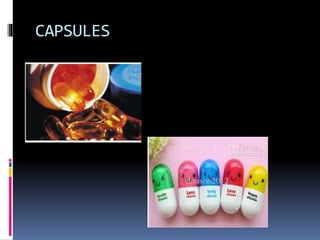
CAPSULES
CONTENTS
 • INTRODUCTION
 • ADVANTAGES
 • DISADVANTAGES
 • QUALITY CONTROL OF CAPSULES
 Physical tests
 Chemical tests
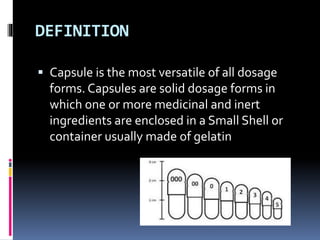
DEFINITION
 Capsule is the most versatile of all dosage
forms. Capsules are solid dosage forms in
which one or more medicinal and inert
ingredients are enclosed in a Small Shell or
container usually made of gelatin
ADVANTAGES OF CAPSULES
 Capsules mask the taste and odour of unpleasant
drugs and can be easily administered.
 They are slippery when moist and hence easy to
swallow with a draught of water.
 As compared to tablets less adjuncts are required.
 The shells are physiologically inert and easily and
quickly digested in the gastrointestinal tract.
 They are economical .
 They are easy to handle and carry.
 The shells can be opacified (with titanium dioxide)
or coloured, to give protection from light.
DISADVANTAGES OF CAPSULES
 The drugs which are hygroscopic absorb
water from the capsule shell making it
brittle and hence are not suitable for filling
into capsules.
 The concentrated solutions which require
previous dilution are unsuitable for
capsules because if administered as such
lead to irritation of stomach.
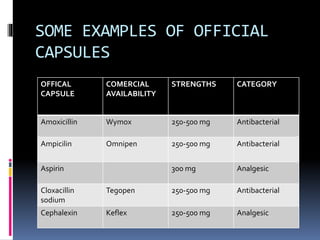
SOME EXAMPLES OF OFFICIAL
CAPSULES
OFFICAL
CAPSULE
COMERCIAL
AVAILABILITY
STRENGTHS CATEGORY
Amoxicillin Wymox 250-500 mg Antibacterial
Ampicilin Omnipen 250-500 mg Antibacterial
Aspirin 300 mg Analgesic
Cloxacillin
sodium
Tegopen 250-500 mg Antibacterial
Cephalexin Keflex 250-500 mg Analgesic
QUALITY CONTROL OF CAPSULES
 Whether capsules are produced on a small
scale or large scale all of them are required to
pass through certain tests i.e., quality control
tests to test the quality of the finished
product.
Quality control tests are
divided into
 PHYSICALTEST
 Disintegration test
 Weight variation
 CHEMICALTEST
 Dissolution test
 Assay
 Content uniformity
 Stability testing
 Moisture permeation test
PHYSICALTESTS OF
CAPSULES
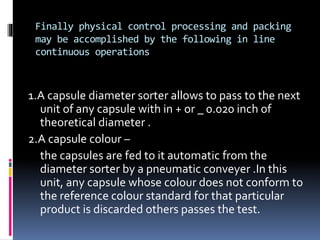
Finally physical control processing and packing
may be accomplished by the following in line
continuous operations
1.A capsule diameter sorter allows to pass to the next
unit of any capsule with in + or _ 0.020 inch of
theoretical diameter .
2.A capsule colour –
the capsules are fed to it automatic from the
diameter sorter by a pneumatic conveyer .In this
unit, any capsule whose colour does not conform to
the reference colour standard for that particular
product is discarded others passes the test.
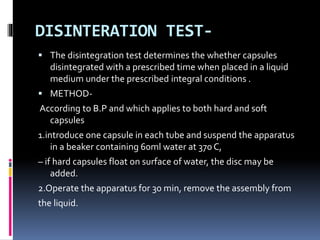
DISINTERATION TEST-
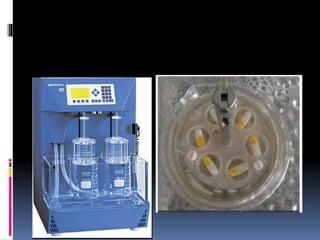
 The disintegration test determines the whether capsules
disintegrated with a prescribed time when placed in a liquid
medium under the prescribed integral conditions .
 METHOD-
According to B.P and which applies to both hard and soft
capsules
1.introduce one capsule in each tube and suspend the apparatus
in a beaker containing 60ml water at 370 C,
– if hard capsules float on surface of water, the disc may be
added.
2.Operate the apparatus for 30 min, remove the assembly from
the liquid.
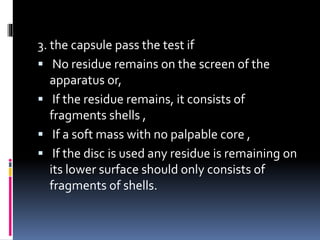
3. the capsule pass the test if
 No residue remains on the screen of the
apparatus or,
 If the residue remains, it consists of
fragments shells ,
 If a soft mass with no palpable core ,
 If the disc is used any residue is remaining on
its lower surface should only consists of
fragments of shells.
WEIGHT VARIATION
 FOR HARD CAPSULES
 weigh 20 capsules individually and determine the
avg weight
 The individual wts should be with in limit of 90-110%
of avg wt
 If not all of capsules fall with in the limits,
 Weigh 20 capsules individually
 Remove the net content of each capsule with the aid
of a small brush
 Weigh the empty shells individually
 NETWT OF CONTENTS INDIVIDUALLY =THEWT
OF SHELL-GROSSWT
 Determine the avg net content from the sum
of individual net wt
 Then determine the difference b/w each
individual net content and avg net content
 LIMITS-
 Not more then 2 of the differences are
greater then 10% of the avg net content
 No case is the difference greater then 25% wt
range
 If more then 2 ,but not more then 6 capsules
deviate from the avg b/w 10-25%
 Determine the net contents of an additional 40
capsules
 Determine the avg content of entire 60 capsules
 Determine the 60 deviations from the new avg
 LIMITS-
 NMT 6 of 60 capsules does the difference
exceed 10% of the avg net content
 No case does the difference exceed 25%
 FOR SOFT CAPSULES
 proceed as directed under hard capsules, but
determine the net wt of the contents of individual
capsules as follows:
 weigh the capsules individually then cut and open
the capsules
 remove the contents by washing with the suitable
solvent
 allow the solvents to evaporate from the shells at
room temp
 weigh the individual shells
 Calculate the net contents
CHEMICALTESTS OF
CAPSULES
DISSOLUTION TEST-
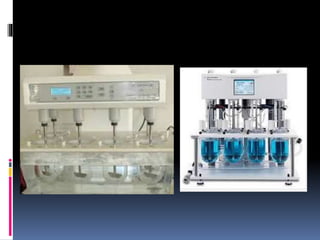
 The dissolution test is carried out using the
dissolution apparatus official in both the U.S.P and
I.P .
 The capsule is placed in a basket , and the basket is
immersed in the dissolution medium and caused to
rotate at a specified speed .
 The dissolution medium is held in a covered 1000ml
glass vessel and maintained at 370 c +-0.5 0c by
means of a constant temperature suitable water
bath .
 The stirrer speed and type of dissolution medium
are specified in the individual monograph .
RESULT -
 Six capsules are tested and are accepted if each
of them is not less than monograph specified
i.e., p +5%
 If it fails then additional six capsules are tested
the result is accepted if the avg. of 12 capsules is
greater than or equal to p and none of them is
less than p-15%.
 If the capsule still fails the test the additional 12
capsules are tested and are accepted if the avg.
of 24 is greater than to p, if not more than two
less than p-15% and none of them is less than p-
25%
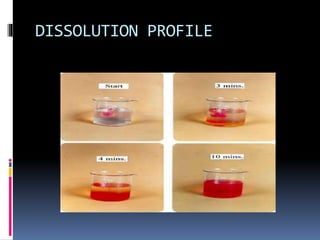
DISSOLUTION PROFILE
FACTORS AFFECTING DRUG DISSOLUTION
FROM HARD GELATIN CAPSULES
 Overall Dissolution Rate is a Function of:
• Dissolution Rate of the Shell
• Rate of Penetration of Dissolution Medium
• Rate of Disaggregation of Powder Mass
• Nature of Primary Drug Particles
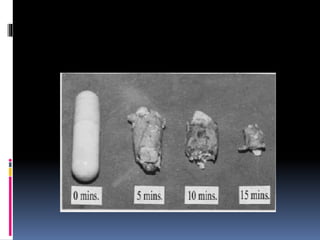
 Normally, shell ruptures and dissolves within
about 4 minutes.
 Rupture occurs first at the shoulders where
shell wall is thinnest.
 Ends fall away and as liquid penetrates and
deaggregation occurs, formulation tend to
spill out of the two ends
CONTENT UNIFORMITY
 10 capsules are taken and subjected to assay
 9 of 10 capsules should be in the range of
+_15% (85-115%)
 And 10th capsule are beyond +_ 15% range
then 20 capsules are assayed
 All capsules with in range of +_25% (75-125%)
MOISTURE PERMEATION TEST
 The degree and rate of moisture penetration is
determined by packaging the dosage unit
together with a colour revealing desiccant pellet
 Expose the packed unit to known relative
humidity over a specified time
 Observe the desiccant pellet for colour change
 Any change in colour indicates absorption of
moisture
 By measuring pre test weight and protest weight
of pellet, amount can be calculated.
BLOOM STRENGHT OF GELATIN
 RAW MATERIALS-
 The gelatin of the capsule shells should be
assayed for varies physical properties like bloom
strength ,viscosity etc..
 PROCEDURE-
 Gelatin is weighed into water to typically create
a 6.67% soln in standard bloom bottles
 The mix is then stirred and keep it for 3 hours at
room temp
 Bottles are placed in a 650 c bath for 20 minutes
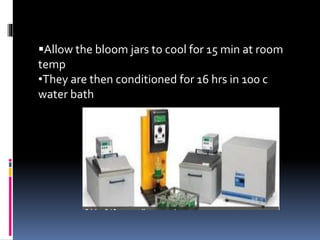
Allow the bloom jars to cool for 15 min at room
temp
•They are then conditioned for 16 hrs in 100 c
water bath
when conducting gelatin bloom test,
 the bloom jar is centered with the probe just
above the sample surface
 The probe penetrates the gelatin to a target
depth of 4mm at a speed of 0.5mm/s , and
then retracts
 The peak force is the gel strength in grams
bloom
THANK YOU!!

In process stability control test for capsule

  • 1.
    IN PROCESS QUALITYCONTROL TEST FOR CAPSULE Presented by: Jinendra Kumar Jain B.pharm 3rd year 17HPH053
  • 2.
  • 3.
    CONTENTS  • INTRODUCTION • ADVANTAGES  • DISADVANTAGES  • QUALITY CONTROL OF CAPSULES  Physical tests  Chemical tests
  • 4.
    DEFINITION  Capsule isthe most versatile of all dosage forms. Capsules are solid dosage forms in which one or more medicinal and inert ingredients are enclosed in a Small Shell or container usually made of gelatin
  • 5.
    ADVANTAGES OF CAPSULES Capsules mask the taste and odour of unpleasant drugs and can be easily administered.  They are slippery when moist and hence easy to swallow with a draught of water.  As compared to tablets less adjuncts are required.  The shells are physiologically inert and easily and quickly digested in the gastrointestinal tract.  They are economical .  They are easy to handle and carry.  The shells can be opacified (with titanium dioxide) or coloured, to give protection from light.
  • 6.
    DISADVANTAGES OF CAPSULES The drugs which are hygroscopic absorb water from the capsule shell making it brittle and hence are not suitable for filling into capsules.  The concentrated solutions which require previous dilution are unsuitable for capsules because if administered as such lead to irritation of stomach.
  • 7.
    SOME EXAMPLES OFOFFICIAL CAPSULES OFFICAL CAPSULE COMERCIAL AVAILABILITY STRENGTHS CATEGORY Amoxicillin Wymox 250-500 mg Antibacterial Ampicilin Omnipen 250-500 mg Antibacterial Aspirin 300 mg Analgesic Cloxacillin sodium Tegopen 250-500 mg Antibacterial Cephalexin Keflex 250-500 mg Analgesic
  • 8.
    QUALITY CONTROL OFCAPSULES  Whether capsules are produced on a small scale or large scale all of them are required to pass through certain tests i.e., quality control tests to test the quality of the finished product.
  • 9.
    Quality control testsare divided into  PHYSICALTEST  Disintegration test  Weight variation  CHEMICALTEST  Dissolution test  Assay  Content uniformity  Stability testing  Moisture permeation test
  • 10.
  • 11.
    Finally physical controlprocessing and packing may be accomplished by the following in line continuous operations 1.A capsule diameter sorter allows to pass to the next unit of any capsule with in + or _ 0.020 inch of theoretical diameter . 2.A capsule colour – the capsules are fed to it automatic from the diameter sorter by a pneumatic conveyer .In this unit, any capsule whose colour does not conform to the reference colour standard for that particular product is discarded others passes the test.
  • 12.
    DISINTERATION TEST-  Thedisintegration test determines the whether capsules disintegrated with a prescribed time when placed in a liquid medium under the prescribed integral conditions .  METHOD- According to B.P and which applies to both hard and soft capsules 1.introduce one capsule in each tube and suspend the apparatus in a beaker containing 60ml water at 370 C, – if hard capsules float on surface of water, the disc may be added. 2.Operate the apparatus for 30 min, remove the assembly from the liquid.
  • 13.
    3. the capsulepass the test if  No residue remains on the screen of the apparatus or,  If the residue remains, it consists of fragments shells ,  If a soft mass with no palpable core ,  If the disc is used any residue is remaining on its lower surface should only consists of fragments of shells.
  • 15.
    WEIGHT VARIATION  FORHARD CAPSULES  weigh 20 capsules individually and determine the avg weight  The individual wts should be with in limit of 90-110% of avg wt  If not all of capsules fall with in the limits,  Weigh 20 capsules individually  Remove the net content of each capsule with the aid of a small brush  Weigh the empty shells individually  NETWT OF CONTENTS INDIVIDUALLY =THEWT OF SHELL-GROSSWT
  • 16.
     Determine theavg net content from the sum of individual net wt  Then determine the difference b/w each individual net content and avg net content  LIMITS-  Not more then 2 of the differences are greater then 10% of the avg net content  No case is the difference greater then 25% wt range
  • 17.
     If morethen 2 ,but not more then 6 capsules deviate from the avg b/w 10-25%  Determine the net contents of an additional 40 capsules  Determine the avg content of entire 60 capsules  Determine the 60 deviations from the new avg  LIMITS-  NMT 6 of 60 capsules does the difference exceed 10% of the avg net content  No case does the difference exceed 25%
  • 18.
     FOR SOFTCAPSULES  proceed as directed under hard capsules, but determine the net wt of the contents of individual capsules as follows:  weigh the capsules individually then cut and open the capsules  remove the contents by washing with the suitable solvent  allow the solvents to evaporate from the shells at room temp  weigh the individual shells  Calculate the net contents
  • 19.
  • 20.
    DISSOLUTION TEST-  Thedissolution test is carried out using the dissolution apparatus official in both the U.S.P and I.P .  The capsule is placed in a basket , and the basket is immersed in the dissolution medium and caused to rotate at a specified speed .  The dissolution medium is held in a covered 1000ml glass vessel and maintained at 370 c +-0.5 0c by means of a constant temperature suitable water bath .  The stirrer speed and type of dissolution medium are specified in the individual monograph .
  • 21.
    RESULT -  Sixcapsules are tested and are accepted if each of them is not less than monograph specified i.e., p +5%  If it fails then additional six capsules are tested the result is accepted if the avg. of 12 capsules is greater than or equal to p and none of them is less than p-15%.  If the capsule still fails the test the additional 12 capsules are tested and are accepted if the avg. of 24 is greater than to p, if not more than two less than p-15% and none of them is less than p- 25%
  • 23.
  • 25.
    FACTORS AFFECTING DRUGDISSOLUTION FROM HARD GELATIN CAPSULES  Overall Dissolution Rate is a Function of: • Dissolution Rate of the Shell • Rate of Penetration of Dissolution Medium • Rate of Disaggregation of Powder Mass • Nature of Primary Drug Particles
  • 26.
     Normally, shellruptures and dissolves within about 4 minutes.  Rupture occurs first at the shoulders where shell wall is thinnest.  Ends fall away and as liquid penetrates and deaggregation occurs, formulation tend to spill out of the two ends
  • 27.
    CONTENT UNIFORMITY  10capsules are taken and subjected to assay  9 of 10 capsules should be in the range of +_15% (85-115%)  And 10th capsule are beyond +_ 15% range then 20 capsules are assayed  All capsules with in range of +_25% (75-125%)
  • 28.
    MOISTURE PERMEATION TEST The degree and rate of moisture penetration is determined by packaging the dosage unit together with a colour revealing desiccant pellet  Expose the packed unit to known relative humidity over a specified time  Observe the desiccant pellet for colour change  Any change in colour indicates absorption of moisture  By measuring pre test weight and protest weight of pellet, amount can be calculated.
  • 29.
    BLOOM STRENGHT OFGELATIN  RAW MATERIALS-  The gelatin of the capsule shells should be assayed for varies physical properties like bloom strength ,viscosity etc..  PROCEDURE-  Gelatin is weighed into water to typically create a 6.67% soln in standard bloom bottles  The mix is then stirred and keep it for 3 hours at room temp  Bottles are placed in a 650 c bath for 20 minutes
  • 30.
    Allow the bloomjars to cool for 15 min at room temp •They are then conditioned for 16 hrs in 100 c water bath
  • 31.
    when conducting gelatinbloom test,  the bloom jar is centered with the probe just above the sample surface  The probe penetrates the gelatin to a target depth of 4mm at a speed of 0.5mm/s , and then retracts  The peak force is the gel strength in grams bloom
  • 32.