12/8/2018Quality Control Test 1
Sanjivani College of Pharmaceutical Education and
Research, Kopargaon
Prepared by
Miss Unnati .M. Patel
F.Y.M Pharm(PQA)
Guided by
Dr A.D.Kulkerni
MPharm(Pharmaceutics)
12/8/20182
CONTENT
1. QC Test for Containers
2. QC Test for Closures
3. QC Test for Secondary Packaging Materials
Quality Control Test
12/8/20183
QUALITY CONTROL TEST FOR CONTAINERS
Quality Control Test
 Different types of container materials.
1. Glass Container
2. Plastic Container
3. Metal Container
4. Rubber
12/8/2018Quality Control Test 4
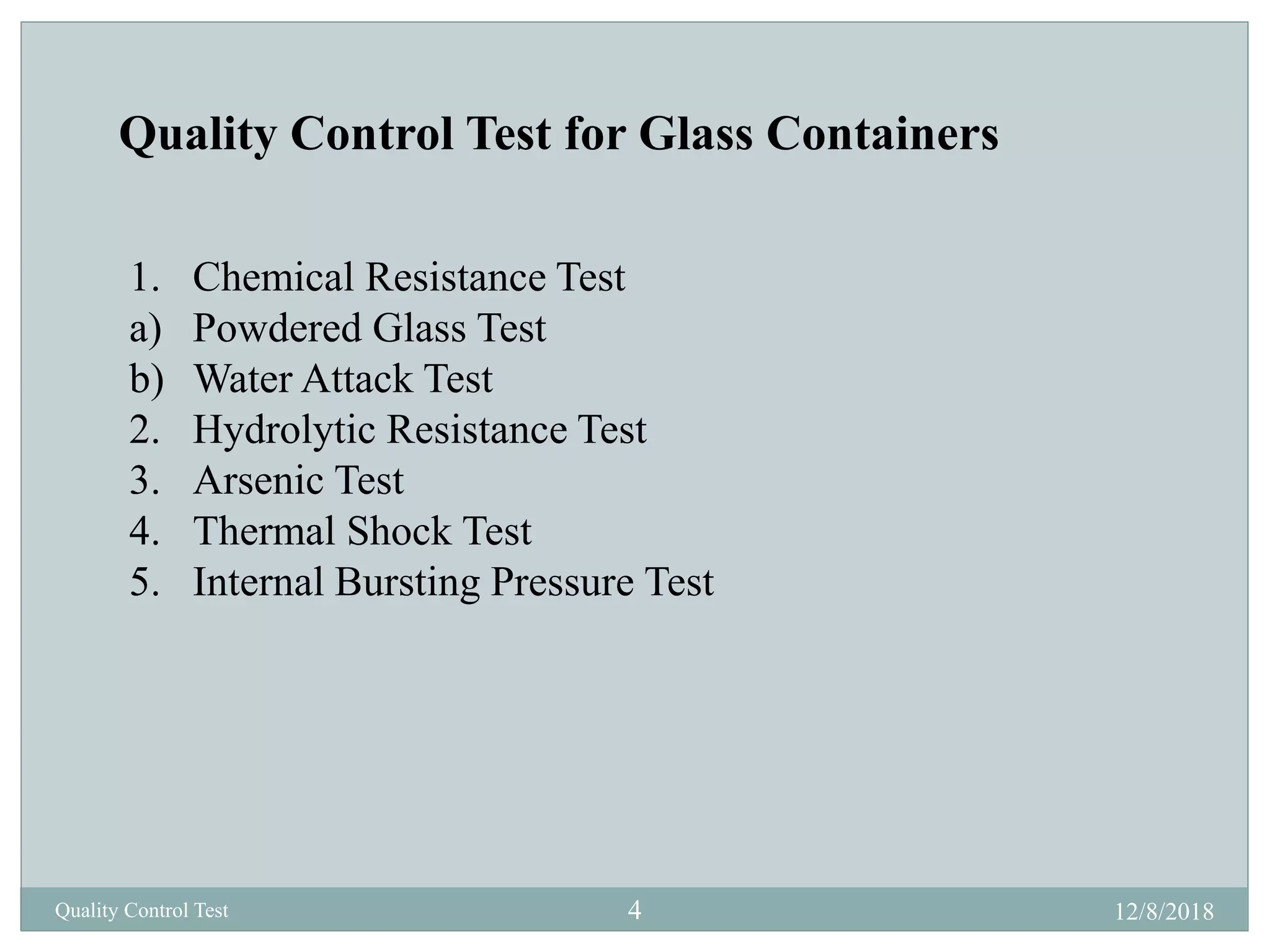
Quality Control Test for Glass Containers
1. Chemical Resistance Test
a) Powdered Glass Test
b) Water Attack Test
2. Hydrolytic Resistance Test
3. Arsenic Test
4. Thermal Shock Test
5. Internal Bursting Pressure Test
12/8/2018Quality Control Test 5
1. Chemical Resistant Test
a) Powdered Glass Test: It is done to estimate the
amount of alkali from powdered glass with happen at
elevated temperature. When glass is powdered,
leaching of alkali is enhanced, which can be titrated
with 0.02N sulphuric acid using methylred as an
indicator.
Step 1
• Preparation of glass specimen
Step 2
• Washing the specimen
12/8/2018Quality Control Test 6
10g of specimen/sample + 50ml oh highly
purified water.Autoclave it at 121̊C.
Cool it and deacant solution in another flask
again add 15ml water and decant solution
Titrate the decant solution with 0.02N sulphuric
acid using indicator and record the volume
Test Container Vol. of 0.02N
H2SO4(ml)
Powdered
Glass Test
Type I
Type III
Type N.P
1.0
8.5
15
Limits:
12/8/2018Quality Control Test 7
b) Water Attack Test: This test is for Type II glass. The
principle involve in this is whether the alkali leaches from
surface of container.
Rinse thoroughly container with high purity
water. Fill it by 90% of it’s capacity with water.
Autoclave it at 121̊C for 30 minutes. Then it is
cooled and liquid is decanted
Decanted liquid is titrated with 0.02N Sulphuric
acid using methylred as an indicator
The volume of sulphuric acid consumed is
recorded and compare with limits
12/8/2018Quality Control Test 8
Test Container Vol. of 0.02N
H2SO4(ml)
Water Attack
Test
Type II
Size(ml)-100
Less than 100
1.0
0.7
0.2
Limits:
2. Leakage Test:
 Drug filled container is placed in contained filled with
colored solution (methyleneblue) and autoclave at 121̊C for 10
min. under pressure.
Later on the container are observed whether colored get
entered in container or not.
12/8/2018Quality Control Test 9
3. Hydrolytic Resistant Test
 This test is only for unused glass container.
At 100̊C for 10
min. allow to
rise temp. to
121̊C for 60 min.
Low down temp
to 100̊C. Cool it
Rinse the
container with
CO2 free water
for 3 times. fill
till a particular
vol. autoclave it
Specific amount
of liquid solution
is titrated with
0.01N HCL
using methylred
as an indicator.
Perform the blank with water
and difference between the
titration represents vol. of
HCL consumed by test liquid
12/8/2018Quality Control Test 10
Limits
12/8/2018Quality Control Test 11
Wash inner and outer surface of container with
D.W. for 5 min.
Dry residue in oven at 130̊C for 30 min. & cool it
& add hydrogen molybdate & refux for 25 min.
Cool the solution and determine absorbance at
840nm. Perform blank.
Pipette out 10 ml and add 10ml of nitric acid on
the water bath maintaing the temperature.
Test solution is same as that of hydrolytic
resistant test (50ml)
4. Arsenic Test
12/8/2018Quality Control Test 12
Limits: The absorbance of test solution should not exceed the
absorbance of arsenic standard solution of 10ppm.
5. Internal Bursting Pressure Test
Instrument used American glass research increment pressure tester.
The test bottle is
filled with water
and placed inside
test chamber
The internal
pressure
automatically raised
by series of
increment at set
time
Bottle are checked
at preselected
pressure level until
container finally
burst.
12/8/2018Quality Control Test 13
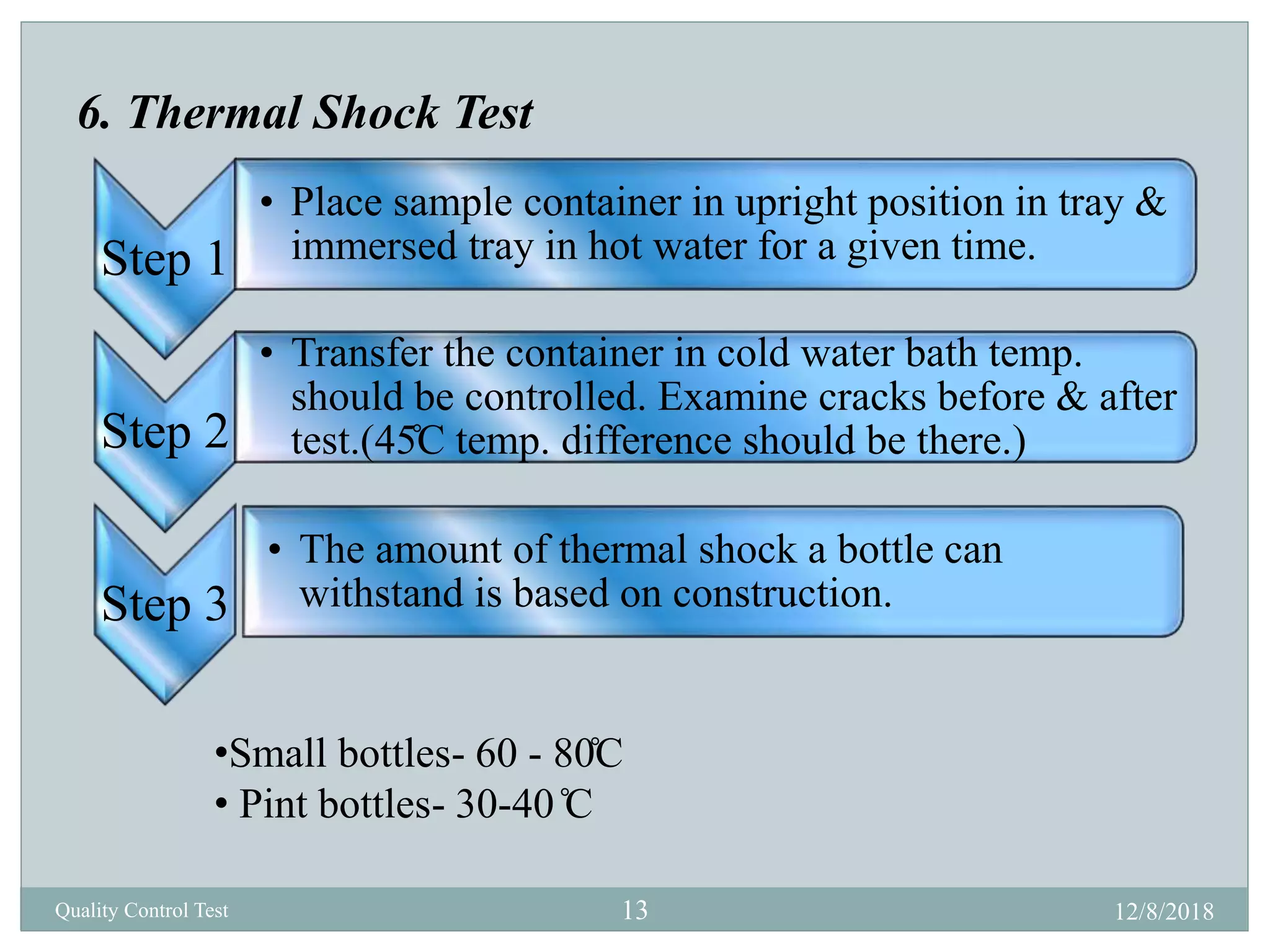
6. Thermal Shock Test
Step 1
• Place sample container in upright position in tray &
immersed tray in hot water for a given time.
Step 2
• Transfer the container in cold water bath temp.
should be controlled. Examine cracks before & after
test.(45̊C temp. difference should be there.)
Step 3
• The amount of thermal shock a bottle can
withstand is based on construction.
•Small bottles- 60 - 80̊C
• Pint bottles- 30-40 ̊C
12/8/2018Quality Control Test 14
Quality
Control
test for
Plastic
Container
Leakage
test
Collapsibi
lity
Transpare
ncy
Water
vapour
permeabilit
y test
Bacteriolog
ical test
12/8/2018Quality Control Test 15
Quality Control Test for Metal Container
• Take 50 empty tubes filled with ointment base,
sealed & kept overnight
Step 1
• A metal bacteriological filter assembly fitted
with filter paper & heated to melting range of
ointment base.
Step 2
• Base from all tubes squeezed at certain rate &
passed through filter under vaccum. further
wash with CHCL3 and observed for particles.
Step 3
12/8/2018Quality Control Test 16
Observations
Particles 1mm and above 50
Particles 0.5mm to 1mm 10
Particles 0.2mm to 0.5mm 2
Particles less than 0.2mm Nil
Total score 62
Limits :
 Lot of tube passes test if total score is less than 100.
 Lot of tubes fails if total score is above 150
 If it is between 100 – 150 test is repeated again with 50 more tubes
12/8/2018Quality Control Test 17
Quality Control Test for collapsible tubes
Quality Control Test for
collapsible tubes
Leakage Test
Power of
Adhesion
Flexibility Product
compatibility
12/8/2018Quality Control Test 18
Quality Control Test for Strip and Blister packing
3/4th of water is poured in
desiccator. Strip and Blister
were placed inside
desiccators and vaccum is
applied
Later on strips, blisters
were taken out. water
present over the outer
surface were wiped out.
The content of strips and
blisters were removed
and presence of moisture
was checked
If there is no leakage,
content will not be
wetted. It indicate
perfect sealing.
12/8/201819
QUALITY CONTROL TEST FOR CLOSURES
1. Sterility Test
2. Fragmentation Test
3. Self-Sealability
4. pH of aqueous extract
5. Light Absorption Test
6. Reducing Substance
7. Residue on Evaporation
8. Penetrability
Quality Control Test
12/8/201820
 Preparation of sample solution
Wash closure in 0.2%w/v of anionic
surfactant for 5 min.
Rinse 5 times with D.W. and add
200ml water.
Further subjected to autoclave and
covering with Al foil.
Allow to cool and separate solution
from closure
Quality Control Test
12/8/201821
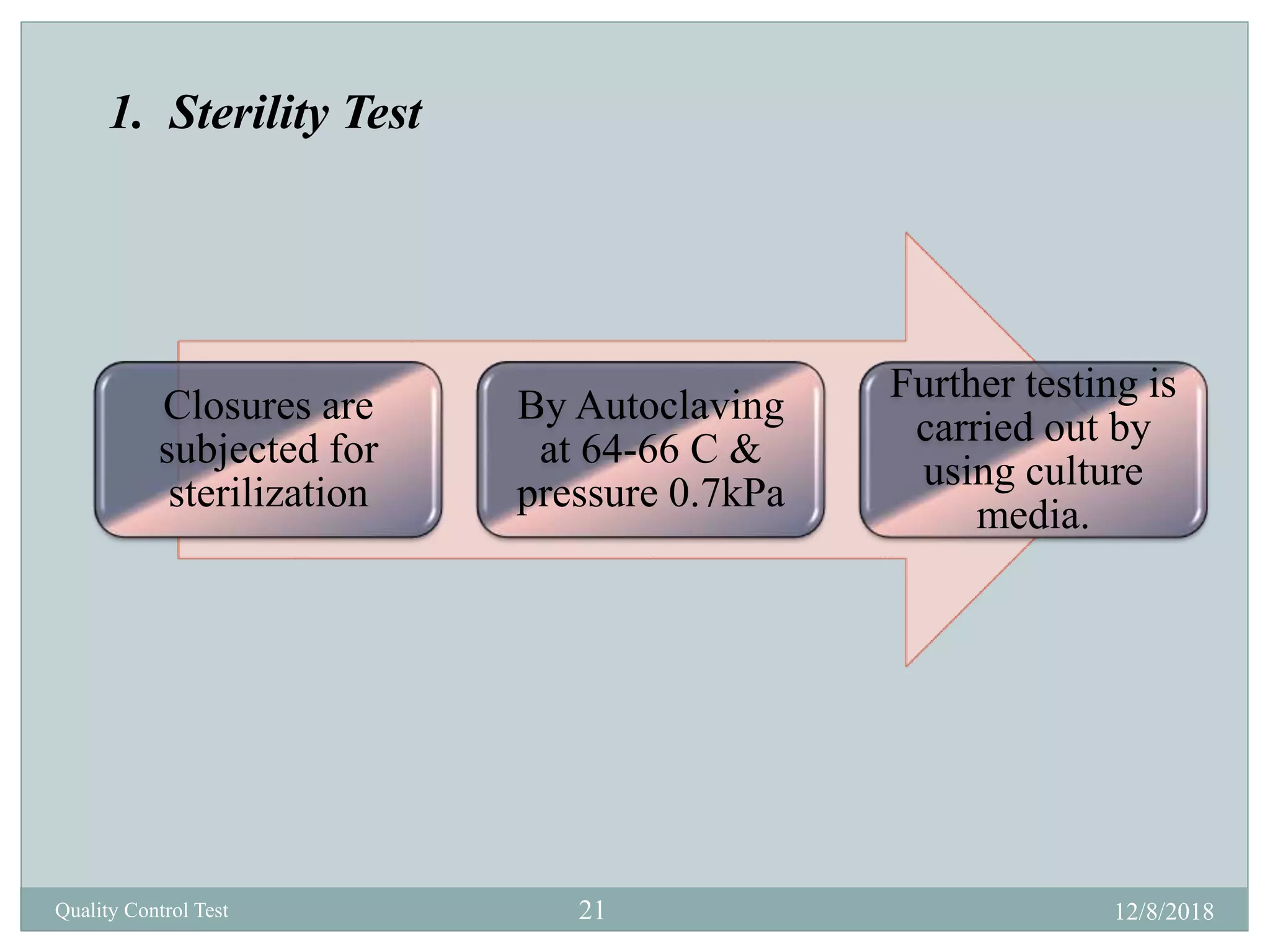
1. Sterility Test
Closures are
subjected for
sterilization
By Autoclaving
at 64-66 C &
pressure 0.7kPa
Further testing is
carried out by
using culture
media.
Quality Control Test
12/8/201822
Take 12 clean vials and
place closures containing
4ml of water
Allow to stand for 16 hrs.
Use hypodermic needle to
inject 1ml of water into the
vial & remove 1ml of air.
Carry this operation for 4
times with new needle
each time.
Pass the water present in
vial through a filter with
pore size of 0.5µm
No. of fragments of
closure retain should be as
per the limits
2. Fragmentation Test
Limit: No. of fragments – NMT 10(in case of butyl rubber)
No. of fragments –NMT 15
Quality Control Test
12/8/201823
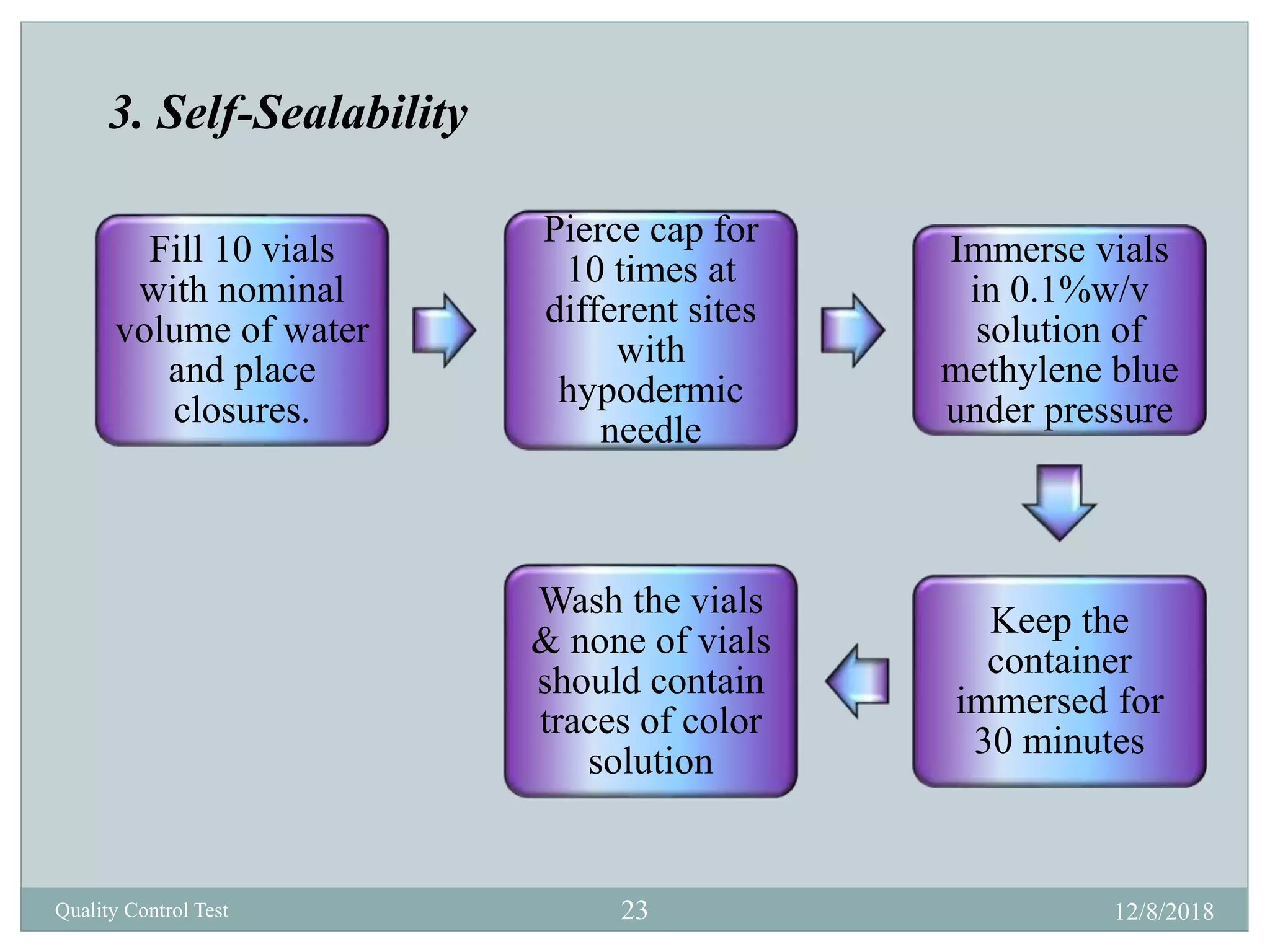
3. Self-Sealability
Fill 10 vials
with nominal
volume of water
and place
closures.
Pierce cap for
10 times at
different sites
with
hypodermic
needle
Immerse vials
in 0.1%w/v
solution of
methylene blue
under pressure
Keep the
container
immersed for
30 minutes
Wash the vials
& none of vials
should contain
traces of color
solution
Quality Control Test
12/8/201824
4. pH of Aqueous Extract
Take 20ml of sample solution and add 0.1ml of
bromothymol blue
Add 0.01M of NaOH till color change from
Blue to Yellow. Volume required is measured
LIMITS: Vol. of NaOH – NMT 0.3 ml
If HCL is used –NMT 0.8 ML
5. Light Absorption Test
 It must be done within 4 hr of preparing sample solution. It is
filtered and its absorbance is measured at 220nm to 360nm.
 Blank is done without closure and absorbance must be
NMT-2.0
Quality Control Test
12/8/201825
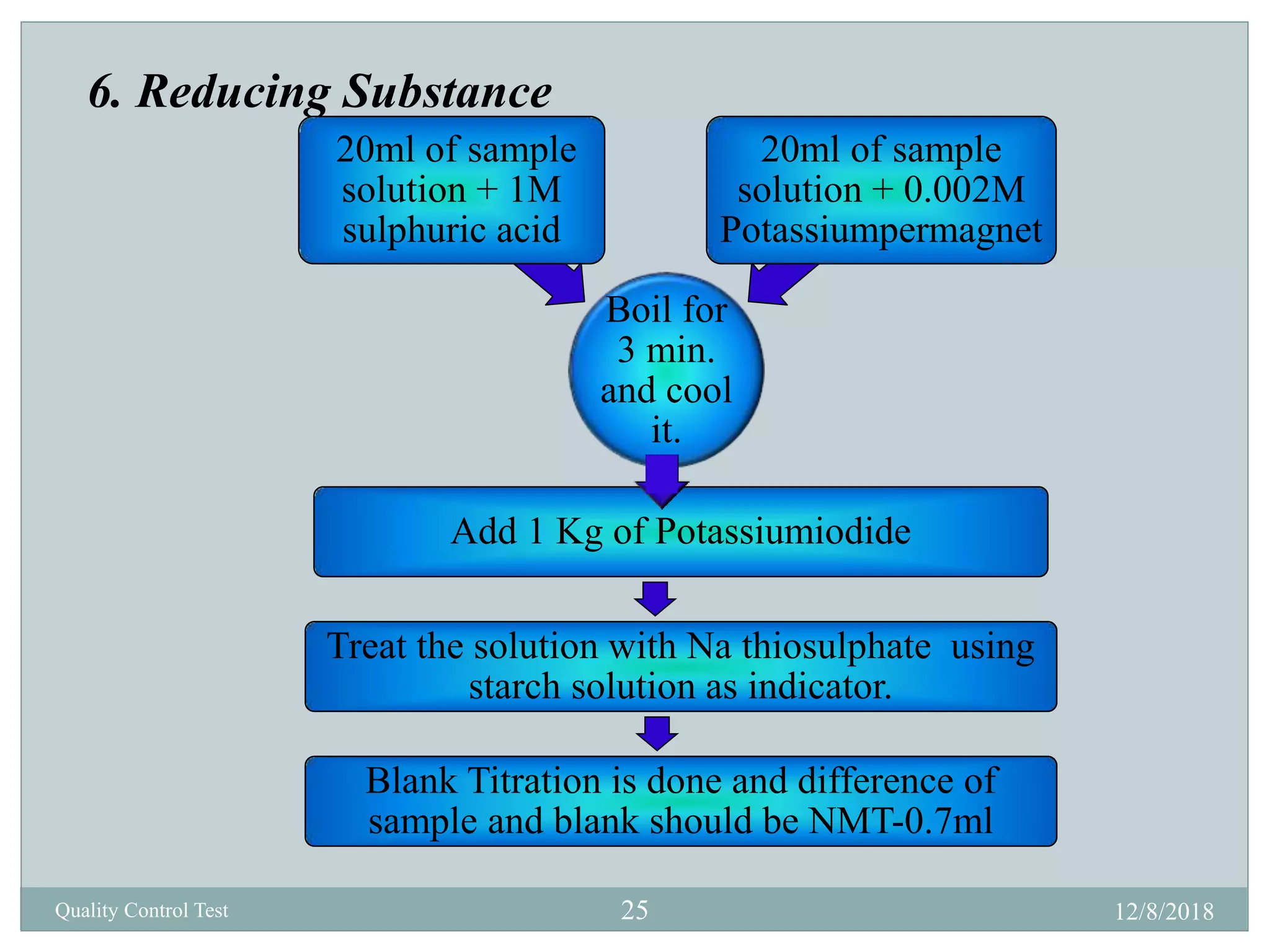
6. Reducing Substance
Boil for
3 min.
and cool
it.
20ml of sample
solution + 1M
sulphuric acid
20ml of sample
solution + 0.002M
Potassiumpermagnet
Add 1 Kg of Potassiumiodide
Treat the solution with Na thiosulphate using
starch solution as indicator.
Blank Titration is done and difference of
sample and blank should be NMT-0.7ml
Quality Control Test
12/8/201826
7. Residue on Evaporation
 The 50ml of sample solution is evaporated at 105̊C.
Residue obtained should be NMT 4mg.
8. Penetrability
 This is to measure the force required to make a hypodermic
needle penetrate easily through closure.
 It is measured by using piercing machine.
 The piercing force must not exceed a stated value, the
hypodermic needle can get damage as a result of undesirable
hardness of closure.
Quality Control Test
12/8/201827
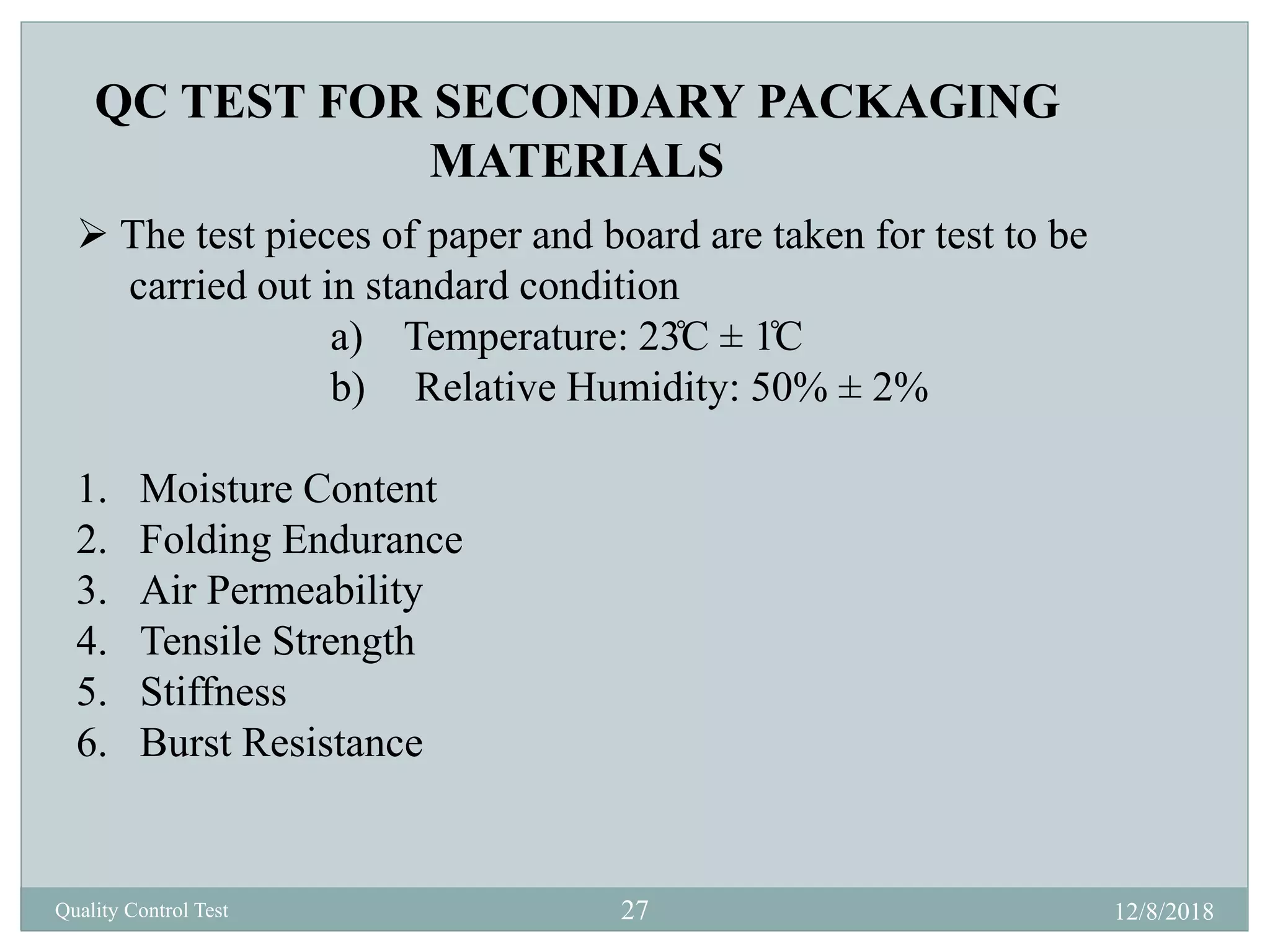
QC TEST FOR SECONDARY PACKAGING
MATERIALS
Quality Control Test
 The test pieces of paper and board are taken for test to be
carried out in standard condition
a) Temperature: 23̊C ± 1̊C
b) Relative Humidity: 50% ± 2%
1. Moisture Content
2. Folding Endurance
3. Air Permeability
4. Tensile Strength
5. Stiffness
6. Burst Resistance
12/8/201828
REFRENCES
Quality Control Test
1. Pharmaceuticals Packaging Technology,Taylor and Francis
by Dean D.A, Evans E.R fifth edition
page no. 188-189.
2. “Packaging”; Cooper and Gunn’s Tutorial Pharmacy, sixth
edition, CBS publicashers
page no. 139-140
12/8/201829Quality Control Test

Quality control test for packaging material ,qc test for glass,metal,rubber

  • 1.
    12/8/2018Quality Control Test1 Sanjivani College of Pharmaceutical Education and Research, Kopargaon Prepared by Miss Unnati .M. Patel F.Y.M Pharm(PQA) Guided by Dr A.D.Kulkerni MPharm(Pharmaceutics)
  • 2.
    12/8/20182 CONTENT 1. QC Testfor Containers 2. QC Test for Closures 3. QC Test for Secondary Packaging Materials Quality Control Test
  • 3.
    12/8/20183 QUALITY CONTROL TESTFOR CONTAINERS Quality Control Test  Different types of container materials. 1. Glass Container 2. Plastic Container 3. Metal Container 4. Rubber
  • 4.
    12/8/2018Quality Control Test4 Quality Control Test for Glass Containers 1. Chemical Resistance Test a) Powdered Glass Test b) Water Attack Test 2. Hydrolytic Resistance Test 3. Arsenic Test 4. Thermal Shock Test 5. Internal Bursting Pressure Test
  • 5.
    12/8/2018Quality Control Test5 1. Chemical Resistant Test a) Powdered Glass Test: It is done to estimate the amount of alkali from powdered glass with happen at elevated temperature. When glass is powdered, leaching of alkali is enhanced, which can be titrated with 0.02N sulphuric acid using methylred as an indicator. Step 1 • Preparation of glass specimen Step 2 • Washing the specimen
  • 6.
    12/8/2018Quality Control Test6 10g of specimen/sample + 50ml oh highly purified water.Autoclave it at 121̊C. Cool it and deacant solution in another flask again add 15ml water and decant solution Titrate the decant solution with 0.02N sulphuric acid using indicator and record the volume Test Container Vol. of 0.02N H2SO4(ml) Powdered Glass Test Type I Type III Type N.P 1.0 8.5 15 Limits:
  • 7.
    12/8/2018Quality Control Test7 b) Water Attack Test: This test is for Type II glass. The principle involve in this is whether the alkali leaches from surface of container. Rinse thoroughly container with high purity water. Fill it by 90% of it’s capacity with water. Autoclave it at 121̊C for 30 minutes. Then it is cooled and liquid is decanted Decanted liquid is titrated with 0.02N Sulphuric acid using methylred as an indicator The volume of sulphuric acid consumed is recorded and compare with limits
  • 8.
    12/8/2018Quality Control Test8 Test Container Vol. of 0.02N H2SO4(ml) Water Attack Test Type II Size(ml)-100 Less than 100 1.0 0.7 0.2 Limits: 2. Leakage Test:  Drug filled container is placed in contained filled with colored solution (methyleneblue) and autoclave at 121̊C for 10 min. under pressure. Later on the container are observed whether colored get entered in container or not.
  • 9.
    12/8/2018Quality Control Test9 3. Hydrolytic Resistant Test  This test is only for unused glass container. At 100̊C for 10 min. allow to rise temp. to 121̊C for 60 min. Low down temp to 100̊C. Cool it Rinse the container with CO2 free water for 3 times. fill till a particular vol. autoclave it Specific amount of liquid solution is titrated with 0.01N HCL using methylred as an indicator. Perform the blank with water and difference between the titration represents vol. of HCL consumed by test liquid
  • 10.
  • 11.
    12/8/2018Quality Control Test11 Wash inner and outer surface of container with D.W. for 5 min. Dry residue in oven at 130̊C for 30 min. & cool it & add hydrogen molybdate & refux for 25 min. Cool the solution and determine absorbance at 840nm. Perform blank. Pipette out 10 ml and add 10ml of nitric acid on the water bath maintaing the temperature. Test solution is same as that of hydrolytic resistant test (50ml) 4. Arsenic Test
  • 12.
    12/8/2018Quality Control Test12 Limits: The absorbance of test solution should not exceed the absorbance of arsenic standard solution of 10ppm. 5. Internal Bursting Pressure Test Instrument used American glass research increment pressure tester. The test bottle is filled with water and placed inside test chamber The internal pressure automatically raised by series of increment at set time Bottle are checked at preselected pressure level until container finally burst.
  • 13.
    12/8/2018Quality Control Test13 6. Thermal Shock Test Step 1 • Place sample container in upright position in tray & immersed tray in hot water for a given time. Step 2 • Transfer the container in cold water bath temp. should be controlled. Examine cracks before & after test.(45̊C temp. difference should be there.) Step 3 • The amount of thermal shock a bottle can withstand is based on construction. •Small bottles- 60 - 80̊C • Pint bottles- 30-40 ̊C
  • 14.
    12/8/2018Quality Control Test14 Quality Control test for Plastic Container Leakage test Collapsibi lity Transpare ncy Water vapour permeabilit y test Bacteriolog ical test
  • 15.
    12/8/2018Quality Control Test15 Quality Control Test for Metal Container • Take 50 empty tubes filled with ointment base, sealed & kept overnight Step 1 • A metal bacteriological filter assembly fitted with filter paper & heated to melting range of ointment base. Step 2 • Base from all tubes squeezed at certain rate & passed through filter under vaccum. further wash with CHCL3 and observed for particles. Step 3
  • 16.
    12/8/2018Quality Control Test16 Observations Particles 1mm and above 50 Particles 0.5mm to 1mm 10 Particles 0.2mm to 0.5mm 2 Particles less than 0.2mm Nil Total score 62 Limits :  Lot of tube passes test if total score is less than 100.  Lot of tubes fails if total score is above 150  If it is between 100 – 150 test is repeated again with 50 more tubes
  • 17.
    12/8/2018Quality Control Test17 Quality Control Test for collapsible tubes Quality Control Test for collapsible tubes Leakage Test Power of Adhesion Flexibility Product compatibility
  • 18.
    12/8/2018Quality Control Test18 Quality Control Test for Strip and Blister packing 3/4th of water is poured in desiccator. Strip and Blister were placed inside desiccators and vaccum is applied Later on strips, blisters were taken out. water present over the outer surface were wiped out. The content of strips and blisters were removed and presence of moisture was checked If there is no leakage, content will not be wetted. It indicate perfect sealing.
  • 19.
    12/8/201819 QUALITY CONTROL TESTFOR CLOSURES 1. Sterility Test 2. Fragmentation Test 3. Self-Sealability 4. pH of aqueous extract 5. Light Absorption Test 6. Reducing Substance 7. Residue on Evaporation 8. Penetrability Quality Control Test
  • 20.
    12/8/201820  Preparation ofsample solution Wash closure in 0.2%w/v of anionic surfactant for 5 min. Rinse 5 times with D.W. and add 200ml water. Further subjected to autoclave and covering with Al foil. Allow to cool and separate solution from closure Quality Control Test
  • 21.
    12/8/201821 1. Sterility Test Closuresare subjected for sterilization By Autoclaving at 64-66 C & pressure 0.7kPa Further testing is carried out by using culture media. Quality Control Test
  • 22.
    12/8/201822 Take 12 cleanvials and place closures containing 4ml of water Allow to stand for 16 hrs. Use hypodermic needle to inject 1ml of water into the vial & remove 1ml of air. Carry this operation for 4 times with new needle each time. Pass the water present in vial through a filter with pore size of 0.5µm No. of fragments of closure retain should be as per the limits 2. Fragmentation Test Limit: No. of fragments – NMT 10(in case of butyl rubber) No. of fragments –NMT 15 Quality Control Test
  • 23.
    12/8/201823 3. Self-Sealability Fill 10vials with nominal volume of water and place closures. Pierce cap for 10 times at different sites with hypodermic needle Immerse vials in 0.1%w/v solution of methylene blue under pressure Keep the container immersed for 30 minutes Wash the vials & none of vials should contain traces of color solution Quality Control Test
  • 24.
    12/8/201824 4. pH ofAqueous Extract Take 20ml of sample solution and add 0.1ml of bromothymol blue Add 0.01M of NaOH till color change from Blue to Yellow. Volume required is measured LIMITS: Vol. of NaOH – NMT 0.3 ml If HCL is used –NMT 0.8 ML 5. Light Absorption Test  It must be done within 4 hr of preparing sample solution. It is filtered and its absorbance is measured at 220nm to 360nm.  Blank is done without closure and absorbance must be NMT-2.0 Quality Control Test
  • 25.
    12/8/201825 6. Reducing Substance Boilfor 3 min. and cool it. 20ml of sample solution + 1M sulphuric acid 20ml of sample solution + 0.002M Potassiumpermagnet Add 1 Kg of Potassiumiodide Treat the solution with Na thiosulphate using starch solution as indicator. Blank Titration is done and difference of sample and blank should be NMT-0.7ml Quality Control Test
  • 26.
    12/8/201826 7. Residue onEvaporation  The 50ml of sample solution is evaporated at 105̊C. Residue obtained should be NMT 4mg. 8. Penetrability  This is to measure the force required to make a hypodermic needle penetrate easily through closure.  It is measured by using piercing machine.  The piercing force must not exceed a stated value, the hypodermic needle can get damage as a result of undesirable hardness of closure. Quality Control Test
  • 27.
    12/8/201827 QC TEST FORSECONDARY PACKAGING MATERIALS Quality Control Test  The test pieces of paper and board are taken for test to be carried out in standard condition a) Temperature: 23̊C ± 1̊C b) Relative Humidity: 50% ± 2% 1. Moisture Content 2. Folding Endurance 3. Air Permeability 4. Tensile Strength 5. Stiffness 6. Burst Resistance
  • 28.
    12/8/201828 REFRENCES Quality Control Test 1.Pharmaceuticals Packaging Technology,Taylor and Francis by Dean D.A, Evans E.R fifth edition page no. 188-189. 2. “Packaging”; Cooper and Gunn’s Tutorial Pharmacy, sixth edition, CBS publicashers page no. 139-140
  • 29.