INTRODUCTION
 Quality – degree of excellence
 Assurance –the act of giving confidence
All laboratory tests are subjected to
uncertainties & errors that degrades their
clinical effectiveness & can pose threat to
patient’s well being. The reliability of test
result is important in avoiding risk to the
patient.
“A test wrongly done is worst than a
test not done.”
QUALITY ASSURANCE
 Is defined by national committee for clinical
laboratory standard (NCCLS) as – the
practice which encompasses all the
procedures, formats & activities directed
towards ensuring that a specified quality or
product is achieved & maintained.
 QA monitors quality performance starting
from ordering of a laboratory test to it’s
reporting, interpretation of result & their
application to the patient’s care.
QUALITY CONTROL
 QC is part & parcel of QA. QC is
concerned with the analytical phase of
QA. It monitors the overall reliability of
laboratory results in terms of accuracy &
precision according to the criteria
specified for measurement i.e.
according to pre established
specifications.
QA= QC+EQA+IQA
Objectives of quality control
Two broad objectives
 Primary objective: to ensure that result of analysis
on patients specimen is reliable enough to be
applicable in his /her care without any doubt & does
not lead to incorrect clinical interpretation.
 Overall objective: that the result obtained from one
lab is comparable to all others using same method
with same degree of significance.
Quality control in chemical
pathology
 Clinical chemistry is most suited for QC
since it is most vulnerable to mistakes.
The process involves usually more than
one quantitative steps & the results are
expressed in numerical forms.
 Accuracy: the extent to which the mean
measurement is close to the true value .
it is generally reflected by ability to
reproduce the value of reference sample
of known concentration
 Precision: measure of random
variability. It is defined as the
reproducibility of a laboratory
determination, when it is run repeatedly
under identical conditions or the ability
of test to measure something
consistently.
PRECISION IS INDEPENDENT OF
ACCURACY.
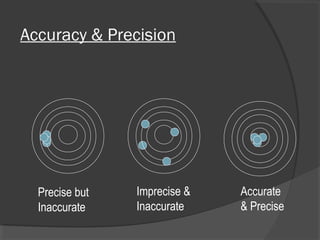
Precise but
Inaccurate
Imprecise &
Inaccurate
Accurate
& Precise
Accuracy & Precision
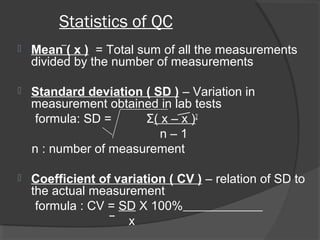
Statistics of QC
 Mean ( x ) = Total sum of all the measurements
divided by the number of measurements
 Standard deviation ( SD ) – Variation in
measurement obtained in lab tests
formula: SD = Σ( x – x )2
n – 1
n : number of measurement
 Coefficient of variation ( CV ) – relation of SD to
the actual measurement
formula : CV = SD X 100%
x
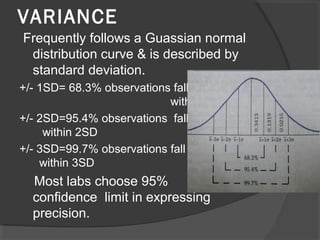
VARIANCE
Frequently follows a Guassian normal
distribution curve & is described by
standard deviation.
+/- 1SD= 68.3% observations fall
within 1SD
+/- 2SD=95.4% observations fall
within 2SD
+/- 3SD=99.7% observations fall
within 3SD
Most labs choose 95%
confidence limit in expressing
precision.
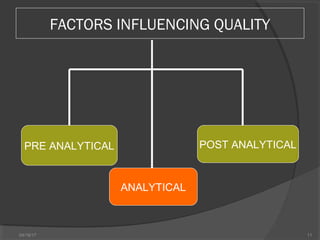
FACTORS INFLUENCING QUALITY
04/18/17 11
PRE ANALYTICAL
ANALYTICAL
POST ANALYTICAL
PRE-ANALYSIS FACTORS
a) Patients preparation : proper instruction to
patient is important to prevent several
factors that affect the values of analysis.
For e.g. too long or too short fasting, effect
of previous meals, drugs, stress, exercise,
posture, & prolonged application of
tourniquet.
b) Specimen handling errors: For e.g.
1. Anticoagulants : EDTA lowers value of Ca++
by
dye binding method.
2. Contamination : with leftover detergents, cork
stoppers & metal syringes, cause raised P & Ca
values. Impurities in distilled water may lead to
incorrect levels of trace elements.
3. Transport & storage faults: Undue
trauma to the RBCs during transport
can lead to hemolysis & thereby
raised LDH, K, Ca, Mg & adenyl
cyclase..
4. Prolonged refrigeration: Leads to loss
of enzyme activity & is detrimental to
lipoprotein analysis
5. Exposure to light : Causes lowered
bilirubin in serum. Lowers porphyrins &
related compound in urine.
c) Matrix effect:
1.Presence of one substance interferes with
the other e.g. icteric serum creates problems
with albumin, cholesterol, total proteins &
glucose estimation.
2.milky sera interferes with albumin, Ca,
amylase, total protein, bilirubin, uric acid
Analytical mistakes
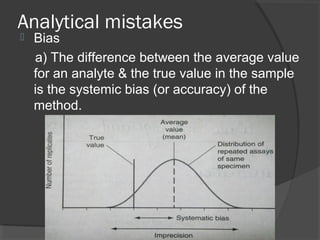
 Bias
a) The difference between the average value
for an analyte & the true value in the sample
is the systemic bias (or accuracy) of the
method.
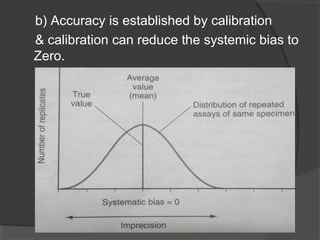
b) Accuracy is established by calibration
& calibration can reduce the systemic bias to
Zero.
 Random mistakes: These constitutes all
sorts of human errors from wrong labeling,
sampling or timing. They are unpredictable &
difficult to control. They are also called as
personal mistakes.
 Reduction of accuracy: A low accuracy is
pointed by the larger difference between
correct values & the reported values &
reflects the procedural part of the work like
deterioration of reagents, increased work
load, poor performance of staff.
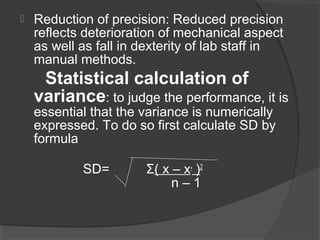
 Reduction of precision: Reduced precision
reflects deterioration of mechanical aspect
as well as fall in dexterity of lab staff in
manual methods.
Statistical calculation of
variance: to judge the performance, it is
essential that the variance is numerically
expressed. To do so first calculate SD by
formula
SD= Σ( x – x- )2
n – 1
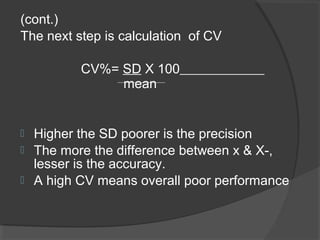
(cont.)
The next step is calculation of CV
CV%= SD X 100
mean
 Higher the SD poorer is the precision
 The more the difference between x & X-,
lesser is the accuracy.
 A high CV means overall poor performance
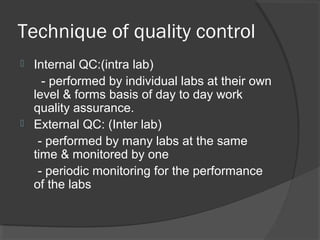
Technique of quality control
 Internal QC:(intra lab)
- performed by individual labs at their own
level & forms basis of day to day work
quality assurance.
 External QC: (Inter lab)
- performed by many labs at the same
time & monitored by one
- periodic monitoring for the performance
of the labs
 Internal QC Technique: it is
implemented in
Prospective Phase
Two Phases:
Retrospective Phase
 PROSPECTIVE (Preventive) PHASE:
This phase involves precautions taken at the
planning stage before actual beginning of the
lab work.
The best policy is that to spend less in long
run spend more initially
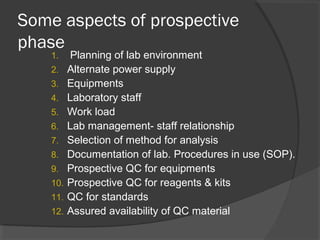
Some aspects of prospective
phase
1. Planning of lab environment
2. Alternate power supply
3. Equipments
4. Laboratory staff
5. Work load
6. Lab management- staff relationship
7. Selection of method for analysis
8. Documentation of lab. Procedures in use (SOP).
9. Prospective QC for equipments
10. Prospective QC for reagents & kits
11. QC for standards
12. Assured availability of QC material
Retrospective (Corrective) phase
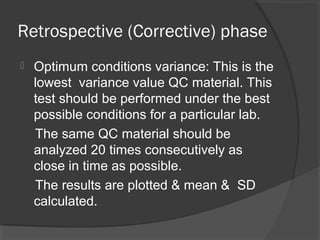
 Optimum conditions variance: This is the
lowest variance value QC material. This
test should be performed under the best
possible conditions for a particular lab.
The same QC material should be
analyzed 20 times consecutively as
close in time as possible.
The results are plotted & mean & SD
calculated.
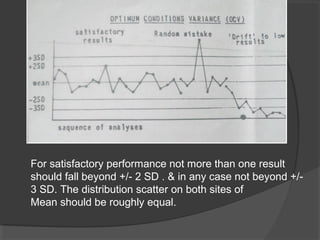
For satisfactory performance not more than one result
should fall beyond +/- 2 SD . & in any case not beyond +/-
3 SD. The distribution scatter on both sites of
Mean should be roughly equal.
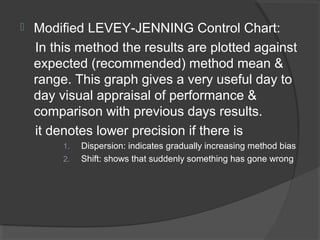
 Modified LEVEY-JENNING Control Chart:
In this method the results are plotted against
expected (recommended) method mean &
range. This graph gives a very useful day to
day visual appraisal of performance &
comparison with previous days results.
it denotes lower precision if there is
1. Dispersion: indicates gradually increasing method bias
2. Shift: shows that suddenly something has gone wrong
2. Modified LEVEY-JENNINGS QC GRAPHS
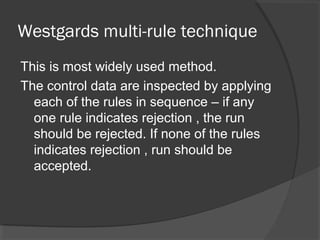
Westgards multi-rule technique
This is most widely used method.
The control data are inspected by applying
each of the rules in sequence – if any
one rule indicates rejection , the run
should be rejected. If none of the rules
indicates rejection , run should be
accepted.
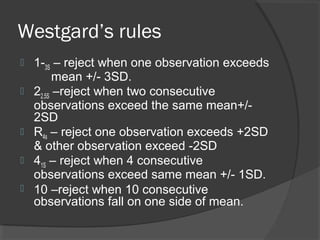
Westgard’s rules
 1-3S – reject when one observation exceeds
mean +/- 3SD.
 22.5S –reject when two consecutive
observations exceed the same mean+/-
2SD
 R4s – reject one observation exceeds +2SD
& other observation exceed -2SD
 41S – reject when 4 consecutive
observations exceed same mean +/- 1SD.
 10 –reject when 10 consecutive
observations fall on one side of mean.
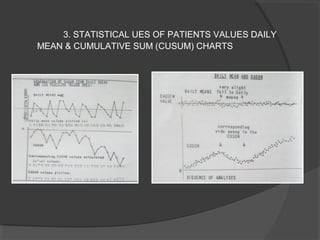
CUMULATIVE SUM TECHNIQUE(CUSUM)
 THE daily mean of any analyte should
fall within a narrow range.
 The daily mean of all tests may be
plotted straight away or CUSUM may be
calculated & plotted.
 To start plotting choose a value as near
to mean as possible & subtract the
mean for the particular day & plot on the
+ve/ -ve side of the horizontal line
(cont.)
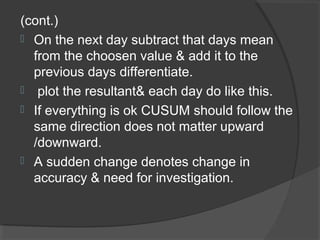
 On the next day subtract that days mean
from the choosen value & add it to the
previous days differentiate.
 plot the resultant& each day do like this.
 If everything is ok CUSUM should follow the
same direction does not matter upward
/downward.
 A sudden change denotes change in
accuracy & need for investigation.
3. STATISTICAL UES OF PATIENTS VALUES DAILY
MEAN & CUMULATIVE SUM (CUSUM) CHARTS
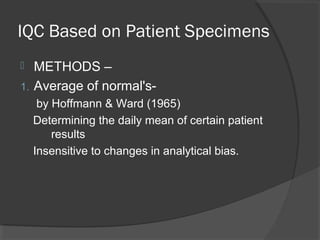
IQC Based on Patient Specimens
 METHODS –
1. Average of normal's-
by Hoffmann & Ward (1965)
Determining the daily mean of certain patient
results
Insensitive to changes in analytical bias.
2. Delta check:
Comparing present result with any previous
results from the same pt & finding out intra
individual variation
3. Pattern recognition: Evaluating the
combination of multiple results for unusual
pattern i.e. visual inspection of RBCs in PBS
do not corresponds to RBC indices.
External Quality Control ( EQC )
 Objective evaluation by an outside agency of the
performance by a number of laboratories on
material which is supplied specially for the
purpose
 is usually organized on a national or regional basis
 analysis of performance is retrospective
 the objective is to achieve comparability with
results of other labs.
Regional QC Programme
 A group of labs in a region is provided
with the same QC material
 They report results wkly to the
organizing lab which analyses the same
statistically
 The comparative results are sent back
to the participating lab for self correction.
 At present no such programme is
running in India.
Survey type QC Programme
 QC samples of unknown values are
periodically sent to the participants
 They are require to analyze it along with
their routine samples
 The report has to be sent back to the
organizers who have the power of
granting or discontinuing accreditation
depending upon the performance.
I.A.P.M.
national quality control
programme in chemicalpathology
 Foundation of programme was laid in
Annual Conference of I.A.P.M. at
Hyderabad in 1987.
 The first ever quality control programme in
chemical pathology was launched & run
during 1990-91 with participants from all
over the country.
 Aims:
1. To improve laboratory standards
through QC
2. To provide infrastructure & knowhow for
an expandable QC programme at
national level.
3. Identify the difficulties coming in the
way.
4. Locate the potential Reference Lab
 METHODOLOGY
Limited no of consenting participants from all over the
country were sent pre-analysed, commercially available,
lyophilised QC sera. Duplicates were analysed at one of
the regional labs for QC under WHO programme
Following tests were done
The participants were requested to return the
results as early as possible after analysing
the QC sera alongwith their ‘routine test’&
without any sort of preferential treatment
On receiving all the reports the results were put
to statistical analysis
The following calculations were made as a part of
statistical analysis
1.Mean =(method mean)
2.S.D. (standard deviation)
3.Variance(v)
4.Variance index(VI)
5.Variance index score(VIS)
 Results
It is customary to express the performance of
the participating labs in any External QC
programme in terms of VIS
Grading according to VIS:
I. < 100 VIS = Excellent performance
II. 101-200 VIS = satisfactory but need attention
III. 201-300 VIS = Borderline , needs action
IV. 301-399 VIS = Unsatisfactory, need review
V. 400 & over VIS = Poor Performance
Discussion
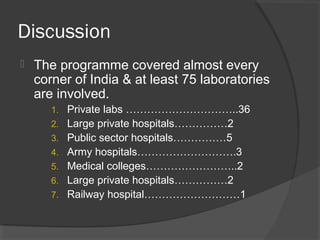
 The programme covered almost every
corner of India & at least 75 laboratories
are involved.
1. Private labs …………………………..36
2. Large private hospitals……………2
3. Public sector hospitals……………5
4. Army hospitals……………………….3
5. Medical colleges……………………..2
6. Large private hospitals……………2
7. Railway hospital………………………1
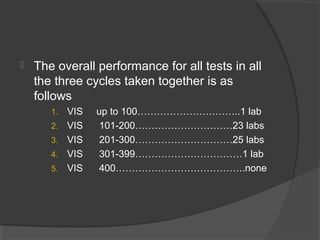
 The overall performance for all tests in all
the three cycles taken together is as
follows
1. VIS up to 100…………………………..1 lab
2. VIS 101-200…………………………23 labs
3. VIS 201-300…………………………25 labs
4. VIS 301-399……………………………1 lab
5. VIS 400………………………………….none
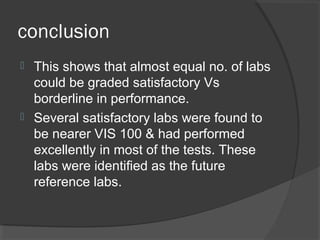
conclusion
 This shows that almost equal no. of labs
could be graded satisfactory Vs
borderline in performance.
 Several satisfactory labs were found to
be nearer VIS 100 & had performed
excellently in most of the tests. These
labs were identified as the future
reference labs.
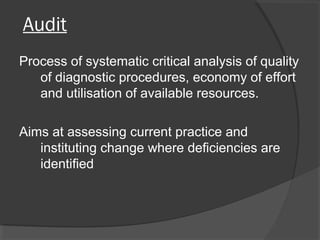
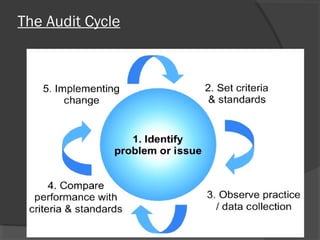
Audit
Process of systematic critical analysis of quality
of diagnostic procedures, economy of effort
and utilisation of available resources.
Aims at assessing current practice and
instituting change where deficiencies are
identified
The Audit Cycle
LABORATORY ACCREDITATION
Accreditation or certification is a recognition
given to an operation or product that has been
evaluated against standard. The purpose for
accreditation is to provide the consumer with
a level of confidence in the quality of process
& the product of organisation.
Laboratory accreditation is a procedure by which
an authoritative body gives formal recognition
of technical competence of testing &/or
calibration laboratory, to carry out specific
tests. This is based on third party assessment
against set standards.
Accreditation system consist of following
three elements
1. Accreditation board – authority – which
accords accreditation
2. Set of standard to be adhered to by the
applicant lab.
3. Auditors appointed by the accreditation
board
The Accreditation Process
1. Application by the lab
2. Quality manual of standard are supplied by
accreditation board for the lab to fill in.
3. Laboratory submit data on required standard.
4. Accreditation board assign inspecting team of lead
assessor & assessors.
5. Assessors assess lab under supervision of lead
assessor.
6. Lead assessor sends report to the board.
7. Board reviews the report & grants accreditation or
asks for corrective action if any, before granting /
denying accreditation
8. Re-assessment every 3 yrs
9. Surveillance of lab by surprise checkup by
authorized assessor
Guidance Organisations
 Assistance In Procedures
 Accreditation Programs
International Standards Organization (ISO)
CLSI (formerly NCCLS)
NABL (India)
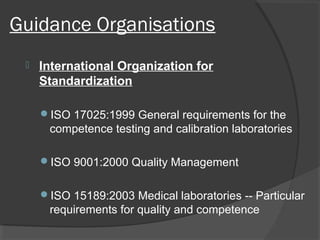
Guidance Organisations
 International Organization for
Standardization
ISO 17025:1999 General requirements for the
competence testing and calibration laboratories
ISO 9001:2000 Quality Management
ISO 15189:2003 Medical laboratories -- Particular
requirements for quality and competence
NABL
 National Accreditation Board for Testing and
Calibration Laboratories (NABL)
 Autonomous body under the Dept of Science &
Technology , Govt. of India
 Registered under Societies Act
 All NABL documents are available on
www.nabl-india.org free of cost
 Maintains linkages with the International Laboratory
Accreditations Co-operation (ILAC) and Asia Pacific
Laboratory Accreditation Co-operation (APLAC)
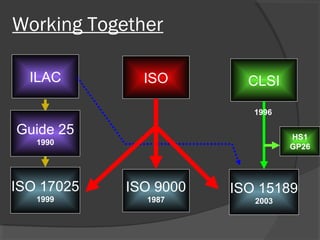
Working Together
ISO
ISO 9000
1987
Guide 25
1990
ISO 17025
1999
ILAC CLSI
ISO 15189
2003
1996
HS1
GP26
CONCLUSION
 The purpose of accreditation is simple &
straight forward. It is an external audit by a
nonbiased third party.
 This external audit includes organization of
an applicant dept & its quality assurance
programme.
 By declaring a defined standard of practice,
the approved departments are able to offer
reassurance to user & provide a hallmark
of performance that is lacking in non-
accredited laboratories.
04/18/17 55
QUALITY IS NEVER DUE TO AN
ACCIDENT-
IT IS THE RESULT OF CONCERTED
PLANNED ACTIVITIES!
Thank you!

Quality control chemical

  • 2.
    INTRODUCTION  Quality –degree of excellence  Assurance –the act of giving confidence All laboratory tests are subjected to uncertainties & errors that degrades their clinical effectiveness & can pose threat to patient’s well being. The reliability of test result is important in avoiding risk to the patient. “A test wrongly done is worst than a test not done.”
  • 3.
    QUALITY ASSURANCE  Isdefined by national committee for clinical laboratory standard (NCCLS) as – the practice which encompasses all the procedures, formats & activities directed towards ensuring that a specified quality or product is achieved & maintained.  QA monitors quality performance starting from ordering of a laboratory test to it’s reporting, interpretation of result & their application to the patient’s care.
  • 4.
    QUALITY CONTROL  QCis part & parcel of QA. QC is concerned with the analytical phase of QA. It monitors the overall reliability of laboratory results in terms of accuracy & precision according to the criteria specified for measurement i.e. according to pre established specifications. QA= QC+EQA+IQA
  • 5.
    Objectives of qualitycontrol Two broad objectives  Primary objective: to ensure that result of analysis on patients specimen is reliable enough to be applicable in his /her care without any doubt & does not lead to incorrect clinical interpretation.  Overall objective: that the result obtained from one lab is comparable to all others using same method with same degree of significance.
  • 6.
    Quality control inchemical pathology  Clinical chemistry is most suited for QC since it is most vulnerable to mistakes. The process involves usually more than one quantitative steps & the results are expressed in numerical forms.  Accuracy: the extent to which the mean measurement is close to the true value . it is generally reflected by ability to reproduce the value of reference sample of known concentration
  • 7.
     Precision: measureof random variability. It is defined as the reproducibility of a laboratory determination, when it is run repeatedly under identical conditions or the ability of test to measure something consistently. PRECISION IS INDEPENDENT OF ACCURACY.
  • 8.
  • 9.
    Statistics of QC Mean ( x ) = Total sum of all the measurements divided by the number of measurements  Standard deviation ( SD ) – Variation in measurement obtained in lab tests formula: SD = Σ( x – x )2 n – 1 n : number of measurement  Coefficient of variation ( CV ) – relation of SD to the actual measurement formula : CV = SD X 100% x
  • 10.
    VARIANCE Frequently follows aGuassian normal distribution curve & is described by standard deviation. +/- 1SD= 68.3% observations fall within 1SD +/- 2SD=95.4% observations fall within 2SD +/- 3SD=99.7% observations fall within 3SD Most labs choose 95% confidence limit in expressing precision.
  • 11.
    FACTORS INFLUENCING QUALITY 04/18/1711 PRE ANALYTICAL ANALYTICAL POST ANALYTICAL
  • 12.
    PRE-ANALYSIS FACTORS a) Patientspreparation : proper instruction to patient is important to prevent several factors that affect the values of analysis. For e.g. too long or too short fasting, effect of previous meals, drugs, stress, exercise, posture, & prolonged application of tourniquet. b) Specimen handling errors: For e.g. 1. Anticoagulants : EDTA lowers value of Ca++ by dye binding method. 2. Contamination : with leftover detergents, cork stoppers & metal syringes, cause raised P & Ca values. Impurities in distilled water may lead to incorrect levels of trace elements.
  • 13.
    3. Transport &storage faults: Undue trauma to the RBCs during transport can lead to hemolysis & thereby raised LDH, K, Ca, Mg & adenyl cyclase.. 4. Prolonged refrigeration: Leads to loss of enzyme activity & is detrimental to lipoprotein analysis 5. Exposure to light : Causes lowered bilirubin in serum. Lowers porphyrins & related compound in urine.
  • 14.
    c) Matrix effect: 1.Presenceof one substance interferes with the other e.g. icteric serum creates problems with albumin, cholesterol, total proteins & glucose estimation. 2.milky sera interferes with albumin, Ca, amylase, total protein, bilirubin, uric acid
  • 15.
    Analytical mistakes  Bias a)The difference between the average value for an analyte & the true value in the sample is the systemic bias (or accuracy) of the method.
  • 16.
    b) Accuracy isestablished by calibration & calibration can reduce the systemic bias to Zero.
  • 17.
     Random mistakes:These constitutes all sorts of human errors from wrong labeling, sampling or timing. They are unpredictable & difficult to control. They are also called as personal mistakes.  Reduction of accuracy: A low accuracy is pointed by the larger difference between correct values & the reported values & reflects the procedural part of the work like deterioration of reagents, increased work load, poor performance of staff.
  • 18.
     Reduction ofprecision: Reduced precision reflects deterioration of mechanical aspect as well as fall in dexterity of lab staff in manual methods. Statistical calculation of variance: to judge the performance, it is essential that the variance is numerically expressed. To do so first calculate SD by formula SD= Σ( x – x- )2 n – 1
  • 19.
    (cont.) The next stepis calculation of CV CV%= SD X 100 mean  Higher the SD poorer is the precision  The more the difference between x & X-, lesser is the accuracy.  A high CV means overall poor performance
  • 20.
    Technique of qualitycontrol  Internal QC:(intra lab) - performed by individual labs at their own level & forms basis of day to day work quality assurance.  External QC: (Inter lab) - performed by many labs at the same time & monitored by one - periodic monitoring for the performance of the labs
  • 21.
     Internal QCTechnique: it is implemented in Prospective Phase Two Phases: Retrospective Phase  PROSPECTIVE (Preventive) PHASE: This phase involves precautions taken at the planning stage before actual beginning of the lab work. The best policy is that to spend less in long run spend more initially
  • 22.
    Some aspects ofprospective phase 1. Planning of lab environment 2. Alternate power supply 3. Equipments 4. Laboratory staff 5. Work load 6. Lab management- staff relationship 7. Selection of method for analysis 8. Documentation of lab. Procedures in use (SOP). 9. Prospective QC for equipments 10. Prospective QC for reagents & kits 11. QC for standards 12. Assured availability of QC material
  • 23.
    Retrospective (Corrective) phase Optimum conditions variance: This is the lowest variance value QC material. This test should be performed under the best possible conditions for a particular lab. The same QC material should be analyzed 20 times consecutively as close in time as possible. The results are plotted & mean & SD calculated.
  • 24.
    For satisfactory performancenot more than one result should fall beyond +/- 2 SD . & in any case not beyond +/- 3 SD. The distribution scatter on both sites of Mean should be roughly equal.
  • 25.
     Modified LEVEY-JENNINGControl Chart: In this method the results are plotted against expected (recommended) method mean & range. This graph gives a very useful day to day visual appraisal of performance & comparison with previous days results. it denotes lower precision if there is 1. Dispersion: indicates gradually increasing method bias 2. Shift: shows that suddenly something has gone wrong
  • 26.
  • 27.
    Westgards multi-rule technique Thisis most widely used method. The control data are inspected by applying each of the rules in sequence – if any one rule indicates rejection , the run should be rejected. If none of the rules indicates rejection , run should be accepted.
  • 28.
    Westgard’s rules  1-3S– reject when one observation exceeds mean +/- 3SD.  22.5S –reject when two consecutive observations exceed the same mean+/- 2SD  R4s – reject one observation exceeds +2SD & other observation exceed -2SD  41S – reject when 4 consecutive observations exceed same mean +/- 1SD.  10 –reject when 10 consecutive observations fall on one side of mean.
  • 29.
    CUMULATIVE SUM TECHNIQUE(CUSUM) THE daily mean of any analyte should fall within a narrow range.  The daily mean of all tests may be plotted straight away or CUSUM may be calculated & plotted.  To start plotting choose a value as near to mean as possible & subtract the mean for the particular day & plot on the +ve/ -ve side of the horizontal line
  • 30.
    (cont.)  On thenext day subtract that days mean from the choosen value & add it to the previous days differentiate.  plot the resultant& each day do like this.  If everything is ok CUSUM should follow the same direction does not matter upward /downward.  A sudden change denotes change in accuracy & need for investigation.
  • 31.
    3. STATISTICAL UESOF PATIENTS VALUES DAILY MEAN & CUMULATIVE SUM (CUSUM) CHARTS
  • 32.
    IQC Based onPatient Specimens  METHODS – 1. Average of normal's- by Hoffmann & Ward (1965) Determining the daily mean of certain patient results Insensitive to changes in analytical bias.
  • 33.
    2. Delta check: Comparingpresent result with any previous results from the same pt & finding out intra individual variation 3. Pattern recognition: Evaluating the combination of multiple results for unusual pattern i.e. visual inspection of RBCs in PBS do not corresponds to RBC indices.
  • 34.
    External Quality Control( EQC )  Objective evaluation by an outside agency of the performance by a number of laboratories on material which is supplied specially for the purpose  is usually organized on a national or regional basis  analysis of performance is retrospective  the objective is to achieve comparability with results of other labs.
  • 35.
    Regional QC Programme A group of labs in a region is provided with the same QC material  They report results wkly to the organizing lab which analyses the same statistically  The comparative results are sent back to the participating lab for self correction.  At present no such programme is running in India.
  • 36.
    Survey type QCProgramme  QC samples of unknown values are periodically sent to the participants  They are require to analyze it along with their routine samples  The report has to be sent back to the organizers who have the power of granting or discontinuing accreditation depending upon the performance.
  • 37.
    I.A.P.M. national quality control programmein chemicalpathology  Foundation of programme was laid in Annual Conference of I.A.P.M. at Hyderabad in 1987.  The first ever quality control programme in chemical pathology was launched & run during 1990-91 with participants from all over the country.
  • 38.
     Aims: 1. Toimprove laboratory standards through QC 2. To provide infrastructure & knowhow for an expandable QC programme at national level. 3. Identify the difficulties coming in the way. 4. Locate the potential Reference Lab
  • 39.
     METHODOLOGY Limited noof consenting participants from all over the country were sent pre-analysed, commercially available, lyophilised QC sera. Duplicates were analysed at one of the regional labs for QC under WHO programme Following tests were done
  • 40.
    The participants wererequested to return the results as early as possible after analysing the QC sera alongwith their ‘routine test’& without any sort of preferential treatment On receiving all the reports the results were put to statistical analysis The following calculations were made as a part of statistical analysis 1.Mean =(method mean) 2.S.D. (standard deviation) 3.Variance(v) 4.Variance index(VI) 5.Variance index score(VIS)
  • 41.
     Results It iscustomary to express the performance of the participating labs in any External QC programme in terms of VIS Grading according to VIS: I. < 100 VIS = Excellent performance II. 101-200 VIS = satisfactory but need attention III. 201-300 VIS = Borderline , needs action IV. 301-399 VIS = Unsatisfactory, need review V. 400 & over VIS = Poor Performance
  • 42.
    Discussion  The programmecovered almost every corner of India & at least 75 laboratories are involved. 1. Private labs …………………………..36 2. Large private hospitals……………2 3. Public sector hospitals……………5 4. Army hospitals……………………….3 5. Medical colleges……………………..2 6. Large private hospitals……………2 7. Railway hospital………………………1
  • 43.
     The overallperformance for all tests in all the three cycles taken together is as follows 1. VIS up to 100…………………………..1 lab 2. VIS 101-200…………………………23 labs 3. VIS 201-300…………………………25 labs 4. VIS 301-399……………………………1 lab 5. VIS 400………………………………….none
  • 44.
    conclusion  This showsthat almost equal no. of labs could be graded satisfactory Vs borderline in performance.  Several satisfactory labs were found to be nearer VIS 100 & had performed excellently in most of the tests. These labs were identified as the future reference labs.
  • 45.
    Audit Process of systematiccritical analysis of quality of diagnostic procedures, economy of effort and utilisation of available resources. Aims at assessing current practice and instituting change where deficiencies are identified
  • 46.
  • 47.
    LABORATORY ACCREDITATION Accreditation orcertification is a recognition given to an operation or product that has been evaluated against standard. The purpose for accreditation is to provide the consumer with a level of confidence in the quality of process & the product of organisation. Laboratory accreditation is a procedure by which an authoritative body gives formal recognition of technical competence of testing &/or calibration laboratory, to carry out specific tests. This is based on third party assessment against set standards.
  • 48.
    Accreditation system consistof following three elements 1. Accreditation board – authority – which accords accreditation 2. Set of standard to be adhered to by the applicant lab. 3. Auditors appointed by the accreditation board
  • 49.
    The Accreditation Process 1.Application by the lab 2. Quality manual of standard are supplied by accreditation board for the lab to fill in. 3. Laboratory submit data on required standard. 4. Accreditation board assign inspecting team of lead assessor & assessors. 5. Assessors assess lab under supervision of lead assessor. 6. Lead assessor sends report to the board. 7. Board reviews the report & grants accreditation or asks for corrective action if any, before granting / denying accreditation 8. Re-assessment every 3 yrs 9. Surveillance of lab by surprise checkup by authorized assessor
  • 50.
    Guidance Organisations  AssistanceIn Procedures  Accreditation Programs International Standards Organization (ISO) CLSI (formerly NCCLS) NABL (India)
  • 51.
    Guidance Organisations  InternationalOrganization for Standardization ISO 17025:1999 General requirements for the competence testing and calibration laboratories ISO 9001:2000 Quality Management ISO 15189:2003 Medical laboratories -- Particular requirements for quality and competence
  • 52.
    NABL  National AccreditationBoard for Testing and Calibration Laboratories (NABL)  Autonomous body under the Dept of Science & Technology , Govt. of India  Registered under Societies Act  All NABL documents are available on www.nabl-india.org free of cost  Maintains linkages with the International Laboratory Accreditations Co-operation (ILAC) and Asia Pacific Laboratory Accreditation Co-operation (APLAC)
  • 53.
    Working Together ISO ISO 9000 1987 Guide25 1990 ISO 17025 1999 ILAC CLSI ISO 15189 2003 1996 HS1 GP26
  • 54.
    CONCLUSION  The purposeof accreditation is simple & straight forward. It is an external audit by a nonbiased third party.  This external audit includes organization of an applicant dept & its quality assurance programme.  By declaring a defined standard of practice, the approved departments are able to offer reassurance to user & provide a hallmark of performance that is lacking in non- accredited laboratories.
  • 55.
    04/18/17 55 QUALITY ISNEVER DUE TO AN ACCIDENT- IT IS THE RESULT OF CONCERTED PLANNED ACTIVITIES!
  • 56.

Editor's Notes

  • #9 Accuracy means capability of the test to detect true value. This can be confirmed by analysing certified reference materials and by participating in external quality assurance schemes. Precision defines reproducibility when test is repeated number of times. Higher the number of variables more is the scope of imprecision. Test may be precise but still inaccurate (Fig ---). It is possible to partly compensate for inaccuracy mathematically but imprecision can only be controlled by stringent internal quality control and infrastructure improvement.