
 Water quality
 Calibration of volumetric glassware
and pipettes
 Stability of electrical power
 Stability of temperature of heating
baths, refrigerators, freezers and
centrifuges
 Reagents stability, integrity and efficiency
 Equipment reliability
 Specificity and sensitivity of selected test
 Procedural reliability using standard
operating procedures
 Proficiency of the personnel
 Use of appropriate controls
 All equipment in the laboratory
ā—¦ Should have instruction manuals
regarding proper use and maintenance
requirements
ā—¦ Should be monitored and recorded for
quality control procedures, function
checks, preventative maintenance and
repairs
These should be documented and filed in
separate log books
 Instrument Maintenance- CONTROLS and
CALIBRATORS
 REGULAR MAINTENANCE
ā—¦ Daily and weekly instrument maintenance
ā—¦ Monthly, six-monthly and annual maintenance
as recommended by supplier
ļ‚– ROUTINE MAINTENANCE- Producing reliable
test results, Minimizing instrument breakdown,
Preventing delays in reporting test results,
Maintaining productivity, Lengthening instrument
life
 PIPETTE’S IMPACT - Pipette accuracy and
precision must checked regularly - the first
time of use and periodically thereafter
 If either fails, it is important to follow the
manufacturer’s instructions for repair and
calibration
 Improperly calibrated pipettes will affect our
assay and should be checked for precision
and accuracy bi-annually
ā—¦ Always store according to the manufacturer’s
recommendations
ā—¦ Reagents must be dated and initialed upon receipt
ā—¦ Lot numbers must be recorded in a reagent quality
control record book
ā—¦ After preparation and/or when placed in service,
reagents must be labeled when put ā€œin serviceā€
according to the manufacturer’s suggested
recommendations
ā—¦ Results of reagent checks must be recorded, dated
and initialed
 Restrict all testing procedures to staff with
appropriate technical training
ā—¦ Testing theory
ā—¦ Instruments
ā—¦ Testing procedures
 Perform and document periodic
performance assessments on all testing
staff
ā—¦ SOPs
ā—¦ Equipment files + Manuals
ā—¦ Service history records of the instrument
ā—¦ Records of daily, weekly and monthly
calibrations and maintenance
 Procedure name
 Clinical significance
 Principle of the method
 Specimen of choice
 Reagents and equipments
 Procedure
 Reference values
 comments
 Have a known concentration of the substance
being measured
 Used to adjust the instrument, kit, test
system in order to standardize the assay
 Sometimes called a standard, although not a
true standard
 Specimens that are analyzed for QC purpose are
known as control materials
 Values cover medical decision points
 Similar to the test specimen
 Available in large quantity
 Stored in small aliquots
 There should be little vial to vial variation so that
difference between the repeated measurements
are attributed to analytical method alone
 It should preferably have the same matrix as the
test specimen of interest.
 Clear concepts in relation to Analytical
methods-
 Calibration,
 trueness,
 accuracy,
 precision,
 linearity, &
 limit of detection
 The calibration function is the relation
between instrument signal(y) and conc. of
analyte (x)
y=f(x)
 It is set of operations that establish the
relationship between values of quantities
indicated by the instrument and the
corresponding values realized by
measurement standards
 Trueness- Trueness of measurements- closeness
of agreement b/n the average value obtained
from a large series of results of measurements
and a true value
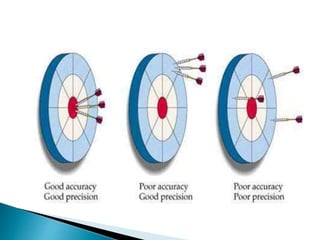
 Accuracy- the closeness of agreement between
the result of measurment and true conc of the
analyte
 Precision - Repeatability (within same
run),reproducibility or closeness of results to
each other performed under changed conditions
of measurement (time,operator,calibrators,
reagent lots)
 Reliability - The ability to maintain both
precision and accuracy
 Linearity- Linearity refers to the relationship
between measured & expected values over
the analytical measurement range. The
presence of linearity is a prerequisite for a
high degree of trueness
 Limit of Detection & Quantification- Limit of
blank (LoB):
 Limit of Detection (LoD
 Limit of Quantification (LoQ):
 True value - The known, accepted value of a
quantifiable property
 Accepted true value - the value
approximating the true value, the difference
between the two values is negligible.
 Error - the discrepancy between the result of
a measurement and the true (or accepted true
value).
 It should be reconstituted carefully and
strictly as per the instructions
 Frozen sample to be thawed properly
 After attaining the temperature, mix slowly by
inversion and then use
 Storage temperature should be strictly
followed
 Assayed
 Unassayed
 Home-made
 Establish written policies and procedures
 – Assign responsibility for monitoring and
reviewing
 – Train staff, obtain control materials
 – Collect data,set target values (mean, SD)
 – Establish control charts, Eg- Levey-Jennings
charts
 – Routinely plot control data
 – Establish and implement troubleshooting and
corrective action
 – Establish and maintain system for
documentation
ANALYSIS OF CONTROL
 Need data set of at least 20 points, obtained
over a 30 day period
 Calculate mean, standard deviation,
coefficient of variation; determine target
ranges
 Develop Levey-Jennings charts, plot results
 A certain amount of variability will naturally
occur when a control is tested repeatedly.
 Variability is affected by operator technique,
environmental conditions, and the
performance characteristics of the assay
method.
 The goal is to differentiate between variability
due to chance from that due to error.
 Median = the value at the center (midpoint)
of the observations
 Mode = the value which occurs with the
greatest frequency
 Mean = the calculated average of the values
 All values are symmetrically distributed
around the mean
 Characteristic ā€œbell-shapedā€ curve
 Assumed for all quality control statistics
 There are several terms that describe the
dispersion or variability of the data around
the mean:
 Range
 Variance
 Standard Deviation
 Coefficient of Variation
 Range refers to the difference or spread
between the highest and lowest observations.
 It is the simplest measure of dispersion.
 It makes no assumption about the shape of
the distribution or the central tendency of the
data.
 The standard deviation (SD) is the square root
of the variance
 SD is the principle calculation used in the
laboratory to measure dispersion of a group
of values around a mean
 The coefficient of variation (CV) is the
standard deviation (SD) expressed as a
percentage of the mean
 Ideally should be less than 5%
 CV= SDMean * 100
 A common method to compare the values
observed for control materials with their
known values is the use of control charts
 Simple graphical displays in which the
observed values are plotted versus the time
when the observations are made
 When plotted points fall within the control
limit- method is performing properly
 When points fall outside- the problem is
developing
LEVY- JENNINGS GRAPH
L-Js are the process control graphs wherein the daily
Q.C. values for all levels of controls are plotted
(minimum 20 values) and an inference about the run is
drawn , to decide ā€œin controlā€ or ā€œout of control run.ā€
Advantage:
•Simple data analysis and display
•Easy adaptation and integration into existing control
practices
•A low level of false rejection or false alarms
•An improved capability for detecting systematic and
random errors
74
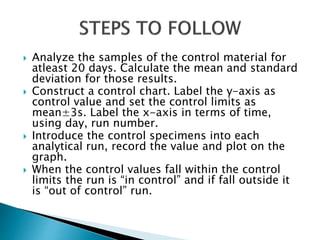
 Analyze the samples of the control material for
atleast 20 days. Calculate the mean and standard
deviation for those results.
 Construct a control chart. Label the y-axis as
control value and set the control limits as
mean±3s. Label the x-axis in terms of time,
using day, run number.
 Introduce the control specimens into each
analytical run, record the value and plot on the
graph.
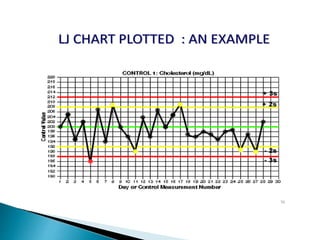
 When the control values fall within the control
limits the run is ā€œin controlā€ and if fall outside it
is ā€œout of controlā€ run.
LJ CHART PLOTTED : AN EXAMPLE
76
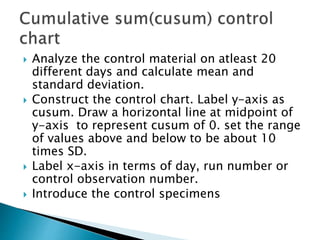
 Analyze the control material on atleast 20
different days and calculate mean and
standard deviation.
 Construct the control chart. Label y-axis as
cusum. Draw a horizontal line at midpoint of
y-axis to represent cusum of 0. set the range
of values above and below to be about 10
times SD.
 Label x-axis in terms of day, run number or
control observation number.
 Introduce the control specimens
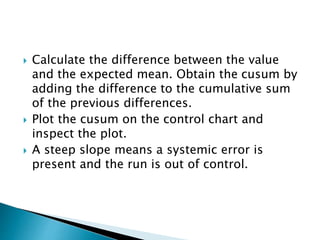
 Calculate the difference between the value
and the expected mean. Obtain the cusum by
adding the difference to the cumulative sum
of the previous differences.
 Plot the cusum on the control chart and
inspect the plot.
 A steep slope means a systemic error is
present and the run is out of control.
 ā€œMultirule Quality Controlā€ developed by Dr.
James O. Westgard based on statistical
concepts
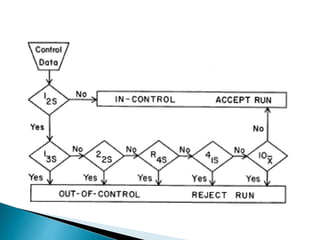
 Uses a combination of decision criteria or
control rules
 Allows determination of whether an
analytical run is ā€œin-controlā€ or ā€œout-of-
control
 Generally used where 2 levels of control
material are analyzed per run
 1ā‚‚s rule
 1ā‚ƒs rule
 2ā‚‚s rule
 Rā‚„s rule
 4₁s rule
 10x rule
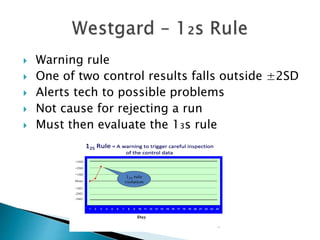
 Warning rule
 One of two control results falls outside ±2SD
 Alerts tech to possible problems
 Not cause for rejecting a run
 Must then evaluate the 1ā‚ƒs rule
12S Rule = A warning to trigger careful inspection
of the control data
1 2 3 4 5 6 7 8 9 10 11 12 13 14 15 16 17 18 19 20 21 22 23 24
Mean
Day
+1SD
+2SD
+3SD
-1SD
-2SD
-3SD
12S rule
violation
79
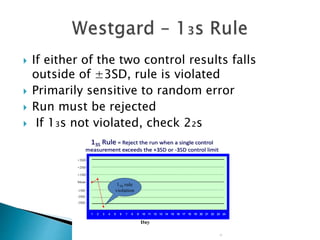
 If either of the two control results falls
outside of ±3SD, rule is violated
 Primarily sensitive to random error
 Run must be rejected
 If 1ā‚ƒs not violated, check 2ā‚‚s
13S Rule = Reject the run when a single control
measurement exceeds the +3SD or -3SD control limit
1 2 3 4 5 6 7 8 9 10 11 12 13 14 15 16 17 18 19 20 21 22 23 24
Mean
Day
+1SD
+2SD
+3SD
-1SD
-2SD
-3SD
13S rule
violation
81
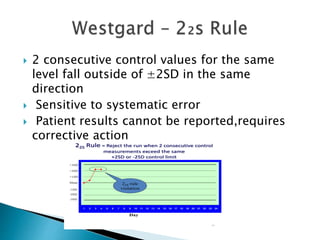
 2 consecutive control values for the same
level fall outside of ±2SD in the same
direction
 Sensitive to systematic error
 Patient results cannot be reported,requires
corrective action
22S Rule = Reject the run when 2 consecutive control
measurements exceed the same
+2SD or -2SD control limit
1 2 3 4 5 6 7 8 9 10 11 12 13 14 15 16 17 18 19 20 21 22 23 24
Mean
Day
+1SD
+2SD
+3SD
-1SD
-2SD
-3SD
22S rule
violation
83
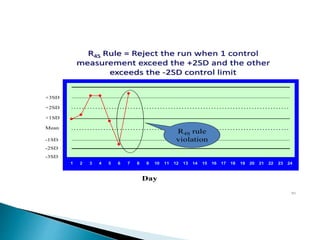
 One control exceeds the mean by –2SD, and
the other control exceeds the mean by +2SD
 The range between the two results will
therefore exceed 4 SD
 Random error has occurred, test run must be
rejected
R4S Rule = Reject the run when 1 control
measurement exceed the +2SD and the other
exceeds the -2SD control limit
1 2 3 4 5 6 7 8 9 10 11 12 13 14 15 16 17 18 19 20 21 22 23 24
Mean
Day
+1SD
+2SD
+3SD
-1SD
-2SD
-3SD
R4S rule
violation
85
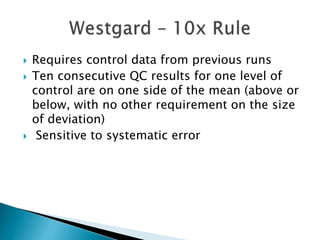
 Requires control data from previous runs
 Four consecutive QC results for one level of
control are outside ±1SD
 Sensitive to systematic error
 Requires control data from previous runs
 Ten consecutive QC results for one level of
control are on one side of the mean (above or
below, with no other requirement on the size
of deviation)
 Sensitive to systematic error
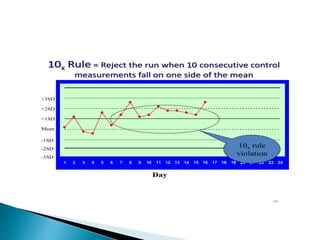
10x Rule = Reject the run when 10 consecutive control
measurements fall on one side of the mean
1 2 3 4 5 6 7 8 9 10 11 12 13 14 15 16 17 18 19 20 21 22 23 24
Mean
Day
+1SD
+2SD
+3SD
-1SD
-2SD
-3SD
10x rule
violation
88
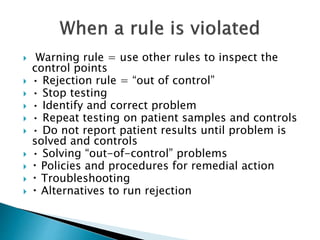
 Warning rule = use other rules to inspect the
control points
 • Rejection rule = ā€œout of controlā€
 • Stop testing
 • Identify and correct problem
 • Repeat testing on patient samples and controls
 • Do not report patient results until problem is
solved and controls
 • Solving ā€œout-of-controlā€ problems
 Policies and procedures for remedial action
 Troubleshooting
 Alternatives to run rejection
External Quality Assessment
• All the control procedures described previously have
focused on monitoring of a single lab
• These procedures constitute internal QC, to distinguish
them from procedures used to compare the
performance of different laboratories are known as
external Quality assessment
• These two procedures are complimentary
• Internal QC- daily monitoring of precision & accuracy
• External QA- long term accuracy of analytical methods
89
• EQA results evaluate performance of the laboratory
against other laboratories participating in the same
program
• Different programs do this in different ways. Eg, t-test is
used to test the statistical significance of any difference
b/n an individual lab’s observed mean & the group mean
• When the diff. is significant lab. is alerted
• Results are instrument and protocol specific
• EQA results should be formally documented within the lab
and should be available on request
External Quality Assessment
90
 Physical inspection- inspect the analytical
method, euipement, reagents and specimens.
Also includes review of records documenting
changes that occur with the instrument and
reagents.
 Relationship of type and source of error-
random error and systematic error
ANALYTICAL VARIABLES IN QUALITY CONTROL.pptx

ANALYTICAL VARIABLES IN QUALITY CONTROL.pptx

  • 1.
     Water quality Calibration of volumetric glassware and pipettes  Stability of electrical power  Stability of temperature of heating baths, refrigerators, freezers and centrifuges
  • 2.
     Reagents stability,integrity and efficiency  Equipment reliability  Specificity and sensitivity of selected test  Procedural reliability using standard operating procedures  Proficiency of the personnel  Use of appropriate controls
  • 3.
     All equipmentin the laboratory ā—¦ Should have instruction manuals regarding proper use and maintenance requirements ā—¦ Should be monitored and recorded for quality control procedures, function checks, preventative maintenance and repairs These should be documented and filed in separate log books
  • 4.
     Instrument Maintenance-CONTROLS and CALIBRATORS  REGULAR MAINTENANCE ā—¦ Daily and weekly instrument maintenance ā—¦ Monthly, six-monthly and annual maintenance as recommended by supplier ļ‚– ROUTINE MAINTENANCE- Producing reliable test results, Minimizing instrument breakdown, Preventing delays in reporting test results, Maintaining productivity, Lengthening instrument life
  • 5.
     PIPETTE’S IMPACT- Pipette accuracy and precision must checked regularly - the first time of use and periodically thereafter  If either fails, it is important to follow the manufacturer’s instructions for repair and calibration  Improperly calibrated pipettes will affect our assay and should be checked for precision and accuracy bi-annually
  • 6.
    ā—¦ Always storeaccording to the manufacturer’s recommendations ā—¦ Reagents must be dated and initialed upon receipt ā—¦ Lot numbers must be recorded in a reagent quality control record book ā—¦ After preparation and/or when placed in service, reagents must be labeled when put ā€œin serviceā€ according to the manufacturer’s suggested recommendations ā—¦ Results of reagent checks must be recorded, dated and initialed
  • 7.
     Restrict alltesting procedures to staff with appropriate technical training ā—¦ Testing theory ā—¦ Instruments ā—¦ Testing procedures  Perform and document periodic performance assessments on all testing staff
  • 8.
    ā—¦ SOPs ā—¦ Equipmentfiles + Manuals ā—¦ Service history records of the instrument ā—¦ Records of daily, weekly and monthly calibrations and maintenance
  • 9.
     Procedure name Clinical significance  Principle of the method  Specimen of choice  Reagents and equipments  Procedure  Reference values  comments
  • 10.
     Have aknown concentration of the substance being measured  Used to adjust the instrument, kit, test system in order to standardize the assay  Sometimes called a standard, although not a true standard
  • 11.
     Specimens thatare analyzed for QC purpose are known as control materials  Values cover medical decision points  Similar to the test specimen  Available in large quantity  Stored in small aliquots  There should be little vial to vial variation so that difference between the repeated measurements are attributed to analytical method alone  It should preferably have the same matrix as the test specimen of interest.
  • 12.
     Clear conceptsin relation to Analytical methods-  Calibration,  trueness,  accuracy,  precision,  linearity, &  limit of detection
  • 13.
     The calibrationfunction is the relation between instrument signal(y) and conc. of analyte (x) y=f(x)  It is set of operations that establish the relationship between values of quantities indicated by the instrument and the corresponding values realized by measurement standards
  • 14.
     Trueness- Truenessof measurements- closeness of agreement b/n the average value obtained from a large series of results of measurements and a true value  Accuracy- the closeness of agreement between the result of measurment and true conc of the analyte  Precision - Repeatability (within same run),reproducibility or closeness of results to each other performed under changed conditions of measurement (time,operator,calibrators, reagent lots)
  • 16.
     Reliability -The ability to maintain both precision and accuracy  Linearity- Linearity refers to the relationship between measured & expected values over the analytical measurement range. The presence of linearity is a prerequisite for a high degree of trueness
  • 17.
     Limit ofDetection & Quantification- Limit of blank (LoB):  Limit of Detection (LoD  Limit of Quantification (LoQ):
  • 18.
     True value- The known, accepted value of a quantifiable property  Accepted true value - the value approximating the true value, the difference between the two values is negligible.  Error - the discrepancy between the result of a measurement and the true (or accepted true value).
  • 19.
     It shouldbe reconstituted carefully and strictly as per the instructions  Frozen sample to be thawed properly  After attaining the temperature, mix slowly by inversion and then use  Storage temperature should be strictly followed
  • 20.
  • 21.
     Establish writtenpolicies and procedures  – Assign responsibility for monitoring and reviewing  – Train staff, obtain control materials  – Collect data,set target values (mean, SD)  – Establish control charts, Eg- Levey-Jennings charts  – Routinely plot control data  – Establish and implement troubleshooting and corrective action  – Establish and maintain system for documentation
  • 22.
  • 23.
     Need dataset of at least 20 points, obtained over a 30 day period  Calculate mean, standard deviation, coefficient of variation; determine target ranges  Develop Levey-Jennings charts, plot results
  • 24.
     A certainamount of variability will naturally occur when a control is tested repeatedly.  Variability is affected by operator technique, environmental conditions, and the performance characteristics of the assay method.  The goal is to differentiate between variability due to chance from that due to error.
  • 25.
     Median =the value at the center (midpoint) of the observations  Mode = the value which occurs with the greatest frequency  Mean = the calculated average of the values
  • 26.
     All valuesare symmetrically distributed around the mean  Characteristic ā€œbell-shapedā€ curve  Assumed for all quality control statistics
  • 27.
     There areseveral terms that describe the dispersion or variability of the data around the mean:  Range  Variance  Standard Deviation  Coefficient of Variation
  • 28.
     Range refersto the difference or spread between the highest and lowest observations.  It is the simplest measure of dispersion.  It makes no assumption about the shape of the distribution or the central tendency of the data.
  • 29.
     The standarddeviation (SD) is the square root of the variance  SD is the principle calculation used in the laboratory to measure dispersion of a group of values around a mean
  • 30.
     The coefficientof variation (CV) is the standard deviation (SD) expressed as a percentage of the mean  Ideally should be less than 5%  CV= SDMean * 100
  • 31.
     A commonmethod to compare the values observed for control materials with their known values is the use of control charts  Simple graphical displays in which the observed values are plotted versus the time when the observations are made  When plotted points fall within the control limit- method is performing properly  When points fall outside- the problem is developing
  • 32.
    LEVY- JENNINGS GRAPH L-Jsare the process control graphs wherein the daily Q.C. values for all levels of controls are plotted (minimum 20 values) and an inference about the run is drawn , to decide ā€œin controlā€ or ā€œout of control run.ā€ Advantage: •Simple data analysis and display •Easy adaptation and integration into existing control practices •A low level of false rejection or false alarms •An improved capability for detecting systematic and random errors 74
  • 33.
     Analyze thesamples of the control material for atleast 20 days. Calculate the mean and standard deviation for those results.  Construct a control chart. Label the y-axis as control value and set the control limits as mean±3s. Label the x-axis in terms of time, using day, run number.  Introduce the control specimens into each analytical run, record the value and plot on the graph.  When the control values fall within the control limits the run is ā€œin controlā€ and if fall outside it is ā€œout of controlā€ run.
  • 34.
    LJ CHART PLOTTED: AN EXAMPLE 76
  • 35.
     Analyze thecontrol material on atleast 20 different days and calculate mean and standard deviation.  Construct the control chart. Label y-axis as cusum. Draw a horizontal line at midpoint of y-axis to represent cusum of 0. set the range of values above and below to be about 10 times SD.  Label x-axis in terms of day, run number or control observation number.  Introduce the control specimens
  • 36.
     Calculate thedifference between the value and the expected mean. Obtain the cusum by adding the difference to the cumulative sum of the previous differences.  Plot the cusum on the control chart and inspect the plot.  A steep slope means a systemic error is present and the run is out of control.
  • 37.
     ā€œMultirule QualityControlā€ developed by Dr. James O. Westgard based on statistical concepts  Uses a combination of decision criteria or control rules  Allows determination of whether an analytical run is ā€œin-controlā€ or ā€œout-of- control
  • 38.
     Generally usedwhere 2 levels of control material are analyzed per run  1ā‚‚s rule  1ā‚ƒs rule  2ā‚‚s rule  Rā‚„s rule  4₁s rule  10x rule
  • 39.
     Warning rule One of two control results falls outside ±2SD  Alerts tech to possible problems  Not cause for rejecting a run  Must then evaluate the 1ā‚ƒs rule 12S Rule = A warning to trigger careful inspection of the control data 1 2 3 4 5 6 7 8 9 10 11 12 13 14 15 16 17 18 19 20 21 22 23 24 Mean Day +1SD +2SD +3SD -1SD -2SD -3SD 12S rule violation 79
  • 40.
     If eitherof the two control results falls outside of ±3SD, rule is violated  Primarily sensitive to random error  Run must be rejected  If 1ā‚ƒs not violated, check 2ā‚‚s 13S Rule = Reject the run when a single control measurement exceeds the +3SD or -3SD control limit 1 2 3 4 5 6 7 8 9 10 11 12 13 14 15 16 17 18 19 20 21 22 23 24 Mean Day +1SD +2SD +3SD -1SD -2SD -3SD 13S rule violation 81
  • 41.
     2 consecutivecontrol values for the same level fall outside of ±2SD in the same direction  Sensitive to systematic error  Patient results cannot be reported,requires corrective action 22S Rule = Reject the run when 2 consecutive control measurements exceed the same +2SD or -2SD control limit 1 2 3 4 5 6 7 8 9 10 11 12 13 14 15 16 17 18 19 20 21 22 23 24 Mean Day +1SD +2SD +3SD -1SD -2SD -3SD 22S rule violation 83
  • 42.
     One controlexceeds the mean by –2SD, and the other control exceeds the mean by +2SD  The range between the two results will therefore exceed 4 SD  Random error has occurred, test run must be rejected
  • 43.
    R4S Rule =Reject the run when 1 control measurement exceed the +2SD and the other exceeds the -2SD control limit 1 2 3 4 5 6 7 8 9 10 11 12 13 14 15 16 17 18 19 20 21 22 23 24 Mean Day +1SD +2SD +3SD -1SD -2SD -3SD R4S rule violation 85
  • 44.
     Requires controldata from previous runs  Four consecutive QC results for one level of control are outside ±1SD  Sensitive to systematic error
  • 45.
     Requires controldata from previous runs  Ten consecutive QC results for one level of control are on one side of the mean (above or below, with no other requirement on the size of deviation)  Sensitive to systematic error
  • 46.
    10x Rule =Reject the run when 10 consecutive control measurements fall on one side of the mean 1 2 3 4 5 6 7 8 9 10 11 12 13 14 15 16 17 18 19 20 21 22 23 24 Mean Day +1SD +2SD +3SD -1SD -2SD -3SD 10x rule violation 88
  • 47.
     Warning rule= use other rules to inspect the control points  • Rejection rule = ā€œout of controlā€  • Stop testing  • Identify and correct problem  • Repeat testing on patient samples and controls  • Do not report patient results until problem is solved and controls  • Solving ā€œout-of-controlā€ problems  Policies and procedures for remedial action  Troubleshooting  Alternatives to run rejection
  • 49.
    External Quality Assessment •All the control procedures described previously have focused on monitoring of a single lab • These procedures constitute internal QC, to distinguish them from procedures used to compare the performance of different laboratories are known as external Quality assessment • These two procedures are complimentary • Internal QC- daily monitoring of precision & accuracy • External QA- long term accuracy of analytical methods 89
  • 50.
    • EQA resultsevaluate performance of the laboratory against other laboratories participating in the same program • Different programs do this in different ways. Eg, t-test is used to test the statistical significance of any difference b/n an individual lab’s observed mean & the group mean • When the diff. is significant lab. is alerted • Results are instrument and protocol specific • EQA results should be formally documented within the lab and should be available on request External Quality Assessment 90
  • 51.
     Physical inspection-inspect the analytical method, euipement, reagents and specimens. Also includes review of records documenting changes that occur with the instrument and reagents.  Relationship of type and source of error- random error and systematic error