Quality Concerns in Teacher
Education
R K Mohalik
RIE, Bhubaneswar
Importance of Teacher
• The Kothari Commission (1964-66) pointed
out, “Investment in teacher education can
yield rich dividends because the financial
resources required are small when measured
against the resulting improvements in the
education of millions”.
• Teacher is the principal means for implementing
all educational programmes and of the
organization of education. It further elaborated
that the principal role of teacher will always be
teaching and providing guidance to their pupils,
not only through classroom instruction and
tutorials but also by personal contact and
numerous other ways through which teachers
have always tried to build up the inner
potentialities of the pupils. NPE, 1986
• Programme of Action (1992) observed,
“Teachers performance is the most crucial
input in the field of education. Whatever
policy may be laid down, in the ultimate
analysis these have to be interpreted and
implemented by teachers as much through
their personal example as through teaching
learning process”.
Concerns in Teacher Education
• Diversity in course structure
• Theory loaded and less practice
• Lack of integration of content and pedagogy
• Lack of integration of ICT
• Traditional approach in transacting curriculum
• Least focus on affective development of
trainees
Continued……
• Short duration of internship in comparison to
other professional courses
• Ill equipped teacher educators
• Poor infrastructure facility like ICT, Lab, Library
• Privatization without monitoring by NCTE
• Teacher education as profitable business
• Research inputs are not included in syllabus
and training
Continued……
• Lack of instructional leadership of Principals
• Faulty way of Admission
• Absent of experiment school
• De-motivated trainees
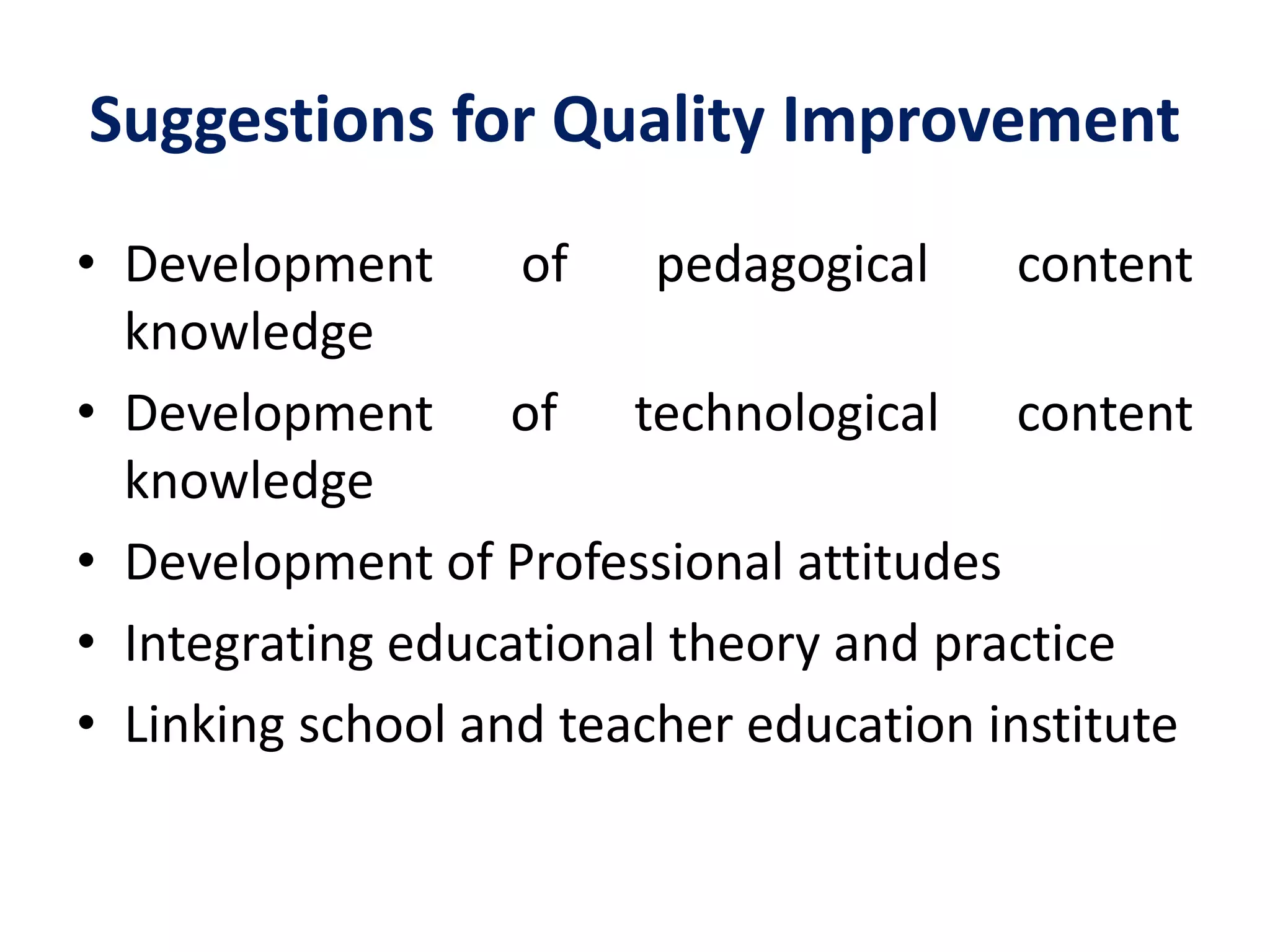
Suggestions for Quality Improvement
• Development of pedagogical content
knowledge
• Development of technological content
knowledge
• Development of Professional attitudes
• Integrating educational theory and practice
• Linking school and teacher education institute
Continued……
• Long duration of internship and field work
with community
• Orientation for teacher educators in latest
pedagogy and technology
• Wide use of ICT in training
• Changing admission system (first work then
get training)
Suggestions for Quality Improvement
• Field Work with Community should be introduced
as it provides rich, real life and hands- on
experience to the prospective teachers regarding
education in rural area. It helps trainees to
develop social skills necessary for successful
adjustment in rural area.
• Privatization and Commercialization of teacher
education should be stopped which leads to large
scale mushrooming of teacher education.
• There should be uniformity in the course structure and
running the B.Ed Course across the Country. The NCTE
may take necessary steps to ensure uniformity of B.Ed
curriculum in the country.
• Teacher education must engage with theory along with
field experiences to help trainees to view knowledge
not as external to the learner but as something that is
actively constructed during learning. Teacher education
should integrate academic knowledge and professional
learning into a meaningful whole.
• Entrance Test should be made mandatory in
all the teacher training college/ institute
where we can really find out the interest,
attitude and aptitude in teaching and get
teachers by choice and not by chance.
• It is desirable that the existing one-year B.Ed. degree
programme is structurally transformed to a two year,
with deeper and more engagement with school-based
experience, reflective and critical engagement with
theory or in short, meaningful/ greater emphasis on
school internship and school experience. It is perhaps
high time that we pay heed to the specific suggestion
of increasing the duration of initial teacher education,
recommended by the two most significant policy
Commissions of post-independence India, namely the
Kothari Commission (1964-66) and the Chattopadhaya
Commission (1983-85).
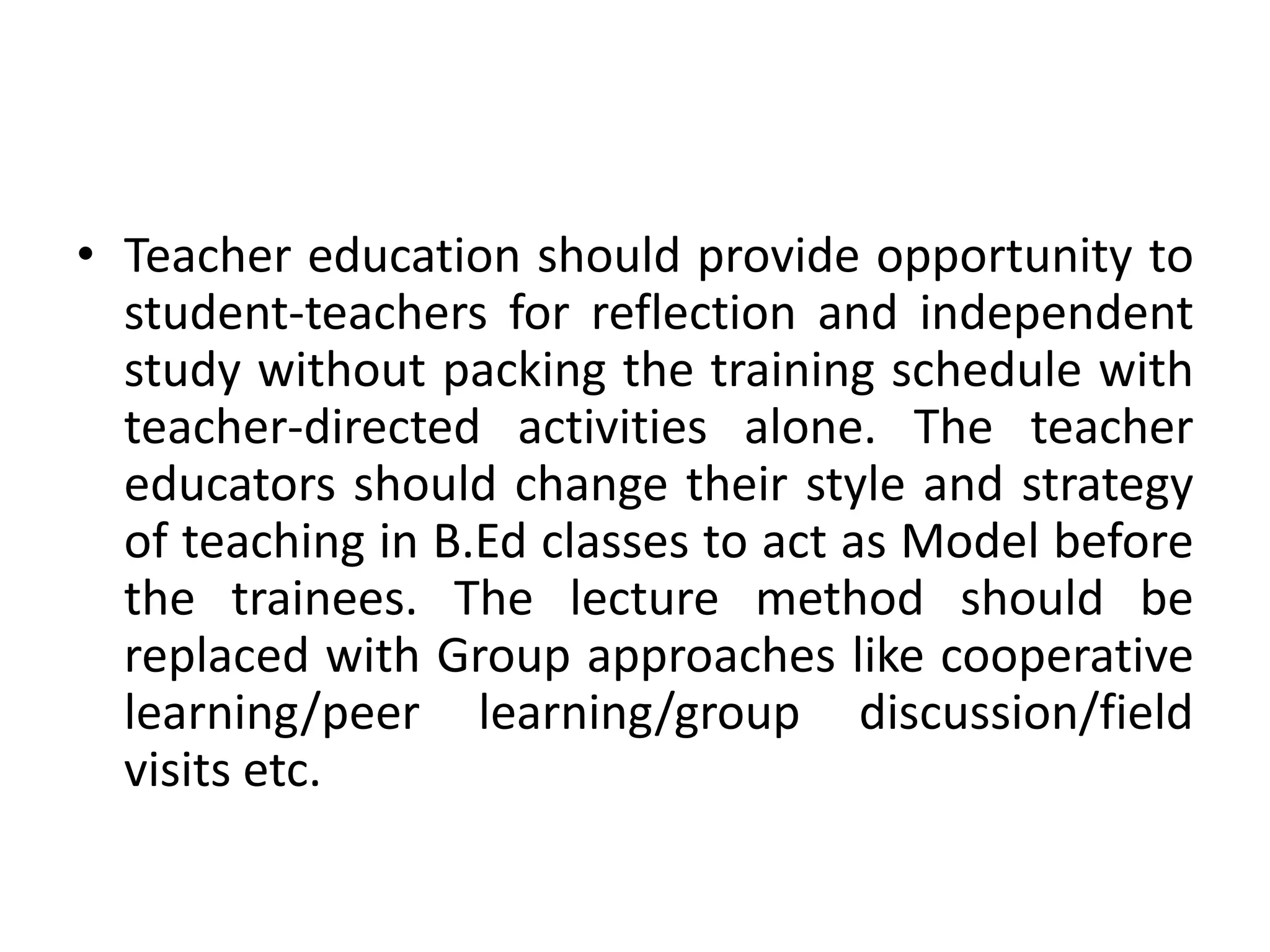
• Teacher education should provide opportunity to
student-teachers for reflection and independent
study without packing the training schedule with
teacher-directed activities alone. The teacher
educators should change their style and strategy
of teaching in B.Ed classes to act as Model before
the trainees. The lecture method should be
replaced with Group approaches like cooperative
learning/peer learning/group discussion/field
visits etc.
• Vertical linkages for post-graduate studies in
education, including research programmes for
students from a variety of science and social
science disciplines need to be provided.
• Teacher Learning Centers (TLCs) may be established as a
structural space located within a teacher education
institution for providing student teachers with hands-on
experience with learning materials, engagement with
learners and opportunities for self-reflection. This can act
as a forum for interaction and sharing, a platform for
classroom-based research, a structural space for self-
directed activities, a platform for developing a repertoire of
skills, a structural space for the personal and psychological
development of teachers and a structural space for forging
links between pre-service and in-service teacher education
as the NPE 1986 maintained that pre-service and in-service
teacher education are inseparable for the development of
teachers..
• Integrated models of teacher education of four or five
years’ duration could comprise of core components that
would be common to all teacher education programmes
(pre-primary, elementary, secondary and senior secondary)
followed by specialization of professional development,
specific to the stage of education.
• Proposals for the comprehensive reform of teacher
education include integrated programmes of teacher
education as the way forward; forging critical links between
school education and universities; providing for
diversification of specializations at the post-graduate level
and providing for diverse routes for undergraduate
students to pursue higher studies in education.
• Reform of teacher education to move forward on
a sound footing demands dedicated research in
the area of foundations of education in the Indian
context by universities, preferably in
independently established departments. The
research in such departments would help
develop the teacher education programmes on a
more sound theoretical basis. The existing
departments of education have hardly been able
to engage themselves in this long-pending need
for their pre-occupation in conducting routine
teacher training and research programmes.

Quality concerns in teacher education

  • 1.
    Quality Concerns inTeacher Education R K Mohalik RIE, Bhubaneswar
  • 2.
    Importance of Teacher •The Kothari Commission (1964-66) pointed out, “Investment in teacher education can yield rich dividends because the financial resources required are small when measured against the resulting improvements in the education of millions”.
  • 3.
    • Teacher isthe principal means for implementing all educational programmes and of the organization of education. It further elaborated that the principal role of teacher will always be teaching and providing guidance to their pupils, not only through classroom instruction and tutorials but also by personal contact and numerous other ways through which teachers have always tried to build up the inner potentialities of the pupils. NPE, 1986
  • 4.
    • Programme ofAction (1992) observed, “Teachers performance is the most crucial input in the field of education. Whatever policy may be laid down, in the ultimate analysis these have to be interpreted and implemented by teachers as much through their personal example as through teaching learning process”.
  • 5.
    Concerns in TeacherEducation • Diversity in course structure • Theory loaded and less practice • Lack of integration of content and pedagogy • Lack of integration of ICT • Traditional approach in transacting curriculum • Least focus on affective development of trainees
  • 6.
    Continued…… • Short durationof internship in comparison to other professional courses • Ill equipped teacher educators • Poor infrastructure facility like ICT, Lab, Library • Privatization without monitoring by NCTE • Teacher education as profitable business • Research inputs are not included in syllabus and training
  • 7.
    Continued…… • Lack ofinstructional leadership of Principals • Faulty way of Admission • Absent of experiment school • De-motivated trainees
  • 8.
    Suggestions for QualityImprovement • Development of pedagogical content knowledge • Development of technological content knowledge • Development of Professional attitudes • Integrating educational theory and practice • Linking school and teacher education institute
  • 9.
    Continued…… • Long durationof internship and field work with community • Orientation for teacher educators in latest pedagogy and technology • Wide use of ICT in training • Changing admission system (first work then get training)
  • 10.
    Suggestions for QualityImprovement • Field Work with Community should be introduced as it provides rich, real life and hands- on experience to the prospective teachers regarding education in rural area. It helps trainees to develop social skills necessary for successful adjustment in rural area. • Privatization and Commercialization of teacher education should be stopped which leads to large scale mushrooming of teacher education.
  • 11.
    • There shouldbe uniformity in the course structure and running the B.Ed Course across the Country. The NCTE may take necessary steps to ensure uniformity of B.Ed curriculum in the country. • Teacher education must engage with theory along with field experiences to help trainees to view knowledge not as external to the learner but as something that is actively constructed during learning. Teacher education should integrate academic knowledge and professional learning into a meaningful whole.
  • 12.
    • Entrance Testshould be made mandatory in all the teacher training college/ institute where we can really find out the interest, attitude and aptitude in teaching and get teachers by choice and not by chance.
  • 13.
    • It isdesirable that the existing one-year B.Ed. degree programme is structurally transformed to a two year, with deeper and more engagement with school-based experience, reflective and critical engagement with theory or in short, meaningful/ greater emphasis on school internship and school experience. It is perhaps high time that we pay heed to the specific suggestion of increasing the duration of initial teacher education, recommended by the two most significant policy Commissions of post-independence India, namely the Kothari Commission (1964-66) and the Chattopadhaya Commission (1983-85).
  • 14.
    • Teacher educationshould provide opportunity to student-teachers for reflection and independent study without packing the training schedule with teacher-directed activities alone. The teacher educators should change their style and strategy of teaching in B.Ed classes to act as Model before the trainees. The lecture method should be replaced with Group approaches like cooperative learning/peer learning/group discussion/field visits etc.
  • 15.
    • Vertical linkagesfor post-graduate studies in education, including research programmes for students from a variety of science and social science disciplines need to be provided.
  • 16.
    • Teacher LearningCenters (TLCs) may be established as a structural space located within a teacher education institution for providing student teachers with hands-on experience with learning materials, engagement with learners and opportunities for self-reflection. This can act as a forum for interaction and sharing, a platform for classroom-based research, a structural space for self- directed activities, a platform for developing a repertoire of skills, a structural space for the personal and psychological development of teachers and a structural space for forging links between pre-service and in-service teacher education as the NPE 1986 maintained that pre-service and in-service teacher education are inseparable for the development of teachers..
  • 17.
    • Integrated modelsof teacher education of four or five years’ duration could comprise of core components that would be common to all teacher education programmes (pre-primary, elementary, secondary and senior secondary) followed by specialization of professional development, specific to the stage of education. • Proposals for the comprehensive reform of teacher education include integrated programmes of teacher education as the way forward; forging critical links between school education and universities; providing for diversification of specializations at the post-graduate level and providing for diverse routes for undergraduate students to pursue higher studies in education.
  • 18.
    • Reform ofteacher education to move forward on a sound footing demands dedicated research in the area of foundations of education in the Indian context by universities, preferably in independently established departments. The research in such departments would help develop the teacher education programmes on a more sound theoretical basis. The existing departments of education have hardly been able to engage themselves in this long-pending need for their pre-occupation in conducting routine teacher training and research programmes.