CURRENT PROBLEMS OF
INDIAN EDUCATION-
PRIMARY, SECONDARY AND HIGHER
EDUCATION
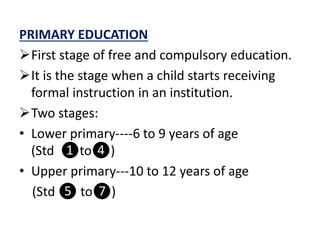
PRIMARY EDUCATION
First stage of free and compulsory education.
It is the stage when a child starts receiving
formal instruction in an institution.
Two stages:
• Lower primary----6 to 9 years of age
(Std ❶to❹)
• Upper primary---10 to 12 years of age
(Std ❺ to❼)
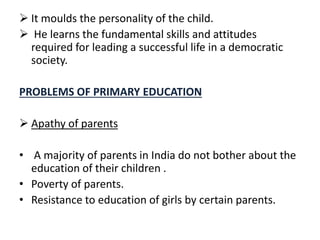
 It moulds the personality of the child.
 He learns the fundamental skills and attitudes
required for leading a successful life in a democratic
society.
PROBLEMS OF PRIMARY EDUCATION
 Apathy of parents
• A majority of parents in India do not bother about the
education of their children .
• Poverty of parents.
• Resistance to education of girls by certain parents.
Overpopulation
CAUSES
Birth rate, death rate, migration, early
marriage, illiteracy, ignorance of parents,
religious belief, joint family and climate.
EFFECTS
Low national income, poverty,
unemployment, etc
REMEDIAL MEASURES
Start new industries, internal migration, family
planning, provide population education.
Problem of resources
• There are only a few schools in India which have
all the primary facilities and materials such as
blackboards, furniture, drinking water, urinals, etc
Wastage and stagnation
• Wastage can be defined as “ the premature
withdrawal of children from school at any stage
before the completion of the course”.
• Thus, the money invested on the individual is
wasted.
• Stagnation is “ the retention of a child in a lower
class for a period of more than one year”.
• He fails in his class and stays there more than the
required time due to poor progress.
• Stagnation discourages the child as well as his
parents to think it is better to withdraw the child
from the school.
Inequality in educational opportunity
We must give equal chances of education to all
pupils irrespective of religion, caste, sex or
economic status without any hindrance.
Problem of finance to start and maintain the
schools.
Problem of universal provision
• In rural and slum areas, provision to provide
primary education is very less.
Problem of staff
• Most of the primary schools are run with
unqualified staff.
Faculty curriculum
• No child centered, no life centered, not
activity centred, etc. It shoud be activity based
and include activities for creative expressions.
Miscellaneous
• It includes physical weakness, continuous
illness, irregular attendance, heterogeneous
age group of students ,etc.
SECONDARY EDUCATION
• It is the second level of schooling that falls
between the primary and higher education.
• It covers children aged 12 to 18.
• It is often referred to as high school and
higher secondary school.
• High school consists of Std VIII, IX and X.
• The final two years of secondary is often
called Higher Secondary or HSS or simply the
“+2” stage.
• Since the secondary stage of education
coincides with the adolescence period, it
becomes the most crucial period.
• It is the terminal stage of a large number of
pupils who enter life.
• It assists them to become useful members of a
complex modern society.
PROBLEMS OF SECONDARY EDUCATION
Heavy curriculum
• Secondary education is predominantly
academic in nature and bookish.
Rigid timetable
• No scope for experimentation and research in
the classroom situation on the part of the
teacher.
Expensive scheme
• It creates heavy financial burden on parents.
Lowering of standard in certain subjects---
syllabus is not updated.
Not child centered
• It ignores individual difference in intelligence,
aptitude and interests of children.
Wastage and stagnation
Highly exam oriented
• Children learn to pass the exams and not for
realizing the developmental goals.
HIGHER EDUCATION
• Higher education is also known as post-
secondary education or third level education.
• Often delivered at universities, academies,
colleges, institutes of technology, etc.
• Higher education includes teaching, research,
exacting applied work and social services.
• It includes both the undergraduate level and
the postgraduate level.
PROBLEMS OF HIGHER EDUCATION
• Colleges are too expensive and
inefficient.
• Students don’t work very hard and
learn little.
• A minority of students graduate on
time and many don’t graduate at all.
• The availability of online education
will create laziness among students,
• Campus violence
• Teaching quality
• Financing
• Privatization
• Quota system
• Problems of educated unemployment
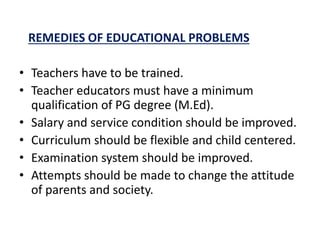
REMEDIES OF EDUCATIONAL PROBLEMS
• Teachers have to be trained.
• Teacher educators must have a minimum
qualification of PG degree (M.Ed).
• Salary and service condition should be improved.
• Curriculum should be flexible and child centered.
• Examination system should be improved.
• Attempts should be made to change the attitude
of parents and society.
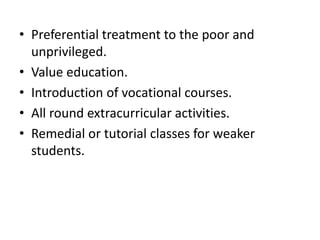
• Preferential treatment to the poor and
unprivileged.
• Value education.
• Introduction of vocational courses.
• All round extracurricular activities.
• Remedial or tutorial classes for weaker
students.
Current problems of

Current problems of

  • 1.
    CURRENT PROBLEMS OF INDIANEDUCATION- PRIMARY, SECONDARY AND HIGHER EDUCATION
  • 2.
    PRIMARY EDUCATION First stageof free and compulsory education. It is the stage when a child starts receiving formal instruction in an institution. Two stages: • Lower primary----6 to 9 years of age (Std ❶to❹) • Upper primary---10 to 12 years of age (Std ❺ to❼)
  • 3.
     It mouldsthe personality of the child.  He learns the fundamental skills and attitudes required for leading a successful life in a democratic society. PROBLEMS OF PRIMARY EDUCATION  Apathy of parents • A majority of parents in India do not bother about the education of their children . • Poverty of parents. • Resistance to education of girls by certain parents.
  • 4.
    Overpopulation CAUSES Birth rate, deathrate, migration, early marriage, illiteracy, ignorance of parents, religious belief, joint family and climate. EFFECTS Low national income, poverty, unemployment, etc REMEDIAL MEASURES Start new industries, internal migration, family planning, provide population education.
  • 5.
    Problem of resources •There are only a few schools in India which have all the primary facilities and materials such as blackboards, furniture, drinking water, urinals, etc Wastage and stagnation • Wastage can be defined as “ the premature withdrawal of children from school at any stage before the completion of the course”. • Thus, the money invested on the individual is wasted.
  • 6.
    • Stagnation is“ the retention of a child in a lower class for a period of more than one year”. • He fails in his class and stays there more than the required time due to poor progress. • Stagnation discourages the child as well as his parents to think it is better to withdraw the child from the school. Inequality in educational opportunity We must give equal chances of education to all pupils irrespective of religion, caste, sex or economic status without any hindrance.
  • 7.
    Problem of financeto start and maintain the schools. Problem of universal provision • In rural and slum areas, provision to provide primary education is very less. Problem of staff • Most of the primary schools are run with unqualified staff. Faculty curriculum • No child centered, no life centered, not activity centred, etc. It shoud be activity based and include activities for creative expressions.
  • 8.
    Miscellaneous • It includesphysical weakness, continuous illness, irregular attendance, heterogeneous age group of students ,etc.
  • 9.
    SECONDARY EDUCATION • Itis the second level of schooling that falls between the primary and higher education. • It covers children aged 12 to 18. • It is often referred to as high school and higher secondary school. • High school consists of Std VIII, IX and X. • The final two years of secondary is often called Higher Secondary or HSS or simply the “+2” stage.
  • 10.
    • Since thesecondary stage of education coincides with the adolescence period, it becomes the most crucial period. • It is the terminal stage of a large number of pupils who enter life. • It assists them to become useful members of a complex modern society.
  • 11.
    PROBLEMS OF SECONDARYEDUCATION Heavy curriculum • Secondary education is predominantly academic in nature and bookish. Rigid timetable • No scope for experimentation and research in the classroom situation on the part of the teacher. Expensive scheme • It creates heavy financial burden on parents.
  • 12.
    Lowering of standardin certain subjects--- syllabus is not updated. Not child centered • It ignores individual difference in intelligence, aptitude and interests of children. Wastage and stagnation Highly exam oriented • Children learn to pass the exams and not for realizing the developmental goals.
  • 13.
    HIGHER EDUCATION • Highereducation is also known as post- secondary education or third level education. • Often delivered at universities, academies, colleges, institutes of technology, etc. • Higher education includes teaching, research, exacting applied work and social services. • It includes both the undergraduate level and the postgraduate level.
  • 14.
    PROBLEMS OF HIGHEREDUCATION • Colleges are too expensive and inefficient. • Students don’t work very hard and learn little. • A minority of students graduate on time and many don’t graduate at all. • The availability of online education will create laziness among students, • Campus violence
  • 15.
    • Teaching quality •Financing • Privatization • Quota system • Problems of educated unemployment
  • 16.
    REMEDIES OF EDUCATIONALPROBLEMS • Teachers have to be trained. • Teacher educators must have a minimum qualification of PG degree (M.Ed). • Salary and service condition should be improved. • Curriculum should be flexible and child centered. • Examination system should be improved. • Attempts should be made to change the attitude of parents and society.
  • 17.
    • Preferential treatmentto the poor and unprivileged. • Value education. • Introduction of vocational courses. • All round extracurricular activities. • Remedial or tutorial classes for weaker students.