Quality Assurance vs. Quality Control
www.kanoah.com
ABOUT US
Kanoah is an innovative company
providing ground-breaking solutions to
software testing professionals on the
Atlassian JIRA platform
About Kanoah Tests
Kanoah Tests is a full featured test management, integrated seamless into
JIRA with the same look-n-feel. No need to learn or switch between different
applications
Coordinate all test management activities including test planning, authoring,
execution, tracking and reporting from a central location
Kanoah Tests enables you to track testing progress and quality to foster
collaboration and visibility across traditional and agile teams
Get real-time insights into your testing progress with out of the box
reports
Easily integrate your automated tests and submit test results with Kanoah
Tests’ powerful REST API or use the API to automate many areas of the
application
After looking for several years at plugins for test management we finally found
Kanoah Tests. The other solutions were either too complex, didn't integrate well
with Jira, or were focused on a single project. Kanoah Tests proved to be an
elegant solution that allowed linking between any project. Kanoah has been
very responsive to feedback, requests, suggestions as well bugs. The customer
service is awesome. I'd highly recommend Kanoah Tests to teams of any size
looking to simplify test management and consolidate tools.
Don
Pierce
Robert
Murhamer
Liked Kanoah from the moment I discovered it. Integrates nicely with JIRA and
especially with Agile. Test cases can be authored right from the story level, but has
all other functionality a Test Case Management solution would need to have,
ranging from creating test plans, executing test cases, importing test cases, API for
automation, a.s.o. Additionally the team at Kanoah is amazing and responding to
any question very quickly. It wasn't hard to sell to my management to purchase
Kanoah. Will highly recommend Kanoah to anybody.
Zour
Brosh
I just start working with Kanoah and I am impressed how it's simple to manage tests
without unlimited non-used features like in most of the test management tools and
still to get the needed functionality and results. The integration with Jira is a great
working solution that enable to share testing and development in simple way on
one system. I recommend to use Kanoah for testing management. It will help to do
Kanoah as much as possible customizable like Jira to match each group
methodology
For more reviews, visit: https://marketplace.atlassian.com/plugins/com.kanoah.test-manager/server/reviews
Reviews
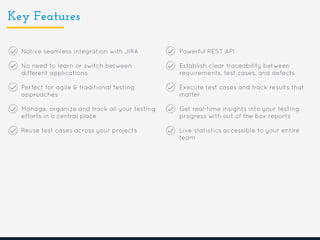
Key Features
Native seamless integration with JIRA
No need to learn or switch between
different applications
Perfect for agile & traditional testing
approaches
Manage, organize and track all your testing
efforts in a central place
Reuse test cases across your projects
Powerful REST API
Establish clear traceability between
requirements, test cases, and defects
Execute test cases and track results that
matter
Get real-time insights into your testing
progress with out of the box reports
Live statistics accessible to your entire
team
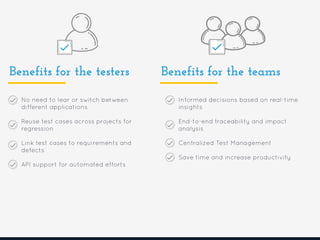
Benefits for the testers
No need to lear or switch between
different applications
Reuse test cases across projects for
regression
Link test cases to requirements and
defects
API support for automated efforts
Benefits for the teams
Informed decisions based on real-time
insights
End-to-end traceability and impact
analysis
Centralized Test Management
Save time and increase productivity
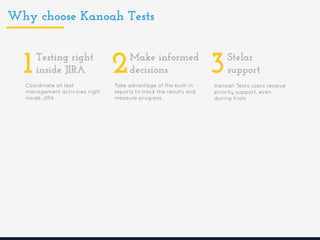
Why choose Kanoah Tests
Coordinate all test
management activities right
inside JIRA
1Testing right
inside JIRA
Take advantage of the built-in
reports to track the results and
measure progress
2Make informed
decisions
Kanoah Tests users receive
priority support, even
during trials
3Stelar
support
Quality Assurance vs. Quality Control
What is Quality Assurance?
Quality Assurance (QA) is a way of preventing mistakes or defects in
manufactured products and avoiding problems when delivering solutions or
services to customers.
Defined by ISO 9000 as “part of quality management focused on providing
confidence that quality requirements will be fulfilled”
It is the systematic measurement, comparison with a standard, monitoring of
processes and an associated feedback loop that confers error prevention. [1]
What is Quality Assurance?
Two principles included in quality assurance are: “Fit for purpose” (the
product should be suitable for the intended purpose); and “right first
time” (mistakes should be eliminated).
QA includes management of the quality of raw materials, assemblies,
products and components, services related to production, and management,
production and inspection processes.
Quality Assurance attempts to improve and stabilize production (and
associated processes) to avoid, or at least minimize, issues which led to the
defect(s) in the first place. [1]
What is Quality Control?
Quality control (QC) is a process by which entities review the quality of all
factors involved in production. ISO 9000 defines quality control as “A part of
quality management focused on fulfilling quality requirements”.
Quality control emphasizes testing of products to uncover defects and
reporting to management who make the decision to allow or deny product
release.[2]
What is Quality Control?
This approach places an emphasis on three aspects:
Elements such as controls, job management, defined and well managed
processes,performance and integrity criteria, and identification of records.
Competence, such as knowledge, skills, experience, and qualifications.
Soft elements, such as personnel, integrity, confidence, organizational
culture, motivation, team spirit, and quality relationships. [2]
Software Quality Assurance
Software quality assurance (SQA) consists of a means of monitoring the
software engineering processes and methods used to ensure quality.
The methods by which this is accomplished are many and varied, and may
include ensuring conformance to one or more standards, such as ISO 9000 or
a model such as CMMI.
SQA is organized into goals, commitments, abilities, activities, measurements,
and verifications. [3]
Software Quality Assurance
SQA encompasses the entire software development process, which includes
processes such as requirements definition, software design, coding, source
code control, code reviews, software configuration management, testing,
release management, and product integration. [3]
SQA helps ensure the development of high-quality software.
SQA practices are implemented in most types of software development,
regardless of the underlying software development model being used. In a
broader sense, SQA incorporates and implements software testing
methodologies to test software. [5]
Software Quality Assurance
SQA processes tests for quality in each phase of development until the
software is complete.
With SQA, the software development process moves into the next phase only
once the current/previous phase complies with the required quality standards.
SQA generally works on one or more industry standards that help in building
software quality guidelines and implementation strategies. These standards
include the ISO 9000 and capability maturity model integration (CMMI). [5]
Software Quality Control
Software Quality Control is the set of procedures used by organizations to
ensure that a software product will meet its quality goals at the best value to
the customer, and to continually improve the organization’s ability to produce
software products in the future.
The main objective is to discover defects of a system and the assessment of
whether the system is usable in an operational situation.
Software quality control refers to specified functional requirements as well as
non-functional requirements such as supportability, performance and usability.
It also refers to the ability for software to perform well in unforeseeable
scenarios and to keep a relatively low defect rate. [4]
Quality Control Activities
Check that assumptions and criteria for the selection of data and the different
factors related to data are documented.
Check for transcription errors in data input and reference.
Check the integrity of database files.
Check for consistency in data.
Check that the movement of inventory data among processing steps is
correct.
Check for uncertainties in data, database files etc.
Undertake review of internal documentation.
Check methodological and data changes resulting in recalculations.
Undertake completeness checks.Compare Results to previous Results. [4]
Differentiating Between QC and QA
Quality means meeting requirements and meeting customer needs, which
means a defect-free product from both the producer’s and the customer’s
viewpoint.
Both quality control and quality assurance are used to make quality happen.
Of the two, quality assurance is the more important.
Quality is an attribute of a product. A product is something produced, such as
a requirement document, test data, source code, load module or terminal
screen. Another type of product is a service that is performed, such as
meetings with customers, help desk activities and training sessions. Services
are a form of products, and therefore, also contain attributes. [6]
Differentiating Between QC and QA
QC is an activity that verifies whether or not the product produced meets
standards.
QA is an activity that establishes and evaluates the processes that produce
the products. If there is no process, there is no role for QA.
Assurance would determine the need for, and acquire or help install system
development methodologies, estimation processes, system maintenance
processes, and so forth. [6]
Quality Assurance
Main concepts of this list have been extracted from here [7] [8] [9].
Deliberates on providing assurance that quality request will be achieved.
Aims to prevent the defect.
Technique of managing the quality.
Does not involve executing the program.
All team members are responsible for QA.
Quality Assurance
Main concepts of this list have been extracted from here [7] [8] [9].
Means planning for doing a process.
Statistical Technique used on QA is known as Statistical Process Control (SPC).
Makes sure you are doing the right things.
Defines standards and methodologies to be followed in order to meet the
customer’s requirement.
Process to create the deliverables.
Quality Control
Main concepts of this list have been extracted from here [7] [8] [9].
Deliberates of fulfilling the quality request.
Aims to identify and improve the defects.
Method to verify the quality.
Always involves executing the program.
Testing team is responsible for QC.
Quality Control
Main concepts of this list have been extracted from here [7] [8] [9].
Means action for executing the planned process.
Statistical Technique used on QC is known as Statistical Quality Control
(SQC).
Makes sure the results of what you’ve done are what you expected.
Ensures that the standards are followed while working on the product.
Process to verify the deliverables
References
[1] https://en.wikipedia.org/wiki/Quality_assurance
[2] https://en.wikipedia.org/wiki/Quality_control
[3] https://en.wikipedia.org/wiki/Software_quality_assurance
[4] https://en.wikipedia.org/wiki/Software_quality_control
[5] https://www.techopedia.com/definition/4363/software-quality-assurance-sqa
[6] Guide to the CSQA Common Body of Knowledge http://
www.softwarecertifications.org/
[7] http://www.diffen.com/difference/Quality_Assurance_vs_Quality_Control
[8] http://www.softwaretestinghelp.com/quality-assurance-vs-quality-control/
[9] http://testingbasicinterviewquestions.blogspot.com.br/2015/03/top-14-
differences-between-qa-and-qc-in.html
Next Steps
Getting Started Guide
GETTING STARTED RESOURCES FREE TRIAL
Documentation
Support
Tutorials
What we're reading this week
Blog
Start you 30-day free trial now

Quality Assurance vs. Quality Control

  • 1.
    Quality Assurance vs.Quality Control
  • 2.
    www.kanoah.com ABOUT US Kanoah isan innovative company providing ground-breaking solutions to software testing professionals on the Atlassian JIRA platform
  • 3.
    About Kanoah Tests KanoahTests is a full featured test management, integrated seamless into JIRA with the same look-n-feel. No need to learn or switch between different applications Coordinate all test management activities including test planning, authoring, execution, tracking and reporting from a central location Kanoah Tests enables you to track testing progress and quality to foster collaboration and visibility across traditional and agile teams Get real-time insights into your testing progress with out of the box reports Easily integrate your automated tests and submit test results with Kanoah Tests’ powerful REST API or use the API to automate many areas of the application
  • 4.
    After looking forseveral years at plugins for test management we finally found Kanoah Tests. The other solutions were either too complex, didn't integrate well with Jira, or were focused on a single project. Kanoah Tests proved to be an elegant solution that allowed linking between any project. Kanoah has been very responsive to feedback, requests, suggestions as well bugs. The customer service is awesome. I'd highly recommend Kanoah Tests to teams of any size looking to simplify test management and consolidate tools. Don Pierce Robert Murhamer Liked Kanoah from the moment I discovered it. Integrates nicely with JIRA and especially with Agile. Test cases can be authored right from the story level, but has all other functionality a Test Case Management solution would need to have, ranging from creating test plans, executing test cases, importing test cases, API for automation, a.s.o. Additionally the team at Kanoah is amazing and responding to any question very quickly. It wasn't hard to sell to my management to purchase Kanoah. Will highly recommend Kanoah to anybody. Zour Brosh I just start working with Kanoah and I am impressed how it's simple to manage tests without unlimited non-used features like in most of the test management tools and still to get the needed functionality and results. The integration with Jira is a great working solution that enable to share testing and development in simple way on one system. I recommend to use Kanoah for testing management. It will help to do Kanoah as much as possible customizable like Jira to match each group methodology For more reviews, visit: https://marketplace.atlassian.com/plugins/com.kanoah.test-manager/server/reviews Reviews
  • 5.
    Key Features Native seamlessintegration with JIRA No need to learn or switch between different applications Perfect for agile & traditional testing approaches Manage, organize and track all your testing efforts in a central place Reuse test cases across your projects Powerful REST API Establish clear traceability between requirements, test cases, and defects Execute test cases and track results that matter Get real-time insights into your testing progress with out of the box reports Live statistics accessible to your entire team
  • 6.
    Benefits for thetesters No need to lear or switch between different applications Reuse test cases across projects for regression Link test cases to requirements and defects API support for automated efforts Benefits for the teams Informed decisions based on real-time insights End-to-end traceability and impact analysis Centralized Test Management Save time and increase productivity
  • 7.
    Why choose KanoahTests Coordinate all test management activities right inside JIRA 1Testing right inside JIRA Take advantage of the built-in reports to track the results and measure progress 2Make informed decisions Kanoah Tests users receive priority support, even during trials 3Stelar support
  • 8.
    Quality Assurance vs.Quality Control
  • 9.
    What is QualityAssurance? Quality Assurance (QA) is a way of preventing mistakes or defects in manufactured products and avoiding problems when delivering solutions or services to customers. Defined by ISO 9000 as “part of quality management focused on providing confidence that quality requirements will be fulfilled” It is the systematic measurement, comparison with a standard, monitoring of processes and an associated feedback loop that confers error prevention. [1]
  • 10.
    What is QualityAssurance? Two principles included in quality assurance are: “Fit for purpose” (the product should be suitable for the intended purpose); and “right first time” (mistakes should be eliminated). QA includes management of the quality of raw materials, assemblies, products and components, services related to production, and management, production and inspection processes. Quality Assurance attempts to improve and stabilize production (and associated processes) to avoid, or at least minimize, issues which led to the defect(s) in the first place. [1]
  • 11.
    What is QualityControl? Quality control (QC) is a process by which entities review the quality of all factors involved in production. ISO 9000 defines quality control as “A part of quality management focused on fulfilling quality requirements”. Quality control emphasizes testing of products to uncover defects and reporting to management who make the decision to allow or deny product release.[2]
  • 12.
    What is QualityControl? This approach places an emphasis on three aspects: Elements such as controls, job management, defined and well managed processes,performance and integrity criteria, and identification of records. Competence, such as knowledge, skills, experience, and qualifications. Soft elements, such as personnel, integrity, confidence, organizational culture, motivation, team spirit, and quality relationships. [2]
  • 13.
    Software Quality Assurance Softwarequality assurance (SQA) consists of a means of monitoring the software engineering processes and methods used to ensure quality. The methods by which this is accomplished are many and varied, and may include ensuring conformance to one or more standards, such as ISO 9000 or a model such as CMMI. SQA is organized into goals, commitments, abilities, activities, measurements, and verifications. [3]
  • 14.
    Software Quality Assurance SQAencompasses the entire software development process, which includes processes such as requirements definition, software design, coding, source code control, code reviews, software configuration management, testing, release management, and product integration. [3] SQA helps ensure the development of high-quality software. SQA practices are implemented in most types of software development, regardless of the underlying software development model being used. In a broader sense, SQA incorporates and implements software testing methodologies to test software. [5]
  • 15.
    Software Quality Assurance SQAprocesses tests for quality in each phase of development until the software is complete. With SQA, the software development process moves into the next phase only once the current/previous phase complies with the required quality standards. SQA generally works on one or more industry standards that help in building software quality guidelines and implementation strategies. These standards include the ISO 9000 and capability maturity model integration (CMMI). [5]
  • 16.
    Software Quality Control SoftwareQuality Control is the set of procedures used by organizations to ensure that a software product will meet its quality goals at the best value to the customer, and to continually improve the organization’s ability to produce software products in the future. The main objective is to discover defects of a system and the assessment of whether the system is usable in an operational situation. Software quality control refers to specified functional requirements as well as non-functional requirements such as supportability, performance and usability. It also refers to the ability for software to perform well in unforeseeable scenarios and to keep a relatively low defect rate. [4]
  • 17.
    Quality Control Activities Checkthat assumptions and criteria for the selection of data and the different factors related to data are documented. Check for transcription errors in data input and reference. Check the integrity of database files. Check for consistency in data. Check that the movement of inventory data among processing steps is correct. Check for uncertainties in data, database files etc. Undertake review of internal documentation. Check methodological and data changes resulting in recalculations. Undertake completeness checks.Compare Results to previous Results. [4]
  • 18.
    Differentiating Between QCand QA Quality means meeting requirements and meeting customer needs, which means a defect-free product from both the producer’s and the customer’s viewpoint. Both quality control and quality assurance are used to make quality happen. Of the two, quality assurance is the more important. Quality is an attribute of a product. A product is something produced, such as a requirement document, test data, source code, load module or terminal screen. Another type of product is a service that is performed, such as meetings with customers, help desk activities and training sessions. Services are a form of products, and therefore, also contain attributes. [6]
  • 19.
    Differentiating Between QCand QA QC is an activity that verifies whether or not the product produced meets standards. QA is an activity that establishes and evaluates the processes that produce the products. If there is no process, there is no role for QA. Assurance would determine the need for, and acquire or help install system development methodologies, estimation processes, system maintenance processes, and so forth. [6]
  • 20.
    Quality Assurance Main conceptsof this list have been extracted from here [7] [8] [9]. Deliberates on providing assurance that quality request will be achieved. Aims to prevent the defect. Technique of managing the quality. Does not involve executing the program. All team members are responsible for QA.
  • 21.
    Quality Assurance Main conceptsof this list have been extracted from here [7] [8] [9]. Means planning for doing a process. Statistical Technique used on QA is known as Statistical Process Control (SPC). Makes sure you are doing the right things. Defines standards and methodologies to be followed in order to meet the customer’s requirement. Process to create the deliverables.
  • 22.
    Quality Control Main conceptsof this list have been extracted from here [7] [8] [9]. Deliberates of fulfilling the quality request. Aims to identify and improve the defects. Method to verify the quality. Always involves executing the program. Testing team is responsible for QC.
  • 23.
    Quality Control Main conceptsof this list have been extracted from here [7] [8] [9]. Means action for executing the planned process. Statistical Technique used on QC is known as Statistical Quality Control (SQC). Makes sure the results of what you’ve done are what you expected. Ensures that the standards are followed while working on the product. Process to verify the deliverables
  • 24.
    References [1] https://en.wikipedia.org/wiki/Quality_assurance [2] https://en.wikipedia.org/wiki/Quality_control [3]https://en.wikipedia.org/wiki/Software_quality_assurance [4] https://en.wikipedia.org/wiki/Software_quality_control [5] https://www.techopedia.com/definition/4363/software-quality-assurance-sqa [6] Guide to the CSQA Common Body of Knowledge http:// www.softwarecertifications.org/ [7] http://www.diffen.com/difference/Quality_Assurance_vs_Quality_Control [8] http://www.softwaretestinghelp.com/quality-assurance-vs-quality-control/ [9] http://testingbasicinterviewquestions.blogspot.com.br/2015/03/top-14- differences-between-qa-and-qc-in.html
  • 25.
    Next Steps Getting StartedGuide GETTING STARTED RESOURCES FREE TRIAL Documentation Support Tutorials What we're reading this week Blog Start you 30-day free trial now