Training Program onTraining Program on
CORRECTIVE ACTIONCORRECTIVE ACTION
ANDAND
PREVENTIVE ACTIONPREVENTIVE ACTION
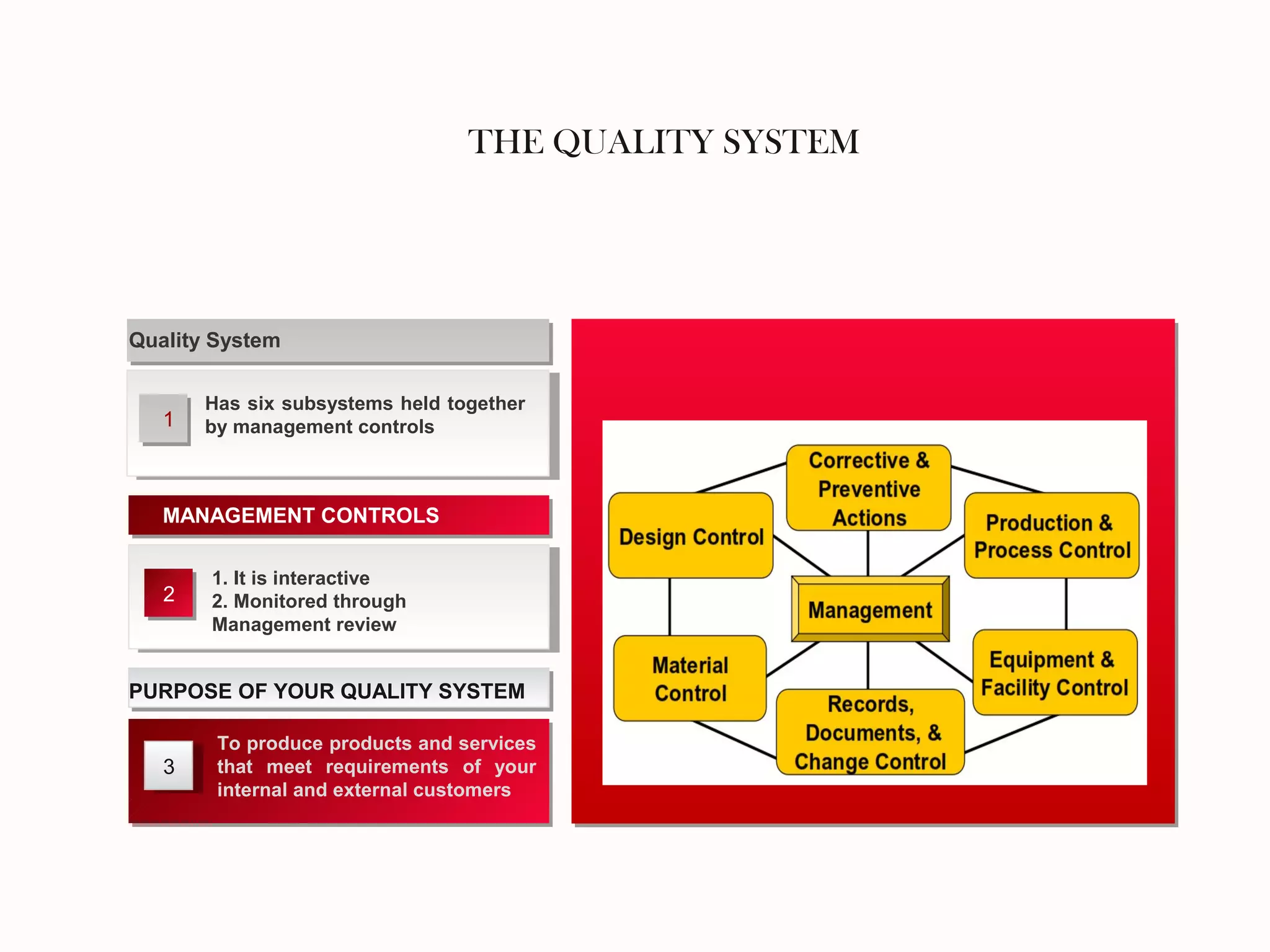
THE QUALITY SYSTEM
11
Has six subsystems held together
by management controls
Quality System
1. It is interactive
2. Monitored through
Management review
MANAGEMENT CONTROLS
3
To produce products and services
that meet requirements of your
internal and external customers
PURPOSE OF YOUR QUALITY SYSTEM
2
THE QUALITY SYSTEMTHE QUALITY SYSTEM
• Each subsystem has a defined function
• CAPA is one of the subsystems
• The function of a CAPA system is to improve
product and processes in the Quality system
• CAPA is a continuous improvement Quality
subsystem
• CAPA is Facts and data driven: risk assessment
and impact assessment.
THE QUALITY SYSTEMTHE QUALITY SYSTEM
THE ROLE OF CAPA
WHAT IS THE ROLE OF CAPA IN
THE QUALITY SYSTEM ?
THE ROLE OF CAPA IN THE QUALITY
SYSTEM
CAPA defined:
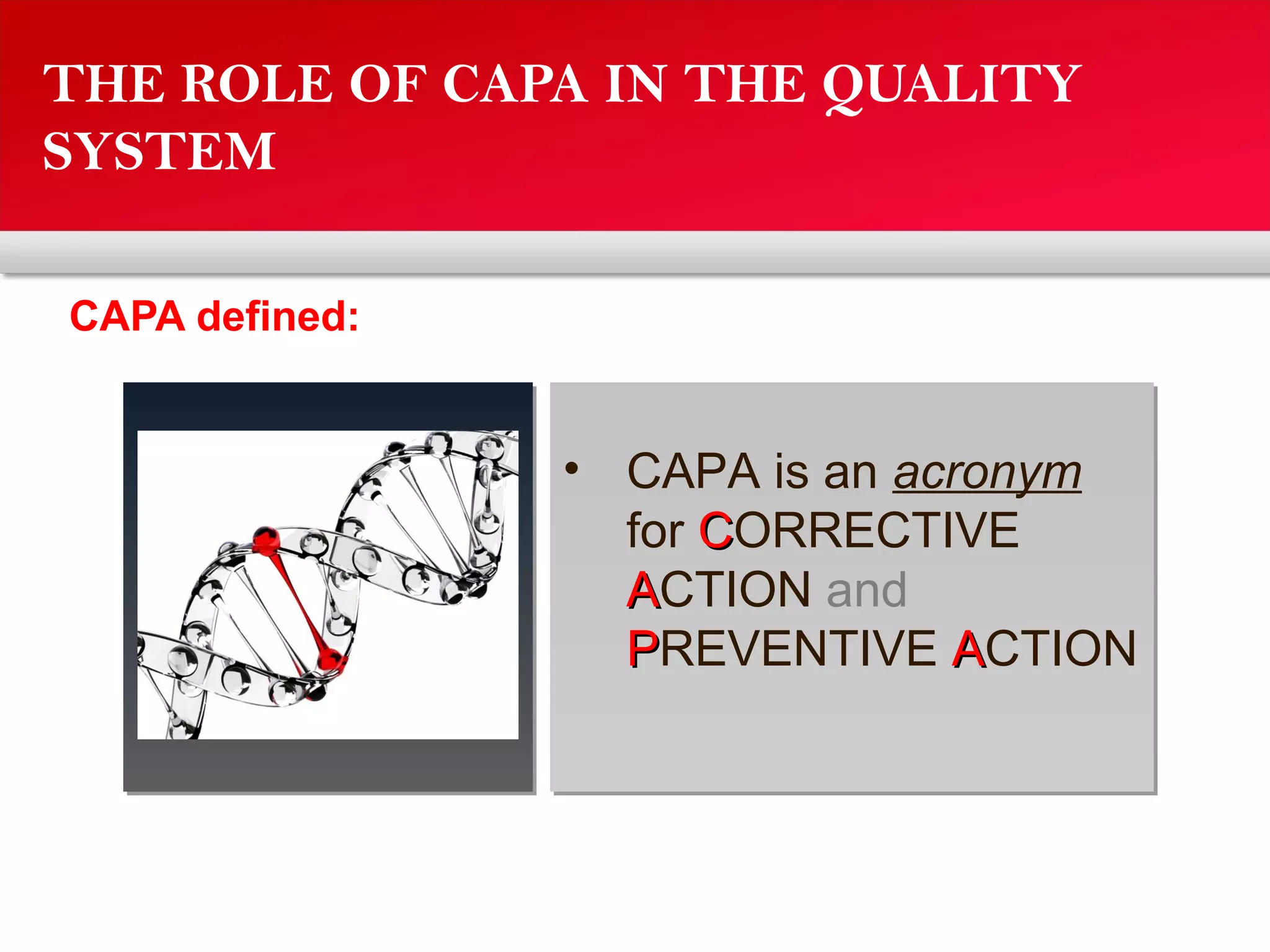
• CAPA is an acronym
for CCORRECTIVE
AACTION and
PPREVENTIVE AACTION
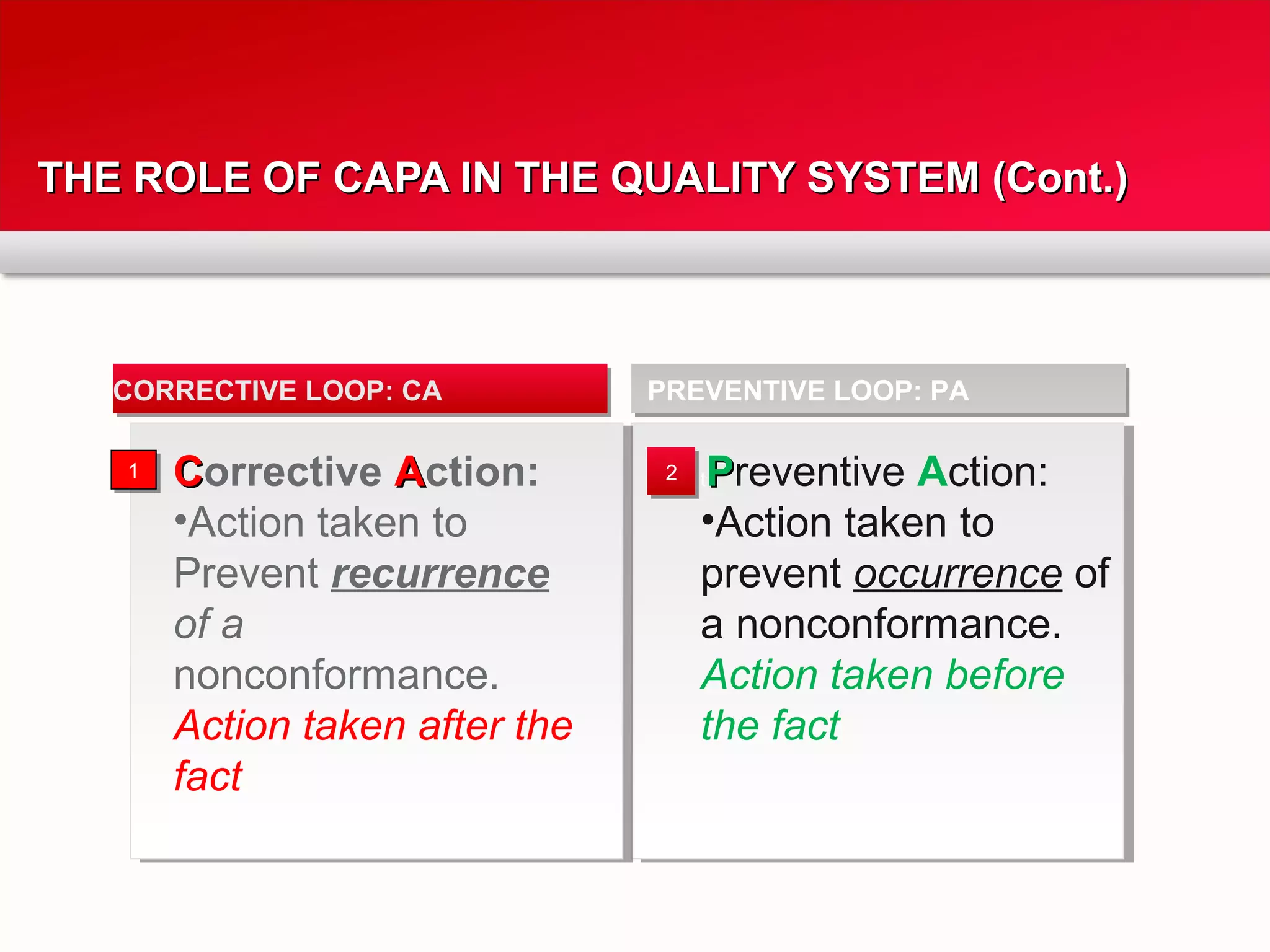
tPPreventive Action:
•Action taken to
prevent occurrence of
a nonconformance.
Action taken before
the fact
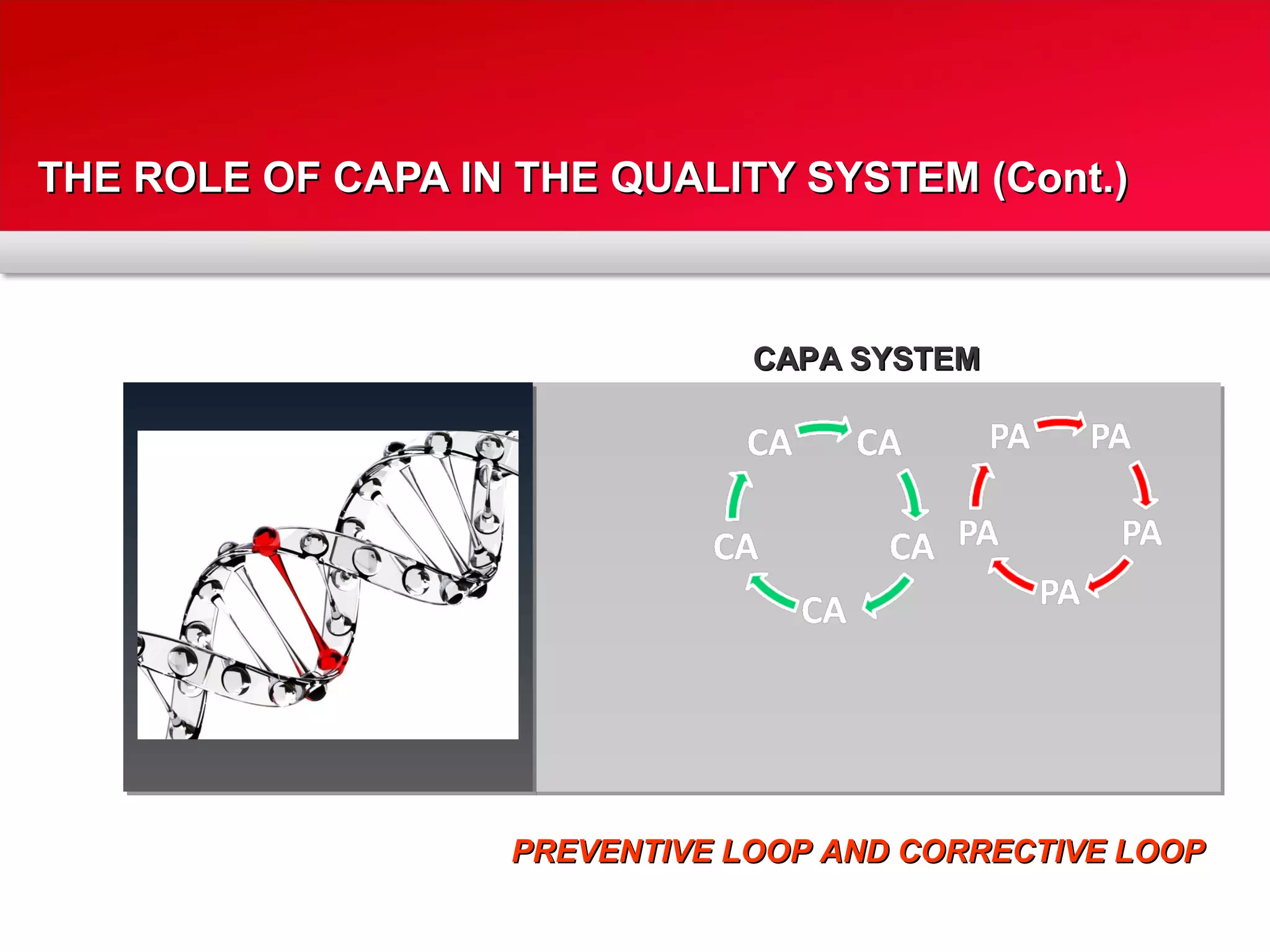
PREVENTIVE LOOP: PA
CCorrective AAction:
•Action taken to
Prevent recurrence
of a
nonconformance.
Action taken after the
fact
CORRECTIVE LOOP: CA
211
THE ROLE OF CAPA IN THE QUALITY SYSTEM (Cont.)THE ROLE OF CAPA IN THE QUALITY SYSTEM (Cont.)
CAPA SYSTEMCAPA SYSTEM
PREVENTIVE LOOP AND CORRECTIVE LOOPPREVENTIVE LOOP AND CORRECTIVE LOOP
THE ROLE OF CAPA IN THE QUALITY SYSTEMTHE ROLE OF CAPA IN THE QUALITY SYSTEM
The role of a CAPA system is to continuously improve productcontinuously improve product
and processesand processes in the Quality systemin the Quality system
•CAPA is a continuous Quality improvement subsystem
•CAPA is Facts and data driven
•CAPA decision making is based on risk assessment and
impact assessment
•Risk assessment is performed on three levels:
End-user, compliance ,and business
THE ROLE OF CAPA IN THE QUALITY SYSTEMTHE ROLE OF CAPA IN THE QUALITY SYSTEM
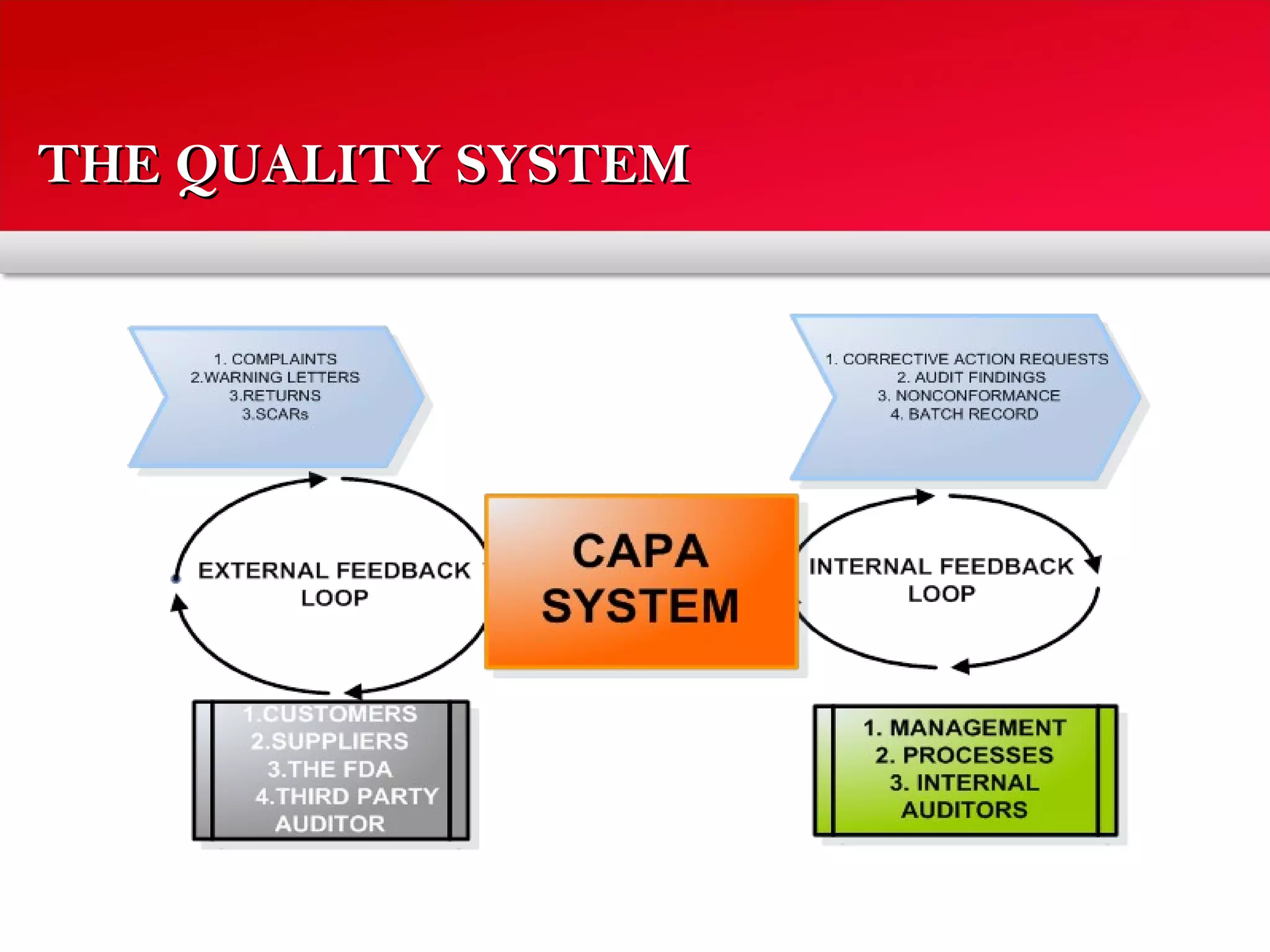
The CAPA system receives information from two
Quality management loops:
•The internal feedback-loop: Quality data from within
the organization
•The external feedback-loop: Quality data from
outside the organization
THE CAPA LANGUAGE
THE CAPA LANGUAGE
A nonconformance:A nonconformance:
•Not meetingNot meeting
specifications, orspecifications, or
requirementsrequirements
THECAPA LANGUAGE: LEXICON (Cont.)
A deviation:A deviation:
•Not following specifiedNot following specified
instructionsinstructions
THE CAPA LANGUAGE: LEXICON (Cont.)
Containment:Containment:
•Action taken to arrest theAction taken to arrest the
effects of nonconformanceeffects of nonconformance
THE CAPA LANGUAGE: LEXICON (Cont.)
A variance:A variance:
•A one time waver toA one time waver to
perform a task through aperform a task through a
planned deviationplanned deviation
THE CAPA LANGUAGE: LEXICON (Cont.)
A Correction:A Correction:
•Action taken to rework, orAction taken to rework, or
repair product to meetrepair product to meet
specificationsspecifications
THE CAPA LANGUAGE: LEXICON (Cont.)
Risk assessment:Risk assessment:
•Action taken to estimateAction taken to estimate
the likelihood andthe likelihood and
consequence of a potentialconsequence of a potential
failure, and failurefailure, and failure
happening againhappening again
THE CAPA LANGUAGE: LEXICON (Cont.)THE CAPA LANGUAGE: LEXICON (Cont.)
Preventive loop:Preventive loop:
•Information fed into theInformation fed into the
CAPA system aboutCAPA system about
potential (future)potential (future)
nonconformitiesnonconformities
THE CAPA LANGUAGE: LEXICON (Cont.)
Corrective loop:Corrective loop:
•Information fed into theInformation fed into the
CAPA system aboutCAPA system about
nonconformitiesnonconformities
THE CAPA LANGUAGE: LEXICON (Cont.)
Closed loop:Closed loop:
•CAPA Information flowCAPA Information flow
from initiation in the CAPAfrom initiation in the CAPA
system to managementsystem to management
review and back to thereview and back to the
CAPA system for closureCAPA system for closure
CAPA SYSTEM REQUIREMENTS
Your own footer Your Logo
KNOW CAPA REQUIREMENTS: PHARMACEUTICALSKNOW CAPA REQUIREMENTS: PHARMACEUTICALS
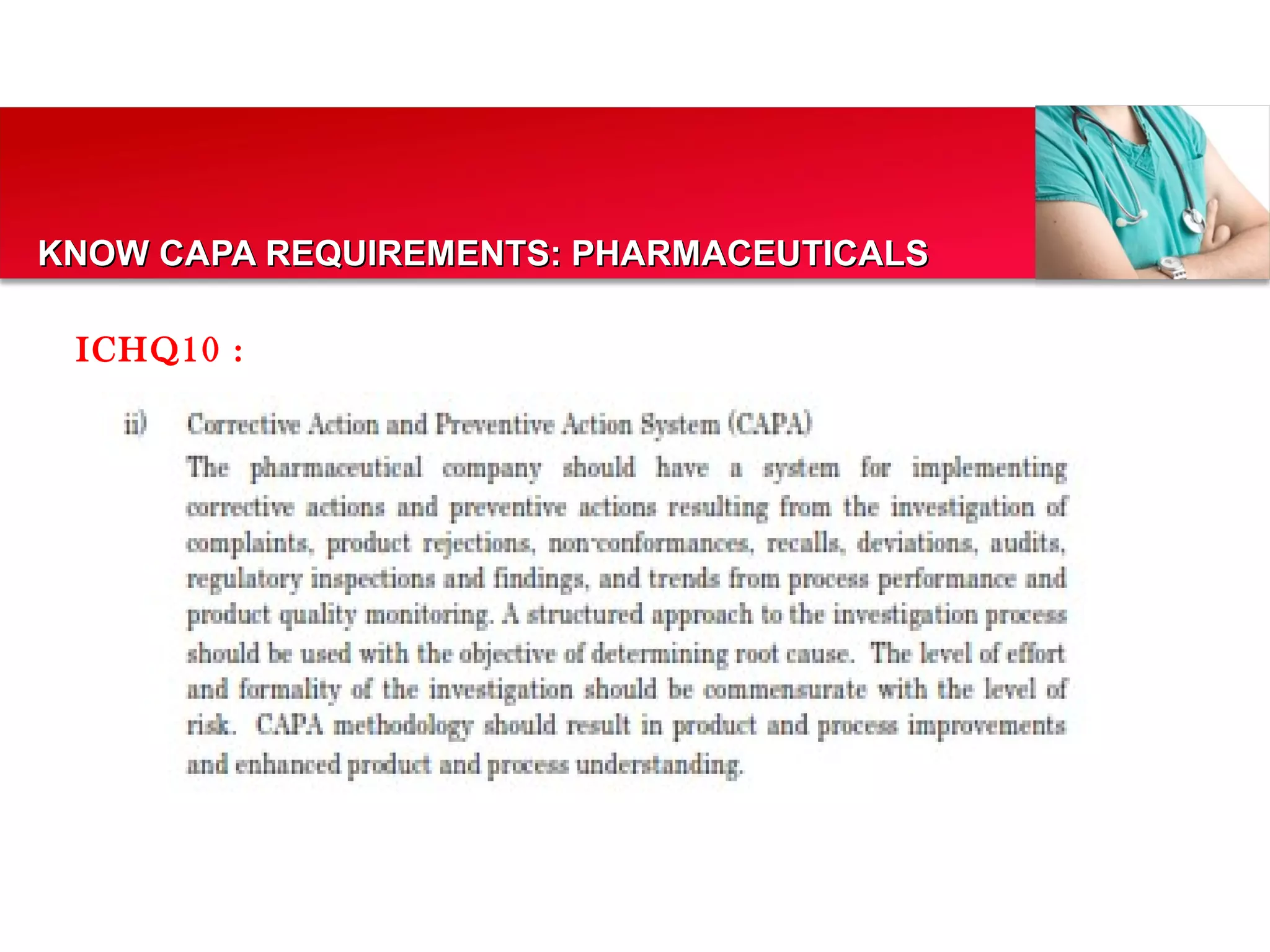
ICHQ10 :
KNOW CAPA REQUIREMENTS: PHARMACEUTICALSKNOW CAPA REQUIREMENTS: PHARMACEUTICALS
ICHQ10 :
1.You must have a CAPA system for product and process improvement
2.Suppliers to your CAPA should be:
•The complaint system
•Process reject data
•Nonconformities
•Deviations
•Audit findings
•Regulatory inspections
•Adverse trends from KPIs
3.Your effort and level of investigation should be risk-based
CAPA REQUIREMENTSCAPA REQUIREMENTS
ICHQ10ICHQ10
The decision as to whether to open a CAPA
or not after reviewing data from data
sources is based on:
•Risk assessment
•Impact assessment
•Trend analysis
CAPA SYSTEM REQUIREMENTSCAPA SYSTEM REQUIREMENTS
The two Quality feedback loops feed two
CAPA loops with information:
•The reactive loop: After the fact (CAR)
•The pro-active loop: Before the fact (PAR)
CARs are initiated based on a
nonconformance.
PARs are initiated based on risk and
adverse trends
CAPA LIFE CYCLECAPA LIFE CYCLE
THE SEVEN PHASES
THECAPA LIFECYCLE
CAPA is definitive:
•It has a beginning and it has an end
•CAPA workflows in six phases
•Each phase accomplishes a task
THE CAPA LIFE CYCLE
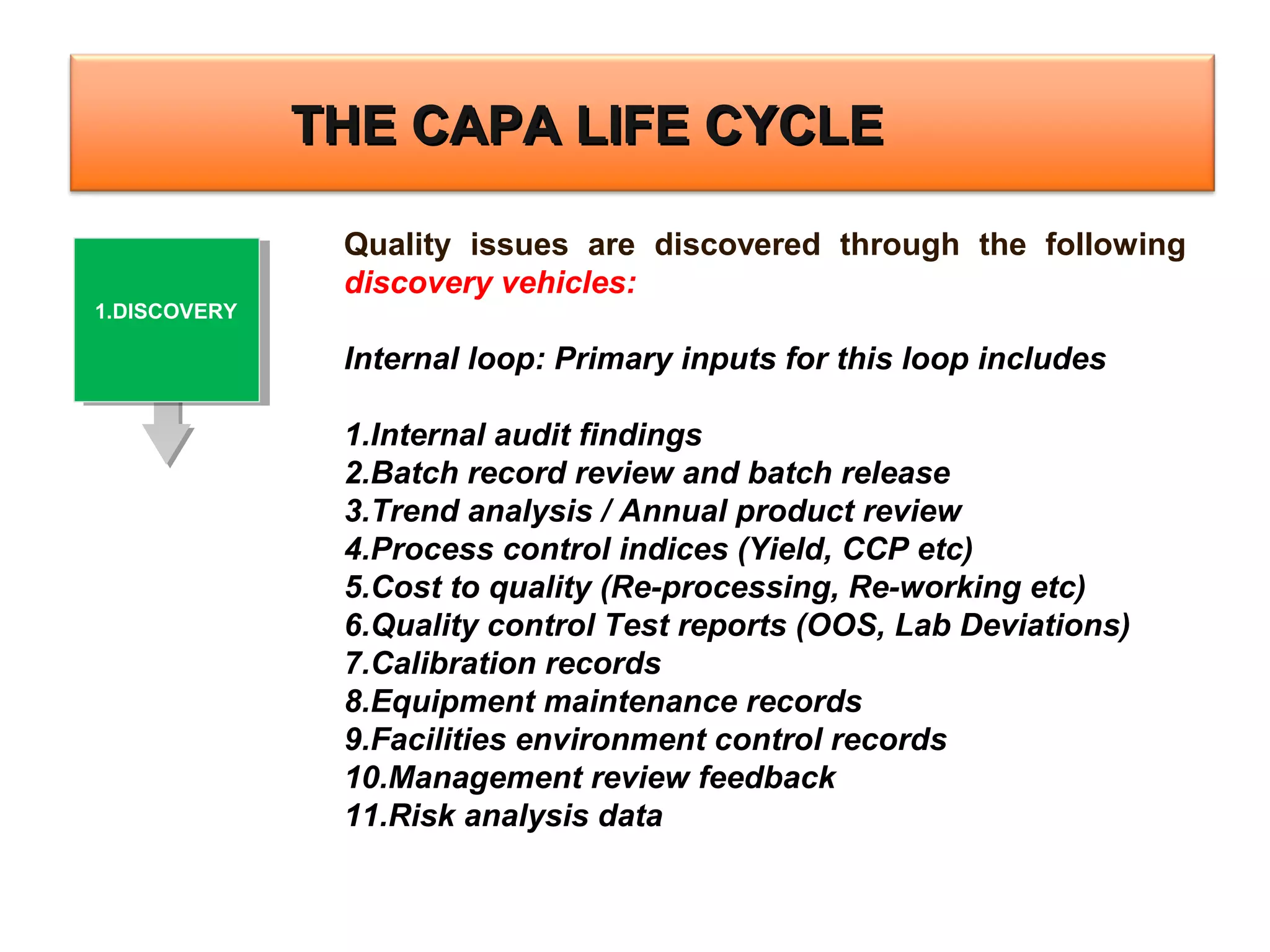
Quality issues are discovered through the following
discovery vehicles:
Internal loop: Primary inputs for this loop includes
1.Internal audit findings
2.Batch record review and batch release
3.Trend analysis / Annual product review
4.Process control indices (Yield, CCP etc)
5.Cost to quality (Re-processing, Re-working etc)
6.Quality control Test reports (OOS, Lab Deviations)
7.Calibration records
8.Equipment maintenance records
9.Facilities environment control records
10.Management review feedback
11.Risk analysis data
THE CAPA LIFE CYCLETHE CAPA LIFE CYCLE
2.CONTAINMENT
1.DISCOVERY
Quality issues are discovered through the following
discovery vehicles:
External loop:
1.Customer complaint
2.Customer returns
3.Customer audit findings
4.Regulatory audit findings : FDA 483s, warning letters,
ISO audit findings
5.Product recall
6.Supplier (Vendor) audits
THE CAPA LIFE CYCLETHE CAPA LIFE CYCLE
1.DISCOVERY
Your own footer Your Logo
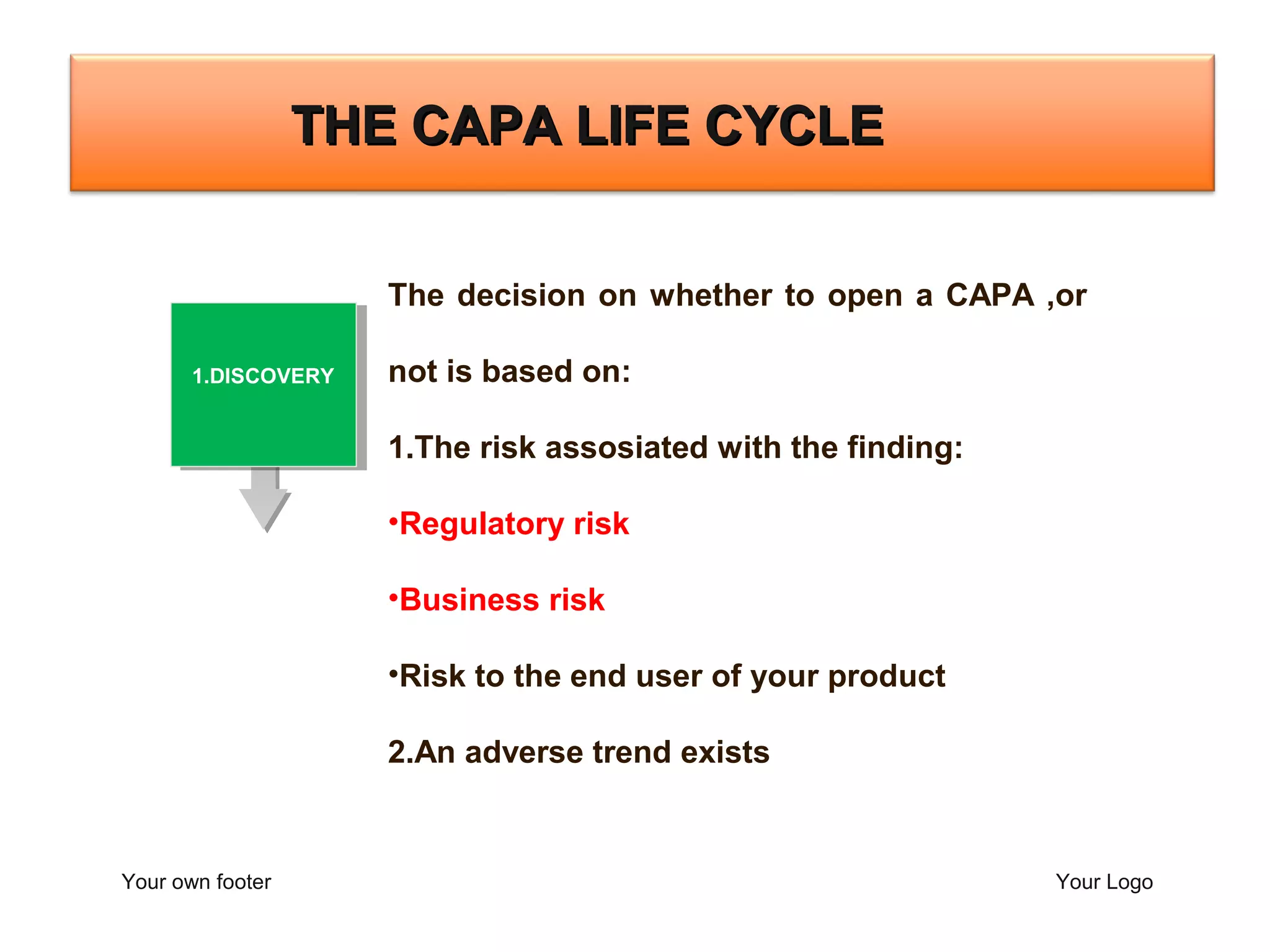
The decision on whether to open a CAPA ,or
not is based on:
1.The risk assosiated with the finding:
•Regulatory risk
•Business risk
•Risk to the end user of your product
2.An adverse trend exists
THE CAPA LIFE CYCLETHE CAPA LIFE CYCLE
2.CONTAINMENT
1.DISCOVERY
Your own footer Your Logo
3.Impact assessment data
•Implications
•Cost
THE CAPA LIFE CYCLETHE CAPA LIFE CYCLE
2.CONTAINMENT
DISCOVERY
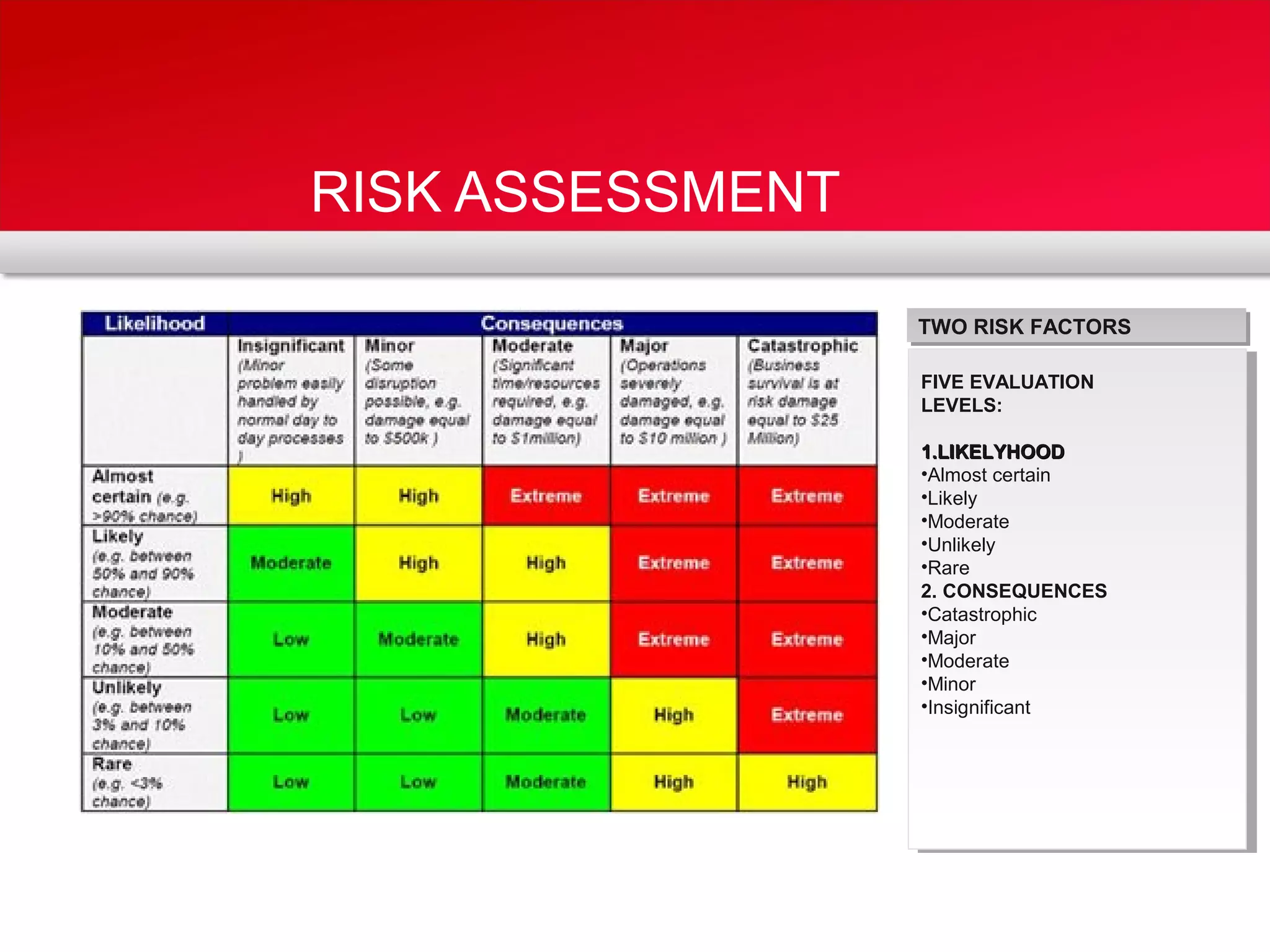
RISK ASSESSMENT
FIVE EVALUATION
LEVELS:
1.LIKELYHOOD1.LIKELYHOOD
•Almost certain
•Likely
•Moderate
•Unlikely
•Rare
2. CONSEQUENCES
•Catastrophic
•Major
•Moderate
•Minor
•Insignificant
TWO RISK FACTORS
ASSESSMENT KEYASSESSMENT KEY
RISK ASSESSMENT
1.EXTREME1.EXTREME
CA: NOWCA: NOW
ContainmentContainment
required !required !
4.LOW
TRENDABLE EVENT:
MONITOR
Containment reffers to arresting the implications
or impact of the problem,or potential problem so it
doesn’t spread
The question that drive this phase are
1.What is the problem or potential problem?
2.Is it important?
3.What should we do to correct it while we look
for long term solution?
4.Does it affect our mission?
5.What is the risk inolved?
6.What is its effect on product, process and
quality management system?
6.CLOSURE
5.MONITOR FOR
EFFECTIVENESS
2.CONTAINMENT
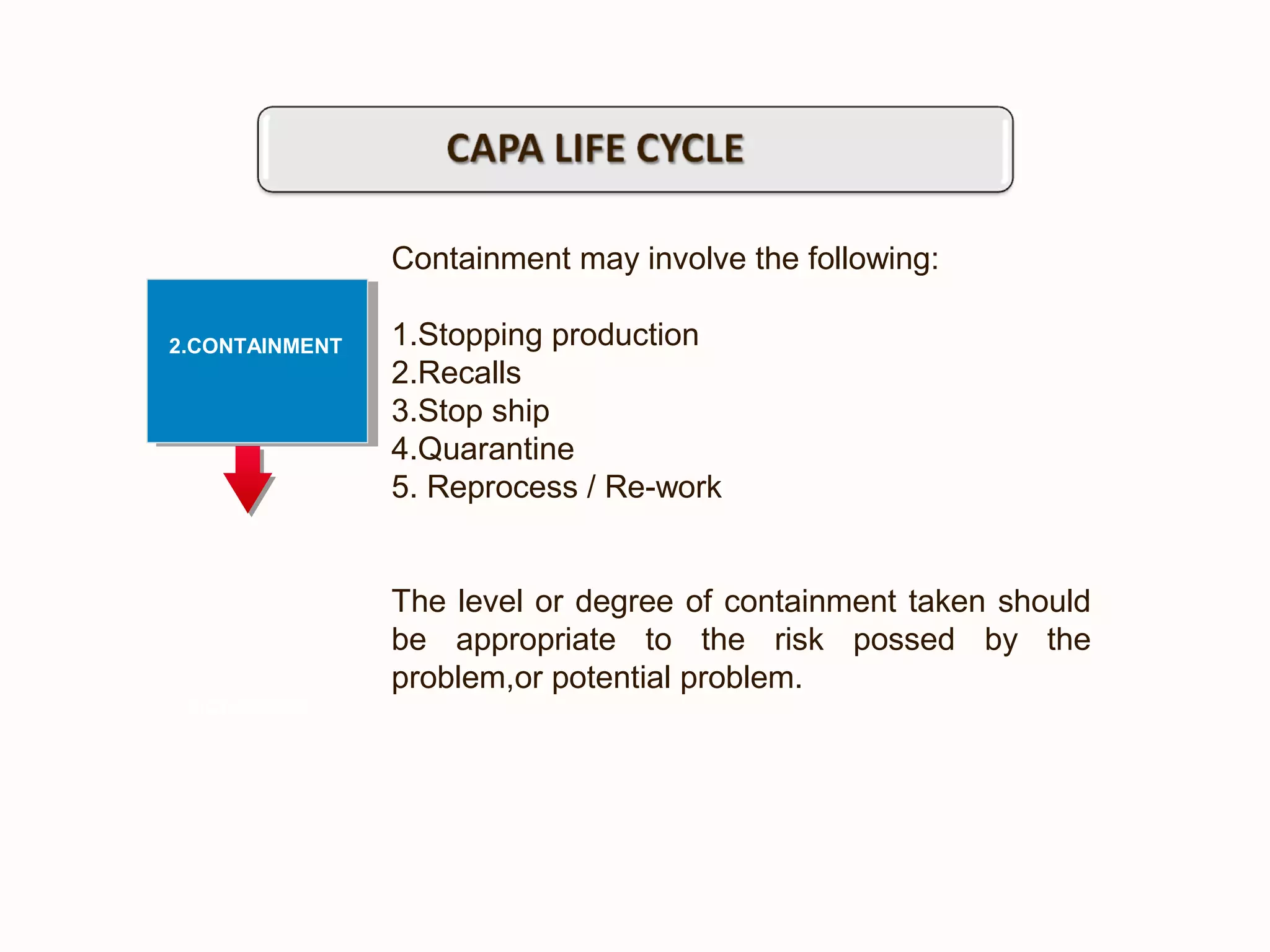
Containment may involve the following:
1.Stopping production
2.Recalls
3.Stop ship
4.Quarantine
5. Reprocess / Re-work
The level or degree of containment taken should
be appropriate to the risk possed by the
problem,or potential problem.
6.CLOSURE
2.CONTAINMENT
Quality system problems and potential
problems are classified in three categories:
1.Product: Specification related
2.Process
3.System
• During investigation the right tool for the right job
should be be used
• The analysis to find the underlying cause of the
problem: Root Cause analysis should be performed
6.CLOSURE
5.MONITOR FOR
EFFECTIVENESS
3.INVESTIGATION
Your own footer Your Logo
C
1.CHOOSE BEST SOLUTION: Through
validation , or verification
2.DEFINE THE CRITERIA FOR SUCCESS
3.DEVELOP IMPLEMENTATION PLAN
4. DEFINE WHAT DATA TO COLLECT AND
WHEN TO COLLECT IT
This is an example text. Go ahead and replace it
with your own text. tThis is an example text. Go
ahead and replace it with your own text. This is
an example text. Go ahead and replace it with
your own text.
6.CLOSURE
5.MONITOR FOR
EFFECTIVENESS
4.IMPLEMENTATION
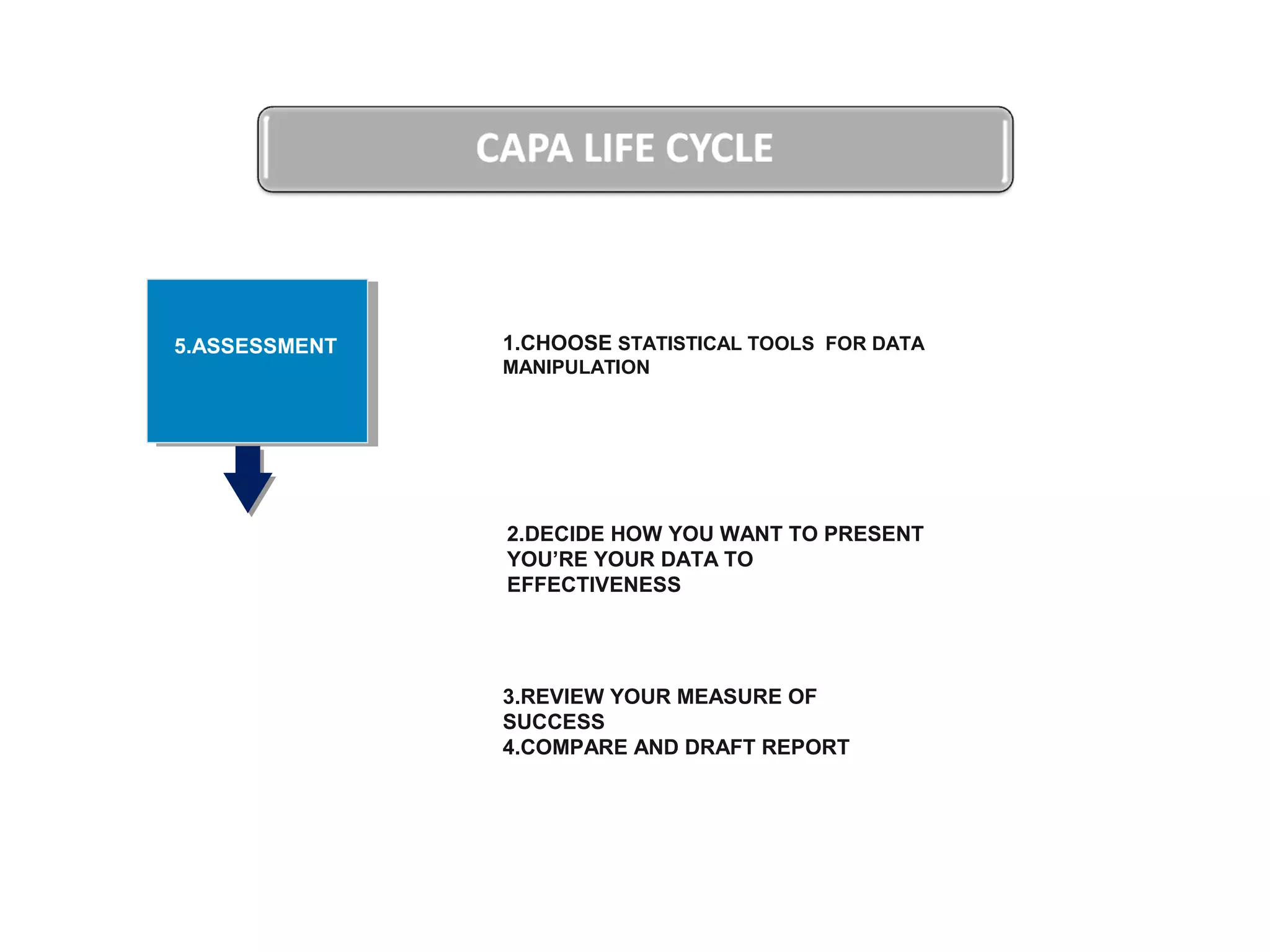
1.CHOOSE STATISTICAL TOOLS FOR DATA
MANIPULATION
2.DECIDE HOW YOU WANT TO PRESENT
YOU’RE YOUR DATA TO
EFFECTIVENESS
3.REVIEW YOUR MEASURE OF
SUCCESS
4.COMPARE AND DRAFT REPORT
6.CLOSURE
5.MONITOR FOR
EFFECTIVENESS
5.ASSESSMENT
Your own footer Your Logo
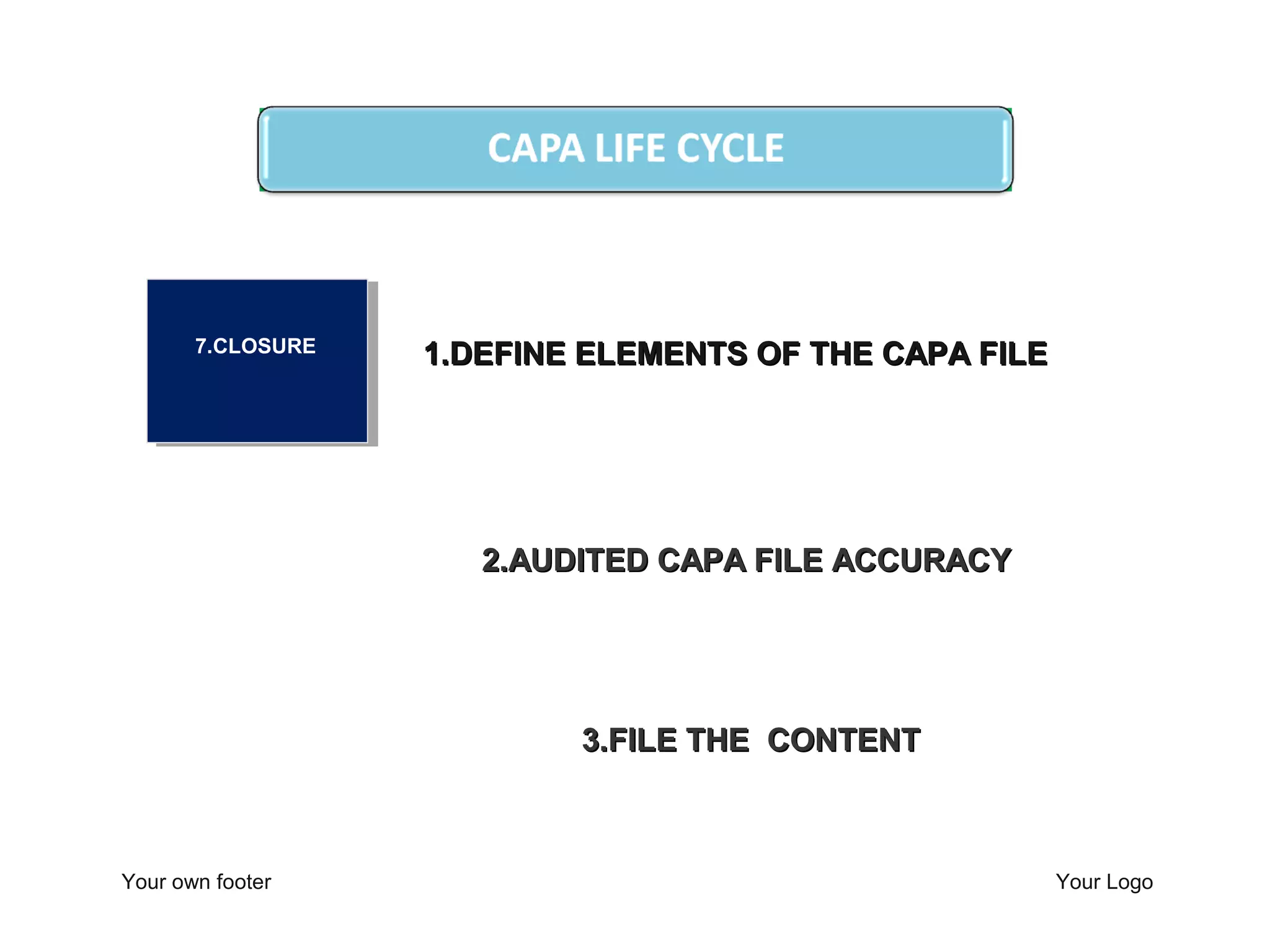
1.DEFINE ELEMENTS OF THE CAPA FILE1.DEFINE ELEMENTS OF THE CAPA FILE
22.AUDITED CAPA FILE ACCURACY2.AUDITED CAPA FILE ACCURACY
3.3.FILE THE CONTENT3.FILE THE CONTENT
6.CLOSURE
5.MONITOR FOR
EFFECTIVENESS
7.CLOSURE
1.A DEFINED CRITERIA
FOR ESCALATION
2.22.DEFINED COMPOSITION OF THE
CAPA REVIEW BOARD
3.DEFINED FREQUENCY
6.CLOSU
RE
5.MONIT
OR FOR
EFFECTI
VENESS
ESCALATI
ON

Corrective and Preventive action (CAPA)

  • 1.
    Training Program onTrainingProgram on CORRECTIVE ACTIONCORRECTIVE ACTION ANDAND PREVENTIVE ACTIONPREVENTIVE ACTION
  • 2.
    THE QUALITY SYSTEM 11 Hassix subsystems held together by management controls Quality System 1. It is interactive 2. Monitored through Management review MANAGEMENT CONTROLS 3 To produce products and services that meet requirements of your internal and external customers PURPOSE OF YOUR QUALITY SYSTEM 2
  • 3.
    THE QUALITY SYSTEMTHEQUALITY SYSTEM
  • 4.
    THE QUALITY SYSTEMTHEQUALITY SYSTEM • Each subsystem has a defined function • CAPA is one of the subsystems • The function of a CAPA system is to improve product and processes in the Quality system • CAPA is a continuous improvement Quality subsystem • CAPA is Facts and data driven: risk assessment and impact assessment.
  • 5.
    THE QUALITY SYSTEMTHEQUALITY SYSTEM
  • 6.
    THE ROLE OFCAPA WHAT IS THE ROLE OF CAPA IN THE QUALITY SYSTEM ?
  • 7.
    THE ROLE OFCAPA IN THE QUALITY SYSTEM CAPA defined: • CAPA is an acronym for CCORRECTIVE AACTION and PPREVENTIVE AACTION
  • 8.
    tPPreventive Action: •Action takento prevent occurrence of a nonconformance. Action taken before the fact PREVENTIVE LOOP: PA CCorrective AAction: •Action taken to Prevent recurrence of a nonconformance. Action taken after the fact CORRECTIVE LOOP: CA 211 THE ROLE OF CAPA IN THE QUALITY SYSTEM (Cont.)THE ROLE OF CAPA IN THE QUALITY SYSTEM (Cont.)
  • 9.
    THE ROLE OFCAPA IN THE QUALITY SYSTEM (Cont.)THE ROLE OF CAPA IN THE QUALITY SYSTEM (Cont.) CAPA SYSTEMCAPA SYSTEM PREVENTIVE LOOP AND CORRECTIVE LOOPPREVENTIVE LOOP AND CORRECTIVE LOOP
  • 10.
    THE ROLE OFCAPA IN THE QUALITY SYSTEMTHE ROLE OF CAPA IN THE QUALITY SYSTEM The role of a CAPA system is to continuously improve productcontinuously improve product and processesand processes in the Quality systemin the Quality system •CAPA is a continuous Quality improvement subsystem •CAPA is Facts and data driven •CAPA decision making is based on risk assessment and impact assessment •Risk assessment is performed on three levels: End-user, compliance ,and business
  • 11.
    THE ROLE OFCAPA IN THE QUALITY SYSTEMTHE ROLE OF CAPA IN THE QUALITY SYSTEM The CAPA system receives information from two Quality management loops: •The internal feedback-loop: Quality data from within the organization •The external feedback-loop: Quality data from outside the organization
  • 12.
  • 13.
    THE CAPA LANGUAGE Anonconformance:A nonconformance: •Not meetingNot meeting specifications, orspecifications, or requirementsrequirements
  • 14.
    THECAPA LANGUAGE: LEXICON(Cont.) A deviation:A deviation: •Not following specifiedNot following specified instructionsinstructions
  • 15.
    THE CAPA LANGUAGE:LEXICON (Cont.) Containment:Containment: •Action taken to arrest theAction taken to arrest the effects of nonconformanceeffects of nonconformance
  • 16.
    THE CAPA LANGUAGE:LEXICON (Cont.) A variance:A variance: •A one time waver toA one time waver to perform a task through aperform a task through a planned deviationplanned deviation
  • 17.
    THE CAPA LANGUAGE:LEXICON (Cont.) A Correction:A Correction: •Action taken to rework, orAction taken to rework, or repair product to meetrepair product to meet specificationsspecifications
  • 18.
    THE CAPA LANGUAGE:LEXICON (Cont.) Risk assessment:Risk assessment: •Action taken to estimateAction taken to estimate the likelihood andthe likelihood and consequence of a potentialconsequence of a potential failure, and failurefailure, and failure happening againhappening again
  • 19.
    THE CAPA LANGUAGE:LEXICON (Cont.)THE CAPA LANGUAGE: LEXICON (Cont.) Preventive loop:Preventive loop: •Information fed into theInformation fed into the CAPA system aboutCAPA system about potential (future)potential (future) nonconformitiesnonconformities
  • 20.
    THE CAPA LANGUAGE:LEXICON (Cont.) Corrective loop:Corrective loop: •Information fed into theInformation fed into the CAPA system aboutCAPA system about nonconformitiesnonconformities
  • 21.
    THE CAPA LANGUAGE:LEXICON (Cont.) Closed loop:Closed loop: •CAPA Information flowCAPA Information flow from initiation in the CAPAfrom initiation in the CAPA system to managementsystem to management review and back to thereview and back to the CAPA system for closureCAPA system for closure
  • 22.
  • 23.
    Your own footerYour Logo KNOW CAPA REQUIREMENTS: PHARMACEUTICALSKNOW CAPA REQUIREMENTS: PHARMACEUTICALS ICHQ10 :
  • 24.
    KNOW CAPA REQUIREMENTS:PHARMACEUTICALSKNOW CAPA REQUIREMENTS: PHARMACEUTICALS ICHQ10 : 1.You must have a CAPA system for product and process improvement 2.Suppliers to your CAPA should be: •The complaint system •Process reject data •Nonconformities •Deviations •Audit findings •Regulatory inspections •Adverse trends from KPIs 3.Your effort and level of investigation should be risk-based
  • 25.
    CAPA REQUIREMENTSCAPA REQUIREMENTS ICHQ10ICHQ10 Thedecision as to whether to open a CAPA or not after reviewing data from data sources is based on: •Risk assessment •Impact assessment •Trend analysis
  • 26.
    CAPA SYSTEM REQUIREMENTSCAPASYSTEM REQUIREMENTS The two Quality feedback loops feed two CAPA loops with information: •The reactive loop: After the fact (CAR) •The pro-active loop: Before the fact (PAR) CARs are initiated based on a nonconformance. PARs are initiated based on risk and adverse trends
  • 27.
    CAPA LIFE CYCLECAPALIFE CYCLE THE SEVEN PHASES
  • 28.
    THECAPA LIFECYCLE CAPA isdefinitive: •It has a beginning and it has an end •CAPA workflows in six phases •Each phase accomplishes a task
  • 29.
  • 30.
    Quality issues arediscovered through the following discovery vehicles: Internal loop: Primary inputs for this loop includes 1.Internal audit findings 2.Batch record review and batch release 3.Trend analysis / Annual product review 4.Process control indices (Yield, CCP etc) 5.Cost to quality (Re-processing, Re-working etc) 6.Quality control Test reports (OOS, Lab Deviations) 7.Calibration records 8.Equipment maintenance records 9.Facilities environment control records 10.Management review feedback 11.Risk analysis data THE CAPA LIFE CYCLETHE CAPA LIFE CYCLE 2.CONTAINMENT 1.DISCOVERY
  • 31.
    Quality issues arediscovered through the following discovery vehicles: External loop: 1.Customer complaint 2.Customer returns 3.Customer audit findings 4.Regulatory audit findings : FDA 483s, warning letters, ISO audit findings 5.Product recall 6.Supplier (Vendor) audits THE CAPA LIFE CYCLETHE CAPA LIFE CYCLE 1.DISCOVERY
  • 32.
    Your own footerYour Logo The decision on whether to open a CAPA ,or not is based on: 1.The risk assosiated with the finding: •Regulatory risk •Business risk •Risk to the end user of your product 2.An adverse trend exists THE CAPA LIFE CYCLETHE CAPA LIFE CYCLE 2.CONTAINMENT 1.DISCOVERY
  • 33.
    Your own footerYour Logo 3.Impact assessment data •Implications •Cost THE CAPA LIFE CYCLETHE CAPA LIFE CYCLE 2.CONTAINMENT DISCOVERY
  • 34.
    RISK ASSESSMENT FIVE EVALUATION LEVELS: 1.LIKELYHOOD1.LIKELYHOOD •Almostcertain •Likely •Moderate •Unlikely •Rare 2. CONSEQUENCES •Catastrophic •Major •Moderate •Minor •Insignificant TWO RISK FACTORS
  • 35.
    ASSESSMENT KEYASSESSMENT KEY RISKASSESSMENT 1.EXTREME1.EXTREME CA: NOWCA: NOW ContainmentContainment required !required ! 4.LOW TRENDABLE EVENT: MONITOR
  • 36.
    Containment reffers toarresting the implications or impact of the problem,or potential problem so it doesn’t spread The question that drive this phase are 1.What is the problem or potential problem? 2.Is it important? 3.What should we do to correct it while we look for long term solution? 4.Does it affect our mission? 5.What is the risk inolved? 6.What is its effect on product, process and quality management system? 6.CLOSURE 5.MONITOR FOR EFFECTIVENESS 2.CONTAINMENT
  • 37.
    Containment may involvethe following: 1.Stopping production 2.Recalls 3.Stop ship 4.Quarantine 5. Reprocess / Re-work The level or degree of containment taken should be appropriate to the risk possed by the problem,or potential problem. 6.CLOSURE 2.CONTAINMENT
  • 38.
    Quality system problemsand potential problems are classified in three categories: 1.Product: Specification related 2.Process 3.System • During investigation the right tool for the right job should be be used • The analysis to find the underlying cause of the problem: Root Cause analysis should be performed 6.CLOSURE 5.MONITOR FOR EFFECTIVENESS 3.INVESTIGATION
  • 39.
    Your own footerYour Logo C 1.CHOOSE BEST SOLUTION: Through validation , or verification 2.DEFINE THE CRITERIA FOR SUCCESS 3.DEVELOP IMPLEMENTATION PLAN 4. DEFINE WHAT DATA TO COLLECT AND WHEN TO COLLECT IT This is an example text. Go ahead and replace it with your own text. tThis is an example text. Go ahead and replace it with your own text. This is an example text. Go ahead and replace it with your own text. 6.CLOSURE 5.MONITOR FOR EFFECTIVENESS 4.IMPLEMENTATION
  • 40.
    1.CHOOSE STATISTICAL TOOLSFOR DATA MANIPULATION 2.DECIDE HOW YOU WANT TO PRESENT YOU’RE YOUR DATA TO EFFECTIVENESS 3.REVIEW YOUR MEASURE OF SUCCESS 4.COMPARE AND DRAFT REPORT 6.CLOSURE 5.MONITOR FOR EFFECTIVENESS 5.ASSESSMENT
  • 41.
    Your own footerYour Logo 1.DEFINE ELEMENTS OF THE CAPA FILE1.DEFINE ELEMENTS OF THE CAPA FILE 22.AUDITED CAPA FILE ACCURACY2.AUDITED CAPA FILE ACCURACY 3.3.FILE THE CONTENT3.FILE THE CONTENT 6.CLOSURE 5.MONITOR FOR EFFECTIVENESS 7.CLOSURE
  • 42.
    1.A DEFINED CRITERIA FORESCALATION 2.22.DEFINED COMPOSITION OF THE CAPA REVIEW BOARD 3.DEFINED FREQUENCY 6.CLOSU RE 5.MONIT OR FOR EFFECTI VENESS ESCALATI ON