Quality assurance
• Maintenance of a desired level of quality in a service or product,
especially by means of attention to every stage of the process of
delivery or production
• An act or process of confirming that quality standards are being met
within an organization
• Through audits and other forms of assessment, QA efforts detect and
correct problems or variances that fall outside established standards
or requirements
• Ensures a high level of quality during the development of products or
services
QA cont’d
• There are different methods of quality assurance in diverse sectors
• Fast food outlets, hospitals, hotels, schools, universities, transporters,
farms, engineering companies, all have different quality assurance
standards specific to their sector
• Several organizations/bodies have been formed to develop QA
standards for particular sectors
• International Organization for Standardization (ISO), founded in 1947,
maintains an effective quality assurance system for manufacturing
and service industries
Quality assurance and quality control
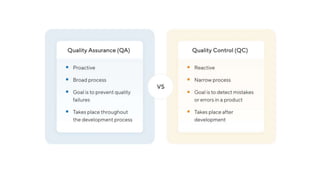
• The QA team is involved at all stages of a product’s development:
production, testing, packaging, and delivery
• In contrast, quality control focuses on detecting mistakes, errors, or
missed requirements in a product
• QA team is proactive, seeks to uncover and address the sources of
quality problems, such as human error or a business using the wrong
materials
• Whereas the QC is reactive, checking the product for mistakes or
components not built to specification
QA and QC cont’d
• QC team performs their tests after production product
• QC aims to catch errors on a finished product before it goes to the
market
• QA team works throughout the development process, making sure
each aspect of the product is on track to deliver a high-quality
customer experience
• QC is much narrower at if focusses only on the finished product
• QA is broader, looking it all process involved in the production process
Good Manufacturing Practices (GMP)
• A system that consists of processes and procedures that ensures
manufacturing products are consistently produced according to set
quality standards
• Protects both the company and consumer from defective products
• Examine and cover every aspect of the manufacturing process to
guard against any risks that can be catastrophic for products
• Quality management, sanitation and hygiene, building and facilities,
equipment, raw materials, personnel, validation and qualification,
complaints, documentation and recordkeeping, inspections and
audits
Components of GMP
Components of GMP cont’d
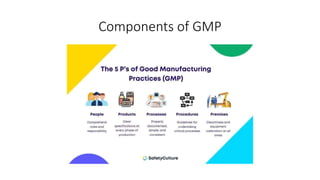
• People
• All workers should follow manufacturing processes and regulations
• Training and upgrading
• Employ competent people to boost productivity and efficiency
• Products
• All products must undergo testing before release onto the market
• Raw materials have clear specifications that are adhered to
• Standard methods for testing, packaging and labeling
Components of GMP cont’d
• Processes
• Properly documented, clear, consistent and made aware to all
employees
• Regular evaluation to make sure employees are complying
• Procedures
• A set of guidelines for undertaking a process to achieve a consistent
result
• Deviations should be reported and investigated
Components of GMP cont’d
• Premises
• Must be clean, avoid cross-contamination
• Avoid accidents, injuries and fatalities
• Proper storage facilities
• Certified anti-fire equipment
• Regularly disinfected
GMP principles
• Create Standard Operating Procedures (SOPs)
• Enforce/implement SOPs and work instructions
• Document procedures and processes
• Validate the effectiveness of SOPs
• Design and use working systems
• Maintain systems, facilities, and equipment
• Develop job competence of workers
• Prevent contamination through cleanliness
• Prioritize quality and integrate into workflow
• Conduct GMP audits regularly
Measures to uphold GMPs
• Quality team
• Skilled workers to focus on improving manufacturing procedures and
complying with GMP
• Undertake quality assessments on operations to identify problems
and develop appropriate corrective measures
• Performing scheduled monitoring of instruments, equipment,
processes, and staff skills
Measures to uphold GMPs cont’d
• Validation
• Check if instruments and processes function according to
expectations
• Process validation
• Cleaning and sanitation validation
• Computer system validation
• Analytical method validation
Measures to uphold GMPs cont’d
• Surprise Audits
• Surprise audits help to gain a more accurate and realistic insight
• Identify root causes of non-compliance
• Gather an honest, unbiased and true status
• Compliance Training
• All employees should receive training on recordkeeping, sanitation,
proper equipment handling, and labeling, and SOPs to minimize
errors and maintain compliance
GMP guidelines
• Quality management
• Sanitation and hygiene
• Buildings/premises and facilities
• Equipment
• Raw materials
• Personnel
• Validation and qualification
• Complaints
• Documentation and record-keeping
• Inspections and quality audits

Biotechnology_5.pptx

  • 1.
    Quality assurance • Maintenanceof a desired level of quality in a service or product, especially by means of attention to every stage of the process of delivery or production • An act or process of confirming that quality standards are being met within an organization • Through audits and other forms of assessment, QA efforts detect and correct problems or variances that fall outside established standards or requirements • Ensures a high level of quality during the development of products or services
  • 2.
    QA cont’d • Thereare different methods of quality assurance in diverse sectors • Fast food outlets, hospitals, hotels, schools, universities, transporters, farms, engineering companies, all have different quality assurance standards specific to their sector • Several organizations/bodies have been formed to develop QA standards for particular sectors • International Organization for Standardization (ISO), founded in 1947, maintains an effective quality assurance system for manufacturing and service industries
  • 3.
    Quality assurance andquality control • The QA team is involved at all stages of a product’s development: production, testing, packaging, and delivery • In contrast, quality control focuses on detecting mistakes, errors, or missed requirements in a product • QA team is proactive, seeks to uncover and address the sources of quality problems, such as human error or a business using the wrong materials • Whereas the QC is reactive, checking the product for mistakes or components not built to specification
  • 4.
    QA and QCcont’d • QC team performs their tests after production product • QC aims to catch errors on a finished product before it goes to the market • QA team works throughout the development process, making sure each aspect of the product is on track to deliver a high-quality customer experience • QC is much narrower at if focusses only on the finished product • QA is broader, looking it all process involved in the production process
  • 6.
    Good Manufacturing Practices(GMP) • A system that consists of processes and procedures that ensures manufacturing products are consistently produced according to set quality standards • Protects both the company and consumer from defective products • Examine and cover every aspect of the manufacturing process to guard against any risks that can be catastrophic for products • Quality management, sanitation and hygiene, building and facilities, equipment, raw materials, personnel, validation and qualification, complaints, documentation and recordkeeping, inspections and audits
  • 7.
  • 8.
    Components of GMPcont’d • People • All workers should follow manufacturing processes and regulations • Training and upgrading • Employ competent people to boost productivity and efficiency • Products • All products must undergo testing before release onto the market • Raw materials have clear specifications that are adhered to • Standard methods for testing, packaging and labeling
  • 9.
    Components of GMPcont’d • Processes • Properly documented, clear, consistent and made aware to all employees • Regular evaluation to make sure employees are complying • Procedures • A set of guidelines for undertaking a process to achieve a consistent result • Deviations should be reported and investigated
  • 10.
    Components of GMPcont’d • Premises • Must be clean, avoid cross-contamination • Avoid accidents, injuries and fatalities • Proper storage facilities • Certified anti-fire equipment • Regularly disinfected
  • 11.
    GMP principles • CreateStandard Operating Procedures (SOPs) • Enforce/implement SOPs and work instructions • Document procedures and processes • Validate the effectiveness of SOPs • Design and use working systems • Maintain systems, facilities, and equipment • Develop job competence of workers • Prevent contamination through cleanliness • Prioritize quality and integrate into workflow • Conduct GMP audits regularly
  • 12.
    Measures to upholdGMPs • Quality team • Skilled workers to focus on improving manufacturing procedures and complying with GMP • Undertake quality assessments on operations to identify problems and develop appropriate corrective measures • Performing scheduled monitoring of instruments, equipment, processes, and staff skills
  • 13.
    Measures to upholdGMPs cont’d • Validation • Check if instruments and processes function according to expectations • Process validation • Cleaning and sanitation validation • Computer system validation • Analytical method validation
  • 14.
    Measures to upholdGMPs cont’d • Surprise Audits • Surprise audits help to gain a more accurate and realistic insight • Identify root causes of non-compliance • Gather an honest, unbiased and true status • Compliance Training • All employees should receive training on recordkeeping, sanitation, proper equipment handling, and labeling, and SOPs to minimize errors and maintain compliance
  • 15.
    GMP guidelines • Qualitymanagement • Sanitation and hygiene • Buildings/premises and facilities • Equipment • Raw materials • Personnel • Validation and qualification • Complaints • Documentation and record-keeping • Inspections and quality audits