AS PER PCI REGULATIONS /B. PARM. VI
SEM./PHARMACEUTICAL QUALITY ASSURANCE
UNIT-1
QUALITY ASSURANCE &
QUALITY MANAGEMENT CONCEPTS
Presented By: VIVEK JAIN
M.Pharm. (Pharmaceutical Analysis)
Associate Professor
ADINA Institute Of Pharmaceutical Sciences, Sagar (M.P.)
EMAIL:pharmamakers2010@gmail.com Any query: 7693039009
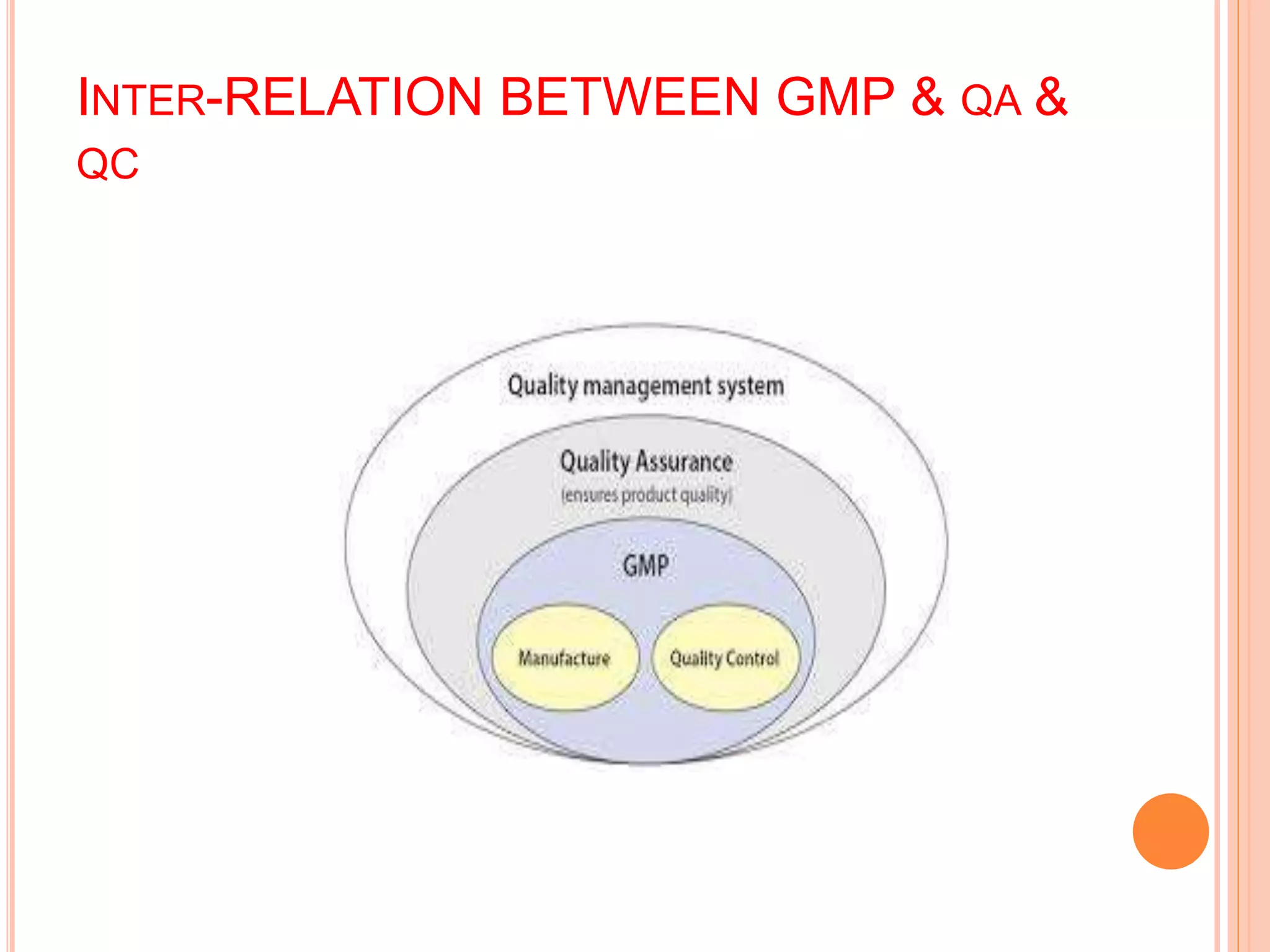
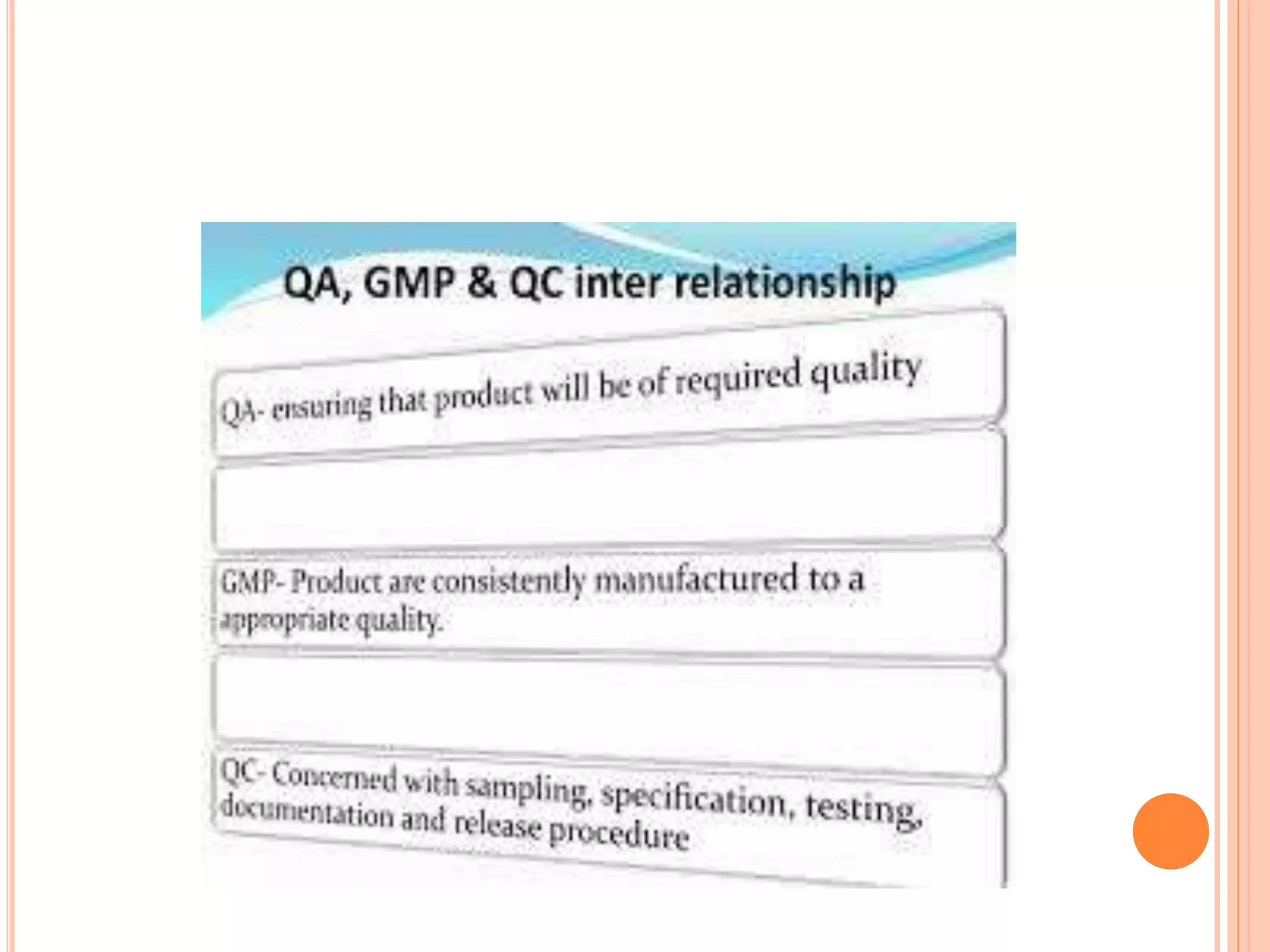
INTER-RELATION BETWEEN GMP & QA &
QC
1.QUALITY MANAGEMENT IN THE DRUG INDUSTRY
(WHO)
In the drug industry at large, quality management is
usually defined as the aspect of management function
that determines and implements the “quality policy”, i.e.
the overall intention and direction of an organization
regarding quality, as formally expressed and authorized
by top management.
The basic elements of quality management are:
 an appropriate infrastructure or “quality system”,
encompassing the organizational structure, procedures,
processes and resources;
 systematic actions necessary to ensure adequate
confidence that a product (or service) will satisfy given
requirements for quality. The totality of these actions is
termed “quality assurance”.
 Within an organization, quality assurance
serves as a management tool. In contractual
situations, quality assurance also serves to
generate confidence in the supplier.
 The concepts of quality assurance, GMP and
quality control are interrelated aspects of quality
management. They are described here in order
to emphasize their relationship and their
fundamental importance to the production and
control of pharmaceutical products.
QUALITY ASSURANCE:
DEFINITIONS
 Quality assurance is a wide-ranging concept covering all
matters that individually or collectively influence the
quality of a product. With regard to pharmaceuticals,
quality assurance can be divided into major areas:
development, quality control, production, distribution,
and inspections. (WHO)
 ISO 9000 define QA as a Part of quality management
focused on providing confidence that quality
requirements will be fulfilled.
 It is the totality of the arrangements made with the
object of ensuring that pharmaceutical products are of
the quality required for their intended use.
 Quality assurance therefore incorporates GMP and
other factors, including those outside the scope of this
guide such as product design and development.
RESPONSIBILITIES OF QA
(a) pharmaceutical products are designed and developed in a
way that takes account of the requirements of GMP and other
associated codes such as those of good laboratory practice
(GLP) and good clinical practice (GCP)
(b) production and control operations are clearly specified in a
written form and GMP requirements are adopted
(c) managerial responsibilities are clearly specified in job
descriptions
(d) arrangements are made for the manufacture, supply and
use of the correct starting and packaging materials
(e) all necessary controls on starting materials, intermediate
products, and bulk products and other in-process controls,
calibrations, and validations are carried out
(f) the finished product is correctly processed and checked,
according to the defined procedures
(g) pharmaceutical products are not sold or supplied before
the authorized persons) have certified that each production
batch has been produced and controlled in accordance with
the requirements of the marketing authorization and any
other regulations relevant to the production, control and
release of pharmaceutical products
(h) satisfactory arrangements exist to ensure, as far as
possible, that the pharmaceutical products are stored by the
manufacturer, distributed, and subsequently handled so that
quality is maintained throughout their shelf-life
(i)there is a procedure for self-inspection and/or quality
audit that regularly appraises the effectiveness and
applicability of the quality assurance system
(j) deviations are reported, investigated and recorded
(k) there is a system for approving changes that may
have an impact on product quality
(l) regular evaluations of the quality of pharmaceutical
products should be conducted with the objective of
verifying the consistency of the process and ensuring its
continuous improvement.
QUALITY CONTROL:
 A system of maintaining standards in manufactured
products by testing a sample of the output against the
specification.
 ISO 9000 defines quality control as "A part of quality
management focused on fulfilling quality requirements"
 It is that part of GMP concerned with sampling,
specification and testing, documentation and release
procedures which ensure that the necessary and
relevant tests are performed and the product is released
for use only after ascertaining it’s quality.
RESPONSIBILITIES OF QC:
 QC is responsible for day to day control of quality within
the company
 QC is responsible for analytical testing of incoming raw
materials and inspection of packaging components,
including labeling
 They conduct in-process testing when required, perform
environmental monitoring, and inspect operations for
compliance.
 They also conduct the required tests on finished dosage
form
 QC plays a major role in the selection of qualified vendors
from whom raw materials are purchased.
 The environmental areas for manufacturing of various
dosage forms are tested and inspected by QC department
DIFFERENCE BETWEEN QA AND QC
 QA is process oriented and QC is product oriented
 QA is a set of activities for ensuring quality in the
processes by which products are developed
QC is a set of activities for ensuring quality in the
products. The activities focus on identifying defects in
the actual products produced
 QA is a managerial tool while QC is a corrective tool
 QA aims to prevent defects with a focus on the process
used to make the product while QC aims to identify and
correct defects in the finished products
 QA goal of QA is to improve development and test
processes so that defects do not arise when the product
is being developed
while Goal of QC is to identify defects after a product is
developed and before it’s released
 A QA aim is to prevent the defect.
While A QC aim is to identify and improve the defects.
 QA is the technique of managing the quality.
While QC is method to verify the quality.
 QA does not involve executing the program.
WhileQC always involves executing the program.
 All team members are responsible for QA.
While Testing team is responsible for QC.
 QA e.g. Verification.
While QC e.g. Validation.
 QA means Planning for doing a process.
QC Means Action for executing the planned process.
 Statistical Technique used on QA is known as
Statistical Process Control (SPC.)
 Statistical Technique used on QC is known as
Statistical Quality Control (SPC.)
 QA makes sure you are doing the right things.
QC makes sure the results of what you’ve done are
what you expected.
 QA Defines standards and methodologies to followed in
order to meet the customer requirements.
QC ensures that the standards are followed while
working on the product.
 QA is the process to create the deliverables.
QC is the process to verify that deliverables.
 QA is responsible for full software development life
cycle.
QC is responsible for software testing life cycle.
GOOD MANUFACTURING PRACTICE (GMP)
 Good Manufacturing Practice is a part of quality
assurance which ensure that the products are
consistently produced and controlled according to quality
standards appropriate to their intended use.
 GMP – A set of principles and procedures which, when
followed by manufacturers for the therapeutic goods,
helps ensure that the products manufactured will have
the required quality
 It is designed to minimize the risks involved in any
pharmaceutical production that cannot be eliminated
through testing the final product.
GMP COVERS:
 All aspects of production; from the starting materials,
premises and equipment to the training and personal
hygiene of staff.
 Detailed, written procedures are essential for each
process that could affect the quality of the finished
product.
 There must be systems to provide documents proof that
correct procedures are consistently followed at each
step in the manufacturing process every time a product
is made.
WHO GOOD MANUFACTURING PRACTICES FOR
PHARMACEUTICAL PRODUCTS: MAIN PRINCIPLES
 GMP is that part of quality management which ensures
that products are consistently produced and controlled
according to the quality standards appropriate to their
intended use and as required by the marketing
authorization, clinical trial authorization or product
specification. GMP is concerned with both production
and QC. GMP is aimed primarily at managing and
minimizing the risks inherent in pharmaceutical
manufacture to ensure the quality, safety and efficacy of
products.
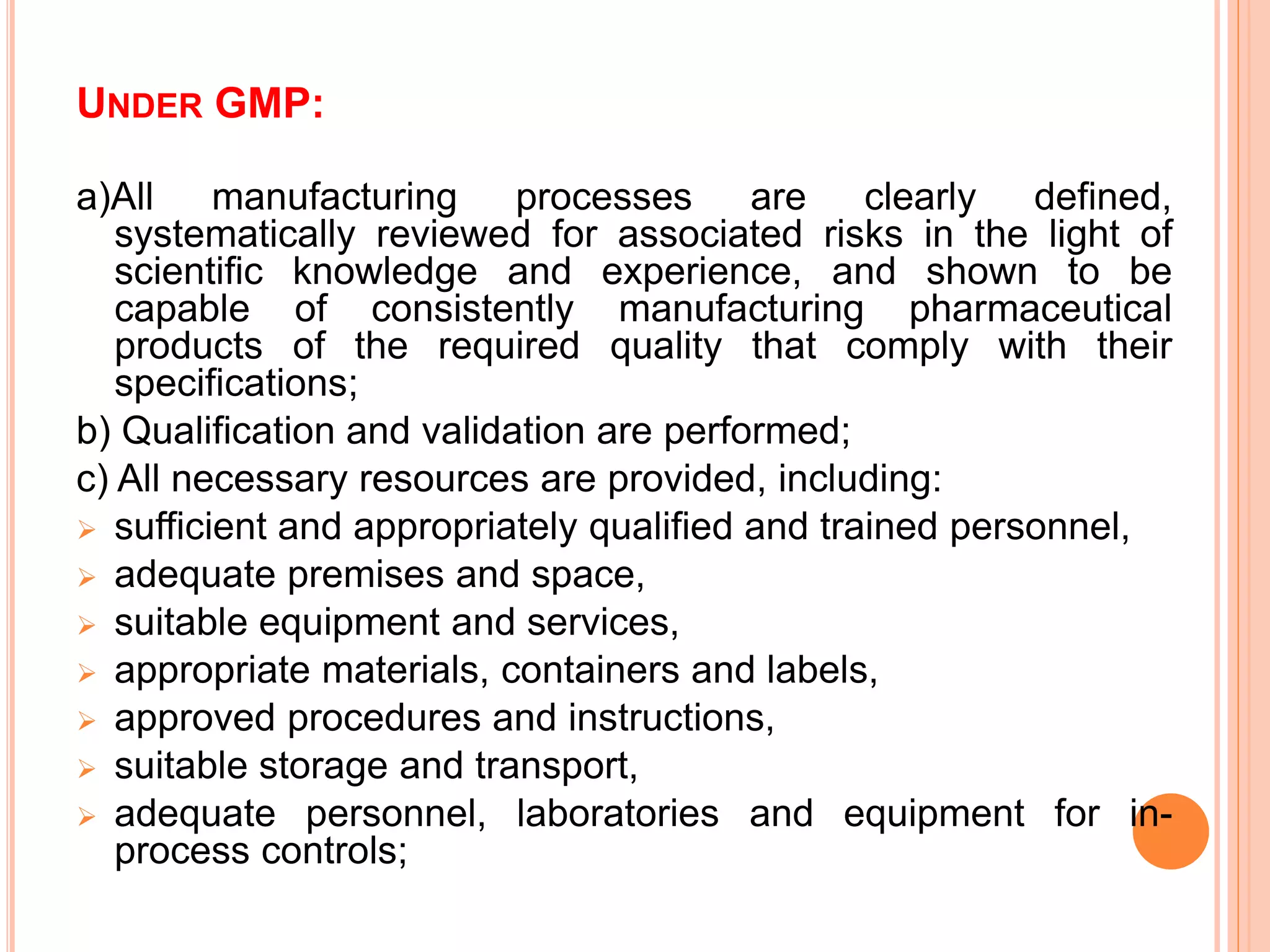
UNDER GMP:
a)All manufacturing processes are clearly defined,
systematically reviewed for associated risks in the light of
scientific knowledge and experience, and shown to be
capable of consistently manufacturing pharmaceutical
products of the required quality that comply with their
specifications;
b) Qualification and validation are performed;
c) All necessary resources are provided, including:
 sufficient and appropriately qualified and trained personnel,
 adequate premises and space,
 suitable equipment and services,
 appropriate materials, containers and labels,
 approved procedures and instructions,
 suitable storage and transport,
 adequate personnel, laboratories and equipment for in-
process controls;
d) Instructions and procedures are written in clear and unambiguous
language, specifically applicable to the facilities provided;
e) Procedures are carried out correctly and personnel are trained to do
so;
f) Records are made (manually and/or by recording instruments) during
manufacture to show that all the steps required by the defined
procedures and instructions have in fact been taken and that the
quantity and quality of the product are as expected. Any significant
deviations are fully recorded and investigated with the objective of
determining the root cause and appropriate corrective and preventive
action is implemented;
g) Records covering manufacture and distribution, which enable the
complete history of a batch to be traced, are retained in a
comprehensible and accessible form;
h) The proper storage and distribution of the products minimizes any
risk to their quality and takes account of good distribution
practices (GDP);
i) A system is available to recall any batch of product from sale or supply;
j) Complaints about marketed products are examined, the causes of
quality defects investigated and appropriate measures taken in
respect of the defective products to prevent recurrence.
LISTS OF IMPORTANT DOCUMENTS IN GMP
 Policies
 Standard operating procedures SOP
 Specifications
 Master formula records MFR
 Batch manufacturing record BMR
 Manuals
 Master plans/Files
 Validation protocols
 Forms and formats
 Records
THANK YOU

Quality Assurance and Quality Management Concepts

  • 1.
    AS PER PCIREGULATIONS /B. PARM. VI SEM./PHARMACEUTICAL QUALITY ASSURANCE UNIT-1 QUALITY ASSURANCE & QUALITY MANAGEMENT CONCEPTS Presented By: VIVEK JAIN M.Pharm. (Pharmaceutical Analysis) Associate Professor ADINA Institute Of Pharmaceutical Sciences, Sagar (M.P.) EMAIL:pharmamakers2010@gmail.com Any query: 7693039009
  • 2.
  • 4.
    1.QUALITY MANAGEMENT INTHE DRUG INDUSTRY (WHO) In the drug industry at large, quality management is usually defined as the aspect of management function that determines and implements the “quality policy”, i.e. the overall intention and direction of an organization regarding quality, as formally expressed and authorized by top management. The basic elements of quality management are:  an appropriate infrastructure or “quality system”, encompassing the organizational structure, procedures, processes and resources;  systematic actions necessary to ensure adequate confidence that a product (or service) will satisfy given requirements for quality. The totality of these actions is termed “quality assurance”.
  • 5.
     Within anorganization, quality assurance serves as a management tool. In contractual situations, quality assurance also serves to generate confidence in the supplier.  The concepts of quality assurance, GMP and quality control are interrelated aspects of quality management. They are described here in order to emphasize their relationship and their fundamental importance to the production and control of pharmaceutical products.
  • 6.
    QUALITY ASSURANCE: DEFINITIONS  Qualityassurance is a wide-ranging concept covering all matters that individually or collectively influence the quality of a product. With regard to pharmaceuticals, quality assurance can be divided into major areas: development, quality control, production, distribution, and inspections. (WHO)  ISO 9000 define QA as a Part of quality management focused on providing confidence that quality requirements will be fulfilled.  It is the totality of the arrangements made with the object of ensuring that pharmaceutical products are of the quality required for their intended use.  Quality assurance therefore incorporates GMP and other factors, including those outside the scope of this guide such as product design and development.
  • 7.
    RESPONSIBILITIES OF QA (a)pharmaceutical products are designed and developed in a way that takes account of the requirements of GMP and other associated codes such as those of good laboratory practice (GLP) and good clinical practice (GCP) (b) production and control operations are clearly specified in a written form and GMP requirements are adopted (c) managerial responsibilities are clearly specified in job descriptions (d) arrangements are made for the manufacture, supply and use of the correct starting and packaging materials (e) all necessary controls on starting materials, intermediate products, and bulk products and other in-process controls, calibrations, and validations are carried out
  • 8.
    (f) the finishedproduct is correctly processed and checked, according to the defined procedures (g) pharmaceutical products are not sold or supplied before the authorized persons) have certified that each production batch has been produced and controlled in accordance with the requirements of the marketing authorization and any other regulations relevant to the production, control and release of pharmaceutical products (h) satisfactory arrangements exist to ensure, as far as possible, that the pharmaceutical products are stored by the manufacturer, distributed, and subsequently handled so that quality is maintained throughout their shelf-life
  • 9.
    (i)there is aprocedure for self-inspection and/or quality audit that regularly appraises the effectiveness and applicability of the quality assurance system (j) deviations are reported, investigated and recorded (k) there is a system for approving changes that may have an impact on product quality (l) regular evaluations of the quality of pharmaceutical products should be conducted with the objective of verifying the consistency of the process and ensuring its continuous improvement.
  • 10.
    QUALITY CONTROL:  Asystem of maintaining standards in manufactured products by testing a sample of the output against the specification.  ISO 9000 defines quality control as "A part of quality management focused on fulfilling quality requirements"  It is that part of GMP concerned with sampling, specification and testing, documentation and release procedures which ensure that the necessary and relevant tests are performed and the product is released for use only after ascertaining it’s quality.
  • 11.
    RESPONSIBILITIES OF QC: QC is responsible for day to day control of quality within the company  QC is responsible for analytical testing of incoming raw materials and inspection of packaging components, including labeling  They conduct in-process testing when required, perform environmental monitoring, and inspect operations for compliance.  They also conduct the required tests on finished dosage form  QC plays a major role in the selection of qualified vendors from whom raw materials are purchased.  The environmental areas for manufacturing of various dosage forms are tested and inspected by QC department
  • 12.
    DIFFERENCE BETWEEN QAAND QC  QA is process oriented and QC is product oriented  QA is a set of activities for ensuring quality in the processes by which products are developed QC is a set of activities for ensuring quality in the products. The activities focus on identifying defects in the actual products produced  QA is a managerial tool while QC is a corrective tool  QA aims to prevent defects with a focus on the process used to make the product while QC aims to identify and correct defects in the finished products  QA goal of QA is to improve development and test processes so that defects do not arise when the product is being developed while Goal of QC is to identify defects after a product is developed and before it’s released
  • 13.
     A QAaim is to prevent the defect. While A QC aim is to identify and improve the defects.  QA is the technique of managing the quality. While QC is method to verify the quality.  QA does not involve executing the program. WhileQC always involves executing the program.  All team members are responsible for QA. While Testing team is responsible for QC.  QA e.g. Verification. While QC e.g. Validation.  QA means Planning for doing a process. QC Means Action for executing the planned process.  Statistical Technique used on QA is known as Statistical Process Control (SPC.)
  • 14.
     Statistical Techniqueused on QC is known as Statistical Quality Control (SPC.)  QA makes sure you are doing the right things. QC makes sure the results of what you’ve done are what you expected.  QA Defines standards and methodologies to followed in order to meet the customer requirements. QC ensures that the standards are followed while working on the product.  QA is the process to create the deliverables. QC is the process to verify that deliverables.  QA is responsible for full software development life cycle. QC is responsible for software testing life cycle.
  • 15.
    GOOD MANUFACTURING PRACTICE(GMP)  Good Manufacturing Practice is a part of quality assurance which ensure that the products are consistently produced and controlled according to quality standards appropriate to their intended use.  GMP – A set of principles and procedures which, when followed by manufacturers for the therapeutic goods, helps ensure that the products manufactured will have the required quality  It is designed to minimize the risks involved in any pharmaceutical production that cannot be eliminated through testing the final product.
  • 16.
    GMP COVERS:  Allaspects of production; from the starting materials, premises and equipment to the training and personal hygiene of staff.  Detailed, written procedures are essential for each process that could affect the quality of the finished product.  There must be systems to provide documents proof that correct procedures are consistently followed at each step in the manufacturing process every time a product is made.
  • 17.
    WHO GOOD MANUFACTURINGPRACTICES FOR PHARMACEUTICAL PRODUCTS: MAIN PRINCIPLES  GMP is that part of quality management which ensures that products are consistently produced and controlled according to the quality standards appropriate to their intended use and as required by the marketing authorization, clinical trial authorization or product specification. GMP is concerned with both production and QC. GMP is aimed primarily at managing and minimizing the risks inherent in pharmaceutical manufacture to ensure the quality, safety and efficacy of products.
  • 18.
    UNDER GMP: a)All manufacturingprocesses are clearly defined, systematically reviewed for associated risks in the light of scientific knowledge and experience, and shown to be capable of consistently manufacturing pharmaceutical products of the required quality that comply with their specifications; b) Qualification and validation are performed; c) All necessary resources are provided, including:  sufficient and appropriately qualified and trained personnel,  adequate premises and space,  suitable equipment and services,  appropriate materials, containers and labels,  approved procedures and instructions,  suitable storage and transport,  adequate personnel, laboratories and equipment for in- process controls;
  • 19.
    d) Instructions andprocedures are written in clear and unambiguous language, specifically applicable to the facilities provided; e) Procedures are carried out correctly and personnel are trained to do so; f) Records are made (manually and/or by recording instruments) during manufacture to show that all the steps required by the defined procedures and instructions have in fact been taken and that the quantity and quality of the product are as expected. Any significant deviations are fully recorded and investigated with the objective of determining the root cause and appropriate corrective and preventive action is implemented; g) Records covering manufacture and distribution, which enable the complete history of a batch to be traced, are retained in a comprehensible and accessible form; h) The proper storage and distribution of the products minimizes any risk to their quality and takes account of good distribution practices (GDP); i) A system is available to recall any batch of product from sale or supply; j) Complaints about marketed products are examined, the causes of quality defects investigated and appropriate measures taken in respect of the defective products to prevent recurrence.
  • 20.
    LISTS OF IMPORTANTDOCUMENTS IN GMP  Policies  Standard operating procedures SOP  Specifications  Master formula records MFR  Batch manufacturing record BMR  Manuals  Master plans/Files  Validation protocols  Forms and formats  Records
  • 21.