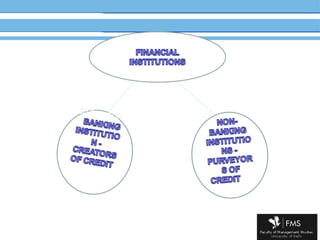
Development Financial Institutions Presented to: Prof. K. K. Jindal, MFI
Group Members Ankur Konwar, N-12 Chirag Sapra, N-18 Kavita Sharma, N-33 Mayank Jain, N-41 Mukesh Kumar, N-43 Vijay Kumar Gupta, N-80
 
 
Development financing Risky business Involves financing of industrial and infrastructure projects Long gestation period Repayment of the long term project loans  depends on performance of the project and  cash flows arising from it
Reasons for project going wrong Technological obsolescence Market competition Change of Government policies Natural calamities Poor management skills Poor infrastructure
Averseness of markets and banking institutions  Uncertain outcome Do not possess enough information and skills to predict with any certainty the outcome.  Cost considerations associated with such risky ventures.  The long term loan comes with a higher price tag. Renders the project financially unviable.
DFIs were established with the Government support for underwriting their losses Making available low cost resources for lending At a lower rate of interest than that demanded by the market for risky projects. worked well in the initial years of development
Financial system moved higher on the learning curve and acquired information and skills necessary for appraisal of long term projects.  It also developed appetite for risk associated with such projects.
Banks and bond markets became sophisticated in risk management techniques They wanted a piece of the pie in the long term project financing Distinct advantages over the traditional DFIs such as low cost of funds And benefit of diversification of loan portfolios
Government support to DFIs waning For fiscal reasons or  In favour of building market efficiency. Following the recommendations of the Narasimham Committee II,  the Reserve Bank’s annual policy statement of April, 2000 suggested that any DFI intending to transform into a bank, could approach RBI or convert itself into an NBFC.
Definition A DFI is defined as "an institution promoted or assisted by Government mainly to provide development finance to one or more sectors or sub-sectors of the economy. The institution distinguishes itself by a judicious balance as between commercial norms of operation, as adopted by any private financial institution  and developmental obligations .” An efficient and robust financial system acts as a powerful engine of economic development by mobilizing resources and allocating the same to their productive uses. It reduces the transaction cost of the economy through provision of an efficient payment mechanism, helps in pooling of risks and making available long-term capital through maturity transformation. By making funds available for entrepreneurial activity and through its impact on economic efficiency and growth, a well functioning financial sector also helps alleviate poverty both directly and indirectly.
DFIs in India The first government sponsored DFI was created in Netherlands in 1822. The first DFI established in India in 1948 was Industrial Finance Corporation of India (IFCI) followed by setting up of State Financial Corporations (SFCs) at the State level after passing of the SFCs Act, 1951. Financial Institutions set up between 1948 and 1974: ICICI Ltd. was set up in 1955,  LIC in 1956,  Refinance Corporation for Industries Ltd. in 1958 (later taken over by IDBI), Agriculture Refinance Corporation (precursor of ARDC and NABARD) in 1963, UTI and IDBI in 1964,
DFIs in India Contd… Rural Electrification Corporation Ltd. and  HUDCO Ltd. in 1969-70, Industrial Reconstruction Corporation of India Ltd. (precursor of IIBI Ltd.) in 1971 and GIC in 1972  Note:-It may be noted here that although the powers to regulate financial institutions had been made available to RBI in 1964 under the newly inserted Chapter IIIB of RBI Act, the definition of term ‘financial institution’ was made precise and comprehensive by amendment to the RBI Act Section 45-I (c) in 1974.
DFIs set up after 1974 and Notification of certain institutions as Public Financial Institutions Another important change that took place in 1974 was the insertion of Section 4A to the Companies Act, 1956 NABARD was set up in 1981,  EXIM Bank (functions carved out of IDBI) in 1982, SCICI Ltd. in 1986 (set up by ICICI Ltd. in 1986 and later merged into ICICI Ltd. in 1997), PFC Ltd. and IRFC Ltd. In 1986,  IREDA Ltd. in 1987,
DFIs set up after 1974 and Notification of certain institutions as Public Financial Institutions Contd. RCTC Ltd. and TDICI Ltd. (later known as IFCI Venture Capital Funds Ltd. and ICICI Venture Funds Management Ltd.) in 1988, NHB in 1988, TFCI Ltd. (set up by IFCI) in 1989, SIDBI (functions carved out of IDBI) in 1989, NEDFi Ltd. in 1995 and IDFC Ltd. in 1997.
Categories of DFIs DFIs can be broadly categorised as all-India or state / regional level institutions depending on their geographical coverage of operation.  Functionally, all-India institutions can be classified as  (i) term-lending institutions (IFCI Ltd., IDBI, IDFC Ltd., IIBI Ltd.) extending long-term finance to different industrial sectors, (ii) refinancing institutions (NABARD, SIDBI, NHB) While most of them extend direct finance, some extend indirect finance and are mainly refinancing institutions viz., SIDBI, NABARD and NHB which also have a regulatory / supervisory role.
Categories of DFIs Contd… Section 4(A), which was inserted in the Companies Act in 1974, defines the term Public Finance Institution (PFI). Besides certain FIs regarded in terms of the said Section as PFIs, Central Government by notification in the official Gazette may notify other institutions as PFIs. As on date there are 46 PFIs which have been so notified by the Central Government.
Identification of DFIs (i) ICICI Ltd. and SCICI Ltd.: After merger of the latter with it, ICICI Ltd has since converted to a bank. (ii) UTI, which is regulated by SEBI. (iii) LIC, GIC and other insurance companies viz., NIA, NIC, OIC and UII, which are regulated by IRDA. (iv) The two Venture Capital Funds viz., IFCI Venture Capital Funds Ltd. and ICICI Venture Funds Management Co. Ltd., which need not be regulated by RBI as DFIs as size wise they are too small to be of systemic significance.
Identification of DFIs Contd.. (v) HUDCO Ltd., which, being a housing finance company, is being regulated by NHB. (vi) National Co-operative Development Corporation and National Dairy Development Board recently notified by GOI as PFIs: they do not appear to be financial institutions in the classical mould. The first category is the all India DFIs established by statute viz., NHB, SIDBI, NABARD and EXIM Bank. The second is the state level institutions set up by statute viz., SFCs. The third is the DFIs that have been constituted as companies under the Companies Act, 1956 and hence are, by definition.
Infrastructure Development Finance  Company Ltd. (IDFC) Vision To build a diversified portfolio of viable infrastructure projects of  national importance and to imbue the projects with best practices in development, management, design, construction and operation while maintaining the highest regard for service, safety and environment.
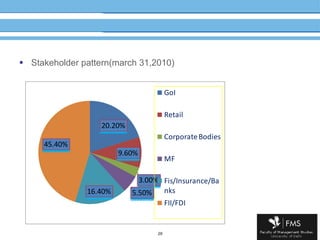
History (1997-2009) 1997 IDFC was founded on the recommendations of the 'Expert Group on Commercialization of Infrastructure Projects' under the Chairmanship of Dr. Rakesh Mohan. IDFC, a Public Private Partnership, incorporated in Chennai. Government holds 40% of the company, 40% is held by foreign shareholders and the rest by domestic entities. IDFC commences business operations with a mission to lead private capital to commercially viable infrastructure projects.
2004   IDFC successfully raises $200 million for the India Development Fund, the first infrastructure  focused private equity fund. 2005 IDFC goes public through a successful public offering that is oversubscribed 38 times. Shares issued at Rs. 34 a share. Lists on the National and Bombay Stock Exchanges. Government shareholding reduces from 40% to 26%.
2006  IDFC successfully raises $450 million for its second infrastructure focused private equity fund . Acquired controlling stake in SSKI ♦  IDFC successfully raises $930 million India Infrastructure Fund (IDFC Project Equity) 2007 IDFC raises additional capital of USD 500 million through a Qualified Institutional Placement at Rs. 127 a share. Government shareholding reduces to 23%.
2008 Acquired controlling stake in SSKI IDFC successfully raises $930 million India Infrastructure Fund (IDFC Project Equity) IDFC successfully raises $700 million for its third infrastructure focused private equity fund . IDFC enters into asset management by acquiring the AMC business of Standard Chartered Bank in India. 2009 IDFC becomes part of Nifty 50. CMP is 143.
Goals Investment:   USD 1 bn in 5 years. Forging Partnerships:  National and international developers, contractors and operators. Values Fairness Integrity Trust Professionalism
Strategic Directions Leverage core strengths Develop large and complex projects Build partnerships Enhance in-house expertise Establish credibility
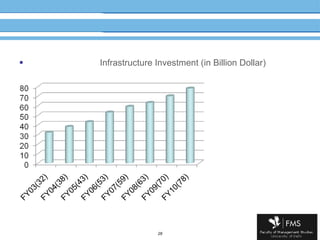
Infrastructure Investment (in Billion Dollar)
Stakeholder pattern(march 31,2010)
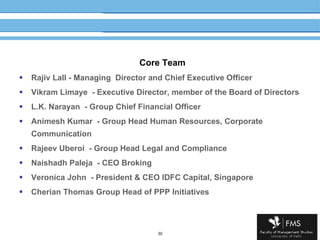
Core Team Rajiv Lall - Managing  Director and Chief Executive Officer Vikram Limaye  - Executive Director, member of the Board of Directors L.K. Narayan  - Group Chief Financial Officer Animesh Kumar  - Group Head Human Resources, Corporate Communication Rajeev Uberoi  - Group Head Legal and Compliance Naishadh Paleja  - CEO Broking Veronica John  - President & CEO IDFC Capital, Singapore Cherian Thomas Group Head of PPP Initiatives
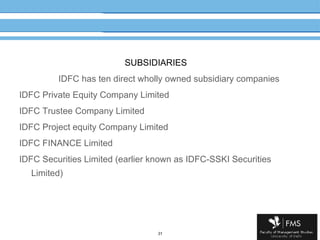
SUBSIDIARIES IDFC has ten direct wholly owned subsidiary companies IDFC Private Equity Company Limited IDFC Trustee Company Limited IDFC Project equity Company Limited IDFC FINANCE Limited IDFC Securities Limited (earlier known as IDFC-SSKI Securities Limited)
IDFC Capital company Limited IDFC PPP Trusteeship Company Limited IDFC Projects Limited IDFC Asset Management Company Limited IDFC AMC Trustee Company Limited
JOINT VENTURES IDFC has three joint ventures : Infrastructure Development Corporation(Karnataka Limited) (iDeC) in the state of Uttaranchal. Delhi integrated Multi Modal Transit System Limited (DIMTS) in Delhi.
Partnership PLUS Expressways Berhard Indian Renewable Energy Development Agency Ltd. (IREDA) Gujarat Urban Development Corporation (GUDC) DP World
Sectors of Operations Infrastructure Development Power Transport Real State Water
New sectors Opportunity   Exploration of four new frontiers Urban services, Rural Infrastructure, HealthCare and Education.
IFCI
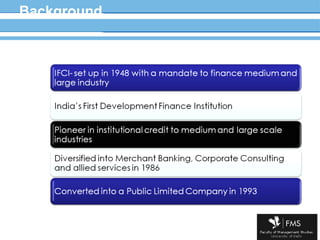
Background
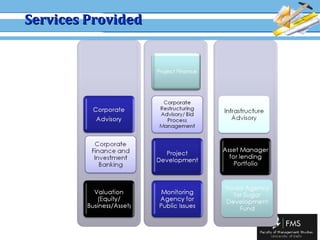
Services Provided
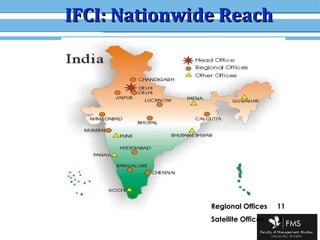
Regional Offices  11 Satellite Offices   6 IFCI: Nationwide Reach
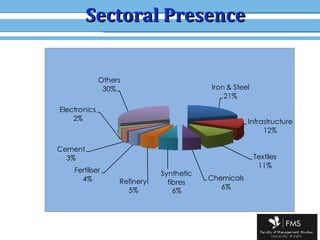
Sectoral Presence
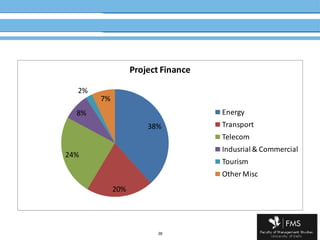
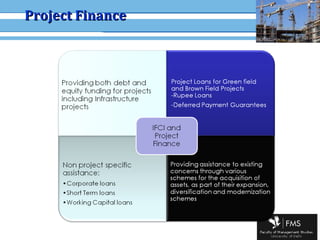
Project Finance
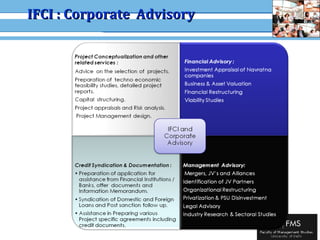
IFCI : Corporate  Advisory
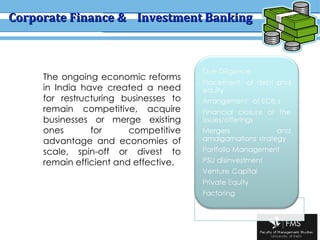
Corporate Finance &  Investment Banking The ongoing economic reforms in India have created a need for restructuring businesses to remain competitive, acquire businesses or merge existing ones for competitive advantage and economies of scale, spin-off or divest to remain efficient and effective.
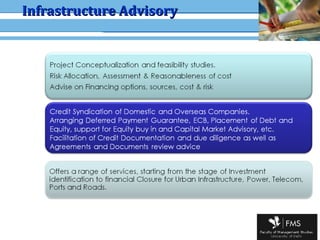
Infrastructure Advisory
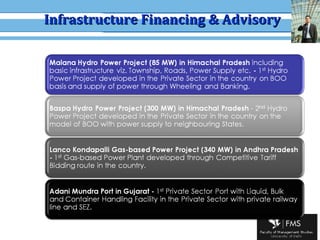
Infrastructure Financing & Advisory
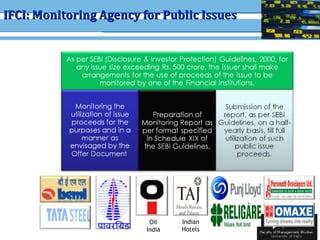
IFCI: Monitoring Agency for Public Issues Oil India Indian Hotels
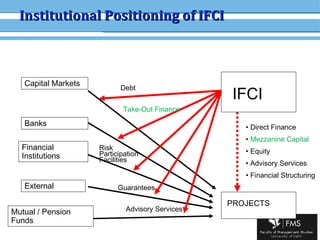
Institutional Positioning of IFCI Debt Take-Out Finance Risk Participation Facilities Guarantees Advisory Services PROJECTS Banks Financial Institutions External Mutual / Pension Funds IFCI Capital Markets Direct Finance Mezzanine Capital Equity Advisory Services Financial Structuring
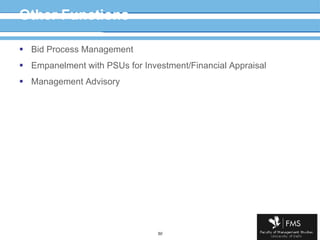
Other Functions Bid Process Management Empanelment with PSUs for Investment/Financial Appraisal Management Advisory

Mfi dfi

  • 1.
    Development Financial InstitutionsPresented to: Prof. K. K. Jindal, MFI
  • 2.
    Group Members AnkurKonwar, N-12 Chirag Sapra, N-18 Kavita Sharma, N-33 Mayank Jain, N-41 Mukesh Kumar, N-43 Vijay Kumar Gupta, N-80
  • 3.
  • 4.
  • 5.
    Development financing Riskybusiness Involves financing of industrial and infrastructure projects Long gestation period Repayment of the long term project loans depends on performance of the project and cash flows arising from it
  • 6.
    Reasons for projectgoing wrong Technological obsolescence Market competition Change of Government policies Natural calamities Poor management skills Poor infrastructure
  • 7.
    Averseness of marketsand banking institutions Uncertain outcome Do not possess enough information and skills to predict with any certainty the outcome. Cost considerations associated with such risky ventures. The long term loan comes with a higher price tag. Renders the project financially unviable.
  • 8.
    DFIs were establishedwith the Government support for underwriting their losses Making available low cost resources for lending At a lower rate of interest than that demanded by the market for risky projects. worked well in the initial years of development
  • 9.
    Financial system movedhigher on the learning curve and acquired information and skills necessary for appraisal of long term projects. It also developed appetite for risk associated with such projects.
  • 10.
    Banks and bondmarkets became sophisticated in risk management techniques They wanted a piece of the pie in the long term project financing Distinct advantages over the traditional DFIs such as low cost of funds And benefit of diversification of loan portfolios
  • 11.
    Government support toDFIs waning For fiscal reasons or In favour of building market efficiency. Following the recommendations of the Narasimham Committee II, the Reserve Bank’s annual policy statement of April, 2000 suggested that any DFI intending to transform into a bank, could approach RBI or convert itself into an NBFC.
  • 12.
    Definition A DFIis defined as "an institution promoted or assisted by Government mainly to provide development finance to one or more sectors or sub-sectors of the economy. The institution distinguishes itself by a judicious balance as between commercial norms of operation, as adopted by any private financial institution and developmental obligations .” An efficient and robust financial system acts as a powerful engine of economic development by mobilizing resources and allocating the same to their productive uses. It reduces the transaction cost of the economy through provision of an efficient payment mechanism, helps in pooling of risks and making available long-term capital through maturity transformation. By making funds available for entrepreneurial activity and through its impact on economic efficiency and growth, a well functioning financial sector also helps alleviate poverty both directly and indirectly.
  • 13.
    DFIs in IndiaThe first government sponsored DFI was created in Netherlands in 1822. The first DFI established in India in 1948 was Industrial Finance Corporation of India (IFCI) followed by setting up of State Financial Corporations (SFCs) at the State level after passing of the SFCs Act, 1951. Financial Institutions set up between 1948 and 1974: ICICI Ltd. was set up in 1955, LIC in 1956, Refinance Corporation for Industries Ltd. in 1958 (later taken over by IDBI), Agriculture Refinance Corporation (precursor of ARDC and NABARD) in 1963, UTI and IDBI in 1964,
  • 14.
    DFIs in IndiaContd… Rural Electrification Corporation Ltd. and HUDCO Ltd. in 1969-70, Industrial Reconstruction Corporation of India Ltd. (precursor of IIBI Ltd.) in 1971 and GIC in 1972 Note:-It may be noted here that although the powers to regulate financial institutions had been made available to RBI in 1964 under the newly inserted Chapter IIIB of RBI Act, the definition of term ‘financial institution’ was made precise and comprehensive by amendment to the RBI Act Section 45-I (c) in 1974.
  • 15.
    DFIs set upafter 1974 and Notification of certain institutions as Public Financial Institutions Another important change that took place in 1974 was the insertion of Section 4A to the Companies Act, 1956 NABARD was set up in 1981, EXIM Bank (functions carved out of IDBI) in 1982, SCICI Ltd. in 1986 (set up by ICICI Ltd. in 1986 and later merged into ICICI Ltd. in 1997), PFC Ltd. and IRFC Ltd. In 1986, IREDA Ltd. in 1987,
  • 16.
    DFIs set upafter 1974 and Notification of certain institutions as Public Financial Institutions Contd. RCTC Ltd. and TDICI Ltd. (later known as IFCI Venture Capital Funds Ltd. and ICICI Venture Funds Management Ltd.) in 1988, NHB in 1988, TFCI Ltd. (set up by IFCI) in 1989, SIDBI (functions carved out of IDBI) in 1989, NEDFi Ltd. in 1995 and IDFC Ltd. in 1997.
  • 17.
    Categories of DFIsDFIs can be broadly categorised as all-India or state / regional level institutions depending on their geographical coverage of operation. Functionally, all-India institutions can be classified as (i) term-lending institutions (IFCI Ltd., IDBI, IDFC Ltd., IIBI Ltd.) extending long-term finance to different industrial sectors, (ii) refinancing institutions (NABARD, SIDBI, NHB) While most of them extend direct finance, some extend indirect finance and are mainly refinancing institutions viz., SIDBI, NABARD and NHB which also have a regulatory / supervisory role.
  • 18.
    Categories of DFIsContd… Section 4(A), which was inserted in the Companies Act in 1974, defines the term Public Finance Institution (PFI). Besides certain FIs regarded in terms of the said Section as PFIs, Central Government by notification in the official Gazette may notify other institutions as PFIs. As on date there are 46 PFIs which have been so notified by the Central Government.
  • 19.
    Identification of DFIs(i) ICICI Ltd. and SCICI Ltd.: After merger of the latter with it, ICICI Ltd has since converted to a bank. (ii) UTI, which is regulated by SEBI. (iii) LIC, GIC and other insurance companies viz., NIA, NIC, OIC and UII, which are regulated by IRDA. (iv) The two Venture Capital Funds viz., IFCI Venture Capital Funds Ltd. and ICICI Venture Funds Management Co. Ltd., which need not be regulated by RBI as DFIs as size wise they are too small to be of systemic significance.
  • 20.
    Identification of DFIsContd.. (v) HUDCO Ltd., which, being a housing finance company, is being regulated by NHB. (vi) National Co-operative Development Corporation and National Dairy Development Board recently notified by GOI as PFIs: they do not appear to be financial institutions in the classical mould. The first category is the all India DFIs established by statute viz., NHB, SIDBI, NABARD and EXIM Bank. The second is the state level institutions set up by statute viz., SFCs. The third is the DFIs that have been constituted as companies under the Companies Act, 1956 and hence are, by definition.
  • 21.
    Infrastructure Development Finance Company Ltd. (IDFC) Vision To build a diversified portfolio of viable infrastructure projects of national importance and to imbue the projects with best practices in development, management, design, construction and operation while maintaining the highest regard for service, safety and environment.
  • 22.
    History (1997-2009) 1997IDFC was founded on the recommendations of the 'Expert Group on Commercialization of Infrastructure Projects' under the Chairmanship of Dr. Rakesh Mohan. IDFC, a Public Private Partnership, incorporated in Chennai. Government holds 40% of the company, 40% is held by foreign shareholders and the rest by domestic entities. IDFC commences business operations with a mission to lead private capital to commercially viable infrastructure projects.
  • 23.
    2004 IDFC successfully raises $200 million for the India Development Fund, the first infrastructure focused private equity fund. 2005 IDFC goes public through a successful public offering that is oversubscribed 38 times. Shares issued at Rs. 34 a share. Lists on the National and Bombay Stock Exchanges. Government shareholding reduces from 40% to 26%.
  • 24.
    2006 IDFCsuccessfully raises $450 million for its second infrastructure focused private equity fund . Acquired controlling stake in SSKI ♦ IDFC successfully raises $930 million India Infrastructure Fund (IDFC Project Equity) 2007 IDFC raises additional capital of USD 500 million through a Qualified Institutional Placement at Rs. 127 a share. Government shareholding reduces to 23%.
  • 25.
    2008 Acquired controllingstake in SSKI IDFC successfully raises $930 million India Infrastructure Fund (IDFC Project Equity) IDFC successfully raises $700 million for its third infrastructure focused private equity fund . IDFC enters into asset management by acquiring the AMC business of Standard Chartered Bank in India. 2009 IDFC becomes part of Nifty 50. CMP is 143.
  • 26.
    Goals Investment: USD 1 bn in 5 years. Forging Partnerships: National and international developers, contractors and operators. Values Fairness Integrity Trust Professionalism
  • 27.
    Strategic Directions Leveragecore strengths Develop large and complex projects Build partnerships Enhance in-house expertise Establish credibility
  • 28.
  • 29.
  • 30.
    Core Team RajivLall - Managing Director and Chief Executive Officer Vikram Limaye - Executive Director, member of the Board of Directors L.K. Narayan - Group Chief Financial Officer Animesh Kumar - Group Head Human Resources, Corporate Communication Rajeev Uberoi - Group Head Legal and Compliance Naishadh Paleja - CEO Broking Veronica John - President & CEO IDFC Capital, Singapore Cherian Thomas Group Head of PPP Initiatives
  • 31.
    SUBSIDIARIES IDFC hasten direct wholly owned subsidiary companies IDFC Private Equity Company Limited IDFC Trustee Company Limited IDFC Project equity Company Limited IDFC FINANCE Limited IDFC Securities Limited (earlier known as IDFC-SSKI Securities Limited)
  • 32.
    IDFC Capital companyLimited IDFC PPP Trusteeship Company Limited IDFC Projects Limited IDFC Asset Management Company Limited IDFC AMC Trustee Company Limited
  • 33.
    JOINT VENTURES IDFChas three joint ventures : Infrastructure Development Corporation(Karnataka Limited) (iDeC) in the state of Uttaranchal. Delhi integrated Multi Modal Transit System Limited (DIMTS) in Delhi.
  • 34.
    Partnership PLUS ExpresswaysBerhard Indian Renewable Energy Development Agency Ltd. (IREDA) Gujarat Urban Development Corporation (GUDC) DP World
  • 35.
    Sectors of OperationsInfrastructure Development Power Transport Real State Water
  • 37.
    New sectors Opportunity Exploration of four new frontiers Urban services, Rural Infrastructure, HealthCare and Education.
  • 38.
  • 39.
  • 40.
  • 41.
    Regional Offices 11 Satellite Offices 6 IFCI: Nationwide Reach
  • 42.
  • 43.
  • 44.
  • 45.
    Corporate Finance & Investment Banking The ongoing economic reforms in India have created a need for restructuring businesses to remain competitive, acquire businesses or merge existing ones for competitive advantage and economies of scale, spin-off or divest to remain efficient and effective.
  • 46.
  • 47.
  • 48.
    IFCI: Monitoring Agencyfor Public Issues Oil India Indian Hotels
  • 49.
    Institutional Positioning ofIFCI Debt Take-Out Finance Risk Participation Facilities Guarantees Advisory Services PROJECTS Banks Financial Institutions External Mutual / Pension Funds IFCI Capital Markets Direct Finance Mezzanine Capital Equity Advisory Services Financial Structuring
  • 50.
    Other Functions BidProcess Management Empanelment with PSUs for Investment/Financial Appraisal Management Advisory