FINANCIAL INCLUSION Group : Bhagwan Sahay Bairwa S-13 Devender Singh Pal S-19 Dipanwita Datta S-21 Hari Kumar S-24 Pushpendra Kumar  S-42 Sravan Bagaria  S-59
“ The future lies with those companies who see the poor as their customers” ~ C.K.Prahalad The Potential of the Unreached
FINANCIAL EXCLUSION
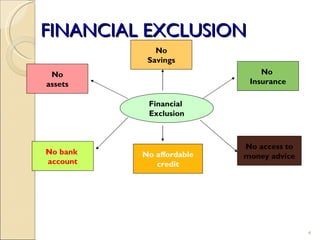
FINANCIAL EXCLUSION Financial  Exclusion No Savings No  Insurance No assets No bank  account No access to money advice No affordable credit
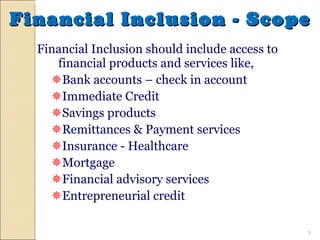
Financial Inclusion - Scope Financial Inclusion should include access to financial products and services like, Bank accounts – check in account Immediate Credit  Savings products Remittances & Payment services Insurance - Healthcare Mortgage Financial advisory services Entrepreneurial credit
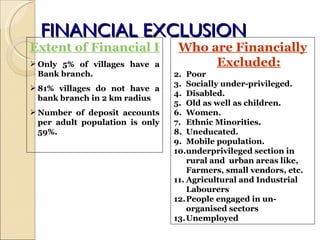
FINANCIAL EXCLUSION Extent of Financial Exclusion Only 5% of villages have a Bank branch. 81% villages do not have a bank branch in 2 km radius Number of deposit accounts per adult population is only 59%. Who are Financially Excluded: Poor Socially under-privileged. Disabled. Old as well as children. Women. Ethnic Minorities. Uneducated. Mobile population.  underprivileged section in rural and  urban areas like, Farmers, small vendors, etc. Agricultural and Industrial Labourers People engaged in un-organised sectors Unemployed
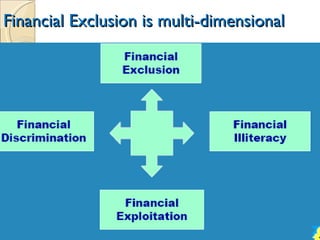
Financial Exclusion is multi-dimensional
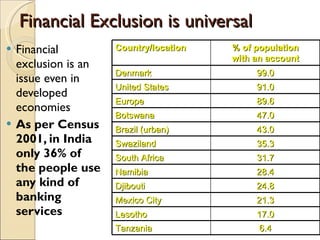
Financial Exclusion is universal Financial exclusion is an issue even in developed economies As per Census 2001, in India only 36% of the people use any kind of banking services Country/location % of population with an account Denmark 99.0 United States 91.0 Europe 89.6 Botswana 47.0 Brazil (urban) 43.0 Swaziland 35.3 South Africa 31.7 Namibia 28.4 Djibouti 24.8 Mexico City 21.3 Lesotho 17.0 Tanzania 6.4
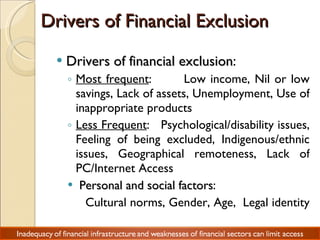
Drivers of Financial Exclusion Drivers of financial exclusion :  Most frequent :  Low income, Nil or low savings, Lack of assets, Unemployment, Use of inappropriate products Less Frequent :  Psychological/disability issues, Feeling of being excluded, Indigenous/ethnic issues, Geographical remoteness, Lack of PC/Internet Access  Personal and social factors :  Cultural norms, Gender, Age,  Legal identity
FINANCIAL INCLUSION
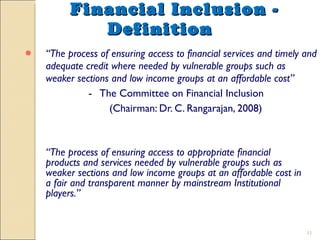
Financial Inclusion - Definition “ The process of ensuring access to financial services and timely and adequate credit where needed by vulnerable groups such as weaker sections and low income groups at an affordable cost” -  The Committee on Financial Inclusion   (Chairman: Dr. C. Rangarajan, 2008) “ The process of ensuring access to appropriate financial products and services needed by vulnerable groups such as weaker sections and low income groups at an affordable cost in a fair and transparent manner by mainstream Institutional players.”
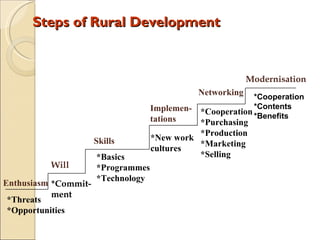
Steps of Rural Development Enthusiasm Skills Implemen- tations Networking *Threats *Opportunities *Basics *Programmes *Technology  *New work  cultures *Cooperation *Purchasing  *Production *Marketing *Selling Will *Commit- ment Modernisation *Cooperation *Contents *Benefits

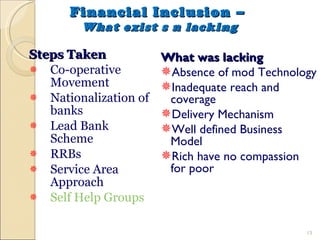
Financial Inclusion –  What exist s n lacking Steps Taken Co-operative Movement Nationalization of banks Lead Bank Scheme RRBs Service Area Approach Self Help Groups What was lacking Absence of mod Technology Inadequate reach and coverage Delivery Mechanism Well defined Business Model Rich have no compassion for poor
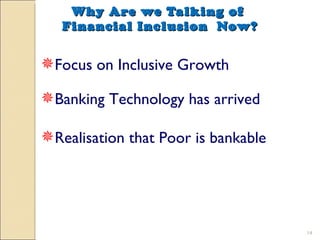
Why Are we Talking of  Financial Inclusion  Now? Focus on Inclusive Growth Banking Technology has arrived Realisation that Poor is bankable
FINANCIAL INCLUSION AND TECHNOLOGY
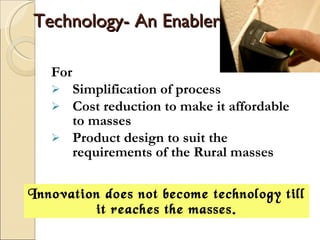
Technology- An Enabler For Simplification of process Cost reduction to make it affordable to masses Product design to suit the requirements of the Rural masses Innovation does not become technology till it reaches the masses.
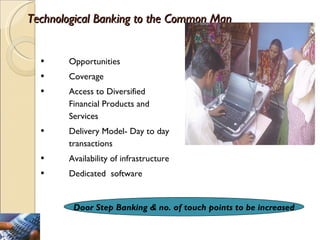
Technological Banking to the Common Man Opportunities Coverage Access to Diversified Financial Products and Services Delivery Model- Day to day transactions Availability of infrastructure Dedicated  software Door Step Banking & no. of touch points to be increased
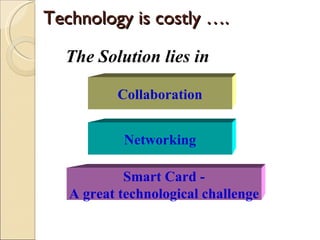
Technology is costly …. The Solution lies in Networking Smart Card - A great technological challenge Collaboration
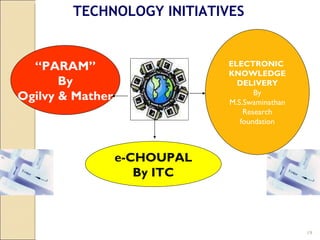
TECHNOLOGY INITIATIVES “ PARAM” By Ogilvy & Mather ELECTRONIC  KNOWLEDGE DELIVERY By M.S.Swaminathan Research foundation e-CHOUPAL By ITC
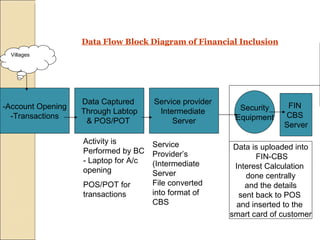
-Account Opening -Transactions Data Captured  Through Labtop & POS/POT  Service provider  Intermediate  Server Activity is Performed by BC - Laptop for A/c opening POS/POT for transactions  Security Equipment FIN  CBS  Server Service Provider’s (Intermediate Server File converted into format of CBS Data is uploaded into FIN-CBS Interest Calculation  done centrally and the details  sent back to POS  and inserted to the  smart card of customer Villages Data Flow Block Diagram of Financial Inclusion
FINANCIAL INCLUSION AND RBI
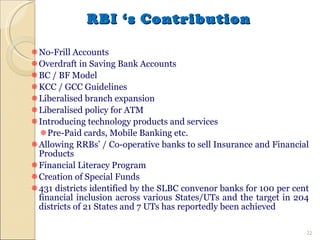
RBI ‘s Contribution No-Frill Accounts Overdraft in Saving Bank Accounts BC / BF Model KCC / GCC Guidelines Liberalised branch expansion Liberalised policy for ATM Introducing technology products and services Pre-Paid cards, Mobile Banking etc. Allowing RRBs’ / Co-operative banks to sell Insurance and Financial Products Financial Literacy Program Creation of Special Funds 431 districts identified by the SLBC convenor banks for 100 per cent financial inclusion across various States/UTs and the target in 204 districts of 21 States and 7 UTs has reportedly been achieved
PROBLEMS WITH FINANCIAL INCLUSION
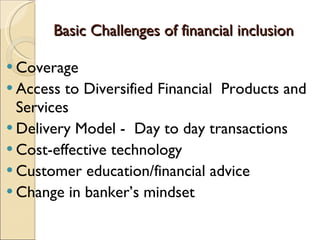
Basic Challenges of financial inclusion Coverage  Access to Diversified Financial  Products and Services  Delivery Model -  Day to day transactions  Cost-effective technology Customer education/financial advice Change in banker’s mindset
Problems / Difficulties Scaling up of activities Appropriate business model yet to evolve BC model too restrictive Limitation of cash delivery points Lack of Interest / Involvement of Big Technology Players
Problems of Financial Exclusion in India   Coverage  Cost of Small Value transaction  Infrastructure  Suitable products  Flexibility  Weak Delivery model  Community Enterprise & Financial  Management support
Pre-conditions for success Attitude and Will power  Technology  Delivery Mechanism  Support Services  Infrastructure  Community Development Support  Product Innovation  Regulatory and Policy Interventions  Involvement of all  especially Development/Administration at District/Block/Village level
Pre-requisites For The Success of Financial Inclusion Appropriate Technology Appropriate and Efficient Delivery model Mainstream banks’ determination and involvement Strong Collaboration among Banks, Technical Service Provider, BC Services  Involvement of all  Especially the state administration at grass-root level  Liberalisation of BC model
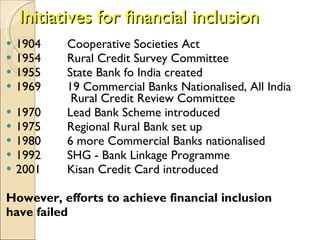
Initiatives for financial inclusion 1904  Cooperative Societies Act 1954 Rural Credit Survey Committee 1955 State Bank fo India created  1969 19 Commercial Banks Nationalised, All India   Rural Credit Review Committee 1970 Lead Bank Scheme introduced  1975 Regional Rural Bank set up 1980 6 more Commercial Banks nationalised 1992 SHG - Bank Linkage Programme 2001 Kisan Credit Card introduced However, efforts to achieve financial inclusion have failed
FINANCIAL INCLUSION AND GLOBLIZATION
Benefits of globalization  Globalization cannot be sustained unless we move towards inclusive growth Financial inclusion will lead to growth with equity This will help empowering the poor to break out of the vicious circle of poverty and live with dignity Then only globalization can be considered truly beneficial.
Globalization has changed the world economic order  New global markets in services including banking, insurance, transport Deregulated financial markets with 24 hour trading Increased cross-border Mergers & Acquisitions Global consumer markets and global consumer brands
Globalization & its discontents Although globalization has brought wider choice, free flow of trade and investment, better technology, in most developing economies, financial services are available only to a small minority More than 3 billion people world-wide are financially excluded Majority of the people in developing countries do not have any banking relationship They seldom get credit, insurance or receive remittances through formal financial institutions
Global Meltdown  - An Opportunity  Focus on Inclusive Growth Focus on Domestic Consumption and Investment Focus on increased Social Sector Spending Emphasis on giving benefits to poor clients Global (bigger) players looking Inward Reduction of Cost (?) Let us Give One Big Push to  Financial Inclusion!
CONCLUSION
CONCLUSION  Financial Inclusion is a win-win situation for the financially excluded, the Corporates, the Govt. and the Banks. Bankers can support by financing the Agri products including their preservation and sales. Corporates can sell / market their products to the large untapped rural markets.
CONCLUSION  Public-Private partnership can utilise “Common Service Centres”for enabling access to Banking Services and products including consumer loans; Micro-finance Services Farm Equipment, Home & Construction Loans Credit Cards, Debit Cards,etc., Bill Payment – Electricity, Utilities, etc.,Payment Gateway, ATMs Multi-purpose “Smart Cards” can simplify the financial inclusion process to reach the unreached.
THANK YOU
Bangladesh Gramin Bank - Microfinance Founded by Mohamed Yunus in 1974 with $27 own money Micro-lending scheme for poor in Bangladesh, mostly women In 30 years bank has 6.6m borrowers including 97% women Founder Mohamed Yunus got Nobel Peace Prize 2006
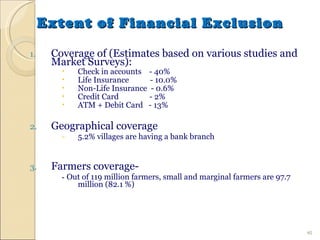
Extent of Financial Exclusion Coverage of (Estimates based on various studies and Market Surveys): Check in accounts  - 40% Life Insurance  - 10.0% Non-Life Insurance  - 0.6% Credit Card  - 2%  ATM + Debit Card  - 13%  Geographical coverage 5.2% villages are having a bank branch Farmers coverage- -  Out of 119 million farmers, small and marginal farmers are 97.7 million (82.1 %)

Financial inclusion

  • 1.
    FINANCIAL INCLUSION Group: Bhagwan Sahay Bairwa S-13 Devender Singh Pal S-19 Dipanwita Datta S-21 Hari Kumar S-24 Pushpendra Kumar S-42 Sravan Bagaria S-59
  • 2.
    “ The futurelies with those companies who see the poor as their customers” ~ C.K.Prahalad The Potential of the Unreached
  • 3.
  • 4.
    FINANCIAL EXCLUSION Financial Exclusion No Savings No Insurance No assets No bank account No access to money advice No affordable credit
  • 5.
    Financial Inclusion -Scope Financial Inclusion should include access to financial products and services like, Bank accounts – check in account Immediate Credit Savings products Remittances & Payment services Insurance - Healthcare Mortgage Financial advisory services Entrepreneurial credit
  • 6.
    FINANCIAL EXCLUSION Extentof Financial Exclusion Only 5% of villages have a Bank branch. 81% villages do not have a bank branch in 2 km radius Number of deposit accounts per adult population is only 59%. Who are Financially Excluded: Poor Socially under-privileged. Disabled. Old as well as children. Women. Ethnic Minorities. Uneducated. Mobile population. underprivileged section in rural and urban areas like, Farmers, small vendors, etc. Agricultural and Industrial Labourers People engaged in un-organised sectors Unemployed
  • 7.
    Financial Exclusion ismulti-dimensional
  • 8.
    Financial Exclusion isuniversal Financial exclusion is an issue even in developed economies As per Census 2001, in India only 36% of the people use any kind of banking services Country/location % of population with an account Denmark 99.0 United States 91.0 Europe 89.6 Botswana 47.0 Brazil (urban) 43.0 Swaziland 35.3 South Africa 31.7 Namibia 28.4 Djibouti 24.8 Mexico City 21.3 Lesotho 17.0 Tanzania 6.4
  • 9.
    Drivers of FinancialExclusion Drivers of financial exclusion : Most frequent : Low income, Nil or low savings, Lack of assets, Unemployment, Use of inappropriate products Less Frequent : Psychological/disability issues, Feeling of being excluded, Indigenous/ethnic issues, Geographical remoteness, Lack of PC/Internet Access Personal and social factors : Cultural norms, Gender, Age, Legal identity
  • 10.
  • 11.
    Financial Inclusion -Definition “ The process of ensuring access to financial services and timely and adequate credit where needed by vulnerable groups such as weaker sections and low income groups at an affordable cost” - The Committee on Financial Inclusion (Chairman: Dr. C. Rangarajan, 2008) “ The process of ensuring access to appropriate financial products and services needed by vulnerable groups such as weaker sections and low income groups at an affordable cost in a fair and transparent manner by mainstream Institutional players.”
  • 12.
    Steps of RuralDevelopment Enthusiasm Skills Implemen- tations Networking *Threats *Opportunities *Basics *Programmes *Technology *New work cultures *Cooperation *Purchasing *Production *Marketing *Selling Will *Commit- ment Modernisation *Cooperation *Contents *Benefits
  • 13.
    Financial Inclusion – What exist s n lacking Steps Taken Co-operative Movement Nationalization of banks Lead Bank Scheme RRBs Service Area Approach Self Help Groups What was lacking Absence of mod Technology Inadequate reach and coverage Delivery Mechanism Well defined Business Model Rich have no compassion for poor
  • 14.
    Why Are weTalking of Financial Inclusion Now? Focus on Inclusive Growth Banking Technology has arrived Realisation that Poor is bankable
  • 15.
  • 16.
    Technology- An EnablerFor Simplification of process Cost reduction to make it affordable to masses Product design to suit the requirements of the Rural masses Innovation does not become technology till it reaches the masses.
  • 17.
    Technological Banking tothe Common Man Opportunities Coverage Access to Diversified Financial Products and Services Delivery Model- Day to day transactions Availability of infrastructure Dedicated software Door Step Banking & no. of touch points to be increased
  • 18.
    Technology is costly…. The Solution lies in Networking Smart Card - A great technological challenge Collaboration
  • 19.
    TECHNOLOGY INITIATIVES “PARAM” By Ogilvy & Mather ELECTRONIC KNOWLEDGE DELIVERY By M.S.Swaminathan Research foundation e-CHOUPAL By ITC
  • 20.
    -Account Opening -TransactionsData Captured Through Labtop & POS/POT Service provider Intermediate Server Activity is Performed by BC - Laptop for A/c opening POS/POT for transactions Security Equipment FIN CBS Server Service Provider’s (Intermediate Server File converted into format of CBS Data is uploaded into FIN-CBS Interest Calculation done centrally and the details sent back to POS and inserted to the smart card of customer Villages Data Flow Block Diagram of Financial Inclusion
  • 21.
  • 22.
    RBI ‘s ContributionNo-Frill Accounts Overdraft in Saving Bank Accounts BC / BF Model KCC / GCC Guidelines Liberalised branch expansion Liberalised policy for ATM Introducing technology products and services Pre-Paid cards, Mobile Banking etc. Allowing RRBs’ / Co-operative banks to sell Insurance and Financial Products Financial Literacy Program Creation of Special Funds 431 districts identified by the SLBC convenor banks for 100 per cent financial inclusion across various States/UTs and the target in 204 districts of 21 States and 7 UTs has reportedly been achieved
  • 23.
  • 24.
    Basic Challenges offinancial inclusion Coverage Access to Diversified Financial Products and Services Delivery Model - Day to day transactions Cost-effective technology Customer education/financial advice Change in banker’s mindset
  • 25.
    Problems / DifficultiesScaling up of activities Appropriate business model yet to evolve BC model too restrictive Limitation of cash delivery points Lack of Interest / Involvement of Big Technology Players
  • 26.
    Problems of FinancialExclusion in India Coverage Cost of Small Value transaction Infrastructure Suitable products Flexibility Weak Delivery model Community Enterprise & Financial Management support
  • 27.
    Pre-conditions for successAttitude and Will power Technology Delivery Mechanism Support Services Infrastructure Community Development Support Product Innovation Regulatory and Policy Interventions Involvement of all especially Development/Administration at District/Block/Village level
  • 28.
    Pre-requisites For TheSuccess of Financial Inclusion Appropriate Technology Appropriate and Efficient Delivery model Mainstream banks’ determination and involvement Strong Collaboration among Banks, Technical Service Provider, BC Services Involvement of all Especially the state administration at grass-root level Liberalisation of BC model
  • 29.
    Initiatives for financialinclusion 1904 Cooperative Societies Act 1954 Rural Credit Survey Committee 1955 State Bank fo India created 1969 19 Commercial Banks Nationalised, All India Rural Credit Review Committee 1970 Lead Bank Scheme introduced 1975 Regional Rural Bank set up 1980 6 more Commercial Banks nationalised 1992 SHG - Bank Linkage Programme 2001 Kisan Credit Card introduced However, efforts to achieve financial inclusion have failed
  • 30.
  • 31.
    Benefits of globalization Globalization cannot be sustained unless we move towards inclusive growth Financial inclusion will lead to growth with equity This will help empowering the poor to break out of the vicious circle of poverty and live with dignity Then only globalization can be considered truly beneficial.
  • 32.
    Globalization has changedthe world economic order New global markets in services including banking, insurance, transport Deregulated financial markets with 24 hour trading Increased cross-border Mergers & Acquisitions Global consumer markets and global consumer brands
  • 33.
    Globalization & itsdiscontents Although globalization has brought wider choice, free flow of trade and investment, better technology, in most developing economies, financial services are available only to a small minority More than 3 billion people world-wide are financially excluded Majority of the people in developing countries do not have any banking relationship They seldom get credit, insurance or receive remittances through formal financial institutions
  • 34.
    Global Meltdown - An Opportunity Focus on Inclusive Growth Focus on Domestic Consumption and Investment Focus on increased Social Sector Spending Emphasis on giving benefits to poor clients Global (bigger) players looking Inward Reduction of Cost (?) Let us Give One Big Push to Financial Inclusion!
  • 35.
  • 36.
    CONCLUSION FinancialInclusion is a win-win situation for the financially excluded, the Corporates, the Govt. and the Banks. Bankers can support by financing the Agri products including their preservation and sales. Corporates can sell / market their products to the large untapped rural markets.
  • 37.
    CONCLUSION Public-Privatepartnership can utilise “Common Service Centres”for enabling access to Banking Services and products including consumer loans; Micro-finance Services Farm Equipment, Home & Construction Loans Credit Cards, Debit Cards,etc., Bill Payment – Electricity, Utilities, etc.,Payment Gateway, ATMs Multi-purpose “Smart Cards” can simplify the financial inclusion process to reach the unreached.
  • 38.
  • 39.
    Bangladesh Gramin Bank- Microfinance Founded by Mohamed Yunus in 1974 with $27 own money Micro-lending scheme for poor in Bangladesh, mostly women In 30 years bank has 6.6m borrowers including 97% women Founder Mohamed Yunus got Nobel Peace Prize 2006
  • 40.
    Extent of FinancialExclusion Coverage of (Estimates based on various studies and Market Surveys): Check in accounts - 40% Life Insurance - 10.0% Non-Life Insurance - 0.6% Credit Card - 2% ATM + Debit Card - 13% Geographical coverage 5.2% villages are having a bank branch Farmers coverage- - Out of 119 million farmers, small and marginal farmers are 97.7 million (82.1 %)

Editor's Notes

  • #7 WHY FINANCIAL EXCLUSION HAPPENS Some of the barriers to starting a banking relationship are:- Fear of banks (environment and staff) Fear of temptation (and getting into debt) Fear of failure (or lack of confidence that they will achieve a successful outcome)
  • #8 Financial Exclusion spiral Core Exclusion : Who operate their financial affairs completely outside the regulated financial system Limited Access: May have a basic bank account but poor financial habits and little advice Included but using inappropriate products : Victims of inappropriate products.
  • #12 Financial Inclusion - Scope Financial Inclusion is delivery of banking services at an affordable cost to the disadvantaged and low income group. 60% of rural and 40% of urban poor sections are deprived of financial services in India.
  • #14 The first legislation on co-operation was passed in 1904, The first urban co-operative bank in India was formed nearly 100 years back in Baroda stated reason for the nationalization was to give the government more control of credit delivery 19 th july, 1969 The Service Area Approach (SAA) introduced in April 1989 to (all rural and semi-urban branches of banks were allocated specific villages, generally in geographical contiguous ) The establishment of the Regional Rural Banks (RRBs) was initiated in 1975