Pythagorean Theorem
S. Anbalagan,
Assistant Professor of Mathematics
Thiagarajar College of Preceptors,
Madurai
Pythagorean Theorem
a
b
c
2
2
2
c
b
a 

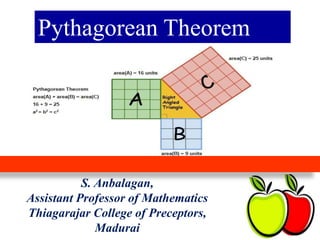
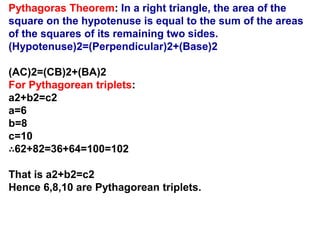
Pythagoras Theorem: In a right triangle, the area of the
square on the hypotenuse is equal to the sum of the areas
of the squares of its remaining two sides.
(Hypotenuse)2=(Perpendicular)2+(Base)2
(AC)2=(CB)2+(BA)2
For Pythagorean triplets:
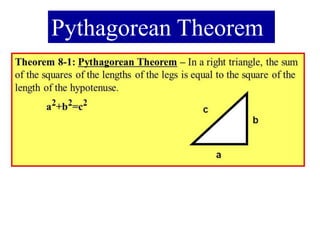
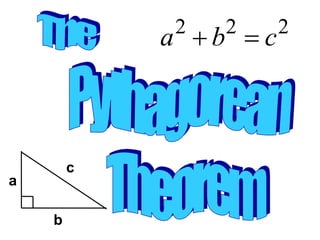
a2+b2=c2
a=6
b=8
c=10
∴62+82=36+64=100=102
That is a2+b2=c2
Hence 6,8,10 are Pythagorean triplets.
Pythagorean Theorem Essential
Questions
How is the Pythagorean Theorem used to
identify side lengths?
When can the Pythagorean Theorem be
used to solve real life patterns?
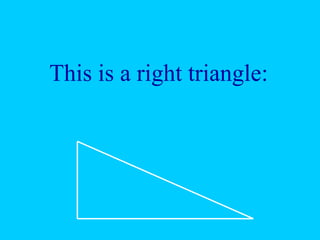
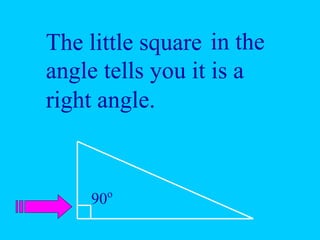
This is a right triangle:
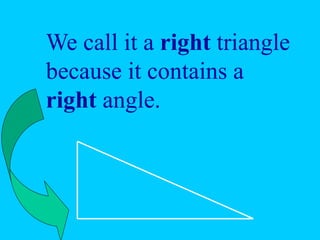
We call it a right triangle
because it contains a
right angle.
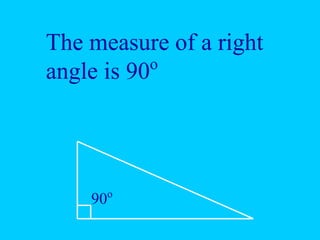
The measure of a right
angle is 90o
90o
The little square
90o
in the
angle tells you it is a
right angle.
About 2,500 years ago, a
Greek mathematician named
Pythagorus discovered a
special relationship between
the sides of right triangles.
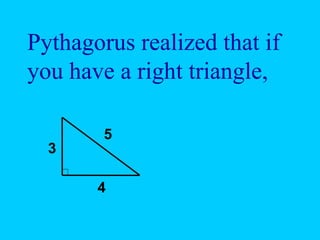
Pythagorus realized that if
you have a right triangle,
3
4
5
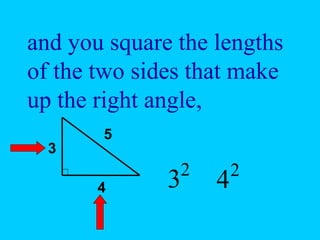
and you square the lengths
of the two sides that make
up the right angle,
2
4
2
3
3
4
5
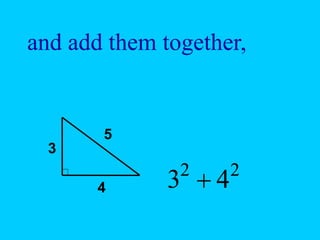
and add them together,
3
4
5
2
4
2
3 2
2
4
3 
2
2
4
3 
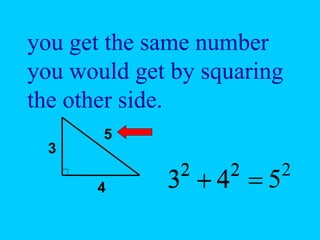
you get the same number
you would get by squaring
the other side.
2
2
2
5
4
3 

3
4
5
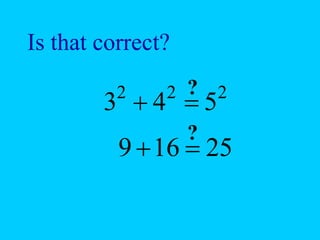
Is that correct?
2
2
2
5
4
3 

?
25
16
9 

?
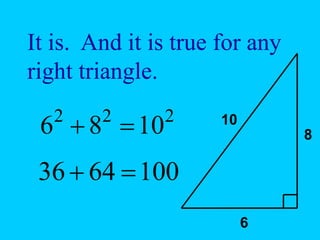
It is. And it is true for any
right triangle.
8
6
10
2
2
2
10
8
6 

100
64
36 

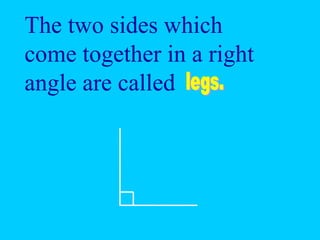
The two sides which
come together in a right
angle are called
The two sides which
come together in a right
angle are called
The two sides which
come together in a right
angle are called
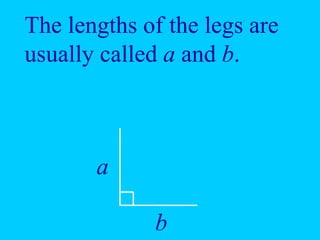
The lengths of the legs are
usually called a and b.
a
b
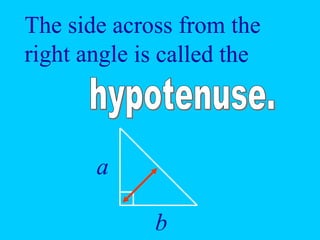
The side across from the
right angle
a
b
is called the
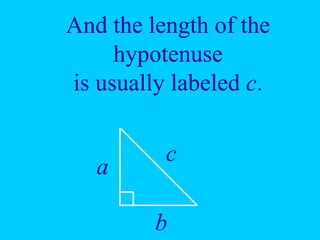
And the length of the
hypotenuse
is usually labeled c.
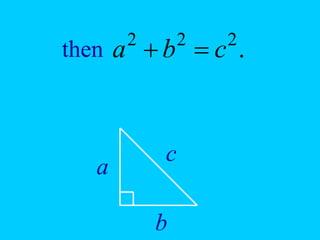
a
b
c
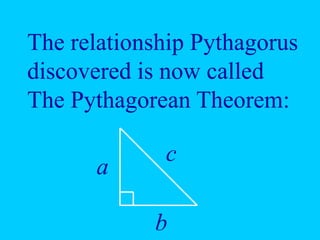
The relationship Pythagorus
discovered is now called
The Pythagorean Theorem:
a
b
c
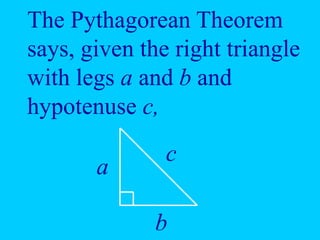
The Pythagorean Theorem
says, given the right triangle
with legs a and b and
hypotenuse c,
a
b
c
then
a
b
c
.
2
2
2
c
b
a 

You can use The Pythagorean
Theorem to solve many kinds
of problems.
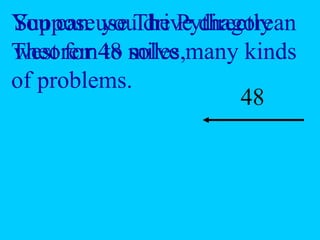
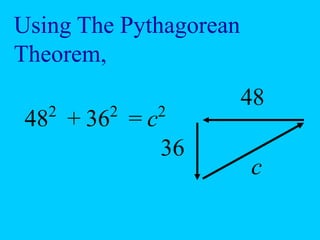
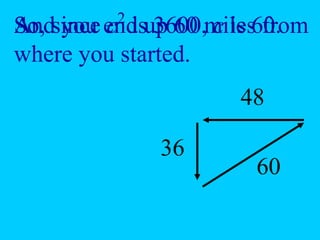
Suppose you drive directly
west for 48 miles,
48
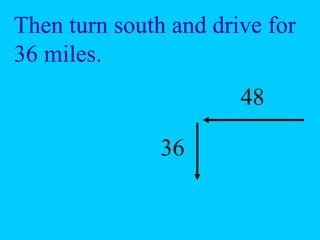
Then turn south and drive for
36 miles.
48
36
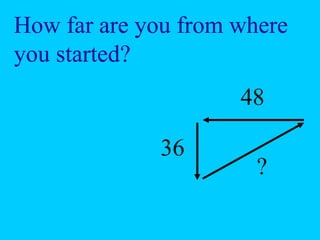
How far are you from where
you started?
48
36
?
482
Using The Pythagorean
Theorem,
48
36
c
362
+ = c2
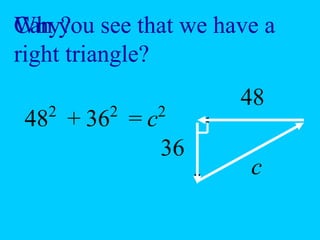
Why?
Can you see that we have a
right triangle?
48
36
c
482
362
+ = c2
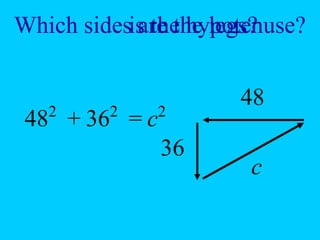
Which side is the hypotenuse?
Which sides are the legs?
48
36
c
482
362
+ = c2

 2
2
36
48
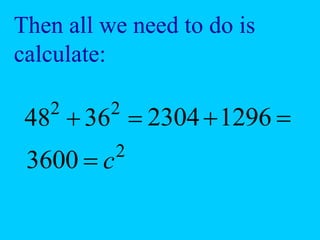
Then all we need to do is
calculate:

1296
2304

3600 2
c
And you end up 60 miles from
where you started.
48
36
60
So, since c2
is 3600, c is 60.
So, since c2
is 3600, c is
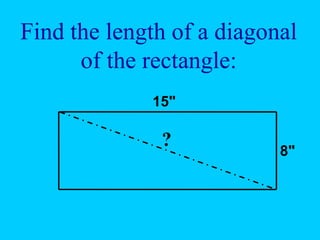
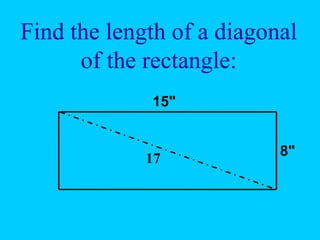
Find the length of a diagonal
of the rectangle:
15"
8"
?
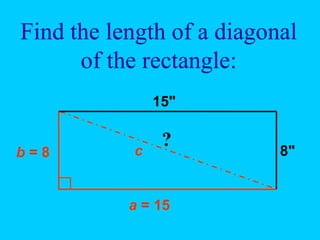
Find the length of a diagonal
of the rectangle:
15"
8"
?
b = 8
a = 15
c
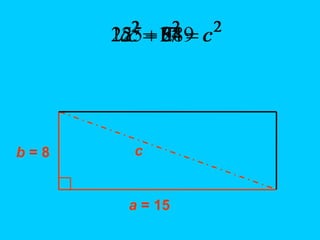
2
2
2
c
b
a 
 2
2
2
8
15 c

 2
64
225 c

 289
2

c 17

c
b = 8
a = 15
c
Find the length of a diagonal
of the rectangle:
15"
8"
17
Practice using
The Pythagorean Theorem
to solve these right triangles:
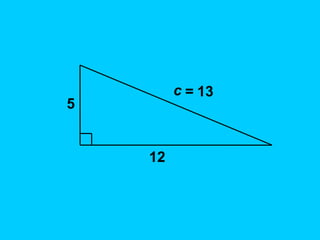
5
12
c = 13
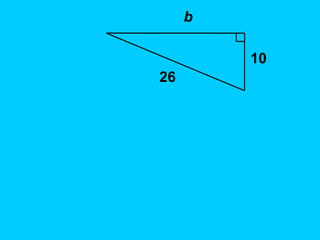
10
b
26
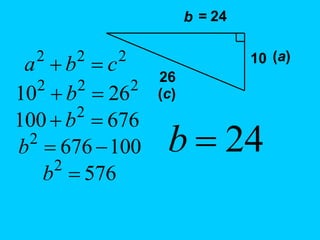
10
b
26
= 24
(a)
(c)
2
2
2
c
b
a 

2
2
2
26
10 
 b
676
100 2

 b
100
676
2


b
576
2

b
24

b
Check It Out! Example 2
A rectangular field has a length of 100 yards and a
width of 33 yards. About how far is it from one corner
of the field to the opposite corner of the field? Round
your answer to the nearest tenth.
Check It Out! Example 2 Continued
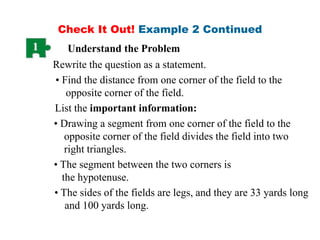
1 Understand the Problem
Rewrite the question as a statement.
• Find the distance from one corner of the field to the
opposite corner of the field.
• The segment between the two corners is
the hypotenuse.
• The sides of the fields are legs, and they are 33 yards long
and 100 yards long.
List the important information:
• Drawing a segment from one corner of the field to the
opposite corner of the field divides the field into two
right triangles.
Check It Out! Example 2 Continued
2 Make a Plan
You can use the Pythagorean Theorem to
write an equation.
Check It Out! Example 2 Continued
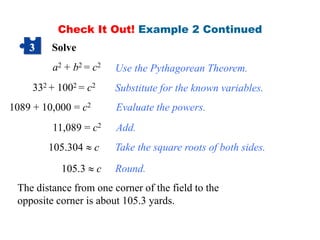
Solve
3
a2 + b2 = c2
332 + 1002 = c2
1089 + 10,000 = c2
11,089 = c2
105.304  c
The distance from one corner of the field to the
opposite corner is about 105.3 yards.
Use the Pythagorean Theorem.
Substitute for the known variables.
Evaluate the powers.
Add.
Take the square roots of both sides.
105.3  c Round.
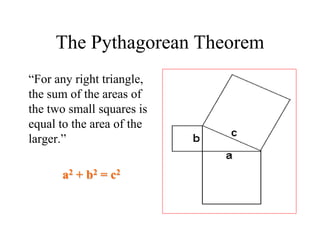
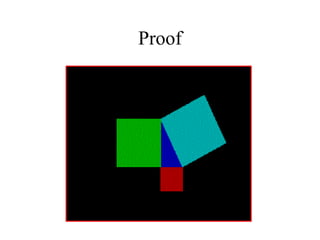
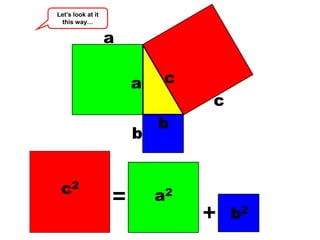
The Pythagorean Theorem
“For any right triangle,
the sum of the areas of
the two small squares is
equal to the area of the
larger.”
a2 + b2 = c2
"The area of the square built
upon the hypotenuse of a right
triangle is equal to the sum of the
areas of the squares upon the
remaining sides."
Proof
a
a
a2
b
b
c
c
b2
c2
Let’s look at it
this way…
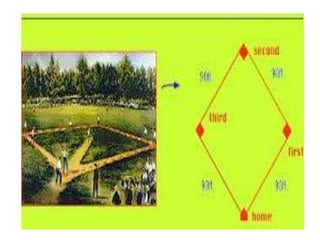
Baseball Problem
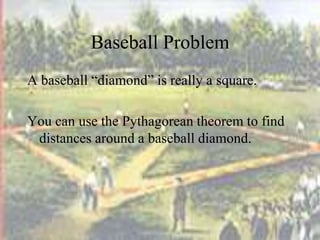
A baseball “diamond” is really a square.
You can use the Pythagorean theorem to find
distances around a baseball diamond.
Baseball Problem
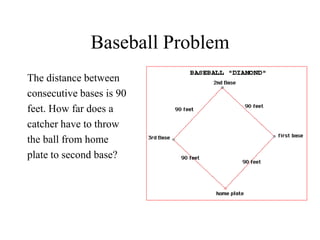
The distance between
consecutive bases is 90
feet. How far does a
catcher have to throw
the ball from home
plate to second base?
Baseball Problem
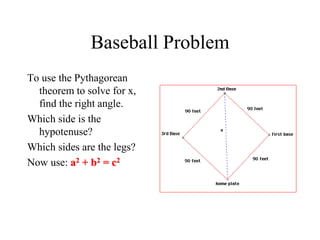
To use the Pythagorean
theorem to solve for x,
find the right angle.
Which side is the
hypotenuse?
Which sides are the legs?
Now use: a2 + b2 = c2
Baseball Problem
Solution
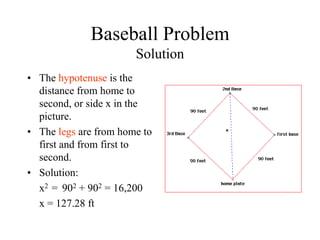
• The hypotenuse is the
distance from home to
second, or side x in the
picture.
• The legs are from home to
first and from first to
second.
• Solution:
x2 = 902 + 902 = 16,200
x = 127.28 ft
Ladder Problem
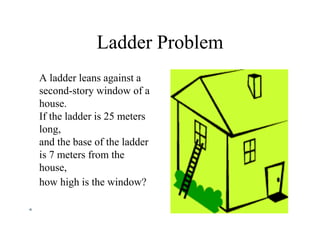
A ladder leans against a
second-story window of a
house.
If the ladder is 25 meters
long,
and the base of the ladder
is 7 meters from the
house,
how high is the window?
Ladder Problem
Solution
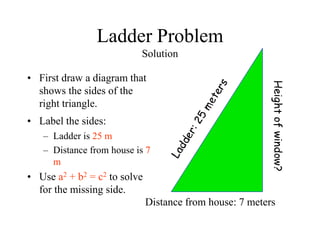
• First draw a diagram that
shows the sides of the
right triangle.
• Label the sides:
– Ladder is 25 m
– Distance from house is 7
m
• Use a2 + b2 = c2 to solve
for the missing side.
Distance from house: 7 meters
Ladder Problem
Solution
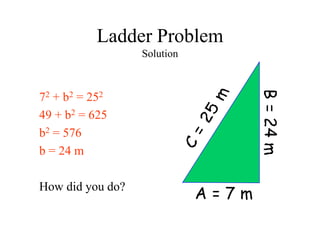
72 + b2 = 252
49 + b2 = 625
b2 = 576
b = 24 m
How did you do?
A = 7 m
PYTHAGOREAN THEOREM
PYTHAGOREAN THEOREM
PYTHAGOREAN THEOREM
PYTHAGOREAN THEOREM
PYTHAGOREAN THEOREM
PYTHAGOREAN THEOREM
PYTHAGOREAN THEOREM
PYTHAGOREAN THEOREM
PYTHAGOREAN THEOREM
PYTHAGOREAN THEOREM
PYTHAGOREAN THEOREM
PYTHAGOREAN THEOREM
PYTHAGOREAN THEOREM
PYTHAGOREAN THEOREM
PYTHAGOREAN THEOREM
PYTHAGOREAN THEOREM
PYTHAGOREAN THEOREM
PYTHAGOREAN THEOREM
PYTHAGOREAN THEOREM

PYTHAGOREAN THEOREM

  • 1.
    Pythagorean Theorem S. Anbalagan, AssistantProfessor of Mathematics Thiagarajar College of Preceptors, Madurai
  • 2.
  • 3.
  • 4.
    Pythagoras Theorem: Ina right triangle, the area of the square on the hypotenuse is equal to the sum of the areas of the squares of its remaining two sides. (Hypotenuse)2=(Perpendicular)2+(Base)2 (AC)2=(CB)2+(BA)2 For Pythagorean triplets: a2+b2=c2 a=6 b=8 c=10 ∴62+82=36+64=100=102 That is a2+b2=c2 Hence 6,8,10 are Pythagorean triplets.
  • 5.
    Pythagorean Theorem Essential Questions Howis the Pythagorean Theorem used to identify side lengths? When can the Pythagorean Theorem be used to solve real life patterns?
  • 6.
    This is aright triangle:
  • 7.
    We call ita right triangle because it contains a right angle.
  • 8.
    The measure ofa right angle is 90o 90o
  • 9.
    The little square 90o inthe angle tells you it is a right angle.
  • 10.
    About 2,500 yearsago, a Greek mathematician named Pythagorus discovered a special relationship between the sides of right triangles.
  • 11.
    Pythagorus realized thatif you have a right triangle, 3 4 5
  • 12.
    and you squarethe lengths of the two sides that make up the right angle, 2 4 2 3 3 4 5
  • 13.
    and add themtogether, 3 4 5 2 4 2 3 2 2 4 3 
  • 14.
    2 2 4 3  you getthe same number you would get by squaring the other side. 2 2 2 5 4 3   3 4 5
  • 15.
    Is that correct? 2 2 2 5 4 3  ? 25 16 9   ?
  • 16.
    It is. Andit is true for any right triangle. 8 6 10 2 2 2 10 8 6   100 64 36  
  • 17.
    The two sideswhich come together in a right angle are called
  • 18.
    The two sideswhich come together in a right angle are called
  • 19.
    The two sideswhich come together in a right angle are called
  • 20.
    The lengths ofthe legs are usually called a and b. a b
  • 21.
    The side acrossfrom the right angle a b is called the
  • 22.
    And the lengthof the hypotenuse is usually labeled c. a b c
  • 23.
    The relationship Pythagorus discoveredis now called The Pythagorean Theorem: a b c
  • 24.
    The Pythagorean Theorem says,given the right triangle with legs a and b and hypotenuse c, a b c
  • 25.
  • 26.
    You can useThe Pythagorean Theorem to solve many kinds of problems. Suppose you drive directly west for 48 miles, 48
  • 27.
    Then turn southand drive for 36 miles. 48 36
  • 28.
    How far areyou from where you started? 48 36 ?
  • 29.
  • 30.
    Why? Can you seethat we have a right triangle? 48 36 c 482 362 + = c2
  • 31.
    Which side isthe hypotenuse? Which sides are the legs? 48 36 c 482 362 + = c2
  • 32.
      2 2 36 48 Then allwe need to do is calculate:  1296 2304  3600 2 c
  • 33.
    And you endup 60 miles from where you started. 48 36 60 So, since c2 is 3600, c is 60. So, since c2 is 3600, c is
  • 34.
    Find the lengthof a diagonal of the rectangle: 15" 8" ?
  • 35.
    Find the lengthof a diagonal of the rectangle: 15" 8" ? b = 8 a = 15 c
  • 36.
    2 2 2 c b a   2 2 2 8 15c   2 64 225 c   289 2  c 17  c b = 8 a = 15 c
  • 37.
    Find the lengthof a diagonal of the rectangle: 15" 8" 17
  • 38.
    Practice using The PythagoreanTheorem to solve these right triangles:
  • 39.
  • 40.
  • 41.
    10 b 26 = 24 (a) (c) 2 2 2 c b a   2 2 2 26 10  b 676 100 2   b 100 676 2   b 576 2  b 24  b
  • 42.
    Check It Out!Example 2 A rectangular field has a length of 100 yards and a width of 33 yards. About how far is it from one corner of the field to the opposite corner of the field? Round your answer to the nearest tenth.
  • 43.
    Check It Out!Example 2 Continued 1 Understand the Problem Rewrite the question as a statement. • Find the distance from one corner of the field to the opposite corner of the field. • The segment between the two corners is the hypotenuse. • The sides of the fields are legs, and they are 33 yards long and 100 yards long. List the important information: • Drawing a segment from one corner of the field to the opposite corner of the field divides the field into two right triangles.
  • 44.
    Check It Out!Example 2 Continued 2 Make a Plan You can use the Pythagorean Theorem to write an equation.
  • 45.
    Check It Out!Example 2 Continued Solve 3 a2 + b2 = c2 332 + 1002 = c2 1089 + 10,000 = c2 11,089 = c2 105.304  c The distance from one corner of the field to the opposite corner is about 105.3 yards. Use the Pythagorean Theorem. Substitute for the known variables. Evaluate the powers. Add. Take the square roots of both sides. 105.3  c Round.
  • 46.
    The Pythagorean Theorem “Forany right triangle, the sum of the areas of the two small squares is equal to the area of the larger.” a2 + b2 = c2
  • 47.
    "The area ofthe square built upon the hypotenuse of a right triangle is equal to the sum of the areas of the squares upon the remaining sides."
  • 48.
  • 49.
  • 50.
    Baseball Problem A baseball“diamond” is really a square. You can use the Pythagorean theorem to find distances around a baseball diamond.
  • 51.
    Baseball Problem The distancebetween consecutive bases is 90 feet. How far does a catcher have to throw the ball from home plate to second base?
  • 52.
    Baseball Problem To usethe Pythagorean theorem to solve for x, find the right angle. Which side is the hypotenuse? Which sides are the legs? Now use: a2 + b2 = c2
  • 53.
    Baseball Problem Solution • Thehypotenuse is the distance from home to second, or side x in the picture. • The legs are from home to first and from first to second. • Solution: x2 = 902 + 902 = 16,200 x = 127.28 ft
  • 54.
    Ladder Problem A ladderleans against a second-story window of a house. If the ladder is 25 meters long, and the base of the ladder is 7 meters from the house, how high is the window?
  • 55.
    Ladder Problem Solution • Firstdraw a diagram that shows the sides of the right triangle. • Label the sides: – Ladder is 25 m – Distance from house is 7 m • Use a2 + b2 = c2 to solve for the missing side. Distance from house: 7 meters
  • 56.
    Ladder Problem Solution 72 +b2 = 252 49 + b2 = 625 b2 = 576 b = 24 m How did you do? A = 7 m