PYTHAGOREAN THEOREM FUN
Ms. Summerville’s 8th Grade Math
ENTRY-TICKET QUIZ: LET’S REVIEW
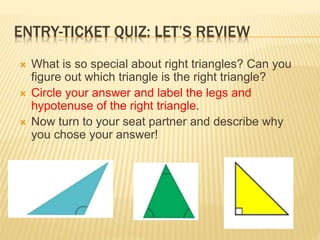
 What is so special about right triangles? Can you
figure out which triangle is the right triangle?
 Circle your answer and label the legs and
hypotenuse of the right triangle.
 Now turn to your seat partner and describe why
you chose your answer!
SOLUTION
The yellow triangle is the
right triangle, because it
contains a 90 degree
measure!
Hypotenuse
Leg
Leg
PYTHAGOREAN THEOREM
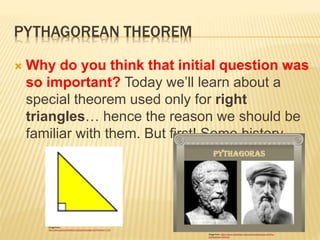
 Why do you think that initial question was
so important? Today we’ll learn about a
special theorem used only for right
triangles… hence the reason we should be
familiar with them. But first! Some history.
Image from:
http://www.jamesvilledewitt.org/teacherpage.cfm?teacher=1123
Image from: https://www.slideshare.net/acavis/pythagoras-and-the-
pythagorean-theorem
CHECKING FOR UNDERSTANDING
 Use these questions to
guide your notes!
 Can you name 2
applications that the
Pythagorean Theorem is
used for?
 Can you name 2 parts of
the world was the
Theorem “seen” before it
was officially proved by
Pythagoras?
 Do you remember the
equation to the Theorem?
 What are 2 interesting
facts about Pythagoras
that you learned from the
film? Why did you
choose these facts?
KEY WORDS WE’LL BE USING TODAY
Definitions for vocabulary words adapted from: http://www.mathwords.com
THE THEOREM
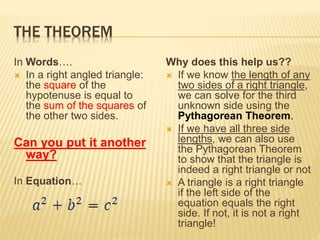
In Words….
 In a right angled triangle:
the square of the
hypotenuse is equal to
the sum of the squares of
the other two sides.
Can you put it another
way?
In Equation…
Why does this help us??
 If we know the length of any
two sides of a right triangle,
we can solve for the third
unknown side using the
Pythagorean Theorem.
 If we have all three side
lengths, we can also use
the Pythagorean Theorem
to show that the triangle is
indeed a right triangle or not
 A triangle is a right triangle
if the left side of the
equation equals the right
side. If not, it is not a right
triangle!
INFORMAL PROOF USING AREA
Think-Pair Share:
1. What evidence can
we use to prove this
theorem is true? Could
you explain to your
partner why you think
this is true?
2. How do you think we
can show this theorem
is true using area?
Now Let’s Watch this
video to see if we were
https://www.youtube.com/w
atch?v=uaj0XcLtN5c
INFORMAL PROOF USING AREA
 Summary:
 If we can show the square
of the hypotenuse is equal
to the sum of the legs
squared, then we can
informally prove the
theorem. When we square
each side, we are have
created an area for each
side.
 Essentially, if we can show
that the sum of the area of
the legs is equal to the
sum of the area for the
hypotenuse, then we can
show the theorem to be
true.
b=4
c=5
b = 3
YOUR TURN!
 Instructions
: Determine
the area for
each of each
side squared.
Then add the
areas for the
two legs and
compare it to
the area of
the
hypotenuse.
Are they the
same? If so,
you’ve
proved the
triangle is a
right triangle!
CHECK YOUR ANSWER
Think-Pair Share: Can you think of
another example?
ONE MORE EXAMPLE…
What about this
one?
Given a triangle…
With side a= 5, Side
b=6, Side c=7, can
you show if this is a
right triangle?
INTRODUCING THE CONVERSE….
 That last problem was a
little sneaky. We can’t
show that when a= 5,
Side b=6, Side c=7, both
sides of the equation are
equal, because they are
not!
 Think-Pair Share…Why
do you think this is an
important question to
address?
 We can use the
Pythagorean Theorem to
also help us determine
WHEN a triangle is indeed
a right triangle….
A 5-6-7 triangle is NOT
a right triangle.
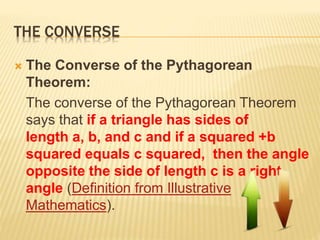
THE CONVERSE
 The Converse of the Pythagorean
Theorem:
The converse of the Pythagorean Theorem
says that if a triangle has sides of
length a, b, and c and if a squared +b
squared equals c squared, then the angle
opposite the side of length c is a right
angle (Definition from Illustrative
Mathematics).
WHAT ARE THE ALTERNATIVE FORMS OF THE
EQUATION?
 Using the Pythagorean
Theorem, we can
solve for an unknown
side in a right triangle.
This can be side a, b,
or c.
 If we are looking for
the hypotenuse, c:
c
a
b
Quick Tip: C must be the
hypotenuse, but you can label a
and b however you wish. In
other words, whichever side you
specify for a or b is just fine!
FINDING THE MISSING SIDE OF A RIGHT
TRIANGLE: SOLVING FOR SIDES A OR B
 Solving for side b: Solving for side a:
SUMMARY
 Make sure to fill this in on your guided notes!
CHECKING FOR COMPREHENSION
 Think about the
following questions and
write your thoughts in
your guided notes:
1. Why does it not matter
which side is
designated as a or b?
Why do you think this
is true?
2. Why is the answer
always positive? Aren’t
we taking a square
root?
 Listen to Ms.
Summerville’s explanation.
Image from: https://socratic.org/questions/does-it-matter-which-sides-you-choose-for-a-b-c-in-a-right-
triangle-when-applyin
Image from: https://www.technologyuk.net/physics/measurement-and-units/measuring-length.shtml
EXAMPLE 1
 Solution:
5
b
13
Check your work!
Given the right triangle
below, solve for b.
EXAMPLE 2
 Given the right
triangle below, solve
for side a:
 Solution
41
a
40
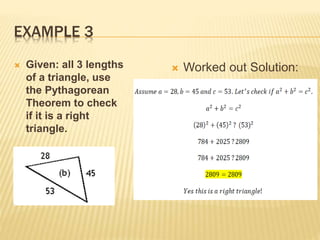
EXAMPLE 3
 Given: all 3 lengths
of a triangle, use
the Pythagorean
Theorem to check
if it is a right
triangle.
 Worked out Solution:
CHECKING FOR UNDERSTANDING: YOUR TURN
 Given: A ladder 10 m long is
used to reach the 3rd story of
a building. It is a distance of
5 meters away from the
building and forms a right
angle.
 Find: What is the height of
the 3rd story? Hint: you are
solving for h.
Image from: https://www.pinterest.com/bronashton/pythagorus/?lp=true
WORKED OUT SOLUTION
Once you solve this problem,
can you check your work? Do
you remember how to do this?
OTHER APPLICATIONS OF THE PYTHAGOREAN
THEOREM
 3 Dimensional
Application: Finding
the diagonal length of
a rectangular prism.
 Coordinate System
Application: Finding
the distance between 2
coordinate points.
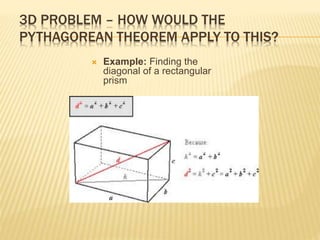
3D PROBLEM – HOW WOULD THE
PYTHAGOREAN THEOREM APPLY TO THIS?
 Example: Finding the
diagonal of a rectangular
prism
SAMPLE PROBLEM
 Given: A shoebox is
shaped like a
rectangular prism. The
dimensions are shown
below.
Find: What is the length of
the diagonal AF?
Solution Steps (in words):
Step 1: Figure our the
known lengths.
Step 2: Break the problem
into 2 triangles.
Step 3: Solve for 1 triangle
at a time and then
substitute the answer
into the second
problem and solve for
the missing information
for the second triangle.
WORKED OUT SOLUTION
SAMPLE PROBLEM 2: DISTANCE BETWEEN 2
POINTS
Given: Two points in the
coordinate system (Suppose I
want to find the distance
between point A and B).
Step 1: Draw a right triangle.
Step 2: Calculate distance for
each leg of the triangle
Step 3: Apply the Pythagorean
Theorem, by substituting the
known values into the
equation and solving for the
missing length. For instance,
we would substitute the
known values for coordinates
AC, and BC into this equation
and then we could solve for
distance AB.
WORKED OUT SOLUTION
EXIT QUIZ - CHECKING FOR UNDERSTANDING
 Write the Pythagorean
Theorem 3 different
ways (How would you
solve for a,b, c?)
 What information can
we know about a
triangle, using the
Pythagorean
Theorem?
 Give one real world
application of the
Pythagorean Theorem.
Where did you get
that idea?
 Do you have any other
questions? Write them
down on your Exit Quiz,
and we’ll address them
next class period.
THANKS FOR YOUR TIME!
 https://www.youtube.com/watch?v=l8-
bnZh8Zuc

Pythagorean theorem fun dr

  • 1.
    PYTHAGOREAN THEOREM FUN Ms.Summerville’s 8th Grade Math
  • 3.
    ENTRY-TICKET QUIZ: LET’SREVIEW  What is so special about right triangles? Can you figure out which triangle is the right triangle?  Circle your answer and label the legs and hypotenuse of the right triangle.  Now turn to your seat partner and describe why you chose your answer!
  • 4.
    SOLUTION The yellow triangleis the right triangle, because it contains a 90 degree measure! Hypotenuse Leg Leg
  • 5.
    PYTHAGOREAN THEOREM  Whydo you think that initial question was so important? Today we’ll learn about a special theorem used only for right triangles… hence the reason we should be familiar with them. But first! Some history. Image from: http://www.jamesvilledewitt.org/teacherpage.cfm?teacher=1123 Image from: https://www.slideshare.net/acavis/pythagoras-and-the- pythagorean-theorem
  • 6.
    CHECKING FOR UNDERSTANDING Use these questions to guide your notes!  Can you name 2 applications that the Pythagorean Theorem is used for?  Can you name 2 parts of the world was the Theorem “seen” before it was officially proved by Pythagoras?  Do you remember the equation to the Theorem?  What are 2 interesting facts about Pythagoras that you learned from the film? Why did you choose these facts?
  • 7.
    KEY WORDS WE’LLBE USING TODAY Definitions for vocabulary words adapted from: http://www.mathwords.com
  • 8.
    THE THEOREM In Words…. In a right angled triangle: the square of the hypotenuse is equal to the sum of the squares of the other two sides. Can you put it another way? In Equation… Why does this help us??  If we know the length of any two sides of a right triangle, we can solve for the third unknown side using the Pythagorean Theorem.  If we have all three side lengths, we can also use the Pythagorean Theorem to show that the triangle is indeed a right triangle or not  A triangle is a right triangle if the left side of the equation equals the right side. If not, it is not a right triangle!
  • 9.
    INFORMAL PROOF USINGAREA Think-Pair Share: 1. What evidence can we use to prove this theorem is true? Could you explain to your partner why you think this is true? 2. How do you think we can show this theorem is true using area? Now Let’s Watch this video to see if we were https://www.youtube.com/w atch?v=uaj0XcLtN5c
  • 10.
    INFORMAL PROOF USINGAREA  Summary:  If we can show the square of the hypotenuse is equal to the sum of the legs squared, then we can informally prove the theorem. When we square each side, we are have created an area for each side.  Essentially, if we can show that the sum of the area of the legs is equal to the sum of the area for the hypotenuse, then we can show the theorem to be true. b=4 c=5 b = 3
  • 11.
    YOUR TURN!  Instructions :Determine the area for each of each side squared. Then add the areas for the two legs and compare it to the area of the hypotenuse. Are they the same? If so, you’ve proved the triangle is a right triangle!
  • 12.
    CHECK YOUR ANSWER Think-PairShare: Can you think of another example?
  • 13.
    ONE MORE EXAMPLE… Whatabout this one? Given a triangle… With side a= 5, Side b=6, Side c=7, can you show if this is a right triangle?
  • 14.
    INTRODUCING THE CONVERSE…. That last problem was a little sneaky. We can’t show that when a= 5, Side b=6, Side c=7, both sides of the equation are equal, because they are not!  Think-Pair Share…Why do you think this is an important question to address?  We can use the Pythagorean Theorem to also help us determine WHEN a triangle is indeed a right triangle…. A 5-6-7 triangle is NOT a right triangle.
  • 15.
    THE CONVERSE  TheConverse of the Pythagorean Theorem: The converse of the Pythagorean Theorem says that if a triangle has sides of length a, b, and c and if a squared +b squared equals c squared, then the angle opposite the side of length c is a right angle (Definition from Illustrative Mathematics).
  • 16.
    WHAT ARE THEALTERNATIVE FORMS OF THE EQUATION?  Using the Pythagorean Theorem, we can solve for an unknown side in a right triangle. This can be side a, b, or c.  If we are looking for the hypotenuse, c: c a b Quick Tip: C must be the hypotenuse, but you can label a and b however you wish. In other words, whichever side you specify for a or b is just fine!
  • 17.
    FINDING THE MISSINGSIDE OF A RIGHT TRIANGLE: SOLVING FOR SIDES A OR B  Solving for side b: Solving for side a:
  • 18.
    SUMMARY  Make sureto fill this in on your guided notes!
  • 19.
    CHECKING FOR COMPREHENSION Think about the following questions and write your thoughts in your guided notes: 1. Why does it not matter which side is designated as a or b? Why do you think this is true? 2. Why is the answer always positive? Aren’t we taking a square root?  Listen to Ms. Summerville’s explanation. Image from: https://socratic.org/questions/does-it-matter-which-sides-you-choose-for-a-b-c-in-a-right- triangle-when-applyin Image from: https://www.technologyuk.net/physics/measurement-and-units/measuring-length.shtml
  • 20.
    EXAMPLE 1  Solution: 5 b 13 Checkyour work! Given the right triangle below, solve for b.
  • 21.
    EXAMPLE 2  Giventhe right triangle below, solve for side a:  Solution 41 a 40
  • 22.
    EXAMPLE 3  Given:all 3 lengths of a triangle, use the Pythagorean Theorem to check if it is a right triangle.  Worked out Solution:
  • 23.
    CHECKING FOR UNDERSTANDING:YOUR TURN  Given: A ladder 10 m long is used to reach the 3rd story of a building. It is a distance of 5 meters away from the building and forms a right angle.  Find: What is the height of the 3rd story? Hint: you are solving for h. Image from: https://www.pinterest.com/bronashton/pythagorus/?lp=true
  • 24.
    WORKED OUT SOLUTION Onceyou solve this problem, can you check your work? Do you remember how to do this?
  • 25.
    OTHER APPLICATIONS OFTHE PYTHAGOREAN THEOREM  3 Dimensional Application: Finding the diagonal length of a rectangular prism.  Coordinate System Application: Finding the distance between 2 coordinate points.
  • 26.
    3D PROBLEM –HOW WOULD THE PYTHAGOREAN THEOREM APPLY TO THIS?  Example: Finding the diagonal of a rectangular prism
  • 27.
    SAMPLE PROBLEM  Given:A shoebox is shaped like a rectangular prism. The dimensions are shown below. Find: What is the length of the diagonal AF? Solution Steps (in words): Step 1: Figure our the known lengths. Step 2: Break the problem into 2 triangles. Step 3: Solve for 1 triangle at a time and then substitute the answer into the second problem and solve for the missing information for the second triangle.
  • 28.
  • 29.
    SAMPLE PROBLEM 2:DISTANCE BETWEEN 2 POINTS Given: Two points in the coordinate system (Suppose I want to find the distance between point A and B). Step 1: Draw a right triangle. Step 2: Calculate distance for each leg of the triangle Step 3: Apply the Pythagorean Theorem, by substituting the known values into the equation and solving for the missing length. For instance, we would substitute the known values for coordinates AC, and BC into this equation and then we could solve for distance AB.
  • 30.
  • 31.
    EXIT QUIZ -CHECKING FOR UNDERSTANDING  Write the Pythagorean Theorem 3 different ways (How would you solve for a,b, c?)  What information can we know about a triangle, using the Pythagorean Theorem?  Give one real world application of the Pythagorean Theorem. Where did you get that idea?  Do you have any other questions? Write them down on your Exit Quiz, and we’ll address them next class period.
  • 32.
    THANKS FOR YOURTIME!  https://www.youtube.com/watch?v=l8- bnZh8Zuc

Editor's Notes

  • #4 http://www.jamesvilledewitt.org/teacherpage.cfm?teacher=1123
  • #6 http://students.um.edu.mt/jcam0001/history.html Clarification question http://www.jamesvilledewitt.org/teacherpage.cfm?teacher=1123
  • #15 https://www.illustrativemathematics.org/content-standards/tasks/724 https://www.triangle-calculator.com/?a=5&b=6&c=7
  • #20 https://socratic.org/questions/does-it-matter-which-sides-you-choose-for-a-b-c-in-a-right-triangle-when-applyin
  • #24 https://www.pinterest.com/bronashton/pythagorus/?lp=true
  • #26 http://flipbooks.pearsonschool.com/texasreview/mathematics/digits/TX_Digits_HomeworkHelper_HTML_Files/Grade%208/Volume%201/page_142.html http://ceemrr.com/Geometry2/LengthAreaVolume/LengthAreaVolume_print.html
  • #28 http://www.bbc.co.uk/education/guides/zfkj6sg/revision/4 http://www.bbc.co.uk/education/guides/zfkj6sg/revision/4
  • #29 http://www.bbc.co.uk/education/guides/zfkj6sg/revision/4
  • #30 http://mdk12.msde.maryland.gov/instruction/clg/lesson_plans/geometry/pythagorean_212.html