passport to the world of
Trigonometry

CLICK TO CONTINUE
A triangle is a polygon made up of three
connected line segments in such a way that
each side is connected to the other two.

CLICK TO CONTINUE
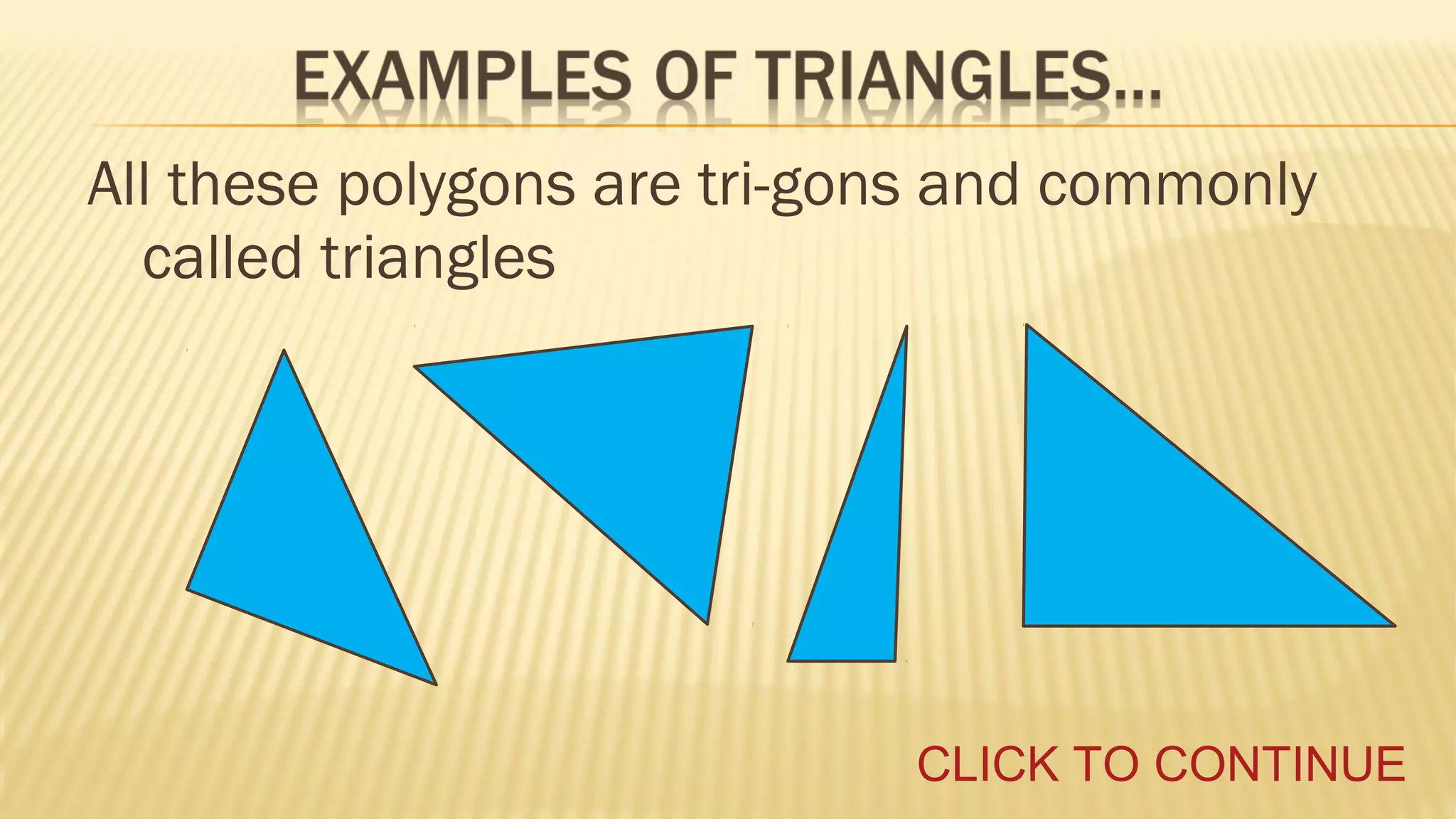
All these polygons are tri-gons and commonly
called triangles

CLICK TO CONTINUE
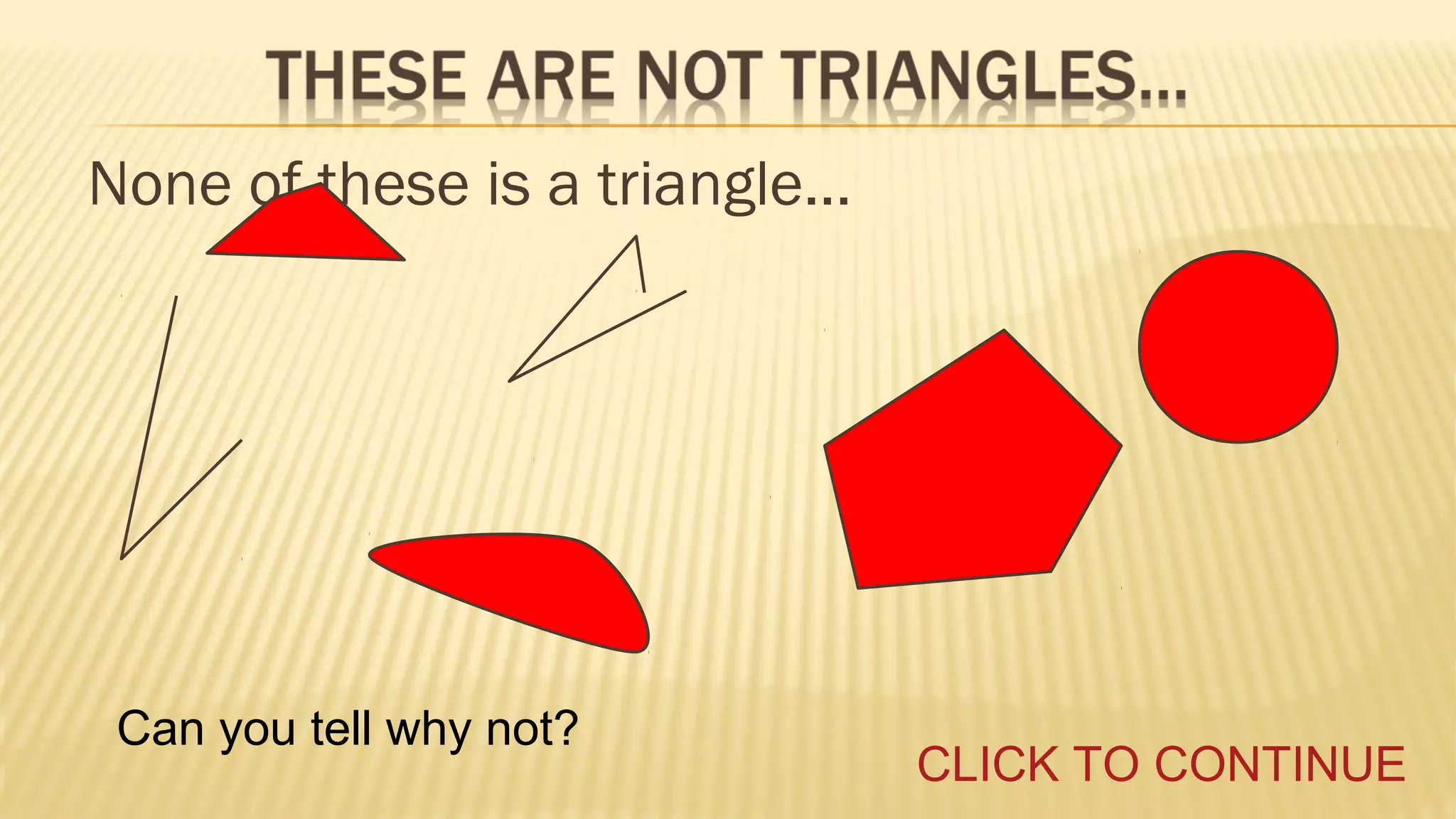
None of these is a triangle...

Can you tell why not?

CLICK TO CONTINUE
CLICK on each one that IS a triangle?

CLICK TO CONTINUE
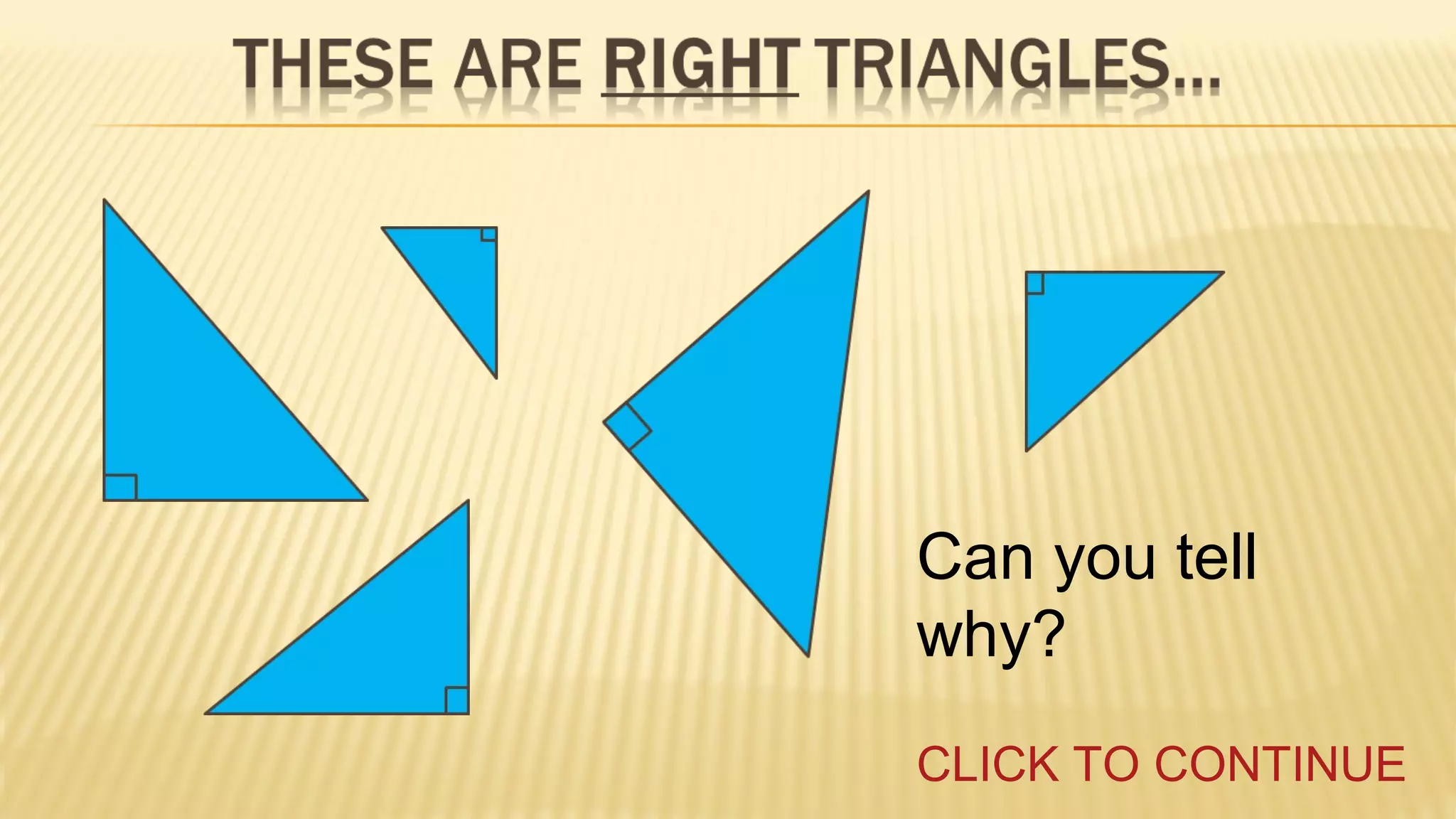
A right triangle is a special triangle that has
one of its angles a right angle.
You can tell it is a right triangle when when one
angle measures 900 or the right angle is
marked by a little square on the angle
whose measure is 900.
CLICK TO CONTINUE
Can you tell
why?
CLICK TO CONTINUE
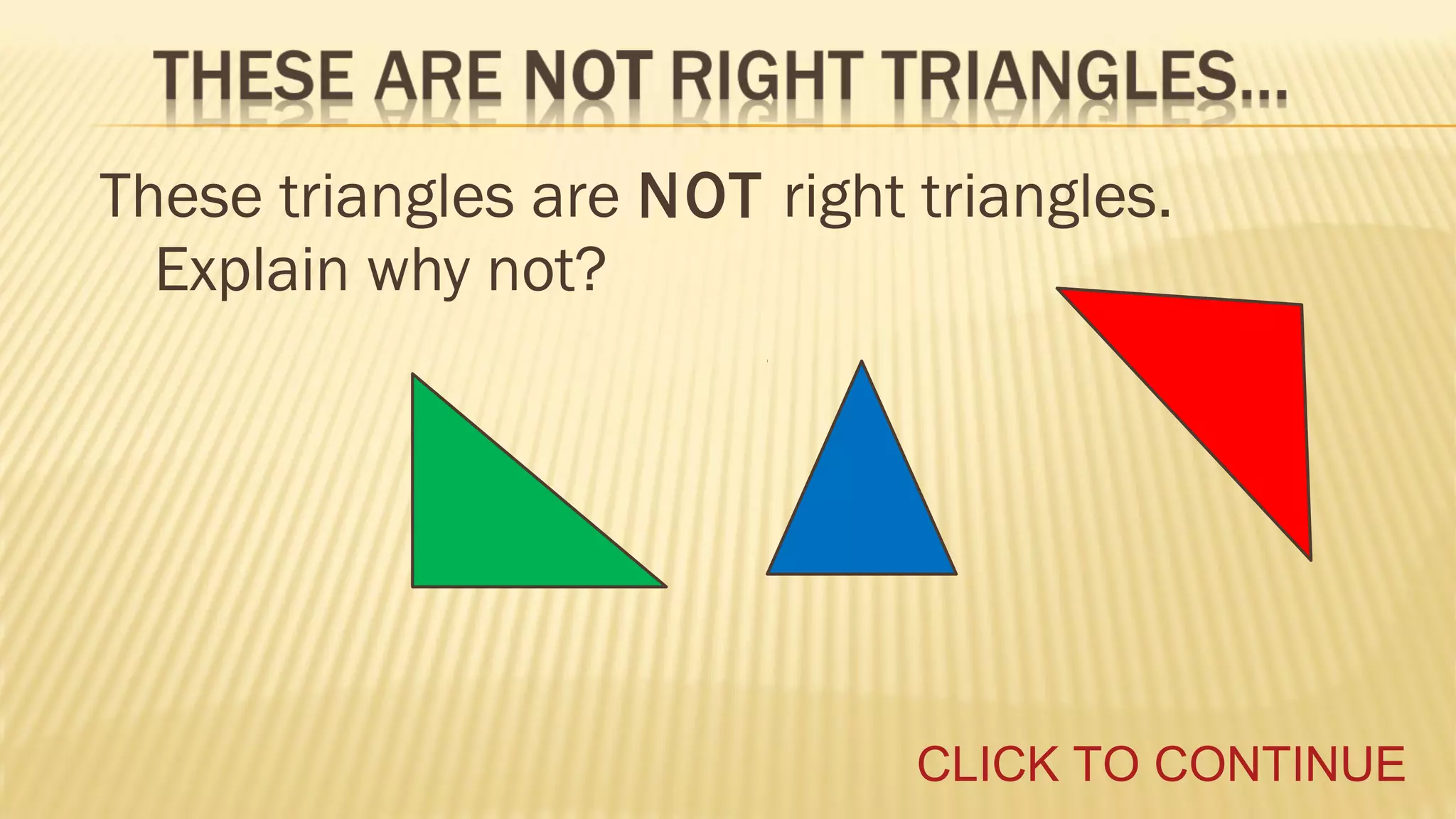
These triangles are NOT right triangles.
Explain why not?

CLICK TO CONTINUE
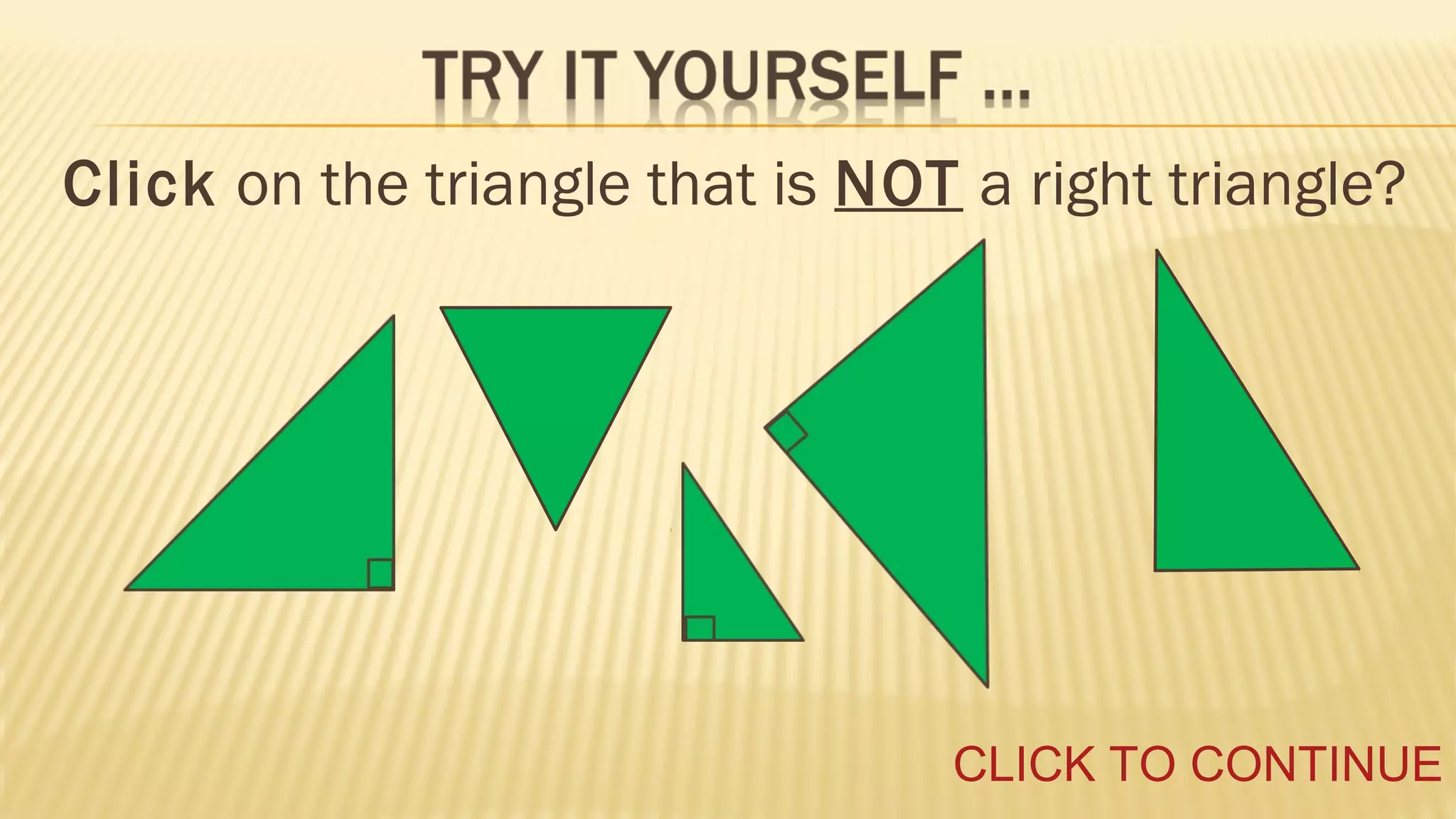
Click on the triangle that is NOT a right triangle?

CLICK TO CONTINUE
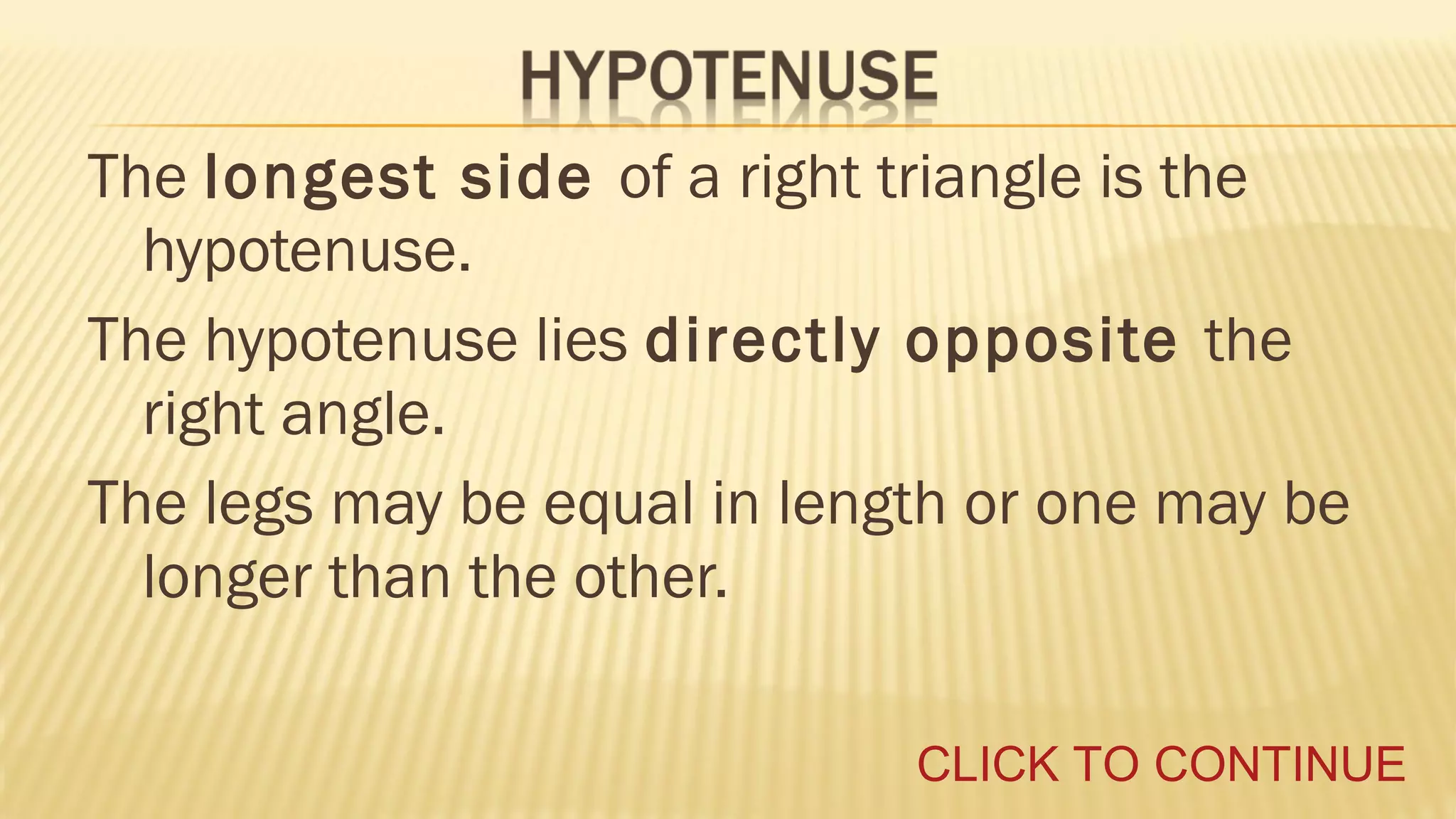
The longest side of a right triangle is the
hypotenuse.
The hypotenuse lies directly opposite the
right angle.
The legs may be equal in length or one may be
longer than the other.
CLICK TO CONTINUE
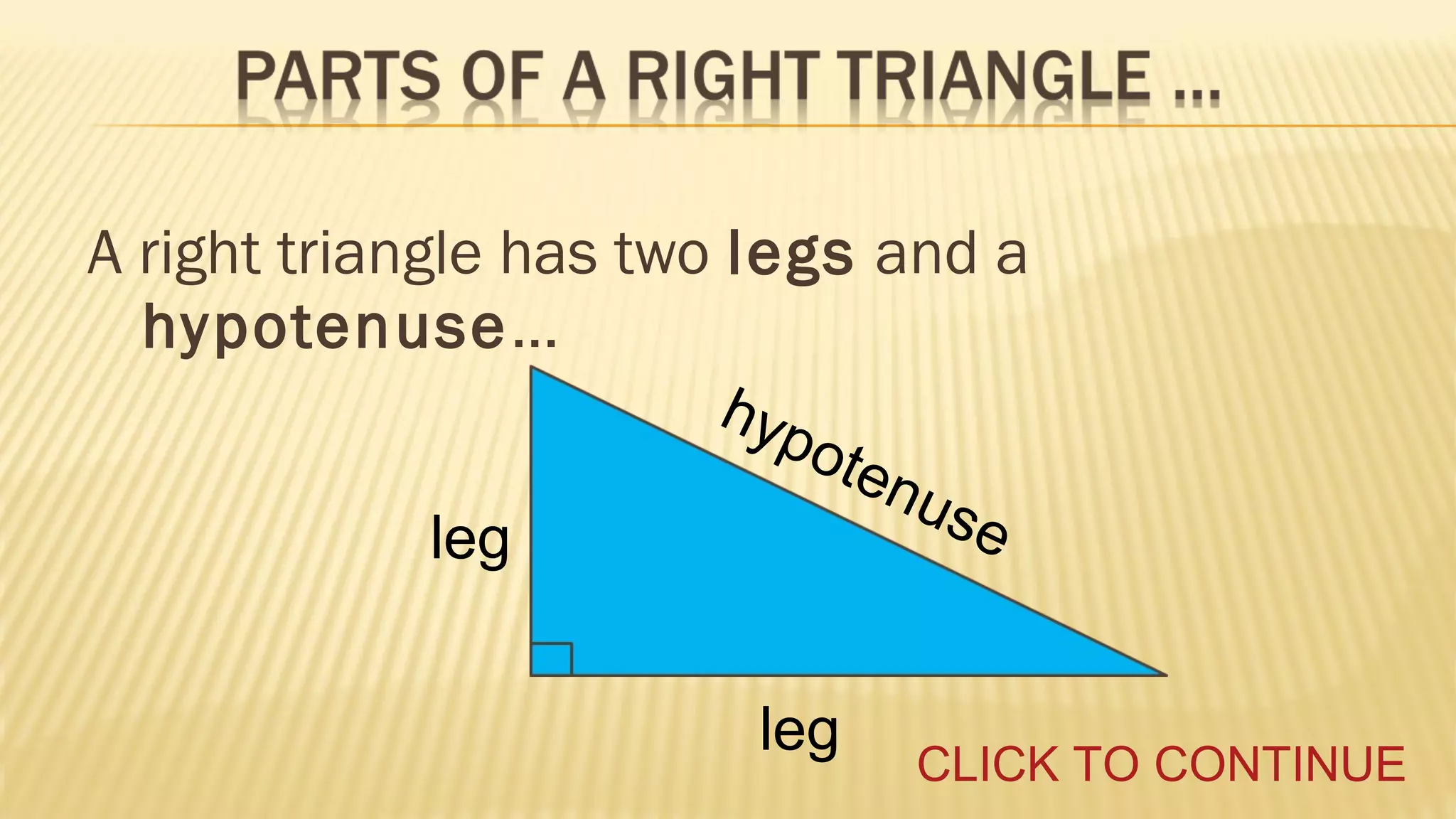
A right triangle has two legs and a
hypotenuse...
hyp
ot

leg
leg

enu
s

e

CLICK TO CONTINUE
Click on the side that is the hypotenuse of
the right triangle.
side 1
side 3
side 2
CLICK TO CONTINUE
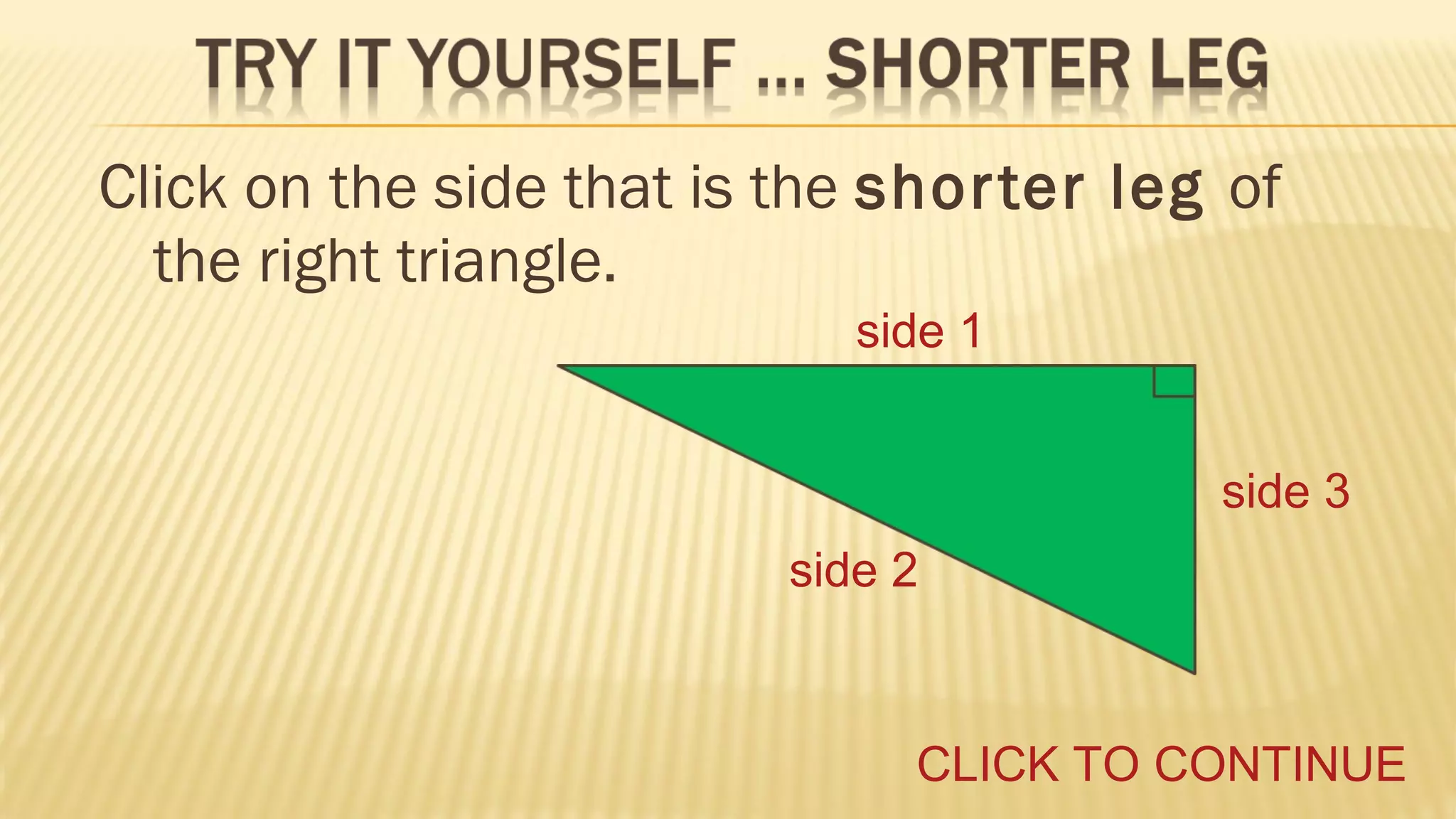
Click on the side that is the shor ter leg of
the right triangle.
side 1
side 3
side 2

CLICK TO CONTINUE
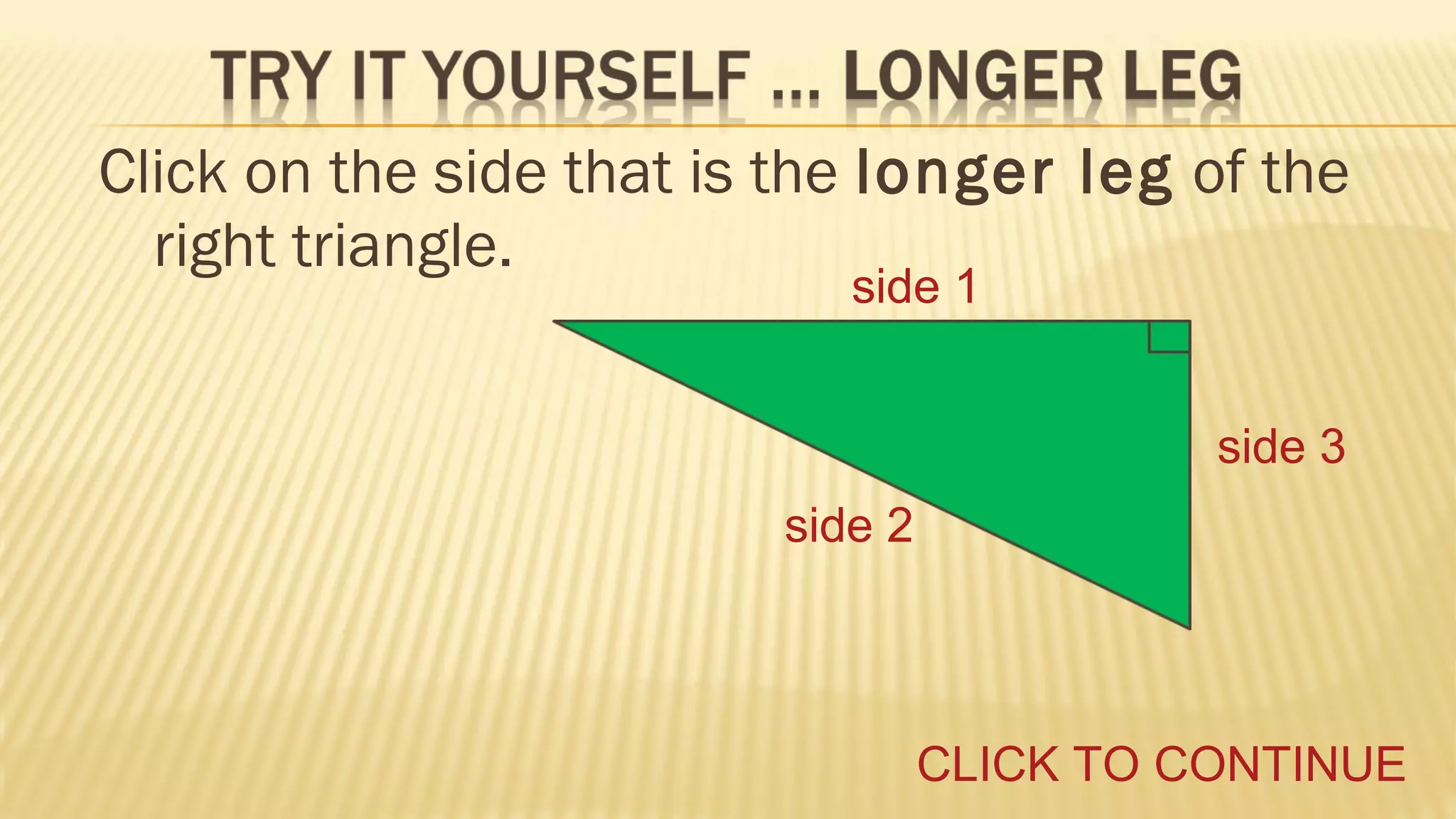
Click on the side that is the longer leg of the
right triangle.
side 1

side 3
side 2

CLICK TO CONTINUE
hyp
o te
nus
e
c

The right triangle has a
special property, called leg b
1
the Pythagorean
Theorem, that can help
a
us find one side if we
leg2
know the other two
If the lengths of hypotenuse and legs are c,
sides.
a and b respectively, then
c2 = a2 + b2
CLICK TO CONTINUE
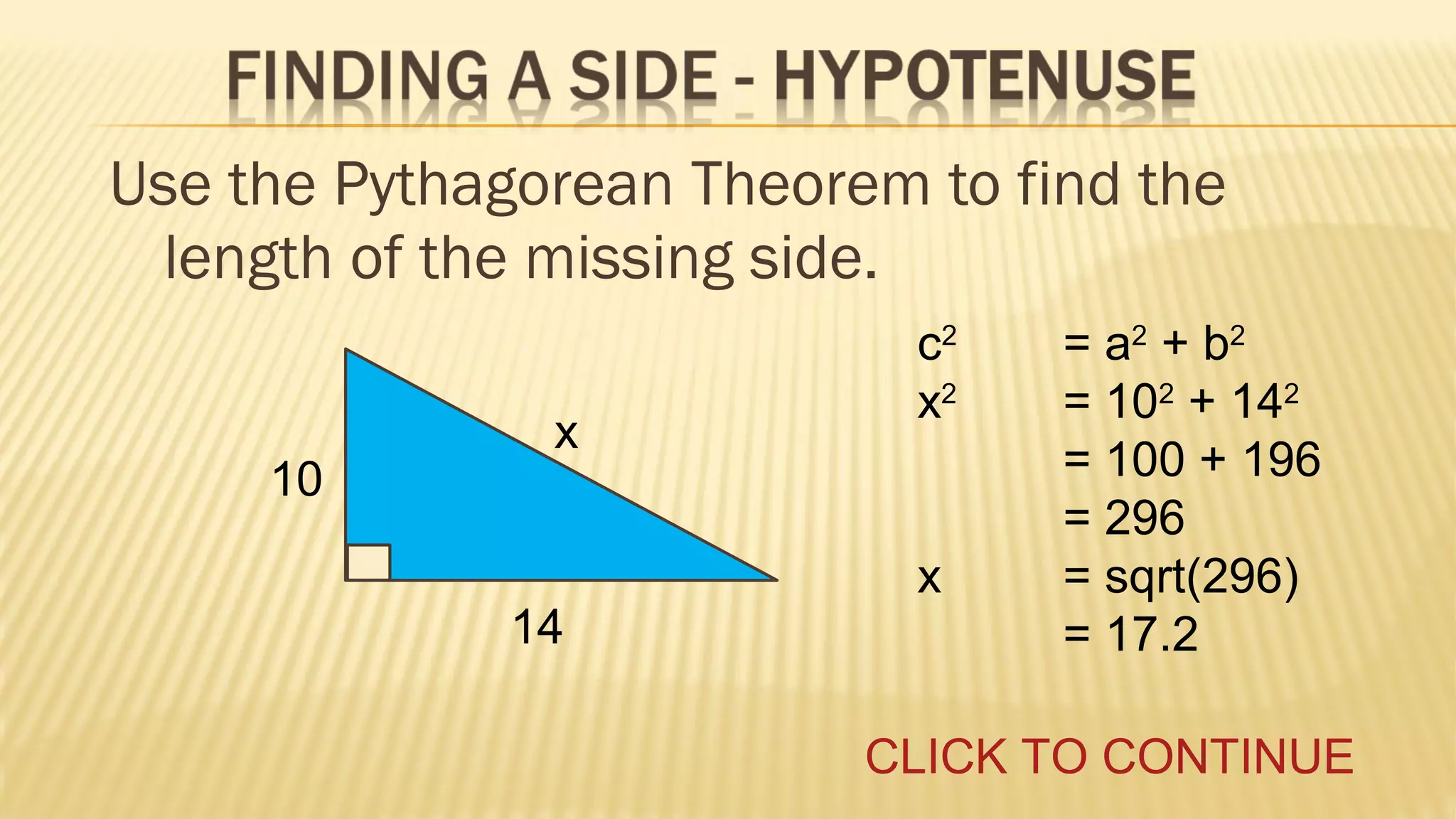
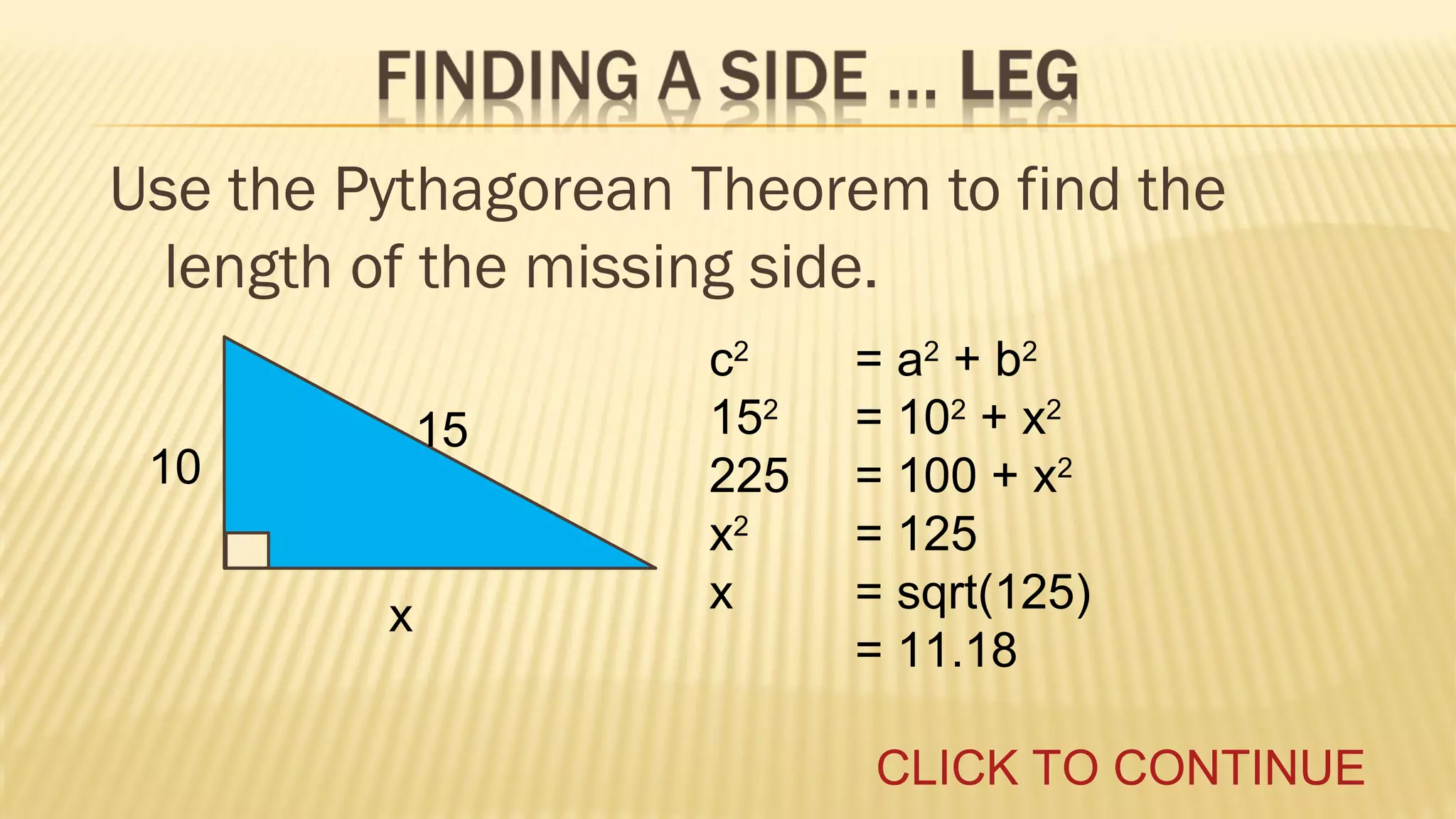
Use the Pythagorean Theorem to find the
length of the missing side.
10

x

14

c2
x2
x

= a2 + b2
= 102 + 142
= 100 + 196
= 296
= sqrt(296)
= 17.2

CLICK TO CONTINUE
Use the Pythagorean Theorem to find the
length of the missing side.
15

10
x

c2
152
225
x2
x

= a2 + b2
= 102 + x2
= 100 + x2
= 125
= sqrt(125)
= 11.18
CLICK TO CONTINUE
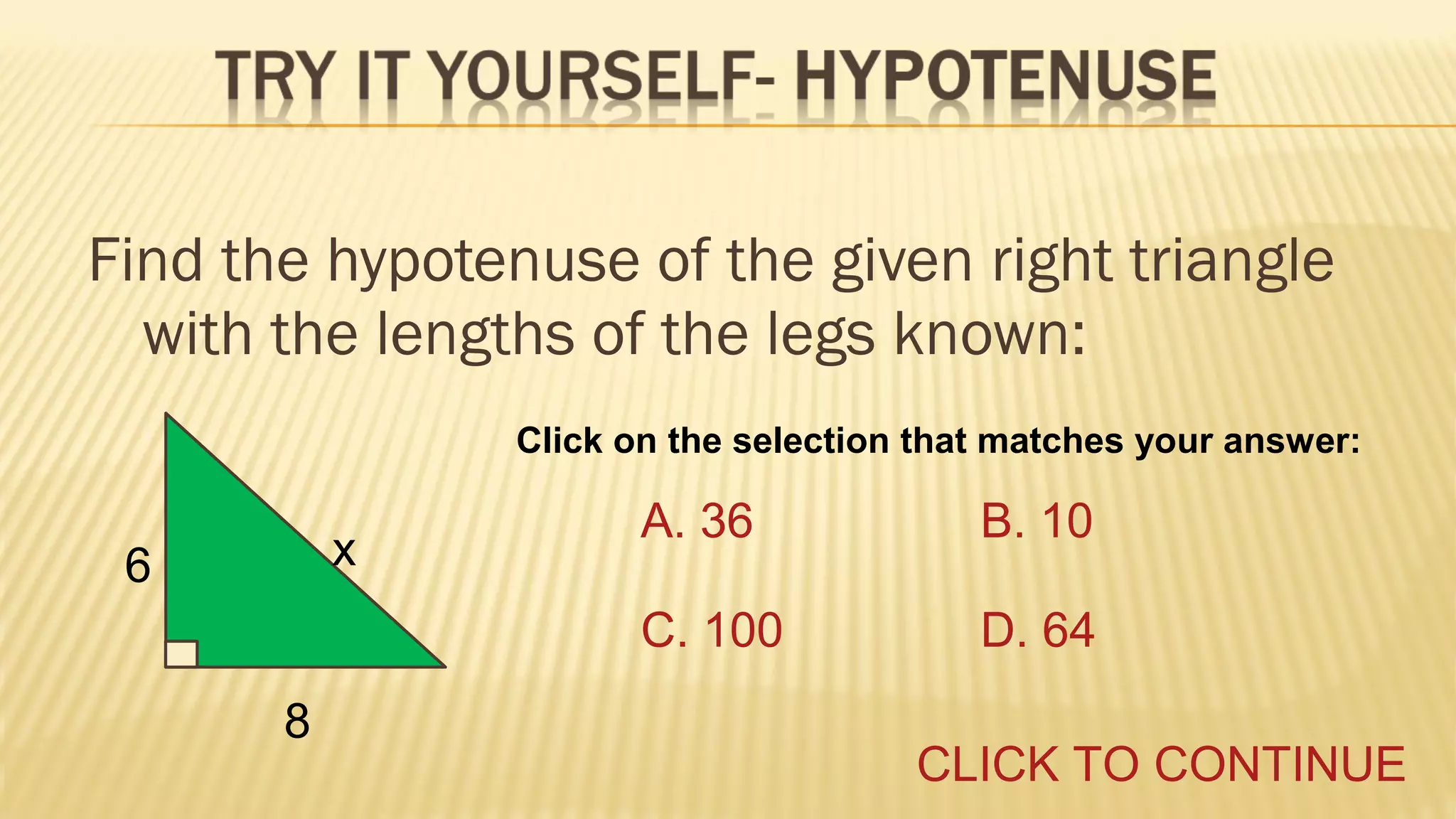
Find the hypotenuse of the given right triangle
with the lengths of the legs known:
Click on the selection that matches your answer:

6
8

A. 36

B. 10

C. 100

x

D. 64
CLICK TO CONTINUE
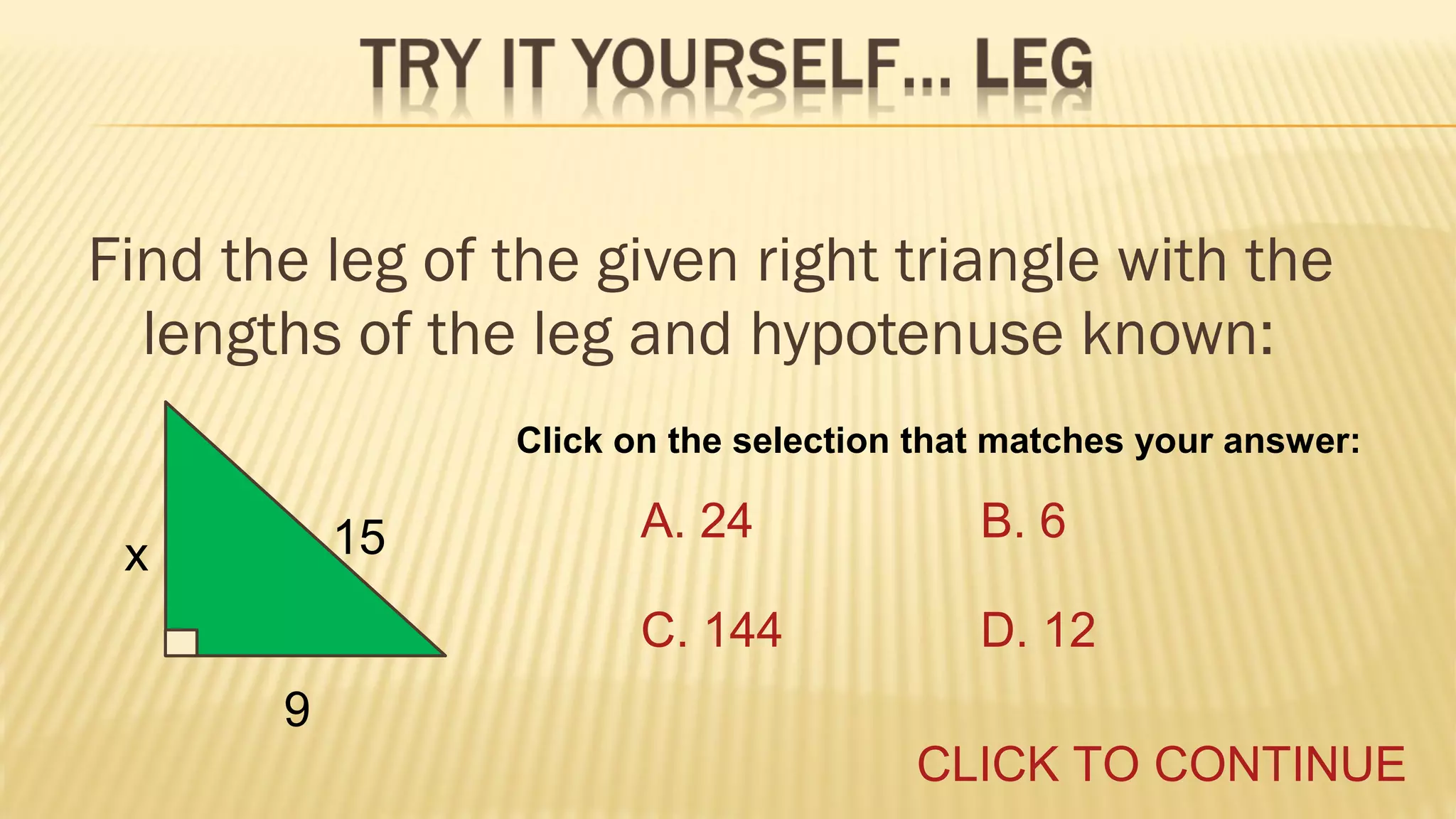
Find the leg of the given right triangle with the
lengths of the leg and hypotenuse known:
Click on the selection that matches your answer:

x

A. 24

B. 6

C. 144

15

D. 12

9
CLICK TO CONTINUE
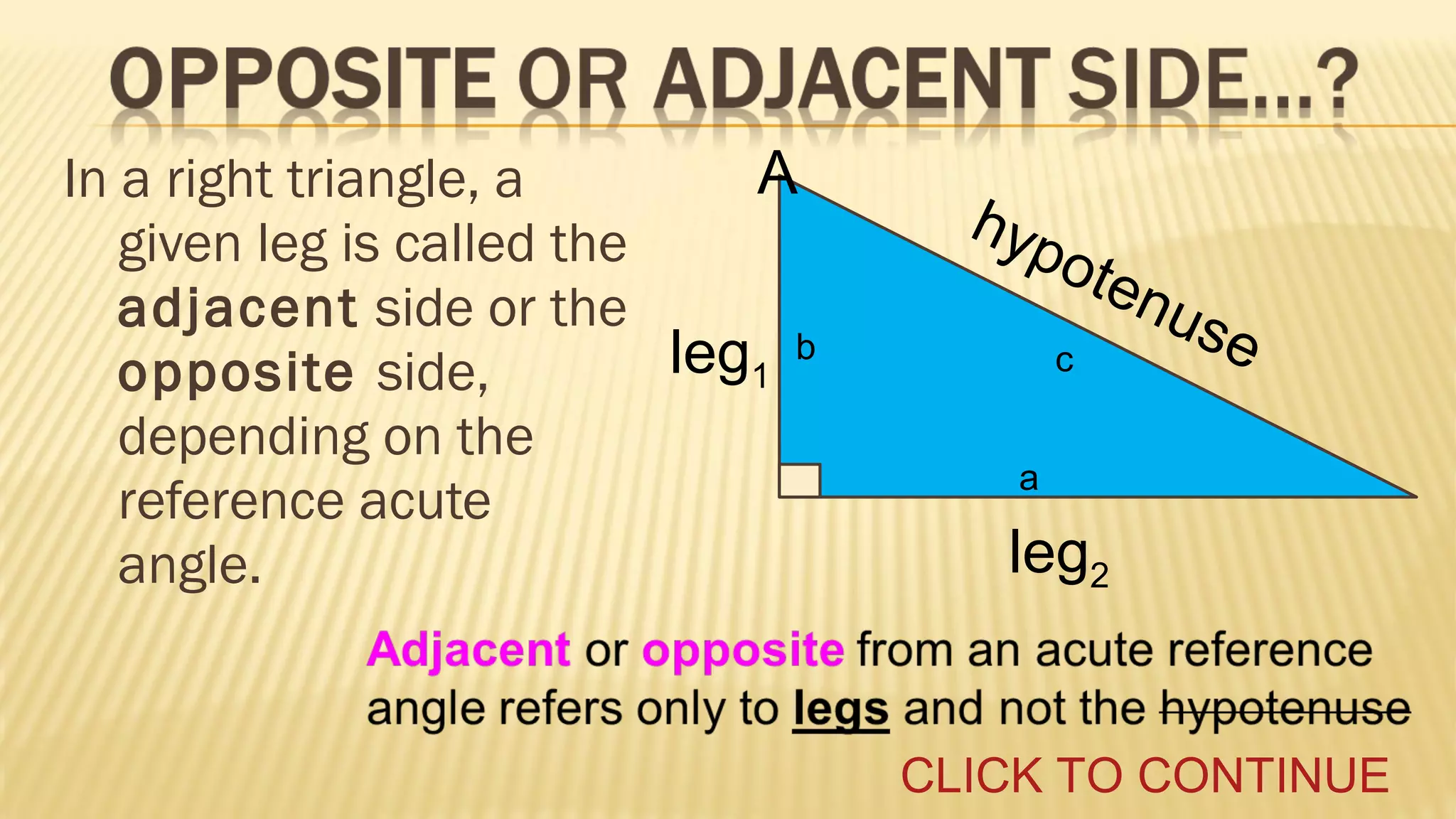
A
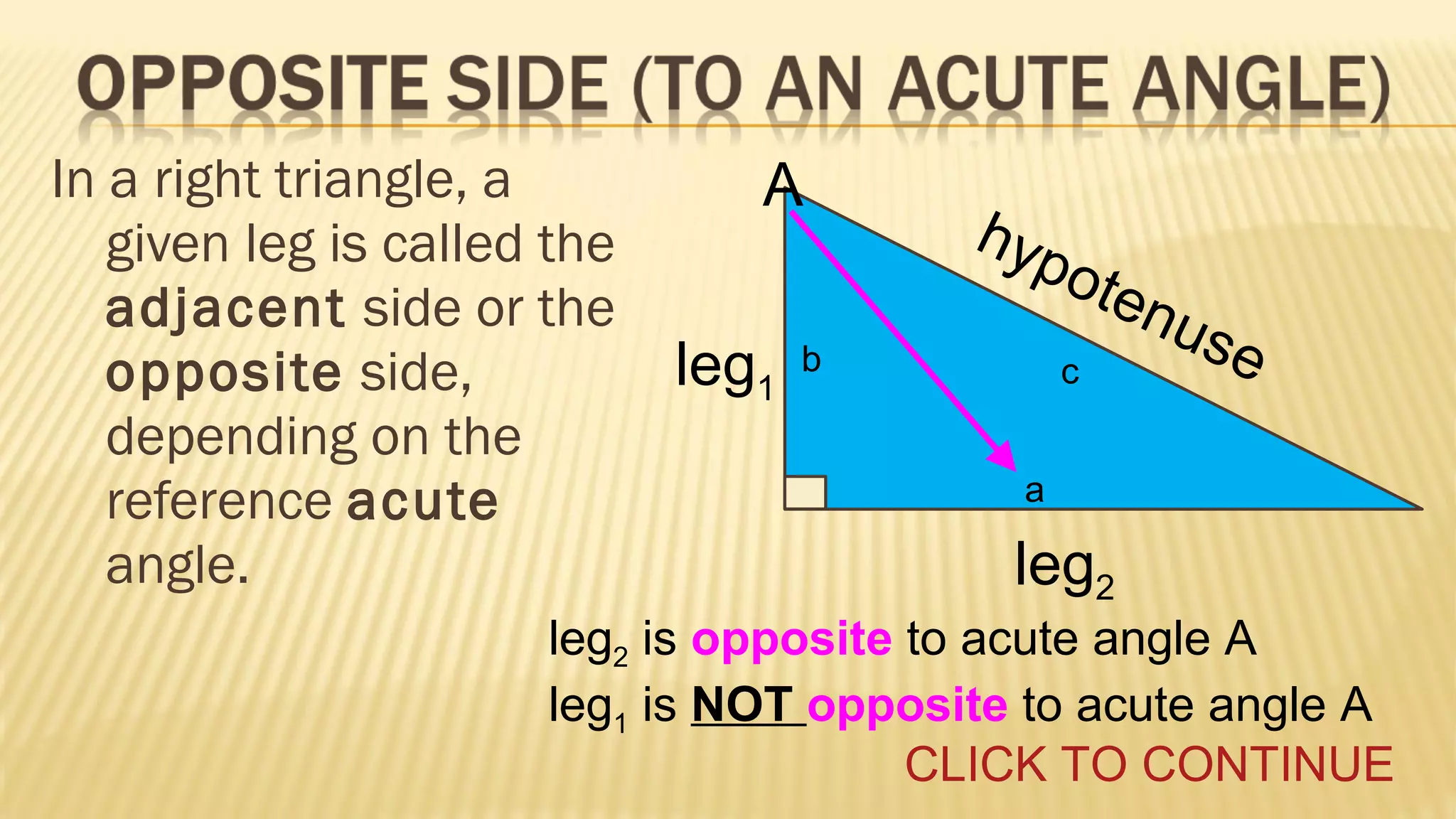
In a right triangle, a
given leg is called the
adjacent side or the
leg1 b
opposite side,
depending on the
reference acute
angle.

hyp
o te
nus
e
c
a

leg2

CLICK TO CONTINUE
In a right triangle, a
given leg is called the
adjacent side or the
opposite side,
depending on the
reference acute
angle.

A
leg1

b

hyp
ote
nus
c

e

a

leg2

leg2 is opposite to acute angle A
leg1 is NOT opposite to acute angle A
CLICK TO CONTINUE
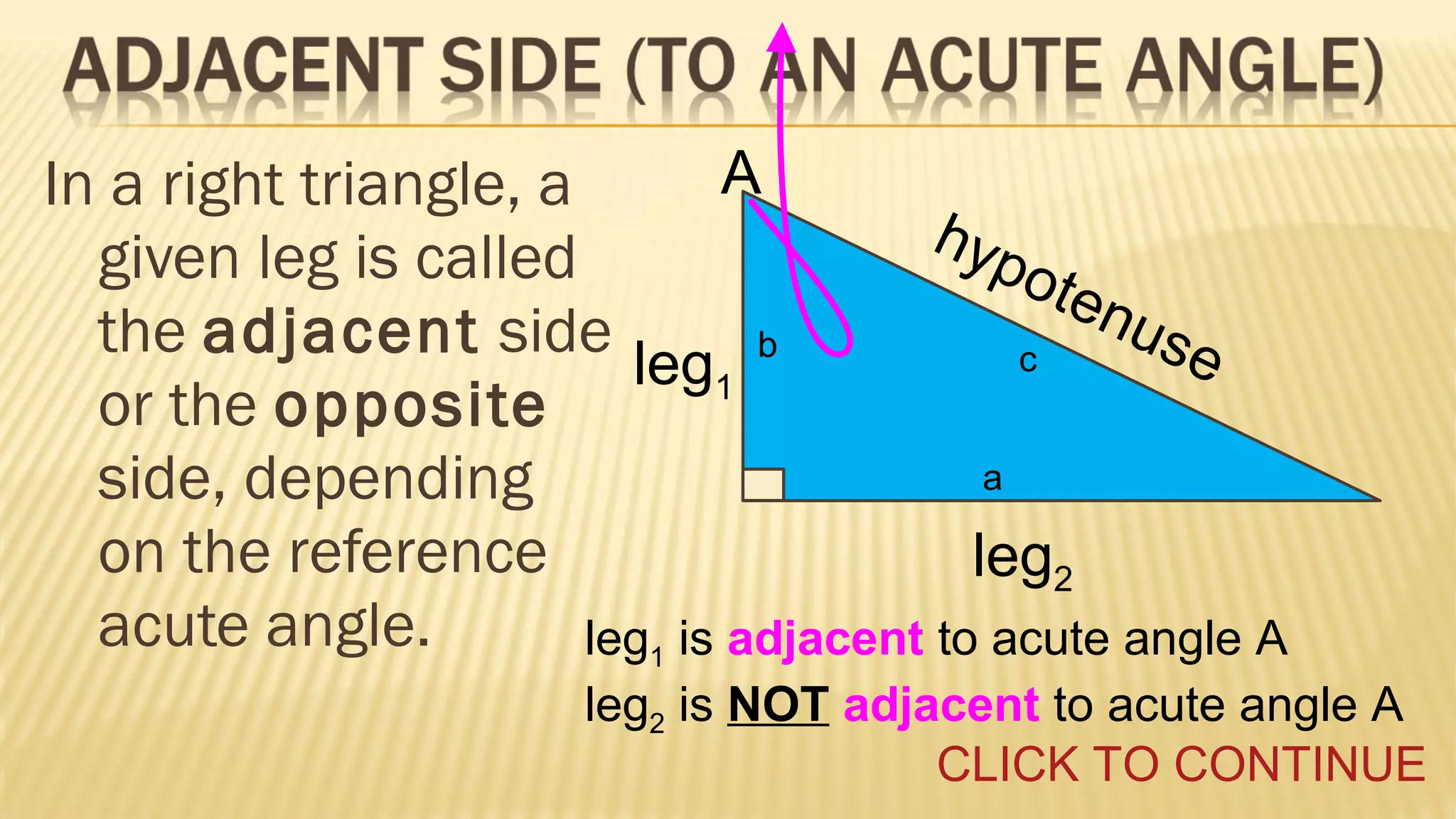
A
In a right triangle, a
hyp
given leg is called
o te
nus
the adjacent side
e
c
leg1 b
or the opposite
a
side, depending
on the reference
leg2
acute angle.
leg1 is adjacent to acute angle A
leg2 is NOT adjacent to acute angle A
CLICK TO CONTINUE
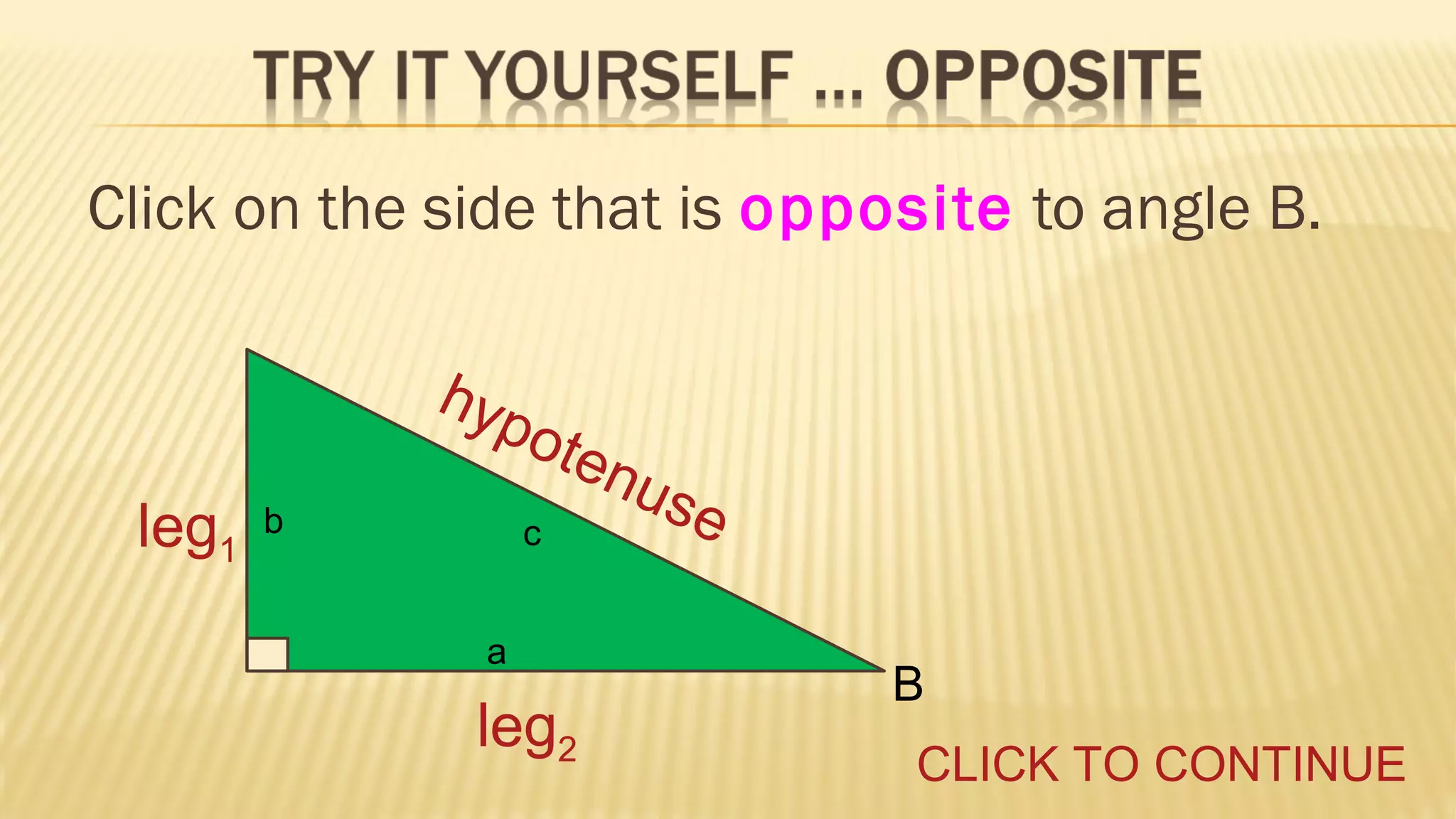
Click on the side that is opposite to angle B.
hyp
o

leg1

ten
use
c

b
a

leg2

B
CLICK TO CONTINUE
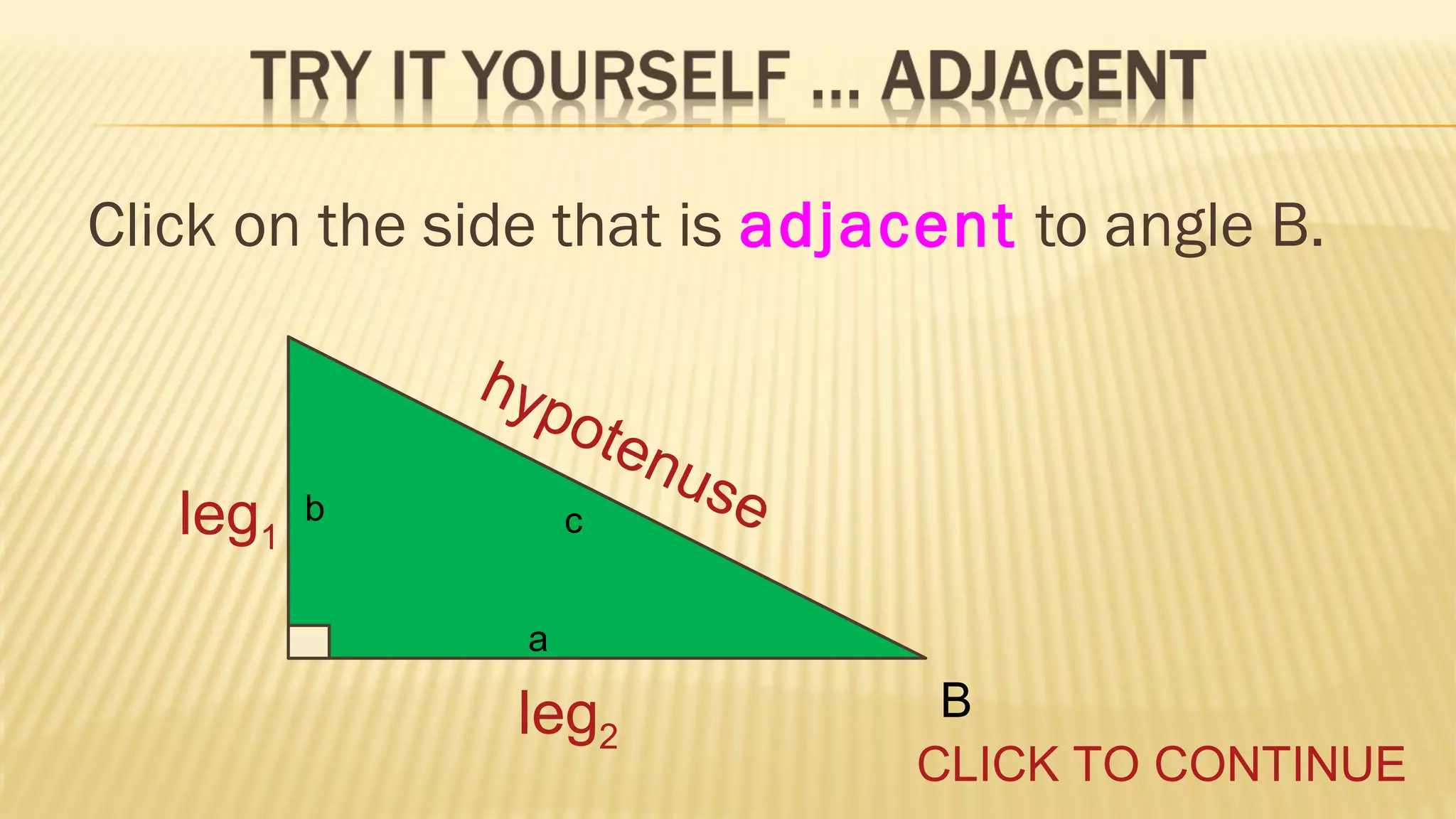
Click on the side that is adjacent to angle B.
hyp
o

leg1

ten
use
c

b
a

leg2

B
CLICK TO CONTINUE
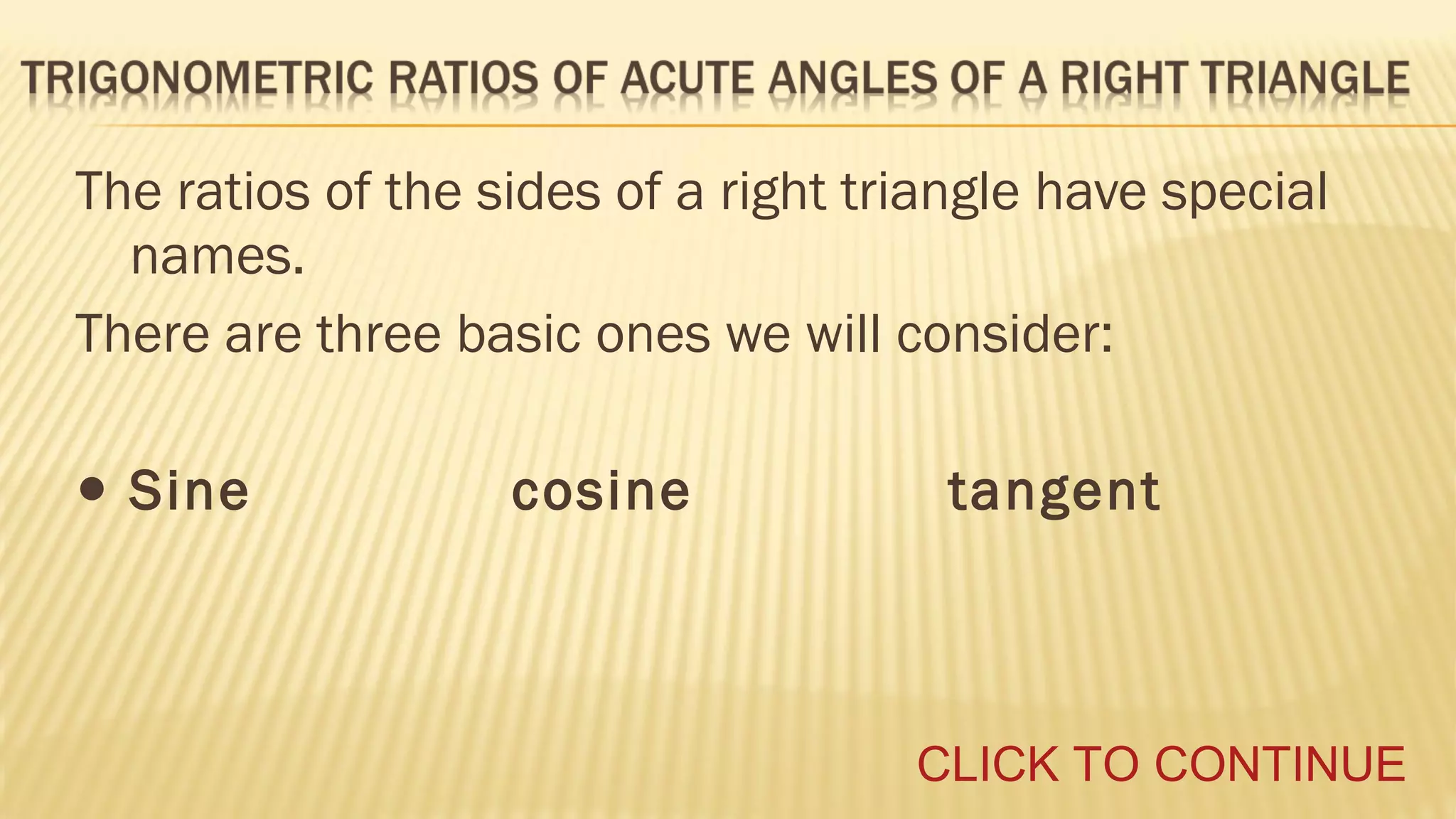
The ratios of the sides of a right triangle have special
names.
There are three basic ones we will consider:

• Sine

cosine

tangent

CLICK TO CONTINUE
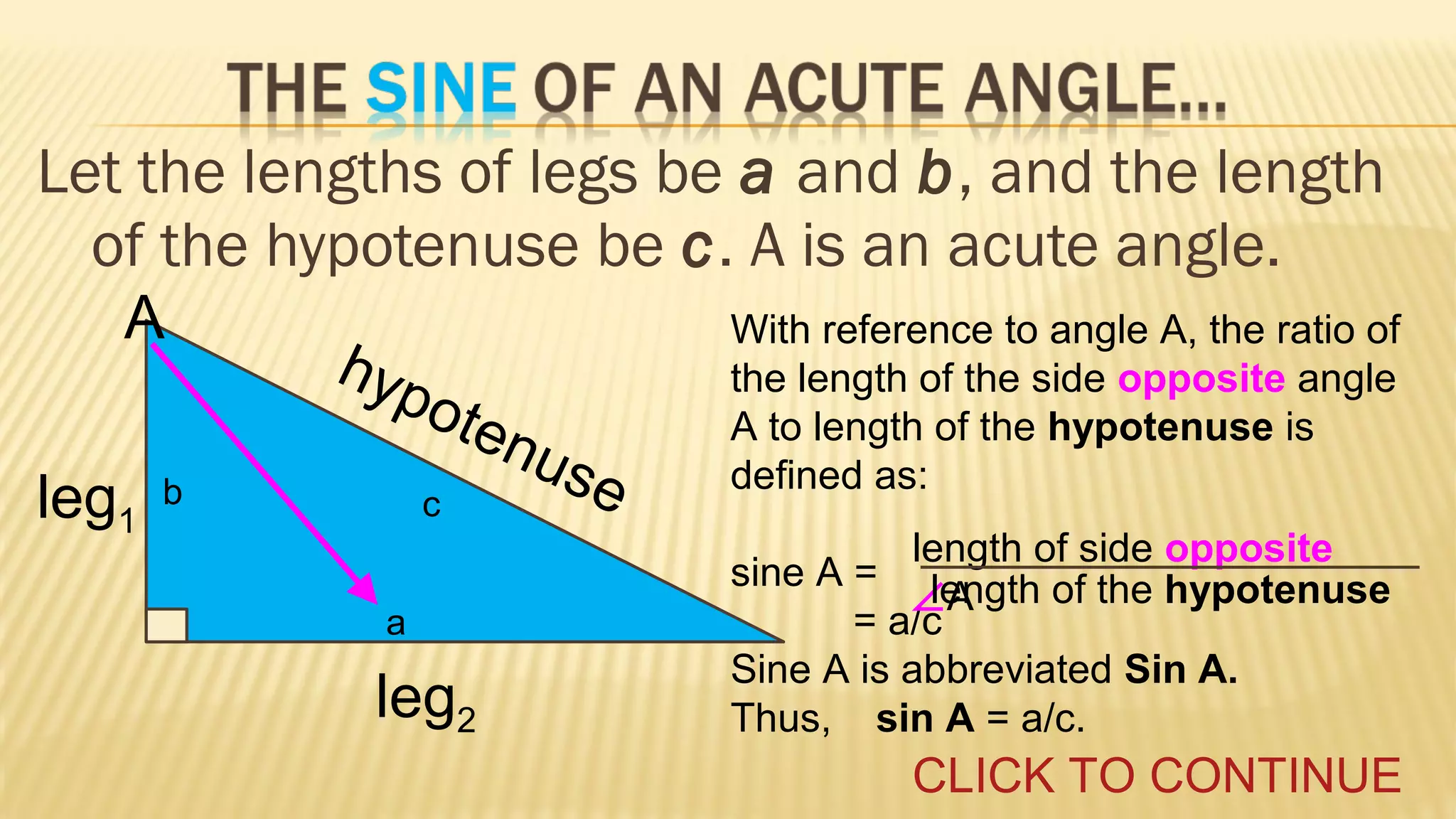
Let the lengths of legs be a and b, and the length
of the hypotenuse be c. A is an acute angle.
A
leg1

hyp
o

ten
use
c

b
a

leg2

With reference to angle A, the ratio of
the length of the side opposite angle
A to length of the hypotenuse is
defined as:
length of side opposite
sine A = length of the hypotenuse
∠A
= a/c
Sine A is abbreviated Sin A.
Thus, sin A = a/c.

CLICK TO CONTINUE
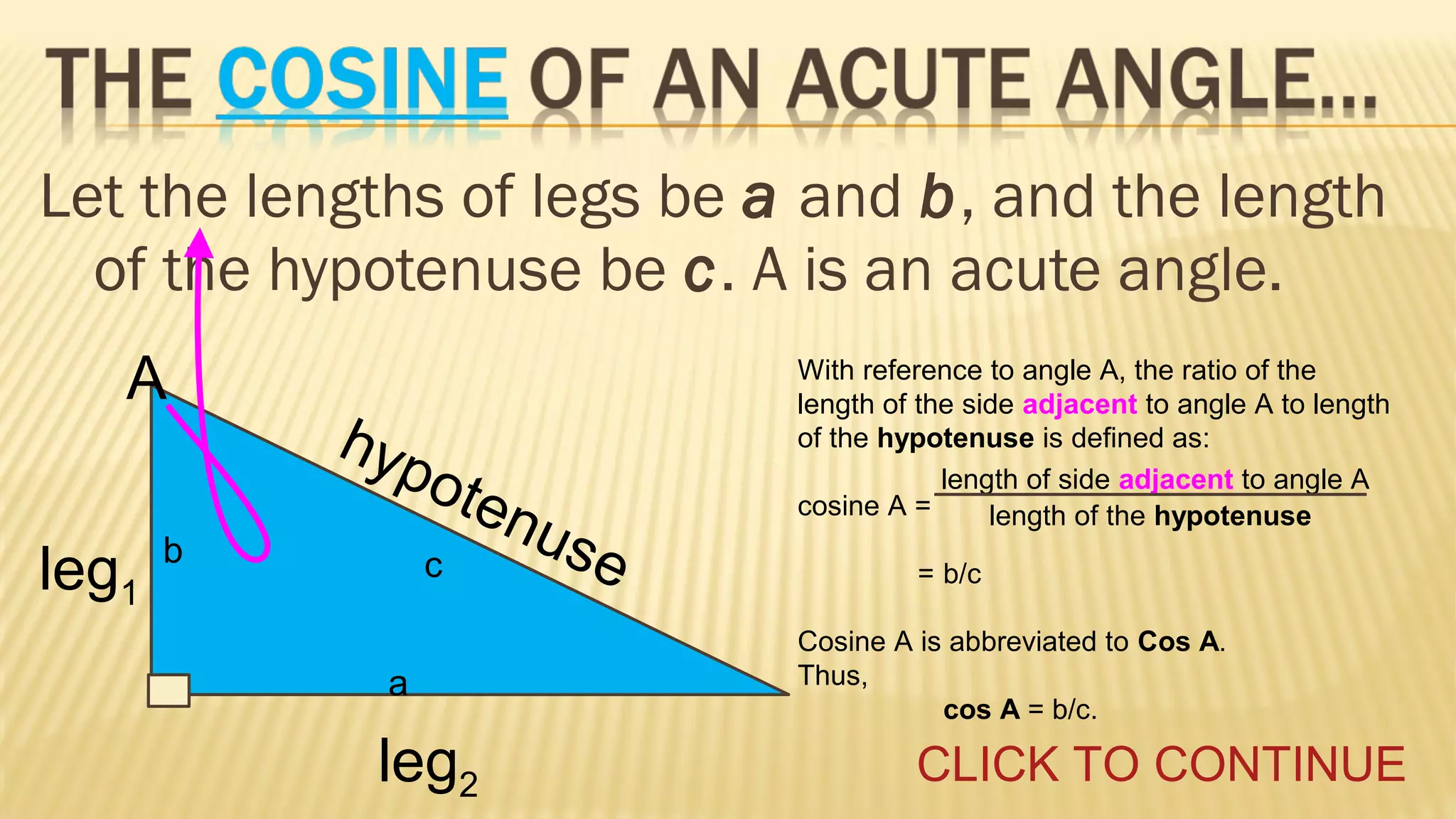
Let the lengths of legs be a and b, and the length
of the hypotenuse be c. A is an acute angle.
A
leg1

hyp
o

ten
use
c

b

a

leg2

With reference to angle A, the ratio of the
length of the side adjacent to angle A to length
of the hypotenuse is defined as:
length of side adjacent to angle A
cosine A =
length of the hypotenuse
= b/c
Cosine A is abbreviated to Cos A.
Thus,
cos A = b/c.

CLICK TO CONTINUE
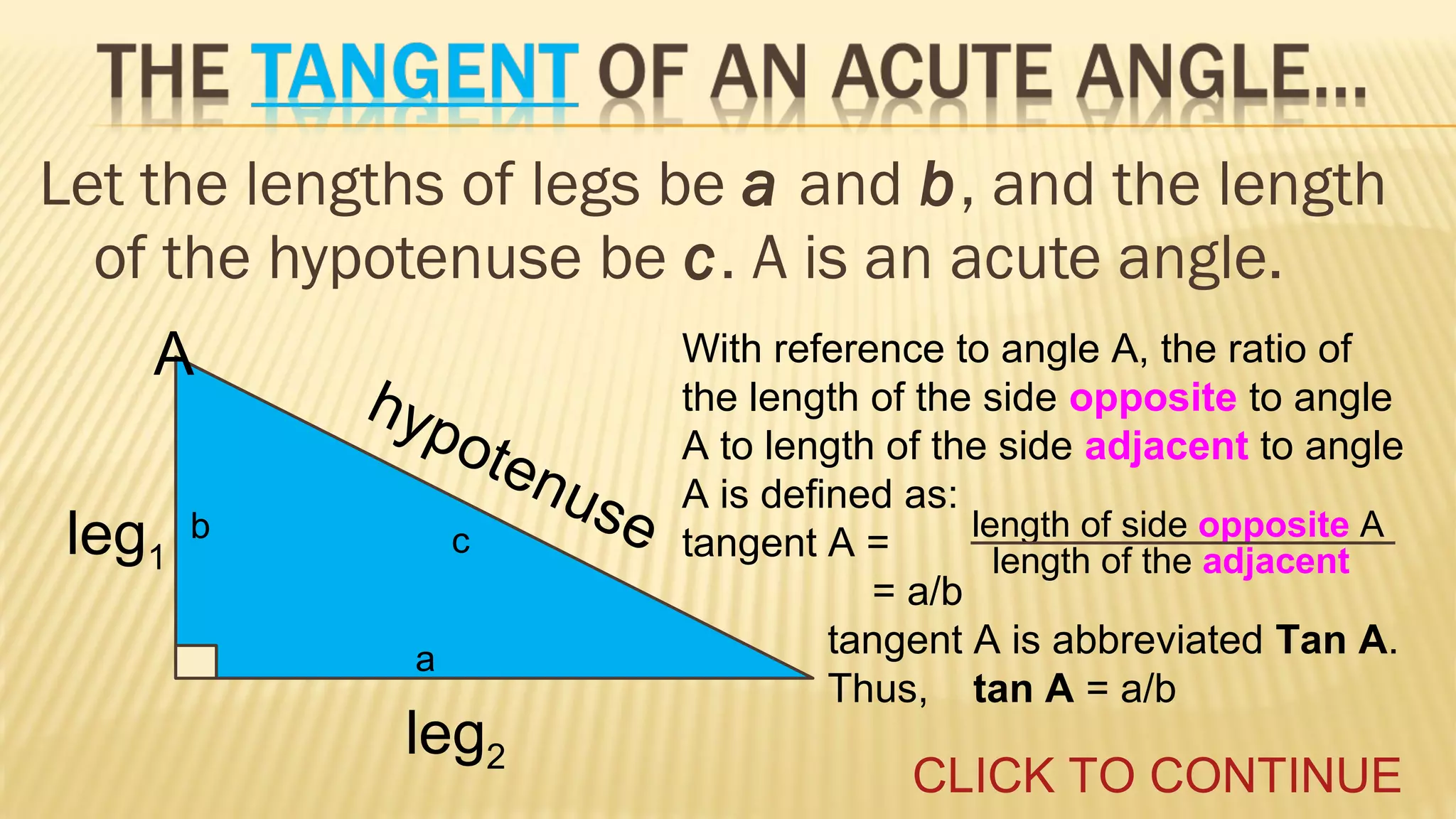
Let the lengths of legs be a and b, and the length
of the hypotenuse be c. A is an acute angle.
A
leg1

hyp
ot

b

c

enu
s

a

leg2

e

With reference to angle A, the ratio of
the length of the side opposite to angle
A to length of the side adjacent to angle
A is defined as:
length of side opposite A
tangent A =
length of the adjacent
= a/b
tangent A is abbreviated Tan A.
Thus, tan A = a/b

CLICK TO CONTINUE
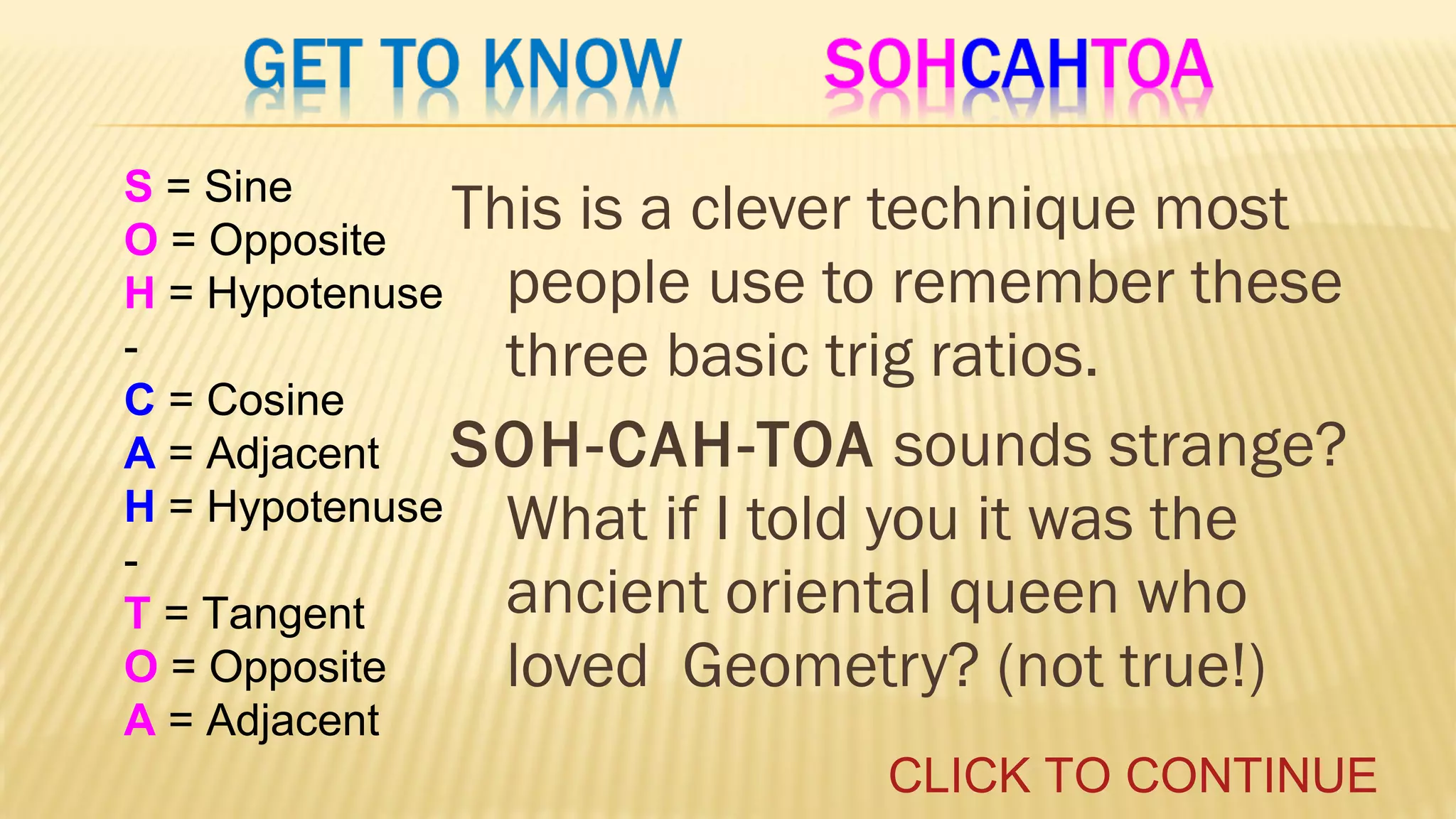
S = Sine
This is a clever technique most
O = Opposite
H = Hypotenuse people use to remember these
three basic trig ratios.
C = Cosine
SOH-CAH-TOA sounds strange?
A = Adjacent
H = Hypotenuse What if I told you it was the
ancient oriental queen who
T = Tangent
O = Opposite
loved Geometry? (not true!)
A = Adjacent

CLICK TO CONTINUE
Find the sine of the given angle. [SOHCAHTOA ]
Sin B = Opposite/Hypotenuse
sin 53.10 = 16/20 = 4/5 = 0.80
20
16

53.10
12

Cos B = Adjacent/Hypotenuse
Cos 53.10 = 12/20 = 3/5 = 0.60
B

Tan B = Opposite/Adjacent
Tan 53.10 = 16/12 = 5/3 =1.67
CLICK TO CONTINUE
Find the value of sine, cosine, and tangent
of the given acute angle. [SOHCAHTOA!]
B

Click to choose your answer from the choices
sin 53.10 =? A. 5/3

53.10

15

B. 3/5

C. 4/3

D. 3/4

E. 4/5

F. 5/4

9
A. 5/3

B. 3/5

C. 4/3

D. 3/4

E. 4/5

F. 5/4

tan 53.10 =? A. 5/3

B. 3/5

C. 4/3

D. 3/4

E. 4/5

F. 5/4

cos 53.10 =?

12

CLICK TO CONTINUE
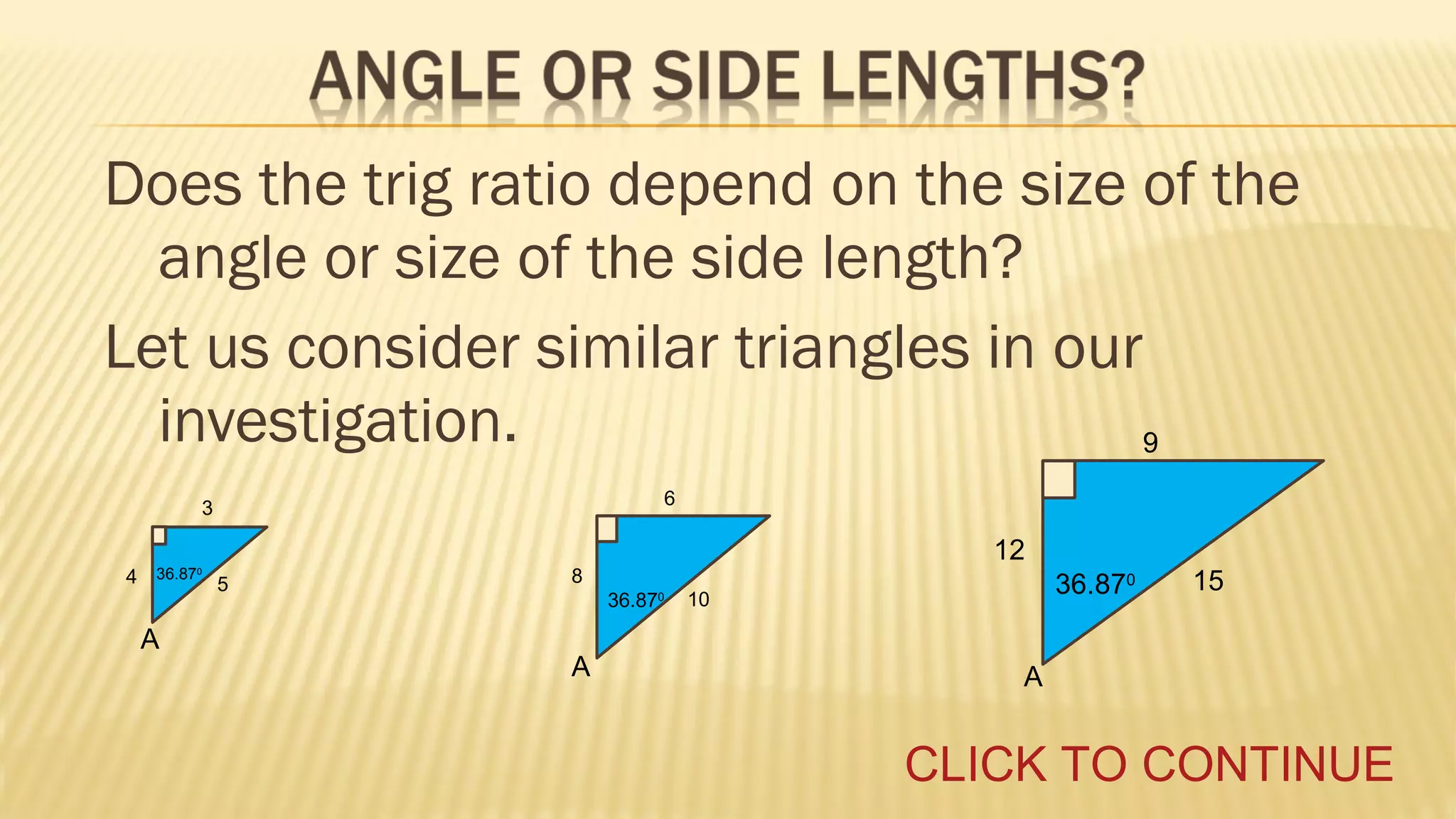
Does the trig ratio depend on the size of the
angle or size of the side length?
Let us consider similar triangles in our
investigation.
9
6

3
4

36.870

A

5

12

8
36.870

A

36.870

10

15

A

CLICK TO CONTINUE
9

[Remember
SOHCAHTOA!]
•
Compute the ratios
and make a
conjecture

6

12

3

36.870

8
4

36.870

36.870

5

A

10

A

15

A

sin 36.870

⅗ = 0.6

6/10 = 0.6

9/15 = 0.6

cos 36.870

⅘ = 0.8

8/10 = 0.8

12/15 = 0.8

tan 36.870

¾ =0.75

6/8 = 0.75

9/12 = 0.75

Conjecture: Trigonometric ratios are a property of similarity (angles)
and not of the length of the sides of a right triangle.

CLICK TO CONTINUE
• The trig ratios are used so often that
•
•

technology makes these values readily
available in the form of tables and on
scientific calculators .
We will now show you how to use your
calculator to find some trig ratios.
Grab a scientific calculator and try it out.
CLICK TO CONTINUE
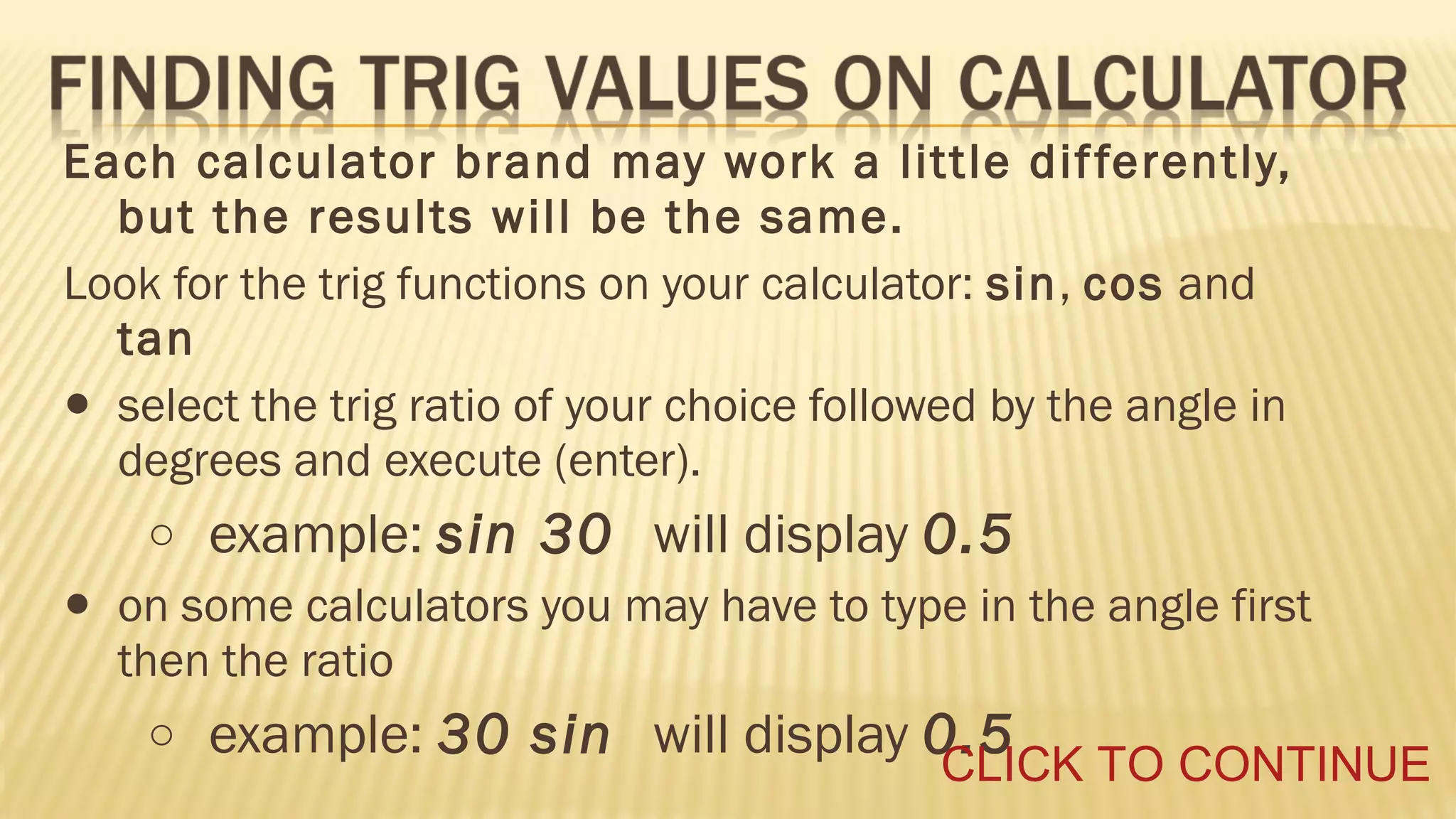
Each calculator brand may work a little dif ferently,
but the results will be the same.
Look for the trig functions on your calculator: sin, cos and
tan
select the trig ratio of your choice followed by the angle in
degrees and execute (enter).

•

o

•

example: sin 30 will display 0.5

on some calculators you may have to type in the angle first
then the ratio
o

example: 30 sin will display 0.5

CLICK TO CONTINUE
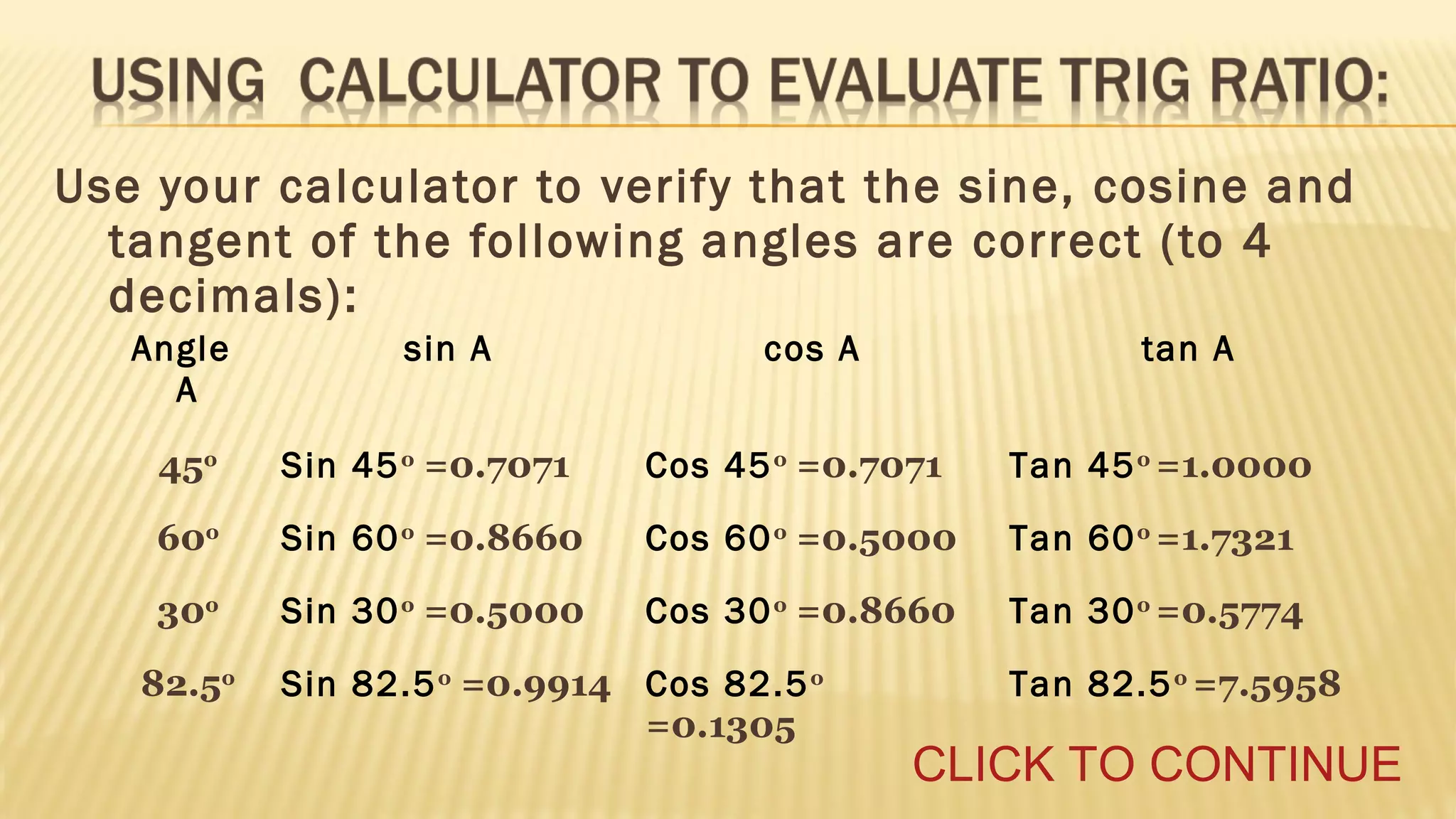
Use your calculator to verify that the sine, cosine and
tangent of the following angles are correct (to 4
decimals):
Angle
A

sin A

cos A

tan A

45o

Sin 45 o =0.7071

Cos 45 o =0.7071

Tan 45 o =1.0000

60o

Sin 60 o =0.8660

Cos 60 o =0.5000

Tan 60 o =1.7321

30o

Sin 30 o =0.5000

Cos 30 o =0.8660

Tan 30 o =0.5774

82.5o

Sin 82.5 o =0.9914 Cos 82.5 o
=0.1305

Tan 82.5 o =7.5958

CLICK TO CONTINUE
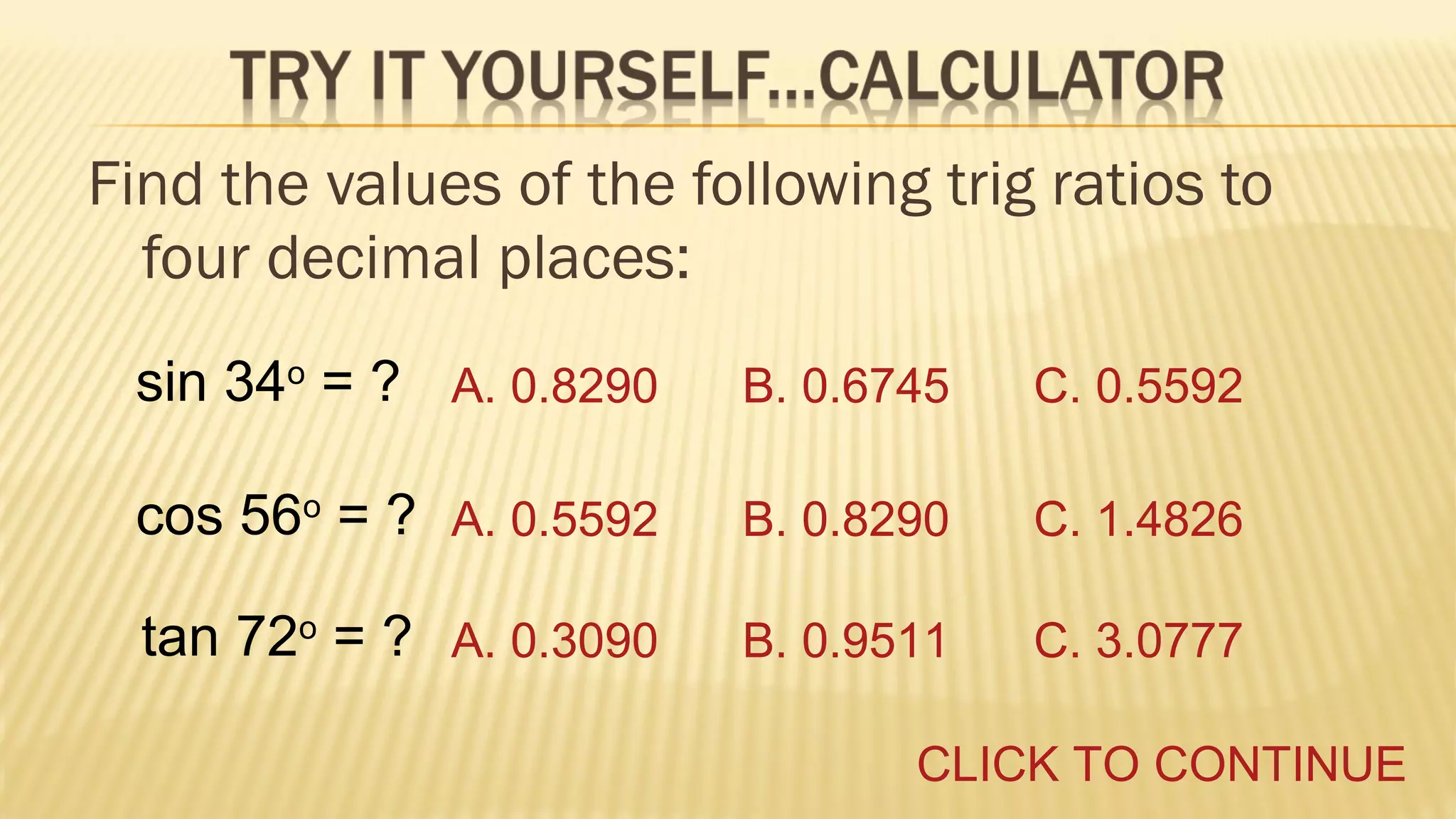
Find the values of the following trig ratios to
four decimal places:
sin 34o = ? A. 0.8290

B. 0.6745

C. 0.5592

cos 56o = ? A. 0.5592

B. 0.8290

C. 1.4826

tan 72o = ? A. 0.3090

B. 0.9511

C. 3.0777

CLICK TO CONTINUE
•
•

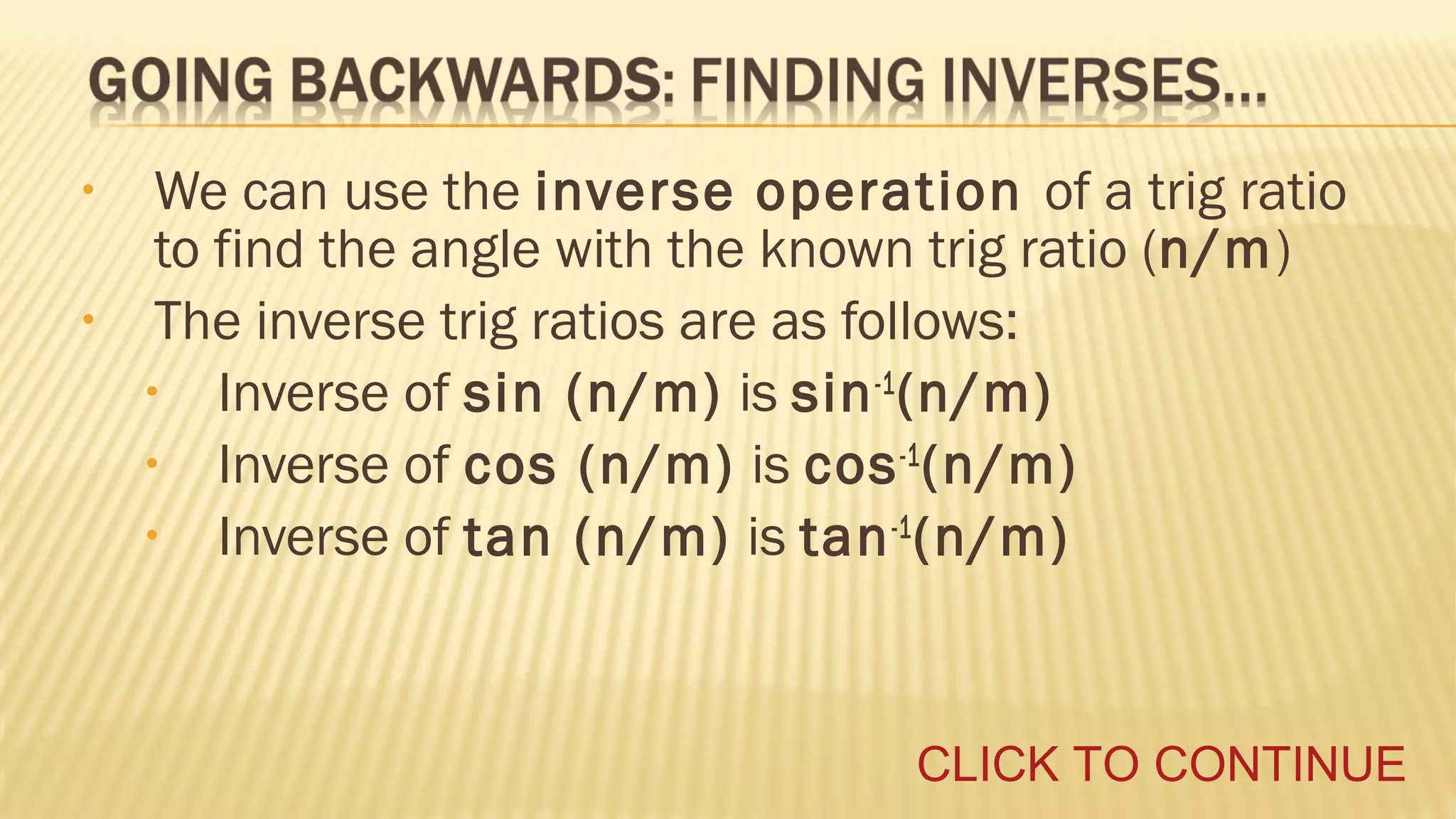
We can use the inverse operation of a trig ratio
to find the angle with the known trig ratio (n/m)
The inverse trig ratios are as follows:
• Inverse of sin (n/m) is sin -1 (n/m)
• Inverse of cos (n/m) is cos -1 (n/m)
• Inverse of tan (n/m) is tan -1 (n/m)

CLICK TO CONTINUE
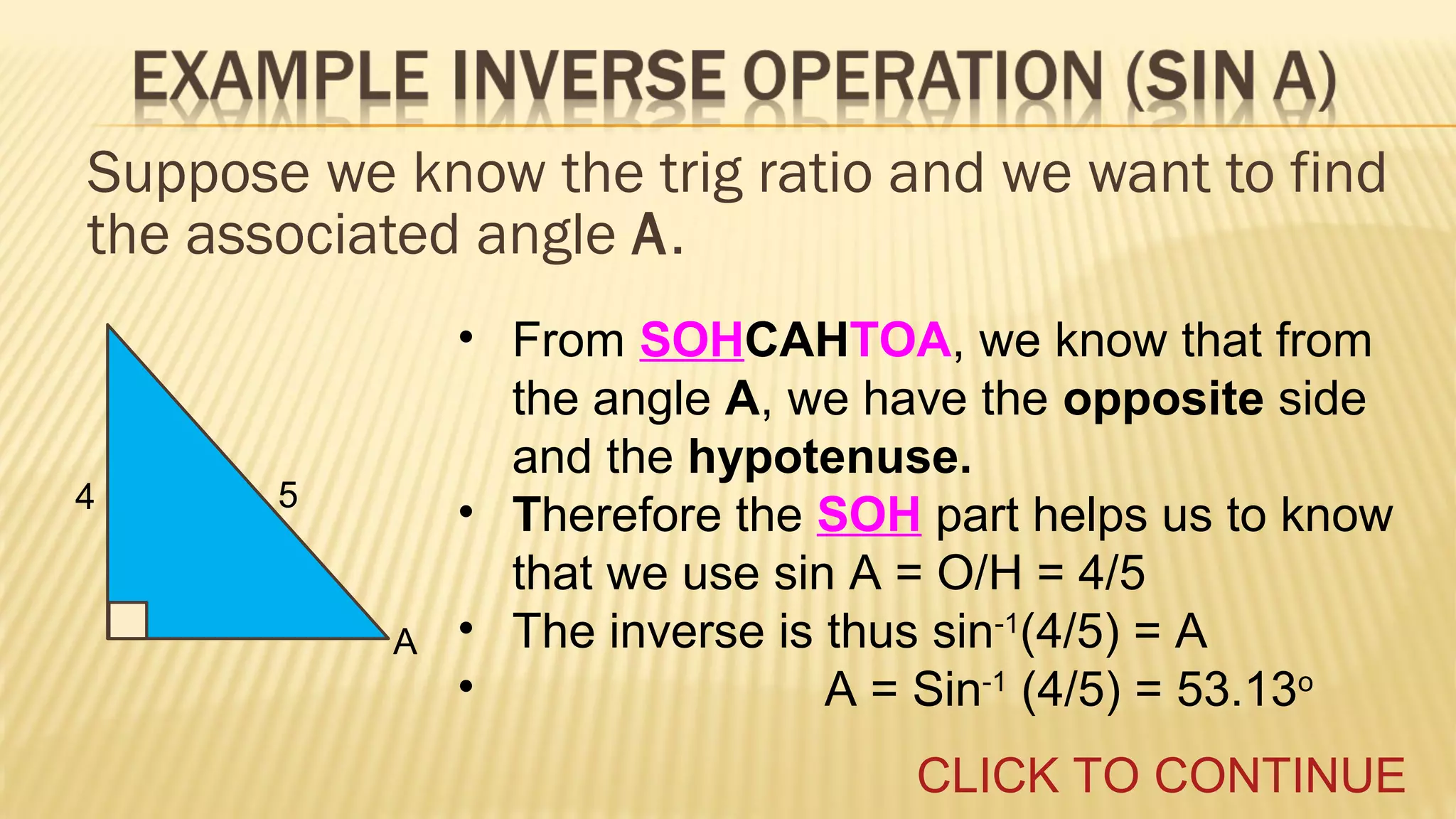
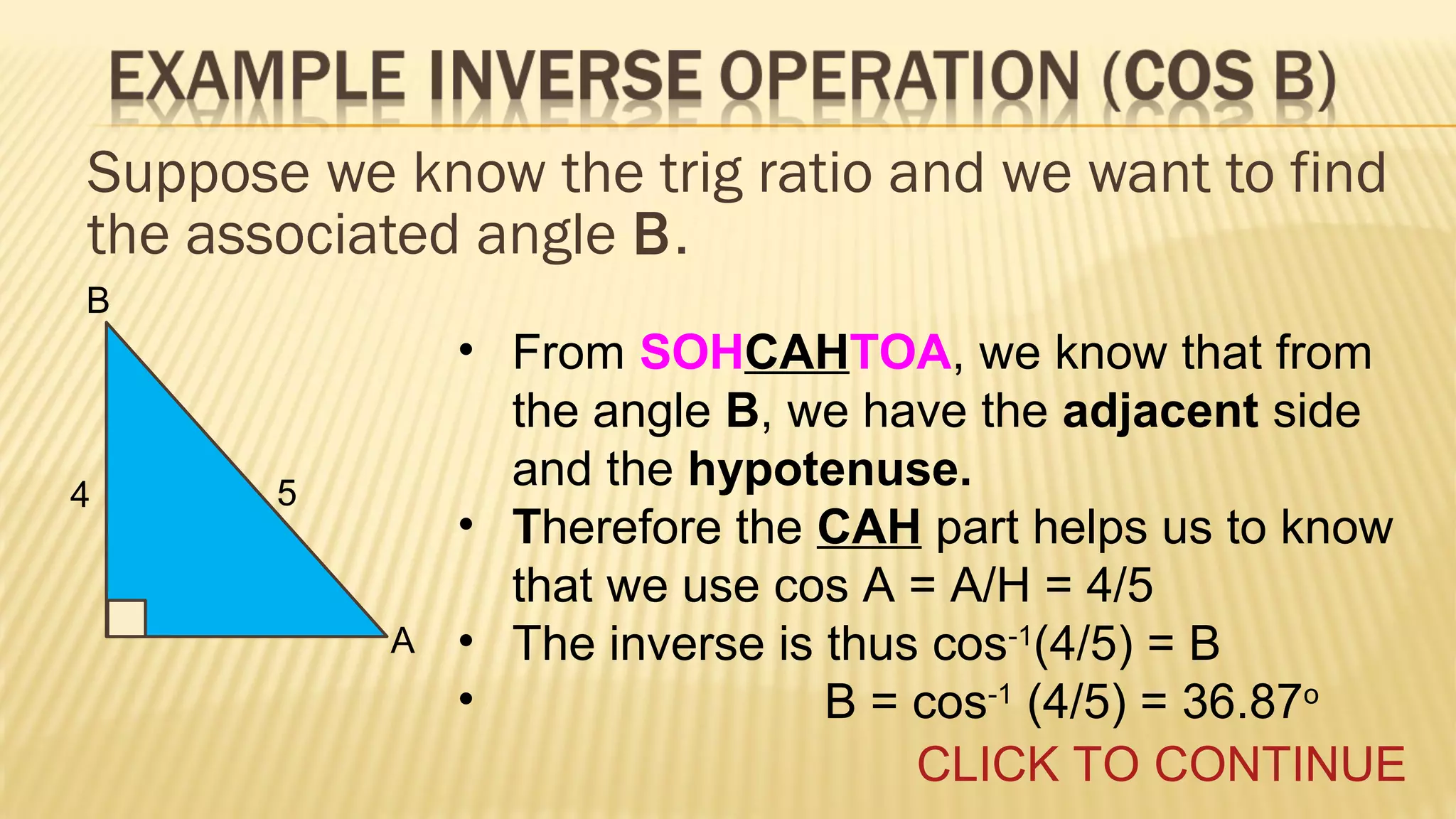
Suppose we know the trig ratio and we want to find
the associated angle A.

4

5

A

• From SOHCAHTOA, we know that from
the angle A, we have the opposite side
and the hypotenuse.
• Therefore the SOH part helps us to know
that we use sin A = O/H = 4/5
• The inverse is thus sin-1(4/5) = A
•
A = Sin-1 (4/5) = 53.13o
CLICK TO CONTINUE
Suppose we know the trig ratio and we want to find
the associated angle B.
B

4

5

A

• From SOHCAHTOA, we know that from
the angle B, we have the adjacent side
and the hypotenuse.
• Therefore the CAH part helps us to know
that we use cos A = A/H = 4/5
• The inverse is thus cos-1(4/5) = B
•
B = cos-1 (4/5) = 36.87o
CLICK TO CONTINUE
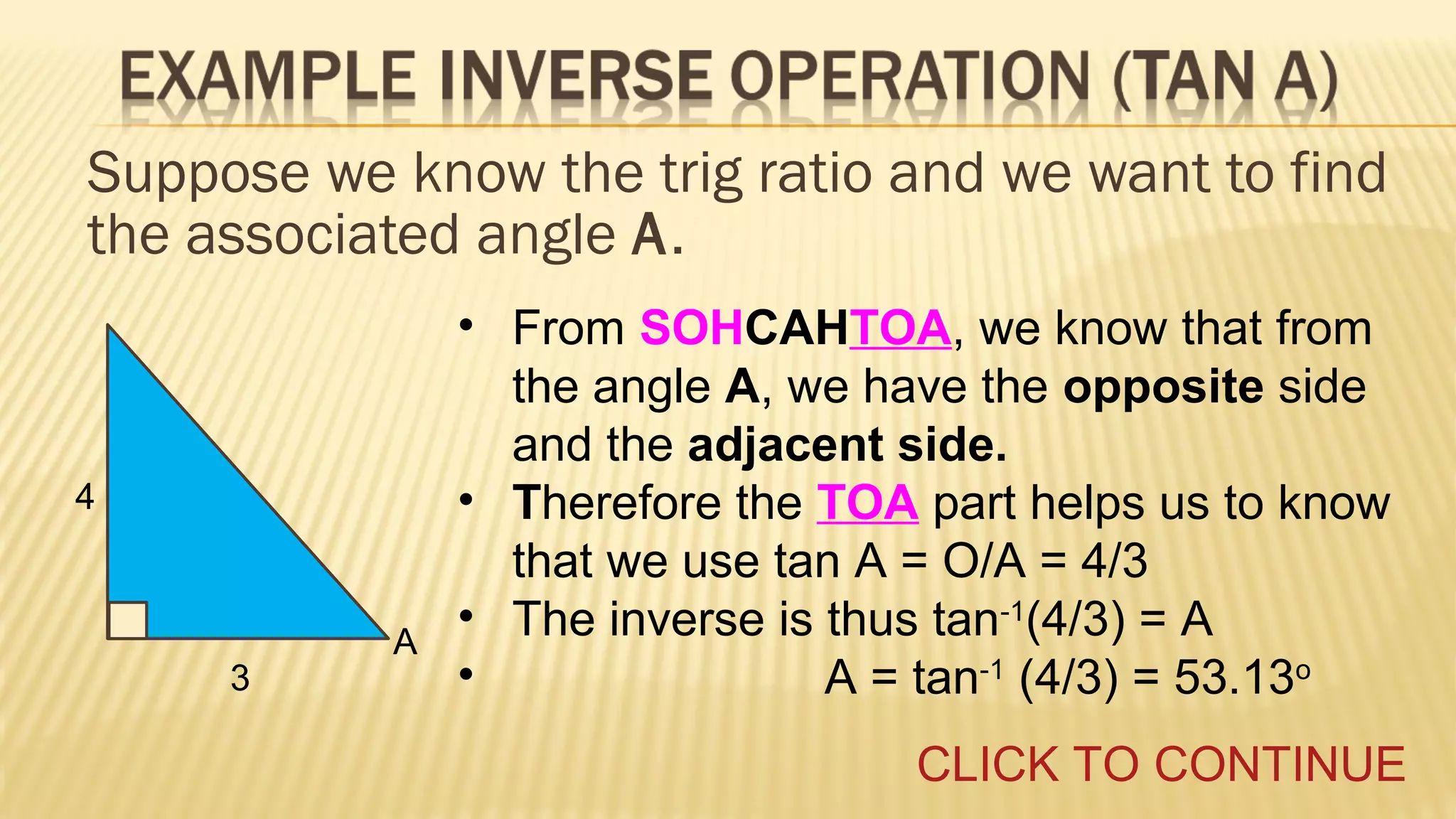
Suppose we know the trig ratio and we want to find
the associated angle A.

4

3

A

• From SOHCAHTOA, we know that from
the angle A, we have the opposite side
and the adjacent side.
• Therefore the TOA part helps us to know
that we use tan A = O/A = 4/3
• The inverse is thus tan-1(4/3) = A
•
A = tan-1 (4/3) = 53.13o
CLICK TO CONTINUE
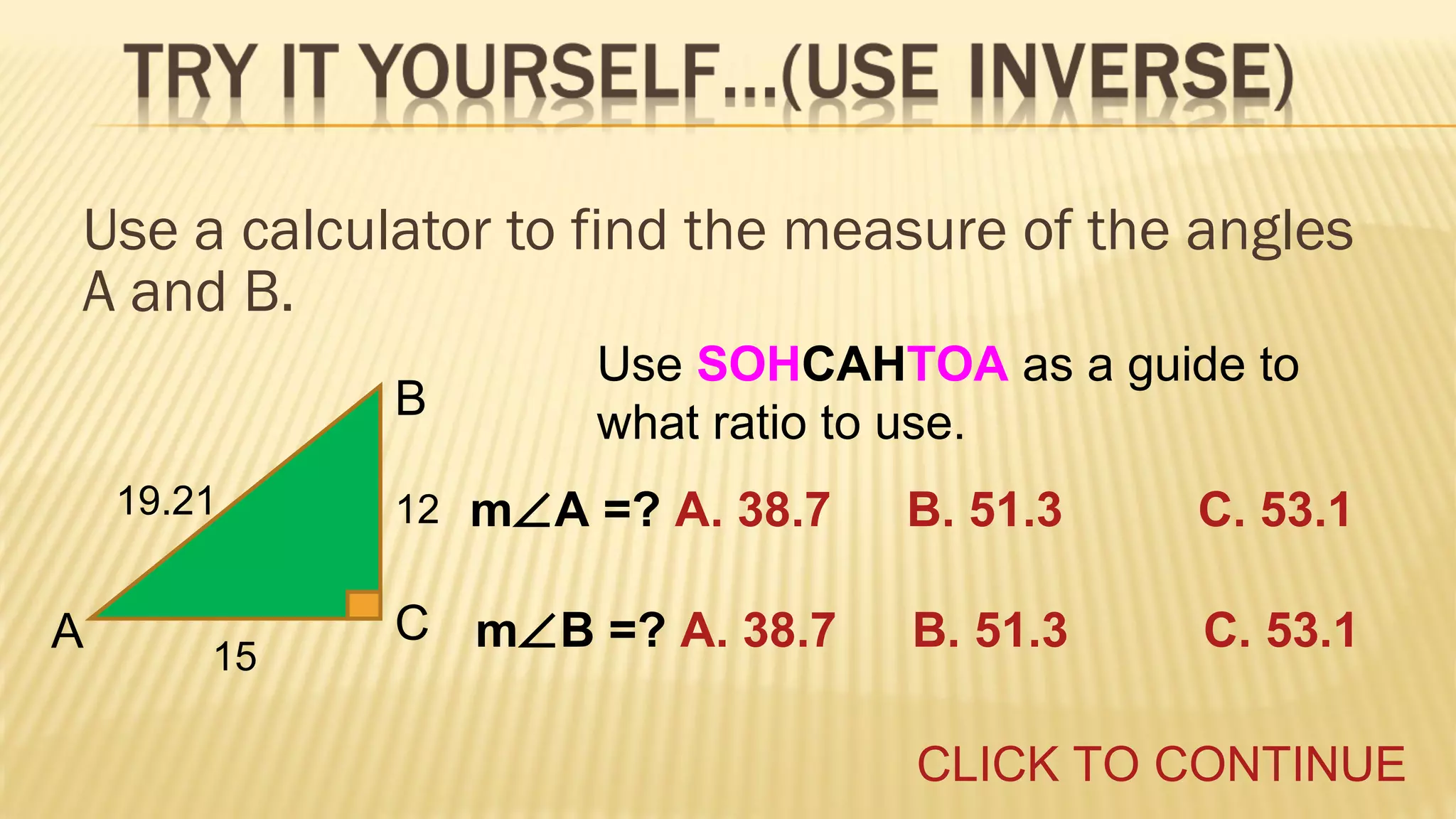
Use a calculator to find the measure of the angles
A and B.
B
19.21

A

15

Use SOHCAHTOA as a guide to
what ratio to use.
m∠A =? A. 38.7

B. 51.3

C. 53.1

C m∠B =? A. 38.7

B. 51.3

C. 53.1

12

CLICK TO CONTINUE
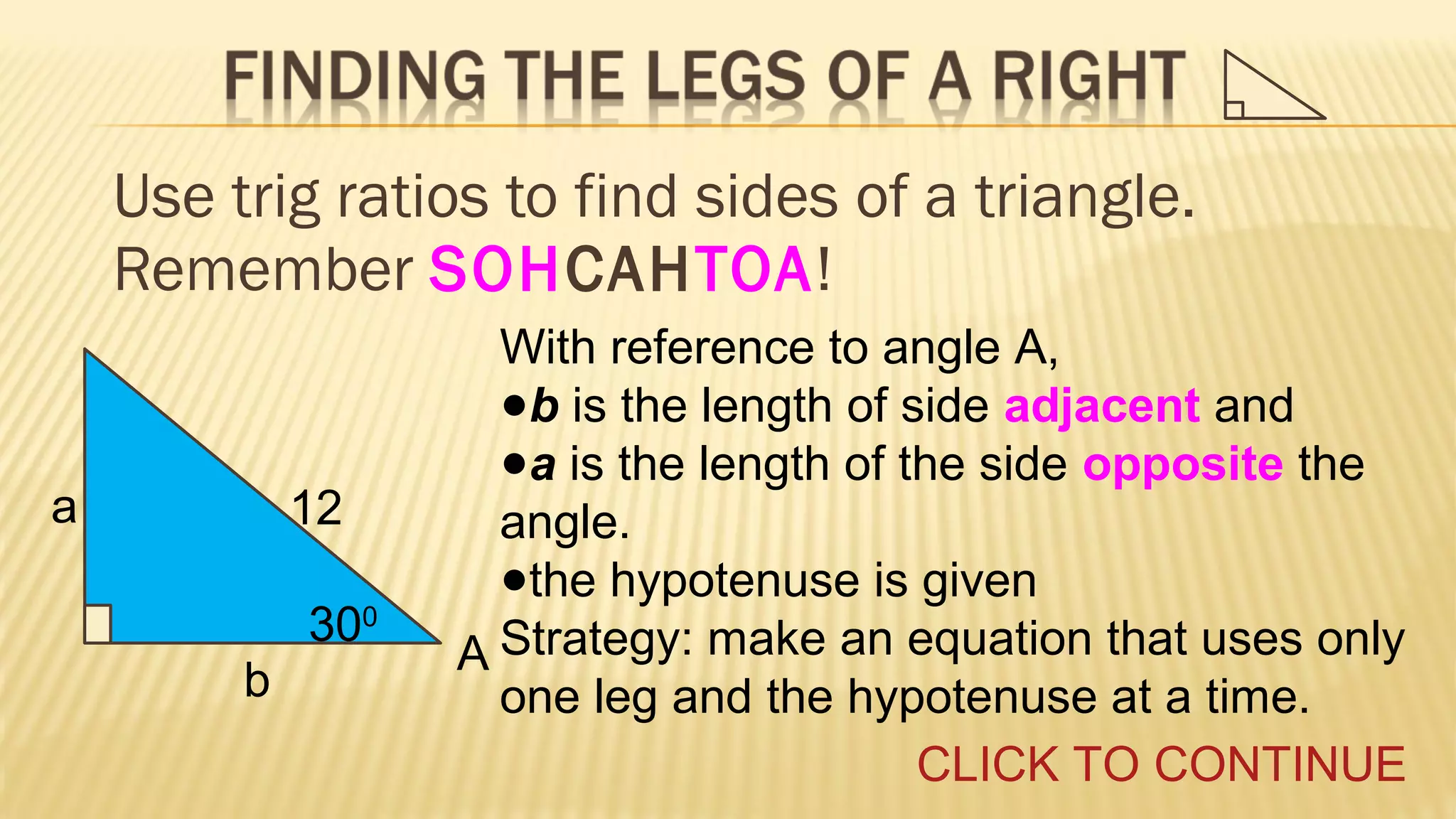
Use trig ratios to find sides of a triangle.
Remember SOHCAHTOA!

a

12
300
b

With reference to angle A,
●b is the length of side adjacent and
●a is the length of the side opposite the
angle.
●the hypotenuse is given
A Strategy: make an equation that uses only
one leg and the hypotenuse at a time.
CLICK TO CONTINUE
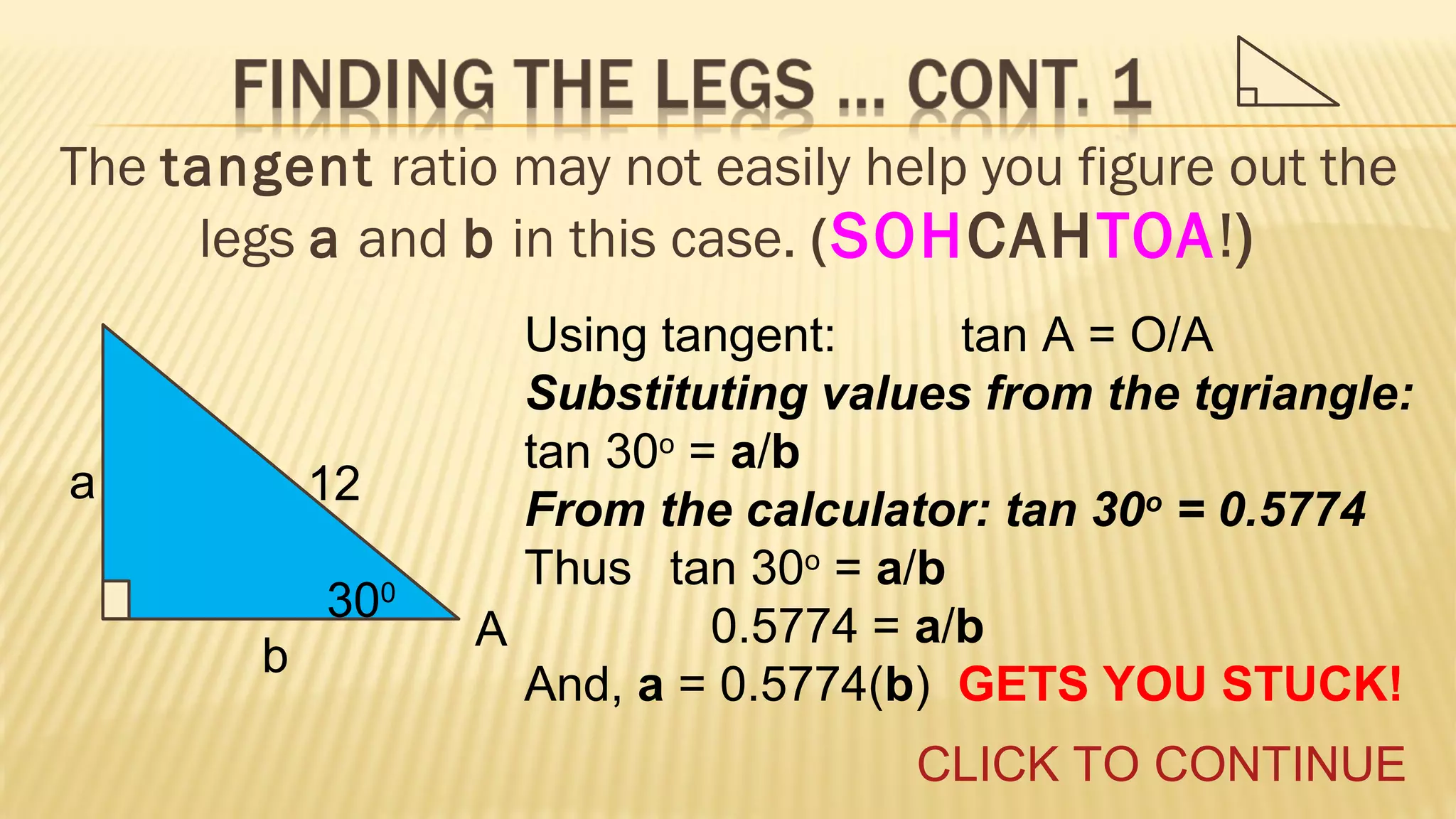
The tangent ratio may not easily help you figure out the
legs a and b in this case. ( SOHCAHTOA!)

a

12
300
b

Using tangent:
tan A = O/A
Substituting values from the tgriangle:
tan 30o = a/b
From the calculator: tan 30o = 0.5774
Thus tan 30o = a/b
0.5774 = a/b
A
And, a = 0.5774(b) GETS YOU STUCK!
CLICK TO CONTINUE
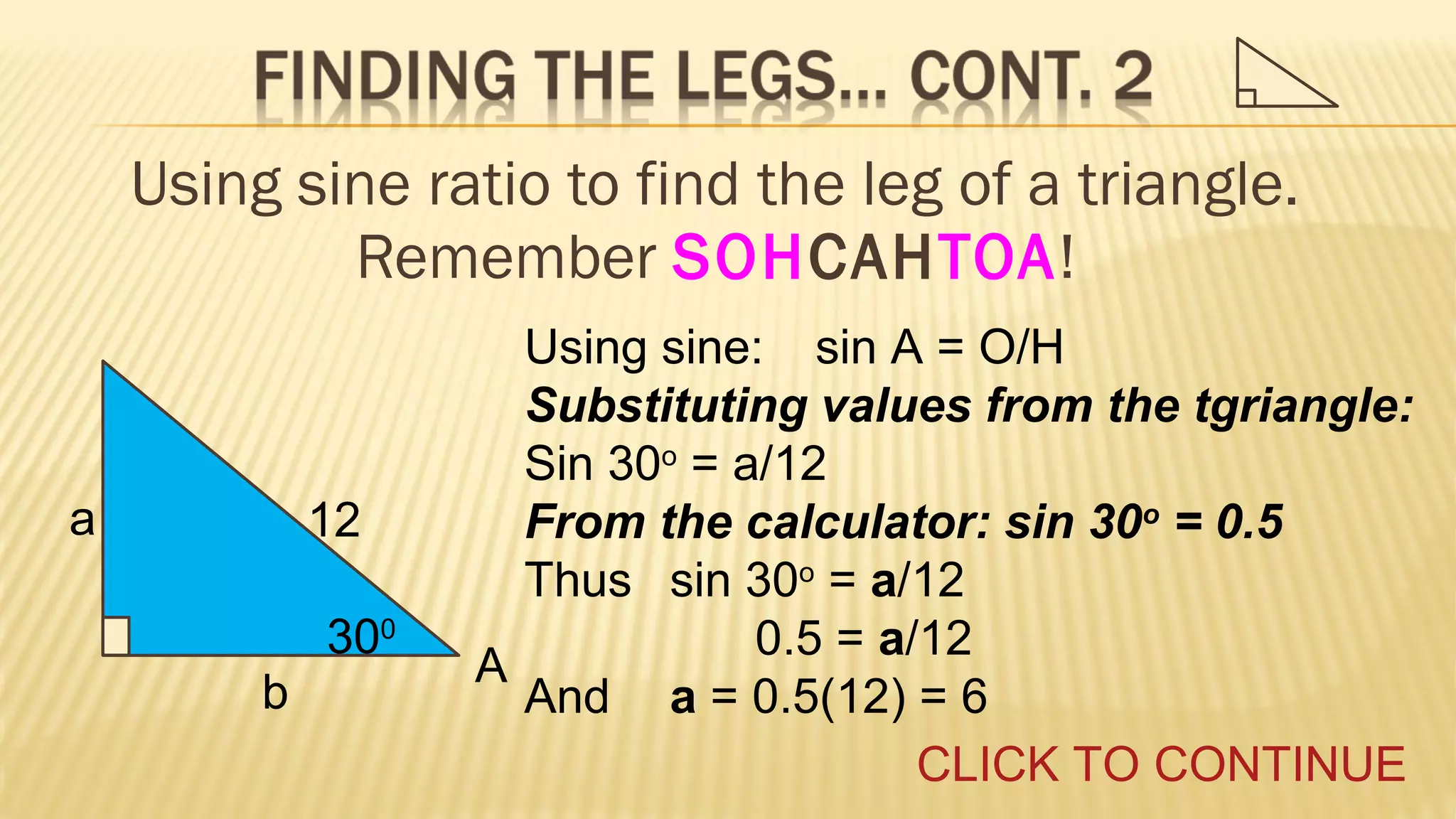
Using sine ratio to find the leg of a triangle.
Remember SOHCAHTOA!

a

12
300
b

Using sine: sin A = O/H
Substituting values from the tgriangle:
Sin 30o = a/12
From the calculator: sin 30o = 0.5
Thus sin 30o = a/12
0.5 = a/12
A
And a = 0.5(12) = 6
CLICK TO CONTINUE
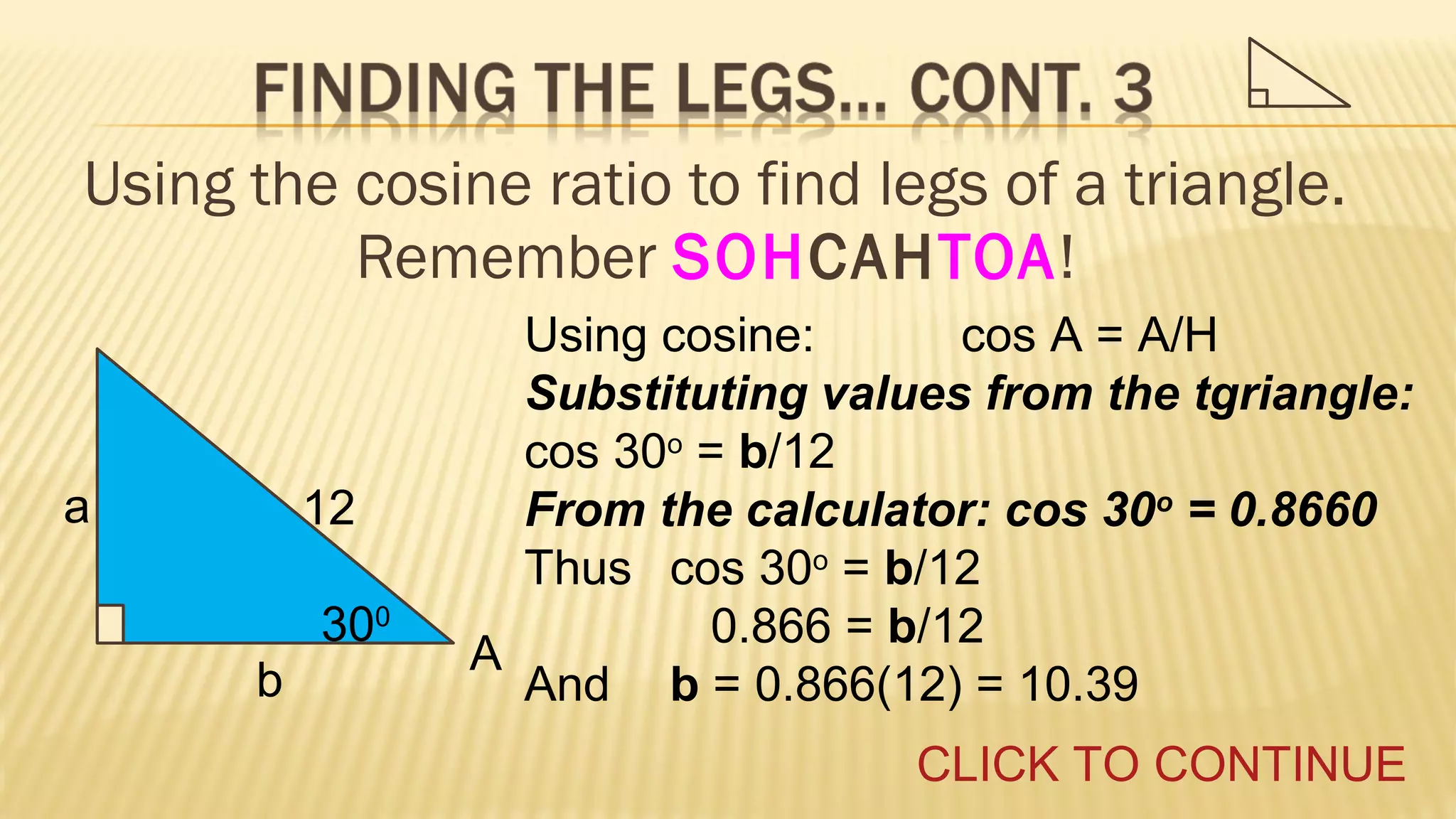
Using the cosine ratio to find legs of a triangle.
Remember SOHCAHTOA!

a

12
300
b

Using cosine:
cos A = A/H
Substituting values from the tgriangle:
cos 30o = b/12
From the calculator: cos 30o = 0.8660
Thus cos 30o = b/12
0.866 = b/12
A
And b = 0.866(12) = 10.39
CLICK TO CONTINUE
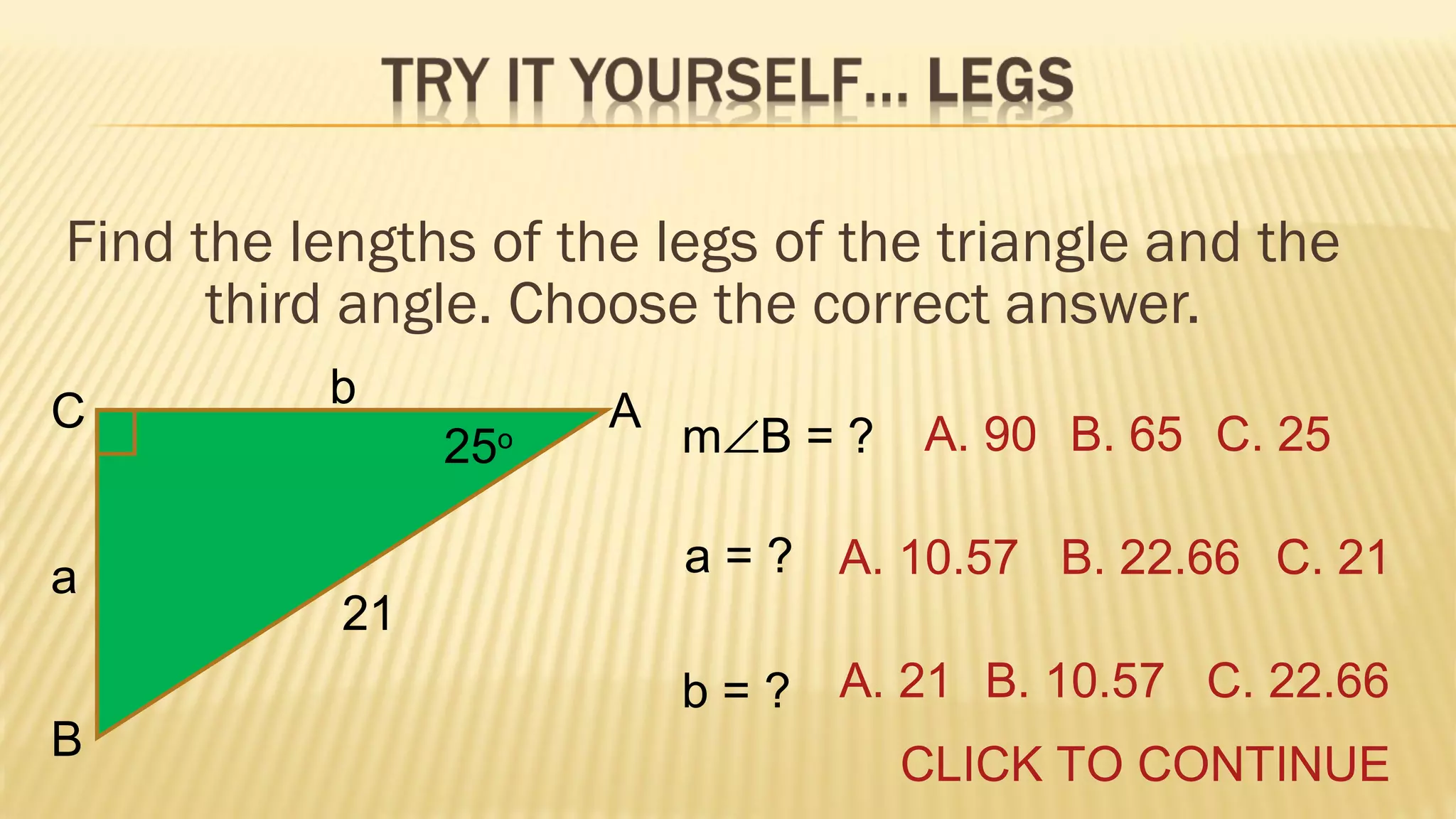
Find the lengths of the legs of the triangle and the
third angle. Choose the correct answer.
C
a
B

b
25

o

A

m∠B = ?

A. 90 B. 65 C. 25

a = ? A. 10.57 B. 22.66 C. 21
21
b = ? A. 21 B. 10.57 C. 22.66
CLICK TO CONTINUE
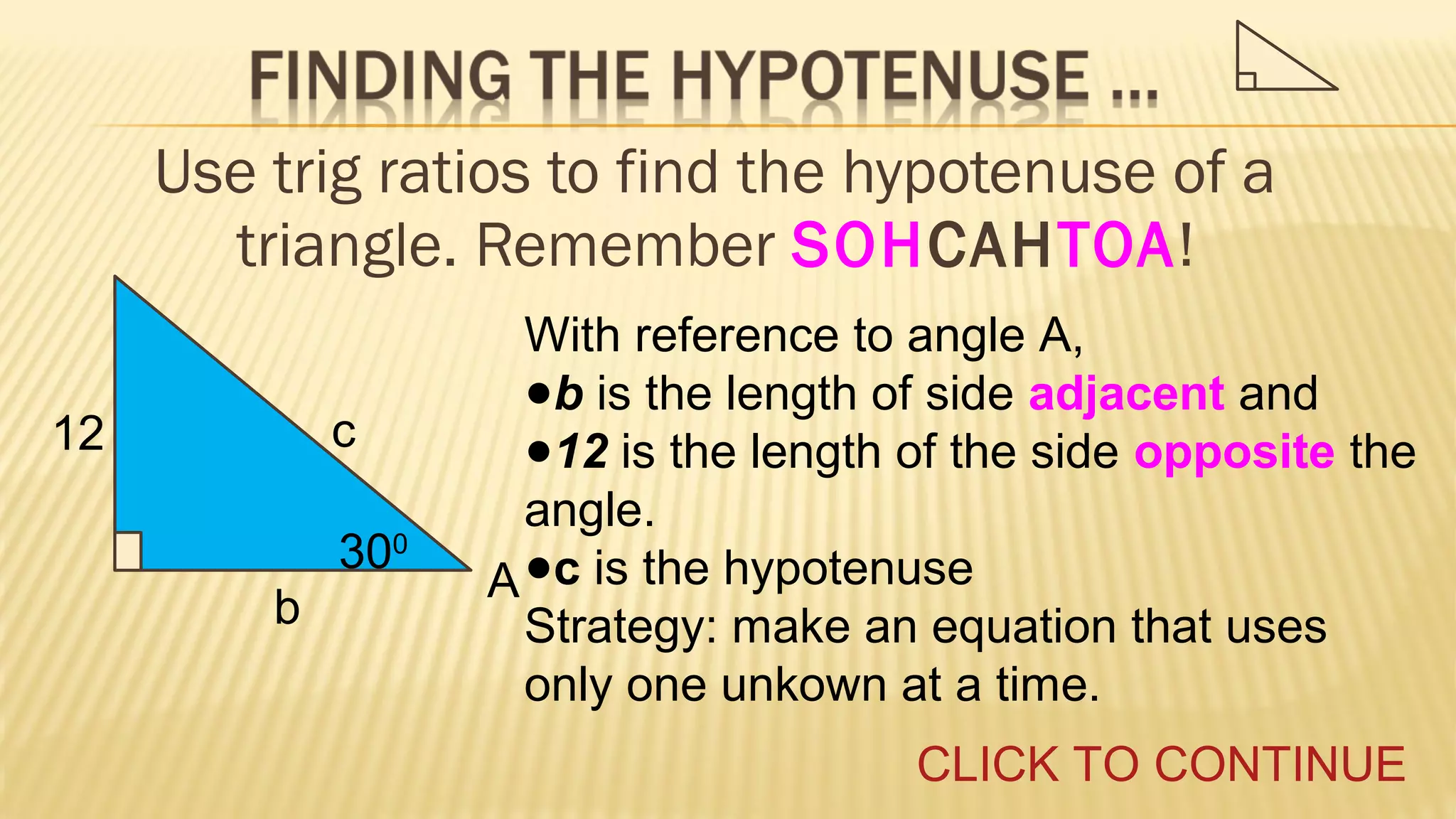
Use trig ratios to find the hypotenuse of a
triangle. Remember SOHCAHTOA!
c

12

300
b

With reference to angle A,
●b is the length of side adjacent and
●12 is the length of the side opposite the
angle.
A ●c is the hypotenuse
Strategy: make an equation that uses
only one unkown at a time.
CLICK TO CONTINUE
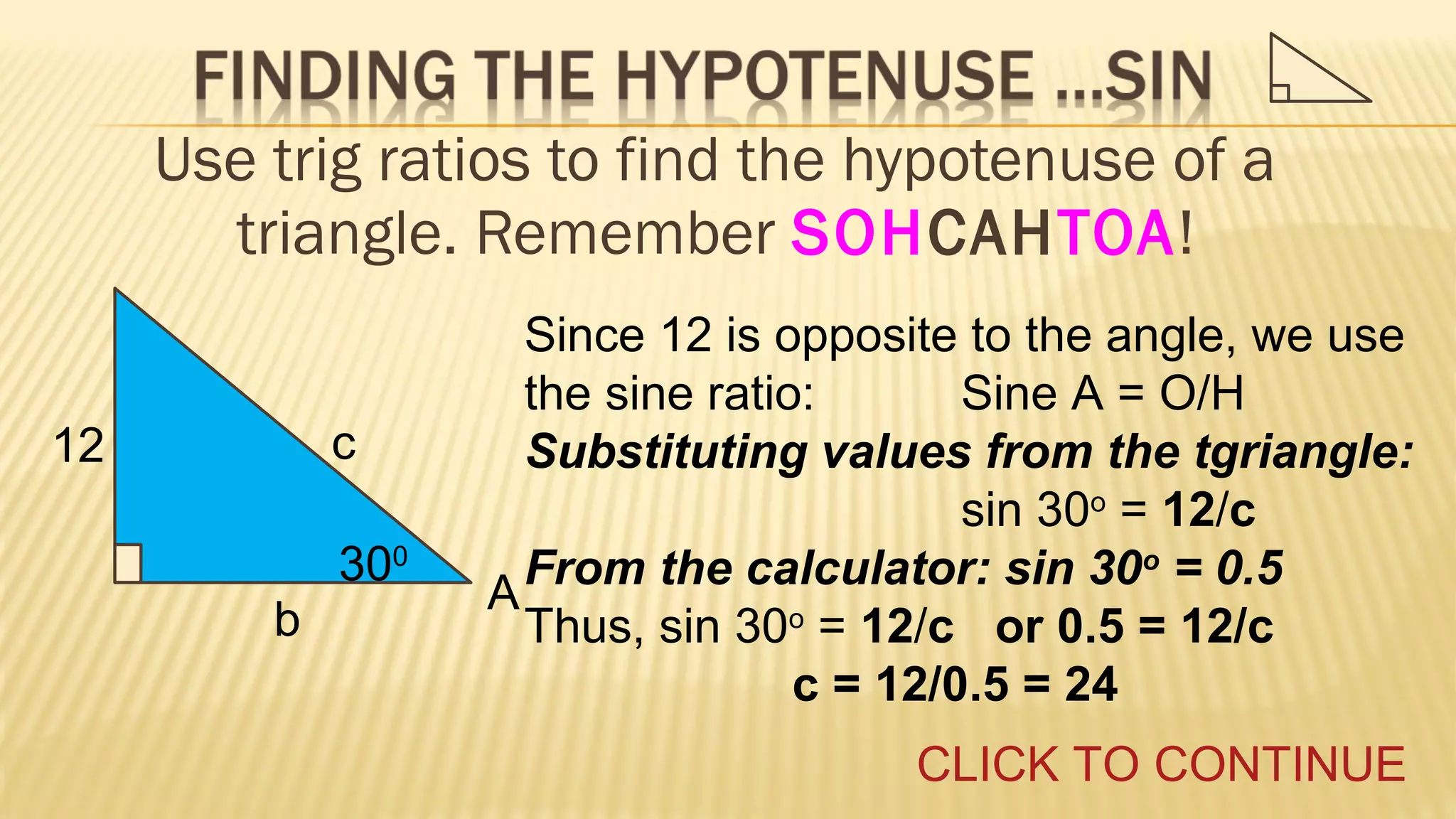
Use trig ratios to find the hypotenuse of a
triangle. Remember SOHCAHTOA!
c

12

300
b

Since 12 is opposite to the angle, we use
the sine ratio:
Sine A = O/H
Substituting values from the tgriangle:
sin 30o = 12/c
From the calculator: sin 30o = 0.5
A
Thus, sin 30o = 12/c or 0.5 = 12/c
c = 12/0.5 = 24
CLICK TO CONTINUE
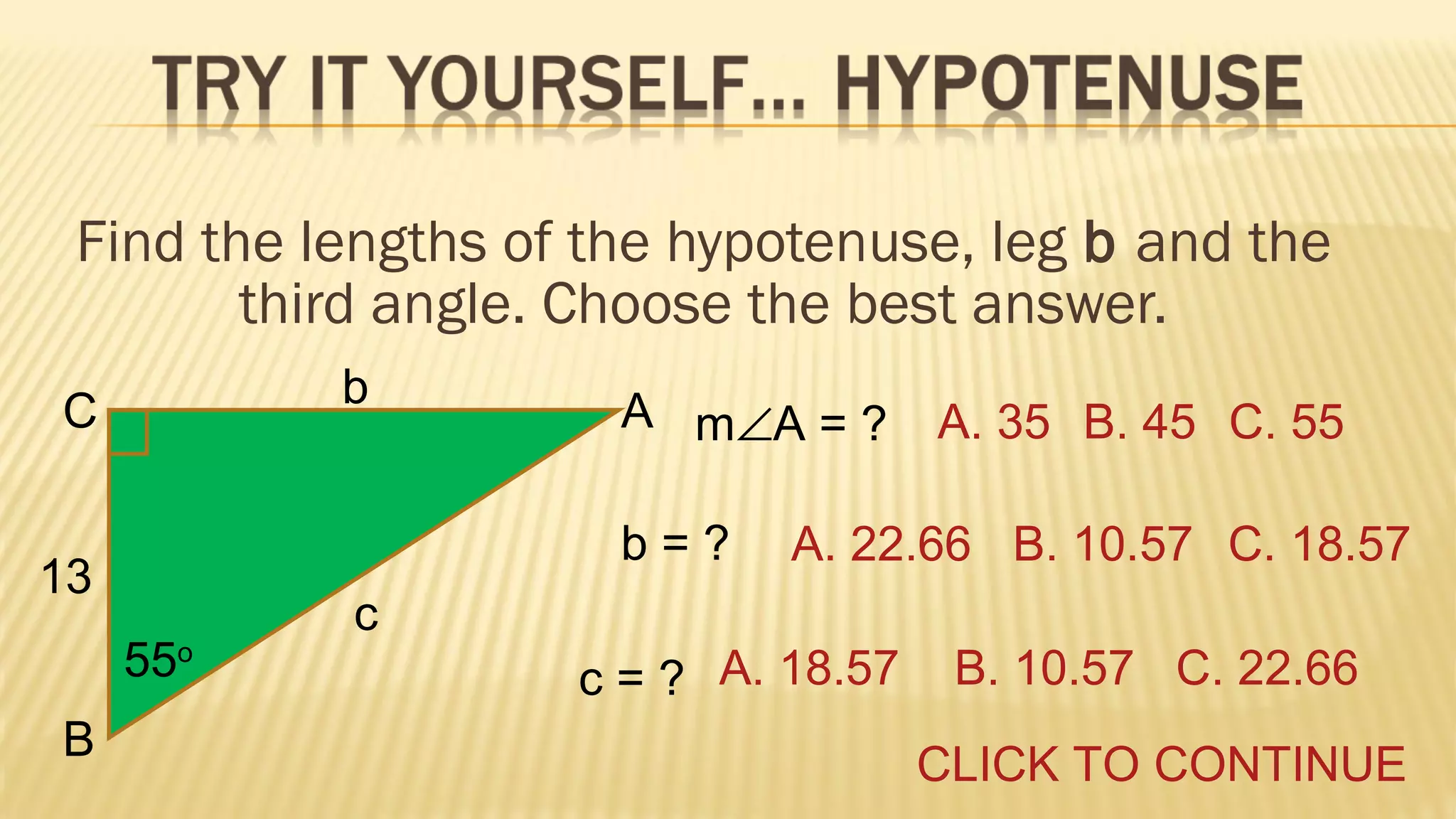
Find the lengths of the hypotenuse, leg b and the
third angle. Choose the best answer.
b

C

b=?

13
55o
B

A m∠A = ?

A. 35 B. 45 C. 55

A. 22.66 B. 10.57 C. 18.57

c
c = ? A. 18.57

B. 10.57 C. 22.66
CLICK TO CONTINUE
•

•

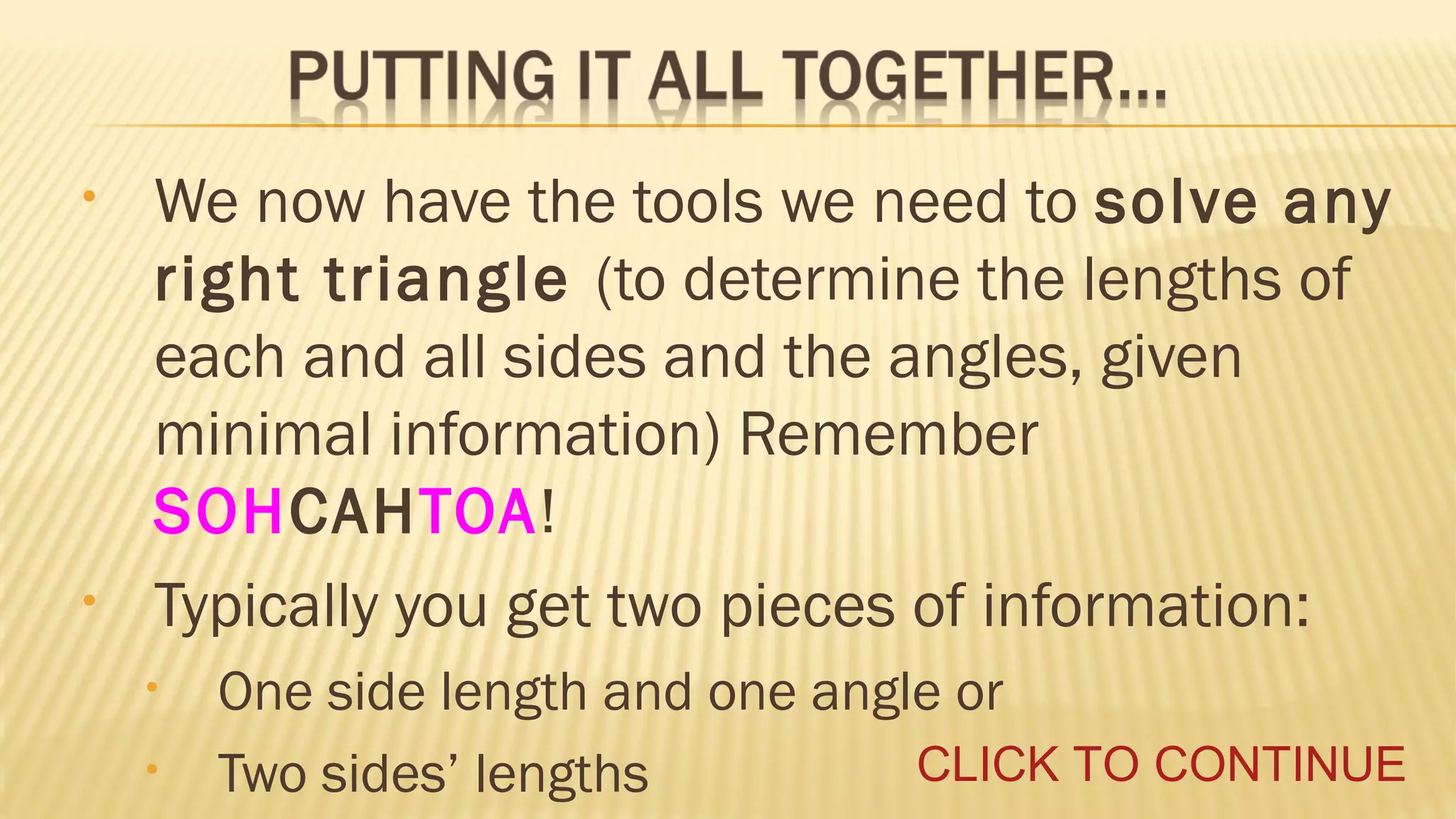
We now have the tools we need to solve any
right triangle (to determine the lengths of
each and all sides and the angles, given
minimal information) Remember
SOHCAHTOA!
Typically you get two pieces of information:
•
•

One side length and one angle or
CLICK TO CONTINUE
Two sides’ lengths
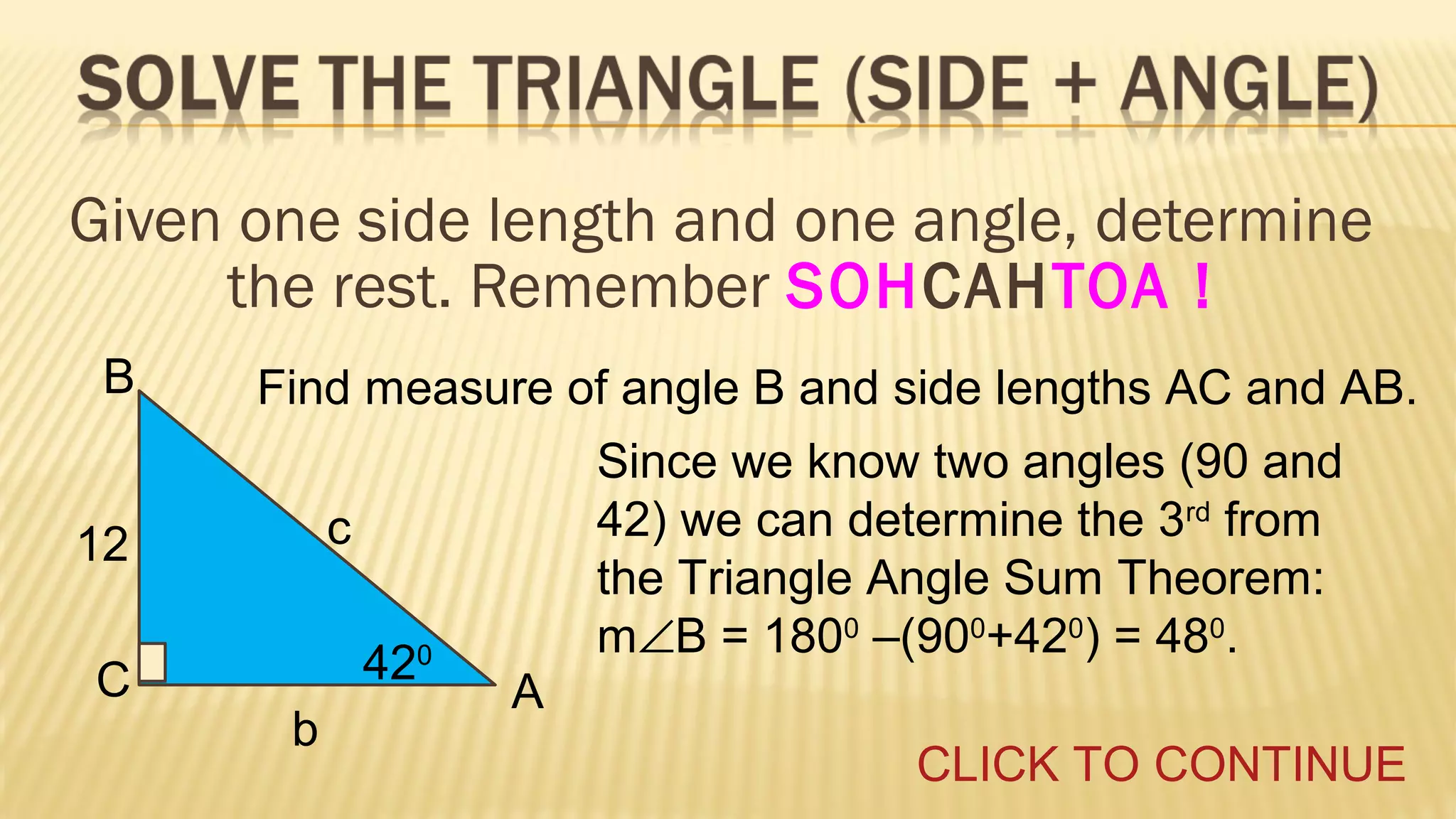
Given one side length and one angle, determine
the rest. Remember SOHCAHTOA !
B

Find measure of angle B and side lengths AC and AB.
c

12
C

Since we know two angles (90 and
42) we can determine the 3rd from
the Triangle Angle Sum Theorem:
m∠B = 1800 –(900+420) = 480.

420
b

A
CLICK TO CONTINUE
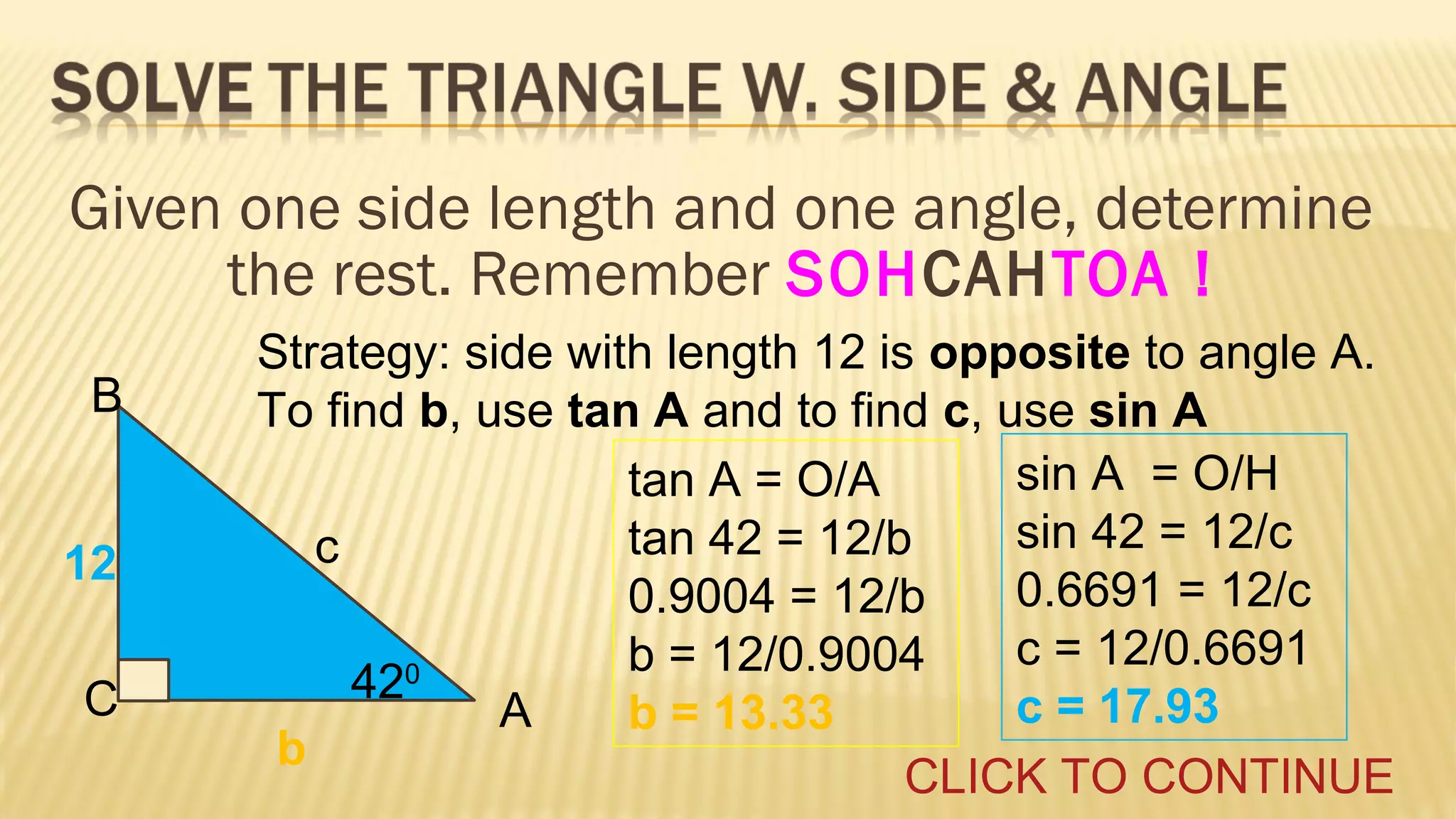
Given one side length and one angle, determine
the rest. Remember SOHCAHTOA !
B
12
C

Strategy: side with length 12 is opposite to angle A.
To find b, use tan A and to find c, use sin A
sin A = O/H
tan A = O/A
sin 42 = 12/c
tan 42 = 12/b
c
0.6691 = 12/c
0.9004 = 12/b
c = 12/0.6691
b = 12/0.9004
0
42
c = 17.93
A
b = 13.33
b
CLICK TO CONTINUE
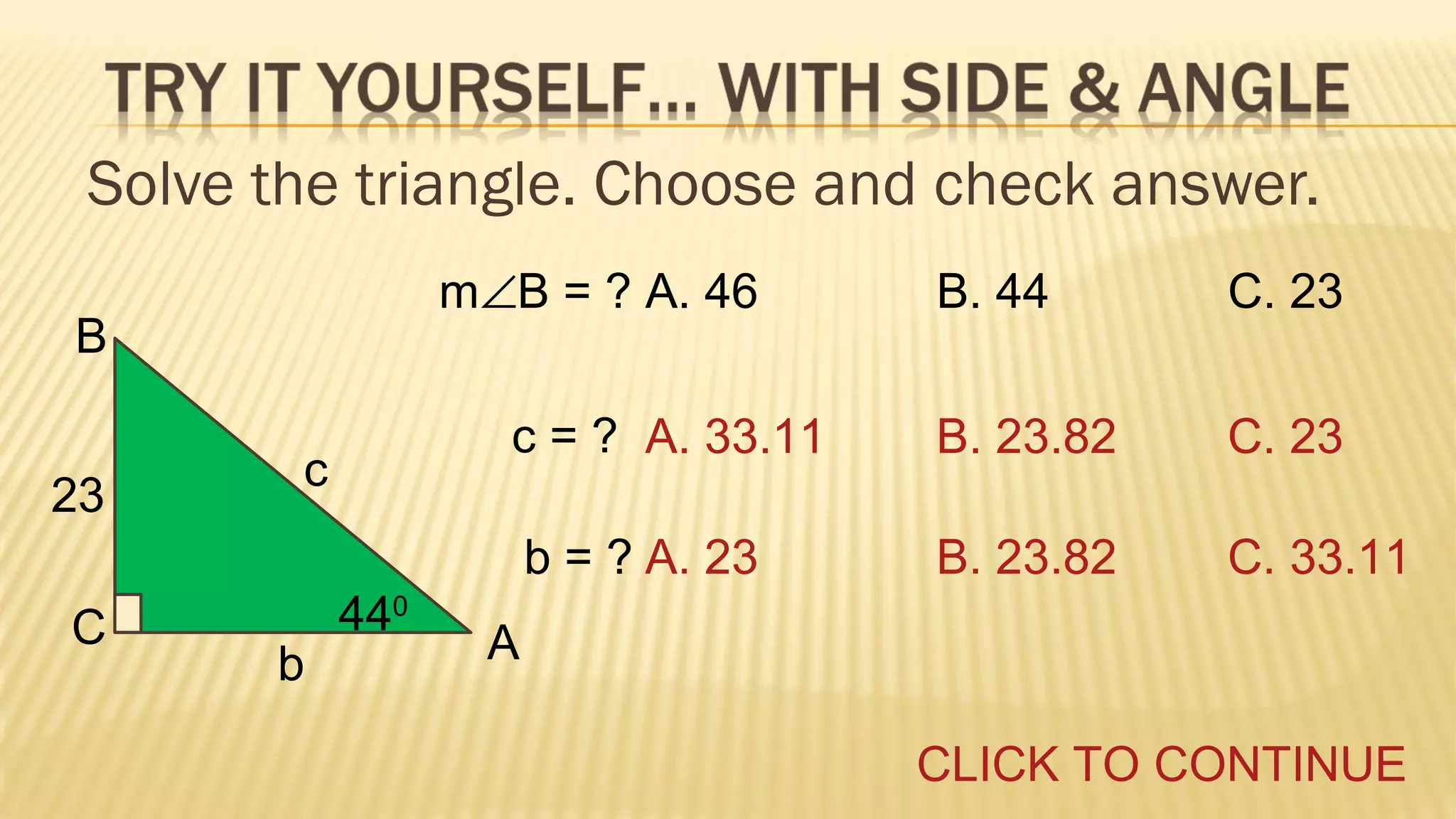
Solve the triangle. Choose and check answer.
m∠B = ? A. 46

C

c

b

440

B. 23.82

C. 23

b = ? A. 23

23

C. 23

c = ? A. 33.11

B

B. 44

B. 23.82

C. 33.11

A
CLICK TO CONTINUE
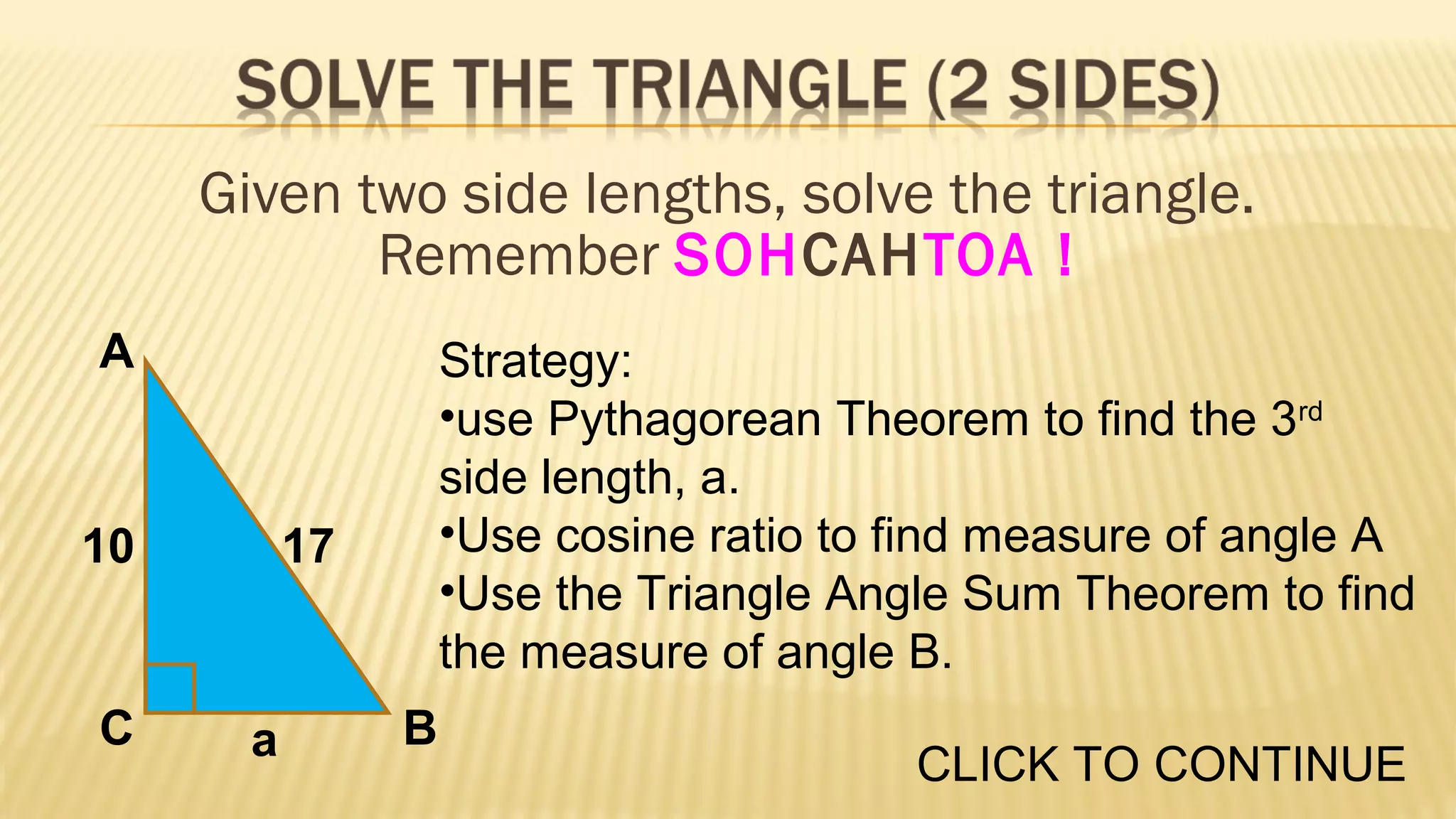
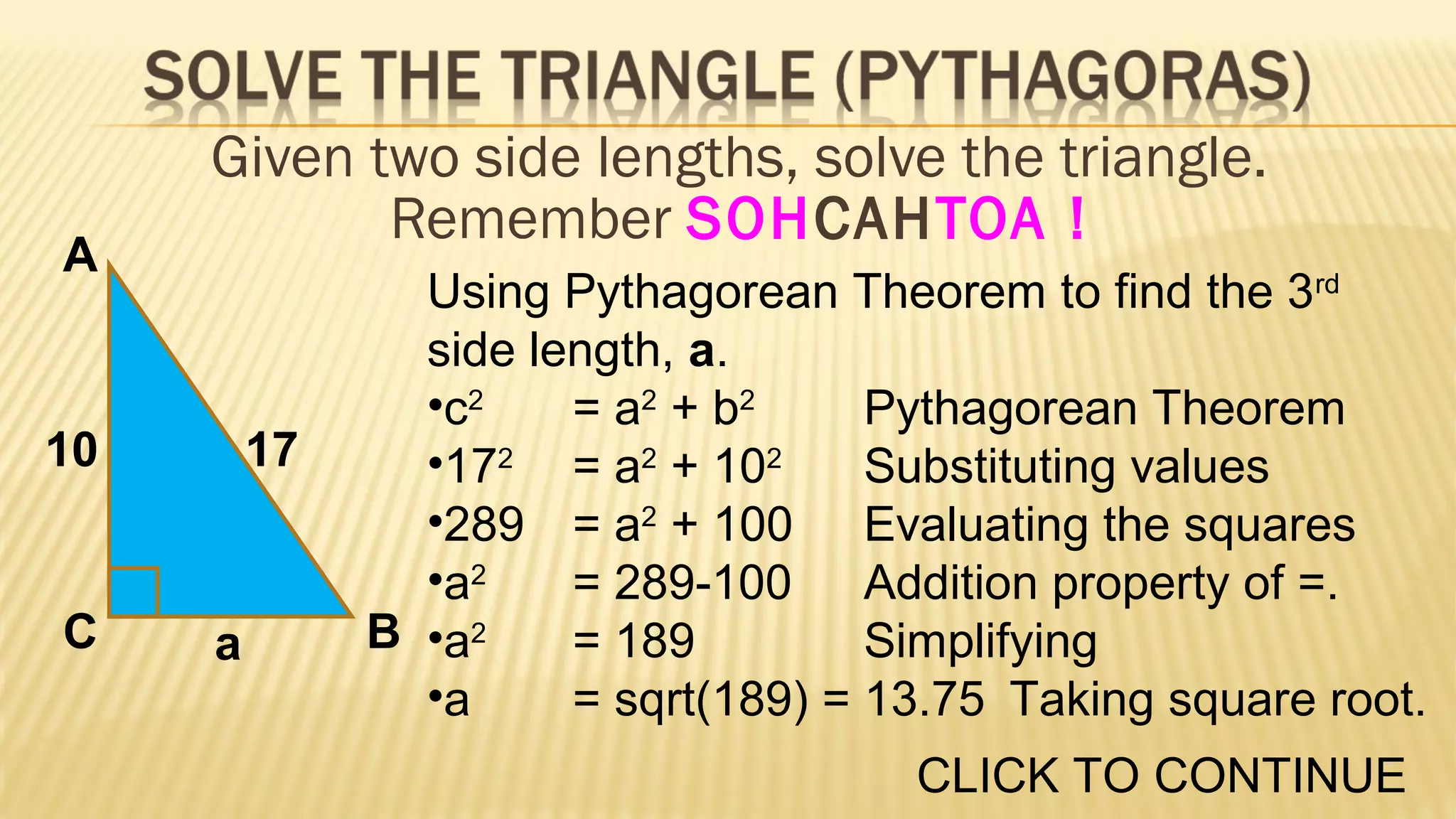
Given two side lengths, solve the triangle.
Remember SOHCAHTOA !
A

10

C

Strategy:
•use Pythagorean Theorem to find the 3rd
side length, a.
•Use cosine ratio to find measure of angle A
•Use the Triangle Angle Sum Theorem to find
the measure of angle B.

17

a

B

CLICK TO CONTINUE
A

Given two side lengths, solve the triangle.
Remember SOHCAHTOA !

10

C

17

a

Using Pythagorean Theorem to find the 3rd
side length, a.
•c2
= a2 + b2
Pythagorean Theorem
•172 = a2 + 102
Substituting values
•289 = a2 + 100 Evaluating the squares
•a2
= 289-100 Addition property of =.
B •a2
= 189
Simplifying
•a
= sqrt(189) = 13.75 Taking square root.
CLICK TO CONTINUE


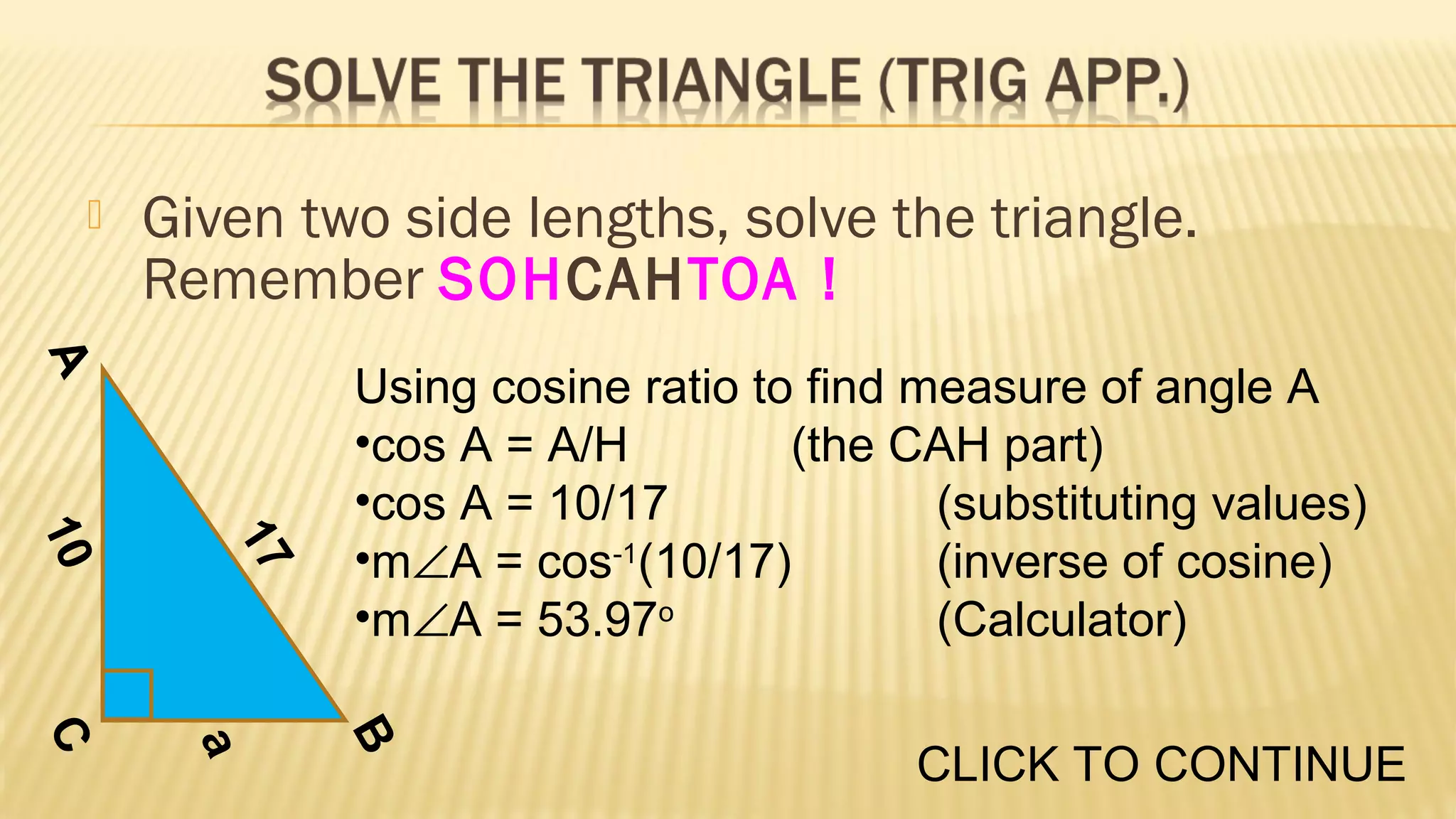
Given two side lengths, solve the triangle.
Remember SOHCAHTOA !

A
17

10

Using cosine ratio to find measure of angle A
•cos A = A/H
(the CAH part)
•cos A = 10/17
(substituting values)
•m∠A = cos-1(10/17)
(inverse of cosine)
•m∠A = 53.97o
(Calculator)
B

a

C

CLICK TO CONTINUE
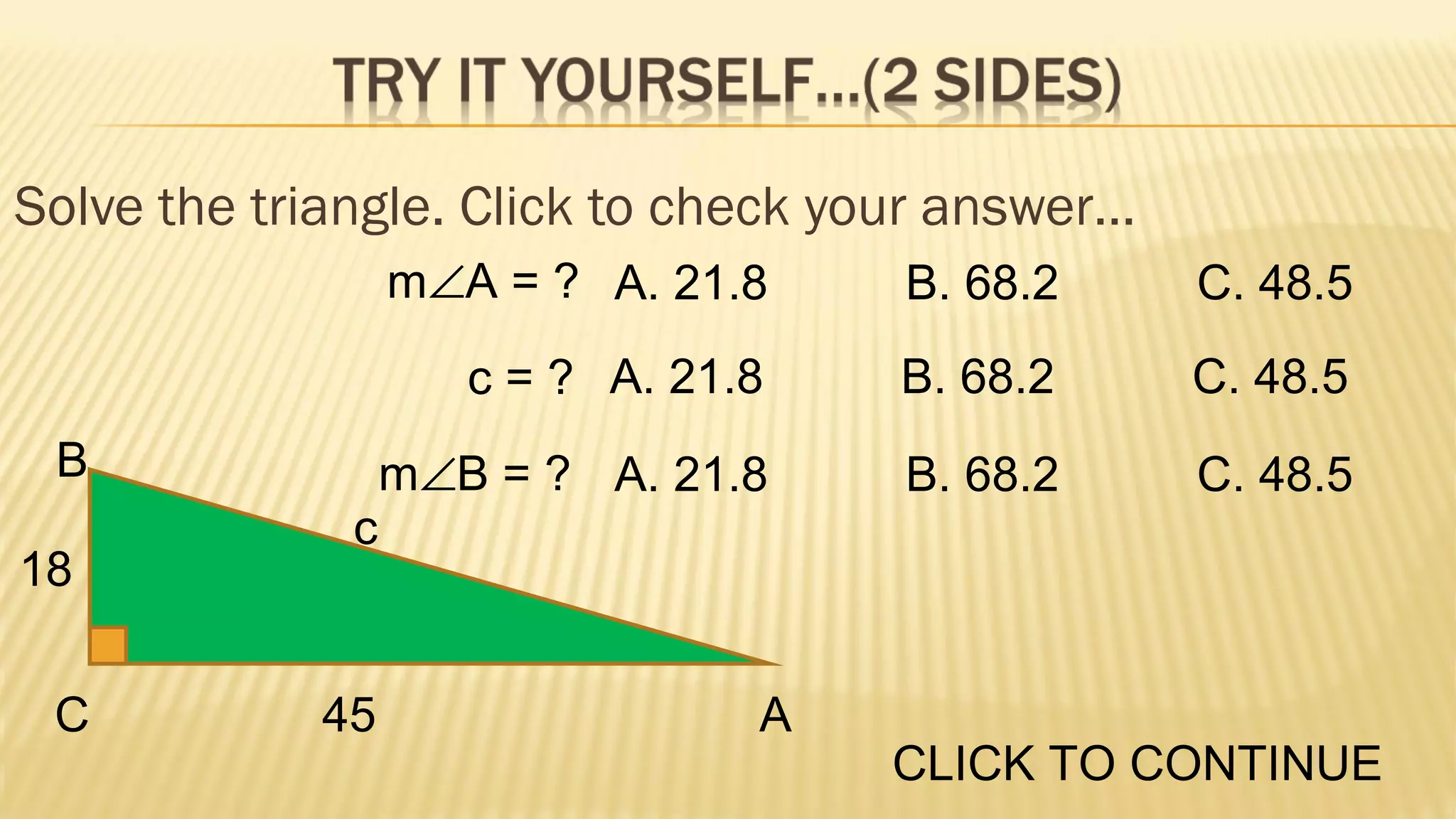
Solve the triangle. Click to check your answer…
m∠A = ? A. 21.8

18
C

c

45

C. 48.5

c = ? A. 21.8
B

B. 68.2
B. 68.2

C. 48.5

m∠B = ? A. 21.8

B. 68.2

C. 48.5

A

CLICK TO CONTINUE
Trigonometry is used to solve real life
problems.
The following slides show a few examples
where trigonometry is used.
Search the Internet for more examples if you
like.
CLICK TO CONTINUE
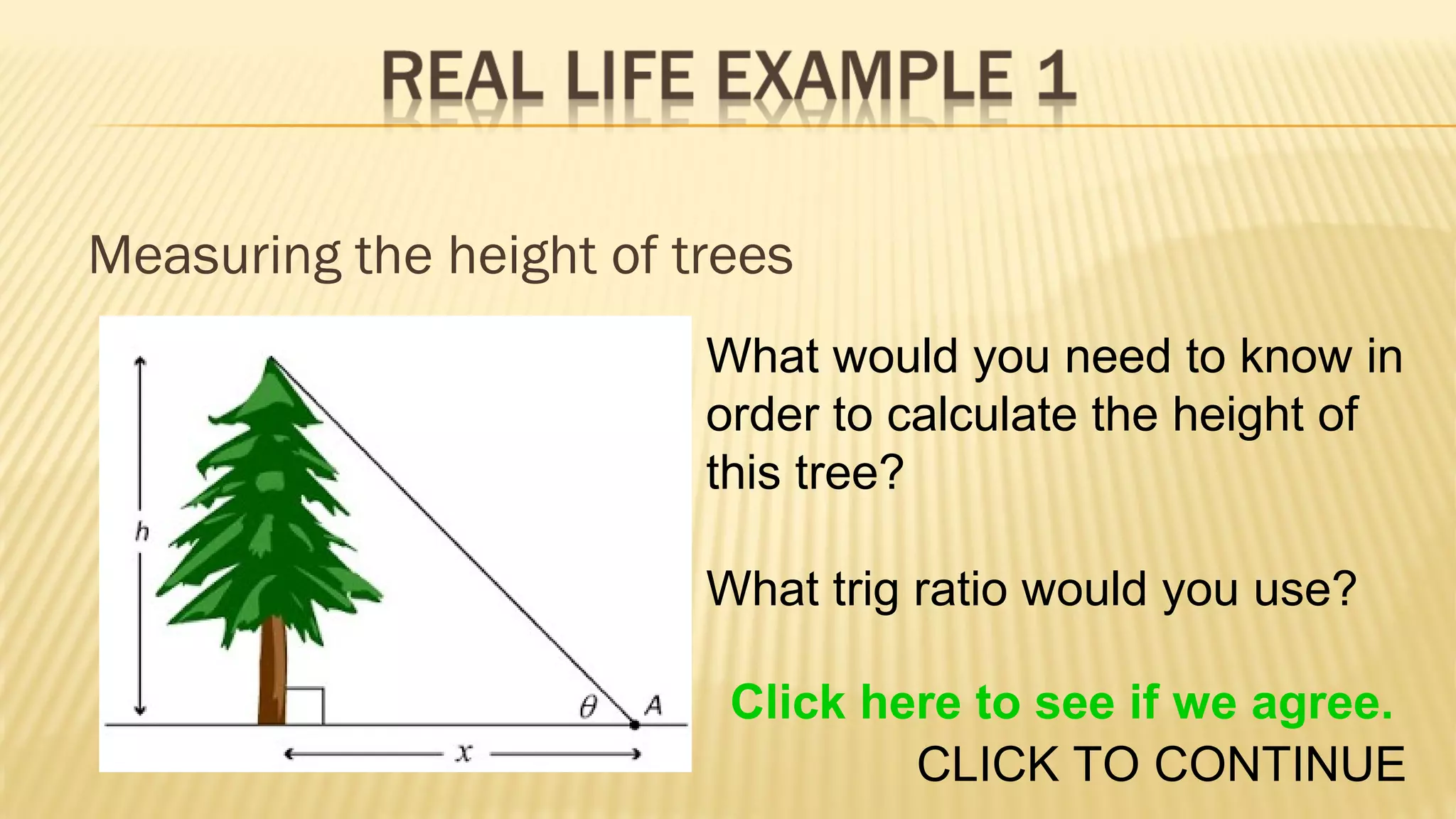
Measuring the height of trees
What would you need to know in
order to calculate the height of
this tree?
What trig ratio would you use?
Click here to see if we agree.
CLICK TO CONTINUE
Tall buildings (skyscrapers), towers and mountains…

CLICK TO CONTINUE
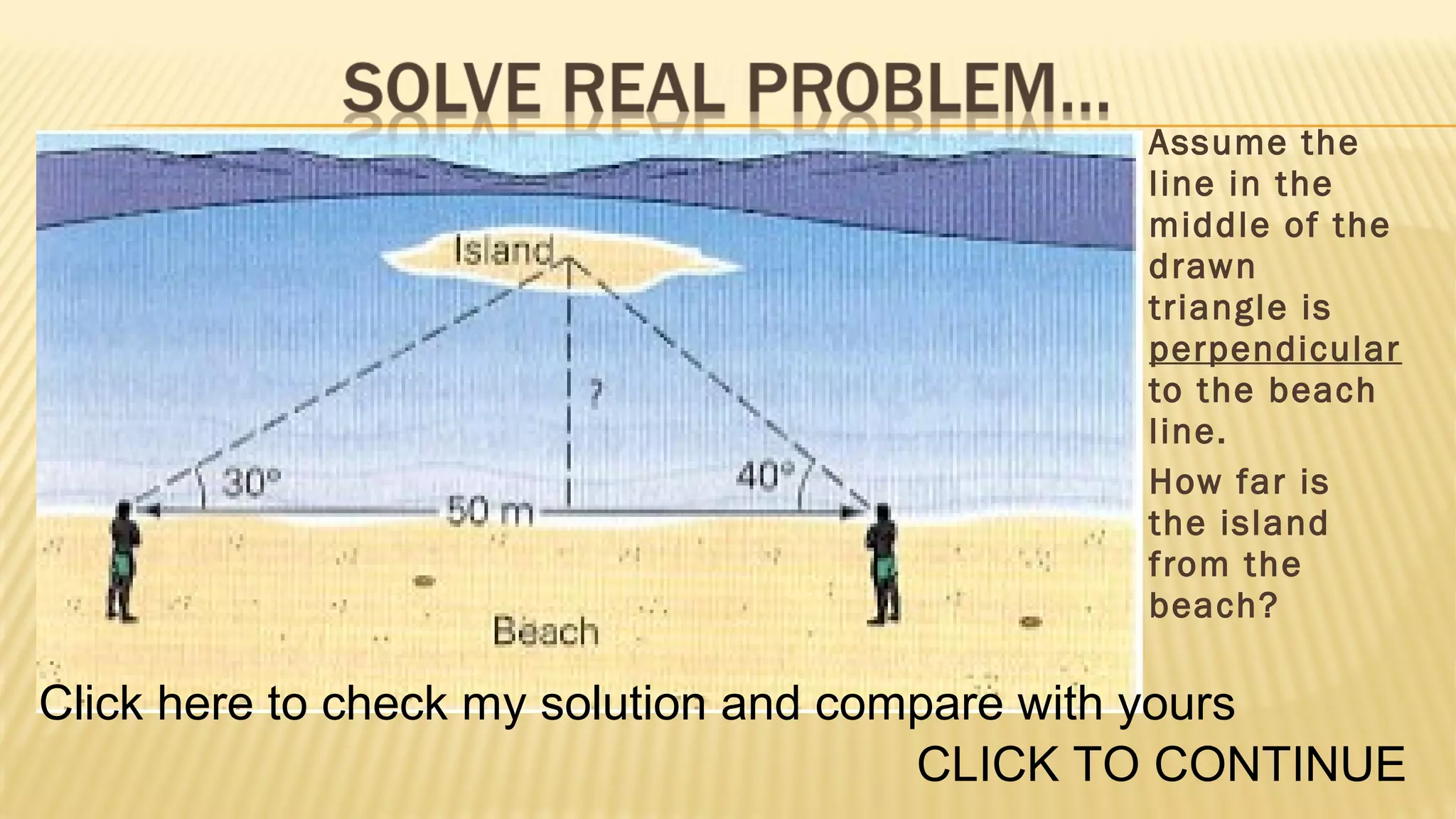
Assume the
line in the
middle of the
drawn
triangle is
perpendicular
to the beach
line.
How far is
the island
from the
beach?

Click here to check my solution and compare with yours
CLICK TO CONTINUE
Be proud of yourself!
You have successfully completed a crash
course in basic trigonometry and I expect you
to be able to do well on this strand in the
Common Core States Standards test. Print the
certificate to show your achievement.
CLICK TO CONTINUE
I hereby certify that
_____________________________________
has satisfactorily completed a basic course in
Introduction to Trigonometry on this day the
____________________ of the year 20___
The bearer is qualified to solve some real world problems
using trigonometry.
Signed: Nevermind

E. Chigoba

Introduction to Trigonometry

  • 1.
    passport to theworld of Trigonometry CLICK TO CONTINUE
  • 2.
    A triangle isa polygon made up of three connected line segments in such a way that each side is connected to the other two. CLICK TO CONTINUE
  • 3.
    All these polygonsare tri-gons and commonly called triangles CLICK TO CONTINUE
  • 4.
    None of theseis a triangle... Can you tell why not? CLICK TO CONTINUE
  • 5.
    CLICK on eachone that IS a triangle? CLICK TO CONTINUE
  • 6.
    A right triangleis a special triangle that has one of its angles a right angle. You can tell it is a right triangle when when one angle measures 900 or the right angle is marked by a little square on the angle whose measure is 900. CLICK TO CONTINUE
  • 7.
  • 8.
    These triangles areNOT right triangles. Explain why not? CLICK TO CONTINUE
  • 9.
    Click on thetriangle that is NOT a right triangle? CLICK TO CONTINUE
  • 10.
    The longest sideof a right triangle is the hypotenuse. The hypotenuse lies directly opposite the right angle. The legs may be equal in length or one may be longer than the other. CLICK TO CONTINUE
  • 11.
    A right trianglehas two legs and a hypotenuse... hyp ot leg leg enu s e CLICK TO CONTINUE
  • 12.
    Click on theside that is the hypotenuse of the right triangle. side 1 side 3 side 2 CLICK TO CONTINUE
  • 13.
    Click on theside that is the shor ter leg of the right triangle. side 1 side 3 side 2 CLICK TO CONTINUE
  • 14.
    Click on theside that is the longer leg of the right triangle. side 1 side 3 side 2 CLICK TO CONTINUE
  • 15.
    hyp o te nus e c The righttriangle has a special property, called leg b 1 the Pythagorean Theorem, that can help a us find one side if we leg2 know the other two If the lengths of hypotenuse and legs are c, sides. a and b respectively, then c2 = a2 + b2 CLICK TO CONTINUE
  • 16.
    Use the PythagoreanTheorem to find the length of the missing side. 10 x 14 c2 x2 x = a2 + b2 = 102 + 142 = 100 + 196 = 296 = sqrt(296) = 17.2 CLICK TO CONTINUE
  • 17.
    Use the PythagoreanTheorem to find the length of the missing side. 15 10 x c2 152 225 x2 x = a2 + b2 = 102 + x2 = 100 + x2 = 125 = sqrt(125) = 11.18 CLICK TO CONTINUE
  • 18.
    Find the hypotenuseof the given right triangle with the lengths of the legs known: Click on the selection that matches your answer: 6 8 A. 36 B. 10 C. 100 x D. 64 CLICK TO CONTINUE
  • 19.
    Find the legof the given right triangle with the lengths of the leg and hypotenuse known: Click on the selection that matches your answer: x A. 24 B. 6 C. 144 15 D. 12 9 CLICK TO CONTINUE
  • 20.
    A In a righttriangle, a given leg is called the adjacent side or the leg1 b opposite side, depending on the reference acute angle. hyp o te nus e c a leg2 CLICK TO CONTINUE
  • 21.
    In a righttriangle, a given leg is called the adjacent side or the opposite side, depending on the reference acute angle. A leg1 b hyp ote nus c e a leg2 leg2 is opposite to acute angle A leg1 is NOT opposite to acute angle A CLICK TO CONTINUE
  • 22.
    A In a righttriangle, a hyp given leg is called o te nus the adjacent side e c leg1 b or the opposite a side, depending on the reference leg2 acute angle. leg1 is adjacent to acute angle A leg2 is NOT adjacent to acute angle A CLICK TO CONTINUE
  • 23.
    Click on theside that is opposite to angle B. hyp o leg1 ten use c b a leg2 B CLICK TO CONTINUE
  • 24.
    Click on theside that is adjacent to angle B. hyp o leg1 ten use c b a leg2 B CLICK TO CONTINUE
  • 25.
    The ratios ofthe sides of a right triangle have special names. There are three basic ones we will consider: • Sine cosine tangent CLICK TO CONTINUE
  • 26.
    Let the lengthsof legs be a and b, and the length of the hypotenuse be c. A is an acute angle. A leg1 hyp o ten use c b a leg2 With reference to angle A, the ratio of the length of the side opposite angle A to length of the hypotenuse is defined as: length of side opposite sine A = length of the hypotenuse ∠A = a/c Sine A is abbreviated Sin A. Thus, sin A = a/c. CLICK TO CONTINUE
  • 27.
    Let the lengthsof legs be a and b, and the length of the hypotenuse be c. A is an acute angle. A leg1 hyp o ten use c b a leg2 With reference to angle A, the ratio of the length of the side adjacent to angle A to length of the hypotenuse is defined as: length of side adjacent to angle A cosine A = length of the hypotenuse = b/c Cosine A is abbreviated to Cos A. Thus, cos A = b/c. CLICK TO CONTINUE
  • 28.
    Let the lengthsof legs be a and b, and the length of the hypotenuse be c. A is an acute angle. A leg1 hyp ot b c enu s a leg2 e With reference to angle A, the ratio of the length of the side opposite to angle A to length of the side adjacent to angle A is defined as: length of side opposite A tangent A = length of the adjacent = a/b tangent A is abbreviated Tan A. Thus, tan A = a/b CLICK TO CONTINUE
  • 29.
    S = Sine Thisis a clever technique most O = Opposite H = Hypotenuse people use to remember these three basic trig ratios. C = Cosine SOH-CAH-TOA sounds strange? A = Adjacent H = Hypotenuse What if I told you it was the ancient oriental queen who T = Tangent O = Opposite loved Geometry? (not true!) A = Adjacent CLICK TO CONTINUE
  • 30.
    Find the sineof the given angle. [SOHCAHTOA ] Sin B = Opposite/Hypotenuse sin 53.10 = 16/20 = 4/5 = 0.80 20 16 53.10 12 Cos B = Adjacent/Hypotenuse Cos 53.10 = 12/20 = 3/5 = 0.60 B Tan B = Opposite/Adjacent Tan 53.10 = 16/12 = 5/3 =1.67 CLICK TO CONTINUE
  • 31.
    Find the valueof sine, cosine, and tangent of the given acute angle. [SOHCAHTOA!] B Click to choose your answer from the choices sin 53.10 =? A. 5/3 53.10 15 B. 3/5 C. 4/3 D. 3/4 E. 4/5 F. 5/4 9 A. 5/3 B. 3/5 C. 4/3 D. 3/4 E. 4/5 F. 5/4 tan 53.10 =? A. 5/3 B. 3/5 C. 4/3 D. 3/4 E. 4/5 F. 5/4 cos 53.10 =? 12 CLICK TO CONTINUE
  • 32.
    Does the trigratio depend on the size of the angle or size of the side length? Let us consider similar triangles in our investigation. 9 6 3 4 36.870 A 5 12 8 36.870 A 36.870 10 15 A CLICK TO CONTINUE
  • 33.
    9 [Remember SOHCAHTOA!] • Compute the ratios andmake a conjecture 6 12 3 36.870 8 4 36.870 36.870 5 A 10 A 15 A sin 36.870 ⅗ = 0.6 6/10 = 0.6 9/15 = 0.6 cos 36.870 ⅘ = 0.8 8/10 = 0.8 12/15 = 0.8 tan 36.870 ¾ =0.75 6/8 = 0.75 9/12 = 0.75 Conjecture: Trigonometric ratios are a property of similarity (angles) and not of the length of the sides of a right triangle. CLICK TO CONTINUE
  • 34.
    • The trigratios are used so often that • • technology makes these values readily available in the form of tables and on scientific calculators . We will now show you how to use your calculator to find some trig ratios. Grab a scientific calculator and try it out. CLICK TO CONTINUE
  • 35.
    Each calculator brandmay work a little dif ferently, but the results will be the same. Look for the trig functions on your calculator: sin, cos and tan select the trig ratio of your choice followed by the angle in degrees and execute (enter). • o • example: sin 30 will display 0.5 on some calculators you may have to type in the angle first then the ratio o example: 30 sin will display 0.5 CLICK TO CONTINUE
  • 36.
    Use your calculatorto verify that the sine, cosine and tangent of the following angles are correct (to 4 decimals): Angle A sin A cos A tan A 45o Sin 45 o =0.7071 Cos 45 o =0.7071 Tan 45 o =1.0000 60o Sin 60 o =0.8660 Cos 60 o =0.5000 Tan 60 o =1.7321 30o Sin 30 o =0.5000 Cos 30 o =0.8660 Tan 30 o =0.5774 82.5o Sin 82.5 o =0.9914 Cos 82.5 o =0.1305 Tan 82.5 o =7.5958 CLICK TO CONTINUE
  • 37.
    Find the valuesof the following trig ratios to four decimal places: sin 34o = ? A. 0.8290 B. 0.6745 C. 0.5592 cos 56o = ? A. 0.5592 B. 0.8290 C. 1.4826 tan 72o = ? A. 0.3090 B. 0.9511 C. 3.0777 CLICK TO CONTINUE
  • 38.
    • • We can usethe inverse operation of a trig ratio to find the angle with the known trig ratio (n/m) The inverse trig ratios are as follows: • Inverse of sin (n/m) is sin -1 (n/m) • Inverse of cos (n/m) is cos -1 (n/m) • Inverse of tan (n/m) is tan -1 (n/m) CLICK TO CONTINUE
  • 39.
    Suppose we knowthe trig ratio and we want to find the associated angle A. 4 5 A • From SOHCAHTOA, we know that from the angle A, we have the opposite side and the hypotenuse. • Therefore the SOH part helps us to know that we use sin A = O/H = 4/5 • The inverse is thus sin-1(4/5) = A • A = Sin-1 (4/5) = 53.13o CLICK TO CONTINUE
  • 40.
    Suppose we knowthe trig ratio and we want to find the associated angle B. B 4 5 A • From SOHCAHTOA, we know that from the angle B, we have the adjacent side and the hypotenuse. • Therefore the CAH part helps us to know that we use cos A = A/H = 4/5 • The inverse is thus cos-1(4/5) = B • B = cos-1 (4/5) = 36.87o CLICK TO CONTINUE
  • 41.
    Suppose we knowthe trig ratio and we want to find the associated angle A. 4 3 A • From SOHCAHTOA, we know that from the angle A, we have the opposite side and the adjacent side. • Therefore the TOA part helps us to know that we use tan A = O/A = 4/3 • The inverse is thus tan-1(4/3) = A • A = tan-1 (4/3) = 53.13o CLICK TO CONTINUE
  • 42.
    Use a calculatorto find the measure of the angles A and B. B 19.21 A 15 Use SOHCAHTOA as a guide to what ratio to use. m∠A =? A. 38.7 B. 51.3 C. 53.1 C m∠B =? A. 38.7 B. 51.3 C. 53.1 12 CLICK TO CONTINUE
  • 43.
    Use trig ratiosto find sides of a triangle. Remember SOHCAHTOA! a 12 300 b With reference to angle A, ●b is the length of side adjacent and ●a is the length of the side opposite the angle. ●the hypotenuse is given A Strategy: make an equation that uses only one leg and the hypotenuse at a time. CLICK TO CONTINUE
  • 44.
    The tangent ratiomay not easily help you figure out the legs a and b in this case. ( SOHCAHTOA!) a 12 300 b Using tangent: tan A = O/A Substituting values from the tgriangle: tan 30o = a/b From the calculator: tan 30o = 0.5774 Thus tan 30o = a/b 0.5774 = a/b A And, a = 0.5774(b) GETS YOU STUCK! CLICK TO CONTINUE
  • 45.
    Using sine ratioto find the leg of a triangle. Remember SOHCAHTOA! a 12 300 b Using sine: sin A = O/H Substituting values from the tgriangle: Sin 30o = a/12 From the calculator: sin 30o = 0.5 Thus sin 30o = a/12 0.5 = a/12 A And a = 0.5(12) = 6 CLICK TO CONTINUE
  • 46.
    Using the cosineratio to find legs of a triangle. Remember SOHCAHTOA! a 12 300 b Using cosine: cos A = A/H Substituting values from the tgriangle: cos 30o = b/12 From the calculator: cos 30o = 0.8660 Thus cos 30o = b/12 0.866 = b/12 A And b = 0.866(12) = 10.39 CLICK TO CONTINUE
  • 47.
    Find the lengthsof the legs of the triangle and the third angle. Choose the correct answer. C a B b 25 o A m∠B = ? A. 90 B. 65 C. 25 a = ? A. 10.57 B. 22.66 C. 21 21 b = ? A. 21 B. 10.57 C. 22.66 CLICK TO CONTINUE
  • 48.
    Use trig ratiosto find the hypotenuse of a triangle. Remember SOHCAHTOA! c 12 300 b With reference to angle A, ●b is the length of side adjacent and ●12 is the length of the side opposite the angle. A ●c is the hypotenuse Strategy: make an equation that uses only one unkown at a time. CLICK TO CONTINUE
  • 49.
    Use trig ratiosto find the hypotenuse of a triangle. Remember SOHCAHTOA! c 12 300 b Since 12 is opposite to the angle, we use the sine ratio: Sine A = O/H Substituting values from the tgriangle: sin 30o = 12/c From the calculator: sin 30o = 0.5 A Thus, sin 30o = 12/c or 0.5 = 12/c c = 12/0.5 = 24 CLICK TO CONTINUE
  • 50.
    Find the lengthsof the hypotenuse, leg b and the third angle. Choose the best answer. b C b=? 13 55o B A m∠A = ? A. 35 B. 45 C. 55 A. 22.66 B. 10.57 C. 18.57 c c = ? A. 18.57 B. 10.57 C. 22.66 CLICK TO CONTINUE
  • 51.
    • • We now havethe tools we need to solve any right triangle (to determine the lengths of each and all sides and the angles, given minimal information) Remember SOHCAHTOA! Typically you get two pieces of information: • • One side length and one angle or CLICK TO CONTINUE Two sides’ lengths
  • 52.
    Given one sidelength and one angle, determine the rest. Remember SOHCAHTOA ! B Find measure of angle B and side lengths AC and AB. c 12 C Since we know two angles (90 and 42) we can determine the 3rd from the Triangle Angle Sum Theorem: m∠B = 1800 –(900+420) = 480. 420 b A CLICK TO CONTINUE
  • 53.
    Given one sidelength and one angle, determine the rest. Remember SOHCAHTOA ! B 12 C Strategy: side with length 12 is opposite to angle A. To find b, use tan A and to find c, use sin A sin A = O/H tan A = O/A sin 42 = 12/c tan 42 = 12/b c 0.6691 = 12/c 0.9004 = 12/b c = 12/0.6691 b = 12/0.9004 0 42 c = 17.93 A b = 13.33 b CLICK TO CONTINUE
  • 54.
    Solve the triangle.Choose and check answer. m∠B = ? A. 46 C c b 440 B. 23.82 C. 23 b = ? A. 23 23 C. 23 c = ? A. 33.11 B B. 44 B. 23.82 C. 33.11 A CLICK TO CONTINUE
  • 55.
    Given two sidelengths, solve the triangle. Remember SOHCAHTOA ! A 10 C Strategy: •use Pythagorean Theorem to find the 3rd side length, a. •Use cosine ratio to find measure of angle A •Use the Triangle Angle Sum Theorem to find the measure of angle B. 17 a B CLICK TO CONTINUE
  • 56.
    A Given two sidelengths, solve the triangle. Remember SOHCAHTOA ! 10 C 17 a Using Pythagorean Theorem to find the 3rd side length, a. •c2 = a2 + b2 Pythagorean Theorem •172 = a2 + 102 Substituting values •289 = a2 + 100 Evaluating the squares •a2 = 289-100 Addition property of =. B •a2 = 189 Simplifying •a = sqrt(189) = 13.75 Taking square root. CLICK TO CONTINUE
  • 57.
     Given two sidelengths, solve the triangle. Remember SOHCAHTOA ! A 17 10 Using cosine ratio to find measure of angle A •cos A = A/H (the CAH part) •cos A = 10/17 (substituting values) •m∠A = cos-1(10/17) (inverse of cosine) •m∠A = 53.97o (Calculator) B a C CLICK TO CONTINUE
  • 58.
    Solve the triangle.Click to check your answer… m∠A = ? A. 21.8 18 C c 45 C. 48.5 c = ? A. 21.8 B B. 68.2 B. 68.2 C. 48.5 m∠B = ? A. 21.8 B. 68.2 C. 48.5 A CLICK TO CONTINUE
  • 59.
    Trigonometry is usedto solve real life problems. The following slides show a few examples where trigonometry is used. Search the Internet for more examples if you like. CLICK TO CONTINUE
  • 60.
    Measuring the heightof trees What would you need to know in order to calculate the height of this tree? What trig ratio would you use? Click here to see if we agree. CLICK TO CONTINUE
  • 61.
    Tall buildings (skyscrapers),towers and mountains… CLICK TO CONTINUE
  • 62.
    Assume the line inthe middle of the drawn triangle is perpendicular to the beach line. How far is the island from the beach? Click here to check my solution and compare with yours CLICK TO CONTINUE
  • 63.
    Be proud ofyourself! You have successfully completed a crash course in basic trigonometry and I expect you to be able to do well on this strand in the Common Core States Standards test. Print the certificate to show your achievement. CLICK TO CONTINUE
  • 64.
    I hereby certifythat _____________________________________ has satisfactorily completed a basic course in Introduction to Trigonometry on this day the ____________________ of the year 20___ The bearer is qualified to solve some real world problems using trigonometry. Signed: Nevermind E. Chigoba

Editor's Notes

  • #83 http://malini-math.blogspot.com/2011/08/applications-of-trigonometry-in-real.html
  • #84 http://malini-math.blogspot.com/2011/08/applications-of-trigonometry-in-real.html
  • #85 http://malini-math.blogspot.com/2011/08/applications-of-trigonometry-in-real.html