Pythagorean Theorem

     Section 11.4
       P. 737
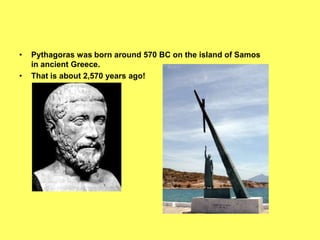
•   Pythagoras was born around 570 BC on the island of Samos
    in ancient Greece.
•   That is about 2,570 years ago!
Pythagoras
• He founded a school in southern Italy after
  traveling in Egypt and the Middle East. He
  was a philosopher, musician, and
  astronomer, but he is most remembered
  as a mathematician.
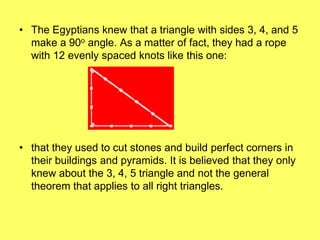
• The Egyptians knew that a triangle with sides 3, 4, and 5
  make a 90o angle. As a matter of fact, they had a rope
  with 12 evenly spaced knots like this one:
                           •


• that they used to cut stones and build perfect corners in
  their buildings and pyramids. It is believed that they only
  knew about the 3, 4, 5 triangle and not the general
  theorem that applies to all right triangles.
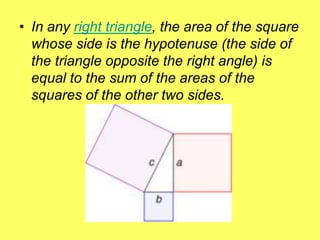
• In any right triangle, the area of the square
  whose side is the hypotenuse (the side of
  the triangle opposite the right angle) is
  equal to the sum of the areas of the
  squares of the other two sides.
• The Pythagorean Theorem is one of the
  most important theorems in the whole
  realm of geometry.


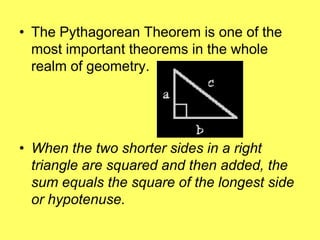
• When the two shorter sides in a right
  triangle are squared and then added, the
  sum equals the square of the longest side
  or hypotenuse.
The Pythagorean Theorem
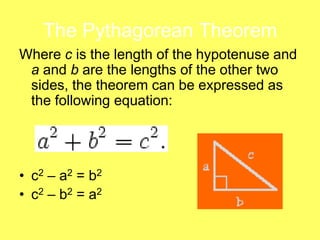
Where c is the length of the hypotenuse and
 a and b are the lengths of the other two
 sides, the theorem can be expressed as
 the following equation:


• c2 – a2 = b2
• c2 – b2 = a2
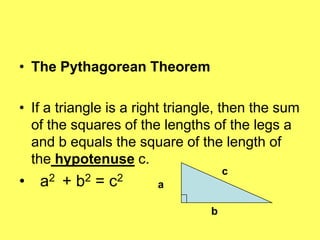
• The Pythagorean Theorem

• If a triangle is a right triangle, then the sum
  of the squares of the lengths of the legs a
  and b equals the square of the length of
  the hypotenuse c.
                                     c
• a2 + b2 = c2          a

                                 b
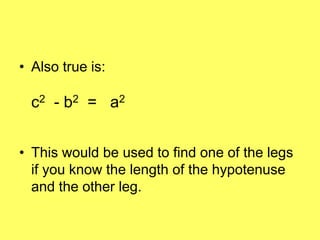
• Also true is:

  c 2 - b 2 = a2


• This would be used to find one of the legs
  if you know the length of the hypotenuse
  and the other leg.
EXAMPLE 1       Use the Pythagorean theorem

 Find the unknown length for the triangle shown.


 SOLUTION

      a 2+ b 2 = c 2      Pythagorean theorem
            2
      a 2 + 6 = 72       Substitute 6 for b and 7 for c.
     a 2 + 36 = 49       Simplify.
           a 2 = 13       Subtract 36 from each side.
           a = 13         Take positive square root of each side.

 ANSWER           The side length a is = 13
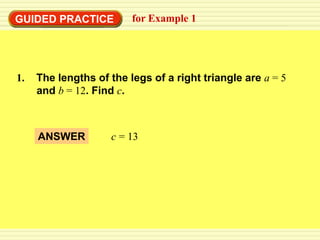
GUIDED PRACTICE          for Example 1


1.   The lengths of the legs of a right triangle are a = 5
     and b = 12. Find c.


     ANSWER         c = 13
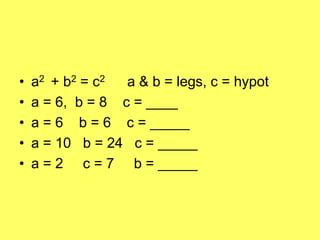
•   a2 + b2 = c2  a & b = legs, c = hypot
•   a = 6, b = 8 c = ____
•   a = 6 b = 6 c = _____
•   a = 10 b = 24 c = _____
•   a = 2 c = 7 b = _____
• Determine if the given lengths are sides of
  a right triangle.
• 5, 11, 12

• 20, 29, 21

• 11.9, 12, 16.9
• Assignment: P. 740
•      1-15, 35

• Make sure you put formula / work on your
  paper!
• Round to the nearest tenths.
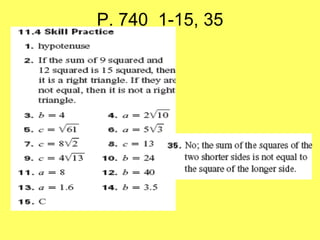
P. 740 1-15, 35

Pythagorean theorem 11.4

  • 1.
    Pythagorean Theorem Section 11.4 P. 737
  • 2.
    Pythagoras was born around 570 BC on the island of Samos in ancient Greece. • That is about 2,570 years ago!
  • 3.
    Pythagoras • He foundeda school in southern Italy after traveling in Egypt and the Middle East. He was a philosopher, musician, and astronomer, but he is most remembered as a mathematician.
  • 4.
    • The Egyptiansknew that a triangle with sides 3, 4, and 5 make a 90o angle. As a matter of fact, they had a rope with 12 evenly spaced knots like this one: • • that they used to cut stones and build perfect corners in their buildings and pyramids. It is believed that they only knew about the 3, 4, 5 triangle and not the general theorem that applies to all right triangles.
  • 5.
    • In anyright triangle, the area of the square whose side is the hypotenuse (the side of the triangle opposite the right angle) is equal to the sum of the areas of the squares of the other two sides.
  • 6.
    • The PythagoreanTheorem is one of the most important theorems in the whole realm of geometry. • When the two shorter sides in a right triangle are squared and then added, the sum equals the square of the longest side or hypotenuse.
  • 7.
    The Pythagorean Theorem Wherec is the length of the hypotenuse and a and b are the lengths of the other two sides, the theorem can be expressed as the following equation: • c2 – a2 = b2 • c2 – b2 = a2
  • 8.
    • The PythagoreanTheorem • If a triangle is a right triangle, then the sum of the squares of the lengths of the legs a and b equals the square of the length of the hypotenuse c. c • a2 + b2 = c2 a b
  • 9.
    • Also trueis: c 2 - b 2 = a2 • This would be used to find one of the legs if you know the length of the hypotenuse and the other leg.
  • 10.
    EXAMPLE 1 Use the Pythagorean theorem Find the unknown length for the triangle shown. SOLUTION a 2+ b 2 = c 2 Pythagorean theorem 2 a 2 + 6 = 72 Substitute 6 for b and 7 for c. a 2 + 36 = 49 Simplify. a 2 = 13 Subtract 36 from each side. a = 13 Take positive square root of each side. ANSWER The side length a is = 13
  • 11.
    GUIDED PRACTICE for Example 1 1. The lengths of the legs of a right triangle are a = 5 and b = 12. Find c. ANSWER c = 13
  • 12.
    a2 + b2 = c2 a & b = legs, c = hypot • a = 6, b = 8 c = ____ • a = 6 b = 6 c = _____ • a = 10 b = 24 c = _____ • a = 2 c = 7 b = _____
  • 13.
    • Determine ifthe given lengths are sides of a right triangle. • 5, 11, 12 • 20, 29, 21 • 11.9, 12, 16.9
  • 14.
    • Assignment: P.740 • 1-15, 35 • Make sure you put formula / work on your paper! • Round to the nearest tenths.
  • 15.