PERMANENT WAY + TRACK
FOUNDATION
RAILWAY TRACK
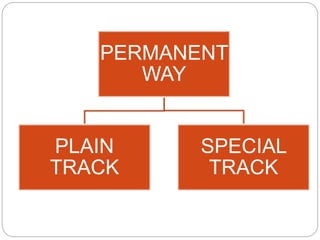
PERMANENT
WAY
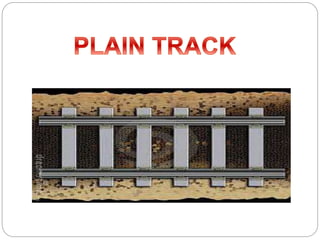
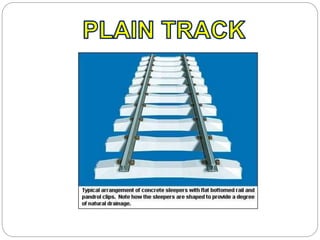
PLAIN
TRACK
SPECIAL
TRACK
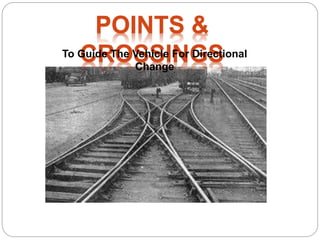
POINTS &
CROSSINGSTo Guide The Vehicle For Directional
Change
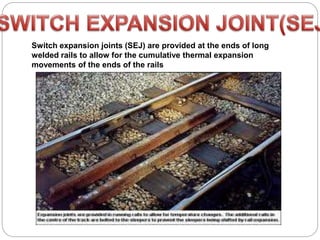
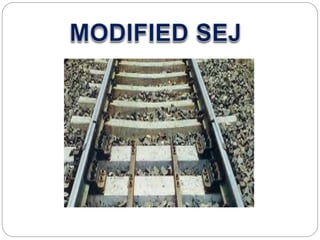
Switch expansion joints (SEJ) are provided at the ends of long
welded rails to allow for the cumulative thermal expansion
movements of the ends of the rails
1. RAILS TRACK STRUCTURE
2. SLEEPERS
3. BALLAST
4. FASTENINGS
PERMANENT WAY
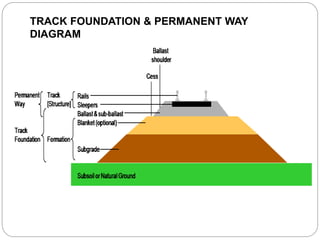
TRACK FOUNDATION & PERMANENT WAY
DIAGRAM
The "track bed" is the layers of ballast and
sub-ballast above a prepared
subgrade/formation (see diagram). It is
designed primarily to reduce the stress on
the subgrade.
The trackbed can significantly influence the
performance of the track, especially ride
quality of passenger service
GAUGE
 The perpendicular distance between the inner
faces of heads of the two rails forming the track is
known as the ‘Gauge’.
 Broad Gauge - 1676 MM
 Meter Gauge - 1000 MM
 Narrow Gauge - 762 MM OR 610
MM
 Broad gauge is known as Indian standard gauge.
 The WORLD standard gauge is 1483MM.
RAILS
 Rails are continuous girders which carry the axle
load.
 Functions:-Provides
 Hard and smooth surface for the wheels of a train
to roll on
 Bears lateral stress and vertical loads due to
breaking and thermal stresses.
 Transmit load to the formation through sleepers
and ballast.
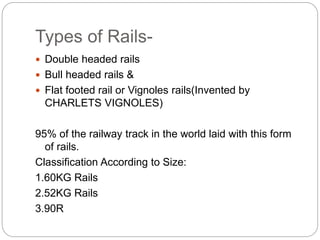
Types of Rails-
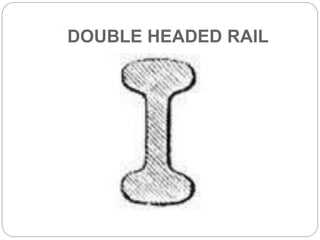
 Double headed rails
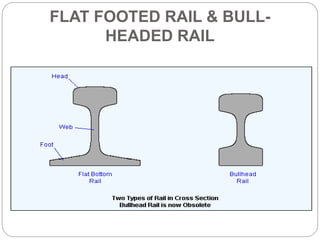
 Bull headed rails &
 Flat footed rail or Vignoles rails(Invented by
CHARLETS VIGNOLES)
95% of the railway track in the world laid with this form
of rails.
Classification According to Size:
1.60KG Rails
2.52KG Rails
3.90R
FLAT FOOTED RAIL & BULL-
HEADED RAIL
DOUBLE HEADED RAIL
Manufacture of Rails:-
Most commonly used alloy steels are:
 1.Medium manganese steel
 2.High Manganese steel
 3.Chromium Steel
Standard Lengths of Rails are:
 12.8 M for B.G
 11.89 M for M.G
SLEEPERS:
 Sleepers are transverse ties in a Railway Track
 Functions:
 To support the rails firmly and evenly
 To maintain gauge correctly
 To transfer the load from rails to ballast
 To maintain alignment of the track
Types of Sleepers:
1. Timber or Wooden sleepers
2. Steel Sleepers
3. Cast Iron Sleepers
4. R.C.C Sleepers
Classification according to the size:
60 Kg 2.74 m x 25 cm x 13 cm on
BG
52 Kg
BALLAST
 Broken stone or any other suitable material
placed below and around the sleepers.
Functions: Provides
1. Provides Hard and level bed for the sleepers to
rest on
2. Provides to hold sleepers in position
3. Provides Elasticity to the track
4. To drain away the rain water and prevent its
percolation into the formation
FORMATION
 Distribute the load of traffic from the sleepers to
the formation without
 Progressive settlement
 Permit drainage of the track
 Prevent lateral movement of the track
 Prevent longitudinal movement of the track, and
 Afford a convenient medium for packing the track
to cross level and
Rail fastenings:
 Fish Plates and Fish Bolts
 Spikes and hook Bolts
 Chairs and keys
 Bearing Plates
Functions:
 Distribute the load coming on rails to the sleepers
over a large area.
 To hold Rails to the sleepers firmly

P.way

  • 1.
    PERMANENT WAY +TRACK FOUNDATION RAILWAY TRACK
  • 2.
  • 5.
    POINTS & CROSSINGSTo GuideThe Vehicle For Directional Change
  • 6.
    Switch expansion joints(SEJ) are provided at the ends of long welded rails to allow for the cumulative thermal expansion movements of the ends of the rails
  • 8.
    1. RAILS TRACKSTRUCTURE 2. SLEEPERS 3. BALLAST 4. FASTENINGS PERMANENT WAY
  • 9.
    TRACK FOUNDATION &PERMANENT WAY DIAGRAM
  • 10.
    The "track bed"is the layers of ballast and sub-ballast above a prepared subgrade/formation (see diagram). It is designed primarily to reduce the stress on the subgrade. The trackbed can significantly influence the performance of the track, especially ride quality of passenger service
  • 11.
    GAUGE  The perpendiculardistance between the inner faces of heads of the two rails forming the track is known as the ‘Gauge’.  Broad Gauge - 1676 MM  Meter Gauge - 1000 MM  Narrow Gauge - 762 MM OR 610 MM  Broad gauge is known as Indian standard gauge.  The WORLD standard gauge is 1483MM.
  • 12.
    RAILS  Rails arecontinuous girders which carry the axle load.  Functions:-Provides  Hard and smooth surface for the wheels of a train to roll on  Bears lateral stress and vertical loads due to breaking and thermal stresses.  Transmit load to the formation through sleepers and ballast.
  • 13.
    Types of Rails- Double headed rails  Bull headed rails &  Flat footed rail or Vignoles rails(Invented by CHARLETS VIGNOLES) 95% of the railway track in the world laid with this form of rails. Classification According to Size: 1.60KG Rails 2.52KG Rails 3.90R
  • 14.
    FLAT FOOTED RAIL& BULL- HEADED RAIL
  • 15.
  • 16.
    Manufacture of Rails:- Mostcommonly used alloy steels are:  1.Medium manganese steel  2.High Manganese steel  3.Chromium Steel Standard Lengths of Rails are:  12.8 M for B.G  11.89 M for M.G
  • 17.
    SLEEPERS:  Sleepers aretransverse ties in a Railway Track  Functions:  To support the rails firmly and evenly  To maintain gauge correctly  To transfer the load from rails to ballast  To maintain alignment of the track
  • 18.
    Types of Sleepers: 1.Timber or Wooden sleepers 2. Steel Sleepers 3. Cast Iron Sleepers 4. R.C.C Sleepers Classification according to the size: 60 Kg 2.74 m x 25 cm x 13 cm on BG 52 Kg
  • 19.
    BALLAST  Broken stoneor any other suitable material placed below and around the sleepers. Functions: Provides 1. Provides Hard and level bed for the sleepers to rest on 2. Provides to hold sleepers in position 3. Provides Elasticity to the track 4. To drain away the rain water and prevent its percolation into the formation
  • 20.
    FORMATION  Distribute theload of traffic from the sleepers to the formation without  Progressive settlement  Permit drainage of the track  Prevent lateral movement of the track  Prevent longitudinal movement of the track, and  Afford a convenient medium for packing the track to cross level and
  • 21.
    Rail fastenings:  FishPlates and Fish Bolts  Spikes and hook Bolts  Chairs and keys  Bearing Plates Functions:  Distribute the load coming on rails to the sleepers over a large area.  To hold Rails to the sleepers firmly