 The direction and position given to the centre line
of the railway track on the ground is called track
alignment.
It includes
 Horizontal alignment such as straight path, its
width, deviation and horizontal curves.
 Vertical alignment such as changes in gradients
and vertical curves.
2GRK, Asst. Professor, SPEC
An ideal alignment should fulfil the following
requirements:
1. Purpose of the track: The alignment should satisfy
the basic purposes of track such as
a) Transportation services: Railways carry the
passenger traffic and goods traffic, local as
well as through.
b) Political and strategic: It is essential to
construct a line to connect two points for
defensive purposes.
3GRK, Asst. Professor, SPEC
c) Linking of centers: A railway line should
construct through the important places.
d) To open up new track: It may be necessary to
align new tracks for the land, whose
resources are not yet tapped.
e) Shortening existing track: When the existing
track is uneconomical, a new track may be
aligned to shorten the existing track which
would prove to be economical.
4GRK, Asst. Professor, SPEC
2. Feasibility: The proposed track should met all
the technical requirements and general planning
of the country.
3. Economy: The initial construction cost,
maintenance cost and operational cost should be
minimum.
4. Safety: The aligned track give safety to track
operations, passenger traffic and goods traffic.
5. Aesthetic aspects: The alignment should be
aesthetically and good give pleasant railway
journey.
5GRK, Asst. Professor, SPEC
The following factors should be considered while design of a
new track:
1. Obligatory or controlling points: The points which governs
the alignment are:
a) Points through which a track must pass: It is desirable that
a track alignment should pass from places of social,
commercial, political and defensive importance.
b) Points through which a track should not pass: The track
should not pass through the following points
i) It is better to avoid river crossing because it requires
major bridge constructions. It is a uneconomical.
ii) it is necessary to avoid high hill passes and saddles.
iii) the alignment should be avoided through the tunnels.
6GRK, Asst. Professor, SPEC
2. Traffic:
 It is essential to satisfy position, nature and amount
of traffic.
 The alignment should pass through the greatest
population.
3. Gauge selection: If the gauge width is increases the
initial cost is more but also increases load carrying
capacity and speed of the trains.
4. Geometric standards: The efficiency of the
alignment depends upon varying conditions of
gradients, speed, loading conditions.
7GRK, Asst. Professor, SPEC
5. Topography of the country: If the heavy gradients are
unavoidable then the cost alignment can be reduced by
different techniques.
6. Economic considerations: The alignment should be
economical.
 The best alignment is one which should gives maximum
annual return(r)
r =[Gross revenue – Annual running expenses ] /
Investment
r = [R- E] / I
7. Other considerations: The miscellaneous factors such as
soil conditions, drainage conditions etc.
8GRK, Asst. Professor, SPEC
In order to have a proper and satisfactory new route,
various surveys are carried out:
1) Traffic survey
2) Reconnaissance Survey
3) Preliminary Survey
4) Location Survey
9GRK, Asst. Professor, SPEC
This consists of collection of the information regarding the
following:
 The general character of the country and the extent of
cultivation.
 Information regarding the local industries and religious
festivals.
 The general condition as regards prosperity of people in the
locality and density of population and its distribution;
 The probable amount of traffic to be served by new railway
line.
 The probable new traffic lines to be opened up to join large
centres of trade.
10GRK, Asst. Professor, SPEC
 Nature and volume of exports and their destination;
 The amount of imports and centres of their
distribution.
 Possibilities of development of industries as a result
of the new railway line.
 Visiting all trade centres and consultation with
prominent citizens and local authorities regarding the
most suitable route for the railway.
 Standard of construction required for carrying the
probable traffic.
 Study of the existing means of transport.
11GRK, Asst. Professor, SPEC
This consists of collection of information regarding the
following:
 Physical features of the country.
 The surface formation of the ground.
 Nature of soil and its classification.
 Streams and rivers of the immediate vicinity, especially
those which are likely to cross the proposed railway line.
 Positions of hills and lakes.
 Samples of water from wells, rivers, etc. so as to ascertain
weather the water is suitable for use in locomotive or not.
 Availability of materials and labour for use during
construction.
12GRK, Asst. Professor, SPEC
Object of preliminary survey:
 To conduct the survey work along the alternative
routes found out by reconnaissance survey and;
 To determine with greater accuracy the cost of the
railway line along these alternative routes.
Importance of preliminary survey:
 It decides the final route and recommends only one
particular route in preference to other alternative
routes;
 Thus, should be carried out with great precision as on
it depends the alignment of the final route.
13GRK, Asst. Professor, SPEC
Object of location survey:
 To carry out the detailed survey along the route which
has been found and fixed as the most economical route
from the data of the preliminary survey.
 It establishes the centre-line of the actual track to be
laid.
 As soon as the location survey is completed, the
construction work is started.
14GRK, Asst. Professor, SPEC
Work of location survey: It is carried out in two stages:
1. Paper location
2. Field location
1. Paper location:
The final route selected is put up on paper and details
such as gradient, curves, contours, etc. are worked out.
 All the working drawings are prepared, even of minor
structures such as signal cabins.
 After the paper location is over, the field work is started
and the centre-line of the track is fixed.
15GRK, Asst. Professor, SPEC
 The field location transfers paper location on the ground;
 It gives all the requirements of the construction engineer
such as benchmarks, levels, measurements, etc.
 The centre-line pegs are driven at every 300 metres
along the centre-line of the track.
 Every change of direction, the beginning and end of the
curve and also the intersecting points are clearly marked.
 In addition to the fixing up of the centre-line of the track,
the centre-lines of bridges, culverts, tunnels, station
buildings, signal cabins, etc. should also be fixed.
16GRK, Asst. Professor, SPEC
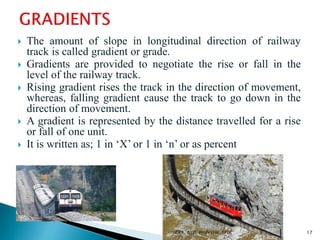
 The amount of slope in longitudinal direction of railway
track is called gradient or grade.
 Gradients are provided to negotiate the rise or fall in the
level of the railway track.
 Rising gradient rises the track in the direction of movement,
whereas, falling gradient cause the track to go down in the
direction of movement.
 A gradient is represented by the distance travelled for a rise
or fall of one unit.
 It is written as; 1 in ‘X’ or 1 in ‘n’ or as percent
17GRK, Asst. Professor, SPEC
•A gradient is normally represented by the distance
travelled for a rise or fall of one unit.
•Sometimes the gradient is indicated as per cent rise
or fall.
•For example, if there is a rise of 1 m in 400 m, the
gradient is 1 in 400 or 0.25%,
18GRK, Asst. Professor, SPEC
Gradients are provided to meet the following
objectives:
 To reach various stations at different elevations
 To follow the natural contours of the ground to
the extent possible
 To reduce the cost of earthwork.
19GRK, Asst. Professor, SPEC
The need for proper geometric design of a track arises
because of the following considerations :
 To ensure the smooth and safe running of trains.
 To achieve maximum speeds.
 To carry heavy axle loads.
 To avoid accidents and derailments due to a
defective permanent way.
 To ensure that the track requires least maintenance.
 For good aesthetics.
20GRK, Asst. Professor, SPEC
 Ruling gradient
 Pusher or helper gradient
 Momentum gradient
 Gradients in station yards
21GRK, Asst. Professor, SPEC
 This is the design gradient basically, because it
is determined on the basis of the performance
of the locomotive and at the same time, it tries
to look at the total amount of load which that
locomotive can take up along with it, while
negotiating any gradient without any loss or
major loss in the speed of the movement.
22GRK, Asst. Professor, SPEC
23GRK, Asst. Professor, SPEC
 It is a maximum gradient (steepest gradient), which
may be permitted on the section of the track.
 It is determined by maximum load that a locomotive
can haul with maximum permissible speed.
 Extra pull required by locomotive on gradient with ‘θ ’
inclination. P = WSinθ =W * gradient
 For Ex:-
Weight of train (W)=500 tonnes
Gradient = 1 in 100
Extra power (P) = 5 tonnes
Ruling gradient
24GRK, Asst. Professor, SPEC
 In Plane area = 1 in 150 to 1 in 250
 In hilly area = 1 in 100 to 1in 150
 Once a ruling gradient is specified for a section, then
all other gradients provided in that section should be
flatter than the ruling gradients (after making due to
compensation for curvature)
25GRK, Asst. Professor, SPEC
 When the gradient of the ensuing section is so steep as
to necessitate the use of an extra engine for pushing the
train, it is known as a pusher or helper gradient.
 Examples of pusher gradients are the Budni -Barkhera
section of Central Railways and the Darjeeling
Himalayan Railway section.
26GRK, Asst. Professor, SPEC
27GRK, Asst. Professor, SPEC
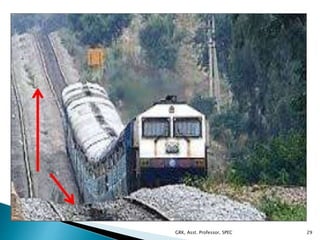
 Momentum gradient steeper than ruling gradient that is
overcome by momentum gathered while having a run in
plane or on falling gradient in valleys.
 Use additional kinetic energy received during run on a
section.
 No obstruction like signals are provided on section with
these gradients(means the train should not be stopped at
that territory).
28GRK, Asst. Professor, SPEC
29GRK, Asst. Professor, SPEC
 For example, in valleys, a falling gradient is
usually followed by rising gradient acquires
sufficient momentum.
 This momentum gives additional kinetic
energy to the moving train which would
enable the train to overcome a steeper rising
gradient than the ruling gradient for a certain
length of the track.
 This rising gradient is called momentum
gradient and this gradient is steeper than ruling
gradient.
30GRK, Asst. Professor, SPEC
31GRK, Asst. Professor, SPEC
The gradients in station yards are quite flat due to the
following reasons:
 To prevent standing vehicles from rolling and moving away
from the yard due to the combined effect of gravity and
strong winds.
 To reduce the additional resistive forces required to start a
locomotive to the extent possible.
 It may be mentioned here that generally, yards are not
levelled completely and certain flat gradients are provided
in order to ensure good drainage.
 The maximum gradient prescribed in station yards on
Indian Railways is 1 in 400, while the recommended
gradient is 1 in 1000.
32GRK, Asst. Professor, SPEC
33GRK, Asst. Professor, SPEC
 Curves provide extra resistance to the movement of
trains. As a result, gradients are compensated to the
following extent on curves:
 On BG tracks, 0.04% per degree of the curve or 70/R,
whichever is minimum.
 On MG tracks, 0.03% per degree of curve or 52.5/R,
whichever is minimum.
 On NG tracks, 0.02% per degree of curve or 35/R,
whichever is minimum where R is the radius of the
curve in metres.
 The gradient of a curved portion of the section should
be flatter than the ruling gradient because of the extra
resistance offered by the curve.
34GRK, Asst. Professor, SPEC
1. Find the steepest gradient on a 2° curve for a
BG line with a ruling gradient of 1 in 200.
Solution
(i) Ruling gradient = 1 in 200 = 0.5%
(ii) Compensation for a 2° curve = 0.04 × 2 = 0.08%
(iii) Compensated gradient = 0.5 – 0.08 = 0.42% = 1
in 238
The steepest gradient on the curved track is 1
in 238.
35GRK, Asst. Professor, SPEC
 Curves are introduced on a railway track to
bypass obstacles, to provide longer and easily
traversed gradients, and to pass a railway line
through obligatory or desirable locations.
 Horizontal curves are provided when a
change in the direction of the track is
required and Vertical curves are provided at
points where two gradients meet or where a
gradient meets level ground.
 Curve is defined either by radius or its degree
36GRK, Asst. Professor, SPEC
 The maximum permissible degree of a curve on a
track depends on various factors such as gauge,
wheel base of the vehicle, maximum permissible
super elevation, and other such allied factors.
The maximum degree or the minimum radius of
the curve permitted on Indian Railways for
various gauges is given in Fig 5.
 Figure No.:5 Maximum Degree of a Curve
 (Source:
dl4a.org/uploads/pdf/EbookRailwayEngineering.
pdf)
37GRK, Asst. Professor, SPEC
38GRK, Asst. Professor, SPEC
 Super elevation or cant (Ca) is the difference in
height between the outer and the inner rail on
a curve.
 It is provided by gradually lifting the outer rail
above the level of the inner rail.
 The inner rail is taken as the reference rail and
is normally maintained at its original level.
 The inner rail is also known as the gradient
rail.
39GRK, Asst. Professor, SPEC
The main functions of super elevation are the
following :
 To ensure a better distribution of load on both
rails.
 To reduce the wear and tear of the rails and
rolling stock.
 To neutralize the effect of lateral forces.
 To provide comfort to passengers.
40GRK, Asst. Professor, SPEC
 A vehicle has a tendency to travel in a straight direction,
which is tangential to the curve, even when it moves on a
circular curve. As a result, the vehicle is subjected to a
constant radial acceleration:
Radial acceleration (g)= V2 /R
Where, V = velocity (metres per second) and
R = Radius of curve (metres).
 This radial acceleration produces a centrifugal force
which acts in a radial direction away from the centre.
41GRK, Asst. Professor, SPEC
The value of the centrifugal force is given by the formula
Force = mass × acceleration
F = m × (V2 /R)
= (W/g) × (V2 /R)
Where,F = Centrifugal force (tonnes),
W = Weight of the vehicle (tonnes),
V = Speed (metre/sec),
g = Acceleration due to gravity (metre/sec2 ), and
R = Radius of the curve (metres).
 To counteract the effect of the centrifugal force, the outer rail of the
curve is elevated with respect to the inner rail by an amount equal to
the super elevation.
 A state of equilibrium is reached when both the wheels exert equal
pressure on the rails and the super elevation is enough to bring the
resultant of the centrifugal force and the force exerted by the weight of
the vehicle at right angles to the plane of the top surface of the rails.
 In this state of equilibrium, the difference in the heights of the outer
and inner rails of the curve known as equilibrium super elevation.
42GRK, Asst. Professor, SPEC
43GRK, Asst. Professor, SPEC
 6.4 Formula for Superelevation
 The θ is the angle that the inclined plane
makes with the horizontal line, then
44GRK, Asst. Professor, SPEC
45GRK, Asst. Professor, SPEC
 where ,
 e = Superelevation,
 G= Gauge,
 V = Velocity,
 g = Acceleration due to gravity, and
 R = Radius of the curve.
 6.5 Thumb Rules for Calculating Superelevation
in the Field
 A field engineer can adopt the following thumb
rules for determining the superelevation of any
curve
46GRK, Asst. Professor, SPEC
 A field engineer can adopt the following thumb
rules for determining the superelevation of any
curve
 Super elevation for BG in cm
 For MG tracks
 Super elevation = three-fifths of the above
formula
 The equilibrium speed is used in this formula
47GRK, Asst. Professor, SPEC
 6.6 Types of Cant
 The cant are further divided on the bases of
speed:
 Equilibrium cant
 Cant deficiency ( Cd )
 Cant excess ( Ce )
 6.6.1 Equilibrium cant
 Value of super elevation derived from the
equation using equilibrium speed
48GRK, Asst. Professor, SPEC
 6.6.2 Cant deficiency ( Cd )
 Cant deficiency (Cd) occurs when a train
travels around a curve at a speed higher than
the equilibrium speed. It is the difference
between the theoretical cant required for
such high speeds and the actual cant
provided. Maximum permissible Cd : 7.6cm
(BG), 5.1cm (MG), 3.8cm (NG).
49GRK, Asst. Professor, SPEC
 6.6.3 Cant excess ( Ce )
 Cant excess (Ce) occurs when a train travels
around a curve at a speed lower than the
equilibrium speed. It is the difference
between the actual cant provided and the
theoretical cant required for such a low
speed.
50GRK, Asst. Professor, SPEC
 7.1 Widening of Gauge on Curve
 When vehicle moves onto a curve, the flange of the
outside wheel of the leading axle continues to travel
in a straight line till it rubs against the rail. Due to the
coning of wheels ,the outside wheel travels a longer
distance compared to the inner wheel. In an effort to
make up for the difference in the distance travelled
by the outer wheel and the inner wheel, the inside
wheels slip backward and the outer wheels skid
forward.
 The widening of the gauge on a curve has, in fact,
tends to decrease the wear and tear on both the
wheel and the track
51GRK, Asst. Professor, SPEC
 The widening of the gauge on curves can be
calculated using the formula
 Extra width on curves
 w = 13(B+L)2/R
 Where,
 B is the wheel base of the vehicle in metres,
 R is the radius of the curve in metres,
 L =0.02(h2 + Dh)1/2 is the lap of the flange in
metres,
 h is the depth of flange below top of the
rail(cm),
 D is the diameter of the wheel of the vehicle
(cm).
52GRK, Asst. Professor, SPEC
53GRK, Asst. Professor, SPEC
GRK, Asst. Professor, SPEC 54
GRK, Asst. Professor, SPEC 55
GRK, Asst. Professor, SPEC 56
GRK, Asst. Professor, SPEC 57
GRK, Asst. Professor, SPEC 58
GRK, Asst. Professor, SPEC 59
GRK, Asst. Professor, SPEC 60
GRK, Asst. Professor, SPEC 61
GRK, Asst. Professor, SPEC 62

Railway engineering part2

  • 2.
     The directionand position given to the centre line of the railway track on the ground is called track alignment. It includes  Horizontal alignment such as straight path, its width, deviation and horizontal curves.  Vertical alignment such as changes in gradients and vertical curves. 2GRK, Asst. Professor, SPEC
  • 3.
    An ideal alignmentshould fulfil the following requirements: 1. Purpose of the track: The alignment should satisfy the basic purposes of track such as a) Transportation services: Railways carry the passenger traffic and goods traffic, local as well as through. b) Political and strategic: It is essential to construct a line to connect two points for defensive purposes. 3GRK, Asst. Professor, SPEC
  • 4.
    c) Linking ofcenters: A railway line should construct through the important places. d) To open up new track: It may be necessary to align new tracks for the land, whose resources are not yet tapped. e) Shortening existing track: When the existing track is uneconomical, a new track may be aligned to shorten the existing track which would prove to be economical. 4GRK, Asst. Professor, SPEC
  • 5.
    2. Feasibility: Theproposed track should met all the technical requirements and general planning of the country. 3. Economy: The initial construction cost, maintenance cost and operational cost should be minimum. 4. Safety: The aligned track give safety to track operations, passenger traffic and goods traffic. 5. Aesthetic aspects: The alignment should be aesthetically and good give pleasant railway journey. 5GRK, Asst. Professor, SPEC
  • 6.
    The following factorsshould be considered while design of a new track: 1. Obligatory or controlling points: The points which governs the alignment are: a) Points through which a track must pass: It is desirable that a track alignment should pass from places of social, commercial, political and defensive importance. b) Points through which a track should not pass: The track should not pass through the following points i) It is better to avoid river crossing because it requires major bridge constructions. It is a uneconomical. ii) it is necessary to avoid high hill passes and saddles. iii) the alignment should be avoided through the tunnels. 6GRK, Asst. Professor, SPEC
  • 7.
    2. Traffic:  Itis essential to satisfy position, nature and amount of traffic.  The alignment should pass through the greatest population. 3. Gauge selection: If the gauge width is increases the initial cost is more but also increases load carrying capacity and speed of the trains. 4. Geometric standards: The efficiency of the alignment depends upon varying conditions of gradients, speed, loading conditions. 7GRK, Asst. Professor, SPEC
  • 8.
    5. Topography ofthe country: If the heavy gradients are unavoidable then the cost alignment can be reduced by different techniques. 6. Economic considerations: The alignment should be economical.  The best alignment is one which should gives maximum annual return(r) r =[Gross revenue – Annual running expenses ] / Investment r = [R- E] / I 7. Other considerations: The miscellaneous factors such as soil conditions, drainage conditions etc. 8GRK, Asst. Professor, SPEC
  • 9.
    In order tohave a proper and satisfactory new route, various surveys are carried out: 1) Traffic survey 2) Reconnaissance Survey 3) Preliminary Survey 4) Location Survey 9GRK, Asst. Professor, SPEC
  • 10.
    This consists ofcollection of the information regarding the following:  The general character of the country and the extent of cultivation.  Information regarding the local industries and religious festivals.  The general condition as regards prosperity of people in the locality and density of population and its distribution;  The probable amount of traffic to be served by new railway line.  The probable new traffic lines to be opened up to join large centres of trade. 10GRK, Asst. Professor, SPEC
  • 11.
     Nature andvolume of exports and their destination;  The amount of imports and centres of their distribution.  Possibilities of development of industries as a result of the new railway line.  Visiting all trade centres and consultation with prominent citizens and local authorities regarding the most suitable route for the railway.  Standard of construction required for carrying the probable traffic.  Study of the existing means of transport. 11GRK, Asst. Professor, SPEC
  • 12.
    This consists ofcollection of information regarding the following:  Physical features of the country.  The surface formation of the ground.  Nature of soil and its classification.  Streams and rivers of the immediate vicinity, especially those which are likely to cross the proposed railway line.  Positions of hills and lakes.  Samples of water from wells, rivers, etc. so as to ascertain weather the water is suitable for use in locomotive or not.  Availability of materials and labour for use during construction. 12GRK, Asst. Professor, SPEC
  • 13.
    Object of preliminarysurvey:  To conduct the survey work along the alternative routes found out by reconnaissance survey and;  To determine with greater accuracy the cost of the railway line along these alternative routes. Importance of preliminary survey:  It decides the final route and recommends only one particular route in preference to other alternative routes;  Thus, should be carried out with great precision as on it depends the alignment of the final route. 13GRK, Asst. Professor, SPEC
  • 14.
    Object of locationsurvey:  To carry out the detailed survey along the route which has been found and fixed as the most economical route from the data of the preliminary survey.  It establishes the centre-line of the actual track to be laid.  As soon as the location survey is completed, the construction work is started. 14GRK, Asst. Professor, SPEC
  • 15.
    Work of locationsurvey: It is carried out in two stages: 1. Paper location 2. Field location 1. Paper location: The final route selected is put up on paper and details such as gradient, curves, contours, etc. are worked out.  All the working drawings are prepared, even of minor structures such as signal cabins.  After the paper location is over, the field work is started and the centre-line of the track is fixed. 15GRK, Asst. Professor, SPEC
  • 16.
     The fieldlocation transfers paper location on the ground;  It gives all the requirements of the construction engineer such as benchmarks, levels, measurements, etc.  The centre-line pegs are driven at every 300 metres along the centre-line of the track.  Every change of direction, the beginning and end of the curve and also the intersecting points are clearly marked.  In addition to the fixing up of the centre-line of the track, the centre-lines of bridges, culverts, tunnels, station buildings, signal cabins, etc. should also be fixed. 16GRK, Asst. Professor, SPEC
  • 17.
     The amountof slope in longitudinal direction of railway track is called gradient or grade.  Gradients are provided to negotiate the rise or fall in the level of the railway track.  Rising gradient rises the track in the direction of movement, whereas, falling gradient cause the track to go down in the direction of movement.  A gradient is represented by the distance travelled for a rise or fall of one unit.  It is written as; 1 in ‘X’ or 1 in ‘n’ or as percent 17GRK, Asst. Professor, SPEC
  • 18.
    •A gradient isnormally represented by the distance travelled for a rise or fall of one unit. •Sometimes the gradient is indicated as per cent rise or fall. •For example, if there is a rise of 1 m in 400 m, the gradient is 1 in 400 or 0.25%, 18GRK, Asst. Professor, SPEC
  • 19.
    Gradients are providedto meet the following objectives:  To reach various stations at different elevations  To follow the natural contours of the ground to the extent possible  To reduce the cost of earthwork. 19GRK, Asst. Professor, SPEC
  • 20.
    The need forproper geometric design of a track arises because of the following considerations :  To ensure the smooth and safe running of trains.  To achieve maximum speeds.  To carry heavy axle loads.  To avoid accidents and derailments due to a defective permanent way.  To ensure that the track requires least maintenance.  For good aesthetics. 20GRK, Asst. Professor, SPEC
  • 21.
     Ruling gradient Pusher or helper gradient  Momentum gradient  Gradients in station yards 21GRK, Asst. Professor, SPEC
  • 22.
     This isthe design gradient basically, because it is determined on the basis of the performance of the locomotive and at the same time, it tries to look at the total amount of load which that locomotive can take up along with it, while negotiating any gradient without any loss or major loss in the speed of the movement. 22GRK, Asst. Professor, SPEC
  • 23.
  • 24.
     It isa maximum gradient (steepest gradient), which may be permitted on the section of the track.  It is determined by maximum load that a locomotive can haul with maximum permissible speed.  Extra pull required by locomotive on gradient with ‘θ ’ inclination. P = WSinθ =W * gradient  For Ex:- Weight of train (W)=500 tonnes Gradient = 1 in 100 Extra power (P) = 5 tonnes Ruling gradient 24GRK, Asst. Professor, SPEC
  • 25.
     In Planearea = 1 in 150 to 1 in 250  In hilly area = 1 in 100 to 1in 150  Once a ruling gradient is specified for a section, then all other gradients provided in that section should be flatter than the ruling gradients (after making due to compensation for curvature) 25GRK, Asst. Professor, SPEC
  • 26.
     When thegradient of the ensuing section is so steep as to necessitate the use of an extra engine for pushing the train, it is known as a pusher or helper gradient.  Examples of pusher gradients are the Budni -Barkhera section of Central Railways and the Darjeeling Himalayan Railway section. 26GRK, Asst. Professor, SPEC
  • 27.
  • 28.
     Momentum gradientsteeper than ruling gradient that is overcome by momentum gathered while having a run in plane or on falling gradient in valleys.  Use additional kinetic energy received during run on a section.  No obstruction like signals are provided on section with these gradients(means the train should not be stopped at that territory). 28GRK, Asst. Professor, SPEC
  • 29.
  • 30.
     For example,in valleys, a falling gradient is usually followed by rising gradient acquires sufficient momentum.  This momentum gives additional kinetic energy to the moving train which would enable the train to overcome a steeper rising gradient than the ruling gradient for a certain length of the track.  This rising gradient is called momentum gradient and this gradient is steeper than ruling gradient. 30GRK, Asst. Professor, SPEC
  • 31.
  • 32.
    The gradients instation yards are quite flat due to the following reasons:  To prevent standing vehicles from rolling and moving away from the yard due to the combined effect of gravity and strong winds.  To reduce the additional resistive forces required to start a locomotive to the extent possible.  It may be mentioned here that generally, yards are not levelled completely and certain flat gradients are provided in order to ensure good drainage.  The maximum gradient prescribed in station yards on Indian Railways is 1 in 400, while the recommended gradient is 1 in 1000. 32GRK, Asst. Professor, SPEC
  • 33.
  • 34.
     Curves provideextra resistance to the movement of trains. As a result, gradients are compensated to the following extent on curves:  On BG tracks, 0.04% per degree of the curve or 70/R, whichever is minimum.  On MG tracks, 0.03% per degree of curve or 52.5/R, whichever is minimum.  On NG tracks, 0.02% per degree of curve or 35/R, whichever is minimum where R is the radius of the curve in metres.  The gradient of a curved portion of the section should be flatter than the ruling gradient because of the extra resistance offered by the curve. 34GRK, Asst. Professor, SPEC
  • 35.
    1. Find thesteepest gradient on a 2° curve for a BG line with a ruling gradient of 1 in 200. Solution (i) Ruling gradient = 1 in 200 = 0.5% (ii) Compensation for a 2° curve = 0.04 × 2 = 0.08% (iii) Compensated gradient = 0.5 – 0.08 = 0.42% = 1 in 238 The steepest gradient on the curved track is 1 in 238. 35GRK, Asst. Professor, SPEC
  • 36.
     Curves areintroduced on a railway track to bypass obstacles, to provide longer and easily traversed gradients, and to pass a railway line through obligatory or desirable locations.  Horizontal curves are provided when a change in the direction of the track is required and Vertical curves are provided at points where two gradients meet or where a gradient meets level ground.  Curve is defined either by radius or its degree 36GRK, Asst. Professor, SPEC
  • 37.
     The maximumpermissible degree of a curve on a track depends on various factors such as gauge, wheel base of the vehicle, maximum permissible super elevation, and other such allied factors. The maximum degree or the minimum radius of the curve permitted on Indian Railways for various gauges is given in Fig 5.  Figure No.:5 Maximum Degree of a Curve  (Source: dl4a.org/uploads/pdf/EbookRailwayEngineering. pdf) 37GRK, Asst. Professor, SPEC
  • 38.
  • 39.
     Super elevationor cant (Ca) is the difference in height between the outer and the inner rail on a curve.  It is provided by gradually lifting the outer rail above the level of the inner rail.  The inner rail is taken as the reference rail and is normally maintained at its original level.  The inner rail is also known as the gradient rail. 39GRK, Asst. Professor, SPEC
  • 40.
    The main functionsof super elevation are the following :  To ensure a better distribution of load on both rails.  To reduce the wear and tear of the rails and rolling stock.  To neutralize the effect of lateral forces.  To provide comfort to passengers. 40GRK, Asst. Professor, SPEC
  • 41.
     A vehiclehas a tendency to travel in a straight direction, which is tangential to the curve, even when it moves on a circular curve. As a result, the vehicle is subjected to a constant radial acceleration: Radial acceleration (g)= V2 /R Where, V = velocity (metres per second) and R = Radius of curve (metres).  This radial acceleration produces a centrifugal force which acts in a radial direction away from the centre. 41GRK, Asst. Professor, SPEC
  • 42.
    The value ofthe centrifugal force is given by the formula Force = mass × acceleration F = m × (V2 /R) = (W/g) × (V2 /R) Where,F = Centrifugal force (tonnes), W = Weight of the vehicle (tonnes), V = Speed (metre/sec), g = Acceleration due to gravity (metre/sec2 ), and R = Radius of the curve (metres).  To counteract the effect of the centrifugal force, the outer rail of the curve is elevated with respect to the inner rail by an amount equal to the super elevation.  A state of equilibrium is reached when both the wheels exert equal pressure on the rails and the super elevation is enough to bring the resultant of the centrifugal force and the force exerted by the weight of the vehicle at right angles to the plane of the top surface of the rails.  In this state of equilibrium, the difference in the heights of the outer and inner rails of the curve known as equilibrium super elevation. 42GRK, Asst. Professor, SPEC
  • 43.
  • 44.
     6.4 Formulafor Superelevation  The θ is the angle that the inclined plane makes with the horizontal line, then 44GRK, Asst. Professor, SPEC
  • 45.
  • 46.
     where , e = Superelevation,  G= Gauge,  V = Velocity,  g = Acceleration due to gravity, and  R = Radius of the curve.  6.5 Thumb Rules for Calculating Superelevation in the Field  A field engineer can adopt the following thumb rules for determining the superelevation of any curve 46GRK, Asst. Professor, SPEC
  • 47.
     A fieldengineer can adopt the following thumb rules for determining the superelevation of any curve  Super elevation for BG in cm  For MG tracks  Super elevation = three-fifths of the above formula  The equilibrium speed is used in this formula 47GRK, Asst. Professor, SPEC
  • 48.
     6.6 Typesof Cant  The cant are further divided on the bases of speed:  Equilibrium cant  Cant deficiency ( Cd )  Cant excess ( Ce )  6.6.1 Equilibrium cant  Value of super elevation derived from the equation using equilibrium speed 48GRK, Asst. Professor, SPEC
  • 49.
     6.6.2 Cantdeficiency ( Cd )  Cant deficiency (Cd) occurs when a train travels around a curve at a speed higher than the equilibrium speed. It is the difference between the theoretical cant required for such high speeds and the actual cant provided. Maximum permissible Cd : 7.6cm (BG), 5.1cm (MG), 3.8cm (NG). 49GRK, Asst. Professor, SPEC
  • 50.
     6.6.3 Cantexcess ( Ce )  Cant excess (Ce) occurs when a train travels around a curve at a speed lower than the equilibrium speed. It is the difference between the actual cant provided and the theoretical cant required for such a low speed. 50GRK, Asst. Professor, SPEC
  • 51.
     7.1 Wideningof Gauge on Curve  When vehicle moves onto a curve, the flange of the outside wheel of the leading axle continues to travel in a straight line till it rubs against the rail. Due to the coning of wheels ,the outside wheel travels a longer distance compared to the inner wheel. In an effort to make up for the difference in the distance travelled by the outer wheel and the inner wheel, the inside wheels slip backward and the outer wheels skid forward.  The widening of the gauge on a curve has, in fact, tends to decrease the wear and tear on both the wheel and the track 51GRK, Asst. Professor, SPEC
  • 52.
     The wideningof the gauge on curves can be calculated using the formula  Extra width on curves  w = 13(B+L)2/R  Where,  B is the wheel base of the vehicle in metres,  R is the radius of the curve in metres,  L =0.02(h2 + Dh)1/2 is the lap of the flange in metres,  h is the depth of flange below top of the rail(cm),  D is the diameter of the wheel of the vehicle (cm). 52GRK, Asst. Professor, SPEC
  • 53.
  • 54.
  • 55.
  • 56.
  • 57.
  • 58.
  • 59.
  • 60.
  • 61.
  • 62.