Cross Section of Permanent Way
By
Dr. T. Vijaya Gowri,
Associate Professor,
Department of Civil Engineering
B. V. Raju Institute of Civil Engineering
Permanent Way
The railway track of permanent nature is called permanent way or
permanent track.
In other words, a permanent way is the combination of rails, fitted on
sleepers and resting on ballast and subgrade.
Purpose of Permanent Way
The purpose of the permanent way is
to provide a permanent facility for safe and quick movements of normal
commercial traffic between the starting and destination station.
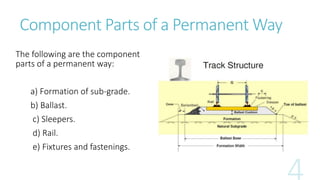
Component Parts of a Permanent Way
The following are the component
parts of a permanent way:
a) Formation of sub-grade.
b) Ballast.
c) Sleepers.
d) Rail.
e) Fixtures and fastenings.
Requirements of
an Ideal Permanent Way
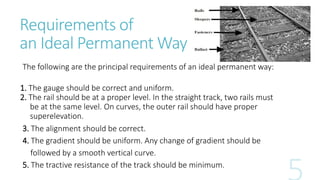
The following are the principal requirements of an ideal permanent way:
1. The gauge should be correct and uniform.
2. The rail should be at a proper level. In the straight track, two rails must
be at the same level. On curves, the outer rail should have proper
superelevation.
3. The alignment should be correct.
4. The gradient should be uniform. Any change of gradient should be
followed by a smooth vertical curve.
5. The tractive resistance of the track should be minimum.
Requirements of
an Ideal Permanent Way
6. The track should possess sufficient elasticity.
7. The track should be sufficiently strong against lateral
forces.
8. The radius and superelevation on curves should be
properly designed and maintained.
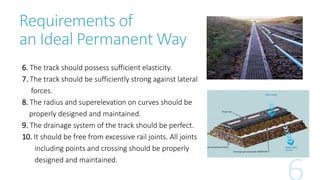
9. The drainage system of the track should be perfect.
10. It should be free from excessive rail joints. All joints
including points and crossing should be properly
designed and maintained.
Requirements of
an Ideal Permanent Way
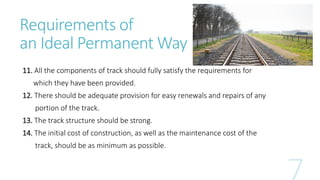
11. All the components of track should fully satisfy the requirements for
which they have been provided.
12. There should be adequate provision for easy renewals and repairs of any
portion of the track.
13. The track structure should be strong.
14. The initial cost of construction, as well as the maintenance cost of the
track, should be as minimum as possible.
Rails
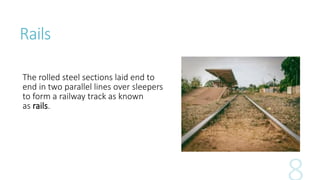
The rolled steel sections laid end to
end in two parallel lines over sleepers
to form a railway track as known
as rails.
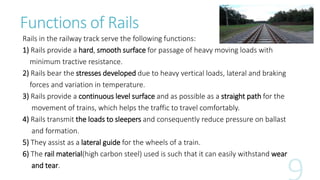
Functions of Rails
Rails in the railway track serve the following functions:
1) Rails provide a hard, smooth surface for passage of heavy moving loads with
minimum tractive resistance.
2) Rails bear the stresses developed due to heavy vertical loads, lateral and braking
forces and variation in temperature.
3) Rails provide a continuous level surface and as possible as a straight path for the
movement of trains, which helps the traffic to travel comfortably.
4) Rails transmit the loads to sleepers and consequently reduce pressure on ballast
and formation.
5) They assist as a lateral guide for the wheels of a train.
6) The rail material(high carbon steel) used is such that it can easily withstand wear
and tear.
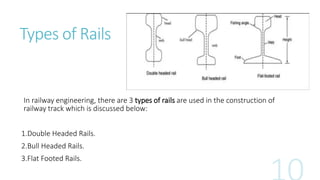
Types of Rails
In railway engineering, there are 3 types of rails are used in the construction of
railway track which is discussed below:
1.Double Headed Rails.
2.Bull Headed Rails.
3.Flat Footed Rails.
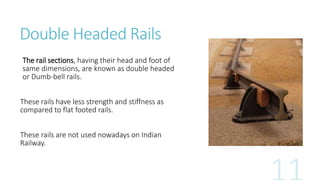
Double Headed Rails
The rail sections, having their head and foot of
same dimensions, are known as double headed
or Dumb-bell rails.
These rails have less strength and stiffness as
compared to flat footed rails.
These rails are not used nowadays on Indian
Railway.
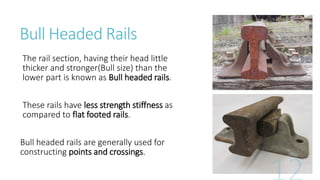
Bull Headed Rails
The rail section, having their head little
thicker and stronger(Bull size) than the
lower part is known as Bull headed rails.
These rails have less strength stiffness as
compared to flat footed rails.
Bull headed rails are generally used for
constructing points and crossings.
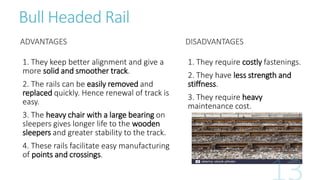
Bull Headed Rail
ADVANTAGES
1. They keep better alignment and give a
more solid and smoother track.
2. The rails can be easily removed and
replaced quickly. Hence renewal of track is
easy.
3. The heavy chair with a large bearing on
sleepers gives longer life to the wooden
sleepers and greater stability to the track.
4. These rails facilitate easy manufacturing
of points and crossings.
DISADVANTAGES
1. They require costly fastenings.
2. They have less strength and
stiffness.
3. They require heavy
maintenance cost.
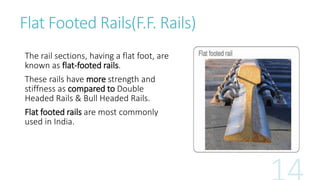
Flat Footed Rails(F.F. Rails)
The rail sections, having a flat foot, are
known as flat-footed rails.
These rails have more strength and
stiffness as compared to Double
Headed Rails & Bull Headed Rails.
Flat footed rails are most commonly
used in India.
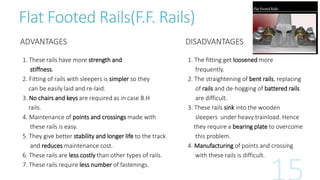
Flat Footed Rails(F.F. Rails)
ADVANTAGES
1. These rails have more strength and
stiffness.
2. Fitting of rails with sleepers is simpler so they
can be easily laid and re-laid.
3. No chairs and keys are required as in case B.H
rails.
4. Maintenance of points and crossings made with
these rails is easy.
5. They give better stability and longer life to the track
and reduces maintenance cost.
6. These rails are less costly than other types of rails.
7. These rails require less number of fastenings.
DISADVANTAGES
1. The fitting get loosened more
frequently.
2. The straightening of bent rails, replacing
of rails and de-hogging of battered rails
are difficult.
3. These rails sink into the wooden
sleepers under heavy trainload. Hence
they require a bearing plate to overcome
this problem.
4. Manufacturing of points and crossing
with these rails is difficult.
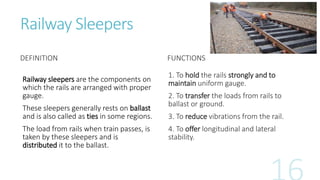
Railway Sleepers
DEFINITION
Railway sleepers are the components on
which the rails are arranged with proper
gauge.
These sleepers generally rests on ballast
and is also called as ties in some regions.
The load from rails when train passes, is
taken by these sleepers and is
distributed it to the ballast.
FUNCTIONS
1. To hold the rails strongly and to
maintain uniform gauge.
2. To transfer the loads from rails to
ballast or ground.
3. To reduce vibrations from the rail.
4. To offer longitudinal and lateral
stability.
Types of Railway Sleepers
Based on the materials used, railway sleepers are classified into following types.
1.Wooden sleepers
2.Concrete sleepers
3.Steel sleepers
4.Cast iron sleepers
5.Composite sleepers
Wooden Sleepers
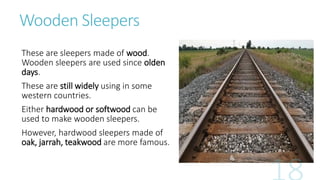
These are sleepers made of wood.
Wooden sleepers are used since olden
days.
These are still widely using in some
western countries.
Either hardwood or softwood can be
used to make wooden sleepers.
However, hardwood sleepers made of
oak, jarrah, teakwood are more famous.
Wooden Sleepers
ADVANTAGES
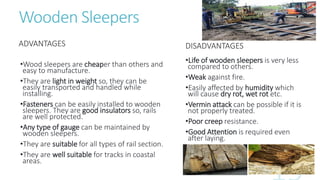
•Wood sleepers are cheaper than others and
easy to manufacture.
•They are light in weight so, they can be
easily transported and handled while
installing.
•Fasteners can be easily installed to wooden
sleepers. They are good insulators so, rails
are well protected.
•Any type of gauge can be maintained by
wooden sleepers.
•They are suitable for all types of rail section.
•They are well suitable for tracks in coastal
areas.
DISADVANTAGES
•Life of wooden sleepers is very less
compared to others.
•Weak against fire.
•Easily affected by humidity which
will cause dry rot, wet rot etc.
•Vermin attack can be possible if it is
not properly treated.
•Poor creep resistance.
•Good Attention is required even
after laying.
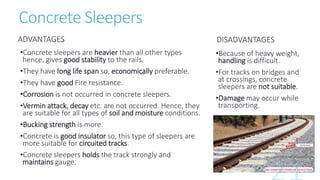
Concrete Sleepers
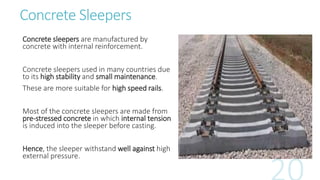
Concrete sleepers are manufactured by
concrete with internal reinforcement.
Concrete sleepers used in many countries due
to its high stability and small maintenance.
These are more suitable for high speed rails.
Most of the concrete sleepers are made from
pre-stressed concrete in which internal tension
is induced into the sleeper before casting.
Hence, the sleeper withstand well against high
external pressure.
Concrete Sleepers
ADVANTAGES
•Concrete sleepers are heavier than all other types
hence, gives good stability to the rails.
•They have long life span so, economically preferable.
•They have good Fire resistance.
•Corrosion is not occurred in concrete sleepers.
•Vermin attack, decay etc. are not occurred. Hence, they
are suitable for all types of soil and moisture conditions.
•Bucking strength is more.
•Concrete is good insulator so, this type of sleepers are
more suitable for circuited tracks.
•Concrete sleepers holds the track strongly and
maintains gauge.
DISADVANTAGES
•Because of heavy weight,
handling is difficult.
•For tracks on bridges and
at crossings, concrete
sleepers are not suitable.
•Damage may occur while
transporting.
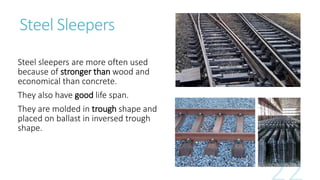
Steel Sleepers
Steel sleepers are more often used
because of stronger than wood and
economical than concrete.
They also have good life span.
They are molded in trough shape and
placed on ballast in inversed trough
shape.
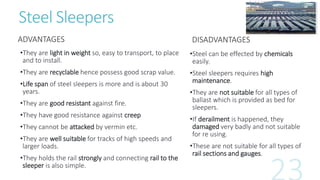
Steel Sleepers
ADVANTAGES
•They are light in weight so, easy to transport, to place
and to install.
•They are recyclable hence possess good scrap value.
•Life span of steel sleepers is more and is about 30
years.
•They are good resistant against fire.
•They have good resistance against creep
•They cannot be attacked by vermin etc.
•They are well suitable for tracks of high speeds and
larger loads.
•They holds the rail strongly and connecting rail to the
sleeper is also simple.
DISADVANTAGES
•Steel can be effected by chemicals
easily.
•Steel sleepers requires high
maintenance.
•They are not suitable for all types of
ballast which is provided as bed for
sleepers.
•If derailment is happened, they
damaged very badly and not suitable
for re using.
•These are not suitable for all types of
rail sections and gauges.
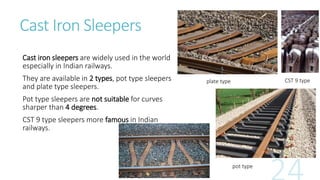
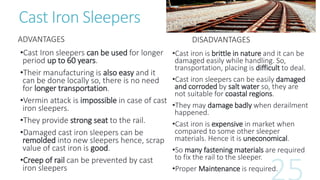
Cast Iron Sleepers
Cast iron sleepers are widely used in the world
especially in Indian railways.
They are available in 2 types, pot type sleepers
and plate type sleepers.
Pot type sleepers are not suitable for curves
sharper than 4 degrees.
CST 9 type sleepers more famous in Indian
railways.
plate type CST 9 type
pot type
Cast Iron Sleepers
ADVANTAGES
•Cast Iron sleepers can be used for longer
period up to 60 years.
•Their manufacturing is also easy and it
can be done locally so, there is no need
for longer transportation.
•Vermin attack is impossible in case of cast
iron sleepers.
•They provide strong seat to the rail.
•Damaged cast iron sleepers can be
remolded into new sleepers hence, scrap
value of cast iron is good.
•Creep of rail can be prevented by cast
iron sleepers
DISADVANTAGES
•Cast iron is brittle in nature and it can be
damaged easily while handling. So,
transportation, placing is difficult to deal.
•Cast iron sleepers can be easily damaged
and corroded by salt water so, they are
not suitable for coastal regions.
•They may damage badly when derailment
happened.
•Cast iron is expensive in market when
compared to some other sleeper
materials. Hence it is uneconomical.
•So many fastening materials are required
to fix the rail to the sleeper.
•Proper Maintenance is required.
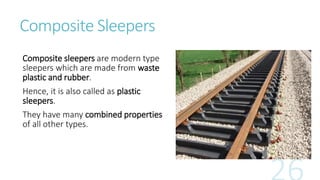
Composite Sleepers
Composite sleepers are modern type
sleepers which are made from waste
plastic and rubber.
Hence, it is also called as plastic
sleepers.
They have many combined properties
of all other types.
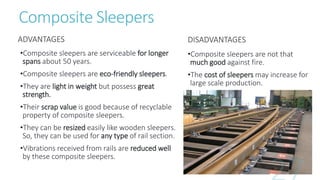
Composite Sleepers
ADVANTAGES
•Composite sleepers are serviceable for longer
spans about 50 years.
•Composite sleepers are eco-friendly sleepers.
•They are light in weight but possess great
strength.
•Their scrap value is good because of recyclable
property of composite sleepers.
•They can be resized easily like wooden sleepers.
So, they can be used for any type of rail section.
•Vibrations received from rails are reduced well
by these composite sleepers.
DISADVANTAGES
•Composite sleepers are not that
much good against fire.
•The cost of sleepers may increase for
large scale production.
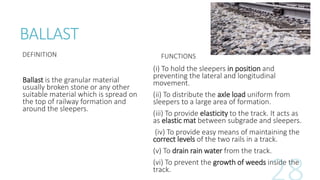
BALLAST
DEFINITION
Ballast is the granular material
usually broken stone or any other
suitable material which is spread on
the top of railway formation and
around the sleepers.
FUNCTIONS
(i) To hold the sleepers in position and
preventing the lateral and longitudinal
movement.
(ii) To distribute the axle load uniform from
sleepers to a large area of formation.
(iii) To provide elasticity to the track. It acts as
as elastic mat between subgrade and sleepers.
(iv) To provide easy means of maintaining the
correct levels of the two rails in a track.
(v) To drain rain water from the track.
(vi) To prevent the growth of weeds inside the
track.
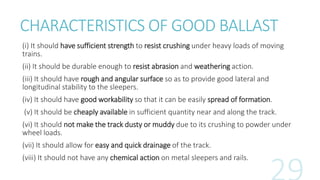
CHARACTERISTICS OF GOOD BALLAST
(i) It should have sufficient strength to resist crushing under heavy loads of moving
trains.
(ii) It should be durable enough to resist abrasion and weathering action.
(iii) It should have rough and angular surface so as to provide good lateral and
longitudinal stability to the sleepers.
(iv) It should have good workability so that it can be easily spread of formation.
(v) It should be cheaply available in sufficient quantity near and along the track.
(vi) It should not make the track dusty or muddy due to its crushing to powder under
wheel loads.
(vii) It should allow for easy and quick drainage of the track.
(viii) It should not have any chemical action on metal sleepers and rails.
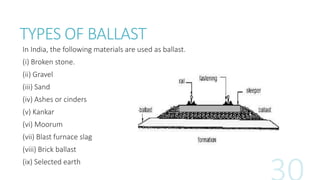
TYPES OF BALLAST
In India, the following materials are used as ballast.
(i) Broken stone.
(ii) Gravel
(iii) Sand
(iv) Ashes or cinders
(v) Kankar
(vi) Moorum
(vii) Blast furnace slag
(viii) Brick ballast
(ix) Selected earth
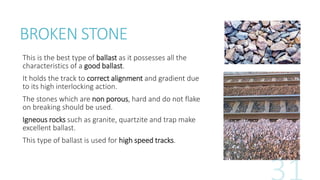
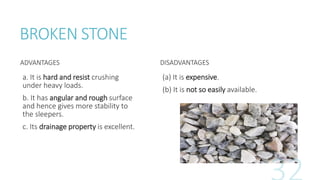
BROKEN STONE
This is the best type of ballast as it possesses all the
characteristics of a good ballast.
It holds the track to correct alignment and gradient due
to its high interlocking action.
The stones which are non porous, hard and do not flake
on breaking should be used.
Igneous rocks such as granite, quartzite and trap make
excellent ballast.
This type of ballast is used for high speed tracks.
BROKEN STONE
ADVANTAGES
a. It is hard and resist crushing
under heavy loads.
b. It has angular and rough surface
and hence gives more stability to
the sleepers.
c. Its drainage property is excellent.
DISADVANTAGES
(a) It is expensive.
(b) It is not so easily available.
GRAVEL
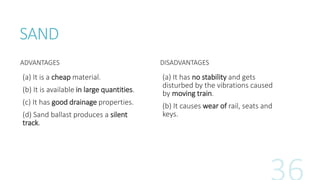
Gravel is the second best material for ballast. This is
obtained either from river beds or from gravel pits and
has smooth rounded fragments.
Gravel obtained from pits usually contains earth which
should be removed by washing.
Gravel obtained from river beds is screened and
required size gravel is used.
Larger size gravels are broken into required size.
Round edges gravels are broken to increase their
interlocking action.
GRAVEL
ADVANTAGES
(a) Gravel is cheaper than stone
ballast.
(b) The drainage property of gravel
excellent.
(c) It holds the track to correct
alignment and gradient.
(d) It is ease to use gravel ballast
than stone ballast at certain places
where formation is unstable
DISADVANTAGES
(a) It requires screening before use
due to large variation in size.
(b) Gravel obtained from pits
requires washing.
(c) Due to round faces the packing
under sleepers is loose.
(d) Gravel easily roll down due to
vibrations.
SAND
Sand is reasonably a good material for the
ballast.
Coarse sand is generally preferred to fine sand
for ballast.
This type of ballast is suitable for packing pot
sleepers.
It is used only on unimportant tracks.
SAND
ADVANTAGES
(a) It is a cheap material.
(b) It is available in large quantities.
(c) It has good drainage properties.
(d) Sand ballast produces a silent
track.
DISADVANTAGES
(a) It has no stability and gets
disturbed by the vibrations caused
by moving train.
(b) It causes wear of rail, seats and
keys.
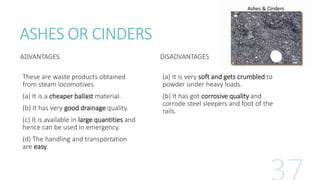
ASHES OR CINDERS
ADVANTAGES
These are waste products obtained
from steam locomotives.
(a) It is a cheaper ballast material.
(b) It has very good drainage quality.
(c) It is available in large quantities and
hence can be used in emergency.
(d) The handling and transportation
are easy.
DISADVANTAGES
(a) It is very soft and gets crumbled to
powder under heavy loads.
(b) It has got corrosive quality and
corrode steel sleepers and foot of the
rails.
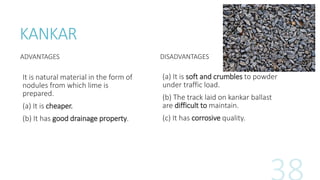
KANKAR
ADVANTAGES
It is natural material in the form of
nodules from which lime is
prepared.
(a) It is cheaper.
(b) It has good drainage property.
DISADVANTAGES
(a) It is soft and crumbles to powder
under traffic load.
(b) The track laid on kankar ballast
are difficult to maintain.
(c) It has corrosive quality.
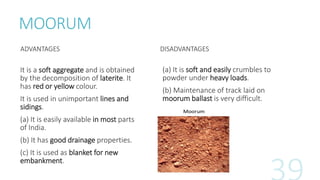
MOORUM
ADVANTAGES
It is a soft aggregate and is obtained
by the decomposition of laterite. It
has red or yellow colour.
It is used in unimportant lines and
sidings.
(a) It is easily available in most parts
of India.
(b) It has good drainage properties.
(c) It is used as blanket for new
embankment.
DISADVANTAGES
(a) It is soft and easily crumbles to
powder under heavy loads.
(b) Maintenance of track laid on
moorum ballast is very difficult.
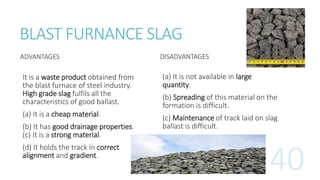
BLAST FURNANCE SLAG
ADVANTAGES
It is a waste product obtained from
the blast furnace of steel industry.
High grade slag fulfils all the
characteristics of good ballast.
(a) It is a cheap material.
(b) It has good drainage properties.
(c) It is a strong material.
(d) It holds the track in correct
alignment and gradient.
DISADVANTAGES
(a) It is not available in large
quantity.
(b) Spreading of this material on the
formation is difficult.
(c) Maintenance of track laid on slag
ballast is difficult.
BRICK BALLAST
ADVANTAGES
At places where good ballast
material is not available over-burnt
bricks are broken into suitable size
to be used as ballast.
(a) It is a cheap material.
(b) It prevents growth of vegetation.
(c) It has good drainage properties.
DISADVANTAGES
(a) It is soft and easily crumbles to
powder under heavy loads.
(b) The rails laid over such ballast
get corrugated.
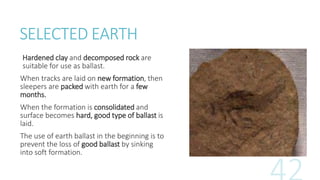
SELECTED EARTH
Hardened clay and decomposed rock are
suitable for use as ballast.
When tracks are laid on new formation, then
sleepers are packed with earth for a few
months.
When the formation is consolidated and
surface becomes hard, good type of ballast is
laid.
The use of earth ballast in the beginning is to
prevent the loss of good ballast by sinking
into soft formation.
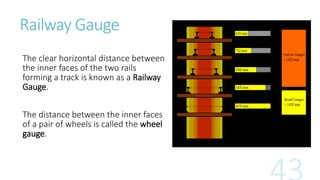
Railway Gauge
The clear horizontal distance between
the inner faces of the two rails
forming a track is known as a Railway
Gauge.
The distance between the inner faces
of a pair of wheels is called the wheel
gauge.
Types of Gauges in India
In India the following gauges are used:
•a) Standard Gauge or Broad Gauge – Gauge width 1.676 m.
•b) Metre/Meter Gauge (M.G) – Gauge width 1.000 m.
•c) Narrow Gauge (N.G) – Gauge width 0.762 m.
•d) Feeder Track Gauge or Light Gauge – Gauge width 0.610 m.
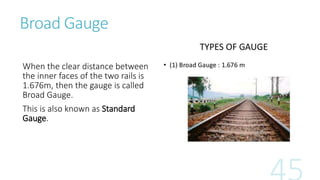
Broad Gauge
When the clear distance between
the inner faces of the two rails is
1.676m, then the gauge is called
Broad Gauge.
This is also known as Standard
Gauge.
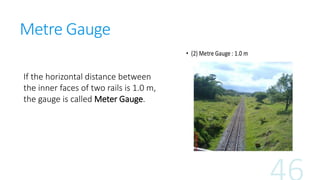
Metre Gauge
If the horizontal distance between
the inner faces of two rails is 1.0 m,
the gauge is called Meter Gauge.
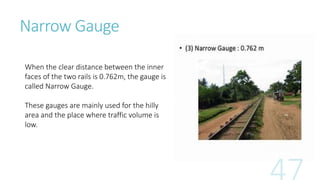
Narrow Gauge
When the clear distance between the inner
faces of the two rails is 0.762m, the gauge is
called Narrow Gauge.
These gauges are mainly used for the hilly
area and the place where traffic volume is
low.
Factors Affecting Adopting
of a Particular Gauge
The following factors govern the choice of different gauges:
1. Cost of construction and funds available for the railway project.
2. Volume and nature of traffic.
3. The intensity of the population.
4. Industrial and commercial development of the locality.
5. Prospects of future development of the area.
6. Topographical and geological features of the country.
7. Speed of movement required.
Advantages of Uniform Gauge
The use of a uniform gauge has the following advantages:
1. The delay cost and hardship in shifting passengers and goods from the vehicle of one gauge to the
other are avoided.
2. Labour expenses of shifting are saved.
3. Breakage of goods due to shifting is avoided.
4. Possibility of thefts and misplacement during the shifting operation is eliminated.
5. Large sheds to store goods are not required.
6. Labour strikes etc. do not affect the service and operation of trains.
7. Wagons can be efficiently used on all the tracks if the gauge is uniform.
8. Locomotives can be effectively used on all the tracks if a uniform gauge is adopted.
9. During military movement, no time is wasted in shifting of personnel and equipment’s if the gauge is
uniform.
10. Duplication of equipment such as platforms, sanitary arrangements, etc is avoided.
References
Satish Chandra and Agarwal, M.M. (2007) "Railway Engineering" Oxford Higher Education,
University Press New Delhi.
Cross Section of Permanent Way.pdf

Cross Section of Permanent Way.pdf

  • 1.
    Cross Section ofPermanent Way By Dr. T. Vijaya Gowri, Associate Professor, Department of Civil Engineering B. V. Raju Institute of Civil Engineering
  • 2.
    Permanent Way The railwaytrack of permanent nature is called permanent way or permanent track. In other words, a permanent way is the combination of rails, fitted on sleepers and resting on ballast and subgrade.
  • 3.
    Purpose of PermanentWay The purpose of the permanent way is to provide a permanent facility for safe and quick movements of normal commercial traffic between the starting and destination station.
  • 4.
    Component Parts ofa Permanent Way The following are the component parts of a permanent way: a) Formation of sub-grade. b) Ballast. c) Sleepers. d) Rail. e) Fixtures and fastenings.
  • 5.
    Requirements of an IdealPermanent Way The following are the principal requirements of an ideal permanent way: 1. The gauge should be correct and uniform. 2. The rail should be at a proper level. In the straight track, two rails must be at the same level. On curves, the outer rail should have proper superelevation. 3. The alignment should be correct. 4. The gradient should be uniform. Any change of gradient should be followed by a smooth vertical curve. 5. The tractive resistance of the track should be minimum.
  • 6.
    Requirements of an IdealPermanent Way 6. The track should possess sufficient elasticity. 7. The track should be sufficiently strong against lateral forces. 8. The radius and superelevation on curves should be properly designed and maintained. 9. The drainage system of the track should be perfect. 10. It should be free from excessive rail joints. All joints including points and crossing should be properly designed and maintained.
  • 7.
    Requirements of an IdealPermanent Way 11. All the components of track should fully satisfy the requirements for which they have been provided. 12. There should be adequate provision for easy renewals and repairs of any portion of the track. 13. The track structure should be strong. 14. The initial cost of construction, as well as the maintenance cost of the track, should be as minimum as possible.
  • 8.
    Rails The rolled steelsections laid end to end in two parallel lines over sleepers to form a railway track as known as rails.
  • 9.
    Functions of Rails Railsin the railway track serve the following functions: 1) Rails provide a hard, smooth surface for passage of heavy moving loads with minimum tractive resistance. 2) Rails bear the stresses developed due to heavy vertical loads, lateral and braking forces and variation in temperature. 3) Rails provide a continuous level surface and as possible as a straight path for the movement of trains, which helps the traffic to travel comfortably. 4) Rails transmit the loads to sleepers and consequently reduce pressure on ballast and formation. 5) They assist as a lateral guide for the wheels of a train. 6) The rail material(high carbon steel) used is such that it can easily withstand wear and tear.
  • 10.
    Types of Rails Inrailway engineering, there are 3 types of rails are used in the construction of railway track which is discussed below: 1.Double Headed Rails. 2.Bull Headed Rails. 3.Flat Footed Rails.
  • 11.
    Double Headed Rails Therail sections, having their head and foot of same dimensions, are known as double headed or Dumb-bell rails. These rails have less strength and stiffness as compared to flat footed rails. These rails are not used nowadays on Indian Railway.
  • 12.
    Bull Headed Rails Therail section, having their head little thicker and stronger(Bull size) than the lower part is known as Bull headed rails. These rails have less strength stiffness as compared to flat footed rails. Bull headed rails are generally used for constructing points and crossings.
  • 13.
    Bull Headed Rail ADVANTAGES 1.They keep better alignment and give a more solid and smoother track. 2. The rails can be easily removed and replaced quickly. Hence renewal of track is easy. 3. The heavy chair with a large bearing on sleepers gives longer life to the wooden sleepers and greater stability to the track. 4. These rails facilitate easy manufacturing of points and crossings. DISADVANTAGES 1. They require costly fastenings. 2. They have less strength and stiffness. 3. They require heavy maintenance cost.
  • 14.
    Flat Footed Rails(F.F.Rails) The rail sections, having a flat foot, are known as flat-footed rails. These rails have more strength and stiffness as compared to Double Headed Rails & Bull Headed Rails. Flat footed rails are most commonly used in India.
  • 15.
    Flat Footed Rails(F.F.Rails) ADVANTAGES 1. These rails have more strength and stiffness. 2. Fitting of rails with sleepers is simpler so they can be easily laid and re-laid. 3. No chairs and keys are required as in case B.H rails. 4. Maintenance of points and crossings made with these rails is easy. 5. They give better stability and longer life to the track and reduces maintenance cost. 6. These rails are less costly than other types of rails. 7. These rails require less number of fastenings. DISADVANTAGES 1. The fitting get loosened more frequently. 2. The straightening of bent rails, replacing of rails and de-hogging of battered rails are difficult. 3. These rails sink into the wooden sleepers under heavy trainload. Hence they require a bearing plate to overcome this problem. 4. Manufacturing of points and crossing with these rails is difficult.
  • 16.
    Railway Sleepers DEFINITION Railway sleepersare the components on which the rails are arranged with proper gauge. These sleepers generally rests on ballast and is also called as ties in some regions. The load from rails when train passes, is taken by these sleepers and is distributed it to the ballast. FUNCTIONS 1. To hold the rails strongly and to maintain uniform gauge. 2. To transfer the loads from rails to ballast or ground. 3. To reduce vibrations from the rail. 4. To offer longitudinal and lateral stability.
  • 17.
    Types of RailwaySleepers Based on the materials used, railway sleepers are classified into following types. 1.Wooden sleepers 2.Concrete sleepers 3.Steel sleepers 4.Cast iron sleepers 5.Composite sleepers
  • 18.
    Wooden Sleepers These aresleepers made of wood. Wooden sleepers are used since olden days. These are still widely using in some western countries. Either hardwood or softwood can be used to make wooden sleepers. However, hardwood sleepers made of oak, jarrah, teakwood are more famous.
  • 19.
    Wooden Sleepers ADVANTAGES •Wood sleepersare cheaper than others and easy to manufacture. •They are light in weight so, they can be easily transported and handled while installing. •Fasteners can be easily installed to wooden sleepers. They are good insulators so, rails are well protected. •Any type of gauge can be maintained by wooden sleepers. •They are suitable for all types of rail section. •They are well suitable for tracks in coastal areas. DISADVANTAGES •Life of wooden sleepers is very less compared to others. •Weak against fire. •Easily affected by humidity which will cause dry rot, wet rot etc. •Vermin attack can be possible if it is not properly treated. •Poor creep resistance. •Good Attention is required even after laying.
  • 20.
    Concrete Sleepers Concrete sleepersare manufactured by concrete with internal reinforcement. Concrete sleepers used in many countries due to its high stability and small maintenance. These are more suitable for high speed rails. Most of the concrete sleepers are made from pre-stressed concrete in which internal tension is induced into the sleeper before casting. Hence, the sleeper withstand well against high external pressure.
  • 21.
    Concrete Sleepers ADVANTAGES •Concrete sleepersare heavier than all other types hence, gives good stability to the rails. •They have long life span so, economically preferable. •They have good Fire resistance. •Corrosion is not occurred in concrete sleepers. •Vermin attack, decay etc. are not occurred. Hence, they are suitable for all types of soil and moisture conditions. •Bucking strength is more. •Concrete is good insulator so, this type of sleepers are more suitable for circuited tracks. •Concrete sleepers holds the track strongly and maintains gauge. DISADVANTAGES •Because of heavy weight, handling is difficult. •For tracks on bridges and at crossings, concrete sleepers are not suitable. •Damage may occur while transporting.
  • 22.
    Steel Sleepers Steel sleepersare more often used because of stronger than wood and economical than concrete. They also have good life span. They are molded in trough shape and placed on ballast in inversed trough shape.
  • 23.
    Steel Sleepers ADVANTAGES •They arelight in weight so, easy to transport, to place and to install. •They are recyclable hence possess good scrap value. •Life span of steel sleepers is more and is about 30 years. •They are good resistant against fire. •They have good resistance against creep •They cannot be attacked by vermin etc. •They are well suitable for tracks of high speeds and larger loads. •They holds the rail strongly and connecting rail to the sleeper is also simple. DISADVANTAGES •Steel can be effected by chemicals easily. •Steel sleepers requires high maintenance. •They are not suitable for all types of ballast which is provided as bed for sleepers. •If derailment is happened, they damaged very badly and not suitable for re using. •These are not suitable for all types of rail sections and gauges.
  • 24.
    Cast Iron Sleepers Castiron sleepers are widely used in the world especially in Indian railways. They are available in 2 types, pot type sleepers and plate type sleepers. Pot type sleepers are not suitable for curves sharper than 4 degrees. CST 9 type sleepers more famous in Indian railways. plate type CST 9 type pot type
  • 25.
    Cast Iron Sleepers ADVANTAGES •CastIron sleepers can be used for longer period up to 60 years. •Their manufacturing is also easy and it can be done locally so, there is no need for longer transportation. •Vermin attack is impossible in case of cast iron sleepers. •They provide strong seat to the rail. •Damaged cast iron sleepers can be remolded into new sleepers hence, scrap value of cast iron is good. •Creep of rail can be prevented by cast iron sleepers DISADVANTAGES •Cast iron is brittle in nature and it can be damaged easily while handling. So, transportation, placing is difficult to deal. •Cast iron sleepers can be easily damaged and corroded by salt water so, they are not suitable for coastal regions. •They may damage badly when derailment happened. •Cast iron is expensive in market when compared to some other sleeper materials. Hence it is uneconomical. •So many fastening materials are required to fix the rail to the sleeper. •Proper Maintenance is required.
  • 26.
    Composite Sleepers Composite sleepersare modern type sleepers which are made from waste plastic and rubber. Hence, it is also called as plastic sleepers. They have many combined properties of all other types.
  • 27.
    Composite Sleepers ADVANTAGES •Composite sleepersare serviceable for longer spans about 50 years. •Composite sleepers are eco-friendly sleepers. •They are light in weight but possess great strength. •Their scrap value is good because of recyclable property of composite sleepers. •They can be resized easily like wooden sleepers. So, they can be used for any type of rail section. •Vibrations received from rails are reduced well by these composite sleepers. DISADVANTAGES •Composite sleepers are not that much good against fire. •The cost of sleepers may increase for large scale production.
  • 28.
    BALLAST DEFINITION Ballast is thegranular material usually broken stone or any other suitable material which is spread on the top of railway formation and around the sleepers. FUNCTIONS (i) To hold the sleepers in position and preventing the lateral and longitudinal movement. (ii) To distribute the axle load uniform from sleepers to a large area of formation. (iii) To provide elasticity to the track. It acts as as elastic mat between subgrade and sleepers. (iv) To provide easy means of maintaining the correct levels of the two rails in a track. (v) To drain rain water from the track. (vi) To prevent the growth of weeds inside the track.
  • 29.
    CHARACTERISTICS OF GOODBALLAST (i) It should have sufficient strength to resist crushing under heavy loads of moving trains. (ii) It should be durable enough to resist abrasion and weathering action. (iii) It should have rough and angular surface so as to provide good lateral and longitudinal stability to the sleepers. (iv) It should have good workability so that it can be easily spread of formation. (v) It should be cheaply available in sufficient quantity near and along the track. (vi) It should not make the track dusty or muddy due to its crushing to powder under wheel loads. (vii) It should allow for easy and quick drainage of the track. (viii) It should not have any chemical action on metal sleepers and rails.
  • 30.
    TYPES OF BALLAST InIndia, the following materials are used as ballast. (i) Broken stone. (ii) Gravel (iii) Sand (iv) Ashes or cinders (v) Kankar (vi) Moorum (vii) Blast furnace slag (viii) Brick ballast (ix) Selected earth
  • 31.
    BROKEN STONE This isthe best type of ballast as it possesses all the characteristics of a good ballast. It holds the track to correct alignment and gradient due to its high interlocking action. The stones which are non porous, hard and do not flake on breaking should be used. Igneous rocks such as granite, quartzite and trap make excellent ballast. This type of ballast is used for high speed tracks.
  • 32.
    BROKEN STONE ADVANTAGES a. Itis hard and resist crushing under heavy loads. b. It has angular and rough surface and hence gives more stability to the sleepers. c. Its drainage property is excellent. DISADVANTAGES (a) It is expensive. (b) It is not so easily available.
  • 33.
    GRAVEL Gravel is thesecond best material for ballast. This is obtained either from river beds or from gravel pits and has smooth rounded fragments. Gravel obtained from pits usually contains earth which should be removed by washing. Gravel obtained from river beds is screened and required size gravel is used. Larger size gravels are broken into required size. Round edges gravels are broken to increase their interlocking action.
  • 34.
    GRAVEL ADVANTAGES (a) Gravel ischeaper than stone ballast. (b) The drainage property of gravel excellent. (c) It holds the track to correct alignment and gradient. (d) It is ease to use gravel ballast than stone ballast at certain places where formation is unstable DISADVANTAGES (a) It requires screening before use due to large variation in size. (b) Gravel obtained from pits requires washing. (c) Due to round faces the packing under sleepers is loose. (d) Gravel easily roll down due to vibrations.
  • 35.
    SAND Sand is reasonablya good material for the ballast. Coarse sand is generally preferred to fine sand for ballast. This type of ballast is suitable for packing pot sleepers. It is used only on unimportant tracks.
  • 36.
    SAND ADVANTAGES (a) It isa cheap material. (b) It is available in large quantities. (c) It has good drainage properties. (d) Sand ballast produces a silent track. DISADVANTAGES (a) It has no stability and gets disturbed by the vibrations caused by moving train. (b) It causes wear of rail, seats and keys.
  • 37.
    ASHES OR CINDERS ADVANTAGES Theseare waste products obtained from steam locomotives. (a) It is a cheaper ballast material. (b) It has very good drainage quality. (c) It is available in large quantities and hence can be used in emergency. (d) The handling and transportation are easy. DISADVANTAGES (a) It is very soft and gets crumbled to powder under heavy loads. (b) It has got corrosive quality and corrode steel sleepers and foot of the rails.
  • 38.
    KANKAR ADVANTAGES It is naturalmaterial in the form of nodules from which lime is prepared. (a) It is cheaper. (b) It has good drainage property. DISADVANTAGES (a) It is soft and crumbles to powder under traffic load. (b) The track laid on kankar ballast are difficult to maintain. (c) It has corrosive quality.
  • 39.
    MOORUM ADVANTAGES It is asoft aggregate and is obtained by the decomposition of laterite. It has red or yellow colour. It is used in unimportant lines and sidings. (a) It is easily available in most parts of India. (b) It has good drainage properties. (c) It is used as blanket for new embankment. DISADVANTAGES (a) It is soft and easily crumbles to powder under heavy loads. (b) Maintenance of track laid on moorum ballast is very difficult.
  • 40.
    BLAST FURNANCE SLAG ADVANTAGES Itis a waste product obtained from the blast furnace of steel industry. High grade slag fulfils all the characteristics of good ballast. (a) It is a cheap material. (b) It has good drainage properties. (c) It is a strong material. (d) It holds the track in correct alignment and gradient. DISADVANTAGES (a) It is not available in large quantity. (b) Spreading of this material on the formation is difficult. (c) Maintenance of track laid on slag ballast is difficult.
  • 41.
    BRICK BALLAST ADVANTAGES At placeswhere good ballast material is not available over-burnt bricks are broken into suitable size to be used as ballast. (a) It is a cheap material. (b) It prevents growth of vegetation. (c) It has good drainage properties. DISADVANTAGES (a) It is soft and easily crumbles to powder under heavy loads. (b) The rails laid over such ballast get corrugated.
  • 42.
    SELECTED EARTH Hardened clayand decomposed rock are suitable for use as ballast. When tracks are laid on new formation, then sleepers are packed with earth for a few months. When the formation is consolidated and surface becomes hard, good type of ballast is laid. The use of earth ballast in the beginning is to prevent the loss of good ballast by sinking into soft formation.
  • 43.
    Railway Gauge The clearhorizontal distance between the inner faces of the two rails forming a track is known as a Railway Gauge. The distance between the inner faces of a pair of wheels is called the wheel gauge.
  • 44.
    Types of Gaugesin India In India the following gauges are used: •a) Standard Gauge or Broad Gauge – Gauge width 1.676 m. •b) Metre/Meter Gauge (M.G) – Gauge width 1.000 m. •c) Narrow Gauge (N.G) – Gauge width 0.762 m. •d) Feeder Track Gauge or Light Gauge – Gauge width 0.610 m.
  • 45.
    Broad Gauge When theclear distance between the inner faces of the two rails is 1.676m, then the gauge is called Broad Gauge. This is also known as Standard Gauge.
  • 46.
    Metre Gauge If thehorizontal distance between the inner faces of two rails is 1.0 m, the gauge is called Meter Gauge.
  • 47.
    Narrow Gauge When theclear distance between the inner faces of the two rails is 0.762m, the gauge is called Narrow Gauge. These gauges are mainly used for the hilly area and the place where traffic volume is low.
  • 48.
    Factors Affecting Adopting ofa Particular Gauge The following factors govern the choice of different gauges: 1. Cost of construction and funds available for the railway project. 2. Volume and nature of traffic. 3. The intensity of the population. 4. Industrial and commercial development of the locality. 5. Prospects of future development of the area. 6. Topographical and geological features of the country. 7. Speed of movement required.
  • 49.
    Advantages of UniformGauge The use of a uniform gauge has the following advantages: 1. The delay cost and hardship in shifting passengers and goods from the vehicle of one gauge to the other are avoided. 2. Labour expenses of shifting are saved. 3. Breakage of goods due to shifting is avoided. 4. Possibility of thefts and misplacement during the shifting operation is eliminated. 5. Large sheds to store goods are not required. 6. Labour strikes etc. do not affect the service and operation of trains. 7. Wagons can be efficiently used on all the tracks if the gauge is uniform. 8. Locomotives can be effectively used on all the tracks if a uniform gauge is adopted. 9. During military movement, no time is wasted in shifting of personnel and equipment’s if the gauge is uniform. 10. Duplication of equipment such as platforms, sanitary arrangements, etc is avoided.
  • 50.
    References Satish Chandra andAgarwal, M.M. (2007) "Railway Engineering" Oxford Higher Education, University Press New Delhi.