RAILWAY ENINEERING
 DEFINATION
 HISTOEY OF RAILWAY
 RAILWAY TRACK
 GAUGE
 RAILS
 SLEEPERS
 BALLAST
DEFFINATION
 The branch of Civil Engineering which deals with the design, construction and maintenance
of the railway tracks for safe and efficient movements of trains is called Railway Engineering
 Land , water & air have been used by man kind developing the transport modes like Railway,
Highway ,Water way & Airway etc.
History of Railways
 1844 :- First proposal for the construction of railways, in India were submitted to East India company
by Mr. R.Macdonald Stephenson.
 •1849 :- The construction of first experimental line of 160 kms from Calcutta to Mirzapur was
undertaken by East India company.
 Railways were first introduced to India in 1853 from Bombay to Thane
 A British engineer, Robert Maitland Brereton, was responsible for the expansion of the railways from 1857
onwards.
 The Allahabad-Jabalpur branch line of the East Indian Railway had been opened in June 1867
 In 1951 the systems were nationalised as one unit, the Indian Railways, becoming one of the largest networks
in the world.
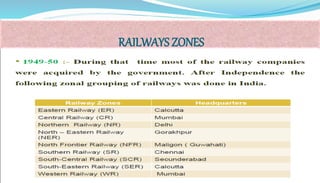
RAILWAYS ZONES
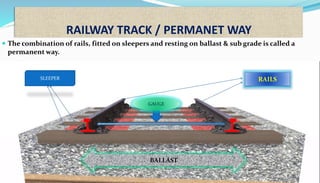
RAILWAY TRACK / PERMANET WAY
 The combination of rails, fitted on sleepers and resting on ballast & sub grade is called a
permanent way.
RAILSSLEEPER
BALLAST
GAUGE
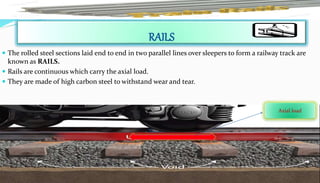
RAILS
 The rolled steel sections laid end to end in two parallel lines over sleepers to form a railway track are
known as RAILS.
 Rails are continuous which carry the axial load.
 They are made of high carbon steel to withstand wear and tear.
Axial load
Rail buckling
TYPES OF RAILS
 The rails used in the construction of railway track can be divided into the following three types :
 (1) Double Headed Rails (D.H. Rail)
 (2) Flat Footed Rails (F.F. Rail)
 (3) Bull Headed Rails (B.H. Rail)
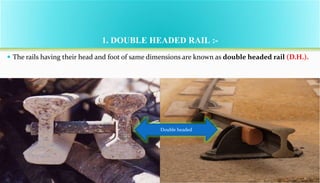
1. DOUBLE HEADED RAIL :-
 The rails having their head and foot of same dimensions are known as double headed rail (D.H.).
Double headed
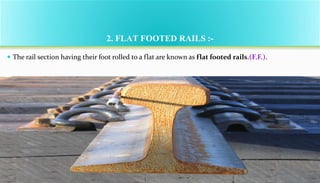
2. FLAT FOOTED RAILS :-
 The rail section having their foot rolled to a flat are known as flat footed rails.(F.F.).
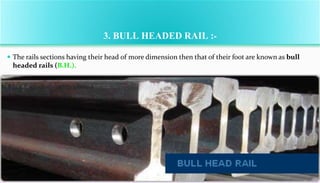
3. BULL HEADED RAIL :-
 The rails sections having their head of more dimension then that of their foot are known as bull
headed rails (B.H.).
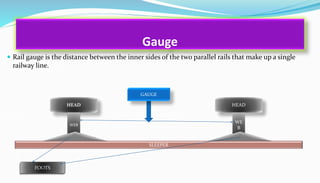
Gauge
 Rail gauge is the distance between the inner sides of the two parallel rails that make up a single
railway line.
HEAD
WEB
HEAD
WE
B
SLEEPER
FOOTS
GAUGE
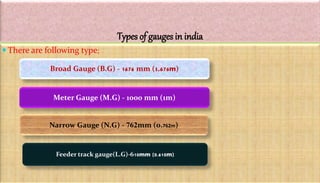
Types of gauges in india
 There are following type;
Broad Gauge (B.G) - 1676 mm (1.676m)
Meter Gauge (M.G) - 1000 mm (1m)
Narrow Gauge (N.G) - 762mm (0.762m)
Feeder track gauge(L.G)-610mm (0.610m)
.
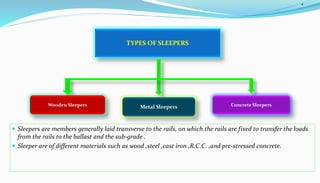
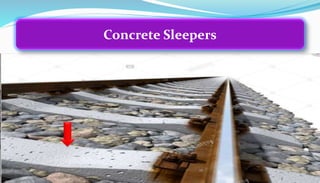
 Sleepers are members generally laid transverse to the rails, on which the rails are fixed to transfer the loads
from the rails to the ballast and the sub-grade .
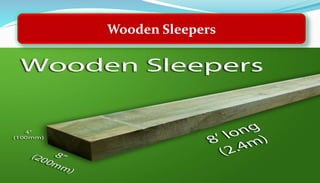
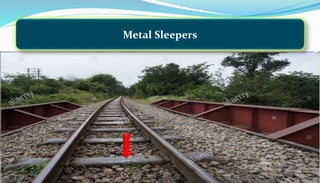
 Sleeper are of different materials such as wood ,steel ,cast iron ,R.C.C. ,and pre-stressed concrete.
TYPES OF SLEEPERS
Metal SleepersWooden Sleepers Concrete Sleepers
Wooden Sleepers
Metal Sleepers
Concrete Sleepers
Ballast
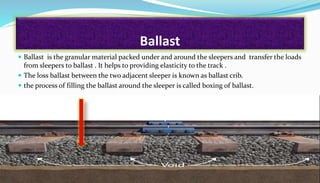
 Ballast is the granular material packed under and around the sleepers and transfer the loads
from sleepers to ballast . It helps to providing elasticity to the track .
 The loss ballast between the two adjacent sleeper is known as ballast crib.
 the process of filling the ballast around the sleeper is called boxing of ballast.

FISH PLATE
Fish plate
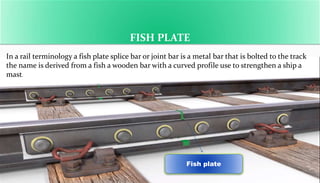
In a rail terminology a fish plate splice bar or joint bar is a metal bar that is bolted to the track
the name is derived from a fish a wooden bar with a curved profile use to strengthen a ship a
mast.
FASTENERS JOINT
FASTENERS JOINT
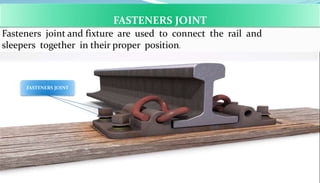
Fasteners joint and fixture are used to connect the rail and
sleepers together in their proper position.
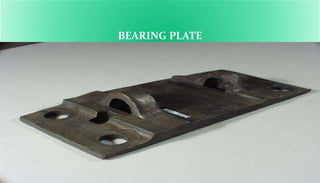
BEARING PLATE

Railway engineering copy

  • 1.
    RAILWAY ENINEERING  DEFINATION HISTOEY OF RAILWAY  RAILWAY TRACK  GAUGE  RAILS  SLEEPERS  BALLAST
  • 2.
    DEFFINATION  The branchof Civil Engineering which deals with the design, construction and maintenance of the railway tracks for safe and efficient movements of trains is called Railway Engineering  Land , water & air have been used by man kind developing the transport modes like Railway, Highway ,Water way & Airway etc.
  • 3.
    History of Railways 1844 :- First proposal for the construction of railways, in India were submitted to East India company by Mr. R.Macdonald Stephenson.  •1849 :- The construction of first experimental line of 160 kms from Calcutta to Mirzapur was undertaken by East India company.  Railways were first introduced to India in 1853 from Bombay to Thane  A British engineer, Robert Maitland Brereton, was responsible for the expansion of the railways from 1857 onwards.  The Allahabad-Jabalpur branch line of the East Indian Railway had been opened in June 1867  In 1951 the systems were nationalised as one unit, the Indian Railways, becoming one of the largest networks in the world.
  • 4.
  • 5.
    RAILWAY TRACK /PERMANET WAY  The combination of rails, fitted on sleepers and resting on ballast & sub grade is called a permanent way. RAILSSLEEPER BALLAST GAUGE
  • 6.
    RAILS  The rolledsteel sections laid end to end in two parallel lines over sleepers to form a railway track are known as RAILS.  Rails are continuous which carry the axial load.  They are made of high carbon steel to withstand wear and tear. Axial load
  • 7.
  • 8.
    TYPES OF RAILS The rails used in the construction of railway track can be divided into the following three types :  (1) Double Headed Rails (D.H. Rail)  (2) Flat Footed Rails (F.F. Rail)  (3) Bull Headed Rails (B.H. Rail)
  • 9.
    1. DOUBLE HEADEDRAIL :-  The rails having their head and foot of same dimensions are known as double headed rail (D.H.). Double headed
  • 10.
    2. FLAT FOOTEDRAILS :-  The rail section having their foot rolled to a flat are known as flat footed rails.(F.F.).
  • 11.
    3. BULL HEADEDRAIL :-  The rails sections having their head of more dimension then that of their foot are known as bull headed rails (B.H.).
  • 12.
    Gauge  Rail gaugeis the distance between the inner sides of the two parallel rails that make up a single railway line. HEAD WEB HEAD WE B SLEEPER FOOTS GAUGE
  • 13.
    Types of gaugesin india  There are following type; Broad Gauge (B.G) - 1676 mm (1.676m) Meter Gauge (M.G) - 1000 mm (1m) Narrow Gauge (N.G) - 762mm (0.762m) Feeder track gauge(L.G)-610mm (0.610m)
  • 14.
    .  Sleepers aremembers generally laid transverse to the rails, on which the rails are fixed to transfer the loads from the rails to the ballast and the sub-grade .  Sleeper are of different materials such as wood ,steel ,cast iron ,R.C.C. ,and pre-stressed concrete. TYPES OF SLEEPERS Metal SleepersWooden Sleepers Concrete Sleepers
  • 15.
  • 16.
  • 17.
  • 18.
    Ballast  Ballast isthe granular material packed under and around the sleepers and transfer the loads from sleepers to ballast . It helps to providing elasticity to the track .  The loss ballast between the two adjacent sleeper is known as ballast crib.  the process of filling the ballast around the sleeper is called boxing of ballast. 
  • 19.
    FISH PLATE Fish plate Ina rail terminology a fish plate splice bar or joint bar is a metal bar that is bolted to the track the name is derived from a fish a wooden bar with a curved profile use to strengthen a ship a mast.
  • 20.
    FASTENERS JOINT FASTENERS JOINT Fastenersjoint and fixture are used to connect the rail and sleepers together in their proper position.
  • 21.

Editor's Notes