Points and Crossings
The arrangements by which different
routes, diverging from the first track, are
connected to facilitate the diversion of trains
from one track to another track without any
obstruction are known as points and
crossings.
Turnouts
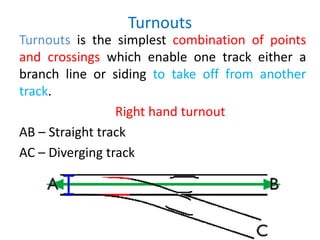
Turnouts is the simplest combination of points
and crossings which enable one track either a
branch line or siding to take off from another
track.
Right hand turnout
AB – Straight track
AC – Diverging track
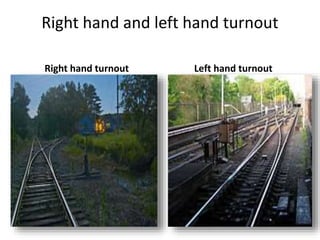
Right hand and left hand turnout
Right hand turnout Left hand turnout
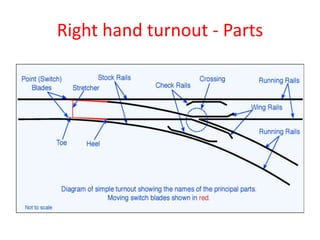
Parts of turnout
1. A Pair of points or switches
2. A Pair of stock rails
3. A Vee crossing
4. Two check rails
5. Four lead rails
6. Switch tie plate (or) Gauge tie chair and crossing
tie-plate
7. Studs or stops
8. Bearing plates; Slide chairs, stretcher bars
9. For operating the points – Rods, Cranks & Levers
10.For locking system – Locking box, lock bar, Plunger
bar
Right hand turnout - Parts
• A Pair of switches
A switch, turnout or [set of] points is a mechanical
installation enabling railway trains to be guided
from one track to another.
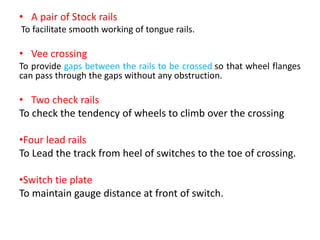
• A pair of Stock rails
To facilitate smooth working of tongue rails.
• Vee crossing
To provide gaps between the rails to be crossed so that wheel flanges
can pass through the gaps without any obstruction.
• Two check rails
To check the tendency of wheels to climb over the crossing
•Four lead rails
To Lead the track from heel of switches to the toe of crossing.
•Switch tie plate
To maintain gauge distance at front of switch.
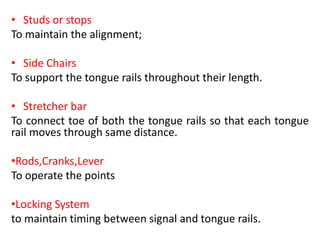
• Studs or stops
To maintain the alignment;
• Side Chairs
To support the tongue rails throughout their length.
• Stretcher bar
To connect toe of both the tongue rails so that each tongue
rail moves through same distance.
•Rods,Cranks,Lever
To operate the points
•Locking System
to maintain timing between signal and tongue rails.
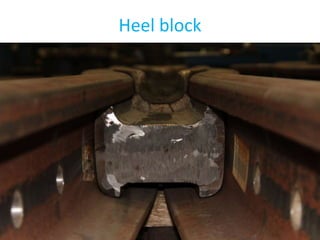
Heel block
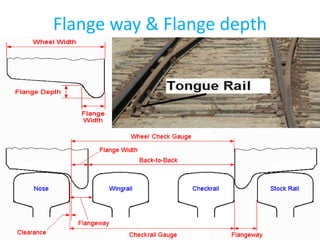
Flange way & Flange depth
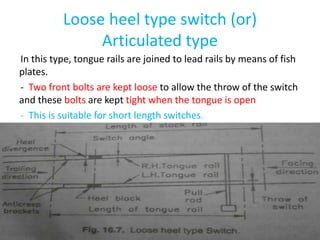
Loose heel type switch (or)
Articulated type
In this type, tongue rails are joined to lead rails by means of fish
plates.
- Two front bolts are kept loose to allow the throw of the switch
and these bolts are kept tight when the tongue is open
- This is suitable for short length switches.
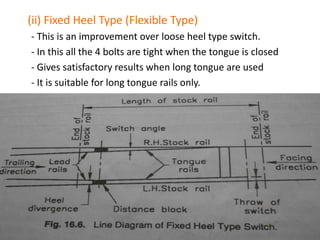
(ii) Fixed Heel Type (Flexible Type)
- This is an improvement over loose heel type switch.
- In this all the 4 bolts are tight when the tongue is closed
- Gives satisfactory results when long tongue are used
- It is suitable for long tongue rails only.
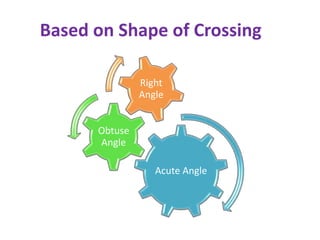
Acute Angle
Obtuse
Angle
Right
Angle
Based on Shape of Crossing
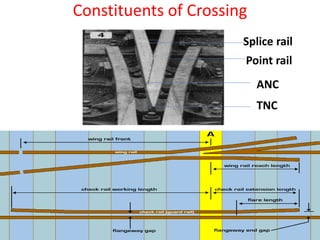
Constituents of Crossing
TNC
ANC
Point rail
Splice rail
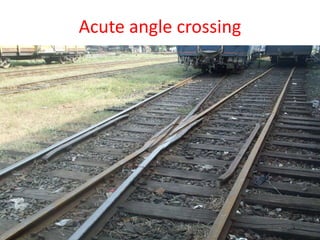
Acute angle crossing
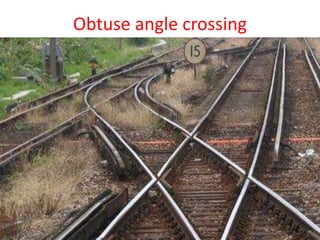
Obtuse angle crossing
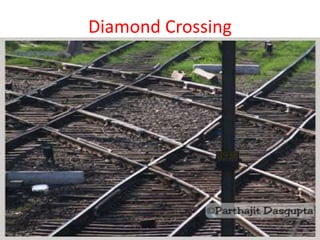
Diamond Crossing
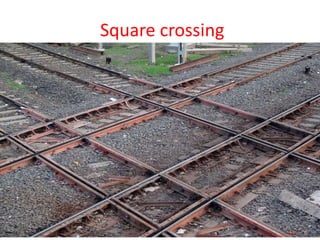
Square crossing
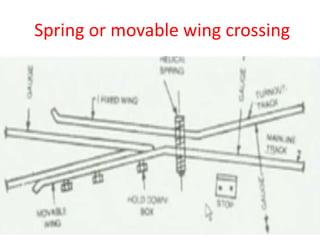
Spring or movable wing crossing

Points and crossings

  • 1.
    Points and Crossings Thearrangements by which different routes, diverging from the first track, are connected to facilitate the diversion of trains from one track to another track without any obstruction are known as points and crossings.
  • 2.
    Turnouts Turnouts is thesimplest combination of points and crossings which enable one track either a branch line or siding to take off from another track. Right hand turnout AB – Straight track AC – Diverging track
  • 3.
    Right hand andleft hand turnout Right hand turnout Left hand turnout
  • 4.
    Parts of turnout 1.A Pair of points or switches 2. A Pair of stock rails 3. A Vee crossing 4. Two check rails 5. Four lead rails 6. Switch tie plate (or) Gauge tie chair and crossing tie-plate 7. Studs or stops 8. Bearing plates; Slide chairs, stretcher bars 9. For operating the points – Rods, Cranks & Levers 10.For locking system – Locking box, lock bar, Plunger bar
  • 5.
  • 6.
    • A Pairof switches A switch, turnout or [set of] points is a mechanical installation enabling railway trains to be guided from one track to another.
  • 7.
    • A pairof Stock rails To facilitate smooth working of tongue rails. • Vee crossing To provide gaps between the rails to be crossed so that wheel flanges can pass through the gaps without any obstruction. • Two check rails To check the tendency of wheels to climb over the crossing •Four lead rails To Lead the track from heel of switches to the toe of crossing. •Switch tie plate To maintain gauge distance at front of switch.
  • 8.
    • Studs orstops To maintain the alignment; • Side Chairs To support the tongue rails throughout their length. • Stretcher bar To connect toe of both the tongue rails so that each tongue rail moves through same distance. •Rods,Cranks,Lever To operate the points •Locking System to maintain timing between signal and tongue rails.
  • 9.
  • 10.
    Flange way &Flange depth
  • 11.
    Loose heel typeswitch (or) Articulated type In this type, tongue rails are joined to lead rails by means of fish plates. - Two front bolts are kept loose to allow the throw of the switch and these bolts are kept tight when the tongue is open - This is suitable for short length switches.
  • 12.
    (ii) Fixed HeelType (Flexible Type) - This is an improvement over loose heel type switch. - In this all the 4 bolts are tight when the tongue is closed - Gives satisfactory results when long tongue are used - It is suitable for long tongue rails only.
  • 14.
  • 15.
  • 16.
  • 17.
  • 18.
  • 19.
  • 20.
    Spring or movablewing crossing