Guided By
xxxx
By
Xxx
Xxx
Xxx
Xxx
xxx
Railway is a very familiar mode of
transport for us. Here we are going to
explain the topic Railway Engineering.
Rail transport is where a train runs
along a set of two parallel steel rails,
known as a railway or railroad. The
rails are anchored perpendicular to
sleepers of timber, concrete or steel, to
maintain a consistent distance apart or
gauge.
The rails and perpendicular
beams are placed on a foundation
made of concrete, or compressed
earth and gravels in a bed of ballast.
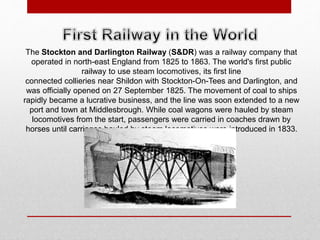
The Stockton and Darlington Railway (S&DR) was a railway company that
operated in north-east England from 1825 to 1863. The world's first public
railway to use steam locomotives, its first line
connected collieries near Shildon with Stockton-On-Tees and Darlington, and
was officially opened on 27 September 1825. The movement of coal to ships
rapidly became a lucrative business, and the line was soon extended to a new
port and town at Middlesbrough. While coal wagons were hauled by steam
locomotives from the start, passengers were carried in coaches drawn by
horses until carriages hauled by steam locomotives were introduced in 1833.
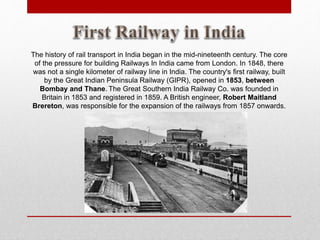
The history of rail transport in India began in the mid-nineteenth century. The core
of the pressure for building Railways In India came from London. In 1848, there
was not a single kilometer of railway line in India. The country's first railway, built
by the Great Indian Peninsula Railway (GIPR), opened in 1853, between
Bombay and Thane. The Great Southern India Railway Co. was founded in
Britain in 1853 and registered in 1859. A British engineer, Robert Maitland
Brereton, was responsible for the expansion of the railways from 1857 onwards.
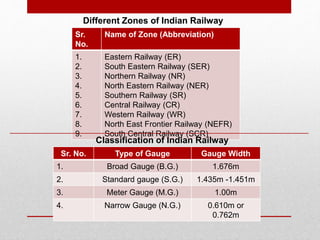
Different Zones of Indian Railway
Sr.
No.
Name of Zone (Abbreviation)
1.
2.
3.
4.
5.
6.
7.
8.
9.
Eastern Railway (ER)
South Eastern Railway (SER)
Northern Railway (NR)
North Eastern Railway (NER)
Southern Railway (SR)
Central Railway (CR)
Western Railway (WR)
North East Frontier Railway (NEFR)
South Central Railway (SCR)
Classification of Indian Railway
Sr. No. Type of Gauge Gauge Width
1. Broad Gauge (B.G.) 1.676m
2. Standard gauge (S.G.) 1.435m -1.451m
3. Meter Gauge (M.G.) 1.00m
4. Narrow Gauge (N.G.) 0.610m or
0.762m
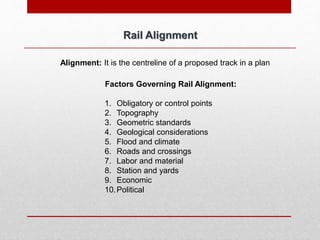
Rail Alignment
Alignment: It is the centreline of a proposed track in a plan
Factors Governing Rail Alignment:
1. Obligatory or control points
2. Topography
3. Geometric standards
4. Geological considerations
5. Flood and climate
6. Roads and crossings
7. Labor and material
8. Station and yards
9. Economic
10.Political
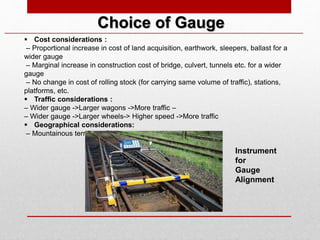
 Cost considerations :
– Proportional increase in cost of land acquisition, earthwork, sleepers, ballast for a
wider gauge
– Marginal increase in construction cost of bridge, culvert, tunnels etc. for a wider
gauge
– No change in cost of rolling stock (for carrying same volume of traffic), stations,
platforms, etc.
 Traffic considerations :
– Wider gauge ->Larger wagons ->More traffic –
– Wider gauge ->Larger wheels-> Higher speed ->More traffic
 Geographical considerations:
– Mountainous terrain -> Sharper curves-> Narrow gauge
Choice of Gauge
Instrument
for
Gauge
Alignment
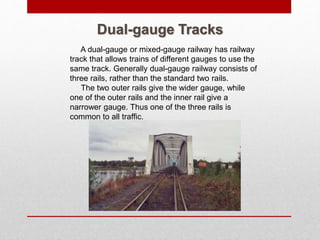
Dual-gauge Tracks
A dual-gauge or mixed-gauge railway has railway
track that allows trains of different gauges to use the
same track. Generally dual-gauge railway consists of
three rails, rather than the standard two rails.
The two outer rails give the wider gauge, while
one of the outer rails and the inner rail give a
narrower gauge. Thus one of the three rails is
common to all traffic.
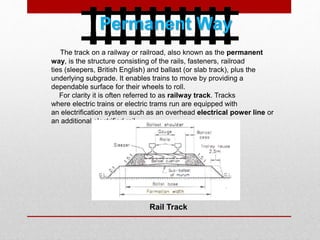
The track on a railway or railroad, also known as the permanent
way, is the structure consisting of the rails, fasteners, railroad
ties (sleepers, British English) and ballast (or slab track), plus the
underlying subgrade. It enables trains to move by providing a
dependable surface for their wheels to roll.
For clarity it is often referred to as railway track. Tracks
where electric trains or electric trams run are equipped with
an electrification system such as an overhead electrical power line or
an additional electrified rail.
Permanent Way
Rail Track
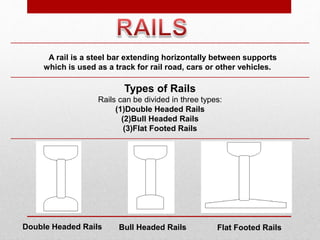
A rail is a steel bar extending horizontally between supports
which is used as a track for rail road, cars or other vehicles.
Types of Rails
Rails can be divided in three types:
(1)Double Headed Rails
(2)Bull Headed Rails
(3)Flat Footed Rails
Double Headed Rails Bull Headed Rails Flat Footed Rails
1) Double Headed Rails
These rails indicate the early stage of development. It essentially consists of
three parts:
(1)Upper Table (2) Web (3) Lower Table
Both the upper and lower tables were identical and they were
introduced with the hope of double doubling the life of rails. When the upper
table is worn out then the rails can be placed upside down reversed on the
chair and so the lower table can be brought into use. But this idea soon turned
out to b wrong because due to continuous contract of lower table with the chair
made the surface of lower table rough and hence the smooth running of the
train was impossible. Therefore, this type of rail is practically out of use.
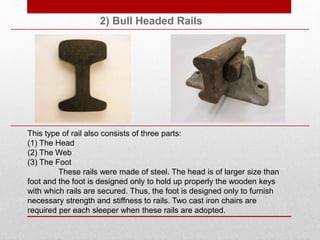
2) Bull Headed Rails
This type of rail also consists of three parts:
(1) The Head
(2) The Web
(3) The Foot
These rails were made of steel. The head is of larger size than
foot and the foot is designed only to hold up properly the wooden keys
with which rails are secured. Thus, the foot is designed only to furnish
necessary strength and stiffness to rails. Two cast iron chairs are
required per each sleeper when these rails are adopted.
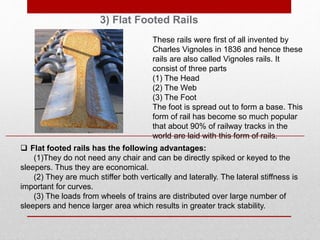
3) Flat Footed Rails
These rails were first of all invented by
Charles Vignoles in 1836 and hence these
rails are also called Vignoles rails. It
consist of three parts
(1) The Head
(2) The Web
(3) The Foot
The foot is spread out to form a base. This
form of rail has become so much popular
that about 90% of railway tracks in the
world are laid with this form of rails.
 Flat footed rails has the following advantages:
(1)They do not need any chair and can be directly spiked or keyed to the
sleepers. Thus they are economical.
(2) They are much stiffer both vertically and laterally. The lateral stiffness is
important for curves.
(3) The loads from wheels of trains are distributed over large number of
sleepers and hence larger area which results in greater track stability.
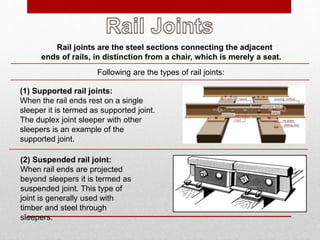
Rail joints are the steel sections connecting the adjacent
ends of rails, in distinction from a chair, which is merely a seat.
Following are the types of rail joints:
(1) Supported rail joints:
When the rail ends rest on a single
sleeper it is termed as supported joint.
The duplex joint sleeper with other
sleepers is an example of the
supported joint.
(2) Suspended rail joint:
When rail ends are projected
beyond sleepers it is termed as
suspended joint. This type of
joint is generally used with
timber and steel through
sleepers.
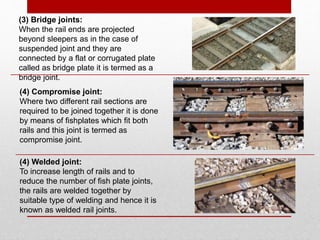
(3) Bridge joints:
When the rail ends are projected
beyond sleepers as in the case of
suspended joint and they are
connected by a flat or corrugated plate
called as bridge plate it is termed as a
bridge joint.
(4) Compromise joint:
Where two different rail sections are
required to be joined together it is done
by means of fishplates which fit both
rails and this joint is termed as
compromise joint.
(4) Welded joint:
To increase length of rails and to
reduce the number of fish plate joints,
the rails are welded together by
suitable type of welding and hence it is
known as welded rail joints.
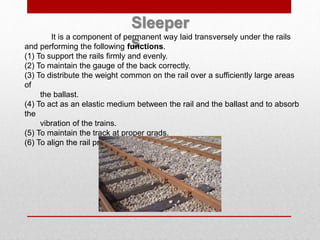
Sleeper
sIt is a component of permanent way laid transversely under the rails
and performing the following functions.
(1) To support the rails firmly and evenly.
(2) To maintain the gauge of the back correctly.
(3) To distribute the weight common on the rail over a sufficiently large areas
of
the ballast.
(4) To act as an elastic medium between the rail and the ballast and to absorb
the
vibration of the trains.
(5) To maintain the track at proper grads.
(6) To align the rail properly.
 Characteristics of Ideal Railway Sleepers
(1) Initial cost and maintenance cost should be low.
(2) They should resist weathering, corrosion, decay and other deterioration.
(3) They should bear the wheel load efficiently and satisfactorily.
(4) They should maintain the correct gauge.
(5) They should absorb shocks or vibrations due to moving vehicles.
(6) It should distribute the load properly and uniformly over the ballast.
(7) They should not break while packing of ballast.
(8) Weight should not be low or high.
Types of Railway Sleepers
Depending upon the position in a railway track, sleepers may be classified as:
1. Longitudinal Sleepers -
2. Transverse Sleepers -
(a) Timber / Wooden sleepers
(b) Steel Sleepers
(c) Cast Iron Sleepers
(d) Concrete Sleepers
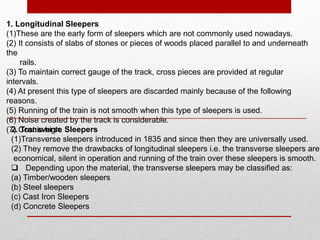
1. Longitudinal Sleepers
(1)These are the early form of sleepers which are not commonly used nowadays.
(2) It consists of slabs of stones or pieces of woods placed parallel to and underneath
the
rails.
(3) To maintain correct gauge of the track, cross pieces are provided at regular
intervals.
(4) At present this type of sleepers are discarded mainly because of the following
reasons.
(5) Running of the train is not smooth when this type of sleepers is used.
(6) Noise created by the track is considerable.
(7) Cost is high.2. Transverse Sleepers
(1)Transverse sleepers introduced in 1835 and since then they are universally used.
(2) They remove the drawbacks of longitudinal sleepers i.e. the transverse sleepers are
economical, silent in operation and running of the train over these sleepers is smooth.
 Depending upon the material, the transverse sleepers may be classified as:
(a) Timber/wooden sleepers
(b) Steel sleepers
(c) Cast Iron Sleepers
(d) Concrete Sleepers
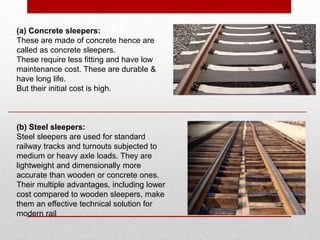
(b) Steel sleepers:
Steel sleepers are used for standard
railway tracks and turnouts subjected to
medium or heavy axle loads. They are
lightweight and dimensionally more
accurate than wooden or concrete ones.
Their multiple advantages, including lower
cost compared to wooden sleepers, make
them an effective technical solution for
modern rail
(a) Concrete sleepers:
These are made of concrete hence are
called as concrete sleepers.
These require less fitting and have low
maintenance cost. These are durable &
have long life.
But their initial cost is high.
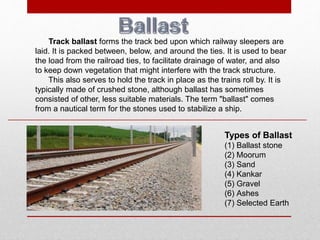
Track ballast forms the track bed upon which railway sleepers are
laid. It is packed between, below, and around the ties. It is used to bear
the load from the railroad ties, to facilitate drainage of water, and also
to keep down vegetation that might interfere with the track structure.
This also serves to hold the track in place as the trains roll by. It is
typically made of crushed stone, although ballast has sometimes
consisted of other, less suitable materials. The term "ballast" comes
from a nautical term for the stones used to stabilize a ship.
Types of Ballast
(1) Ballast stone
(2) Moorum
(3) Sand
(4) Kankar
(5) Gravel
(6) Ashes
(7) Selected Earth
A rail fastening system is a means of fixing rails or sleepers.
The terms rail anchors, tie plates, chairs and track fasteners are
used to refer to parts or all of a rail fastening system. Various
types of fastening have been used over the years.
Fixtures and Fastenings
FUNCTIONS OF FIXTURES AND FASTENINGS
Rail fixtures and fastenings have the following
functions:
(i) To join the rails end to end to form full length of
track.
(ii) To fix the rails to sleepers.
(iii) To maintain the correct alignment of the track.
(iv) To provide proper expansion gap between rails.
(v) To maintain the required tilt of rails.
(vi) To set the points and crossings in proper position.
TYPES OF FIXTURES AND FASTENING
Fixtures and fastenings commonly used in a permanent way are of following
types:
1. Fish plates 4. Chairs
2. Bearing plates 5. Bolts
3. Spikes 6. Keys
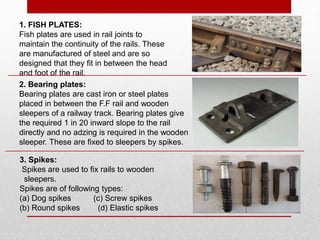
1. FISH PLATES:
Fish plates are used in rail joints to
maintain the continuity of the rails. These
are manufactured of steel and are so
designed that they fit in between the head
and foot of the rail.
2. Bearing plates:
Bearing plates are cast iron or steel plates
placed in between the F.F rail and wooden
sleepers of a railway track. Bearing plates give
the required 1 in 20 inward slope to the rail
directly and no adzing is required in the wooden
sleeper. These are fixed to sleepers by spikes.
3. Spikes:
Spikes are used to fix rails to wooden
sleepers.
Spikes are of following types:
(a) Dog spikes (c) Screw spikes
(b) Round spikes (d) Elastic spikes
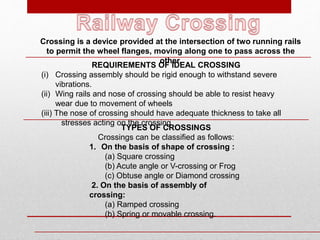
Crossing is a device provided at the intersection of two running rails
to permit the wheel flanges, moving along one to pass across the
other.
TYPES OF CROSSINGS
Crossings can be classified as follows:
1. On the basis of shape of crossing :
(a) Square crossing
(b) Acute angle or V-crossing or Frog
(c) Obtuse angle or Diamond crossing
2. On the basis of assembly of
crossing:
(a) Ramped crossing
(b) Spring or movable crossing.
REQUIREMENTS OF IDEAL CROSSING
(i) Crossing assembly should be rigid enough to withstand severe
vibrations.
(ii) Wing rails and nose of crossing should be able to resist heavy
wear due to movement of wheels
(iii) The nose of crossing should have adequate thickness to take all
stresses acting on the crossing.
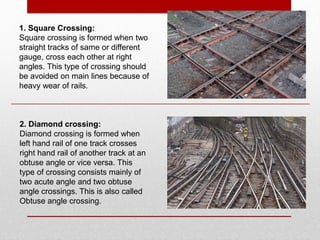
1. Square Crossing:
Square crossing is formed when two
straight tracks of same or different
gauge, cross each other at right
angles. This type of crossing should
be avoided on main lines because of
heavy wear of rails.
2. Diamond crossing:
Diamond crossing is formed when
left hand rail of one track crosses
right hand rail of another track at an
obtuse angle or vice versa. This
type of crossing consists mainly of
two acute angle and two obtuse
angle crossings. This is also called
Obtuse angle crossing.
Requirements of railway station:
(1) Booking office
(2) Waiting rooms
(3) W/C and Bathroom arrangement
(4) An Enquiry Office
(5) Staffroom
(6) Residential quarters for staff
(7) Arrangement of Signal for controlling trains
(8) Easy and Comfortable approach roads
(9) Big waiting halls
Railway engineering

Railway engineering

  • 1.
  • 2.
    Railway is avery familiar mode of transport for us. Here we are going to explain the topic Railway Engineering. Rail transport is where a train runs along a set of two parallel steel rails, known as a railway or railroad. The rails are anchored perpendicular to sleepers of timber, concrete or steel, to maintain a consistent distance apart or gauge. The rails and perpendicular beams are placed on a foundation made of concrete, or compressed earth and gravels in a bed of ballast.
  • 3.
    The Stockton andDarlington Railway (S&DR) was a railway company that operated in north-east England from 1825 to 1863. The world's first public railway to use steam locomotives, its first line connected collieries near Shildon with Stockton-On-Tees and Darlington, and was officially opened on 27 September 1825. The movement of coal to ships rapidly became a lucrative business, and the line was soon extended to a new port and town at Middlesbrough. While coal wagons were hauled by steam locomotives from the start, passengers were carried in coaches drawn by horses until carriages hauled by steam locomotives were introduced in 1833.
  • 4.
    The history ofrail transport in India began in the mid-nineteenth century. The core of the pressure for building Railways In India came from London. In 1848, there was not a single kilometer of railway line in India. The country's first railway, built by the Great Indian Peninsula Railway (GIPR), opened in 1853, between Bombay and Thane. The Great Southern India Railway Co. was founded in Britain in 1853 and registered in 1859. A British engineer, Robert Maitland Brereton, was responsible for the expansion of the railways from 1857 onwards.
  • 5.
    Different Zones ofIndian Railway Sr. No. Name of Zone (Abbreviation) 1. 2. 3. 4. 5. 6. 7. 8. 9. Eastern Railway (ER) South Eastern Railway (SER) Northern Railway (NR) North Eastern Railway (NER) Southern Railway (SR) Central Railway (CR) Western Railway (WR) North East Frontier Railway (NEFR) South Central Railway (SCR) Classification of Indian Railway Sr. No. Type of Gauge Gauge Width 1. Broad Gauge (B.G.) 1.676m 2. Standard gauge (S.G.) 1.435m -1.451m 3. Meter Gauge (M.G.) 1.00m 4. Narrow Gauge (N.G.) 0.610m or 0.762m
  • 6.
    Rail Alignment Alignment: Itis the centreline of a proposed track in a plan Factors Governing Rail Alignment: 1. Obligatory or control points 2. Topography 3. Geometric standards 4. Geological considerations 5. Flood and climate 6. Roads and crossings 7. Labor and material 8. Station and yards 9. Economic 10.Political
  • 7.
     Cost considerations: – Proportional increase in cost of land acquisition, earthwork, sleepers, ballast for a wider gauge – Marginal increase in construction cost of bridge, culvert, tunnels etc. for a wider gauge – No change in cost of rolling stock (for carrying same volume of traffic), stations, platforms, etc.  Traffic considerations : – Wider gauge ->Larger wagons ->More traffic – – Wider gauge ->Larger wheels-> Higher speed ->More traffic  Geographical considerations: – Mountainous terrain -> Sharper curves-> Narrow gauge Choice of Gauge Instrument for Gauge Alignment
  • 8.
    Dual-gauge Tracks A dual-gaugeor mixed-gauge railway has railway track that allows trains of different gauges to use the same track. Generally dual-gauge railway consists of three rails, rather than the standard two rails. The two outer rails give the wider gauge, while one of the outer rails and the inner rail give a narrower gauge. Thus one of the three rails is common to all traffic.
  • 9.
    The track ona railway or railroad, also known as the permanent way, is the structure consisting of the rails, fasteners, railroad ties (sleepers, British English) and ballast (or slab track), plus the underlying subgrade. It enables trains to move by providing a dependable surface for their wheels to roll. For clarity it is often referred to as railway track. Tracks where electric trains or electric trams run are equipped with an electrification system such as an overhead electrical power line or an additional electrified rail. Permanent Way Rail Track
  • 10.
    A rail isa steel bar extending horizontally between supports which is used as a track for rail road, cars or other vehicles. Types of Rails Rails can be divided in three types: (1)Double Headed Rails (2)Bull Headed Rails (3)Flat Footed Rails Double Headed Rails Bull Headed Rails Flat Footed Rails
  • 11.
    1) Double HeadedRails These rails indicate the early stage of development. It essentially consists of three parts: (1)Upper Table (2) Web (3) Lower Table Both the upper and lower tables were identical and they were introduced with the hope of double doubling the life of rails. When the upper table is worn out then the rails can be placed upside down reversed on the chair and so the lower table can be brought into use. But this idea soon turned out to b wrong because due to continuous contract of lower table with the chair made the surface of lower table rough and hence the smooth running of the train was impossible. Therefore, this type of rail is practically out of use.
  • 12.
    2) Bull HeadedRails This type of rail also consists of three parts: (1) The Head (2) The Web (3) The Foot These rails were made of steel. The head is of larger size than foot and the foot is designed only to hold up properly the wooden keys with which rails are secured. Thus, the foot is designed only to furnish necessary strength and stiffness to rails. Two cast iron chairs are required per each sleeper when these rails are adopted.
  • 13.
    3) Flat FootedRails These rails were first of all invented by Charles Vignoles in 1836 and hence these rails are also called Vignoles rails. It consist of three parts (1) The Head (2) The Web (3) The Foot The foot is spread out to form a base. This form of rail has become so much popular that about 90% of railway tracks in the world are laid with this form of rails.  Flat footed rails has the following advantages: (1)They do not need any chair and can be directly spiked or keyed to the sleepers. Thus they are economical. (2) They are much stiffer both vertically and laterally. The lateral stiffness is important for curves. (3) The loads from wheels of trains are distributed over large number of sleepers and hence larger area which results in greater track stability.
  • 14.
    Rail joints arethe steel sections connecting the adjacent ends of rails, in distinction from a chair, which is merely a seat. Following are the types of rail joints: (1) Supported rail joints: When the rail ends rest on a single sleeper it is termed as supported joint. The duplex joint sleeper with other sleepers is an example of the supported joint. (2) Suspended rail joint: When rail ends are projected beyond sleepers it is termed as suspended joint. This type of joint is generally used with timber and steel through sleepers.
  • 15.
    (3) Bridge joints: Whenthe rail ends are projected beyond sleepers as in the case of suspended joint and they are connected by a flat or corrugated plate called as bridge plate it is termed as a bridge joint. (4) Compromise joint: Where two different rail sections are required to be joined together it is done by means of fishplates which fit both rails and this joint is termed as compromise joint. (4) Welded joint: To increase length of rails and to reduce the number of fish plate joints, the rails are welded together by suitable type of welding and hence it is known as welded rail joints.
  • 16.
    Sleeper sIt is acomponent of permanent way laid transversely under the rails and performing the following functions. (1) To support the rails firmly and evenly. (2) To maintain the gauge of the back correctly. (3) To distribute the weight common on the rail over a sufficiently large areas of the ballast. (4) To act as an elastic medium between the rail and the ballast and to absorb the vibration of the trains. (5) To maintain the track at proper grads. (6) To align the rail properly.
  • 17.
     Characteristics ofIdeal Railway Sleepers (1) Initial cost and maintenance cost should be low. (2) They should resist weathering, corrosion, decay and other deterioration. (3) They should bear the wheel load efficiently and satisfactorily. (4) They should maintain the correct gauge. (5) They should absorb shocks or vibrations due to moving vehicles. (6) It should distribute the load properly and uniformly over the ballast. (7) They should not break while packing of ballast. (8) Weight should not be low or high. Types of Railway Sleepers Depending upon the position in a railway track, sleepers may be classified as: 1. Longitudinal Sleepers - 2. Transverse Sleepers - (a) Timber / Wooden sleepers (b) Steel Sleepers (c) Cast Iron Sleepers (d) Concrete Sleepers
  • 18.
    1. Longitudinal Sleepers (1)Theseare the early form of sleepers which are not commonly used nowadays. (2) It consists of slabs of stones or pieces of woods placed parallel to and underneath the rails. (3) To maintain correct gauge of the track, cross pieces are provided at regular intervals. (4) At present this type of sleepers are discarded mainly because of the following reasons. (5) Running of the train is not smooth when this type of sleepers is used. (6) Noise created by the track is considerable. (7) Cost is high.2. Transverse Sleepers (1)Transverse sleepers introduced in 1835 and since then they are universally used. (2) They remove the drawbacks of longitudinal sleepers i.e. the transverse sleepers are economical, silent in operation and running of the train over these sleepers is smooth.  Depending upon the material, the transverse sleepers may be classified as: (a) Timber/wooden sleepers (b) Steel sleepers (c) Cast Iron Sleepers (d) Concrete Sleepers
  • 19.
    (b) Steel sleepers: Steelsleepers are used for standard railway tracks and turnouts subjected to medium or heavy axle loads. They are lightweight and dimensionally more accurate than wooden or concrete ones. Their multiple advantages, including lower cost compared to wooden sleepers, make them an effective technical solution for modern rail (a) Concrete sleepers: These are made of concrete hence are called as concrete sleepers. These require less fitting and have low maintenance cost. These are durable & have long life. But their initial cost is high.
  • 20.
    Track ballast formsthe track bed upon which railway sleepers are laid. It is packed between, below, and around the ties. It is used to bear the load from the railroad ties, to facilitate drainage of water, and also to keep down vegetation that might interfere with the track structure. This also serves to hold the track in place as the trains roll by. It is typically made of crushed stone, although ballast has sometimes consisted of other, less suitable materials. The term "ballast" comes from a nautical term for the stones used to stabilize a ship. Types of Ballast (1) Ballast stone (2) Moorum (3) Sand (4) Kankar (5) Gravel (6) Ashes (7) Selected Earth
  • 21.
    A rail fasteningsystem is a means of fixing rails or sleepers. The terms rail anchors, tie plates, chairs and track fasteners are used to refer to parts or all of a rail fastening system. Various types of fastening have been used over the years. Fixtures and Fastenings FUNCTIONS OF FIXTURES AND FASTENINGS Rail fixtures and fastenings have the following functions: (i) To join the rails end to end to form full length of track. (ii) To fix the rails to sleepers. (iii) To maintain the correct alignment of the track. (iv) To provide proper expansion gap between rails. (v) To maintain the required tilt of rails. (vi) To set the points and crossings in proper position. TYPES OF FIXTURES AND FASTENING Fixtures and fastenings commonly used in a permanent way are of following types: 1. Fish plates 4. Chairs 2. Bearing plates 5. Bolts 3. Spikes 6. Keys
  • 22.
    1. FISH PLATES: Fishplates are used in rail joints to maintain the continuity of the rails. These are manufactured of steel and are so designed that they fit in between the head and foot of the rail. 2. Bearing plates: Bearing plates are cast iron or steel plates placed in between the F.F rail and wooden sleepers of a railway track. Bearing plates give the required 1 in 20 inward slope to the rail directly and no adzing is required in the wooden sleeper. These are fixed to sleepers by spikes. 3. Spikes: Spikes are used to fix rails to wooden sleepers. Spikes are of following types: (a) Dog spikes (c) Screw spikes (b) Round spikes (d) Elastic spikes
  • 23.
    Crossing is adevice provided at the intersection of two running rails to permit the wheel flanges, moving along one to pass across the other. TYPES OF CROSSINGS Crossings can be classified as follows: 1. On the basis of shape of crossing : (a) Square crossing (b) Acute angle or V-crossing or Frog (c) Obtuse angle or Diamond crossing 2. On the basis of assembly of crossing: (a) Ramped crossing (b) Spring or movable crossing. REQUIREMENTS OF IDEAL CROSSING (i) Crossing assembly should be rigid enough to withstand severe vibrations. (ii) Wing rails and nose of crossing should be able to resist heavy wear due to movement of wheels (iii) The nose of crossing should have adequate thickness to take all stresses acting on the crossing.
  • 24.
    1. Square Crossing: Squarecrossing is formed when two straight tracks of same or different gauge, cross each other at right angles. This type of crossing should be avoided on main lines because of heavy wear of rails. 2. Diamond crossing: Diamond crossing is formed when left hand rail of one track crosses right hand rail of another track at an obtuse angle or vice versa. This type of crossing consists mainly of two acute angle and two obtuse angle crossings. This is also called Obtuse angle crossing.
  • 25.
    Requirements of railwaystation: (1) Booking office (2) Waiting rooms (3) W/C and Bathroom arrangement (4) An Enquiry Office (5) Staffroom (6) Residential quarters for staff (7) Arrangement of Signal for controlling trains (8) Easy and Comfortable approach roads (9) Big waiting halls