Rocket Science
Blast Off Experiment
Principles behind what makes rockets
rock!
What You Need to Know ?
• Aerospace engineering is the branch of engineering concerned with
the design, manufacture, and operation of launch vehicles,
satellites, spacecraft, and ground-support facilities for the
exploration of outer space. One type of spacecraft is a rocket, which
is powered by gases that are forced out of one end.
• Rocket-like devices were demonstrated about 360 B.C. By the Greek
mathematician and scientist Archytas (428-350 B.C.). So while some
form of a rocket has been in existence for many years, the science
of how a rocket works was first described by the British scientist Sir
Isaac Newton (1642-1727) in 1687. Newton stated three important
scientific principles that govern the motion of all objects, whether
on Earth or in space.
• These principles, now called Newton's laws of motion, provided
engineers with the basic knowledge necessary to design modern
rockets such as the Saturn V rockets and the Space
Shuttle Discovery.
We will check with this Simple Experiment
What You Need ?
• 6 feet (1.8 m) of string
• 4-inch (10 cm) piece of drinking straw
• 2 chairs
• 9-inch (23 cm) round balloon
• Spring clothespin
• Transparent tape
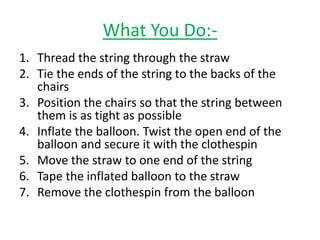
What You Do:-
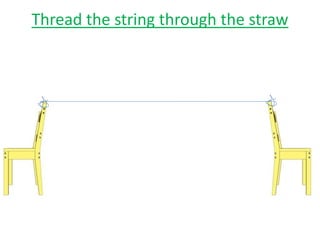
1. Thread the string through the straw
2. Tie the ends of the string to the backs of the
chairs
3. Position the chairs so that the string between
them is as tight as possible
4. Inflate the balloon. Twist the open end of the
balloon and secure it with the clothespin
5. Move the straw to one end of the string
6. Tape the inflated balloon to the straw
7. Remove the clothespin from the balloon
Thread the string through the straw
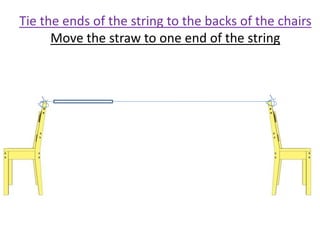
Tie the ends of the string to the backs of the chairs
Move the straw to one end of the string
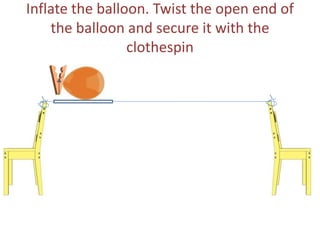
Inflate the balloon. Twist the open end of
the balloon and secure it with the
clothespin
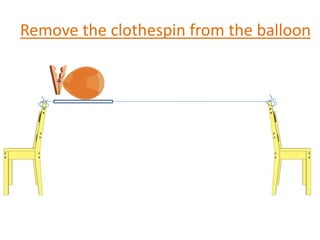
Remove the clothespin from the balloon
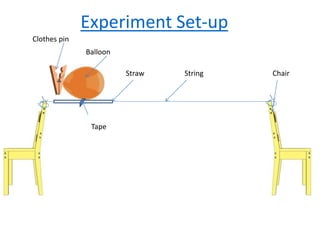
Clothes pin
Balloon
Straw
Tape
String Chair
Experiment Set-up
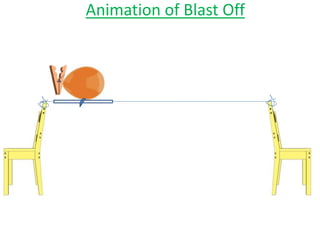
Animation of Blast Off
What Happened?
• The straw with the attached balloon quickly
moves across the string. The movement stops
at the end of the string or when the forces
acting on the balloon are balanced.
Why?
• When the inflated balloon is closed, the air inside
pushes equally in all directions.
• The balloon doesn't move because all the forces are
balanced.
• When the balloon is open, the action-reaction pair of
forces opposite the balloon's opening is unbalanced.
• One force is the walls of the balloon pushing on the
gas inside the balloon. This force pushes the gas out of
the balloon's opening. The other force is the gas
pushing on the balloon's wall opposite the opening.
• This force pushes the balloon in the direction opposite
the opening.
THE END

Rocket science experiment for class iv

  • 1.
  • 2.
    Principles behind whatmakes rockets rock!
  • 3.
    What You Needto Know ? • Aerospace engineering is the branch of engineering concerned with the design, manufacture, and operation of launch vehicles, satellites, spacecraft, and ground-support facilities for the exploration of outer space. One type of spacecraft is a rocket, which is powered by gases that are forced out of one end. • Rocket-like devices were demonstrated about 360 B.C. By the Greek mathematician and scientist Archytas (428-350 B.C.). So while some form of a rocket has been in existence for many years, the science of how a rocket works was first described by the British scientist Sir Isaac Newton (1642-1727) in 1687. Newton stated three important scientific principles that govern the motion of all objects, whether on Earth or in space. • These principles, now called Newton's laws of motion, provided engineers with the basic knowledge necessary to design modern rockets such as the Saturn V rockets and the Space Shuttle Discovery. We will check with this Simple Experiment
  • 4.
    What You Need? • 6 feet (1.8 m) of string • 4-inch (10 cm) piece of drinking straw • 2 chairs • 9-inch (23 cm) round balloon • Spring clothespin • Transparent tape
  • 5.
    What You Do:- 1.Thread the string through the straw 2. Tie the ends of the string to the backs of the chairs 3. Position the chairs so that the string between them is as tight as possible 4. Inflate the balloon. Twist the open end of the balloon and secure it with the clothespin 5. Move the straw to one end of the string 6. Tape the inflated balloon to the straw 7. Remove the clothespin from the balloon
  • 6.
    Thread the stringthrough the straw
  • 7.
    Tie the endsof the string to the backs of the chairs Move the straw to one end of the string
  • 8.
    Inflate the balloon.Twist the open end of the balloon and secure it with the clothespin
  • 9.
    Remove the clothespinfrom the balloon
  • 10.
  • 11.
  • 12.
    What Happened? • Thestraw with the attached balloon quickly moves across the string. The movement stops at the end of the string or when the forces acting on the balloon are balanced.
  • 13.
    Why? • When theinflated balloon is closed, the air inside pushes equally in all directions. • The balloon doesn't move because all the forces are balanced. • When the balloon is open, the action-reaction pair of forces opposite the balloon's opening is unbalanced. • One force is the walls of the balloon pushing on the gas inside the balloon. This force pushes the gas out of the balloon's opening. The other force is the gas pushing on the balloon's wall opposite the opening. • This force pushes the balloon in the direction opposite the opening.
  • 14.