Railway Engineering
Submitted by:
Akshay Kaushal (110134)
Jaspreet Singh (110138)
https://www.youtube.com/watch?v=pvg3e2P2TAo
History of Indian Railway
Railway Engineering
• It is a branch of civil engineering concerned with the design,
construction, maintenance, and operation of railways.
• Railway engineering includes elements of civil, mechanical,
industrial, and electrical engineering.
• Railway engineers handle the design, construction, and operation
of railroads and mass transit systems that use a fixed guideway
(such as light rail or even monorails).
• Typical tasks would include determining horizontal and vertical
alignment design, station location and design, construction cost
estimating, and establishment of signaling & controlling system.
• Railroad engineers can also move into the specialized field of
train dispatching which focuses on train movement control.
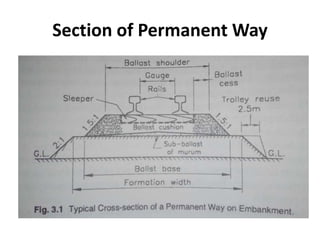
Section of Permanent Way
RAIL GAUGE
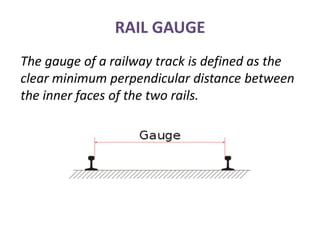
The gauge of a railway track is defined as the
clear minimum perpendicular distance between
the inner faces of the two rails.
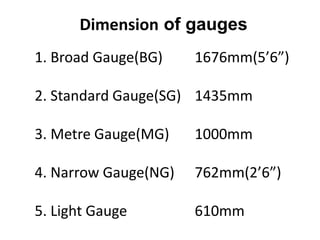
Dimension of gauges
1. Broad Gauge(BG) 1676mm(5’6”)
2. Standard Gauge(SG) 1435mm
3. Metre Gauge(MG) 1000mm
4. Narrow Gauge(NG) 762mm(2’6”)
5. Light Gauge 610mm
Coning of Wheels
• Coning of wheels – The distance between the inside edges of
wheel flanges is generally kept less than the gauge. Gap is
about 38 mm on Either side. Normally the tyre is absolutely
ahead centre on the head of the rail, as the wheel is coned to
keep it in this central position automatically. These wheel are
coned at a slope
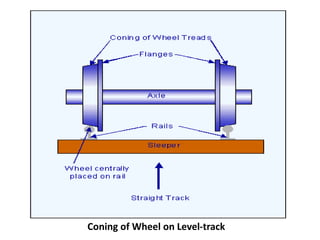
• Theory of coning:- On a level track, as soon as the axle moves
towards one rail, the diameter of the wheel tread over the rail
increases, while It decreases over the other rail. This prevents
to further movement And axle retreats back to its original
position (with equal dia or both rails and equal pressure on
both rails).
Coning of Wheel on Level-track
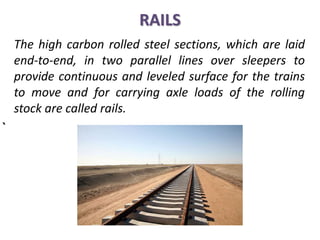
RAILS
The high carbon rolled steel sections, which are laid
end-to-end, in two parallel lines over sleepers to
provide continuous and leveled surface for the trains
to move and for carrying axle loads of the rolling
stock are called rails.
`
Functions of the rails:
To provide continuous and level surface for the
movement of trains with minimum friction with
steel wheels of the rolling stock;
Provide strength, durability and lateral guidance
to the track;
Transmit the axle loads to sleepers which transfer
the same load to the underlying ballast and
formation;
Bear the stresses developed due to heavy vertical
loads, breaking forces and temperature variance.
RAILS
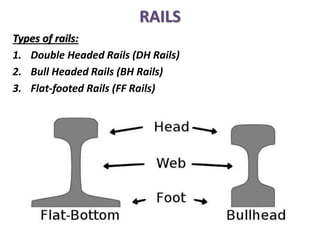
Types of rails:
1. Double Headed Rails (DH Rails)
2. Bull Headed Rails (BH Rails)
3. Flat-footed Rails (FF Rails)
Length of Rails
On Indian Railways the standard lengths are the following:
Length = 12.80 m. (42 ft.) for BG (say 13 m) and
Length = 11.89 m. (39 ft.) for MG (say 12 m)
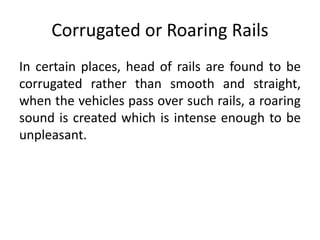
Corrugated or Roaring Rails
In certain places, head of rails are found to be
corrugated rather than smooth and straight,
when the vehicles pass over such rails, a roaring
sound is created which is intense enough to be
unpleasant.
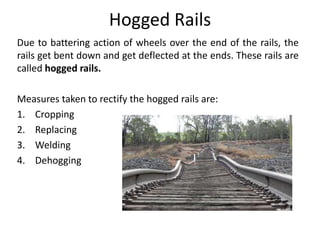
Hogged Rails
Due to battering action of wheels over the end of the rails, the
rails get bent down and get deflected at the ends. These rails are
called hogged rails.
Measures taken to rectify the hogged rails are:
1. Cropping
2. Replacing
3. Welding
4. Dehogging
Reason of Hogging!
https://www.youtube.com/watch?v=9njqDgjIcWQ
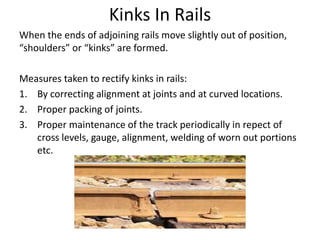
Kinks In Rails
When the ends of adjoining rails move slightly out of position,
“shoulders” or “kinks” are formed.
Measures taken to rectify kinks in rails:
1. By correcting alignment at joints and at curved locations.
2. Proper packing of joints.
3. Proper maintenance of the track periodically in repect of
cross levels, gauge, alignment, welding of worn out portions
etc.
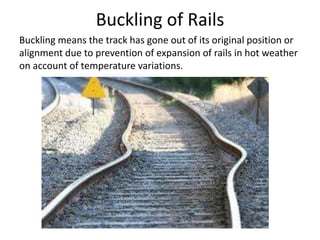
Buckling of Rails
Buckling means the track has gone out of its original position or
alignment due to prevention of expansion of rails in hot weather
on account of temperature variations.
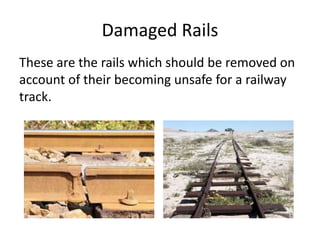
Damaged Rails
These are the rails which should be removed on
account of their becoming unsafe for a railway
track.
Rail Features
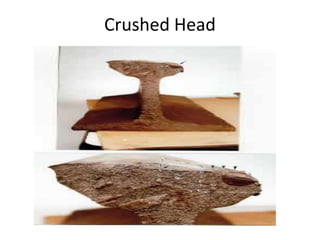
• Crushed Heads
• Square or Angular Break
• Split Heads
• Split Web
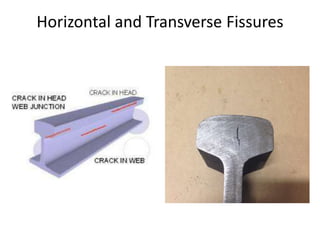
• Horizontal Fissures
• Transverse Fissures
• Flowing Metal in Heads
• Horizontal Cracks
Crushed Head
Split Heads
Horizontal and Transverse Fissures
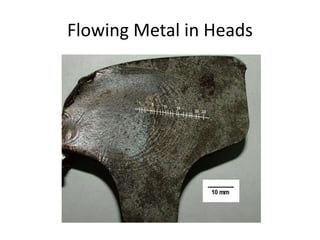
Flowing Metal in Heads
Rail Joints
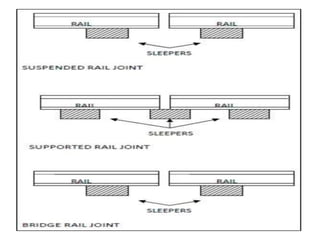
• Supported Rail Joint
• Suspended Rail Joint
• Bridge Joint
• Base Joint
• Welded Rail Joint
• Staggered or Broken Joint
• Square or Even Joint
• Compromise Joint
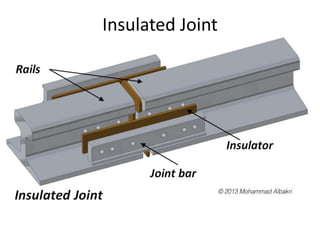
• Insulated Joint
• Expansion Joint`
Rail Joint
Insulated Joint
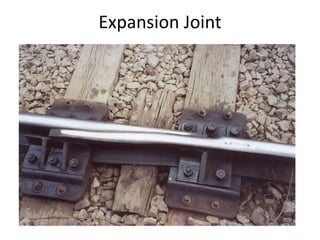
Expansion Joint
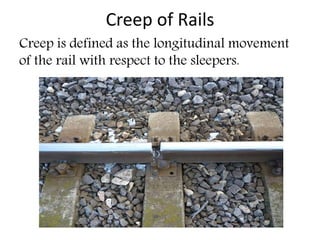
Creep of Rails
Creep is defined as the longitudinal movement
of the rail with respect to the sleepers.
Defects of Creep
(i) Sleepers move out of position thereby the rail gauge.
(ii) Position of points and crossings are disturbed.
(iii) Interlocking mechanism gets
disturbed.
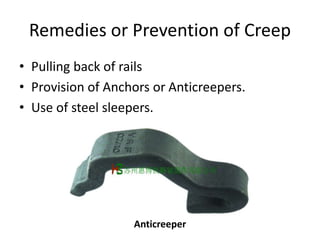
Remedies or Prevention of Creep
• Pulling back of rails
• Provision of Anchors or Anticreepers.
• Use of steel sleepers.
Anticreeper
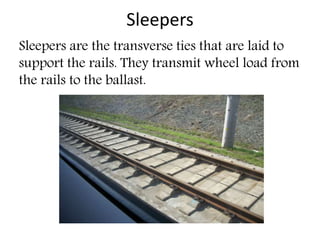
Sleepers
Sleepers are the transverse ties that are laid to
support the rails. They transmit wheel load from
the rails to the ballast.
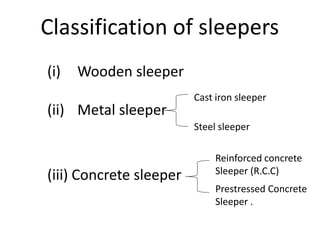
Classification of sleepers
(i) Wooden sleeper
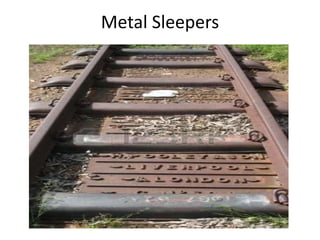
(ii) Metal sleeper
Cast iron sleeper
Steel sleeper
(iii) Concrete sleeper
Reinforced concrete
Sleeper (R.C.C)
Prestressed Concrete
Sleeper .
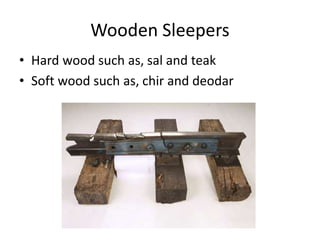
Wooden Sleepers
• Hard wood such as, sal and teak
• Soft wood such as, chir and deodar
Metal Sleepers
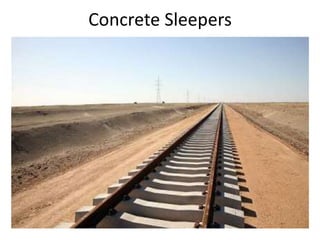
Concrete Sleepers
Sleeper Density
Sleeper density is the number of sleepers Per
rail length. It is specified as (M+x) or (N+x),
where M or N is the length of the rail in meters
and x is a number that varies according to
factors such as axle load, speed, type & section
of the rail etc.
It varies in India from M+4 to M+7 for main
tracks.
Track Fittings & Fastenings
• Fish plates
• Spikes
– Dog spikes
– Screw spikes
– Round spikes
– Standard spikes
– Elastic spikes
• Bolts
– Dog or Hook bolt
– Fish bolt
– Rag bolt
– Fang nut and bolt
• Keys
– Wooden key for C.I. Chair
– M.S. key and steel trough
sleepers
– Stuart’s key
– Morgan key
– Cotter and tie bars
• Chairs
– Cast steel chairs
– Mild steel and Cast Iron
Slide Chairs
• Blocks
– Heel blocks
– Distance blocks
– Crossing blocks
– Check blocks
• Plates
– Bearing Plates
– Saddle Plates
Track Fittings & Fastenings contd..
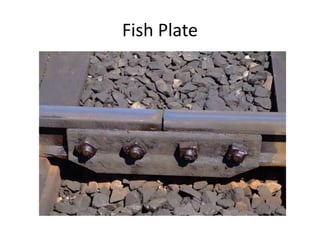
Fish Plate
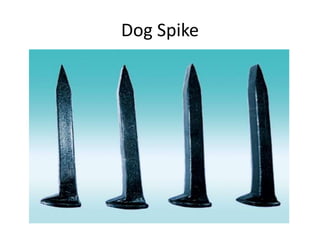
Dog Spike
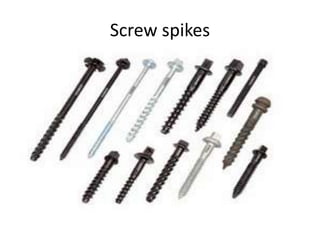
Screw spikes
Chair
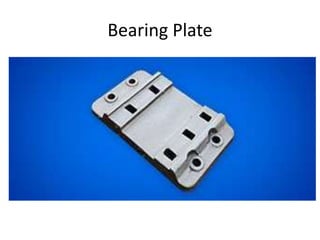
Bearing Plate
Ballast
To provide structural support for
the track, holding it in good line
and surface
To distribute the load evenly to the
subballast and subgrade and thus
help to provide stability
Provide for drainage
Ballast in railroad terminology is durable granular material placed between
the crosstie and the sub ballast to hold the track in line and grade.
The primary purposes of ballast are:
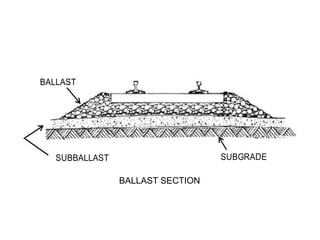
BALLAST
SUBBALLAST SUBGRADE
BALLAST SECTION
Types of Ballast
• Broken Stone
• Gravel or River Pebbles or Shingle
• Ashes or Cinders
• Sand
• Mooram
• Kankar
• Brick Ballast
• Blast Furnace Slag
• Selected Earth
Ballast Size
• For wooden sleepers = 5.1 cm
• For steel sleepers = 3.8 cm
• For under switches & crossings = 2.54 cm
Points & Crossings
• Points and crossings provide flexibility of
movement by connecting one line to another
according to requirements.
• They also help for imposing restrictions over
turnouts which necessarily retard the
movements.
• From safety aspect, it is also important as points
and crossings are weak kinks or points in the
track and vehicles are susceptible to derailments
at these places.
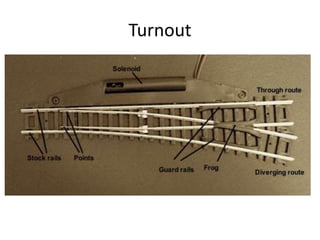
Turnouts
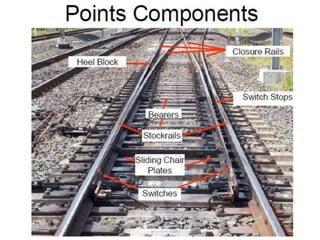
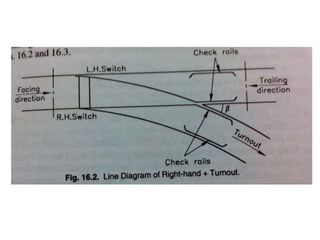
• It’s the simplest combination of points and crossings which
enables one track either a branch line or a siding, to take
off from another track.
• Parts of a turnout:
– A pair of points or switches
– A pair of stockrails
– A Vee crossing
– Two check rails
– Four lead rails
– Switch tie plate
– Studs or stops
– Bearing plates, slide chairs, stretcher bars etc.
– For operating the points – rods, cranks, levers etc.
– For locking system – locking box, lock bar, plunger bar etc.
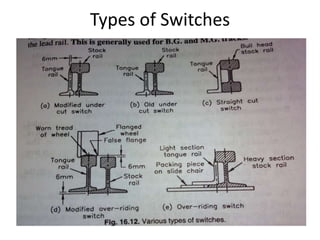
Types of Switches
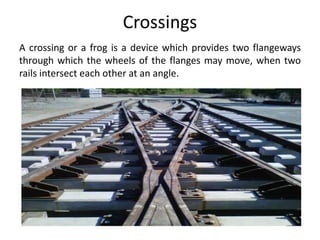
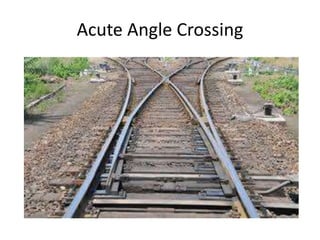
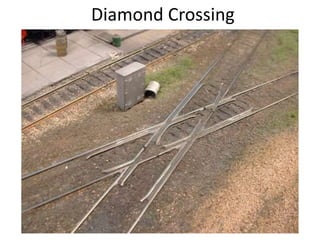
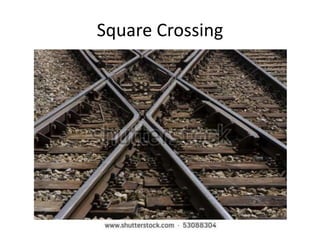
Crossings
A crossing or a frog is a device which provides two flangeways
through which the wheels of the flanges may move, when two
rails intersect each other at an angle.
Acute Angle Crossing
Diamond Crossing
Square Crossing
Track Junctions
• Turnouts
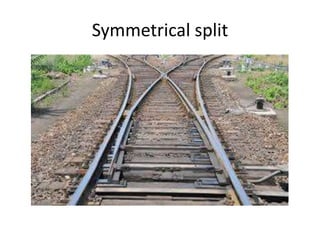
• Symmetrical split
• Three throw switch
• Double turnout or Tandem
• Diamond crossing
• Cross overs
• Single slip and double slip
• Gauntlet track and ladder tracks
• Temporary diversion
• Triangle
• Double junctions
Turnout
Symmetrical split
https://www.youtube.com/watch?v=L_wOPY5Pu-A
How Railway Track Changes
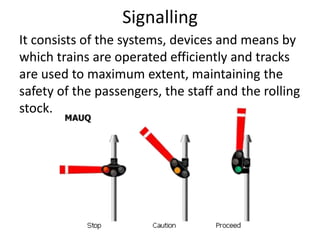
Signalling
It consists of the systems, devices and means by
which trains are operated efficiently and tracks
are used to maximum extent, maintaining the
safety of the passengers, the staff and the rolling
stock.
On the basis of Operating
Characteristics:
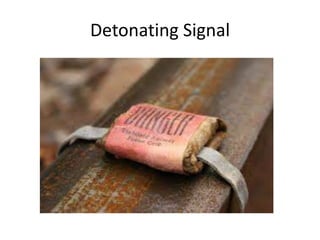
• Detonating Signals (Fog or audible signals)
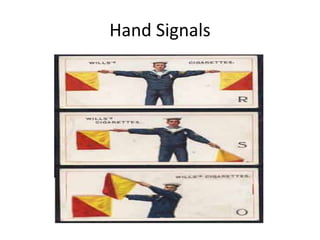
• Hand signals (Visual Indication signals)
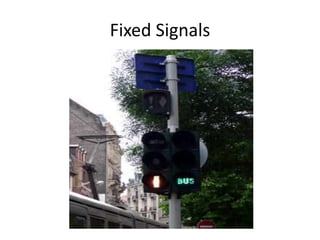
• Fixed signals (Visual Indication signals)
Detonating Signal
Hand Signals
Fixed Signals
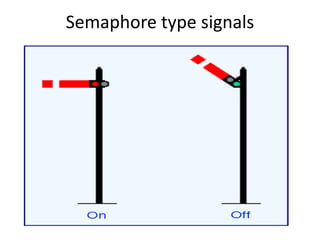
• Stop or Semaphore type Signals
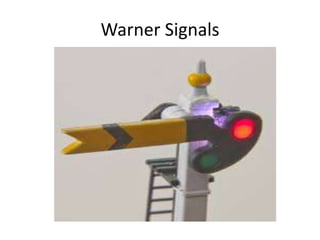
• Warner Signals
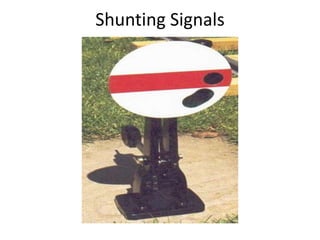
• Shunting Signals (Disc or Ground Signals)
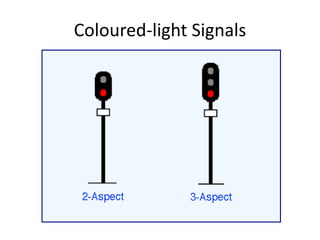
• Coloured-light Signals
On the basis of Functional
Characteristics:
Semaphore type signals
Warner Signals
Shunting Signals
Coloured-light Signals
• Reception Signals
– Outer signals
– Home signals
• Departure Signals
– Starter
– Advance Starter
On the basis of Locational
Characteristics:
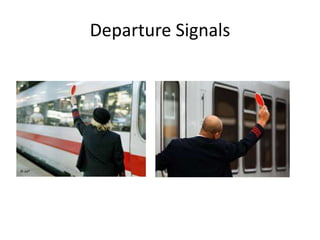
Departure Signals
• Repeater or Co-acting signals
• Routing Signals
• Calling on signals
• Point indicator
• Modified lower quadrant semaphore signal
• Miscellaneous signals
On the basis of Special Characteristics:
High Speed Bullet Train
https://www.youtube.com/watch?v=2-_yS60NhyM
THANK YOU

Railway engineering

  • 1.
    Railway Engineering Submitted by: AkshayKaushal (110134) Jaspreet Singh (110138)
  • 2.
  • 3.
    Railway Engineering • Itis a branch of civil engineering concerned with the design, construction, maintenance, and operation of railways. • Railway engineering includes elements of civil, mechanical, industrial, and electrical engineering. • Railway engineers handle the design, construction, and operation of railroads and mass transit systems that use a fixed guideway (such as light rail or even monorails). • Typical tasks would include determining horizontal and vertical alignment design, station location and design, construction cost estimating, and establishment of signaling & controlling system. • Railroad engineers can also move into the specialized field of train dispatching which focuses on train movement control.
  • 4.
  • 5.
    RAIL GAUGE The gaugeof a railway track is defined as the clear minimum perpendicular distance between the inner faces of the two rails.
  • 6.
    Dimension of gauges 1.Broad Gauge(BG) 1676mm(5’6”) 2. Standard Gauge(SG) 1435mm 3. Metre Gauge(MG) 1000mm 4. Narrow Gauge(NG) 762mm(2’6”) 5. Light Gauge 610mm
  • 7.
    Coning of Wheels •Coning of wheels – The distance between the inside edges of wheel flanges is generally kept less than the gauge. Gap is about 38 mm on Either side. Normally the tyre is absolutely ahead centre on the head of the rail, as the wheel is coned to keep it in this central position automatically. These wheel are coned at a slope • Theory of coning:- On a level track, as soon as the axle moves towards one rail, the diameter of the wheel tread over the rail increases, while It decreases over the other rail. This prevents to further movement And axle retreats back to its original position (with equal dia or both rails and equal pressure on both rails).
  • 8.
    Coning of Wheelon Level-track
  • 9.
    RAILS The high carbonrolled steel sections, which are laid end-to-end, in two parallel lines over sleepers to provide continuous and leveled surface for the trains to move and for carrying axle loads of the rolling stock are called rails. `
  • 10.
    Functions of therails: To provide continuous and level surface for the movement of trains with minimum friction with steel wheels of the rolling stock; Provide strength, durability and lateral guidance to the track; Transmit the axle loads to sleepers which transfer the same load to the underlying ballast and formation; Bear the stresses developed due to heavy vertical loads, breaking forces and temperature variance.
  • 11.
    RAILS Types of rails: 1.Double Headed Rails (DH Rails) 2. Bull Headed Rails (BH Rails) 3. Flat-footed Rails (FF Rails)
  • 12.
    Length of Rails OnIndian Railways the standard lengths are the following: Length = 12.80 m. (42 ft.) for BG (say 13 m) and Length = 11.89 m. (39 ft.) for MG (say 12 m)
  • 13.
    Corrugated or RoaringRails In certain places, head of rails are found to be corrugated rather than smooth and straight, when the vehicles pass over such rails, a roaring sound is created which is intense enough to be unpleasant.
  • 14.
    Hogged Rails Due tobattering action of wheels over the end of the rails, the rails get bent down and get deflected at the ends. These rails are called hogged rails. Measures taken to rectify the hogged rails are: 1. Cropping 2. Replacing 3. Welding 4. Dehogging
  • 15.
  • 16.
    Kinks In Rails Whenthe ends of adjoining rails move slightly out of position, “shoulders” or “kinks” are formed. Measures taken to rectify kinks in rails: 1. By correcting alignment at joints and at curved locations. 2. Proper packing of joints. 3. Proper maintenance of the track periodically in repect of cross levels, gauge, alignment, welding of worn out portions etc.
  • 17.
    Buckling of Rails Bucklingmeans the track has gone out of its original position or alignment due to prevention of expansion of rails in hot weather on account of temperature variations.
  • 18.
    Damaged Rails These arethe rails which should be removed on account of their becoming unsafe for a railway track.
  • 19.
    Rail Features • CrushedHeads • Square or Angular Break • Split Heads • Split Web • Horizontal Fissures • Transverse Fissures • Flowing Metal in Heads • Horizontal Cracks
  • 20.
  • 21.
  • 22.
  • 23.
  • 25.
    Rail Joints • SupportedRail Joint • Suspended Rail Joint • Bridge Joint • Base Joint • Welded Rail Joint • Staggered or Broken Joint • Square or Even Joint • Compromise Joint • Insulated Joint • Expansion Joint`
  • 26.
  • 28.
  • 29.
  • 30.
    Creep of Rails Creepis defined as the longitudinal movement of the rail with respect to the sleepers.
  • 31.
    Defects of Creep (i)Sleepers move out of position thereby the rail gauge. (ii) Position of points and crossings are disturbed. (iii) Interlocking mechanism gets disturbed.
  • 32.
    Remedies or Preventionof Creep • Pulling back of rails • Provision of Anchors or Anticreepers. • Use of steel sleepers. Anticreeper
  • 33.
    Sleepers Sleepers are thetransverse ties that are laid to support the rails. They transmit wheel load from the rails to the ballast.
  • 34.
    Classification of sleepers (i)Wooden sleeper (ii) Metal sleeper Cast iron sleeper Steel sleeper (iii) Concrete sleeper Reinforced concrete Sleeper (R.C.C) Prestressed Concrete Sleeper .
  • 35.
    Wooden Sleepers • Hardwood such as, sal and teak • Soft wood such as, chir and deodar
  • 36.
  • 37.
  • 38.
    Sleeper Density Sleeper densityis the number of sleepers Per rail length. It is specified as (M+x) or (N+x), where M or N is the length of the rail in meters and x is a number that varies according to factors such as axle load, speed, type & section of the rail etc. It varies in India from M+4 to M+7 for main tracks.
  • 39.
    Track Fittings &Fastenings • Fish plates • Spikes – Dog spikes – Screw spikes – Round spikes – Standard spikes – Elastic spikes • Bolts – Dog or Hook bolt – Fish bolt – Rag bolt – Fang nut and bolt • Keys – Wooden key for C.I. Chair – M.S. key and steel trough sleepers – Stuart’s key – Morgan key – Cotter and tie bars • Chairs – Cast steel chairs – Mild steel and Cast Iron Slide Chairs
  • 40.
    • Blocks – Heelblocks – Distance blocks – Crossing blocks – Check blocks • Plates – Bearing Plates – Saddle Plates Track Fittings & Fastenings contd..
  • 41.
  • 42.
  • 43.
  • 44.
  • 45.
  • 46.
    Ballast To provide structuralsupport for the track, holding it in good line and surface To distribute the load evenly to the subballast and subgrade and thus help to provide stability Provide for drainage Ballast in railroad terminology is durable granular material placed between the crosstie and the sub ballast to hold the track in line and grade. The primary purposes of ballast are:
  • 47.
  • 48.
    Types of Ballast •Broken Stone • Gravel or River Pebbles or Shingle • Ashes or Cinders • Sand • Mooram • Kankar • Brick Ballast • Blast Furnace Slag • Selected Earth
  • 49.
    Ballast Size • Forwooden sleepers = 5.1 cm • For steel sleepers = 3.8 cm • For under switches & crossings = 2.54 cm
  • 50.
    Points & Crossings •Points and crossings provide flexibility of movement by connecting one line to another according to requirements. • They also help for imposing restrictions over turnouts which necessarily retard the movements. • From safety aspect, it is also important as points and crossings are weak kinks or points in the track and vehicles are susceptible to derailments at these places.
  • 51.
    Turnouts • It’s thesimplest combination of points and crossings which enables one track either a branch line or a siding, to take off from another track. • Parts of a turnout: – A pair of points or switches – A pair of stockrails – A Vee crossing – Two check rails – Four lead rails – Switch tie plate – Studs or stops – Bearing plates, slide chairs, stretcher bars etc. – For operating the points – rods, cranks, levers etc. – For locking system – locking box, lock bar, plunger bar etc.
  • 54.
  • 55.
    Crossings A crossing ora frog is a device which provides two flangeways through which the wheels of the flanges may move, when two rails intersect each other at an angle.
  • 56.
  • 57.
  • 58.
  • 59.
    Track Junctions • Turnouts •Symmetrical split • Three throw switch • Double turnout or Tandem • Diamond crossing • Cross overs • Single slip and double slip • Gauntlet track and ladder tracks • Temporary diversion • Triangle • Double junctions
  • 60.
  • 61.
  • 62.
  • 63.
    Signalling It consists ofthe systems, devices and means by which trains are operated efficiently and tracks are used to maximum extent, maintaining the safety of the passengers, the staff and the rolling stock.
  • 64.
    On the basisof Operating Characteristics: • Detonating Signals (Fog or audible signals) • Hand signals (Visual Indication signals) • Fixed signals (Visual Indication signals)
  • 65.
  • 66.
  • 67.
  • 68.
    • Stop orSemaphore type Signals • Warner Signals • Shunting Signals (Disc or Ground Signals) • Coloured-light Signals On the basis of Functional Characteristics:
  • 69.
  • 70.
  • 71.
  • 72.
  • 73.
    • Reception Signals –Outer signals – Home signals • Departure Signals – Starter – Advance Starter On the basis of Locational Characteristics:
  • 74.
  • 75.
    • Repeater orCo-acting signals • Routing Signals • Calling on signals • Point indicator • Modified lower quadrant semaphore signal • Miscellaneous signals On the basis of Special Characteristics:
  • 76.
    High Speed BulletTrain https://www.youtube.com/watch?v=2-_yS60NhyM
  • 77.