TRAINING REPORT
(TRAINING DURING : MAY –JUNE 2016 )
( GUIDED BY MR. DEVENDRA GUPTA )
RIDDHI SIDDHI HIGH LEVEL BRIDGE
By
JAIPUR DEVELOPMENT AUTHORITY (JDA),
Ram Kishor Vyas Bhawan, Indra Circle,
Jawaharlal Nehru Marg,
Jaipur (302004) Rajasthan, India
Submitted by :
Mahavir Prasad Meena
13CE10022
Department of Civil Engineering
IIT Kharagpur
ACKNOWLEDGEMENT
I would like to thank JaipurDevelopmentAuthority(JDA) for giving methis
invaluable opportunityto learn so much practical knowledge which would have
impossible to learn through onlylooking at images from textbooks. I have gained
invaluable insights into how construction of any superstructureis handled and how
any difficultywhich comes in between is tackled. Apartfrom technical knowledge, I
have gain insights into construction management, efficientman-power
managementand lots of other thing.
I am deeply indebted to our training in-chargeat site Mr. DevendraGupta whose
help, stimulating suggestions and encouragementhelped me in all the time at the
training site and also for writing this training report. Also I am thankfulto Mr.
ManishJangid and Mr. BharatSingh for helping meunderstand the process of
construction.
My colleagues from the Civil Engineering Department supported me in my project
work. I want to thank them for all their help, support, interestand valuable hints
Especially, I would like to give my special thanks to my parents whose patient love
enabled me to complete this work. And at last butnot the least I would like to
thank God for the successful completion of my project.
CONTENTS
1. INTRODUCTION
2. DETAILS OF BRIDGE
3. BRIDGE COMPONENTS
3.1 PILE FOUNDATION
3.1.1 PILE & PILE CAP
3.2 SUBSTRUCTURES
3.2.1 PIER &PIERCAP , PEDESTAL,BEARING,ABUTMENT
3.3 SUPERSTRUCTURES
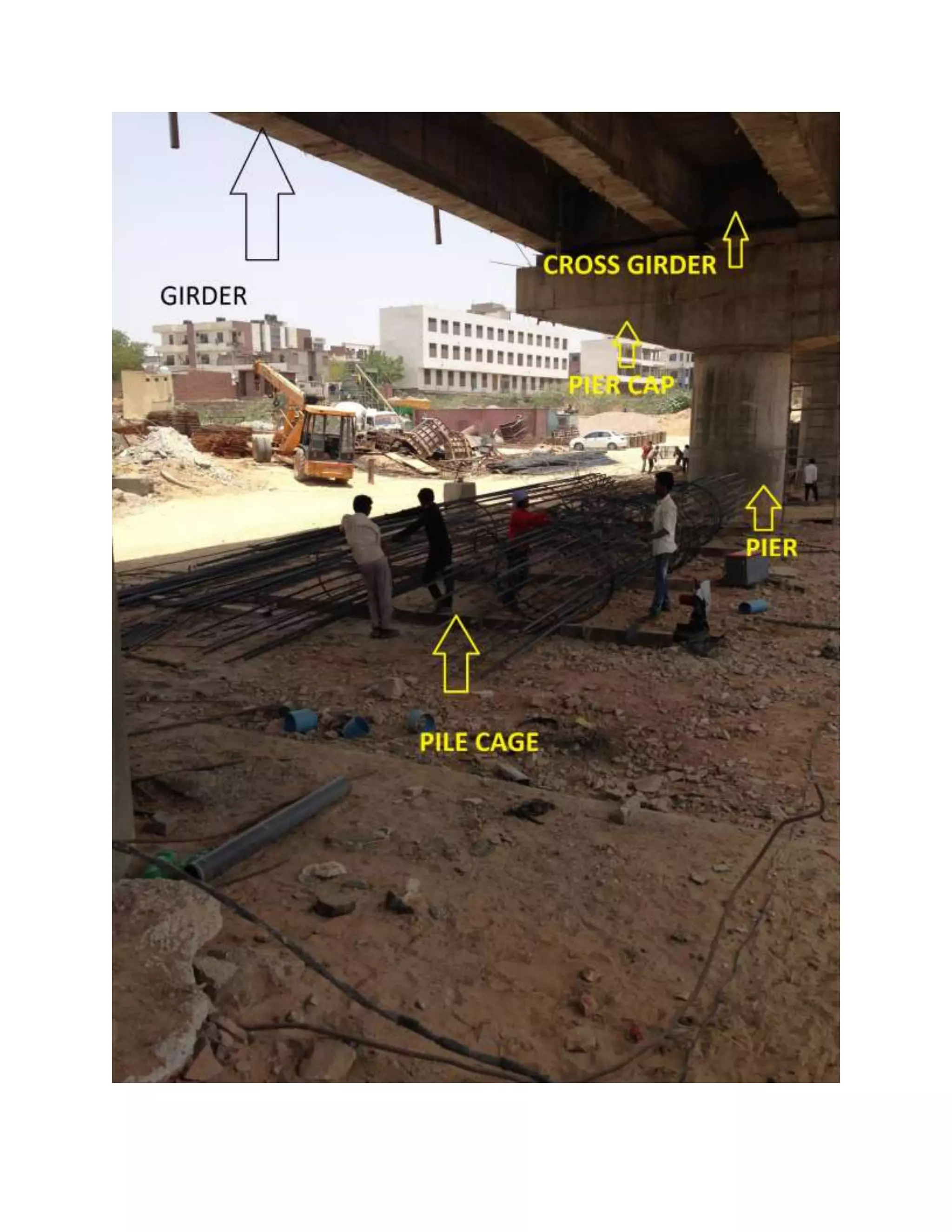
3.3.1 GIRDER, SLAB, CRASH BARRIER
INTRODUCTION
Seeingthe currentincrease inthe trafficconditionsandwaterlogging problemduringthe rainyseasons
at AmanishahNullah,JaipurDevelopmentAuthority(JDA) hasbaggedthe contractto PRL For Bridge
overAmanishahNulluh.
The bridge isconstructed536m overAmanishahNullah.The bridge whichwillconnectthe VijayPath
JunctiontoShipraPath, Mansarovar,Jaipur.It isexpectedtoreduce the pressure of hightrafficcoming
straightto the city.
The type of bridge thatis beenconstructedover kenriverisknownasgirderbridge.A girderbridge in
general isa bridge thatusesgirdersas the meansof supportingthe deck.A bridge consistsof three
parts: the foundation(foundationandpiers),the superstructure (girder,slab),andthe deck.
Solidslabanddeckslab withgirdersare usedinbridge.The bridge ismade of concrete andsteel.
Girdersare castingat site itself.Prestressedgirdersare used.
Due to hightrafficit wasdecidedthatfinishfirstone side withparallelworkonthe otherside.
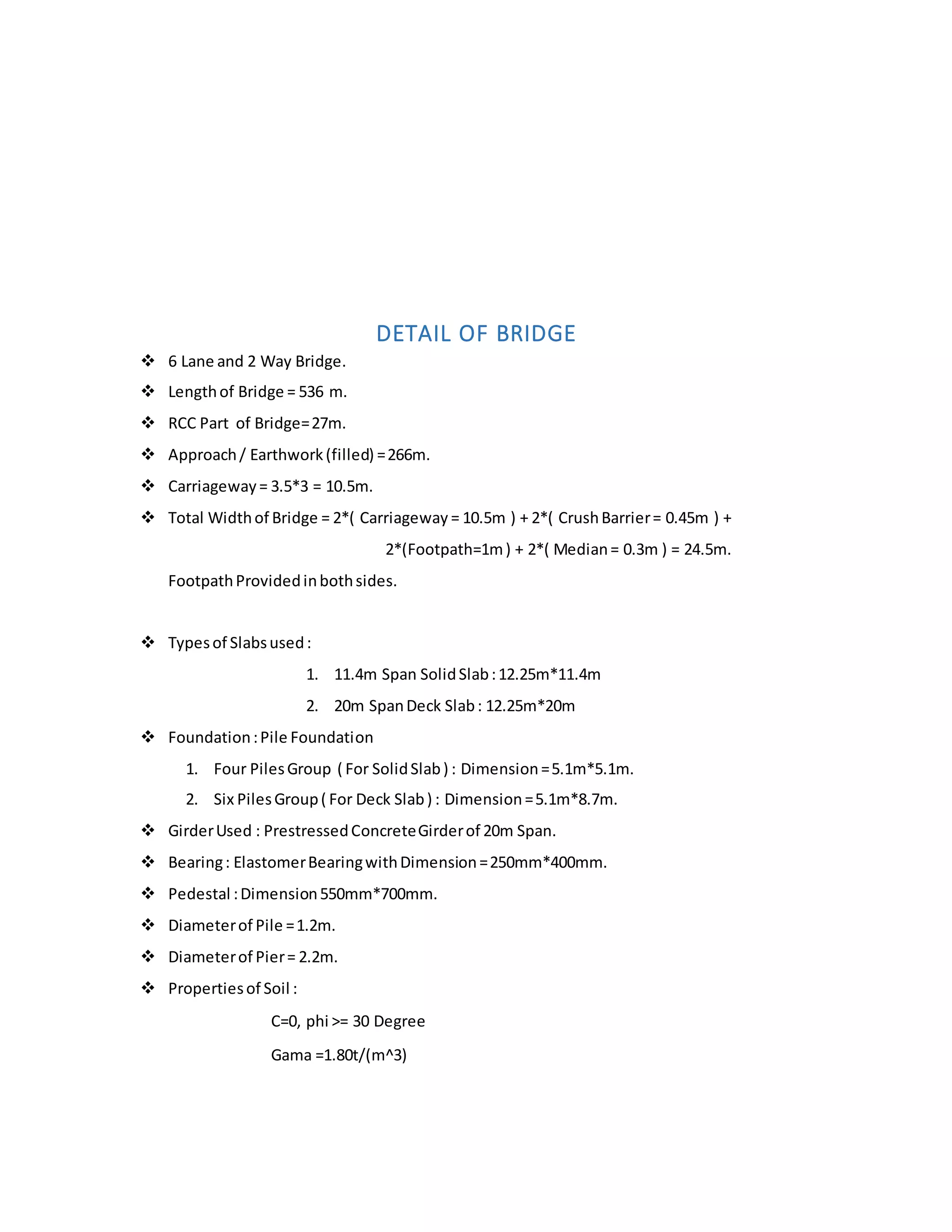
DETAIL OF BRIDGE
 6 Lane and 2 Way Bridge.
 Lengthof Bridge = 536 m.
 RCC Part of Bridge=27m.
 Approach/ Earthwork(filled) =266m.
 Carriageway= 3.5*3 = 10.5m.
 Total Widthof Bridge = 2*( Carriageway = 10.5m ) + 2*( CrushBarrier= 0.45m ) +
2*(Footpath=1m) + 2*( Median= 0.3m ) = 24.5m.
FootpathProvidedinbothsides.
 Typesof Slabsused:
1. 11.4m Span SolidSlab:12.25m*11.4m
2. 20m SpanDeck Slab: 12.25m*20m
 Foundation:Pile Foundation
1. Four PilesGroup ( For SolidSlab) : Dimension=5.1m*5.1m.
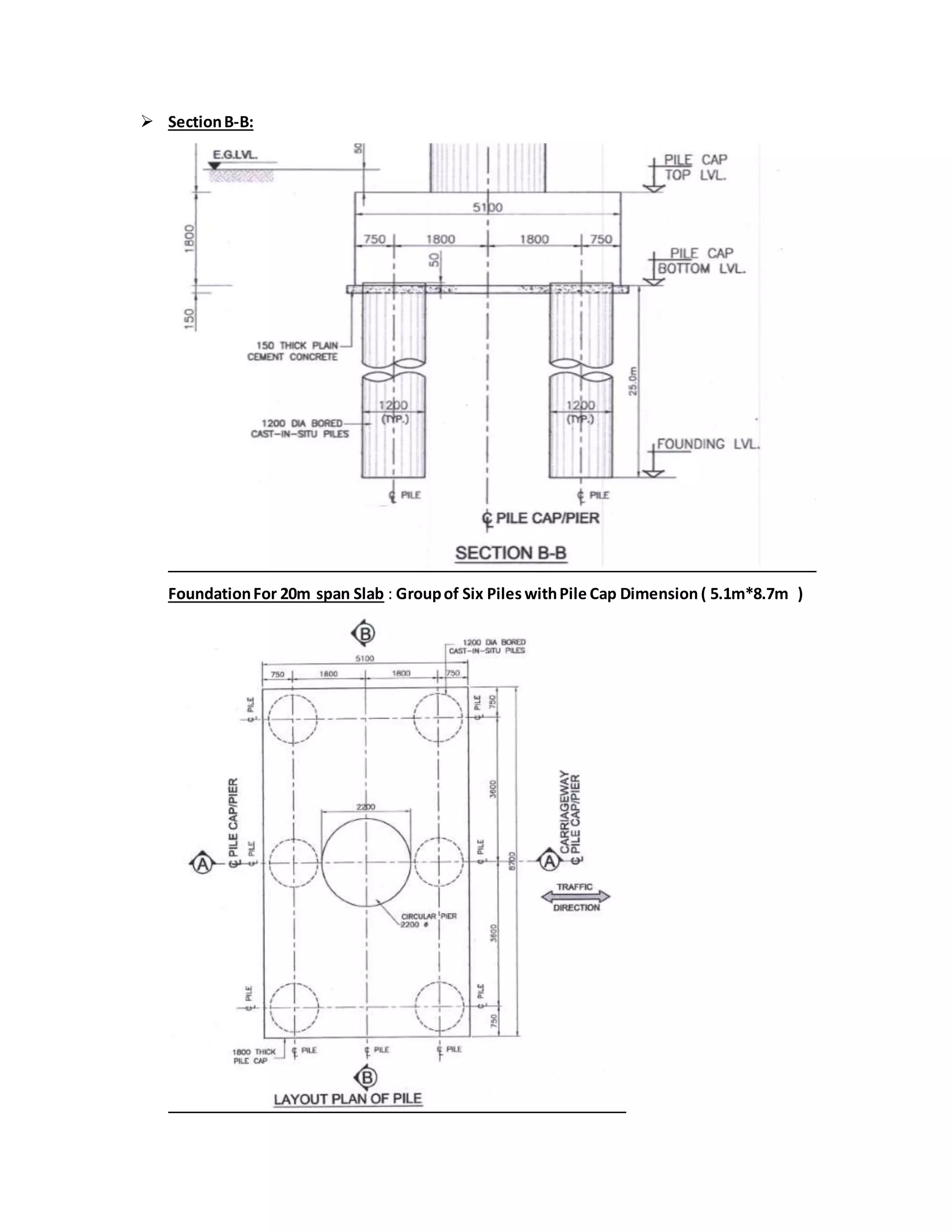
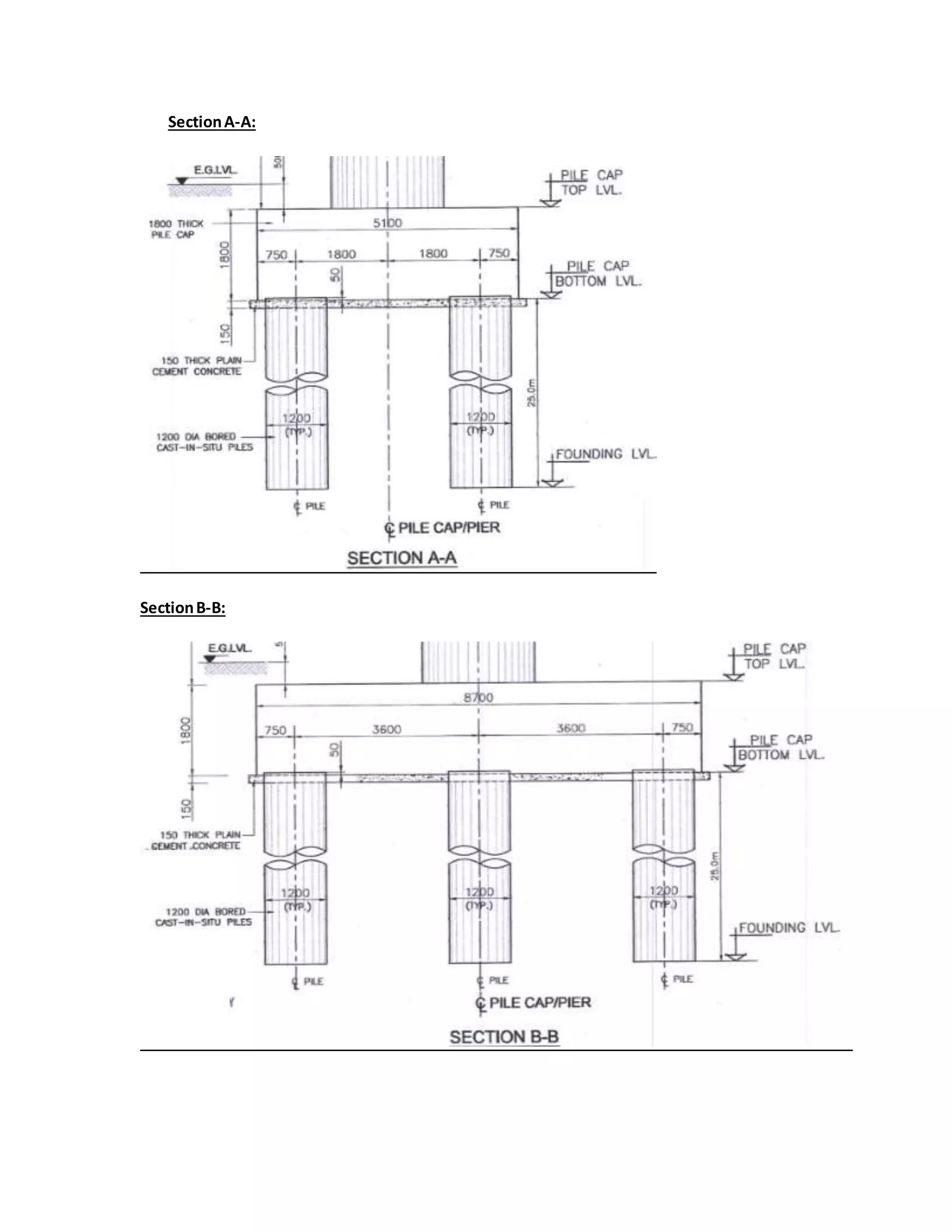
2. Six PilesGroup( For Deck Slab) : Dimension=5.1m*8.7m.
 GirderUsed : PrestressedConcreteGirderof 20m Span.
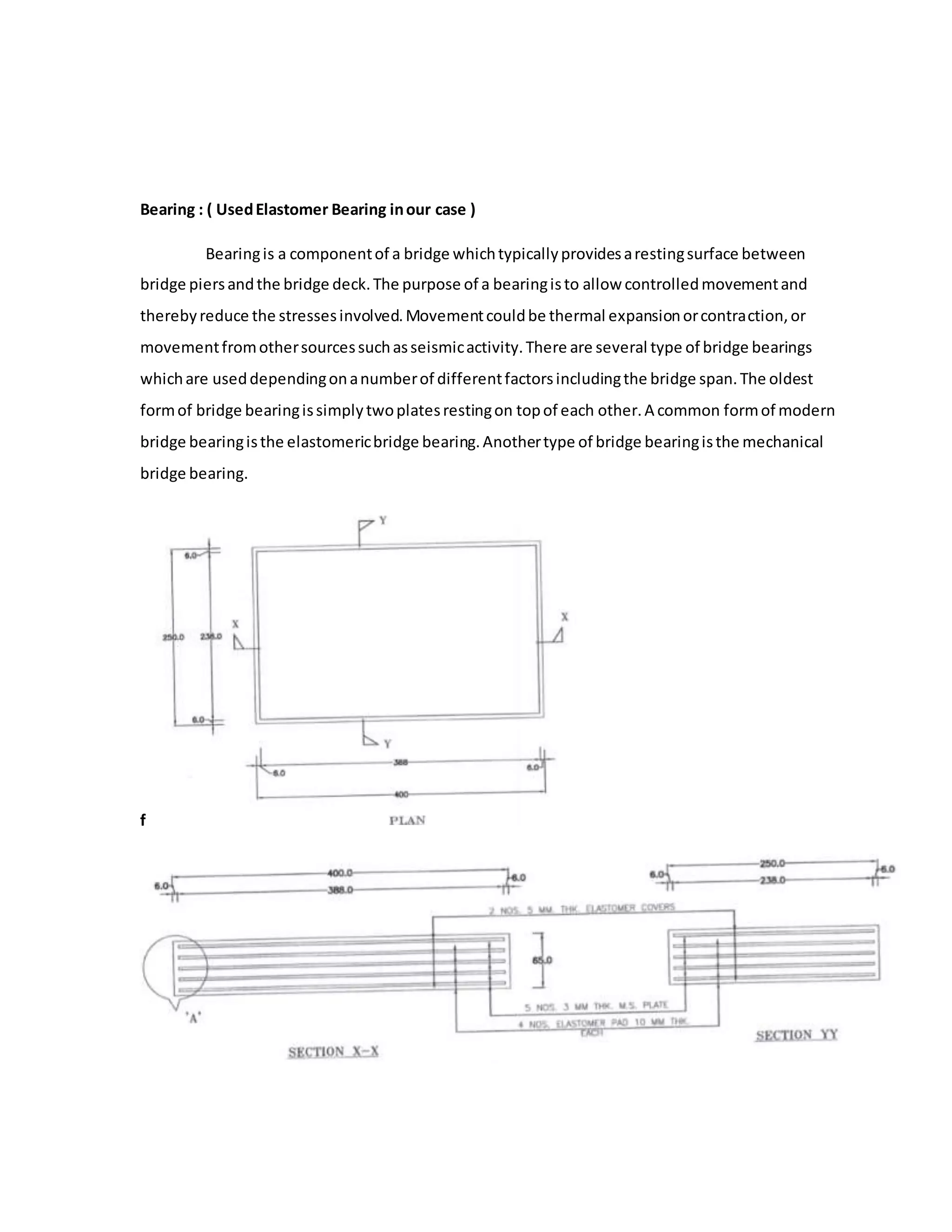
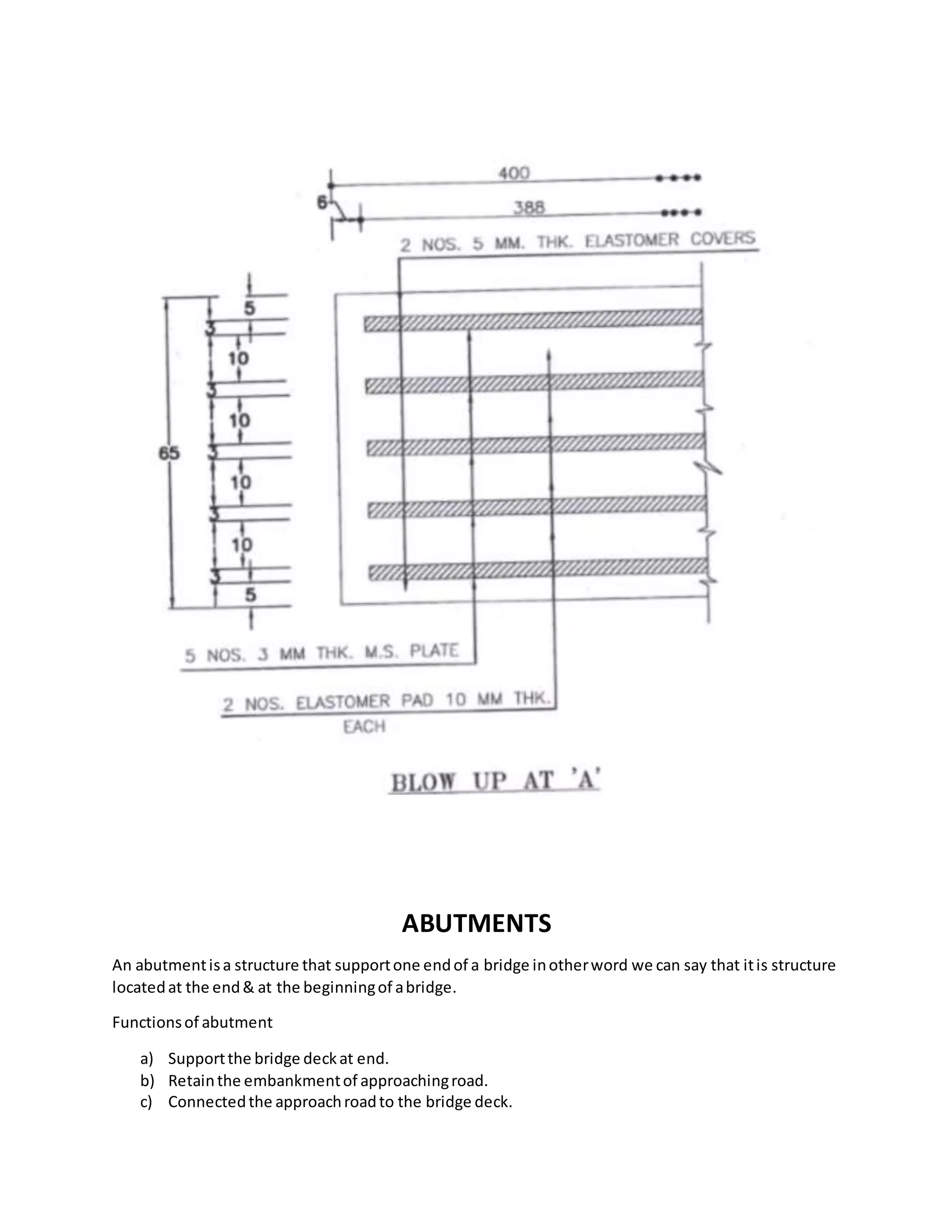
 Bearing: ElastomerBearingwithDimension=250mm*400mm.
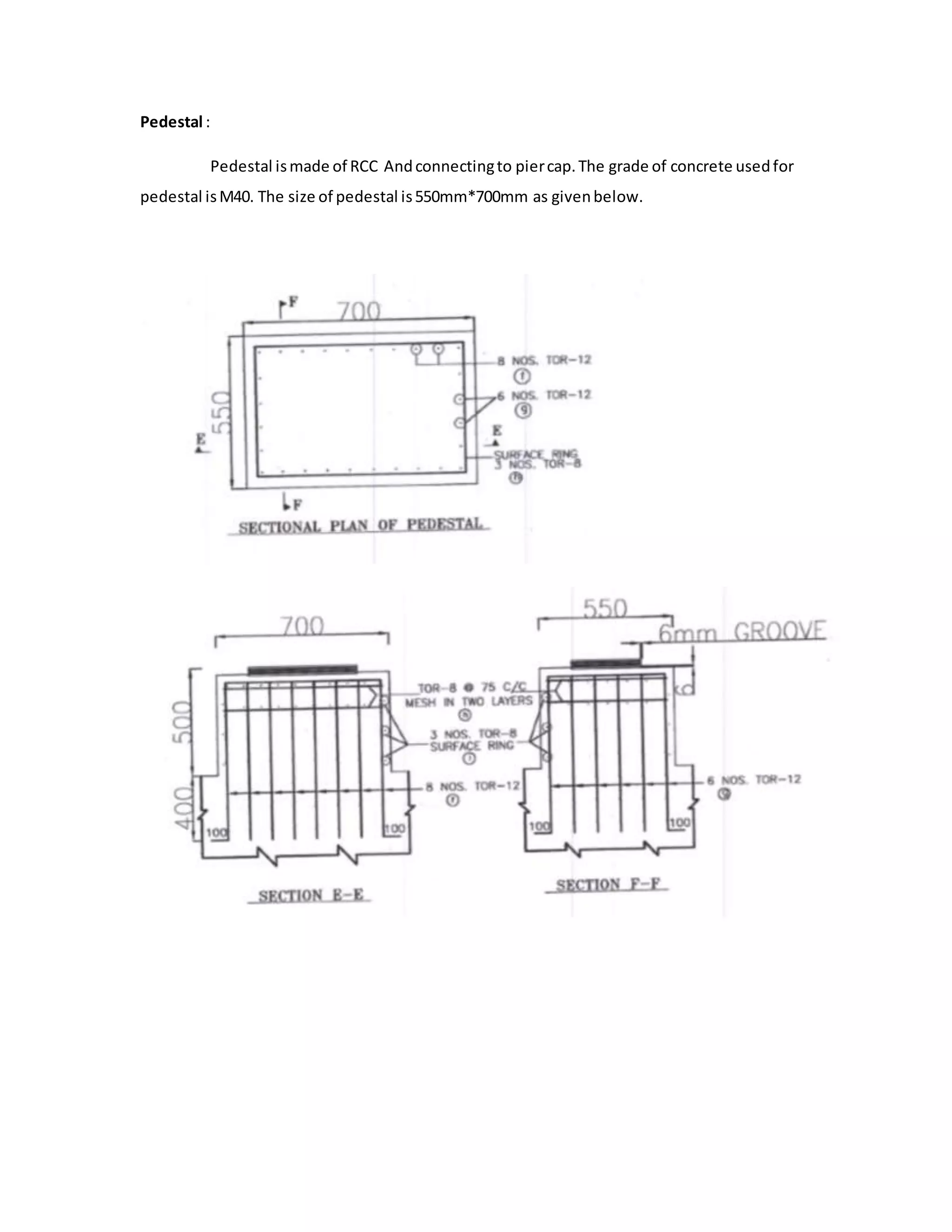
 Pedestal :Dimension550mm*700mm.
 Diameterof Pile =1.2m.
 Diameterof Pier= 2.2m.
 Propertiesof Soil :
C=0, phi >= 30 Degree
Gama =1.80t/(m^3)
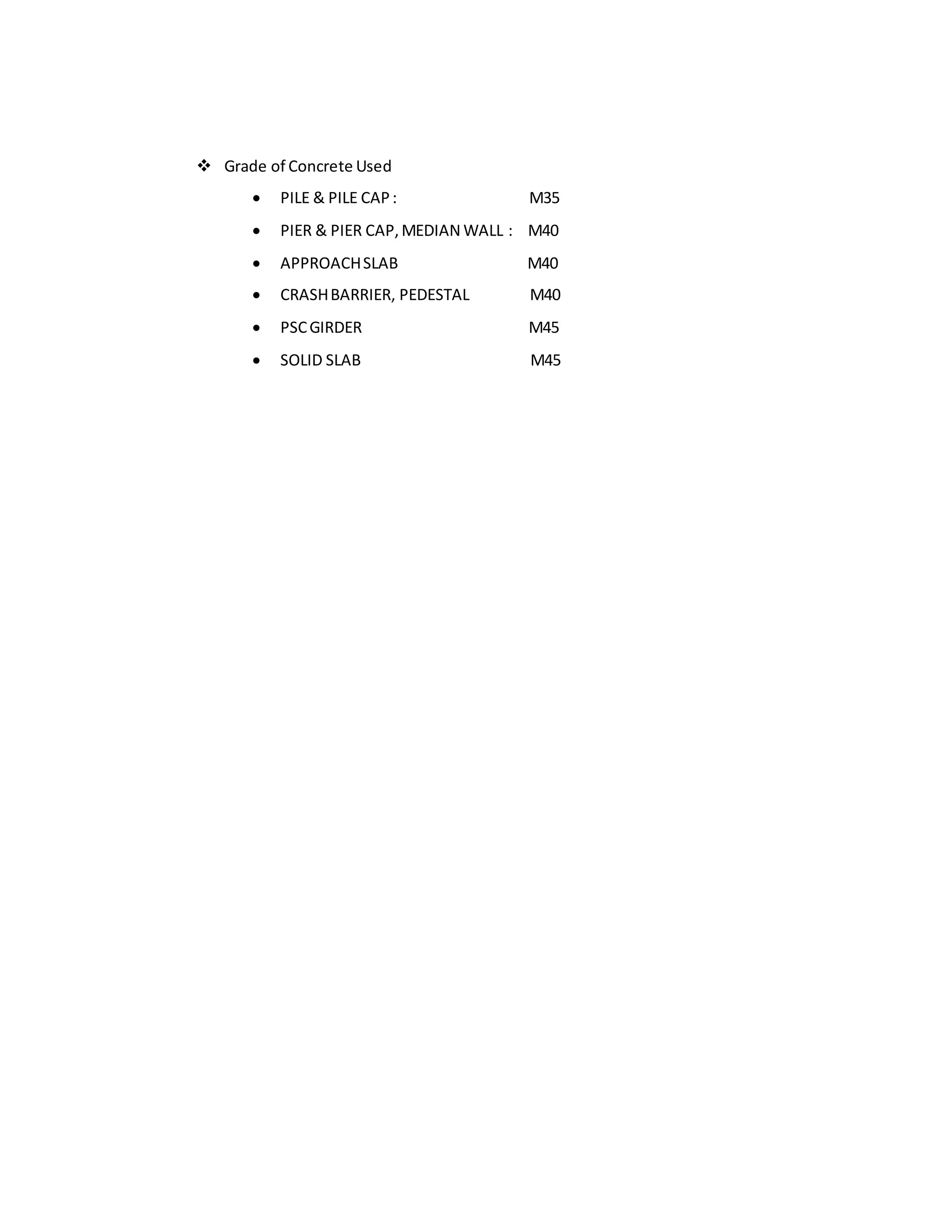
 Grade of Concrete Used
 PILE & PILE CAP: M35
 PIER & PIER CAP,MEDIAN WALL : M40
 APPROACHSLAB M40
 CRASHBARRIER, PEDESTAL M40
 PSCGIRDER M45
 SOLID SLAB M45
FOUNDATION DESIGN
PILE FOUNDATION: Diameter= 1.2m and Depth =25m.
Piledfoundations :
General descriptionsof pile typesThere isalarge varietyof typesof pile usedforfoundationwork.The
choice depends onthe environmentalandgroundconditions,the presenceorabsence of groundwater,
the functionof the pile,i.e.whethercompression,upliftorlateral loadsare tobe carried,the desired
speedof constructionandconsiderationof relative cost.The abilityof the pile toresistaggressive
substancesororganismsinthe ground or insurroundingwatermustalsobe considered.InBS8004,
pilesare groupedintothree categories:
(1) Large displacementpiles:these include all solidpiles,includingtimber andprecastconcrete andsteel
or concrete tubesclosedatthe lowerendbya shoe or plug,whichmaybe eitherleftinplace or
extrudedtoforman enlargedfoot.
(2) Small displacementpiles:these includerolled-steelsections,open-endedtubesandhollow sections
if the ground entersfreelyduringdriving.
(3) Replacementpiles:these are formedbyboringorothermethodsof excavation;the boreholemaybe
linedwithacasingor tube that is eitherleftinplace orextractedasthe hole isfilled.
Drivenand cast-in-place piles : These are widelyusedinthe displacementpilegroup.A tube
closedat itslowerendbya detachable shoe orby a plugof gravel or dry concrete isdriventothe
desiredpenetration.Steelreinforcementislowereddownthe tube andthe latteristhenwithdrawn
duringor afterplacingthe concrete.These typeshave the advantagesthat:(1) the lengthcanbe varied
readilytosuitvariationinthe level of the bearingstratum;(2) the closedendexcludesgroundwater;(3)
an enlargedbase canbe formedby hammeringoutthe concrete placedatthe toe; (4) the
reinforcementisrequiredonlyforthe functionof the pile asafoundationelement,i.e.notfrom
considerationsof liftinganddrivingasforthe precastconcrete pile;and(5) the noise andvibrationare
not severe whenthe pilesare drivenbyadrophammeroperatingwithinthe drive tube.Drivenand
cast-in-place pilesmaynotbe suitable forverysoftsoil conditionswhere the newlyplacedconcretecan
be squeezedinwardsasthe drive tube iswithdrawncausing'necking'of the pile shaft,noristhe
uncasedshaftsuitable forgroundwhere waterisencounteredunderartesianheadwhichwashesout
the cementfromthe unsetconcrete.These problemscanbe overcome byproviding apermanent
casing.Ground heave candamage adjacentpilesbefore the concrete hashardened,andheavedpiles
cannot easilybe redriven.However,thisproblemcanbe overcome eitherbypreboringorbydrivinga
numberof tubesina groupinadvance of placingthe concrete.The latterisdelayeduntil pile drivinghas
proceededtoa distance of at least6.5 pile diametersfromthe one beingconcretedif small (upto3mm)
upliftispermitted,or8 diametersawayif negligible (lessthan3mm) upliftmustbe achieved.22The
lengthsof drivenandcast-in-place pilesare limitedbythe abilityof the drivingrigstoextractthe drive
tube and theycannotbe installedinverylarge diameters.Theyare unsuitable forriverormarine works
unlessspeciallyadaptedforextendingthemthroughwaterandcannotbe driveninsituationsof low
headroom.
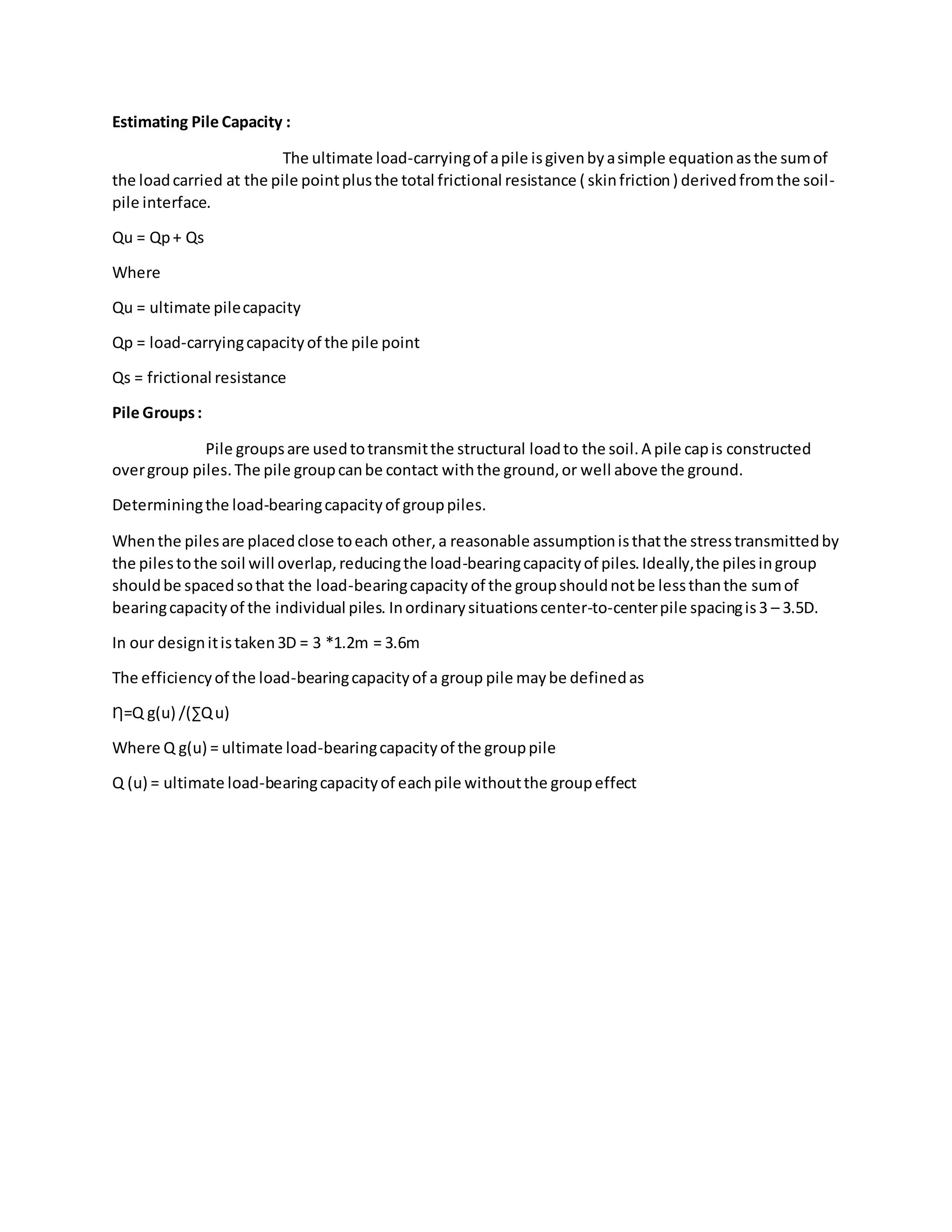
Estimating Pile Capacity :
The ultimate load-carryingof apile isgivenbyasimple equationasthe sumof
the loadcarried at the pile pointplusthe total frictional resistance ( skinfriction) derivedfromthe soil-
pile interface.
Qu = Qp+ Qs
Where
Qu = ultimate pilecapacity
Qp = load-carryingcapacityof the pile point
Qs = frictional resistance
Pile Groups:
Pile groupsare usedtotransmitthe structural loadto the soil.A pile capis constructed
overgroup piles.The pile groupcanbe contact withthe ground,or well above the ground.
Determiningthe load-bearingcapacityof grouppiles.
Whenthe pilesare placedclose toeach other,a reasonable assumptionisthatthe stresstransmittedby
the pilestothe soil will overlap,reducingthe load-bearingcapacityof piles.Ideally,the pilesingroup
shouldbe spacedsothat the load-bearingcapacity of the groupshouldnotbe lessthanthe sumof
bearingcapacityof the individual piles. Inordinarysituationscenter-to-centerpile spacingis3 – 3.5D.
In our designitistaken3D = 3 *1.2m = 3.6m
The efficiencyof the load-bearingcapacityof a group pile maybe definedas
Ƞ=Q g(u) /(∑Qu)
Where Q g(u) = ultimate load-bearingcapacityof the grouppile
Q (u) = ultimate load-bearingcapacityof eachpile withoutthe groupeffect
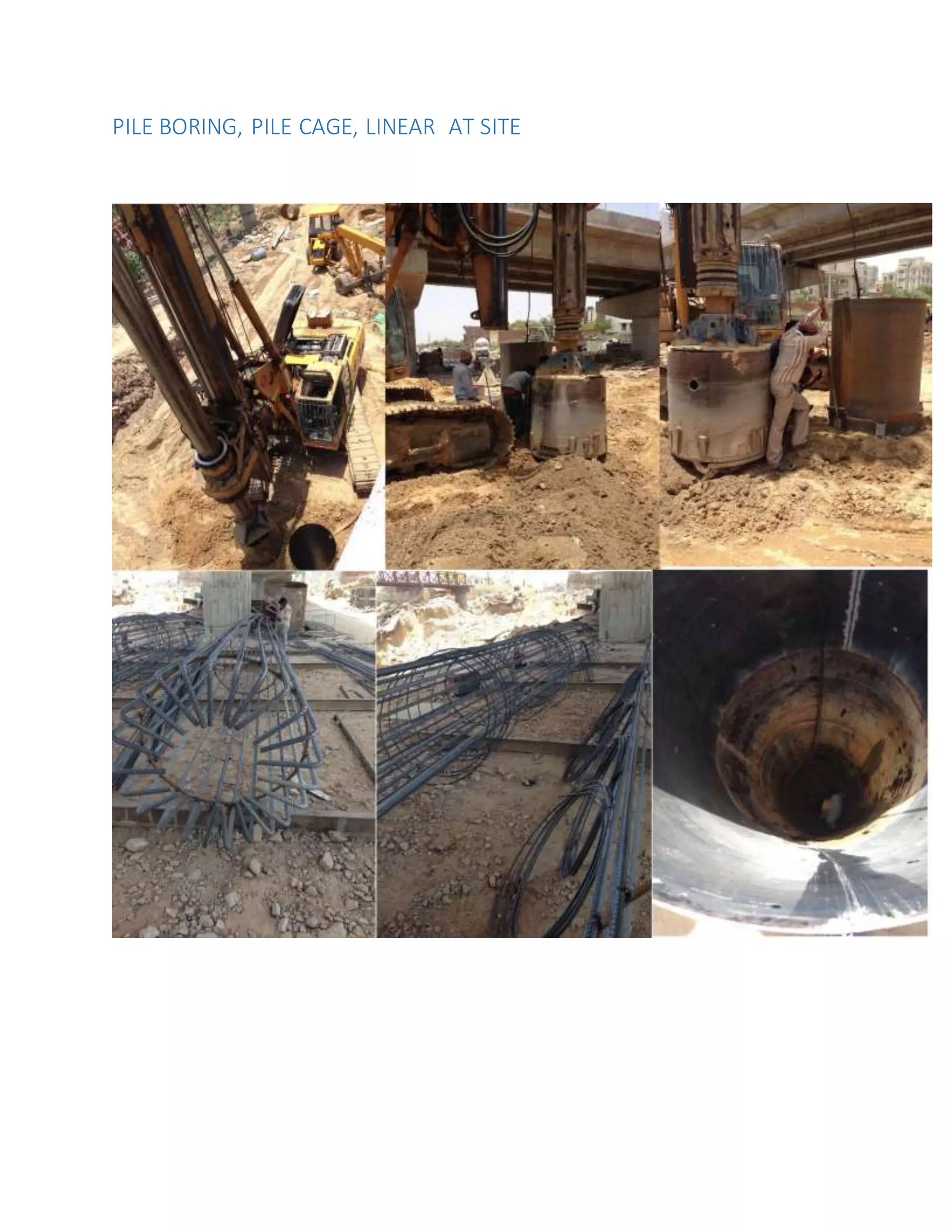
PILE BORING, PILE CAGE, LINEAR AT SITE
SUBSTRUCTURES
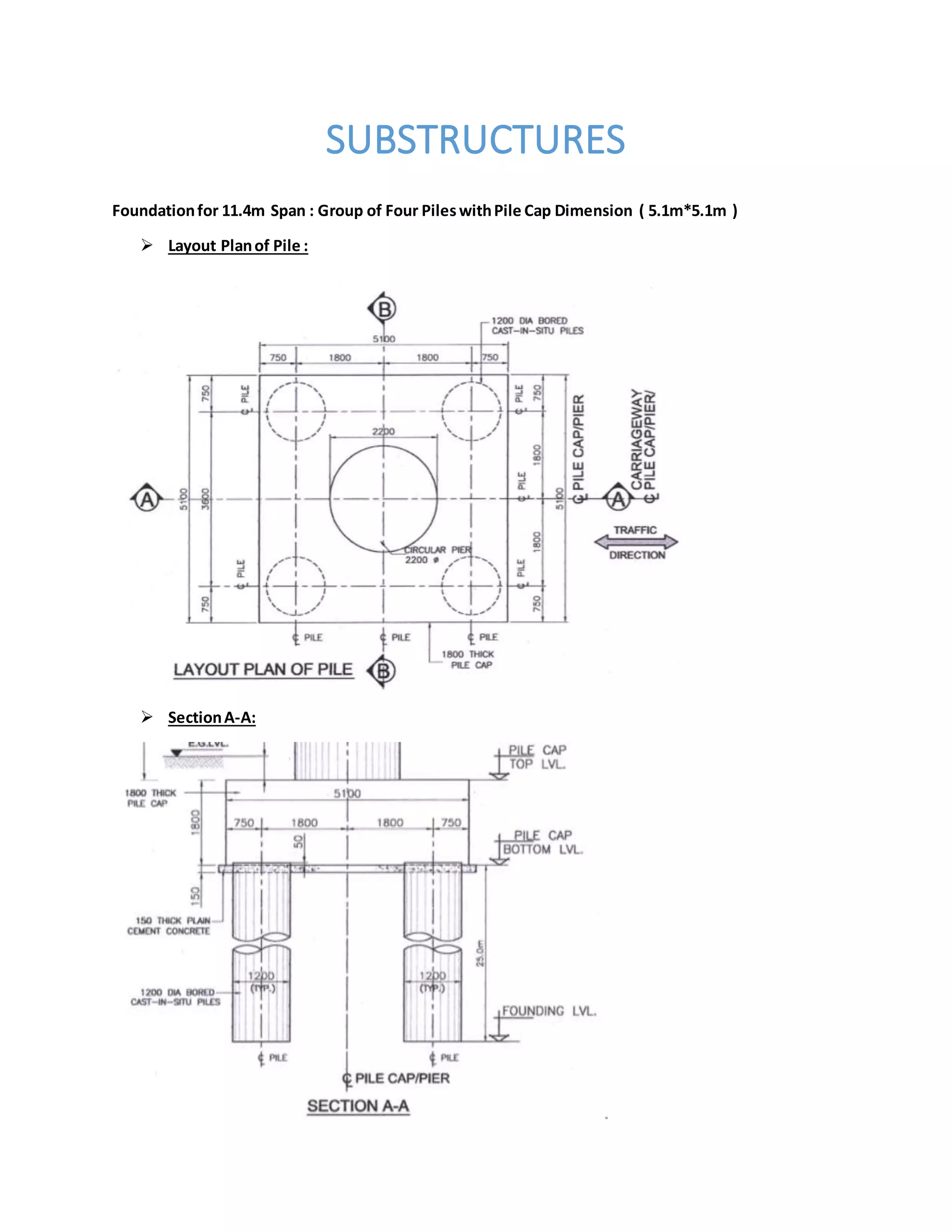
Foundationfor 11.4m Span : Group of Four PileswithPile Cap Dimension ( 5.1m*5.1m )
 Layout Planof Pile :
 SectionA-A:
 SectionB-B:
FoundationFor 20m span Slab : Groupof Six Piles withPile Cap Dimension ( 5.1m*8.7m )
SectionA-A:
SectionB-B:
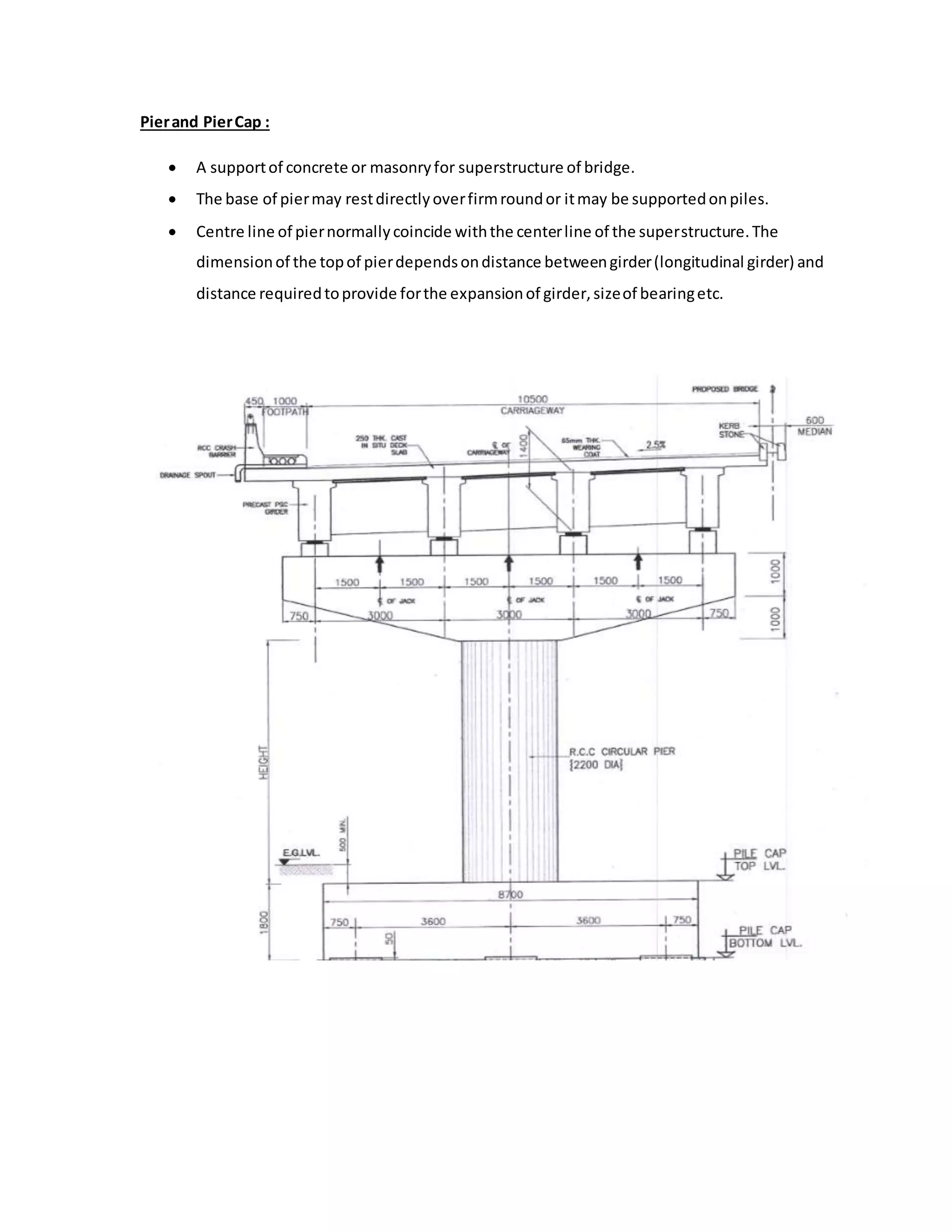
Pierand PierCap :
 A supportof concrete or masonryfor superstructure of bridge.
 The base of piermay restdirectlyoverfirmroundor itmay be supportedonpiles.
 Centre line of piernormallycoincide withthe centerline of the superstructure.The
dimensionof the topof pierdependsondistance betweengirder(longitudinal girder) and
distance requiredtoprovide forthe expansionof girder,sizeof bearingetc.
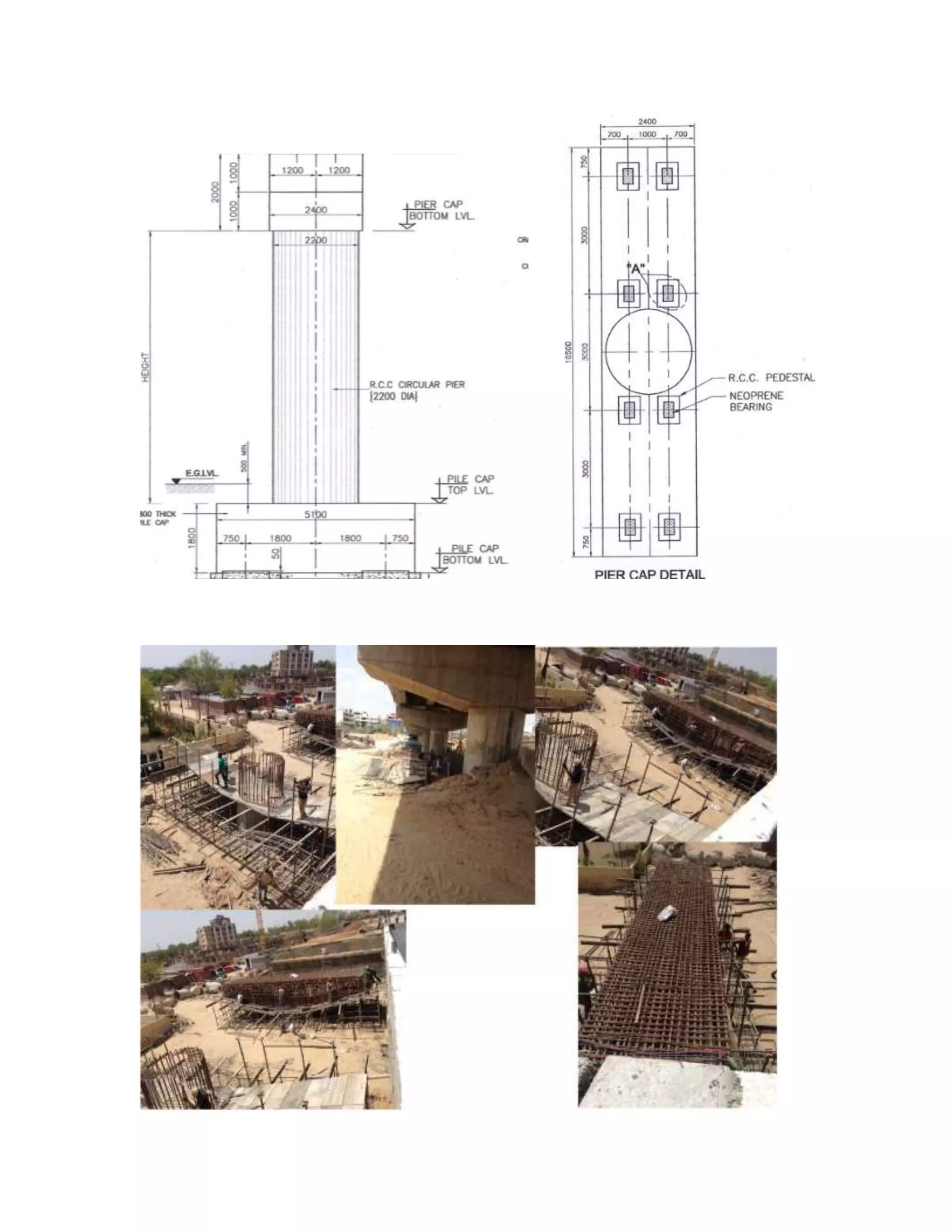
Pedestal :
Pedestal ismade of RCC Andconnectingto piercap.The grade of concrete usedfor
pedestal isM40. The size of pedestal is550mm*700mm as givenbelow.
Bearing : ( UsedElastomer Bearing inour case )
Bearingis a componentof a bridge whichtypicallyprovidesarestingsurface between
bridge piersandthe bridge deck.The purpose of a bearingisto allow controlledmovementand
therebyreduce the stressesinvolved.Movementcouldbe thermal expansionorcontraction,or
movementfromothersourcessuchasseismicactivity.There are several type of bridge bearings
whichare useddependingonanumberof differentfactorsincludingthe bridge span.The oldest
formof bridge bearingissimplytwoplatesrestingon topof each other.A common formof modern
bridge bearingisthe elastomericbridge bearing.Anothertype of bridge bearingisthe mechanical
bridge bearing.
f
ABUTMENTS
An abutmentisa structure that supportone endof a bridge inotherword we can say that itis structure
locatedat the end& at the beginningof abridge.
Functionsof abutment
a) Supportthe bridge deckat end.
b) Retainthe embankmentof approachingroad.
c) Connectedthe approachroadto the bridge deck.
SUPERSTRUCTURE
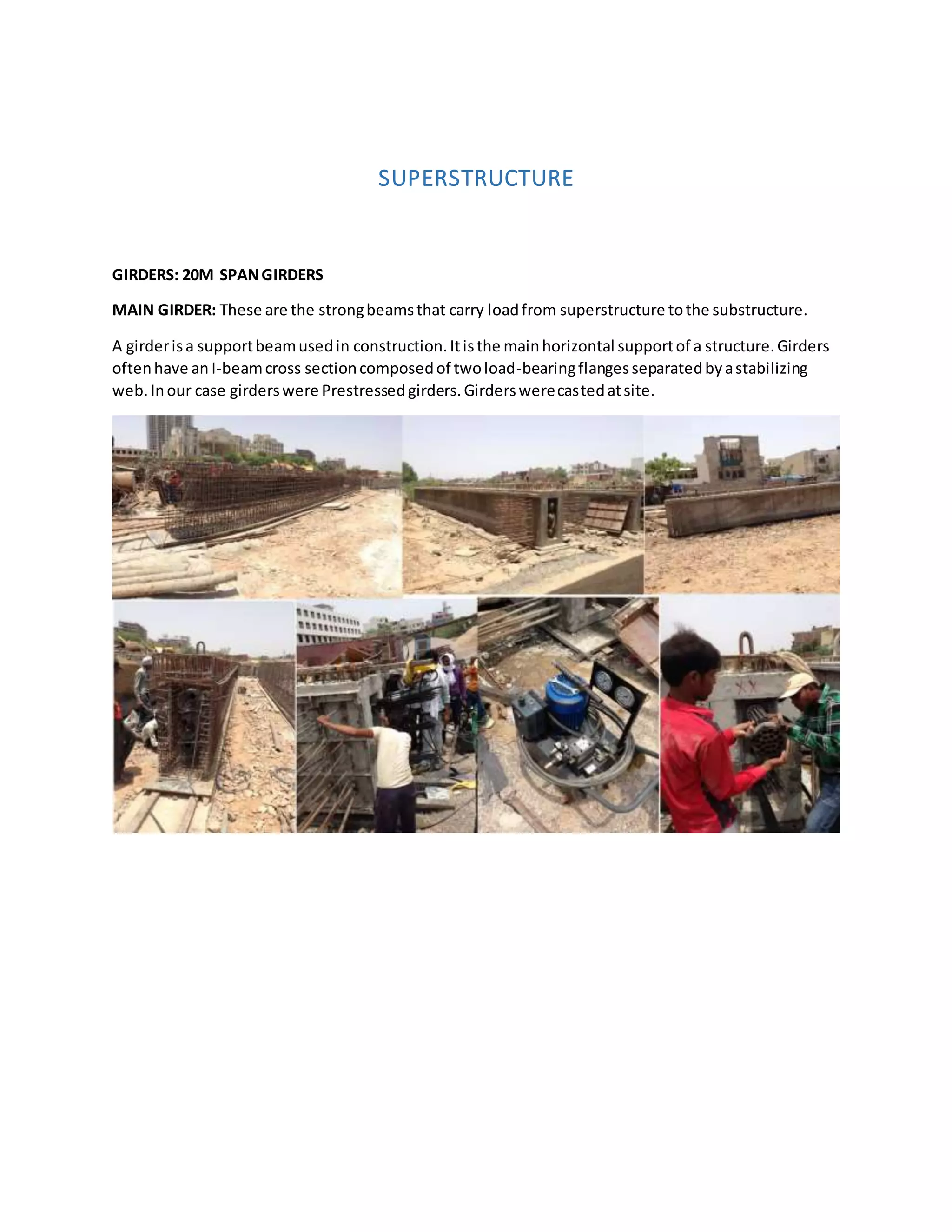
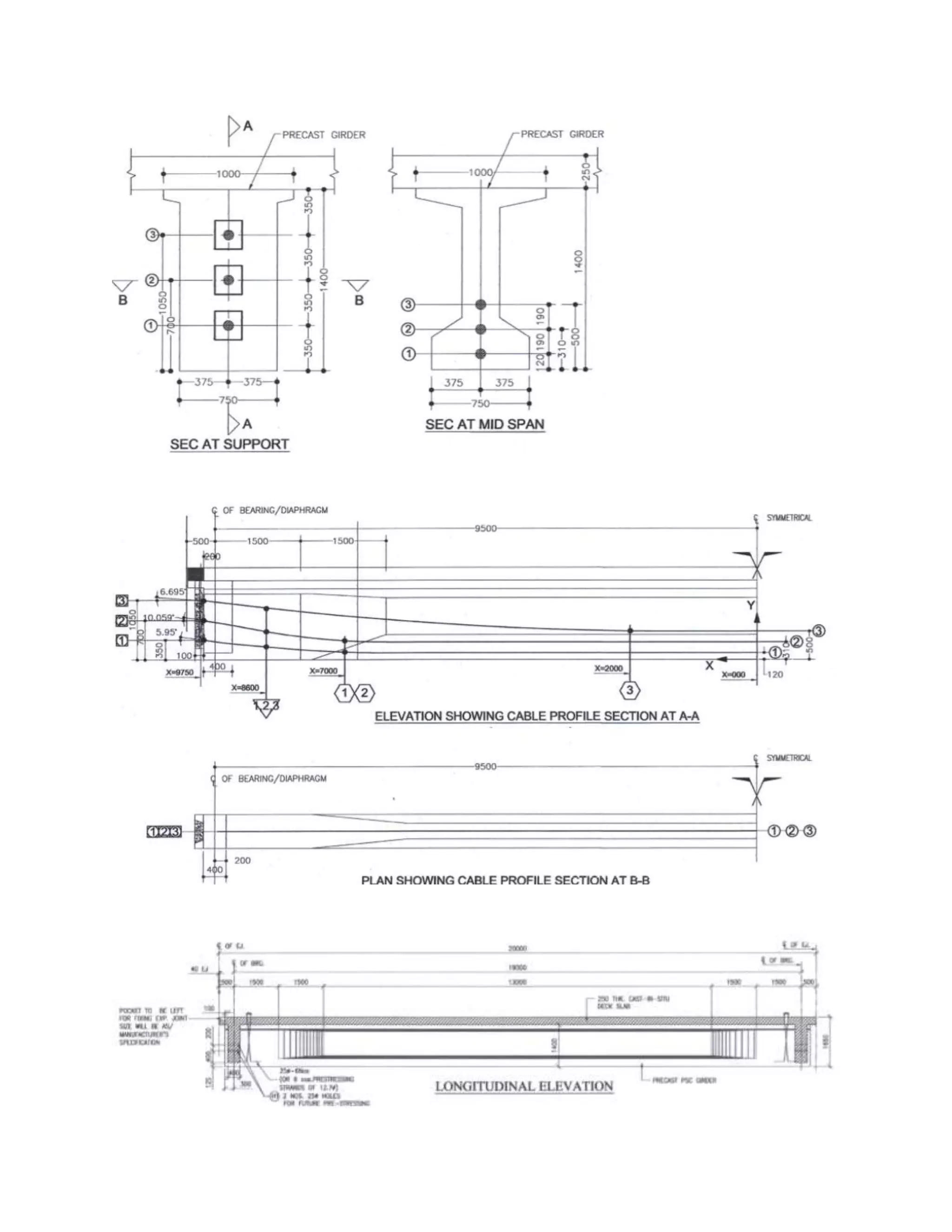
GIRDERS: 20M SPANGIRDERS
MAIN GIRDER: These are the strongbeamsthat carry loadfrom superstructure tothe substructure.
A girderisa supportbeamusedin construction.Itisthe mainhorizontal supportof a structure.Girders
oftenhave an I-beamcross sectioncomposedof twoload-bearingflangesseparatedbyastabilizing
web.Inour case girderswere Prestressedgirders.Girderswerecastedatsite.
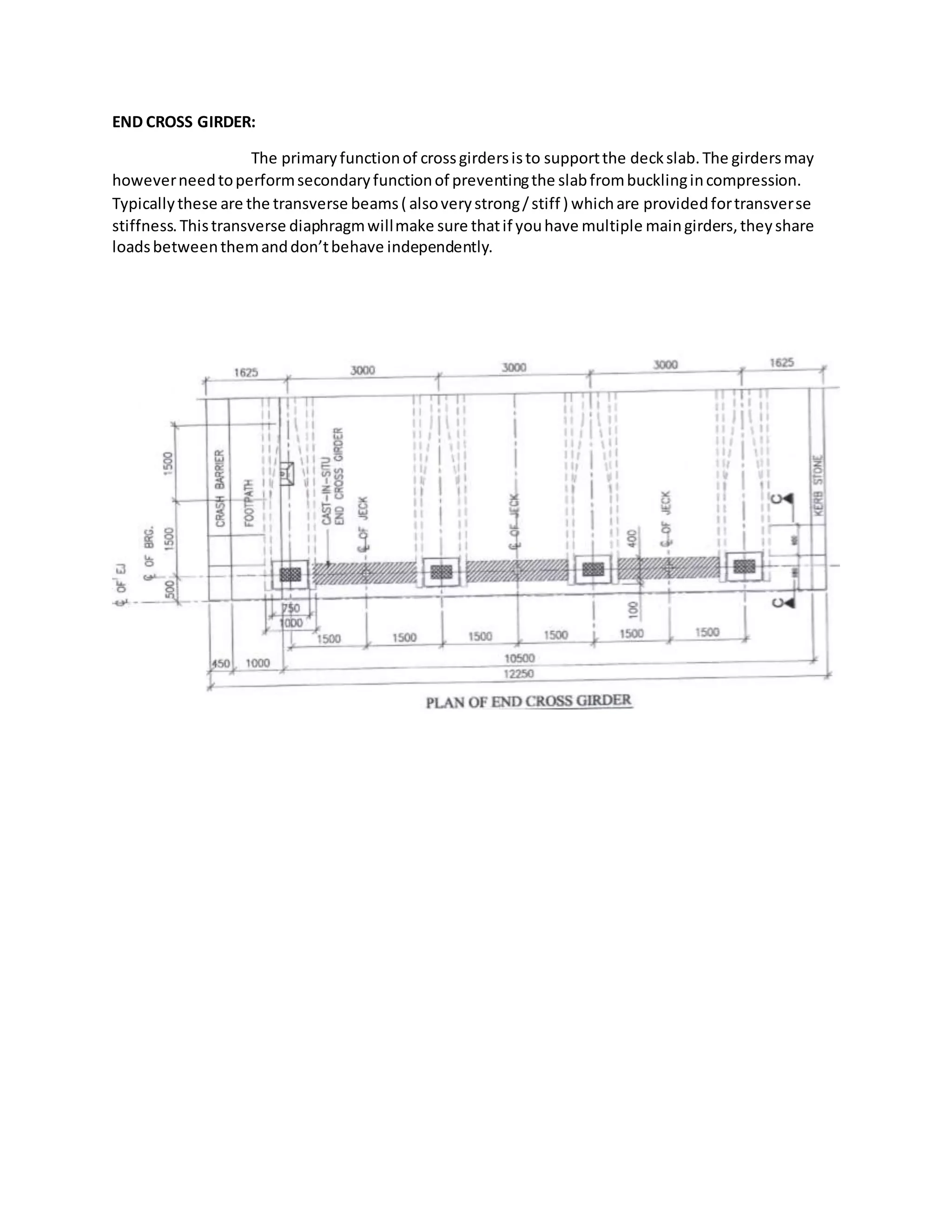
END CROSS GIRDER:
The primaryfunctionof crossgirdersisto supportthe deckslab.The girdersmay
howeverneedtoperformsecondaryfunctionof preventingthe slabfrombucklingincompression.
Typicallythese are the transverse beams( alsoverystrong/stiff ) whichare providedfortransverse
stiffness.Thistransverse diaphragmwillmake sure thatif youhave multiple maingirders,theyshare
loadsbetweenthemanddon’tbehave independently.
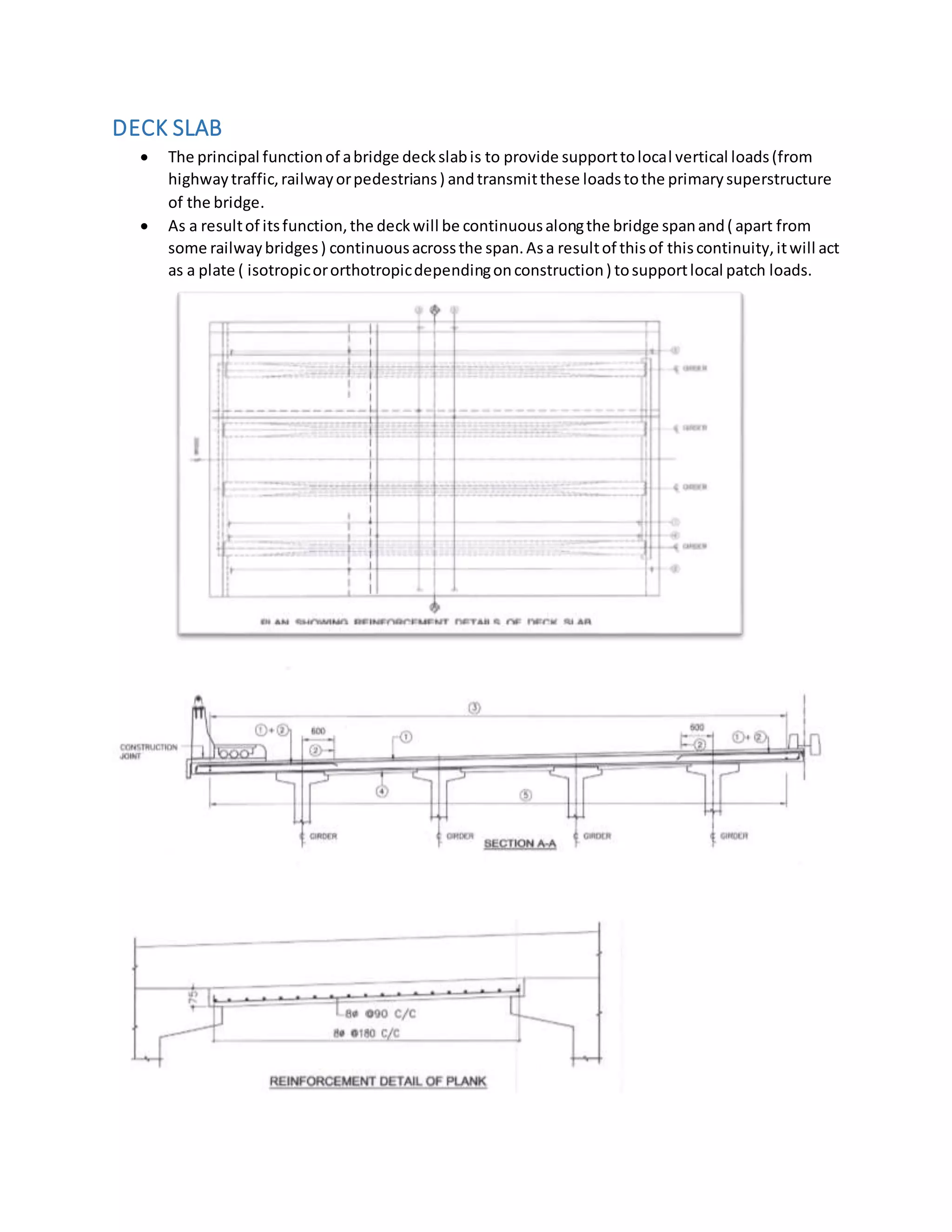
DECK SLAB
 The principal functionof abridge deckslabis to provide supporttolocal vertical loads(from
highwaytraffic,railwayorpedestrians) andtransmitthese loadstothe primarysuperstructure
of the bridge.
 As a resultof itsfunction,the deckwill be continuousalongthe bridge spanand( apart from
some railwaybridges) continuousacrossthe span.Asa resultof thisof thiscontinuity,itwill act
as a plate ( isotropicororthotropicdependingonconstruction) tosupportlocal patch loads.
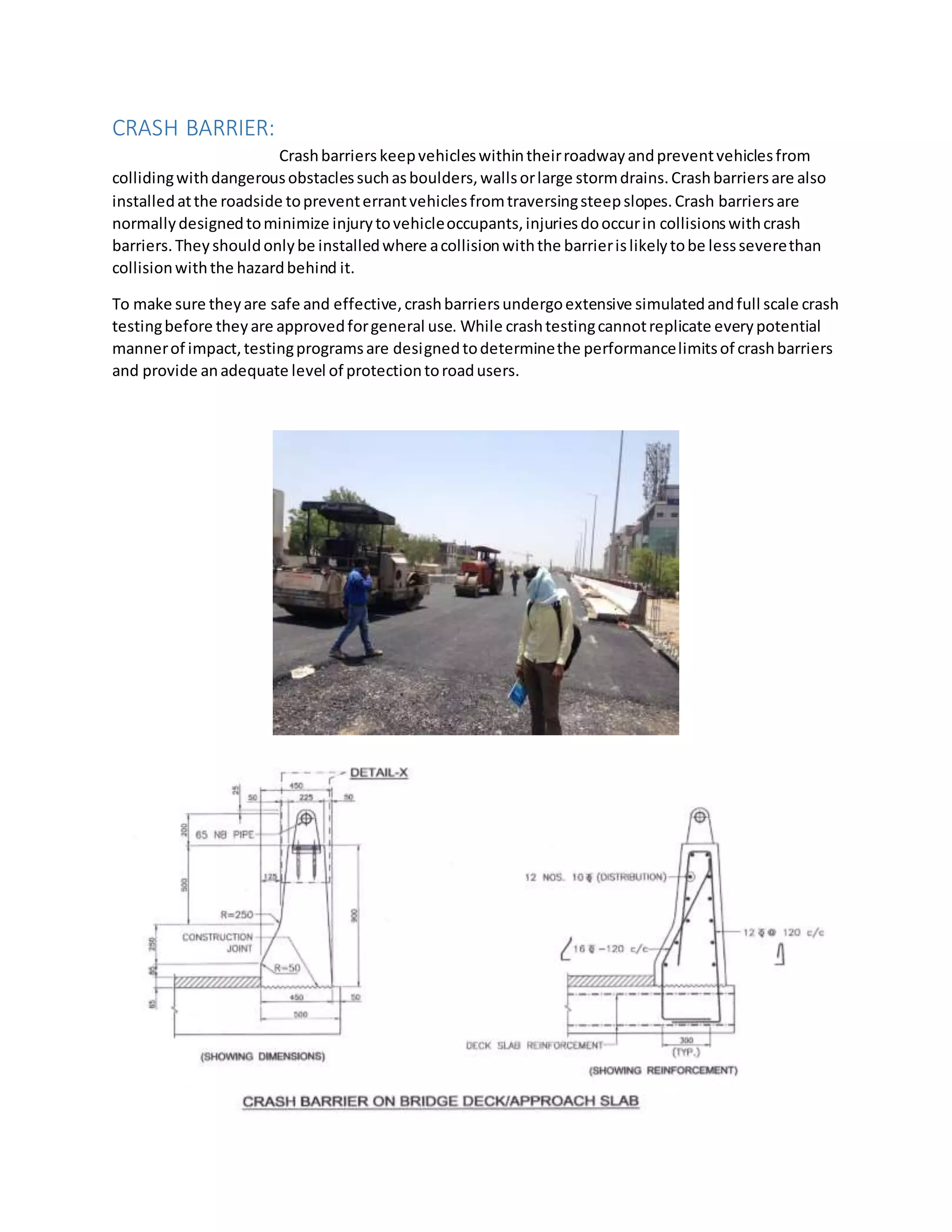
CRASH BARRIER:
Crashbarriers keepvehicleswithintheirroadwayandpreventvehiclesfrom
collidingwithdangerousobstaclessuchasboulders,wallsorlarge stormdrains.Crashbarriersare also
installedatthe roadside topreventerrantvehiclesfromtraversingsteepslopes.Crash barriersare
normallydesignedtominimize injurytovehicleoccupants,injuriesdooccurin collisionswithcrash
barriers.Theyshouldonlybe installedwhere acollisionwiththe barrierislikelytobe lessseverethan
collisionwiththe hazardbehind it.
To make sure theyare safe and effective,crashbarriersundergoextensive simulatedandfull scale crash
testingbefore theyare approvedforgeneral use. While crashtestingcannotreplicate everypotential
mannerof impact,testingprogramsare designedtodeterminethe performancelimitsof crashbarriers
and provide anadequate level of protectiontoroadusers.
CONCLUSSION
This training helpedme togain knowledge by experiencing various works taking
place int the site. By this in plant training I had a opportunity towitness various
situations inthe site andpractically and innovatively overcoming theminbrief I
learnedabout various newconstructiontechnologies andmore importantly I
experiencedthe whole constructionof laying out a span of a girder bridge. This
helpedme in clearing various theoretical andpractical doubts andmade me
somewhat realize the future scope of civil engineering

Training Report on Bridge Construction

  • 1.
    TRAINING REPORT (TRAINING DURING: MAY –JUNE 2016 ) ( GUIDED BY MR. DEVENDRA GUPTA ) RIDDHI SIDDHI HIGH LEVEL BRIDGE By JAIPUR DEVELOPMENT AUTHORITY (JDA), Ram Kishor Vyas Bhawan, Indra Circle, Jawaharlal Nehru Marg, Jaipur (302004) Rajasthan, India Submitted by : Mahavir Prasad Meena 13CE10022 Department of Civil Engineering IIT Kharagpur
  • 2.
    ACKNOWLEDGEMENT I would liketo thank JaipurDevelopmentAuthority(JDA) for giving methis invaluable opportunityto learn so much practical knowledge which would have impossible to learn through onlylooking at images from textbooks. I have gained invaluable insights into how construction of any superstructureis handled and how any difficultywhich comes in between is tackled. Apartfrom technical knowledge, I have gain insights into construction management, efficientman-power managementand lots of other thing. I am deeply indebted to our training in-chargeat site Mr. DevendraGupta whose help, stimulating suggestions and encouragementhelped me in all the time at the training site and also for writing this training report. Also I am thankfulto Mr. ManishJangid and Mr. BharatSingh for helping meunderstand the process of construction. My colleagues from the Civil Engineering Department supported me in my project work. I want to thank them for all their help, support, interestand valuable hints Especially, I would like to give my special thanks to my parents whose patient love enabled me to complete this work. And at last butnot the least I would like to thank God for the successful completion of my project.
  • 3.
    CONTENTS 1. INTRODUCTION 2. DETAILSOF BRIDGE 3. BRIDGE COMPONENTS 3.1 PILE FOUNDATION 3.1.1 PILE & PILE CAP 3.2 SUBSTRUCTURES 3.2.1 PIER &PIERCAP , PEDESTAL,BEARING,ABUTMENT 3.3 SUPERSTRUCTURES 3.3.1 GIRDER, SLAB, CRASH BARRIER
  • 4.
    INTRODUCTION Seeingthe currentincrease inthetrafficconditionsandwaterlogging problemduringthe rainyseasons at AmanishahNullah,JaipurDevelopmentAuthority(JDA) hasbaggedthe contractto PRL For Bridge overAmanishahNulluh. The bridge isconstructed536m overAmanishahNullah.The bridge whichwillconnectthe VijayPath JunctiontoShipraPath, Mansarovar,Jaipur.It isexpectedtoreduce the pressure of hightrafficcoming straightto the city. The type of bridge thatis beenconstructedover kenriverisknownasgirderbridge.A girderbridge in general isa bridge thatusesgirdersas the meansof supportingthe deck.A bridge consistsof three parts: the foundation(foundationandpiers),the superstructure (girder,slab),andthe deck. Solidslabanddeckslab withgirdersare usedinbridge.The bridge ismade of concrete andsteel. Girdersare castingat site itself.Prestressedgirdersare used. Due to hightrafficit wasdecidedthatfinishfirstone side withparallelworkonthe otherside.
  • 5.
    DETAIL OF BRIDGE 6 Lane and 2 Way Bridge.  Lengthof Bridge = 536 m.  RCC Part of Bridge=27m.  Approach/ Earthwork(filled) =266m.  Carriageway= 3.5*3 = 10.5m.  Total Widthof Bridge = 2*( Carriageway = 10.5m ) + 2*( CrushBarrier= 0.45m ) + 2*(Footpath=1m) + 2*( Median= 0.3m ) = 24.5m. FootpathProvidedinbothsides.  Typesof Slabsused: 1. 11.4m Span SolidSlab:12.25m*11.4m 2. 20m SpanDeck Slab: 12.25m*20m  Foundation:Pile Foundation 1. Four PilesGroup ( For SolidSlab) : Dimension=5.1m*5.1m. 2. Six PilesGroup( For Deck Slab) : Dimension=5.1m*8.7m.  GirderUsed : PrestressedConcreteGirderof 20m Span.  Bearing: ElastomerBearingwithDimension=250mm*400mm.  Pedestal :Dimension550mm*700mm.  Diameterof Pile =1.2m.  Diameterof Pier= 2.2m.  Propertiesof Soil : C=0, phi >= 30 Degree Gama =1.80t/(m^3)
  • 6.
     Grade ofConcrete Used  PILE & PILE CAP: M35  PIER & PIER CAP,MEDIAN WALL : M40  APPROACHSLAB M40  CRASHBARRIER, PEDESTAL M40  PSCGIRDER M45  SOLID SLAB M45
  • 8.
    FOUNDATION DESIGN PILE FOUNDATION:Diameter= 1.2m and Depth =25m. Piledfoundations : General descriptionsof pile typesThere isalarge varietyof typesof pile usedforfoundationwork.The choice depends onthe environmentalandgroundconditions,the presenceorabsence of groundwater, the functionof the pile,i.e.whethercompression,upliftorlateral loadsare tobe carried,the desired speedof constructionandconsiderationof relative cost.The abilityof the pile toresistaggressive substancesororganismsinthe ground or insurroundingwatermustalsobe considered.InBS8004, pilesare groupedintothree categories: (1) Large displacementpiles:these include all solidpiles,includingtimber andprecastconcrete andsteel or concrete tubesclosedatthe lowerendbya shoe or plug,whichmaybe eitherleftinplace or extrudedtoforman enlargedfoot. (2) Small displacementpiles:these includerolled-steelsections,open-endedtubesandhollow sections if the ground entersfreelyduringdriving. (3) Replacementpiles:these are formedbyboringorothermethodsof excavation;the boreholemaybe linedwithacasingor tube that is eitherleftinplace orextractedasthe hole isfilled. Drivenand cast-in-place piles : These are widelyusedinthe displacementpilegroup.A tube closedat itslowerendbya detachable shoe orby a plugof gravel or dry concrete isdriventothe desiredpenetration.Steelreinforcementislowereddownthe tube andthe latteristhenwithdrawn duringor afterplacingthe concrete.These typeshave the advantagesthat:(1) the lengthcanbe varied readilytosuitvariationinthe level of the bearingstratum;(2) the closedendexcludesgroundwater;(3) an enlargedbase canbe formedby hammeringoutthe concrete placedatthe toe; (4) the reinforcementisrequiredonlyforthe functionof the pile asafoundationelement,i.e.notfrom considerationsof liftinganddrivingasforthe precastconcrete pile;and(5) the noise andvibrationare not severe whenthe pilesare drivenbyadrophammeroperatingwithinthe drive tube.Drivenand cast-in-place pilesmaynotbe suitable forverysoftsoil conditionswhere the newlyplacedconcretecan be squeezedinwardsasthe drive tube iswithdrawncausing'necking'of the pile shaft,noristhe uncasedshaftsuitable forgroundwhere waterisencounteredunderartesianheadwhichwashesout the cementfromthe unsetconcrete.These problemscanbe overcome byproviding apermanent casing.Ground heave candamage adjacentpilesbefore the concrete hashardened,andheavedpiles cannot easilybe redriven.However,thisproblemcanbe overcome eitherbypreboringorbydrivinga numberof tubesina groupinadvance of placingthe concrete.The latterisdelayeduntil pile drivinghas proceededtoa distance of at least6.5 pile diametersfromthe one beingconcretedif small (upto3mm) upliftispermitted,or8 diametersawayif negligible (lessthan3mm) upliftmustbe achieved.22The lengthsof drivenandcast-in-place pilesare limitedbythe abilityof the drivingrigstoextractthe drive tube and theycannotbe installedinverylarge diameters.Theyare unsuitable forriverormarine works unlessspeciallyadaptedforextendingthemthroughwaterandcannotbe driveninsituationsof low headroom.
  • 9.
    Estimating Pile Capacity: The ultimate load-carryingof apile isgivenbyasimple equationasthe sumof the loadcarried at the pile pointplusthe total frictional resistance ( skinfriction) derivedfromthe soil- pile interface. Qu = Qp+ Qs Where Qu = ultimate pilecapacity Qp = load-carryingcapacityof the pile point Qs = frictional resistance Pile Groups: Pile groupsare usedtotransmitthe structural loadto the soil.A pile capis constructed overgroup piles.The pile groupcanbe contact withthe ground,or well above the ground. Determiningthe load-bearingcapacityof grouppiles. Whenthe pilesare placedclose toeach other,a reasonable assumptionisthatthe stresstransmittedby the pilestothe soil will overlap,reducingthe load-bearingcapacityof piles.Ideally,the pilesingroup shouldbe spacedsothat the load-bearingcapacity of the groupshouldnotbe lessthanthe sumof bearingcapacityof the individual piles. Inordinarysituationscenter-to-centerpile spacingis3 – 3.5D. In our designitistaken3D = 3 *1.2m = 3.6m The efficiencyof the load-bearingcapacityof a group pile maybe definedas Ƞ=Q g(u) /(∑Qu) Where Q g(u) = ultimate load-bearingcapacityof the grouppile Q (u) = ultimate load-bearingcapacityof eachpile withoutthe groupeffect
  • 10.
    PILE BORING, PILECAGE, LINEAR AT SITE
  • 11.
    SUBSTRUCTURES Foundationfor 11.4m Span: Group of Four PileswithPile Cap Dimension ( 5.1m*5.1m )  Layout Planof Pile :  SectionA-A:
  • 12.
     SectionB-B: FoundationFor 20mspan Slab : Groupof Six Piles withPile Cap Dimension ( 5.1m*8.7m )
  • 13.
  • 14.
    Pierand PierCap : A supportof concrete or masonryfor superstructure of bridge.  The base of piermay restdirectlyoverfirmroundor itmay be supportedonpiles.  Centre line of piernormallycoincide withthe centerline of the superstructure.The dimensionof the topof pierdependsondistance betweengirder(longitudinal girder) and distance requiredtoprovide forthe expansionof girder,sizeof bearingetc.
  • 16.
    Pedestal : Pedestal ismadeof RCC Andconnectingto piercap.The grade of concrete usedfor pedestal isM40. The size of pedestal is550mm*700mm as givenbelow.
  • 17.
    Bearing : (UsedElastomer Bearing inour case ) Bearingis a componentof a bridge whichtypicallyprovidesarestingsurface between bridge piersandthe bridge deck.The purpose of a bearingisto allow controlledmovementand therebyreduce the stressesinvolved.Movementcouldbe thermal expansionorcontraction,or movementfromothersourcessuchasseismicactivity.There are several type of bridge bearings whichare useddependingonanumberof differentfactorsincludingthe bridge span.The oldest formof bridge bearingissimplytwoplatesrestingon topof each other.A common formof modern bridge bearingisthe elastomericbridge bearing.Anothertype of bridge bearingisthe mechanical bridge bearing. f
  • 18.
    ABUTMENTS An abutmentisa structurethat supportone endof a bridge inotherword we can say that itis structure locatedat the end& at the beginningof abridge. Functionsof abutment a) Supportthe bridge deckat end. b) Retainthe embankmentof approachingroad. c) Connectedthe approachroadto the bridge deck.
  • 19.
    SUPERSTRUCTURE GIRDERS: 20M SPANGIRDERS MAINGIRDER: These are the strongbeamsthat carry loadfrom superstructure tothe substructure. A girderisa supportbeamusedin construction.Itisthe mainhorizontal supportof a structure.Girders oftenhave an I-beamcross sectioncomposedof twoload-bearingflangesseparatedbyastabilizing web.Inour case girderswere Prestressedgirders.Girderswerecastedatsite.
  • 21.
    END CROSS GIRDER: Theprimaryfunctionof crossgirdersisto supportthe deckslab.The girdersmay howeverneedtoperformsecondaryfunctionof preventingthe slabfrombucklingincompression. Typicallythese are the transverse beams( alsoverystrong/stiff ) whichare providedfortransverse stiffness.Thistransverse diaphragmwillmake sure thatif youhave multiple maingirders,theyshare loadsbetweenthemanddon’tbehave independently.
  • 22.
    DECK SLAB  Theprincipal functionof abridge deckslabis to provide supporttolocal vertical loads(from highwaytraffic,railwayorpedestrians) andtransmitthese loadstothe primarysuperstructure of the bridge.  As a resultof itsfunction,the deckwill be continuousalongthe bridge spanand( apart from some railwaybridges) continuousacrossthe span.Asa resultof thisof thiscontinuity,itwill act as a plate ( isotropicororthotropicdependingonconstruction) tosupportlocal patch loads.
  • 23.
    CRASH BARRIER: Crashbarriers keepvehicleswithintheirroadwayandpreventvehiclesfrom collidingwithdangerousobstaclessuchasboulders,wallsorlargestormdrains.Crashbarriersare also installedatthe roadside topreventerrantvehiclesfromtraversingsteepslopes.Crash barriersare normallydesignedtominimize injurytovehicleoccupants,injuriesdooccurin collisionswithcrash barriers.Theyshouldonlybe installedwhere acollisionwiththe barrierislikelytobe lessseverethan collisionwiththe hazardbehind it. To make sure theyare safe and effective,crashbarriersundergoextensive simulatedandfull scale crash testingbefore theyare approvedforgeneral use. While crashtestingcannotreplicate everypotential mannerof impact,testingprogramsare designedtodeterminethe performancelimitsof crashbarriers and provide anadequate level of protectiontoroadusers.
  • 24.
    CONCLUSSION This training helpedmetogain knowledge by experiencing various works taking place int the site. By this in plant training I had a opportunity towitness various situations inthe site andpractically and innovatively overcoming theminbrief I learnedabout various newconstructiontechnologies andmore importantly I experiencedthe whole constructionof laying out a span of a girder bridge. This helpedme in clearing various theoretical andpractical doubts andmade me somewhat realize the future scope of civil engineering