PURPOSEFUL INSTRUCTIONAL
COACHING
October 11, 2012
Dr. Beth Metcalf

Instructional Coach
http://purposefulcoaching.wikispaces.com
/
Fundamental Beliefs
Teachers/educators are capable adults who, with the
right mix of understanding and engagement, are well
equipped to improve the quality and outcomes of their
instruction.
Mastery in any profession, including teaching, is a
lifelong journey.
Fundamental Approach
You cannot teach a person anything. You can only help
him find it within himself.
GALILEO
Fundamental are Based on
Adult Learning









Adults are autonomous and self-directed.
Adult learning builds on a wide variety of previous
experiences, knowledge, mental models, selfdirection, interests, resources, and competencies.
Adult learning needs to be facilitated rather than
directed. Adults want to be treated as equals and
shown respect both for what they know and how
they prefer to learn.
Adults need specific behavioral feedback that is
free of evaluative or judgmental opinions.
Adults need follow-up support to continue and
advance their learning over time.
Coaching is Important
Leadership
Leadership is communicating to people their
worth and potential so clearly that they come to
see it in themselves.
Stephen Covey
Reflection on Self-Assessment


Are there trends?



What questions do you need to have
answered today?
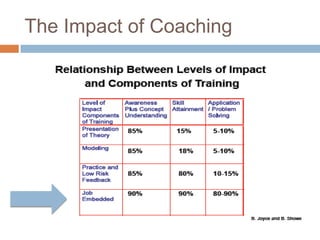
The Impact of Coaching
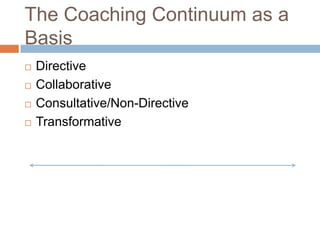
The Coaching Continuum as a
Basis





Directive
Collaborative
Consultative/Non-Directive
Transformative
Coaching Continuum
At the heart of the coaching continuum is the
concept that each of us has resources that
enable us to grow and change from within.
Costa and Garmston
The Continuum Supports
Purpose
Linking Goals to Outcomes
Matching Outcomes to Coaching
Alignment Between Goals, Outcomes, and
Coaching Creates Purpose……IMPACT!
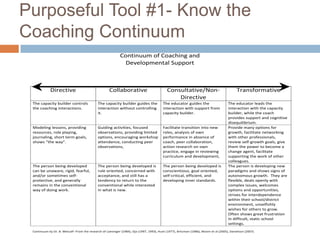
Purposeful Tool #1- Know the
Coaching Continuum
Continuum of Coaching and
Developmental Support

Directive

Collaborative

Consultative/NonDirective

The capacity builder controls
the coaching interactions.

The capacity builder guides the
interaction without controlling
it.

The educator guides the
interaction with support from
capacity builder.

Modeling lessons, providing
resources, role playing,
journaling, short term goals,
shows “the way”.

Guiding activities, focused
observations, providing limited
options, encouraging workshop
attendance, conducting peer
observations,

Facilitate transition into new
roles, analysis of own
performance in absence of
coach, peer collaboration,
action research on own
practice, engage in reviewing
curriculum and development,

The person being developed
can be unaware, rigid, fearful,
and/or sometimes selfprotective, and generally
remains in the conventional
way of doing work.

The person being developed is
rule oriented, concerned with
acceptance, and still has a
tendency to return to the
conventional while interested
in what is new.

The person being developed is
conscientious, goal oriented,
self-critical, efficient, and
developing inner standards.

Transformative
The educator leads the
interaction with the capacity
builder, while the coach
provides support and cognitive
disequilibrium.
Provide many options for
growth, facilitate networking
with other professionals,
review self-growth goals, give
them the power to become a
change agent, facilitate
supporting the work of other
colleagues.
The person is developing new
paradigms and shows signs of
autonomous growth. They are
flexible, deals openly with
complex issues, welcomes
options and opportunities,
strives for interdependence
within their school/district
environment, unselfishly
wishes for others to grow.
Often shows great frustration
in difficult, static school
settings.

Continuum by Dr. B. Metcalf--From the research of Loevinger (1984), Oja (1997, 1993), Hunt (1977), Britzman (1986), Bloom et al (2005), Danielson (2007)
Purposeful Tool #2-Listening
Positive Listening-are you listening for the
good?
It takes longer for the human brain to process
a negative statement than a positive
statement.
What are the expectations of an adult when
you are asked to listen? Table talk.
A Purposeful Tool-Know Your
Listening
Autobiographical listening -85% of all listening
thoughts of themselves, their concerns, their stories. A constant
relationship with self. Well…let me tell you about this kids I
had….In my
classroom I…..

Inquisitive listening
asking questions of the listener that ARE NOT relevant
asking for lots of details does not necessarily coach forwards
without outcomes and goals this is common

Solution listening
waiting to tell someone what you think they should do
coaching is about support of another’s growth, not giving answers
help them create their own answers
Checking for Listening SetAsides…
Do I?

•I mentally check my coat of "SELF" when
entering the door of a coaching
conversation.
•When coaching, I am aware of when one of
"my stories" begins to enter my thinking, and
I block it.
•While listening (active), I garner
information—not for mere curiosity, but to
understand—so that I may pose a question
Checking for Listening SetAsides
•

I free myself of "should" thinking when
coaching so that I do not slip into offering
solutions.

•

When I catch myself rehearsing a response, I
stop myself and stay focused on verbals and
non-verbals of the other person and focus on a
“continuum question”.

•

I am aware of some of my filters and set them
aside so as to remain open to hearing the
person I am coaching.
Try Listening …..



While listening (active), I garner information—not for
mere curiosity, but to understand.
If I am really listening…




I am collecting information
I am thinking of their place and purpose
I am focused on the speakers goals and
progress!
Purposeful Tool #3Conversation






If you can’t listen-STOP HERE!
Don’t confuse your ability to ask questions with
good coaching conversation skills.

The conversation is your entry point. The
stories that teachers share reframe and claim
where they want to go.
Purposeful Tool-Conversation


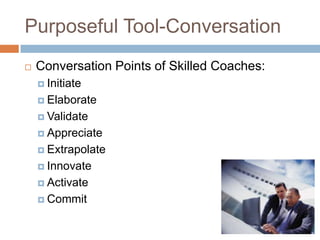
Conversation Points of Skilled Coaches:
 Initiate
 Elaborate
 Validate
 Appreciate
 Extrapolate
 Innovate
 Activate
 Commit
Mediational Language-STOP
Mediational Questions
•What went on in your mind when ...?
•What would be your criteria for this to be ...?
•How is ... different (like) ...?
•When is another time you need to ...?
•What do you think the problem is ...?
•What's another way you might approach this?
•What do you think would happen if ...?
Approachable Voice , Plural Language , Tentative Language,
Positive Presuppositions
Facilitative Language-GO
• Setting a goal for the conversation and
agreeing on it.
• Naming something that isn’t working and
getting it out in the open so the group can deal
with it.
• Record ideas or issues that are deferred and
agree on when they will be addressed before
the conversation ends.
• Reminding the group of a previous agreement
or ground rule when the discussion starts going
off focus.
Tying a Purposeful Conversation
To Stop and Go Language
 Initiate
 Elaborate
 Validate
 Appreciate
 Extrapolate
 Innovate
 Activate
 Commit
Purposeful Tool #4-Honor the Role
of Feelings in the Coaching Tasks


Paying attention to feelings.



Disregarding this is disregarding human
nature.



If you don’t know the current state of mind of
your coach you likely will not navigate the
coaching conversation successfully.
One Way To Honor the Role of
Feelings…


Looking for the cues



Acknowledging them



Including them in the conversation if needed



Keeping them from being the center of the
task!
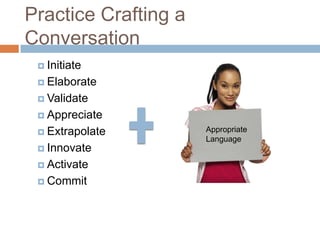
Practice Crafting a
Conversation
 Initiate
 Elaborate
 Validate
 Appreciate
 Extrapolate
 Innovate
 Activate
 Commit

Appropriate
Language
Purposeful Tool #5Know the Seven Archetypal Stories of All
Changing Organizations









The Rule Breaker
Is the Boss Human
The Little Man
The Fear Story
Will Anyone Help
Is It Okay to Make Mistakes
Obstacles
To avoid the typical stories….
Don’t ask typical questions!


How did it go? NO



How did you grow?
What did you change?
What engaged you?
Tell me about what has been working well since I last
saw you?
Tell me any valuable lessons you can reflect on from
today?
Explain to me your very best moment from the
lessons this week?
When did your students feel most connected to the
lesson?










Avoid the Typical Story


Can you come up with some other great
question starters?



Can you relate those back to the continuum?
Are you eliciting the kind of outcomes you
want with your questions?
Purposeful Tool #6Don’t Confuse the Task


Supervise, Evaluate, or Coach?



You can’t do it at the same time.



Only you can determine your charge.



Draw clear lines.
Managing vs. Developing
Telling/managing undermines autonomy and provokes
enemy images, both internal and external. Such
interference makes it harder rather than easier for
teachers to find motivation and movement (Pink, 2009).
It may be commonplace for supervisors, consultants,
and trainers to diagnose problems, give instructions,
and provide incentives for performance improvement,
but these approaches contradict what we know about
adult learning. “Change or die” is not an effective threat
(Deutschman, 2007).
Managing Vs. Developing

At best “facts, fear, and force” generate temporary
compliance; at worst they generate resistance and
outright rebellion.
Managing vs. Coaching

Neither is the enemy of the other.
Supervisors are NOT coaches.
Supervision is NOT a coaching relationship. Don’t
define it that way. You are preparing for failure.
Be Transparent and Trustworthy


Trust to make mistakes and longstanding learning cannot occur when
being evaluated.



Evaluation is an event, change is a
process.
Purposeful Tool #7
Filters of Perception



Someone’s perception can
support them in making a
premature cognitive commitment.
Sample Filters of Perception for
Educators


Educational Belief Systems
 Educators

hold deep beliefs about their work;
including roles of students, schools, community,
and leadership.
 Education belief systems are powerful predictors
of behavior.
 Language

Cues: You know how these kids are, this is
the best they can do.
Sample Filters of Perception for
Educators


Field Dependency
 Independent

is task-oriented and competitive

 Language

Cue: Do I have to do this on a committee?
Just tell me what to do. Why are we talking so much?

 Dependent

enjoys others-seeks out collaborative
relationships.
 Language

Cue: I like to write all my lesson plans with
my team. We do everything together!
Perception is Reality




Someone’s perception can support
them in making a premature cognitive
commitment.
Some perceptions you run into
are…..table talk.
Filters Affect Cognitive Shifts
Knowing and recognizing the
human variables. Value human diversity
and talk about them, figure out where
you conscientiously use these variables
to create trust and then growth.
Managing Their Filters with Your
Filters
Are you feeding their need? Do you match too
closely what they might need or want to hear?
Create Cognitive Disequilibrium
Cognitive Disequilibrium and using the Coaching
Continuum….how can they work hand in hand?
Purposeful Tool #8 Formalize
Coaching
Agreements and Logs
Formal agreements for coaching elevate
expectations
Opens communication about the continuum
Creates clarity of goals and outcomes/alignment
Makes best use of precious time
Helps manage large coaching loads
Real change takes time and commitment
Sample Components of
Agreements
• Confidentiality Statement
• Specific Coaching Goals
• Agreed Upon Times to Meet or Collaborate
• How Communication will Occur
• Times for Revisiting the Goal
Purposeful Tool #9
Evaluate Your Own Coaching
Coaching Professional Code of Ethics
(William and Anderson, 2006)
International Coach Federation Code of
Ethics (certifiedcoach.org)
IAC Coaching Masteries
Actions and characteristics are universal of masterful coaches and that are
measureable and observable.
International Association of Coaching, 2009
The IAC Masteries
• Establishing and Maintaining a Trusting Relationship
• Perceiving, Affirming, and Expanding the Clients
Potential
• Engaging in Supportive Listening
• Processing in the Present
• Expressing and Communicating Effectively
• Clarifying to Create Understanding and Confidence
• Setting and Keeping Clear Intentions
• Inviting Possibility
• Helping the client identify and create supportive
systems and structures
Tying all The Tools Together
•Transformative
Coaching and the
Continuum
The Continuum Supports
Purpose
Goals to Outcomes
Matching Outcomes to Coaching
Alignment Between Goals, Outcomes, and
Coaching Creates Purpose……IMPACT!
Transformative Coaching
Suppose you came upon someone in the woods
working to saw down a tree. They are exhausted from
working for hours. You suggest they take a break to
sharpen the saw. They might reply, " I didn't have time
to sharpen the saw, I'm busy sawing!"
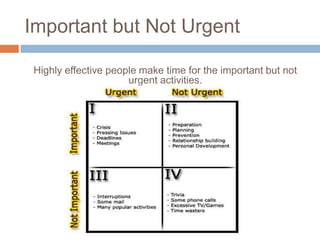
Working on the important, but not urgent is at the
center of having long-term influence on people
(transformative change).
Adapted from
Stephen Covey (1932 -)
Source: The 7 Habits of Highly Effective People
Important but Not Urgent
Highly effective people make time for the important but not
urgent activities.
Transformative Coaching
Moves beyond improved
“performance”….
(Strategies, trying new things, being directed)

To changing the way of
“being”.
(leading or integrating into a new identity in the
culture)
Indicators of Transformative
Change












Using Influence in one’s role with ethics and integrity
in the service of all students and their families
The proposition that all students can learn is part of
who they are
Continuous self improvement
The proposition that diversity enriches the school
Collaboration and communication with families,
communities…..in decision making.
Trusting people and their judgments and involving
them in leadership and management processes
Actively participates in the political and policy making
context in education.
Self-Checking Evaluation



Stickman Activity
Making Learning Visible

Characteristics of a Purposeful Instructional Coach
What doe s this person know?
How doe s this person see the people
they support/coach ?

What does this person say?
What is their tone of voice?
What are strengths of this
person?
How doe s the character feel
about him/herself?

What does this person do th at
makes a diffe rence? How can th ey
measure their impact?

What is a potential
Achillies Heel? What
is that may keep this
person from being
successfu l?

What are some things this puposeful caoch should not do?
NC Region II WRESA PD
Purposeful Coaching
B. Metcalf [Type text]

[Type text]

[Type text]
Coaching Expert Groups


Using the Tools



Practicing The Tools



Expert Team Sharing
Coaching Coaching Scenario





Team reviews scenario (15 mins)
Team discusses the coaching needed within
the context of the scenario (15 mins)
Team prepares for the coaching by using the
tools sheet as a guide (30 mins).
Final Self Assessment
Complete Stickman (if you didn’t)
Review self-assessment questions
from beginning of the day. Any
movement?
Characteristics of a Purposeful Instructional Coach

What doe s this person know?

How doe s this person see the people
they support/coach ?

What does this person say?
What is their tone of voice?

What are strengths of this
person?
How doe s the character feel
about him/herself?

What does this person do th at
makes a diffe rence? How can th ey
measure their impact?

What is a potential
Achillies Heel? What
is that may keep this
person from being
successfu l?

What are some things this puposeful caoch should not do?
NC Region II WRESA PD
Purposeful Coaching
B. Metcalf [Type text]

[Type text]

[Type text]
Questions
Beth Metcalf
Elizabeth.metcalf@dpi.nc.gov
910-619-3120
References
Browne-Ferrigno, T., & Muth, R. (2004). Leadership mentoring in clinical practice: Role socialization,
professional development, and capacity building. Educational Administration Quarterly, 40(4), 468-494.

Daresh, J. (2004). Mentoring school leaders: professional promise or predictable problems? Educational
Administration Quarterly, 40(4), 495-517.
Glickman, C. (1985). Supervision of instruction: a developmental approach. Boston, MA: Allyn and Bacon.
Hopkins-Thompson, P. (2000). Colleagues helping colleagues: Mentoring and coaching. NASSP Bulletin,
84(6), 29-36.

Joyce, B. & Showers, B. (2002). Student achievement through staff development. Alexandria, VA: Association
for Supervision and Curriculum Development.
Reiman, A., & Thies-Sprinthall, L. (1998). Mentoring and supervision for teacher development. New York:
Addison-Wesley Longman
Thorndyke, L. E., Gusic, M. E., & Milner, R. J. (2008). Functional mentoring: A practical approach with
multilevel outcomes. Jounral of Continuing Education in the Health
Professions, 28(3), 157-164.
Vygotsky, L. (1978). Interaction between learning and development: Mind and society (pp. 79- 91). Cambridge,
MA: Harvard University Press.
Moran (b.), (2010). Evocative Coaching. Josey-Bass. San Fransicso, Ca.

Purposeful Coaching - Curriculum Facilitators/Lead Teachers

  • 1.
    PURPOSEFUL INSTRUCTIONAL COACHING October 11,2012 Dr. Beth Metcalf Instructional Coach
  • 2.
  • 3.
    Fundamental Beliefs Teachers/educators arecapable adults who, with the right mix of understanding and engagement, are well equipped to improve the quality and outcomes of their instruction. Mastery in any profession, including teaching, is a lifelong journey.
  • 4.
    Fundamental Approach You cannotteach a person anything. You can only help him find it within himself. GALILEO
  • 5.
    Fundamental are Basedon Adult Learning      Adults are autonomous and self-directed. Adult learning builds on a wide variety of previous experiences, knowledge, mental models, selfdirection, interests, resources, and competencies. Adult learning needs to be facilitated rather than directed. Adults want to be treated as equals and shown respect both for what they know and how they prefer to learn. Adults need specific behavioral feedback that is free of evaluative or judgmental opinions. Adults need follow-up support to continue and advance their learning over time.
  • 6.
    Coaching is Important Leadership Leadershipis communicating to people their worth and potential so clearly that they come to see it in themselves. Stephen Covey
  • 7.
    Reflection on Self-Assessment  Arethere trends?  What questions do you need to have answered today?
  • 8.
    The Impact ofCoaching
  • 9.
    The Coaching Continuumas a Basis     Directive Collaborative Consultative/Non-Directive Transformative
  • 10.
    Coaching Continuum At theheart of the coaching continuum is the concept that each of us has resources that enable us to grow and change from within. Costa and Garmston
  • 11.
    The Continuum Supports Purpose LinkingGoals to Outcomes Matching Outcomes to Coaching Alignment Between Goals, Outcomes, and Coaching Creates Purpose……IMPACT!
  • 12.
    Purposeful Tool #1-Know the Coaching Continuum Continuum of Coaching and Developmental Support Directive Collaborative Consultative/NonDirective The capacity builder controls the coaching interactions. The capacity builder guides the interaction without controlling it. The educator guides the interaction with support from capacity builder. Modeling lessons, providing resources, role playing, journaling, short term goals, shows “the way”. Guiding activities, focused observations, providing limited options, encouraging workshop attendance, conducting peer observations, Facilitate transition into new roles, analysis of own performance in absence of coach, peer collaboration, action research on own practice, engage in reviewing curriculum and development, The person being developed can be unaware, rigid, fearful, and/or sometimes selfprotective, and generally remains in the conventional way of doing work. The person being developed is rule oriented, concerned with acceptance, and still has a tendency to return to the conventional while interested in what is new. The person being developed is conscientious, goal oriented, self-critical, efficient, and developing inner standards. Transformative The educator leads the interaction with the capacity builder, while the coach provides support and cognitive disequilibrium. Provide many options for growth, facilitate networking with other professionals, review self-growth goals, give them the power to become a change agent, facilitate supporting the work of other colleagues. The person is developing new paradigms and shows signs of autonomous growth. They are flexible, deals openly with complex issues, welcomes options and opportunities, strives for interdependence within their school/district environment, unselfishly wishes for others to grow. Often shows great frustration in difficult, static school settings. Continuum by Dr. B. Metcalf--From the research of Loevinger (1984), Oja (1997, 1993), Hunt (1977), Britzman (1986), Bloom et al (2005), Danielson (2007)
  • 13.
    Purposeful Tool #2-Listening PositiveListening-are you listening for the good? It takes longer for the human brain to process a negative statement than a positive statement. What are the expectations of an adult when you are asked to listen? Table talk.
  • 14.
    A Purposeful Tool-KnowYour Listening Autobiographical listening -85% of all listening thoughts of themselves, their concerns, their stories. A constant relationship with self. Well…let me tell you about this kids I had….In my classroom I….. Inquisitive listening asking questions of the listener that ARE NOT relevant asking for lots of details does not necessarily coach forwards without outcomes and goals this is common Solution listening waiting to tell someone what you think they should do coaching is about support of another’s growth, not giving answers help them create their own answers
  • 15.
    Checking for ListeningSetAsides… Do I? •I mentally check my coat of "SELF" when entering the door of a coaching conversation. •When coaching, I am aware of when one of "my stories" begins to enter my thinking, and I block it. •While listening (active), I garner information—not for mere curiosity, but to understand—so that I may pose a question
  • 16.
    Checking for ListeningSetAsides • I free myself of "should" thinking when coaching so that I do not slip into offering solutions. • When I catch myself rehearsing a response, I stop myself and stay focused on verbals and non-verbals of the other person and focus on a “continuum question”. • I am aware of some of my filters and set them aside so as to remain open to hearing the person I am coaching.
  • 17.
    Try Listening …..  Whilelistening (active), I garner information—not for mere curiosity, but to understand.
  • 18.
    If I amreally listening…    I am collecting information I am thinking of their place and purpose I am focused on the speakers goals and progress!
  • 19.
    Purposeful Tool #3Conversation    Ifyou can’t listen-STOP HERE! Don’t confuse your ability to ask questions with good coaching conversation skills. The conversation is your entry point. The stories that teachers share reframe and claim where they want to go.
  • 20.
    Purposeful Tool-Conversation  Conversation Pointsof Skilled Coaches:  Initiate  Elaborate  Validate  Appreciate  Extrapolate  Innovate  Activate  Commit
  • 21.
    Mediational Language-STOP Mediational Questions •Whatwent on in your mind when ...? •What would be your criteria for this to be ...? •How is ... different (like) ...? •When is another time you need to ...? •What do you think the problem is ...? •What's another way you might approach this? •What do you think would happen if ...? Approachable Voice , Plural Language , Tentative Language, Positive Presuppositions
  • 22.
    Facilitative Language-GO • Settinga goal for the conversation and agreeing on it. • Naming something that isn’t working and getting it out in the open so the group can deal with it. • Record ideas or issues that are deferred and agree on when they will be addressed before the conversation ends. • Reminding the group of a previous agreement or ground rule when the discussion starts going off focus.
  • 23.
    Tying a PurposefulConversation To Stop and Go Language  Initiate  Elaborate  Validate  Appreciate  Extrapolate  Innovate  Activate  Commit
  • 24.
    Purposeful Tool #4-Honorthe Role of Feelings in the Coaching Tasks  Paying attention to feelings.  Disregarding this is disregarding human nature.  If you don’t know the current state of mind of your coach you likely will not navigate the coaching conversation successfully.
  • 25.
    One Way ToHonor the Role of Feelings…  Looking for the cues  Acknowledging them  Including them in the conversation if needed  Keeping them from being the center of the task!
  • 26.
    Practice Crafting a Conversation Initiate  Elaborate  Validate  Appreciate  Extrapolate  Innovate  Activate  Commit Appropriate Language
  • 27.
    Purposeful Tool #5Knowthe Seven Archetypal Stories of All Changing Organizations        The Rule Breaker Is the Boss Human The Little Man The Fear Story Will Anyone Help Is It Okay to Make Mistakes Obstacles
  • 28.
    To avoid thetypical stories…. Don’t ask typical questions!  How did it go? NO  How did you grow? What did you change? What engaged you? Tell me about what has been working well since I last saw you? Tell me any valuable lessons you can reflect on from today? Explain to me your very best moment from the lessons this week? When did your students feel most connected to the lesson?      
  • 29.
    Avoid the TypicalStory  Can you come up with some other great question starters?  Can you relate those back to the continuum? Are you eliciting the kind of outcomes you want with your questions?
  • 30.
    Purposeful Tool #6Don’tConfuse the Task  Supervise, Evaluate, or Coach?  You can’t do it at the same time.  Only you can determine your charge.  Draw clear lines.
  • 31.
    Managing vs. Developing Telling/managingundermines autonomy and provokes enemy images, both internal and external. Such interference makes it harder rather than easier for teachers to find motivation and movement (Pink, 2009). It may be commonplace for supervisors, consultants, and trainers to diagnose problems, give instructions, and provide incentives for performance improvement, but these approaches contradict what we know about adult learning. “Change or die” is not an effective threat (Deutschman, 2007).
  • 32.
    Managing Vs. Developing Atbest “facts, fear, and force” generate temporary compliance; at worst they generate resistance and outright rebellion.
  • 33.
    Managing vs. Coaching Neitheris the enemy of the other. Supervisors are NOT coaches. Supervision is NOT a coaching relationship. Don’t define it that way. You are preparing for failure.
  • 34.
    Be Transparent andTrustworthy  Trust to make mistakes and longstanding learning cannot occur when being evaluated.  Evaluation is an event, change is a process.
  • 35.
    Purposeful Tool #7 Filtersof Perception  Someone’s perception can support them in making a premature cognitive commitment.
  • 36.
    Sample Filters ofPerception for Educators  Educational Belief Systems  Educators hold deep beliefs about their work; including roles of students, schools, community, and leadership.  Education belief systems are powerful predictors of behavior.  Language Cues: You know how these kids are, this is the best they can do.
  • 37.
    Sample Filters ofPerception for Educators  Field Dependency  Independent is task-oriented and competitive  Language Cue: Do I have to do this on a committee? Just tell me what to do. Why are we talking so much?  Dependent enjoys others-seeks out collaborative relationships.  Language Cue: I like to write all my lesson plans with my team. We do everything together!
  • 38.
    Perception is Reality   Someone’sperception can support them in making a premature cognitive commitment. Some perceptions you run into are…..table talk.
  • 39.
    Filters Affect CognitiveShifts Knowing and recognizing the human variables. Value human diversity and talk about them, figure out where you conscientiously use these variables to create trust and then growth.
  • 40.
    Managing Their Filterswith Your Filters Are you feeding their need? Do you match too closely what they might need or want to hear? Create Cognitive Disequilibrium Cognitive Disequilibrium and using the Coaching Continuum….how can they work hand in hand?
  • 41.
    Purposeful Tool #8Formalize Coaching Agreements and Logs Formal agreements for coaching elevate expectations Opens communication about the continuum Creates clarity of goals and outcomes/alignment Makes best use of precious time Helps manage large coaching loads Real change takes time and commitment
  • 42.
    Sample Components of Agreements •Confidentiality Statement • Specific Coaching Goals • Agreed Upon Times to Meet or Collaborate • How Communication will Occur • Times for Revisiting the Goal
  • 43.
    Purposeful Tool #9 EvaluateYour Own Coaching Coaching Professional Code of Ethics (William and Anderson, 2006) International Coach Federation Code of Ethics (certifiedcoach.org) IAC Coaching Masteries Actions and characteristics are universal of masterful coaches and that are measureable and observable. International Association of Coaching, 2009
  • 44.
    The IAC Masteries •Establishing and Maintaining a Trusting Relationship • Perceiving, Affirming, and Expanding the Clients Potential • Engaging in Supportive Listening • Processing in the Present • Expressing and Communicating Effectively • Clarifying to Create Understanding and Confidence • Setting and Keeping Clear Intentions • Inviting Possibility • Helping the client identify and create supportive systems and structures
  • 45.
    Tying all TheTools Together •Transformative Coaching and the Continuum
  • 46.
    The Continuum Supports Purpose Goalsto Outcomes Matching Outcomes to Coaching Alignment Between Goals, Outcomes, and Coaching Creates Purpose……IMPACT!
  • 47.
    Transformative Coaching Suppose youcame upon someone in the woods working to saw down a tree. They are exhausted from working for hours. You suggest they take a break to sharpen the saw. They might reply, " I didn't have time to sharpen the saw, I'm busy sawing!" Working on the important, but not urgent is at the center of having long-term influence on people (transformative change). Adapted from Stephen Covey (1932 -) Source: The 7 Habits of Highly Effective People
  • 48.
    Important but NotUrgent Highly effective people make time for the important but not urgent activities.
  • 49.
    Transformative Coaching Moves beyondimproved “performance”…. (Strategies, trying new things, being directed) To changing the way of “being”. (leading or integrating into a new identity in the culture)
  • 50.
    Indicators of Transformative Change        UsingInfluence in one’s role with ethics and integrity in the service of all students and their families The proposition that all students can learn is part of who they are Continuous self improvement The proposition that diversity enriches the school Collaboration and communication with families, communities…..in decision making. Trusting people and their judgments and involving them in leadership and management processes Actively participates in the political and policy making context in education.
  • 51.
    Self-Checking Evaluation   Stickman Activity MakingLearning Visible Characteristics of a Purposeful Instructional Coach What doe s this person know? How doe s this person see the people they support/coach ? What does this person say? What is their tone of voice? What are strengths of this person? How doe s the character feel about him/herself? What does this person do th at makes a diffe rence? How can th ey measure their impact? What is a potential Achillies Heel? What is that may keep this person from being successfu l? What are some things this puposeful caoch should not do? NC Region II WRESA PD Purposeful Coaching B. Metcalf [Type text] [Type text] [Type text]
  • 52.
    Coaching Expert Groups  Usingthe Tools  Practicing The Tools  Expert Team Sharing
  • 53.
    Coaching Coaching Scenario    Teamreviews scenario (15 mins) Team discusses the coaching needed within the context of the scenario (15 mins) Team prepares for the coaching by using the tools sheet as a guide (30 mins).
  • 54.
    Final Self Assessment CompleteStickman (if you didn’t) Review self-assessment questions from beginning of the day. Any movement? Characteristics of a Purposeful Instructional Coach What doe s this person know? How doe s this person see the people they support/coach ? What does this person say? What is their tone of voice? What are strengths of this person? How doe s the character feel about him/herself? What does this person do th at makes a diffe rence? How can th ey measure their impact? What is a potential Achillies Heel? What is that may keep this person from being successfu l? What are some things this puposeful caoch should not do? NC Region II WRESA PD Purposeful Coaching B. Metcalf [Type text] [Type text] [Type text]
  • 55.
  • 56.
    References Browne-Ferrigno, T., &Muth, R. (2004). Leadership mentoring in clinical practice: Role socialization, professional development, and capacity building. Educational Administration Quarterly, 40(4), 468-494. Daresh, J. (2004). Mentoring school leaders: professional promise or predictable problems? Educational Administration Quarterly, 40(4), 495-517. Glickman, C. (1985). Supervision of instruction: a developmental approach. Boston, MA: Allyn and Bacon. Hopkins-Thompson, P. (2000). Colleagues helping colleagues: Mentoring and coaching. NASSP Bulletin, 84(6), 29-36. Joyce, B. & Showers, B. (2002). Student achievement through staff development. Alexandria, VA: Association for Supervision and Curriculum Development. Reiman, A., & Thies-Sprinthall, L. (1998). Mentoring and supervision for teacher development. New York: Addison-Wesley Longman Thorndyke, L. E., Gusic, M. E., & Milner, R. J. (2008). Functional mentoring: A practical approach with multilevel outcomes. Jounral of Continuing Education in the Health Professions, 28(3), 157-164. Vygotsky, L. (1978). Interaction between learning and development: Mind and society (pp. 79- 91). Cambridge, MA: Harvard University Press. Moran (b.), (2010). Evocative Coaching. Josey-Bass. San Fransicso, Ca.

Editor's Notes

  • #2 Table IntroductionsWhat has been your best learning experience as an adult? What made it so good?
  • #3 Notecard—what do you believe about the people you coach.
  • #5 The Inner Game of Tennis, first published in 1974, by Timothy Gallwey……was a call to limit the use of instructions and incentives in coaching because of their oftentimes debilitating impact on the internal dynamics that make for optimum skill development and performance improvement. Basically you would psych yourself out by “trying to hard”, but when you just practiced and had a mastery of skill you were easy and skillful and felt greater success.
  • #6 Do any of these speak to you as a coach?
  • #8 Use notecards or sticky notes to collect your thoughts. Is there any question you would like to discuss?
  • #13 Fundamental Approach-You cannot teach a person anything. You can only help him find it within himself. Mastery is a life long journey?What do you see?Why do you suppose the Continuum is Tool #1?Self-reflection. Make a list of the last 5-10 coaching activities you were involved in. Where do you spend the majority of your coaching energy?
  • #14 It is easy for coaches to fall into common patterns of communication. Real listening and awareness results in more dynamic interactions. Listening is the first and likley most important service you can provide to your teacher learner. People have the misconception that coaching is about what you say….it’s really about what you do with what you hear and learning.
  • #18 Read the story of Charles (p.222Evoc Coach). You are the department chair’s coach. What did you hear? What information did you garner that helps you understand him?
  • #20 Well structured conversations contain many, many clues for root causes of issues and what tools are needed to solve them.
  • #21 I am not suggesting you script your conversation. What I am suggesting is that there are ways to talk to people that elicit real information. We need coaching informaiton and these conversation points can get us there.
  • #24 Handout-Have the group use the handout to determine which part of the conversation is a stop or which part is a go.
  • #27 P. 223 Ron
  • #28 Why am I telling you this? It’s the stories people tell, but they aren’t thoughtful, they are rehearsed. So when you get them, typically the person has not thought much beyond their normal conversational level of engagement.
  • #30 Table Work on Question Starters…..Chart Paper-Table Shares.
  • #41 Handout….
  • #47 Blank piece of paper---Goal of a person you are coaching. Have you created definable outcomes? List them on sticky notes. One on each sticky note. Turn back to your continuum…can you match those stick notes to the type of coaching you need to be doing? What do you see?
  • #49 Back on your sticky notes…what do you see. Do you see a lot of important but not urgent tasks? If so, think about how you can move to that so you have more transformative coaching.