Visible Learning

Professor John Hattie
Auckland University
    New Zealand
What is Visible Learning?
• Visible Learning is the result of 15 years’
  research and synthesises over 800 meta-
  analyses (over 50,000 studies) relating to
  the influences on achievement in school-
  aged students. It presents the largest ever
  collection of evidence-based research into
  what actually works in schools to improve
  learning (and what doesn’t).
Meta-analysis & effect size
• The vast majority of innovations or educational strategies can
  be said to “work” because they can be shown to have a
  positive effect.
• But a student left to work on his own, with the laziest supply
  teacher, would be likely to show improvement over a year.
• In 1976 Gene Glass introduced the notion of meta-analysis –
  whereby the effects of each study are converted to a common
  measure or effect size.
• An effect size of 1.0 would improve the rate of learning by
  50% and would mean that, on average, students receiving that
  treatment would exceed 84% of students not receiving that
  treatment.
• At least half of all students can and do achieve an effect size
  of 0.4 in a year (the hinge point), so anything with an effect
  size of over 0.4 is likely to be having a visible effect.
Influences on student learning

Expectations          Mastery Learning
Homework              Challenge of Goals
 Feedback         Aims & Policies of the School
Ability Grouping           Peer Tutoring
      Teacher-Student Relationships
Diamond Nine Activity
• With a partner discuss these nine factors
  that influence student achievement
• Place them in a diamond shape, in order of
  how great you think their positive influence
  is (on average)
• Think about why they have this effect
Mastery Learning:
All children can learn when they focus on mastering
   tasks in a collaborative environment.
Appropriate learning conditions in the classroom
   include:
 High levels of cooperation between classmates;
 Focused teacher feedback that is both frequent
   and diagnostic;
 Variable time allowed to reach levels of
   attainment
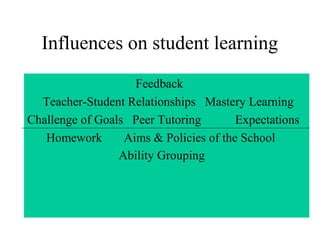
Influences on student learning
                    Feedback
  Teacher-Student Relationships Mastery Learning
Challenge of Goals Peer Tutoring        Expectations
   Homework       Aims & Policies of the School
                 Ability Grouping
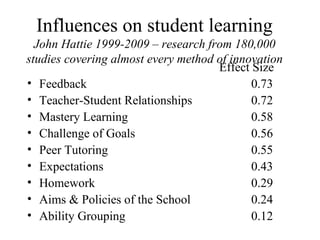
Influences on student learning
  John Hattie 1999-2009 – research from 180,000
studies covering almost every method of innovation
                                     Effect Size
• Feedback                                  0.73
• Teacher-Student Relationships             0.72
• Mastery Learning                          0.58
• Challenge of Goals                        0.56
• Peer Tutoring                             0.55
• Expectations                              0.43
• Homework                                  0.29
• Aims & Policies of the School             0.24
• Ability Grouping                          0.12
If feedback is so important, what
    kind of feedback should be
 taking place in our classrooms?
     Discuss in pairs for 2 minutes
“The most powerful single influence
   enhancing achievement is feedback”
• Quality feedback is needed, not more feedback
• Much of the feedback provided by the teacher to
  the student is not valued and not acted on
• Students with a Growth Mindset welcome
  feedback and are more likely to use it to improve
  their performance
• Oral feedback is much more effective than
  written
• The most powerful feedback is provided from
  the student to the teacher
How could we obtain more
  feedback from students?

How can we ensure we act on
   this feedback to raise
       achievement?
       Discuss in pairs
Expectations
• What do we base our expectations on of
  student learning?
Duesk and Joseph 1983 said:
• Attractiveness
• Prior conduct of child
• Cumulative information about child
• Social class!
• Weinstein (2002) has shown that students know that they
  are treated differently and that teachers have higher
  expectations of some than others!
• WE KNOW WE ARE ALL GUILTY BUT AT LEAST
  WE CAN BE AWARE. We need to prepare to be
  surprised! We need to stop negative expectations in their
  tracks. Could we use this as a team focus?
Expectations: Tracking &
             Mindsets
• Tracking: There are differences in classes where
  teachers aim to select talent for different pathways
  (such as schools with tracking) compared with those
  where achievement cultures aim to develop talent in
  each child.
• Fixed & Growth Mindsets: There are also
  differences in classes where teachers believe that
  achievement (and intelligence) is difficult to change
  because it is fixed and innate compared to teachers
  who believe achievement (and intelligence) is
  changeable (Carol Dweck 2006).
• “Be prepared to be surprised” seems to be the
  mantra to avoid negative expectation effects.
Setting Goals
• There is strong evidence that challenging, achievable goals
  influence achievement, provided the individual is
  involved in setting them.
• Locke & Latham (1990) found that achievement is
  enhanced to the degree that teachers set challenging, rather
  than “do your best” goals, relative to the students’ present
  competencies. There is a direct linear relationship
  between the degree of goal difficulty and performance .
• Goals have a self-energizing effect if they are
  appropriately challenging as they can motivate students to
  exert effort in line with the difficulty or demands of the
  goal.
• Commitment to the goals helps, but is not necessary for
  goal attainment – except for Special Needs students, where
  commitment makes a major difference.
Setting Goals – Personal Bests
• Martin (2006) argued that a good method to assist
  students in setting task-specific and situation-
  specific goals was to use the notion of “personal
  bests”.
• He found that setting personal bests had high
  positive relationships to educational
  aspirations, enjoyment of school, participation
  in class and persistence on the task.
Are your students fully involved
       in setting goals?

   Are their goals as high as
   possible while still being
          attainable?
          Discuss in pairs
Mastery Learning:
All children can learn when they focus on mastering
   tasks in a collaborative environment.
Appropriate learning conditions in the classroom
   include:
 High levels of cooperation between classmates;
 Focused teacher feedback that is both frequent
   and diagnostic;
 Variable time allowed to reach levels of
   attainment
Is our classroom climate truly
attuned to Mastery Learning?
  What could we be doing to provide
       more opportunities for
         Mastery Learning?
Teacher – Student Relationships
• Developing a warmer socio-emotional climate in
  the classroom, fostering effort and thus
  engagement for all students, requires teachers to
  enter the classroom with certain conceptions about
  progress, relationships and students.
• It requires them to believe that their role is that
  of a change agent – that all students can learn
  and progress, that achievement for all is
  changeable and not fixed, and that
  demonstrating to all students that they care
  about their learning is both powerful and
  effective.
Visible Learning P.128, The Contributions from the Teacher – J.Hattie 2009
• In a study by Russell Bishop students,
  parents, management and teachers were
  asked what are the major influences on
  student achievement.

• WHAT DO YOU THINK EACH
  ANSWERED?
ANSWERS
• All except the teachers said the relationships
  between the teachers and the students!!!!
• Teachers thought:
• Child’s attitude and disposition
• Child’s home background
• Working conditions of the school
• OR that pupils who are not learning are deficient
  in some way.
• How can we combat this attitude in ourselves?
Ability Grouping
• 88% of children placed in sets or streams at
  age 4 remain in the same groupings until
  they leave school (Annabelle Dixon, Forum
  2002)
Ability Grouping
• Effect sizes of whole class ability grouping
  (0.12) and within class ability grouping
  (0.16) are uniformly low.
• Expectations and goal setting become even
  more important if children are grouped by
  ability
DfES Standards Site (Gifted &
       Talented section)
• “If schools continue to use predominantly
  mixed-ability settings, they should be able
  to demonstrate high pupil attainment
  relative to other, similar school”
• Why no similar warning to schools that
  persist in using rigid setting procedures,
  when research shows that these systems do
  not raise achievement?
Creating Independent Learners

       You need two things:
          Great schools
         Expert teachers
Great Schools
•   Create a climate that all are responsible for the
    progress of the students
•   Use information openly and intelligently
•   Use research-based evidence
•   Collaborate to improve learning
•   Develop expert teachers

    Building Teacher Quality – John Hattie, University of Auckland
    2003
What are some differences
between experienced teachers
    and expert teachers?

    Discuss in pairs for 2 minutes
          Close Hand-outs
As an Expert Teacher you
Meet with colleagues regularly to discuss:
• Evidence of progress of your and their students
• How to improve your teaching
• How to change your teaching
• How to do this in the light of evidence that what
  you are doing at present is not having the effect
  that you want

  Building Teacher Quality (The difference between
  experienced teachers & expert teachers)– John Hattie,
  University of Auckland 2003
The teacher
• ‘Not all teachers are effective, not all teachers are experts
  and not all teachers have powerful effects on students. It is
  teachers’ variability in effect that is critical.
• EXPERT TEACHERS ARE DISTINGUISHED BY 3
  DIMENSIONS:
• Challenge
• Deep Representation
• Monitoring and feedback
• Do you have a powerful effect on your pupils and how do
  you know? – Discuss in pairs
Do you feel psychologically safe
          to discuss:
• Successes and failures in your classroom
• How to improve your teaching (not the
  kids, not the curriculum, not the resources,
  not the class size, not the conditions….)
• What assessment says about what you are
  doing (not the kids)

  Discuss in pairs for two minutes
Influences on student learning –
         Transition Issues
“The greatest single issue facing the further enhancement of
   student achievement is the need for teachers to have a
   common perception of progress. When a student moves
   from one teacher to another, there is no guarantee that he
   or she will experience increasingly challenging tasks,
   have a teacher with similar (hopefully high)
   expectations of progress, or work with a teacher who
   will grow the student from where he or she is, as opposed
   to where the teacher believes he or she should be at the
   start of the year.”
   Visible Learning by Professor John Hattie (2009)
How could we improve transition
    from one teacher to another to
   ensure we provide increasingly
  challenging tasks for every child?

• Discuss for two minutes
John Hattie on the art of teaching
• “…the act of teaching reaches its epitome of success after
  the lesson has been structured, after the content has been
  delivered, and after the classroom has been organised. The
  art of teaching, and its major successes, relate to “what
  happens next” – the manner in which the teacher reacts to
  how the student interprets, accommodates, rejects and/or
  reinvents the content and skills, how the student relates
  and applies the content to other tasks, and how the student
  reacts in light of success and failure apropos the content
  and methods that the teacher taught. Learning is
  spontaneous, individualistic, and often earned through
  effort. It is a timeworn, slow, gradual, fits-and-starts
  kind of process, which can have a flow of its own, but
  requires passion, patience, and attention to detail (from
  the teacher and the student)”.

Visible learning collingwood_23.11.09

  • 1.
    Visible Learning Professor JohnHattie Auckland University New Zealand
  • 2.
    What is VisibleLearning? • Visible Learning is the result of 15 years’ research and synthesises over 800 meta- analyses (over 50,000 studies) relating to the influences on achievement in school- aged students. It presents the largest ever collection of evidence-based research into what actually works in schools to improve learning (and what doesn’t).
  • 3.
    Meta-analysis & effectsize • The vast majority of innovations or educational strategies can be said to “work” because they can be shown to have a positive effect. • But a student left to work on his own, with the laziest supply teacher, would be likely to show improvement over a year. • In 1976 Gene Glass introduced the notion of meta-analysis – whereby the effects of each study are converted to a common measure or effect size. • An effect size of 1.0 would improve the rate of learning by 50% and would mean that, on average, students receiving that treatment would exceed 84% of students not receiving that treatment. • At least half of all students can and do achieve an effect size of 0.4 in a year (the hinge point), so anything with an effect size of over 0.4 is likely to be having a visible effect.
  • 4.
    Influences on studentlearning Expectations Mastery Learning Homework Challenge of Goals Feedback Aims & Policies of the School Ability Grouping Peer Tutoring Teacher-Student Relationships
  • 5.
    Diamond Nine Activity •With a partner discuss these nine factors that influence student achievement • Place them in a diamond shape, in order of how great you think their positive influence is (on average) • Think about why they have this effect
  • 6.
    Mastery Learning: All childrencan learn when they focus on mastering tasks in a collaborative environment. Appropriate learning conditions in the classroom include:  High levels of cooperation between classmates;  Focused teacher feedback that is both frequent and diagnostic;  Variable time allowed to reach levels of attainment
  • 7.
    Influences on studentlearning Feedback Teacher-Student Relationships Mastery Learning Challenge of Goals Peer Tutoring Expectations Homework Aims & Policies of the School Ability Grouping
  • 8.
    Influences on studentlearning John Hattie 1999-2009 – research from 180,000 studies covering almost every method of innovation Effect Size • Feedback 0.73 • Teacher-Student Relationships 0.72 • Mastery Learning 0.58 • Challenge of Goals 0.56 • Peer Tutoring 0.55 • Expectations 0.43 • Homework 0.29 • Aims & Policies of the School 0.24 • Ability Grouping 0.12
  • 9.
    If feedback isso important, what kind of feedback should be taking place in our classrooms? Discuss in pairs for 2 minutes
  • 10.
    “The most powerfulsingle influence enhancing achievement is feedback” • Quality feedback is needed, not more feedback • Much of the feedback provided by the teacher to the student is not valued and not acted on • Students with a Growth Mindset welcome feedback and are more likely to use it to improve their performance • Oral feedback is much more effective than written • The most powerful feedback is provided from the student to the teacher
  • 11.
    How could weobtain more feedback from students? How can we ensure we act on this feedback to raise achievement? Discuss in pairs
  • 12.
    Expectations • What dowe base our expectations on of student learning?
  • 13.
    Duesk and Joseph1983 said: • Attractiveness • Prior conduct of child • Cumulative information about child • Social class! • Weinstein (2002) has shown that students know that they are treated differently and that teachers have higher expectations of some than others! • WE KNOW WE ARE ALL GUILTY BUT AT LEAST WE CAN BE AWARE. We need to prepare to be surprised! We need to stop negative expectations in their tracks. Could we use this as a team focus?
  • 14.
    Expectations: Tracking & Mindsets • Tracking: There are differences in classes where teachers aim to select talent for different pathways (such as schools with tracking) compared with those where achievement cultures aim to develop talent in each child. • Fixed & Growth Mindsets: There are also differences in classes where teachers believe that achievement (and intelligence) is difficult to change because it is fixed and innate compared to teachers who believe achievement (and intelligence) is changeable (Carol Dweck 2006). • “Be prepared to be surprised” seems to be the mantra to avoid negative expectation effects.
  • 15.
    Setting Goals • Thereis strong evidence that challenging, achievable goals influence achievement, provided the individual is involved in setting them. • Locke & Latham (1990) found that achievement is enhanced to the degree that teachers set challenging, rather than “do your best” goals, relative to the students’ present competencies. There is a direct linear relationship between the degree of goal difficulty and performance . • Goals have a self-energizing effect if they are appropriately challenging as they can motivate students to exert effort in line with the difficulty or demands of the goal. • Commitment to the goals helps, but is not necessary for goal attainment – except for Special Needs students, where commitment makes a major difference.
  • 16.
    Setting Goals –Personal Bests • Martin (2006) argued that a good method to assist students in setting task-specific and situation- specific goals was to use the notion of “personal bests”. • He found that setting personal bests had high positive relationships to educational aspirations, enjoyment of school, participation in class and persistence on the task.
  • 17.
    Are your studentsfully involved in setting goals? Are their goals as high as possible while still being attainable? Discuss in pairs
  • 18.
    Mastery Learning: All childrencan learn when they focus on mastering tasks in a collaborative environment. Appropriate learning conditions in the classroom include:  High levels of cooperation between classmates;  Focused teacher feedback that is both frequent and diagnostic;  Variable time allowed to reach levels of attainment
  • 19.
    Is our classroomclimate truly attuned to Mastery Learning? What could we be doing to provide more opportunities for Mastery Learning?
  • 20.
    Teacher – StudentRelationships • Developing a warmer socio-emotional climate in the classroom, fostering effort and thus engagement for all students, requires teachers to enter the classroom with certain conceptions about progress, relationships and students. • It requires them to believe that their role is that of a change agent – that all students can learn and progress, that achievement for all is changeable and not fixed, and that demonstrating to all students that they care about their learning is both powerful and effective. Visible Learning P.128, The Contributions from the Teacher – J.Hattie 2009
  • 21.
    • In astudy by Russell Bishop students, parents, management and teachers were asked what are the major influences on student achievement. • WHAT DO YOU THINK EACH ANSWERED?
  • 22.
    ANSWERS • All exceptthe teachers said the relationships between the teachers and the students!!!! • Teachers thought: • Child’s attitude and disposition • Child’s home background • Working conditions of the school • OR that pupils who are not learning are deficient in some way. • How can we combat this attitude in ourselves?
  • 23.
    Ability Grouping • 88%of children placed in sets or streams at age 4 remain in the same groupings until they leave school (Annabelle Dixon, Forum 2002)
  • 24.
    Ability Grouping • Effectsizes of whole class ability grouping (0.12) and within class ability grouping (0.16) are uniformly low. • Expectations and goal setting become even more important if children are grouped by ability
  • 25.
    DfES Standards Site(Gifted & Talented section) • “If schools continue to use predominantly mixed-ability settings, they should be able to demonstrate high pupil attainment relative to other, similar school” • Why no similar warning to schools that persist in using rigid setting procedures, when research shows that these systems do not raise achievement?
  • 26.
    Creating Independent Learners You need two things: Great schools Expert teachers
  • 27.
    Great Schools • Create a climate that all are responsible for the progress of the students • Use information openly and intelligently • Use research-based evidence • Collaborate to improve learning • Develop expert teachers Building Teacher Quality – John Hattie, University of Auckland 2003
  • 28.
    What are somedifferences between experienced teachers and expert teachers? Discuss in pairs for 2 minutes Close Hand-outs
  • 29.
    As an ExpertTeacher you Meet with colleagues regularly to discuss: • Evidence of progress of your and their students • How to improve your teaching • How to change your teaching • How to do this in the light of evidence that what you are doing at present is not having the effect that you want Building Teacher Quality (The difference between experienced teachers & expert teachers)– John Hattie, University of Auckland 2003
  • 30.
    The teacher • ‘Notall teachers are effective, not all teachers are experts and not all teachers have powerful effects on students. It is teachers’ variability in effect that is critical. • EXPERT TEACHERS ARE DISTINGUISHED BY 3 DIMENSIONS: • Challenge • Deep Representation • Monitoring and feedback • Do you have a powerful effect on your pupils and how do you know? – Discuss in pairs
  • 31.
    Do you feelpsychologically safe to discuss: • Successes and failures in your classroom • How to improve your teaching (not the kids, not the curriculum, not the resources, not the class size, not the conditions….) • What assessment says about what you are doing (not the kids) Discuss in pairs for two minutes
  • 32.
    Influences on studentlearning – Transition Issues “The greatest single issue facing the further enhancement of student achievement is the need for teachers to have a common perception of progress. When a student moves from one teacher to another, there is no guarantee that he or she will experience increasingly challenging tasks, have a teacher with similar (hopefully high) expectations of progress, or work with a teacher who will grow the student from where he or she is, as opposed to where the teacher believes he or she should be at the start of the year.” Visible Learning by Professor John Hattie (2009)
  • 33.
    How could weimprove transition from one teacher to another to ensure we provide increasingly challenging tasks for every child? • Discuss for two minutes
  • 34.
    John Hattie onthe art of teaching • “…the act of teaching reaches its epitome of success after the lesson has been structured, after the content has been delivered, and after the classroom has been organised. The art of teaching, and its major successes, relate to “what happens next” – the manner in which the teacher reacts to how the student interprets, accommodates, rejects and/or reinvents the content and skills, how the student relates and applies the content to other tasks, and how the student reacts in light of success and failure apropos the content and methods that the teacher taught. Learning is spontaneous, individualistic, and often earned through effort. It is a timeworn, slow, gradual, fits-and-starts kind of process, which can have a flow of its own, but requires passion, patience, and attention to detail (from the teacher and the student)”.