Mentoring is a term used to help, advise and guide employees through the complexities of the business. Mentoring is a mutual learning partnership in which individuals assist each other with personal and career development through coaching, role modeling couseling, sharing knowledge and providing emotional support. Offline help from one person to another in making significant transitions in knowledge, work or thinking.
Creating possibilities and providing guidance and support to others in a relationship of trust; it includes facilitating, bringing visions to life and enabling people to achieve. A mentor is that person who achieves a one-to-one developmental relationship with a learner; and one whom the learner identifies as having enabled personal growth to take place.
Friend Philosopher Guide
Who took an interest in my welfare and development at a time when I was taking on challenges, such as starting a new job? Who has been a useful role model in my life? Who helped me uncover and use a hidden talent or ability? Who helped me face and resolve a difficult situation in my personal and / or professional life? Who challenged me to acquire a new vision and take a new direction?
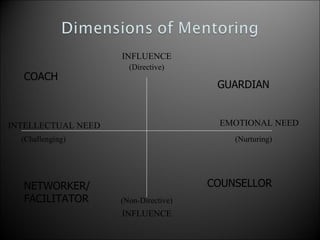
(Directive) INFLUENCE (Non-Directive) INFLUENCE INTELLECTUAL NEED EMOTIONAL NEED (Challenging) (Nurturing) COACH GUARDIAN NETWORKER/ FACILITATOR COUNSELLOR
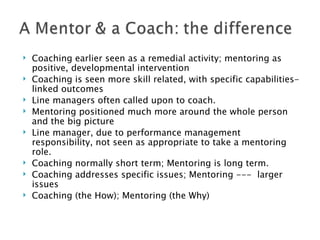
Coaching earlier seen as a remedial activity; mentoring as positive, developmental intervention Coaching is seen more skill related, with specific capabilities-linked outcomes Line managers often called upon to coach. Mentoring positioned much more around the whole person and the big picture Line manager, due to performance management responsibility, not seen as appropriate to take a mentoring role. Coaching normally short term; Mentoring is long term. Coaching addresses specific issues; Mentoring ---  larger issues Coaching (the How); Mentoring (the Why)
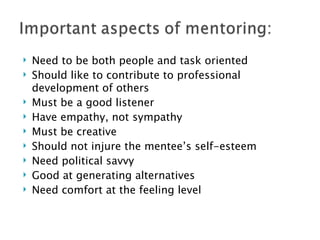
Need to be both people and task oriented Should like to contribute to professional development of others Must be a good listener Have empathy, not sympathy Must be creative Should not injure the mentee’s self-esteem Need political savvy Good at generating alternatives Need comfort at the feeling level
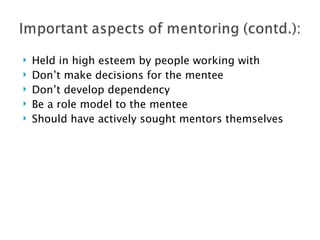
Held in high esteem by people working with Don’t make decisions for the mentee Don’t develop dependency Be a role model to the mentee Should have actively sought mentors themselves
Specific learning functions: - Learning technical skills and knowledge - Learning current jobs - Learning organisational culture - Learning organisational policies - Being prepared for future jobs / promotions
General Career Development functions: - Obtaining challenging tasks - Obtaining protection - Obtaining sponsorship, recommendations - Obtaining endorsement for acts / views - Making career moves - Getting achievements showcased - Clarifying work / Career goals
Personal help functions: - Obtaining counselling - Obtaining moral support / encouragement - Obtaining a Role Model - Obtaining praise - Obtaining a confidante - Achieving friendship - Achieving trust
Take the lead Pay attention to the relationship and develop it Clarify aims and objectives of mentoring; Support and counsel Listen; ask open questions Negotiate an agenda Take lead in creating rapport Show your commitment to your mentee Give it time; be patient Help mentee arrive at his / her own answer Resist temptation to give advise
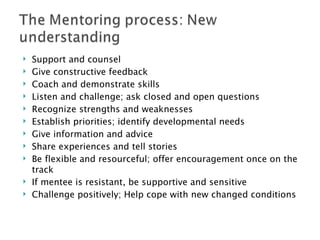
Support and counsel Give constructive feedback Coach and demonstrate skills Listen and challenge; ask closed and open questions Recognize strengths and weaknesses Establish priorities; identify developmental needs Give information and advice Share experiences and tell stories Be flexible and resourceful; offer encouragement once on the track If mentee is resistant, be supportive and sensitive Challenge positively; Help cope with new changed conditions
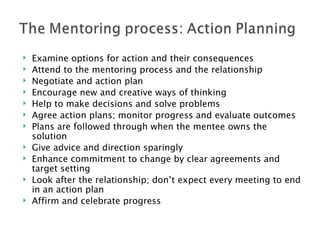
Examine options for action and their consequences Attend to the mentoring process and the relationship Negotiate and action plan Encourage new and creative ways of thinking Help to make decisions and solve problems Agree action plans; monitor progress and evaluate outcomes Plans are followed through when the mentee owns the solution Give advice and direction sparingly Enhance commitment to change by clear agreements and target setting Look after the relationship; don’t expect every meeting to end in an action plan Affirm and celebrate progress
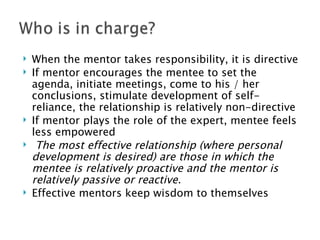
When the mentor takes responsibility, it is directive If mentor encourages the mentee to set the agenda, initiate meetings, come to his / her conclusions, stimulate development of self-reliance, the relationship is relatively non-directive If mentor plays the role of the expert, mentee feels less empowered The most effective relationship (where personal development is desired) are those in which the mentee is relatively proactive and the mentor is relatively passive or reactive. Effective mentors keep wisdom to themselves
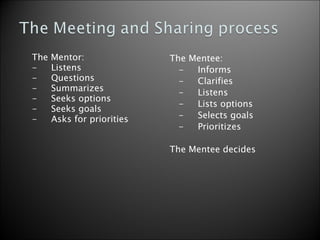
The Mentor: - Listens - Questions - Summarizes - Seeks options - Seeks goals - Asks for priorities The Mentee: - Informs - Clarifies - Listens - Lists options - Selects goals - Prioritizes The Mentee decides
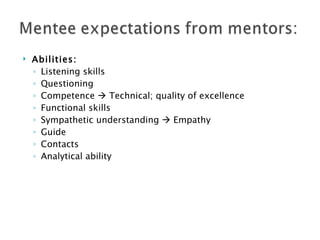
Abilities: Listening skills Questioning Competence    Technical; quality of excellence Functional skills Sympathetic understanding    Empathy Guide Contacts Analytical ability
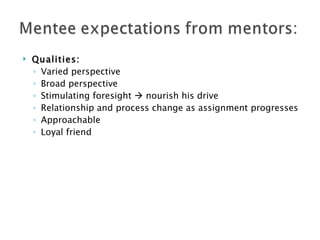
Qualities: Varied perspective Broad perspective Stimulating foresight    nourish his drive Relationship and process change as assignment progresses Approachable Loyal friend
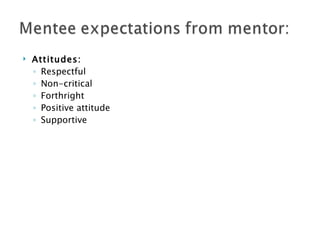
Attitudes: Respectful Non-critical Forthright Positive attitude Supportive
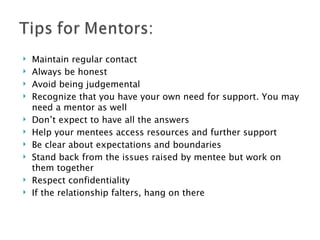
Maintain regular contact Always be honest Avoid being judgemental Recognize that you have your own need for support. You may need a mentor as well Don’t expect to have all the answers Help your mentees access resources and further support Be clear about expectations and boundaries Stand back from the issues raised by mentee but work on them together Respect confidentiality If the relationship falters, hang on there
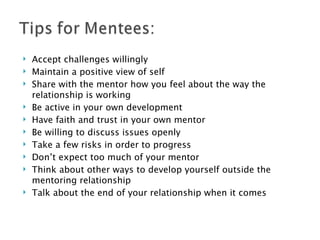
Accept challenges willingly Maintain a positive view of self Share with the mentor how you feel about the way the relationship is working Be active in your own development Have faith and trust in your own mentor Be willing to discuss issues openly Take a few risks in order to progress Don’t expect too much of your mentor Think about other ways to develop yourself outside the mentoring relationship Talk about the end of your relationship when it comes
 

A Simple Guide for Mentoring

  • 1.
  • 2.
  • 3.
  • 4.
  • 5.
  • 6.
    Mentoring is aterm used to help, advise and guide employees through the complexities of the business. Mentoring is a mutual learning partnership in which individuals assist each other with personal and career development through coaching, role modeling couseling, sharing knowledge and providing emotional support. Offline help from one person to another in making significant transitions in knowledge, work or thinking.
  • 7.
    Creating possibilities andproviding guidance and support to others in a relationship of trust; it includes facilitating, bringing visions to life and enabling people to achieve. A mentor is that person who achieves a one-to-one developmental relationship with a learner; and one whom the learner identifies as having enabled personal growth to take place.
  • 8.
  • 9.
    Who took aninterest in my welfare and development at a time when I was taking on challenges, such as starting a new job? Who has been a useful role model in my life? Who helped me uncover and use a hidden talent or ability? Who helped me face and resolve a difficult situation in my personal and / or professional life? Who challenged me to acquire a new vision and take a new direction?
  • 10.
    (Directive) INFLUENCE (Non-Directive)INFLUENCE INTELLECTUAL NEED EMOTIONAL NEED (Challenging) (Nurturing) COACH GUARDIAN NETWORKER/ FACILITATOR COUNSELLOR
  • 11.
    Coaching earlier seenas a remedial activity; mentoring as positive, developmental intervention Coaching is seen more skill related, with specific capabilities-linked outcomes Line managers often called upon to coach. Mentoring positioned much more around the whole person and the big picture Line manager, due to performance management responsibility, not seen as appropriate to take a mentoring role. Coaching normally short term; Mentoring is long term. Coaching addresses specific issues; Mentoring --- larger issues Coaching (the How); Mentoring (the Why)
  • 12.
    Need to beboth people and task oriented Should like to contribute to professional development of others Must be a good listener Have empathy, not sympathy Must be creative Should not injure the mentee’s self-esteem Need political savvy Good at generating alternatives Need comfort at the feeling level
  • 13.
    Held in highesteem by people working with Don’t make decisions for the mentee Don’t develop dependency Be a role model to the mentee Should have actively sought mentors themselves
  • 14.
    Specific learning functions:- Learning technical skills and knowledge - Learning current jobs - Learning organisational culture - Learning organisational policies - Being prepared for future jobs / promotions
  • 15.
    General Career Developmentfunctions: - Obtaining challenging tasks - Obtaining protection - Obtaining sponsorship, recommendations - Obtaining endorsement for acts / views - Making career moves - Getting achievements showcased - Clarifying work / Career goals
  • 16.
    Personal help functions:- Obtaining counselling - Obtaining moral support / encouragement - Obtaining a Role Model - Obtaining praise - Obtaining a confidante - Achieving friendship - Achieving trust
  • 17.
    Take the leadPay attention to the relationship and develop it Clarify aims and objectives of mentoring; Support and counsel Listen; ask open questions Negotiate an agenda Take lead in creating rapport Show your commitment to your mentee Give it time; be patient Help mentee arrive at his / her own answer Resist temptation to give advise
  • 18.
    Support and counselGive constructive feedback Coach and demonstrate skills Listen and challenge; ask closed and open questions Recognize strengths and weaknesses Establish priorities; identify developmental needs Give information and advice Share experiences and tell stories Be flexible and resourceful; offer encouragement once on the track If mentee is resistant, be supportive and sensitive Challenge positively; Help cope with new changed conditions
  • 19.
    Examine options foraction and their consequences Attend to the mentoring process and the relationship Negotiate and action plan Encourage new and creative ways of thinking Help to make decisions and solve problems Agree action plans; monitor progress and evaluate outcomes Plans are followed through when the mentee owns the solution Give advice and direction sparingly Enhance commitment to change by clear agreements and target setting Look after the relationship; don’t expect every meeting to end in an action plan Affirm and celebrate progress
  • 20.
    When the mentortakes responsibility, it is directive If mentor encourages the mentee to set the agenda, initiate meetings, come to his / her conclusions, stimulate development of self-reliance, the relationship is relatively non-directive If mentor plays the role of the expert, mentee feels less empowered The most effective relationship (where personal development is desired) are those in which the mentee is relatively proactive and the mentor is relatively passive or reactive. Effective mentors keep wisdom to themselves
  • 21.
    The Mentor: -Listens - Questions - Summarizes - Seeks options - Seeks goals - Asks for priorities The Mentee: - Informs - Clarifies - Listens - Lists options - Selects goals - Prioritizes The Mentee decides
  • 22.
    Abilities: Listening skillsQuestioning Competence  Technical; quality of excellence Functional skills Sympathetic understanding  Empathy Guide Contacts Analytical ability
  • 23.
    Qualities: Varied perspectiveBroad perspective Stimulating foresight  nourish his drive Relationship and process change as assignment progresses Approachable Loyal friend
  • 24.
    Attitudes: Respectful Non-criticalForthright Positive attitude Supportive
  • 25.
    Maintain regular contactAlways be honest Avoid being judgemental Recognize that you have your own need for support. You may need a mentor as well Don’t expect to have all the answers Help your mentees access resources and further support Be clear about expectations and boundaries Stand back from the issues raised by mentee but work on them together Respect confidentiality If the relationship falters, hang on there
  • 26.
    Accept challenges willinglyMaintain a positive view of self Share with the mentor how you feel about the way the relationship is working Be active in your own development Have faith and trust in your own mentor Be willing to discuss issues openly Take a few risks in order to progress Don’t expect too much of your mentor Think about other ways to develop yourself outside the mentoring relationship Talk about the end of your relationship when it comes
  • 27.