Chocolate Boosts 
Brain Power!
Grouping Students
People Passion Proof 
Visible Learning: 
How Do We Make It So? 
The Data Difference 
PROCEDE 2014 
Julie Hobbs, ASSET Carol Marriott, ASSET
WALT: 
We Are Learning To: 
 Understand John Hattie’s high size-effect 
influences and how they can impact on 
student achievement. 
 We Are Learning To: 
 Apply his findings to our work with adult and 
‘young adult’ learners.
Teachers need to know what success criteria 
are expected and what the students will be 
accountable for from the lesson. 
The students also need to be informed about 
the standards of performance.
Success Criteria 
I will know that I have been 
a successful teacher when 
you can: 
1. Identify 2 high size-effect 
influences. 
2. Identify a next step in the 
process of creating visible 
learning in classrooms.
Goals: 
 Enroll students 
 Retain students 
 Provide the foundation/ skills that will help with 
employment 
 Increase student success
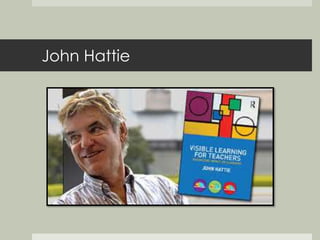
John Hattie
Hattie’s work looked at typical effects 
of different interventions across: 
1000+ meta-analyses 
60,000 studies 
260 million students
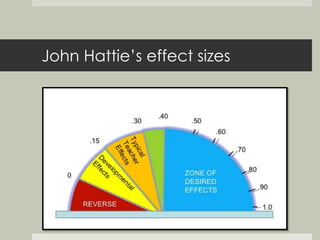
John Hattie’s effect sizes
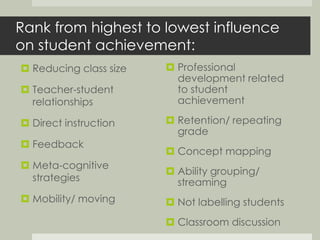
Rank from highest to lowest influence 
on student achievement: 
 Reducing class size 
 Teacher-student 
relationships 
 Direct instruction 
 Feedback 
 Meta-cognitive 
strategies 
 Mobility/ moving 
 Professional 
development related 
to student 
achievement 
 Retention/ repeating 
grade 
 Concept mapping 
 Ability grouping/ 
streaming 
 Not labelling students 
 Classroom discussion
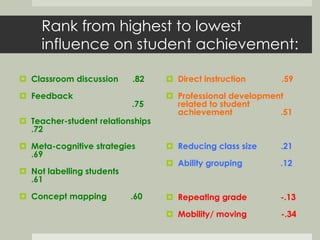
Rank from highest to lowest 
influence on student achievement: 
 Classroom discussion .82 
 Feedback 
.75 
 Teacher-student relationships 
.72 
 Meta-cognitive strategies 
.69 
 Not labelling students 
.61 
 Concept mapping .60 
 Direct instruction .59 
 Professional development 
related to student 
achievement .51 
 Reducing class size .21 
 Ability grouping .12 
 Repeating grade -.13 
 Mobility/ moving -.34
Reaction?
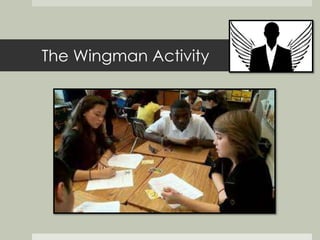
The Wingman Activity
To do: 
You: 
 Take notes of facts that: 
 Are important 
 Startle you 
 You question 
 Upset you 
 Create cognitive 
dissonance 
 Discuss these with your 
group. 
The Wingman: 
 Take notes of facts. 
 Record, on the template 
provided, your group’s: 
 Comments 
 Disagreements 
 Questions 
 A-ha moments
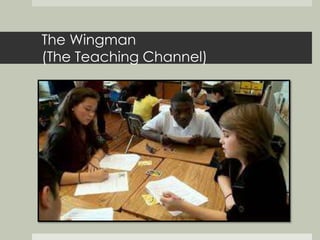
The Wingman 
(The Teaching Channel)
Application…
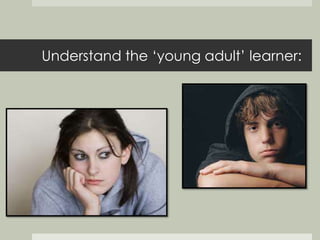
Understand the ‘young adult’ learner:
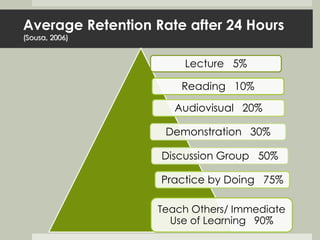
Average Retention Rate after 24 Hours 
(Sousa, 2006) 
Lecture 5% 
Reading 10% 
Audiovisual 20% 
Demonstration 30% 
Discussion Group 50% 
Practice by Doing 75% 
Teach Others/ Immediate 
Use of Learning 90%
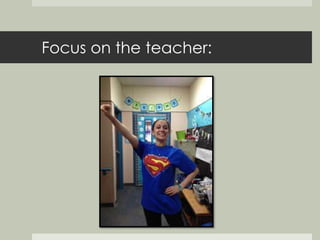
Focus on the teacher:
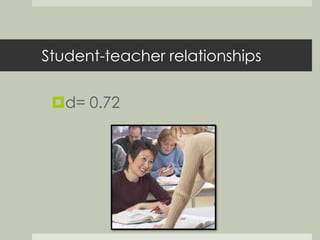
Student-teacher relationships 
d= 0.72
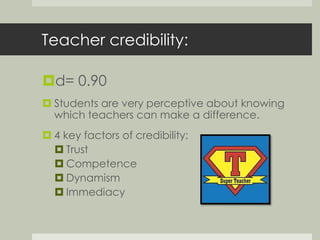
Teacher credibility: 
d= 0.90 
 Students are very perceptive about knowing 
which teachers can make a difference. 
 4 key factors of credibility: 
 Trust 
 Competence 
 Dynamism 
 Immediacy
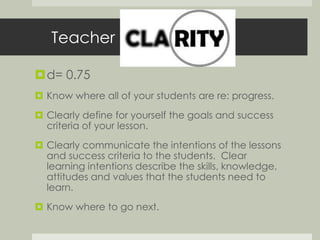
Teacher 
d= 0.75 
 Know where all of your students are re: progress. 
 Clearly define for yourself the goals and success 
criteria of your lesson. 
 Clearly communicate the intentions of the lessons 
and success criteria to the students. Clear 
learning intentions describe the skills, knowledge, 
attitudes and values that the students need to 
learn. 
 Know where to go next.
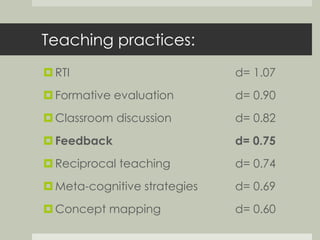
Teaching practices: 
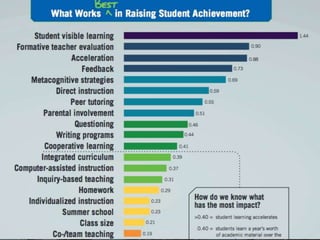
 RTI d= 1.07 
 Formative evaluation d= 0.90 
 Classroom discussion d= 0.82 
Feedback d= 0.75 
 Reciprocal teaching d= 0.74 
Meta-cognitive strategies d= 0.69 
Concept mapping d= 0.60
Feedback 
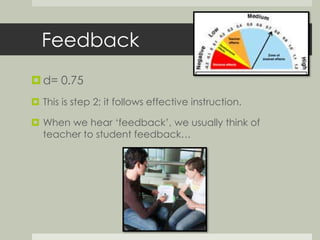
d= 0.75 
 This is step 2; it follows effective instruction. 
 When we hear ‘feedback’, we usually think of 
teacher to student feedback…
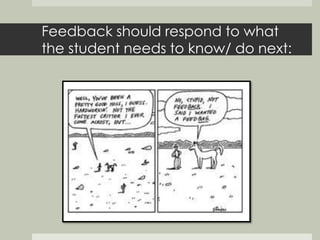
Feedback should respond to what 
the student needs to know/ do next:
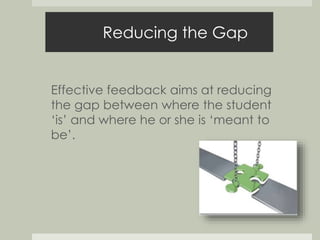
Reducing the Gap 
Effective feedback aims at reducing 
the gap between where the student 
‘is’ and where he or she is ‘meant to 
be’.
Cooperative Learning – Jigsaw 
“Know Thy Impact”
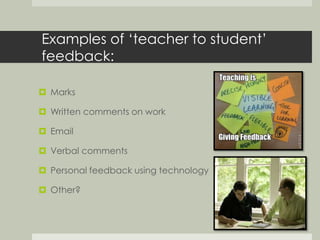
Examples of ‘teacher to student’ 
feedback: 
 Marks 
 Written comments on work 
 Email 
 Verbal comments 
 Personal feedback using technology 
 Other?
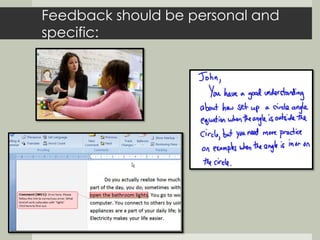
Feedback should be personal and 
specific:
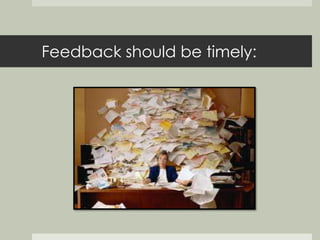
Feedback should be timely:
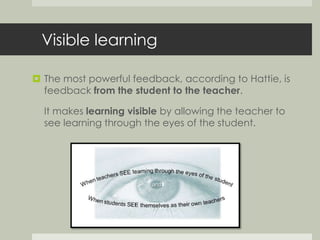
Visible learning 
 The most powerful feedback, according to Hattie, is 
feedback from the student to the teacher. 
It makes learning visible by allowing the teacher to 
see learning through the eyes of the student.
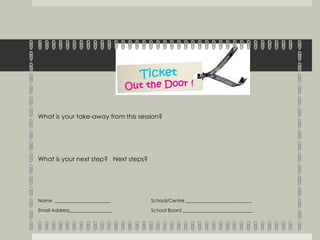
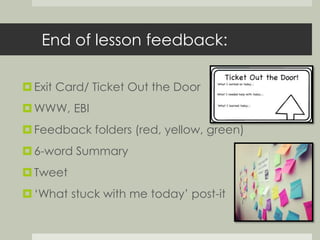
End of lesson feedback: 
 Exit Card/ Ticket Out the Door 
WWW, EBI 
Feedback folders (red, yellow, green) 
 6-word Summary 
 Tweet 
 ‘What stuck with me today’ post-it
Rapid review:
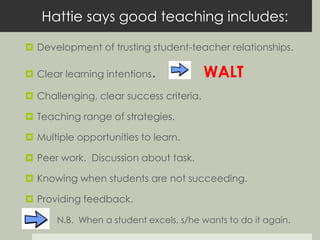
Hattie says good teaching includes: 
 Development of trusting student-teacher relationships. 
 Clear learning intentions. WALT 
 Challenging, clear success criteria. 
 Teaching range of strategies. 
 Multiple opportunities to learn. 
 Peer work. Discussion about task. 
 Knowing when students are not succeeding. 
 Providing feedback. 
N.B. When a student excels, s/he wants to do it again.
Over to you…
What is your take-away from this session? 
What is your next step? Next steps? 
Name ________________________ School/Centre ____________________________ 
Email Address__________________ School Board ______________________________

PROCEDE 2014-Visible Learning: How Do We Make it So

  • 3.
  • 4.
  • 5.
    People Passion Proof Visible Learning: How Do We Make It So? The Data Difference PROCEDE 2014 Julie Hobbs, ASSET Carol Marriott, ASSET
  • 6.
    WALT: We AreLearning To:  Understand John Hattie’s high size-effect influences and how they can impact on student achievement.  We Are Learning To:  Apply his findings to our work with adult and ‘young adult’ learners.
  • 7.
    Teachers need toknow what success criteria are expected and what the students will be accountable for from the lesson. The students also need to be informed about the standards of performance.
  • 8.
    Success Criteria Iwill know that I have been a successful teacher when you can: 1. Identify 2 high size-effect influences. 2. Identify a next step in the process of creating visible learning in classrooms.
  • 9.
    Goals:  Enrollstudents  Retain students  Provide the foundation/ skills that will help with employment  Increase student success
  • 10.
  • 11.
    Hattie’s work lookedat typical effects of different interventions across: 1000+ meta-analyses 60,000 studies 260 million students
  • 12.
  • 13.
    Rank from highestto lowest influence on student achievement:  Reducing class size  Teacher-student relationships  Direct instruction  Feedback  Meta-cognitive strategies  Mobility/ moving  Professional development related to student achievement  Retention/ repeating grade  Concept mapping  Ability grouping/ streaming  Not labelling students  Classroom discussion
  • 14.
    Rank from highestto lowest influence on student achievement:  Classroom discussion .82  Feedback .75  Teacher-student relationships .72  Meta-cognitive strategies .69  Not labelling students .61  Concept mapping .60  Direct instruction .59  Professional development related to student achievement .51  Reducing class size .21  Ability grouping .12  Repeating grade -.13  Mobility/ moving -.34
  • 16.
  • 17.
  • 18.
    To do: You:  Take notes of facts that:  Are important  Startle you  You question  Upset you  Create cognitive dissonance  Discuss these with your group. The Wingman:  Take notes of facts.  Record, on the template provided, your group’s:  Comments  Disagreements  Questions  A-ha moments
  • 19.
    The Wingman (TheTeaching Channel)
  • 20.
  • 23.
    Understand the ‘youngadult’ learner:
  • 24.
    Average Retention Rateafter 24 Hours (Sousa, 2006) Lecture 5% Reading 10% Audiovisual 20% Demonstration 30% Discussion Group 50% Practice by Doing 75% Teach Others/ Immediate Use of Learning 90%
  • 25.
    Focus on theteacher:
  • 26.
  • 27.
    Teacher credibility: d=0.90  Students are very perceptive about knowing which teachers can make a difference.  4 key factors of credibility:  Trust  Competence  Dynamism  Immediacy
  • 28.
    Teacher d= 0.75  Know where all of your students are re: progress.  Clearly define for yourself the goals and success criteria of your lesson.  Clearly communicate the intentions of the lessons and success criteria to the students. Clear learning intentions describe the skills, knowledge, attitudes and values that the students need to learn.  Know where to go next.
  • 29.
    Teaching practices: RTI d= 1.07  Formative evaluation d= 0.90  Classroom discussion d= 0.82 Feedback d= 0.75  Reciprocal teaching d= 0.74 Meta-cognitive strategies d= 0.69 Concept mapping d= 0.60
  • 30.
    Feedback d= 0.75  This is step 2; it follows effective instruction.  When we hear ‘feedback’, we usually think of teacher to student feedback…
  • 31.
    Feedback should respondto what the student needs to know/ do next:
  • 32.
    Reducing the Gap Effective feedback aims at reducing the gap between where the student ‘is’ and where he or she is ‘meant to be’.
  • 33.
    Cooperative Learning –Jigsaw “Know Thy Impact”
  • 34.
    Examples of ‘teacherto student’ feedback:  Marks  Written comments on work  Email  Verbal comments  Personal feedback using technology  Other?
  • 35.
    Feedback should bepersonal and specific:
  • 36.
  • 37.
    Visible learning The most powerful feedback, according to Hattie, is feedback from the student to the teacher. It makes learning visible by allowing the teacher to see learning through the eyes of the student.
  • 38.
    End of lessonfeedback:  Exit Card/ Ticket Out the Door WWW, EBI Feedback folders (red, yellow, green)  6-word Summary  Tweet  ‘What stuck with me today’ post-it
  • 39.
  • 40.
    Hattie says goodteaching includes:  Development of trusting student-teacher relationships.  Clear learning intentions. WALT  Challenging, clear success criteria.  Teaching range of strategies.  Multiple opportunities to learn.  Peer work. Discussion about task.  Knowing when students are not succeeding.  Providing feedback. N.B. When a student excels, s/he wants to do it again.
  • 41.
  • 42.
    What is yourtake-away from this session? What is your next step? Next steps? Name ________________________ School/Centre ____________________________ Email Address__________________ School Board ______________________________

Editor's Notes

  • #2 Letchworth State Park….Glen Iris Inn… Grand Canyon of the East near Rochester NY.
  • #3 Introduction to tables. Top hats - fidget toys, chocolate, post-its.
  • #8 What is it that teachers want as a result of their teaching…..
  • #12 University of Auckland in New Zealand
  • #14 Placemat activity.
  • #16 Hattie Visible Learning
  • #20 Show clip here
  • #34 Know thy Impact – Group 1 – pg. 18 – mid-column 1 pg. 20 Group 2 - mid-column 1 pg. 20 –bottom of pg. 20 Group 3 – pg. 21 Group 4 – pg. 22 – end As a summary – write one piece of information or one strategy that you learned from one of your group members and post it on the wall. Also I am going to ask you to answer these questions at the end of the discussions. What might you do differently from now on in your class?
  • #37 Passage about teacher and correcting